Following the Clues: Guess What Projects a16z with $15 Billion Will Invest In?

marsbitXuất bản vào 2026-01-12Cập nhật gần nhất vào 2026-01-12

Tóm tắt

a16z Raises $15 Billion, Signaling Major Crypto Investments Ahead Venture capital giant Andreessen Horowitz (a16z) has raised $15 billion in new funding, its largest round to date. The firm emphasized that winning the next century of technological competition hinges on advancements in AI and crypto. The capital will be allocated across six funds, with significant implications for the crypto sector: * **App Fund ($1.7B):** Targets consumer applications, including Web3, fintech, and AI apps. * **Infrastructure Fund ($1.7B):** Focuses on foundational tech, including blockchain protocols (L1s, L2s), developer tools, and AI infrastructure. * **Growth Fund ($6.75B):** Will back mature, late-stage companies, such as established crypto exchanges and unicorns (e.g., Coinbase). A review of a16z's 2025 investments revealed heavy bets on prediction markets (Kalshi), wallet services, privacy blockchains, stablecoins, and AI-crypto intersections. Looking to 2026, a16z's published "big ideas" highlight key areas of excitement, suggesting these will be prime investment targets. These include: * Enhanced privacy as a core crypto feature. * The expansion of smarter prediction markets. * "Crypto-native" stablecoins and real-world asset (RWA) tokenization. * Improved on/off-ramps for stablecoins. * The convergence of AI and crypto, specifically around agentic systems ("know your agent"). * The concept of the internet evolving into a bank. In summary, a16z's massive new war...

Original | Odaily Planet Daily (@OdailyChina)

Author | Azuma (@azuma_eth)

On January 9, amidst a highly active cryptocurrency market, the venture capital giant Andreessen Horowitz (a16z) announced the completion of a new $15 billion fundraising round. This is the largest fundraising effort in the firm's history, accounting for over 18% of the total venture capital raised in the United States in 2025.

In the relatively brief official announcement, a16z mentioned cryptocurrency twice. The most critical statement, "Our mission is to ensure that the United States wins the technological competition of the next 100 years, which begins with winning the key architectures of the future—artificial intelligence and cryptocurrency technology," indicates that a16z, now well-funded, will continue to actively invest in the cryptocurrency market.

Breakdown of Six Major Directions

According to a16z's plan, this batch of funds will be allocated across six major directions: the American Dynamism fund will receive $1.176 billion, the App fund $1.7 billion, the Bio + Health fund $700 million, the Infrastructure fund $1.7 billion, the Growth fund $6.75 billion, and the Other Venture Strategies fund $3 billion.

Although a16z did not explicitly designate a dedicated cryptocurrency fund in this fundraising, these six directions actually have significant overlap with cryptocurrency.

First is the American Dynamism fund. This is a direction with a clear "political" focus that a16z has been promoting in recent years. Its core goal is to use venture capital to rebuild America's "hard power" and national competitiveness. The fund will primarily invest in aerospace, defense, public safety, education, housing, supply chain, industry, and manufacturing—objectively speaking, this fund has little crossover with cryptocurrency.

Next is the App fund. This is one of a16z's most traditional and VC-centric funds. Its core goal is to focus on application-layer products that can be directly used by consumers. The fund will mainly invest in consumer internet products, AI applications, creator tools, social products, content services, gaming, fintech, and Web3 applications—this is also the direction where a16z's cryptocurrency narrative is most easily realized.

Then comes the Bio + Health fund. This is a long-term bet for a16z beyond "pure technology." Its core goal is to use software, data, and engineering thinking to transform the life sciences and healthcare systems. The fund's main investment areas include biotechnology, drug development platforms, gene editing, synthetic biology, medical data and AI diagnostics, and healthcare infrastructure software—this part has little direct overlap with cryptocurrency, but DeSci could be a potential intersection point.

The Infrastructure fund focuses on infrastructure. Its core goal is to provide an irreplaceable technological foundation for the next generation of applications and platforms. The fund's main investment areas are cloud computing and distributed systems, AI infrastructure, data platforms, developer tools, network protocols, and blockchain underlying protocols (L1, L2, other tools)—this is another core battleground for a16z in the cryptocurrency space, alongside the App fund.

The Growth fund primarily invests in Series C and later stages, as well as Pre-IPO stages. Its core goal is not to find new opportunities but to amplify returns by supporting proven winners. The fund mainly invests in mature tech companies, AI platforms, fintech unicorns, and mature Web3 infrastructure or applications—a16z's official website shows that Coinbase, Kalshi, and others are explicitly categorized here.

The Other Venture Strategies fund is relatively special. It does not have a single theme but is more like a flexible "tactical capital pool," often used for special structure transactions, cross-fund collaborative investments, emerging field experimentation, secondary market opportunities, regional or thematic experimental funds, etc.—this fund has little direct crossover with cryptocurrency, but it cannot be ruled out that temporary associations may occur at special junctures, such as responsive moves during certain policy windows.

Looking at the six intended directions for this $15 billion, the App fund, Infrastructure fund, and Growth fund will be the main channels for a16z to inject capital into the cryptocurrency primary market. Among them, the App fund and Infrastructure fund will focus more on native application-layer and protocol-layer projects in the cryptocurrency market, respectively; while the Growth fund will focus more on platform-type services such as exchanges and prediction markets, and its investments will tend to favor leading players in sectors that have already shown advantages.

a16z's Investment Review for 2025

According to incomplete statistics from Odaily Planet Daily, a16z made a total of 31 investments in the broader cryptocurrency field over the past year, with two investments each in prediction market Kalshi, AI security company Doppel, and privacy blockchain Seismic—especially Kalshi. a16z first co-led a $300 million Series D funding round for the company in October with Sequoia, at a valuation of $5 billion; it invested again in November, participating in the company's $1 billion Series E funding round at a valuation of $11 billion—this was a16z's biggest bet in the cryptocurrency field last year.
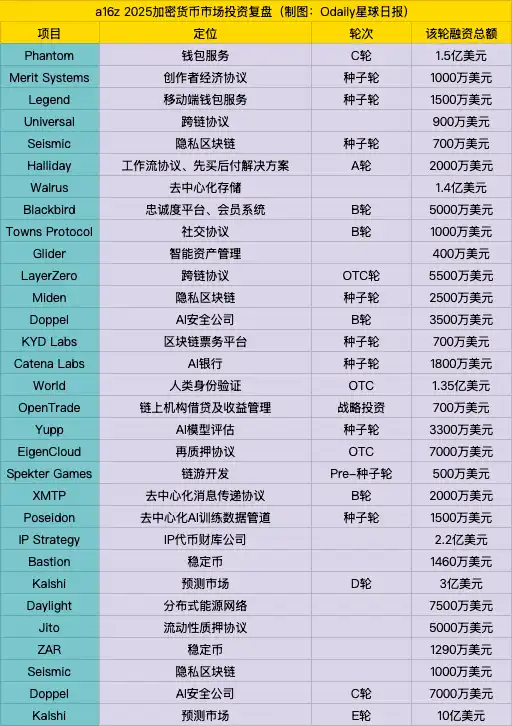
As can be seen from the statistics in the chart above, aside from the heavy bet on prediction markets, wallet services, privacy blockchains, stablecoins, and the intersection of AI and cryptocurrency were the focus of a16z's布局 in 2025. These sub-sectors can be categorized into the blockchain underlying protocols and tools covered by the Infrastructure fund, and the fintech and AI applications covered by the App fund.

a16z's Predictions for 2026

On New Year's Day 2026, a16z Crypto officially published a New Year's outlook article. In the article, a16z mentioned 17 potential developments they are excited about for 2026, which may contain clues to the firm's focus areas for future investments.
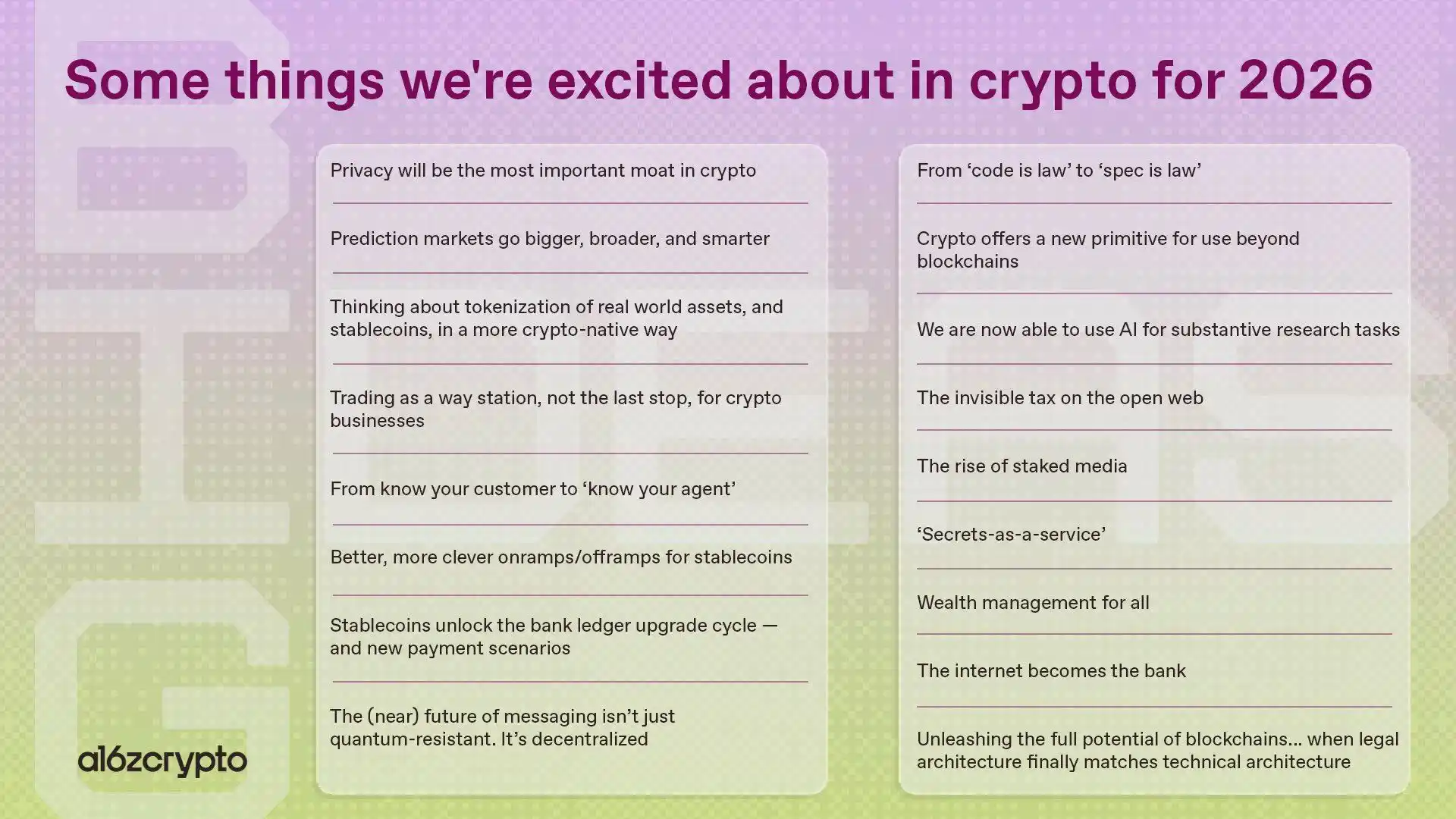
These 17 potential developments are:

  • Privacy will become the most important moat in crypto;
  • Prediction markets will become larger, broader, and smarter;
  • Thinking more "crypto-natively" about real-world asset tokenization and stablecoins;
  • Trading is just a waystation for crypto businesses, not the final destination;
  • From "Know Your Customer" (KYC) to "Know Your Agent";
  • Better, smarter on-ramps and off-ramps for stablecoins;
  • Stablecoins will kick off a bank ledger upgrade cycle and spawn new payment scenarios;
  • The future of instant messaging is not just quantum-resistant, but also decentralized;
  • From "code is law" to "norms are law";
  • Crypto is providing a new kind of foundational primitive whose uses go beyond blockchains themselves;
  • We can now use AI to perform substantive research tasks;
  • The "invisible tax" of the open internet;
  • The rise of Staked Media;
  • "Secrets-as-a-Service";
  • Wealth management for everyone;
  • The internet is becoming the bank;
  • When the legal framework finally matches the technical framework, the full potential of blockchains will be unleashed.

Among these 17 potential developments, some explicitly mention specific business models, including the sectors a16z has already heavily invested in, such as privacy, prediction markets, stablecoins, and AI. a16z also directly provided optimization paths for related models, such as the need for smarter on-ramp and off-ramp solutions for stablecoins.

At the same time, another part of the potential developments belongs to imaginings of future states, such as the internet eventually becoming the bank. However, how these imaginings will be realized is not clearly answered by a16z—this question needs to be left to entrepreneurs who can bring innovative solutions, and they are precisely the targets that a16z's $15 billion is most eager to find.


Câu hỏi Liên quan

QWhat are the six main directions a16z plans to allocate its new $15 billion funding, and which ones are most relevant to cryptocurrency?

AThe six directions are: American Dynamism ($1.176B), App ($1.7B), Bio + Health ($0.7B), Infrastructure ($1.7B), Growth ($6.75B), and Other Venture Strategies ($3B). The App, Infrastructure, and Growth funds are most relevant to cryptocurrency, focusing on Web3 applications, blockchain protocols, and mature crypto companies respectively.

QWhich cryptocurrency-related sectors did a16z focus on in 2025, and can you name a key company they invested in?

AIn 2025, a16z focused on wallet services, privacy blockchains, stablecoins, and AI-crypto intersections. A key investment was Kalshi, a prediction market platform, where a16z participated in both a $300M Series D (at $5B valuation) and a $1B Series E (at $11B valuation).

QAccording to a16z's 2026 outlook, what are some specific areas they are excited about for cryptocurrency development?

Aa16z's 2026 outlook highlights 17 areas, including privacy as a key moat, expansion of prediction markets, improved stablecoin on/off ramps, 'crypto-native' RWA tokenization, AI agent verification, decentralized communication, and the evolution from 'code is law' to 'norms as law'.

QHow does a16z's Infrastructure fund specifically support the cryptocurrency ecosystem?

AThe Infrastructure fund ($1.7B) supports cryptocurrency by investing in blockchain底层协议 (L1s, L2s), distributed systems, network protocols, and developer tools that form the foundational technology for next-generation applications and platforms in crypto.

QWhat is the overarching mission statement a16z emphasized in their funding announcement regarding future technology competition?

Aa16z's mission is 'to ensure that America wins the next 100 years of technological competition, starting with winning the key architectures of the future—artificial intelligence and crypto technologies.'

Nội dung Liên quan

Chiến bào hẹn hò Hàn Quốc: SK Hynix vượt mặt Samsung như thế nào?

Tại các công ty mai môi ở Seoul gần đây xuất hiện một hiện tượng kỳ lạ: một số nam giới khi đi xem mắt sẽ cẩn thận giấu danh thiếp có tên công ty SK Hynix, chỉ đưa ra khi cảm thấy đối phương "tốt". Điều này phản ánh vị thế mới của SK Hynix - từ một công ty bán dẫn luôn đứng sau Samsung, nay đã vươn lên dẫn đầu nhờ lợi nhuận khổng lồ, phần lớn đến từ việc thống trị thị trường HBM (Bộ nhớ Băng thông Cao), linh kiện then chốt cho AI. Bài học thành công của SK Hynix bắt nguồn từ hai quyết định mang tính bước ngoặt. Năm 2008, khi công ty tiền thân Hynix vừa thoát khỏi bờ vực phá sản, họ đã mạo hiểm nhận lời AMD phát triển HBM - một công nghệ mới đầy thách thức với thị trường nhỏ hẹp lúc bấy giờ. Trong khi đó, gã khổng lồ Samsung, với nhiều mảng kinh doanh thành công, đã chọn theo đuổi một hướng đi khác (HMC) và không dành toàn lực cho HBM. Bước ngoặt thứ hai đến năm 2012 khi Chủ tịch Tập đoàn SK, Chey Tae-won, mua lại Hynix. Ông đã đầu tư mạnh mẽ và kiên trì duy trì ngân sách cho nghiên cứu HBM trong hơn một thập kỷ, ngay cả khi thị trường ảm đạm và triển vọng thương mại hóa còn mờ mịt. Sự kiên định này đã được đền đáp khi làn sóng AI bùng nổ từ năm 2022, biến HBM thành "cổ cồn" và đưa SK Hynix trở thành nhà cung cấp chính cho NVIDIA, chiếm tới 62% thị phần HBM toàn cầu vào năm 2025 và lần đầu tiên vượt Samsung về lợi nhuận. Câu chuyện của SK Hynix minh họa một nghịch lý: những công ty thành công lớn (như Samsung) thường bị chính thành công của mình trói buộc, khó lòng đặt cược toàn bộ vào một hướng đi mới đầy rủi ro. Trong khi đó, những "kẻ thách thức" bị dồn vào chân tường (như Hynix năm 2008) lại có thể mạo hiểm để đổi đời. Thành công này cũng dựa trên mô hình tài phiệt Hàn Quốc, cho phép các quyết định đầu tư dài hạn dưới ý chí của một lãnh đạo, mà không bị áp lực lợi nhuận hàng quý chi phối. Tuy nhiên, vị thế dẫn đầu của SK Hynix không phải là vĩnh viễn. Samsung đang gấp rút đuổi kịp với thế hệ HBM4, và những thách thức kỹ thuật như vấn đề biến dạng khi xếp chồng nhiều lớp, hay sự phụ thuộc quá lớn vào khách hàng NVIDIA, có thể là điểm yếu trong tương lai. Bài học lớn nhất từ câu chuyện này là: trong một thế giới mà mọi người đều đuổi theo sự chắc chắn, việc dám đặt cược vào một hướng đi dài hạn không chắc chắn lại thường mang lại phần thưởng lớn nhất.

marsbit4 phút trước

Chiến bào hẹn hò Hàn Quốc: SK Hynix vượt mặt Samsung như thế nào?

marsbit4 phút trước

Cơn sốt lưu trữ cổ phiếu Mỹ lan rộng lần thứ ba sang tiền điện tử, VVV dẫn đầu nhóm 'Hạ tầng Dữ liệu AI'

**Tóm tắt bài báo:** Làn sóng đầu tư vào lĩnh vực lưu trữ từ thị trường chứng khoán Mỹ đang lan sang thị trường tiền mã hóa với tần suất cao. Ngày 11/5, token Venice (VVV) thuộc nhóm "cơ sở hạ tầng dữ liệu AI" đã tăng mạnh 17.63%, dẫn đầu đà tăng, cùng với các token khác như Chainbase, SQD, Vana. Động lực chính bắt nguồn từ đợt tăng giá cổ phiếu ngành bộ nhớ (như SanDisk, Micron) tại Mỹ, do nhu cầu cơ sở hạ tầng AI tăng vọt. Ban đầu (ngày 6/5), làn sóng tác động đến các token lưu trữ thuần túy như FIL, AR, STORJ. Sang ngày 7/5, nó mở rộng sang cả mảng DePIN, với IO tăng tới 69%. Đến giai đoạn hiện tại (ngày 11/5), trọng tâm đã chuyển dịch từ "lưu trữ" sang "cơ sở hạ tầng AI" rộng hơn, bao gồm cả suy luận AI (VVV) và mạng dữ liệu. VVV nổi bật không chỉ nhờ tác động ngoại lai từ thị trường Mỹ mà còn do các yếu tố nội tại như cơ chế giảm phát (mua lại và đốt token), cùng những hợp tác thực tế. Trong khi đó, các dự án lưu trữ truyền thống khác chỉ tăng nhẹ dưới 4%. Sự thay đổi này cho thấy dòng tiền đang trở nên chọn lọc hơn, tìm kiếm các tài sản có câu chuyện phát triển cụ thể thay vì dàn trải. Sự bền vững của xu hướng này phụ thuộc vào việc cơn sốt chip bộ nhớ tại Mỹ có tiếp tục hay không, trong bối cảnh nguồn cung vẫn rất hạn chế đến tận năm 2026.

marsbit14 phút trước

Cơn sốt lưu trữ cổ phiếu Mỹ lan rộng lần thứ ba sang tiền điện tử, VVV dẫn đầu nhóm 'Hạ tầng Dữ liệu AI'

marsbit14 phút trước

Một Bài Viết Hiểu Rõ Hash: 'Máy Đào Trình Duyệt' Trên Ethereum

Hash là một token ERC-20 mới trên mạng chính Ethereum, định vị mình là "token hậu lượng tử khai thác bằng trình duyệt". Dự án tập trung vào việc phát hành công bằng với các quy tắc được xác định trước trong hợp đồng thông minh: không có đội ngũ kiểm soát, không khai thác trước, tổng nguồn cung cố định 21 triệu token. Điểm đặc biệt là người dùng có thể tham gia "khai thác" token Hash trực tiếp trên trình duyệt web bằng GPU mà không cần phần mềm chuyên dụng. Cơ chế hoạt động như một trò chơi giải đố trên chuỗi: mỗi ví được gán một thử thách duy nhất, người dùng tìm một giá trị nonce để tạo ra kết quả băm keccak256 đủ nhỏ để đáp ứng độ khó hiện tại và gửi lên hợp đồng để nhận thưởng. Hệ thống được thiết kế để chống gian lận và thay đổi thử thách định kỳ. Lộ trình phát hành bắt chước Bitcoin với phần thưởng khối giảm một nửa sau mỗi 100,000 lần đúc. Giai đoạn đầu (era 1) thưởng 100 Hash cho mỗi lần đúc thành công, và tốc độ mục tiêu là khoảng 1 lần đúc mỗi phút. Điều này có nghĩa là phần lớn token (khoảng 47.6% tổng cung) sẽ được phát hành nhanh chóng trong giai đoạn đầu, dự kiến khai thác hết trong khoảng 290 ngày. Dự án nhấn mạnh yếu tố "an toàn hậu lượng tử", lập luận rằng cơ chế dựa trên hàm băm keccak256 (thuộc họ SHA-3) sẽ có khả năng kháng lại các cuộc tấn công bằng máy tính lượng tử tốt hơn so với các hệ thống dựa trên đường cong elliptic. Hash đã hoàn thành đợt bán Genesis và niêm yết trên Uniswap, với vốn hóa thị trường dao động mạnh. Mặc dù có câu chuyện kỹ thuật và cơ chế rõ ràng, đây vẫn là một dự án mới có tính biến động cao, với rủi ro lớn từ việc phát hành token tập trung ở giai đoạn đầu và thanh khoản còn non trẻ.

marsbit15 phút trước

Một Bài Viết Hiểu Rõ Hash: 'Máy Đào Trình Duyệt' Trên Ethereum

marsbit15 phút trước

Hiểu Rõ Nguyên Nhân Của Cơn Sốt Tăng Giá Trong Ngành Lưu Trữ Thời Gian Gần Đây Qua Một Bài Viết

Tác giả: hoidya|0xU Ngành lưu trữ, bao gồm DRAM, NAND và HBM, là nền tảng cho mọi hệ thống số. Trước đây, nó có tính chu kỳ mạnh do cung (chậm trễ trong xây dựng công suất) và cầu (từ điện tử tiêu dùng, máy chủ) không đồng bộ, dẫn đến chu kỳ bùng nổ rồi suy thoái. Tuy nhiên, AI đang thay đổi cơ bản cấu trúc này. Nhu cầu từ AI (như máy chủ đào tạo mô hình) là liên tục, bắt buộc và tăng trưởng nhanh, đặc biệt cho HBM (Bộ nhớ Băng thông Cao) để giải quyết nghẽn băng thông GPU. Điều này biến bộ nhớ từ "hàng hóa có thể trì hoãn" thành "cơ sở hạ tầng" thiết yếu. Sự thay đổi cung quan trọng: các nhà sản xuất (Samsung, SK hynix, Micron) ưu tiên chuyển sản xuất sang HBM vì lợi nhuận cao hơn, làm giảm nguồn cung cho DRAM/NAND truyền thống. Kết quả là giá tăng mạnh, thời gian giao hàng kéo dài (tới 52-70 tuần), và thị trường chuyển từ giao dịch giao ngay sang phân bổ theo hợp đồng dài hạn. Lợi ích dịch chuyển: Các nhà cung cấp bộ nhớ thu lợi, trở thành nhà cung cấp hạ tầng AI. Các công ty đám mây lớn (Microsoft, AWS, Google) khóa nguồn cung lâu dài để đảm bảo chi phí. Sức mạnh định giá chuyển từ thị trường mở sang cấu trúc hợp đồng. Rủi ro chính: Chu kỳ siêu cầu này có thể bị phá vỡ nếu: 1) Đầu tư AI (capex) của các đại gia công nghệ sụt giảm, 2) Công nghệ bộ nhớ mới thay thế HBM, hoặc 3) Các nhà sản xuất mở rộng công suất quá nhanh, dẫn đến dư thừa. Cấu trúc mới chỉ tồn tại nếu tốc độ tăng trưởng nhu cầu AI vượt xa tốc độ mở rộng công suất và thay thế công nghệ.

marsbit36 phút trước

Hiểu Rõ Nguyên Nhân Của Cơn Sốt Tăng Giá Trong Ngành Lưu Trữ Thời Gian Gần Đây Qua Một Bài Viết

marsbit36 phút trước

Giao dịch

Giao ngay
Hợp đồng Tương lai
活动图片