DOGE Year-End Review: Did Musk's Hundred-Day Reform Work?

marsbitXuất bản vào 2025-12-31Cập nhật gần nhất vào 2025-12-31

Tóm tắt

DOGE Year-End Review: Did Musk's 100-Day Reform Work? The DOGE (Department of Government Efficiency) initiative, led by Elon Musk and Vivek Ramaswamy, aimed to cut bureaucratic waste, reduce regulations, and save $2 trillion to balance the federal budget. Despite ambitious goals, Musk resigned after just 130 days, and DOGE was dissolved by November—10 months into an 18-month plan. DOGE achieved a 9% reduction in federal employees (271,000 jobs cut) and claimed $21.4–25 billion in savings through contract terminations and program closures. However, total federal spending increased from $6.75–7.135 trillion in 2024 to $7.01–7.6 trillion in 2025, a 4–6% rise. Mandatory spending (e.g., Social Security, Medicare) and interest on debt—unaffected by administrative cuts—drove this growth. Independent analyses suggested actual savings were as low as $3 billion, with potential future tax losses from weakened IRS enforcement offsetting gains. Post-Musk, DOGE’s influence waned, and service disruptions emerged. The reform highlighted the fundamental mismatch between corporate efficiency models and government operations, where statutory spending and systemic inertia limit top-down restructuring. The experiment underscored that government cannot be run like a business, as efficiency must balance fairness, stability, and public trust.

Federal employees were successfully reduced by 271,000, a decrease of 9%, setting the largest peacetime layoff record. However, at the same time, total federal expenditures did not decrease but instead increased, soaring from $6.75-7.135 trillion in 2024 to $7.01-7.6 trillion, a net increase of $248-480 billion. This phenomenon of "losing weight but gaining mass" is the core contradiction of the DOGE (Department of Government Efficiency) reform.
This "external advisor" agency, initially led by Elon Musk and Vivek Ramaswamy, promised to use commercial means to dismantle government bureaucracy, cut redundant regulations, reduce wasteful spending, and ultimately save $2 trillion to balance the federal budget. This ambitious plan was expected to last until July 2026, giving them 18 months to transform the government. However, reality proved far harsher than expected: Musk resigned hastily in May, serving only a 130-day term as a special government employee; by November, DOGE quietly dissolved, a full 8 months before the original term was set to end.

This was not an unfinished reform, but a complete abandonment. From launch to disappearance, DOGE's actual lifespan was only about 10 months. When the savings target was clearly unattainable, legal challenges ensued, and disputes with Trump became public, Musk chose to return to his business empire, leaving behind a crumbling agency and a host of unanswered questions. This rapid fall from ambition to disillusionment exposed not only missteps in reform strategy but also the essential, difficult-to-cross chasm between corporate logic and government operations.

I. The Grand Vision vs. The Harsh Reality: A Complete Divergence

DOGE's reform vision was full of Silicon Valley-style idealism. They planned to use lean management principles to terminate hundreds of billions of dollars in inefficient contracts, close redundant facilities, reduce the federal workforce from about 3.015 million to a leaner size, and replace some bureaucratic functions with AI and automation tools. This methodology has proven successful time and again in the business world—why couldn't it be used to transform the government?
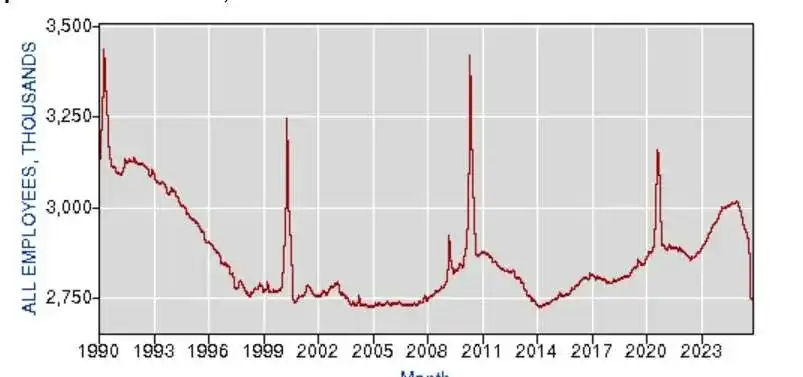
Chart: Federal Employee Count Since 1990

In January 2025, Musk joined DOGE as a special government employee, with a term set for 130 days. In Silicon Valley, 130 days is enough to launch a product prototype, complete a round of financing, or even turn around a startup's fate. In the initial months, DOGE demonstrated dazzling execution. From January to November, federal employees decreased from 3.015 million to 2.744 million, a net reduction of 271,000 positions. This was not only the largest peacetime federal layoff since WWII, but the speed of execution was also staggering. Specific actions included terminating a $290 million refugee facility contract at the Department of Health and Human Services, $190 million in IT redundancy spending at the Treasury Department, and closing hundreds of inefficient agencies and programs, cumulatively undertaking over 29,000 reduction actions. DOGE claimed these measures saved approximately $21.4-25 billion, primarily concentrated in non-defense federal mandatory spending, which decreased by 22.4% year-on-year.
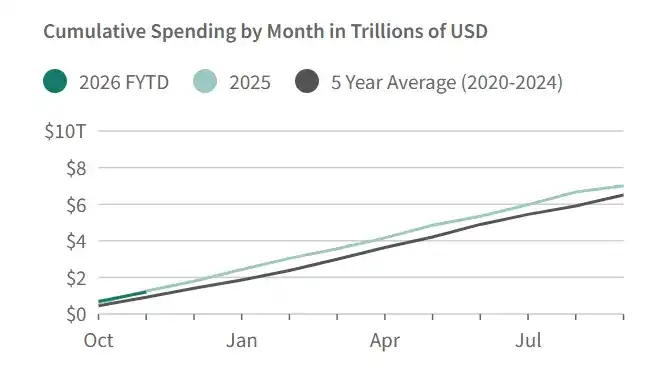
Chart: Cumulative Federal Government Expenditure

But the data on the spending side told a completely different story. Overall federal expenditure rose from about $6.75-7.135 trillion in 2024 to about $7.01-7.6 trillion in 2025, an increase of 4%-6%. Spending in just the first 11 months reached $7.6 trillion, $248 billion more than the same period the previous year. More ironically, some independent analyses suggested that DOGE's claimed savings figures might be severely inflated, with verifiable savings potentially only in the tens of billions, even as low as $3 billion. Due to the weakening of IRS enforcement capabilities, this could lead to at least $350 billion in lost tax revenue over the next decade, making the net effect of the so-called "savings" close to zero or even negative.

Resistance from reality soon became apparent. Federal spending continued to climb; mandatory spending like Social Security, Medicare, and interest on the national debt was completely unaffected by administrative layoffs. By May, multiple pressures converged. Musk's relationship with Trump began to deteriorate, with public disputes between the two. Legal challenges followed, questioning DOGE's authority and procedural legality. Tesla's business was also calling him back—stock price fluctuations, production issues, market competition, all requiring the CEO's attention. Most crucially, the $2 trillion savings target was clearly an impossible mission; staying on a project doomed to fail held no benefit for Musk's personal brand. As soon as his 130-day term ended, Musk announced his return to private enterprise. He did not apply for an extension, did not ask for more resources, but chose a clean break. This decision itself was the loudest admission: transforming the government with business methods was far more difficult than he had thought.

II. The Struggles of the Headless Horseman: Decline from May to November
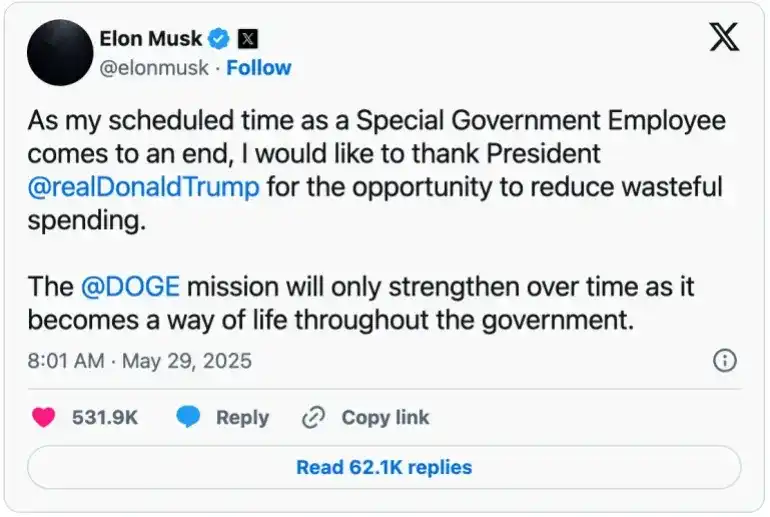
After Musk's departure, DOGE tried to prove it could continue. The White House signaled that the "DOGE spirit" would be integrated into the government's daily operations, becoming part of the "government lifestyle." Some former DOGE employees were embedded in various federal agencies to continue pushing layoffs and cost cuts. Ramaswamy was still nominally leading the agency, trying to maintain the reform momentum.

But DOGE without Musk was like a rocket without an engine; inertia could only last so long. Without the star founder's halo, the agency's attention rapidly declined. Without Musk's direct communication channel with Trump, DOGE's influence within the government was greatly diminished. More importantly, the limitations of the reform became increasingly apparent—those large expenditure items that truly required Congressional legislation to change were utterly beyond DOGE's reach.

During this period, DOGE's achievements became harder to define. Although some layoff actions continued, spending data kept rising. Reports of service disruptions began to increase. Social Security applications were delayed, regulatory gaps appeared, and key positions were left unfilled due to over-cutting. Criticism grew louder: in the name of optimizing efficiency, DOGE was undermining the government's basic operational capacity. Legal challenges also accumulated, questioning whether many of DOGE's actions exceeded executive authority.

By November, several authoritative media outlets began reporting a fact: DOGE had quietly disbanded. Reuters, TIME, CNN, Newsweek, and others used terms like "disbanded," "quietly shut down," and "no longer exists" to describe the agency's fate. There was no formal dissolution announcement, no press conference; DOGE simply vanished from public view. Its charter, originally meant to last until July 2026, was terminated early, with many functions transferred to the Office of Personnel Management or other常规 agencies.

This silent end perhaps speaks volumes more than any failure. Not even a decent farewell, because admitting failure itself was an embarrassment. DOGE went from a revolutionary agency promising to change the government to a brief interlude everyone wanted to forget as quickly as possible.

III. The Underlying Logic of "Reducing Staff Without Saving Money"

1. The Impenetrable Wall of Mandatory Spending
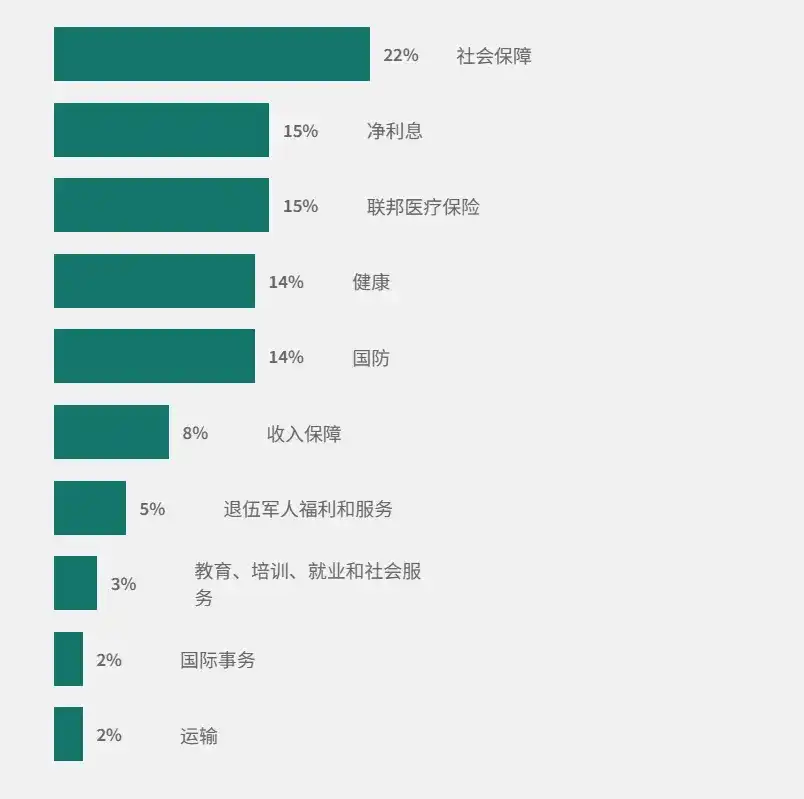
The most fundamental difference between the government fiscal system and a corporation is that over 70% of federal spending is on mandatory programs. These expenditures grow automatically as mandated by law, influenced by demographics, economic cycles, and interest rate fluctuations, completely unaffected by administrative layoffs. The 2025 data clearly shows this rigidity: benefit spending like Social Security and Medicare increased by about $168 billion, driven mainly by an aging population and inflation adjustments; national debt interest costs soared by $71 billion, with the debt scale already expanded to $36-38.3 trillion, making interest expenditure even exceed the defense budget, becoming the federal government's largest single expense.

These rigid expenditures directly offset all of DOGE's savings efforts. No matter how many administrative staff were cut, Social Security payments still had to be made according to statutory formulas, Medicare subsidies still had to be paid based on enrollment, and national debt interest had to be paid on time to maintain national credit. As an executive agency, DOGE could not unilaterally modify benefit programs authorized by Congress, meaning the effort was confined to the "periphery" from the start, unable to touch the "core" of expenditures.

At a deeper level, this rigidity stems from constitutional and legislative frameworks. The government is not a profit-seeking enterprise but a public institution承担ing the function of a social safety net. When a 65-year-old applies for Social Security, the government cannot refuse payment for "cost optimization." This is the essential difference between government and business, and the fundamental reason corporate thinking hit a wall here.

2. The "Offsetting" of Inter-Departmental Spending

DOGE did achieve some results in the discretionary spending area. They terminated 5,200 projects and hundreds of billions of dollars in contracts in departments like Health and Human Services, Education, and the Agency for International Development, saving about $37 billion. But these savings were quickly吞噬ed by growth in other departments. Defense spending increased due to geopolitical tensions, infrastructure investment膨胀ed due to the Trump administration's priorities, and the spillover effects of mandatory spending further pushed up the overall budget.

The result was "local slimming, global expansion." This is similar to the "savings transfer" phenomenon common in corporate mergers and acquisitions—costs cut in one department often reappear in another form elsewhere. But the government lacks the flexible adjustment mechanisms of a company and cannot reconfigure resources as quickly. The 2025 spending growth also included emergency response (increased natural disaster funds) and inflation adjustments (CPI rose about 3%-4%), these external factors further amplified the "offsetting" effect.

Specific data shows that DOGE's savings accounted for only 0.3%-0.5% of total spending, far insufficient to reverse the overall trend. In 2025, mandatory spending increased by $221 billion, discretionary spending increased by $80 billion, and net interest costs increased by $71 billion. When you save a few billion in one pocket but pull out hundreds of billions from three others, the so-called "efficiency improvement" becomes a numbers game.

3. The Cost Inertia and Transition Friction of Agency Operations

Layoffs are never a zero-cost operation, especially in the government system. Implementing the DOGE reform itself generated huge expenses: severance pay, paid leave, rehiring costs after wrongful termination, totaling an estimated $135 billion. This figure already far exceeds many of the "savings" projects claimed by DOGE. More hidden costs came from productivity losses and service disruptions.

The operation of government agencies highly relies on institutional memory and human networks. When large numbers of experienced employees left, Social Security applications began to delay, regulatory gaps appeared, and policy implementation efficiency actually decreased. Although AI and automation were held in high hopes, these tools are far from mature enough to completely replace human judgment. Algorithmic governance might be efficient, but it also brings new problems like data privacy leaks and algorithmic bias. In the process of transitioning from a "public service apparatus" to a "data-driven terminal," the government is losing something difficult to quantify but crucial—legitimacy, social cohesion, and public trust.

A more practical problem is the increase in overtime pay for remaining employees and rising contract outsourcing costs. The government outsourced work previously done internally to private contractors, often at a higher price. In the long run, large-scale brain drain could create a "knowledge gap," affecting policy continuity and professional capacity accumulation.

Conclusion: Who Lost? Reflecting on the Cost and Boundaries of Reform

In this collision of ideals and reality, who ultimately lost? Perhaps first the idealistic reformers, who underestimated the complexity of government operations and mistakenly thought business logic could be directly transplanted into the public sector. Taxpayers might benefit from partial savings in the short term, but face the risk of service cuts and quality decline in the long run. Beneficiaries of public services, especially groups relying on Social Security and Medicare, might suffer from service disruptions and reduced efficiency.

The deeper loser might be the entire system's sustainability and democratic legitimacy. When the government is "optimized" like a business, those values that cannot be measured by numbers—fairness, stability, social cohesion—are quietly being eroded. Opinion polls showed DOGE's approval rating hovering around 40%, reflecting public recognition of efficiency gains coexisting with concerns about service disruptions.

But this collision was not entirely meaningless. If DOGE can push Congress to take action and truly touch core issues like welfare reform and debt control, it could still become a historical turning point. The key is to recognize that the government is not a business; efficiency needs to be balanced with fairness, sustainability, and democratic principles. A business can sacrifice everything for profit, but the government must保留 the last line of defense for society's most vulnerable groups. This is the most important lesson corporate thinking needs to learn, and the most profound insight left to us by this激烈 collision.

Data for this report was compiled and edited by WolfDAO. Please contact us if you have any questions for updates;

Author: Nikka / WolfDAO ( X : @10xWolfdao )

Câu hỏi Liên quan

QWhat was the main contradiction in the DOGE reform efforts as described in the article?

AThe main contradiction was that while the DOGE successfully reduced the federal workforce by 271,000 employees (a 9% cut), the total federal spending actually increased by $248-480 billion, from $6.75-7.135 trillion to $7.01-7.6 trillion. This 'slimming down but gaining weight' phenomenon highlighted the core failure of the reform.

QWhy did Elon Musk leave the DOGE after only 130 days?

AElon Musk left due to multiple converging pressures: a deteriorating relationship with Trump, mounting legal challenges questioning DOGE's authority, the need to return to his business empire (Tesla) to address stock volatility and production issues, and the realization that the $2 trillion savings goal was an impossible task that could damage his personal brand.

QWhat happened to the DOGE after Elon Musk's departure?

AAfter Musk left, the DOGE attempted to continue but quickly lost influence and momentum. It was described as losing its engine. It was eventually quietly disbanded in November, about 10 months after its start and 8 months before its original end date, with many of its functions transferred to other agencies like the Office of Personnel Management.

QAccording to the article, what are the fundamental reasons why corporate logic failed within the government?

ACorporate logic failed due to three fundamental reasons: 1) The 'impregnable wall' of mandatory spending (over 70% of the budget) on programs like Social Security and Medicare, which is required by law and unaffected by administrative cuts. 2) The 'see-saw effect' of spending, where savings in one department were swallowed by increases in others like defense and infrastructure. 3) The high cost inertia and transition friction of the reforms themselves, including severance pay, productivity loss, and the inability of AI to fully replace human judgment.

QWhat were some of the hidden costs and negative consequences of the DOGE's workforce reductions?

AHidden costs included an estimated $135 billion in implementation costs (severance, paid leave, rehiring after wrongful termination). Negative consequences included service disruptions (delays in Social Security applications), regulatory vacuums, loss of institutional memory, increased overtime pay for remaining staff, higher costs from outsourcing to contractors, and a long-term 'knowledge gap' affecting policy continuity.

Nội dung Liên quan

Ghi chép 8 năm khởi nghiệp của đối tác định hướng AI tại a16z

Tác giả, một doanh nhân tiên phong trong lĩnh vực AI generative, đã chia sẻ hành trình 8 năm xây dựng Rosebud AI và những suyết định quan trọng trước khi chuyển sang vai trò mới với tư cách đối tác tại a16z, tập trung đầu tư vào cơ sở hạ tầng AI. Bắt đầu từ năm 2018 khi AI generative còn được gọi là "truyền thông tổng hợp", ông tin tưởng vào tiềm năng biến việc sáng tạo trở nên dễ dàng như chơi game. Các sản phẩm ban đầu như TokkingHeads đã thu hút hàng triệu người dùng bằng cách thiết kế trải nghiệm đơn giản, che đi những hạn chế của mô hình AI thời kỳ đầu. Sự ra mắt của GPT-4 vào năm 2023 là bước ngoặt, khi khả năng tạo mã đủ mạnh để phát triển công cụ trò chơi cho người sáng tạo không chuyên. Ông nhấn mạnh rằng giai đoạn chứng minh khả năng của AI generative đã kết thúc, và cuộc cạnh tranh tiếp theo sẽ xoay quanh việc tổ chức, sản phẩm hóa và thương mại hóa các khả năng này. Trong vai trò mới tại a16z, ông sẽ tập trung vào đầu tư vào frontier model stack, cơ sở hạ tầng và các công cụ phát triển xung quanh mô hình AI. Ông cũng bày tỏ sự lạc quan về những đột phá mà AI mang lại trong lĩnh vực toán học và khoa học.

marsbit8 giờ trước

Ghi chép 8 năm khởi nghiệp của đối tác định hướng AI tại a16z

marsbit8 giờ trước

Giao dịch

Giao ngay
Hợp đồng Tương lai

Bài viết Nổi bật

POO DOGE là gì

Poo Doge: Một Người Chơi Đổi Mới Trong Không Gian Crypto Giới Thiệu Trong bối cảnh tiền điện tử và công nghệ blockchain phát triển nhanh chóng, những dự án mới liên tục xuất hiện nhằm thu hút sự chú ý của các nhà đầu tư và những người đam mê công nghệ. Một trong những dự án như vậy là Poo Doge ($POO DOGE), được ra mắt vào năm 2022 như một sản phẩm độc đáo trong hệ sinh thái Web3. Hoạt động trên nền tảng Dogechain, Poo Doge đã tạo ra một vị thế riêng như một công cụ phi tập trung nhằm cải thiện cách mà người dùng quản lý tài sản kỹ thuật số của họ. Bài viết này đi sâu vào các khía cạnh cốt lõi của Poo Doge, khám phá mục tiêu, chức năng, người sáng tạo và những đặc điểm độc đáo giúp nó nổi bật trong một thị trường đông đúc. Poo Doge là gì? Poo Doge là một loại tiền điện tử phi tập trung được thiết kế đặc biệt cho hệ sinh thái Dogechain. Sử dụng Machine ảo Ethereum (EVM), nó hoạt động như một công cụ theo dõi danh mục linh hoạt và thân thiện với người dùng. Mục tiêu chính của dự án này là cung cấp cho người dùng khả năng theo dõi và quản lý nhiều token một cách hiệu quả trong khuôn khổ Dogechain. Như một loại tiền tệ phi tập trung, Poo Doge nổi bật với sự tập trung vào bảo mật và sự đơn giản trong quản lý tài sản. Người dùng có thể theo dõi các khoản đầu tư và quản lý danh mục token mà không gặp phải những phức tạp thường liên quan đến các nền tảng crypto truyền thống. Cách tiếp cận tập trung vào người dùng này trong quản lý tài sản là vô song, đặc biệt trong bối cảnh độc đáo của Dogechain, nơi cung cấp một môi trường nhẹ nhàng và do cộng đồng dẫn dắt. Ai là người sáng tạo Poo Doge? Thông tin liên quan đến các cá nhân hoặc đội ngũ cụ thể chịu trách nhiệm về sự sáng tạo của Poo Doge vẫn chưa được công bố. Trong một ngành công nghiệp mà sự minh bạch thường được quảng bá như một giá trị cơ bản, việc thiếu thông tin công khai về người sáng lập có thể gây ra câu hỏi trong số các người dùng và nhà đầu tư tiềm năng. Tuy nhiên, sự ẩn danh này không làm giảm đi mục tiêu và tác động mà dự án mong muốn trong không gian Web3. Ai là các nhà đầu tư của Poo Doge? Hiện tại, không có thông tin công khai nào về các nhà đầu tư cụ thể hoặc tổ chức đầu tư nào hỗ trợ cho dự án Poo Doge. Sự thiếu sót này có thể cho thấy rằng dự án này đang được tự tài trợ hoặc vẫn chưa thu hút được sự chú ý từ các thực thể đầu tư lớn thường đi kèm với các sáng kiến crypto rộng rãi hơn. Trong khi sự thiếu ủng hộ có khả năng xác định có thể bị coi là đáng ngờ, không hiếm thấy những dự án mới nổi, đặc biệt là những dự án tập trung vào công nghệ phi tập trung, ban đầu hoạt động mà không có sự hỗ trợ từ các tổ chức lớn. Khi Poo Doge tiếp tục phát triển và mở rộng cơ sở người dùng, khả năng tiếp cận các nhà đầu tư tiềm năng có thể xảy ra. Poo Doge hoạt động như thế nào? Poo Doge hoạt động dựa trên nguyên tắc phân quyền, tận dụng Dogechain (EVM) để cung cấp một giải pháp theo dõi danh mục rõ ràng. Dưới đây là những khía cạnh chính về cách thức hoạt động của dự án: Nền Tảng Phi Tập Trung Được xây dựng trên một khung phân quyền có nghĩa là Poo Doge được thiết kế để loại bỏ các điểm thất bại trung tâm, điều này thường là một nguy cơ trong các hệ thống ngân hàng và tài chính truyền thống. Sự phân quyền này không chỉ nâng cao bảo mật mà còn thúc đẩy sự minh bạch, vì tất cả các giao dịch đều có thể xác minh trên blockchain. Theo Dõi Danh Mục Đặc điểm nổi bật của Poo Doge là vai trò của nó như một công cụ theo dõi danh mục, lần đầu tiên xuất hiện trên blockchain meme coin nguyên gốc của Dogechain. Cách tiếp cận đổi mới này cho phép người dùng quản lý hiệu quả các khoản đầu tư của họ trên các token khác nhau. Người dùng có thể nắm bắt thông tin về các khoản nắm giữ, sự biến động và hiệu suất lịch sử, từ đó đưa ra quyết định đầu tư thông minh hơn. Tương Thích EVM Poo Doge tận dụng Machine ảo Ethereum, cho phép tích hợp và khả năng tương tác mượt mà với các blockchain tương thích EVM khác. Khả năng kỹ thuật này là rất quan trọng trong hệ sinh thái crypto liên kết, giúp Poo Doge cung cấp các chức năng được nâng cao, tạo điều kiện cho các giao dịch chéo chuỗi và thu hút một cơ sở người dùng rộng lớn hơn. Thời Gian Phát Triển của Poo Doge Để hiểu rõ hơn về sự phát triển của Poo Doge trong bối cảnh tiền điện tử, đây là một dòng thời gian ngắn gọn nêu bật các cột mốc quan trọng trong lịch sử của nó: 2022: Poo Doge ($POO DOGE) chính thức ra mắt, gia nhập thị trường tiền điện tử. Phát Triển năm 2022: Dự án tập trung vào việc xây dựng và tối ưu hóa hoạt động của nó trong môi trường Dogechain, tập trung vào chức năng chính của nó như một công cụ theo dõi danh mục. Cung Cấp Token: Một tổng cung 1,000,000,000,000 token đã được thiết lập, mặc dù được lưu ý rằng không có token nào đang lưu hành tại thời điểm này, cho thấy rằng dự án có thể vẫn đang trong giai đoạn phát triển ban đầu. Các Tính Năng Đặc Biệt Poo Doge tự tách mình ra khỏi các dự án khác theo nhiều cách quan trọng: Ưu Điểm Người Đi Đầu: Là công cụ theo dõi danh mục đầu tiên trên Dogechain, Poo Doge chiếm một vị trí độc đáo có thể thu hút những người dùng sớm và nâng cao vị thế thị trường của nó. Tập Trung Vào Người Dùng: Dự án nhấn mạnh sự đơn giản và thân thiện với người dùng, đảm bảo rằng ngay cả những người có thể thiếu kiến thức sâu rộng về blockchain cũng có thể quản lý tài sản kỹ thuật số của mình một cách hiệu quả. Phi Tập Trung và Bảo Mật: Bằng cách hoạt động trong một khung phân quyền, người dùng có thể tận hưởng bảo mật cao hơn và sự tự tin rằng danh mục của họ được bảo vệ khỏi những vụ hack tiềm năng có thể ảnh hưởng đến các nền tảng tập trung. Cách Tiếp Cận Dựa Vào Cộng Đồng: Sự phụ thuộc của Poo Doge vào sự tham gia và phản hồi của cộng đồng là rất quan trọng trong sự phát triển của nó, có thể dẫn đến một sản phẩm gần gũi hơn với nhu cầu của người dùng. Kết Luận Poo Doge ($POO DOGE) đại diện cho một sự phát triển thú vị trong bối cảnh Web3 và tiền điện tử. Mặc dù có những khoảng trống đáng chú ý trong thông tin công khai về những người sáng tạo và nhà đầu tư của nó, cách tiếp cận đổi mới của dự án đối với tài chính phi tập trung và quản lý tài sản có triển vọng đáng kể. Với sự tập trung vào trải nghiệm người dùng và khái niệm tiên phong của một công cụ theo dõi danh mục trên Dogechain, Poo Doge đang chuẩn bị thu hút sự chú ý khi nó tiếp tục phát triển. Khi bối cảnh tiền điện tử ngày càng phát triển và trưởng thành, những sáng kiến như Poo Doge nhấn mạnh sự chuyển dịch liên tục hướng tới phân quyền và trao quyền cho người dùng trong tài chính, mở đường cho một kỷ nguyên mới của quản lý tài sản kỹ thuật số.

Tổng lượt xem 383Xuất bản vào 2024.04.05Cập nhật vào 2024.12.03

POO DOGE là gì

Làm thế nào để Mua DOGE

Chào mừng bạn đến với HTX.com! Chúng tôi đã làm cho mua Dogecoin (DOGE) trở nên đơn giản và thuận tiện. Làm theo hướng dẫn từng bước của chúng tôi để bắt đầu hành trình tiền kỹ thuật số của bạn.Bước 1: Tạo Tài khoản HTX của BạnSử dụng email hoặc số điện thoại của bạn để đăng ký tài khoản miễn phí trên HTX. Trải nghiệm hành trình đăng ký không rắc rối và mở khóa tất cả tính năng. Nhận Tài khoản của tôiBước 2: Truy cập Mua Crypto và Chọn Phương thức Thanh toán của BạnThẻ Tín dụng/Ghi nợ: Sử dụng Visa hoặc Mastercard của bạn để mua Dogecoin (DOGE) ngay lập tức.Số dư: Sử dụng tiền từ số dư tài khoản HTX của bạn để giao dịch liền mạch.Bên thứ ba: Chúng tôi đã thêm những phương thức thanh toán phổ biến như Google Pay và Apple Pay để nâng cao sự tiện lợi.P2P: Giao dịch trực tiếp với người dùng khác trên HTX.Thị trường mua bán phi tập trung (OTC): Chúng tôi cung cấp những dịch vụ được thiết kế riêng và tỷ giá hối đoái cạnh tranh cho nhà giao dịch.Bước 3: Lưu trữ Dogecoin (DOGE) của BạnSau khi mua Dogecoin (DOGE), lưu trữ trong tài khoản HTX của bạn. Ngoài ra, bạn có thể gửi đi nơi khác qua chuyển khoản blockchain hoặc sử dụng để giao dịch những tiền kỹ thuật số khác.Bước 4: Giao dịch Dogecoin (DOGE)Giao dịch Dogecoin (DOGE) dễ dàng trên thị trường giao ngay của HTX. Chỉ cần truy cập vào tài khoản của bạn, chọn cặp giao dịch, thực hiện giao dịch và theo dõi trong thời gian thực. Chúng tôi cung cấp trải nghiệm thân thiện với người dùng cho cả người mới bắt đầu và người giao dịch dày dạn kinh nghiệm.

Tổng lượt xem 1.3kXuất bản vào 2024.12.11Cập nhật vào 2025.03.21

Làm thế nào để Mua DOGE

DOGE M là gì

Doge Matrix ($doge m): Giống Mới của Tiền Điện Tử Được Điều Khiển Bởi Cộng Đồng Giới thiệu Trong bối cảnh không ngừng phát triển của tiền điện tử, các dự án mới liên tục xuất hiện, mỗi dự án đều nhằm thu hút sự quan tâm của các nhà đầu tư và những người đam mê. Một trong những cái tên mới nhất trong lĩnh vực này là Doge Matrix, được đại diện bởi ký hiệu $doge m. Dự án này đã thu hút sự chú ý nhờ vào nguồn gốc từ văn hóa meme phổ biến xung quanh Dogecoin, thiết lập vị trí của nó trong không gian web3. Bài viết này nhằm cung cấp một phân tích toàn diện về Doge Matrix, bao gồm tổng quan, người sáng lập, nhà đầu tư, chức năng, thời gian và các khía cạnh nổi bật. Doge Matrix ($doge m) là gì? Doge Matrix là một dự án tiền điện tử được điều khiển bởi cộng đồng, dường như xây dựng dựa trên sức hấp dẫn rộng rãi của Dogecoin, một loại tiền tệ kỹ thuật số nổi tiếng với linh vật Shiba Inu và nguồn gốc meme của nó. Mặc dù các mục tiêu tổng thể của Doge Matrix chưa được định nghĩa rõ ràng, nhưng nó được đặc trưng bởi cam kết khai thác sự tham gia và hỗ trợ của cộng đồng. Khác với các loại tiền điện tử truyền thống thường nhấn mạnh vào tiện ích hoặc giá trị nội tại thông qua các công nghệ cơ bản, Doge Matrix tự định vị trong một không gian chấp nhận hiện tượng văn hóa của tiền điện tử, đặc biệt thu hút những người đồng cảm với tinh thần của các tài sản dựa trên meme. Dựa vào sức mạnh của cộng đồng Dogecoin, Doge Matrix hoạt động như một phần của hệ sinh thái rộng lớn hơn, mời gọi sự tham gia và gắn kết từ những người dùng có chung sở thích về tiền điện tử và không gian kỹ thuật số. Ai là Người Sáng Lập Doge Matrix ($doge m)? Danh tính của người sáng lập Doge Matrix vẫn chưa được biết đến. Sự thiếu minh bạch này không phải là điều hiếm gặp trong không gian tiền điện tử, nơi một số dự án được ra mắt mà không tiết lộ danh tính của các nhà sáng lập. Việc thiếu thông tin về đội ngũ sáng lập có thể gây ra những câu hỏi trong lòng các nhà đầu tư tiềm năng về trách nhiệm và định hướng của dự án. Ai là Các Nhà Đầu Tư của Doge Matrix ($doge m)? Hiện tại, không có thông tin công khai nào chi tiết về các nhà đầu tư hoặc quỹ đầu tư hỗ trợ Doge Matrix. Dự án dường như chủ yếu dựa vào sự hỗ trợ của cộng đồng hơn là đầu tư từ các tổ chức. Mô hình này phù hợp với bản chất được điều khiển bởi cộng đồng của sáng kiến, tạo ra một môi trường mà hướng đi của dự án được hình thành bởi các thành viên tham gia chứ không phải bị quyết định bởi một số ít nhà đầu tư tài chính. Doge Matrix ($doge m) Hoạt Động Như Thế Nào? Các chi tiết liên quan đến cơ chế hoạt động của Doge Matrix vẫn còn mơ hồ, phản ánh một xu hướng rộng hơn của các dự án trong không gian đồng tiền meme, nơi các chức năng đổi mới không phải lúc nào cũng được diễn đạt rõ ràng. Tuy nhiên, Doge Matrix dường như được thiết kế để khai thác hệ sinh thái tiền điện tử hiện có bằng cách khuyến khích sự tham gia của người dùng trong khi tận dụng các tham chiếu văn hóa quen thuộc liên quan đến Dogecoin. Các đặc điểm có thể độc đáo của nó xuất phát từ các tương tác trong cộng đồng hơn là từ các tiến bộ công nghệ, nhấn mạnh vào những trải nghiệm chung và sự hợp tác giữa các chủ sở hữu token. Mặc dù các đổi mới cụ thể chưa được nêu rõ, nhưng dự án dường như tạo ra một không gian nơi các thành viên trong cộng đồng có thể tham gia, chia sẻ ý tưởng và thúc đẩy tiềm năng của dự án. Thời Gian của Doge Matrix ($doge m) Nhìn lại thời gian của dự án cho thấy những sự kiện đáng chú ý đã định hình hành trình của nó cho đến nay: 25 tháng 11, 2024: Doge Matrix đạt giá trị cao nhất mọi thời đại, đánh dấu một cột mốc quan trọng trong lịch sử ban đầu của nó. 1 tháng 1, 2025: Ngược lại, Doge Matrix đạt giá trị thấp nhất mọi thời đại, minh họa sự biến động thường thấy liên quan đến tiền điện tử, đặc biệt là trong các giai đoạn đầu của vòng đời dự án. Đang diễn ra: Dự án tiếp tục được giao dịch và hỗ trợ tích cực bởi cộng đồng của nó, mặc dù các cột mốc hoặc mục tiêu cụ thể trong tương lai vẫn chưa được công bố. Các Điểm Chính Về Doge Matrix ($doge m) Tập Trung Vào Cộng Đồng Tại trung tâm của Doge Matrix là cam kết với sự tham gia của cộng đồng. Dự án phát triển dựa trên nguyên tắc hợp tác và các mục tiêu chung giữa các thành viên, nhấn mạnh tầm quan trọng của nỗ lực tập thể. Khác với các dự án tập trung thường có cấu trúc lãnh đạo rõ ràng, Doge Matrix hiện tại thể hiện một cách tiếp cận linh hoạt hơn đối với quản trị, nơi tiếng nói của mỗi thành viên trong cộng đồng đều quan trọng. Biến Động Thị trường tiền điện tử nổi tiếng với sự biến động của nó, và Doge Matrix cũng không ngoại lệ. Lịch sử giá của nó phản ánh những biến động đáng kể giữa các giá trị cao và thấp, điều này là điển hình cho nhiều loại tiền điện tử mới nhưng cũng nhấn mạnh các rủi ro liên quan đến đầu tư vào các token mới nổi. Thiếu Thông Tin Chi Tiết Một trong những đặc điểm nổi bật nhất về Doge Matrix là sự thiếu hụt thông tin chi tiết về các nền tảng công nghệ và cơ chế hoạt động của nó. Sự mơ hồ này yêu cầu các nhà đầu tư tiềm năng phải tiến hành thẩm định kỹ lưỡng trước khi tham gia vào dự án. Kết Luận Tóm lại, Doge Matrix ($doge m) minh họa một làn sóng mới của các dự án tiền điện tử dựa nhiều vào sự tham gia của cộng đồng và sự liên quan văn hóa. Mặc dù thiếu một số thông tin cụ thể—như lãnh đạo rõ ràng, mục tiêu xác định và chức năng chi tiết—dự án đã quản lý để tạo ra sự quan tâm trong cộng đồng crypto, tận dụng sức hấp dẫn đã được thiết lập của văn hóa meme. Như với bất kỳ khoản đầu tư nào trong không gian tiền điện tử, việc hiểu các rủi ro vốn có và tiến hành nghiên cứu toàn diện là điều cần thiết cho các thành viên tiềm năng. Doge Matrix là một lời nhắc nhở về tính năng động, đôi khi khó đoán của ngành công nghiệp crypto, được đánh dấu bởi sự phát triển không ngừng và sự nhiệt tình cho các sáng kiến được điều khiển bởi cộng đồng.

Tổng lượt xem 390Xuất bản vào 2025.02.03Cập nhật vào 2025.02.03

DOGE M là gì

Thảo luận

Chào mừng đến với Cộng đồng HTX. Tại đây, bạn có thể được thông báo về những phát triển nền tảng mới nhất và có quyền truy cập vào thông tin chuyên sâu về thị trường. Ý kiến ​​của người dùng về giá của DOGE (DOGE) được trình bày dưới đây.

活动图片














