Crypto nears its ‘Netscape moment’ as industry approaches inflection point

cointelegraphXuất bản vào 2025-12-09Cập nhật gần nhất vào 2025-12-09

Tóm tắt

The cryptocurrency industry is approaching its "Netscape moment," driven by advancements in blockchain infrastructure and the rise of regulated investment products, according to Paradigm co-founder Matt Huang. This inflection point mirrors the early internet's mass adoption phase, where ease of use and institutional accessibility became key catalysts. Onchain systems enable open, programmable finance, while regulated products like ETFs attract traditional investors by offering familiar, compliant access. Analysts note over 200 crypto ETPs may launch soon, broadening participation. Despite concerns about speculation and memecoin dominance on some networks, experts argue that centralized platforms and ETFs expand the onchain economy rather than threaten it. The true risk lies in slowed technological progress; continued innovation in functionality and market structures is essential for long-term value creation.

The cryptocurrency industry is approaching its “Netscape moment,” as steady progress in blockchain infrastructure and the rise of regulated investment products drive a new wave of institutional adoption, according to Paradigm co-founder Matt Huang.

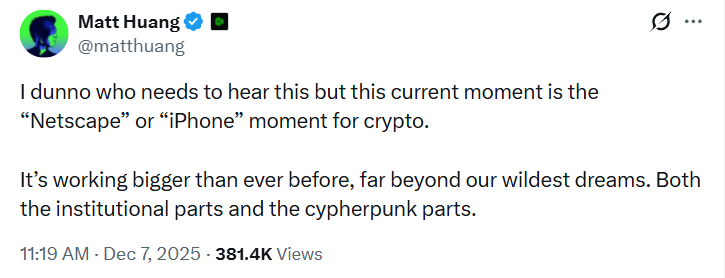
The crypto sector is “facing its ‘Netscape’ or ‘iPhone’ moment,” Huang wrote Sunday in a post on X. “It’s working bigger than ever before, far beyond our wildest dreams. Both the institutional parts and the cypherpunk parts.”

Netscape launched the first easy-to-use web browser for mainstream users in 1994 before going public with a successful initial public offering (IPO) in August 1995, marking the first building block that triggered the internet’s mass adoption.

However, Microsoft saw the large-scale interest and capitalized on it on it by freely bundling Internet Explorer as a pre-installed component of the Windows operating system, outcompeting Netscape to become the most widely used internet browser.
Source: Matt Huang

Onchain usability meets regulated access

In the crypto world, Bitcoin’s (BTC) peer-to-peer model and decentralized finance (DeFi) have enabled a new vision of an open, programmable financial system that cuts out intermediaries.

At the same time, centralized platforms and traditional investment vehicles are attracting a growing share of new capital because they are easier to use and fit within familiar regulatory frameworks.

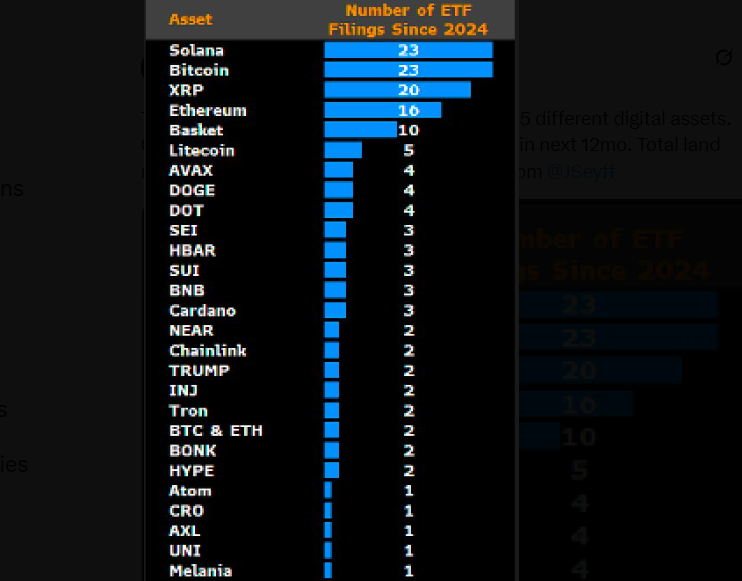
About 200 crypto-based exchange-traded products (ETPs) could launch on the market in the next year, with 155 awaiting approval as of Oct. 22, according to Bloomberg’s senior ETF analyst, Eric Balchunas.

Crypto ETPs provide easier access to altcoins for traditional investors on brokerage platforms that don’t have an account on a centralized cryptocurrency exchange.
Source: Eric Balchunas

Related: Prediction markets emerge as speculative ‘arbitrage arena’ for crypto traders

Onchain products are becoming easier to use, while “regulated” investment vehicles are making crypto more accessible, signaling that the industry may be at the tipping point ahead of mass adoption, Lacie Zhang, market analyst at Bitget Wallet, told Cointelegraph.

“ETFs and similar products legitimize digital assets but don’t replace what onchain systems uniquely offer, such as direct ownership, programmable settlement, and real-time transfers.”

She added that regulated access points tend to pull more liquidity onto underlying networks by drawing in institutional capital and new participants, rather than “displacing onchain activity.”

Related: Bitcoin now settles Visa-scale volumes, but most is for wholesale, not coffee

Despite some concerns about centralization, the rise of centralized finance (CeFi) platforms and ETFs is an “expansion of the onchain economy,” not an inherent threat, according to Marcin Kazmierczak, co-founder of RedStone, a blockchain oracle solutions provider.

“The Netscape moment isn’t about onchain versus CeFi. It’s about the broader crypto ecosystem finally attracting capital that actually stays around long-term,” he told Cointelegraph, adding that the two ecosystems are “not adversarial.”

Netscape moment or dot-com bubble repeat?

However, the crypto industry may still risk a market crash akin to the dot-com bubble, considering that the majority of revenue is derived from speculative memecoin trading for some blockchain networks.

On Solana, memecoin trading accounted for 62% of the network’s decentralized app revenue in June, and the majority of its $1.6 billion in revenue for the first half of 2025.

To reach its true potential, the developers need to focus on advancing the industry’s real-world utility, as the only “real risk” to the industry is a “slowdown in technological development,” according to Edwin Mata, lawyer, co-founder and CEO of tokenization platform Brickken.

“What matters is that onchain environments continue creating functionality, automation, and new market structures, because that is where fundamental value is produced,” he told Cointelegraph.

Magazine: Solana vs Ethereum ETFs, Facebook’s influence on Bitwise — Hunter Horsley

Nội dung Liên quan

Bank of America âm thầm triển khai: 6 nghìn tỷ USD tiền gửi ngân hàng có thể đổ vào stablecoin?

Bài viết thảo luận về động thái mới đây của Bank of America (BofA) trong việc bổ nhiệm lãnh đạo cấp cao để đẩy mạnh nền tảng tài sản kỹ thuật số, bao gồm stablecoin, tiền gửi được token hóa, lưu ký và thanh toán tiền mã hóa. Điều này diễn ra trong bối cảnh thị trường crypto đang suy yếu. Một con số gây chú ý trên mạng xã hội là 6 nghìn tỷ USD tiền gửi ngân hàng có thể chuyển sang stablecoin, dựa trên báo cáo của Bộ Tài chính Mỹ và phát biểu của CEO BofA Brian Moynihan. Tuy nhiên, ông nhấn mạnh điều kiện tiên quyết là stablecoin phải được phép trả lãi. Dù đạo luật GENIUS đã được ký nhưng việc triển khai quy tắc cuối cùng bị trì hoãn đến tháng 1/2027. Trong khi chờ đợi, các ngân hàng lớn như JPMorgan, Citi và BofA đã tích cực phát triển mạng lưới tiền gửi được token hóa chung, nhắm mục tiêu ra mắt vào đầu năm 2027. Có hai quan điểm trái chiều: một bên cho rằng việc áp dụng stablecoin cho các trường hợp thực tế bởi các tổ chức đang tăng trưởng mạnh; bên kia chỉ ra rằng cấu trúc cơ bản chưa thay đổi và thị trường stablecoin hiện khá trầm lắng. Dù vậy, dữ liệu lạc quan dự báo khối lượng thanh toán bằng stablecoin sẽ tiếp tục tăng vọt. Cuộc đua hướng tới thời hạn tháng 1/2027 đã bắt đầu, đánh dấu sự dịch chuyển quan trọng trong quá trình hợp nhất giữa tài chính truyền thống và tiền mã hóa.

Foresight News10 phút trước

Bank of America âm thầm triển khai: 6 nghìn tỷ USD tiền gửi ngân hàng có thể đổ vào stablecoin?

Foresight News10 phút trước

Bộ trưởng Tài chính Mỹ Besant tuyên bố: Mỹ sắp kiểm soát 80% sức mạnh tính toán toàn cầu

Bộ trưởng Tài chính Mỹ Janet Yellen tuyên bố Mỹ sắp kiểm soát 80% năng lực tính toán toàn cầu, coi đây là trụ cột chiến lược kinh tế quốc gia. Bà cho biết Mỹ hiện chiếm 50-60% và sẽ sớm đạt 80%, đồng thời nhấn mạnh đây là cuộc cạnh tranh chiến lược "không thể thua", với lợi thế AI hiện tại khoảng một năm. Tuyên bố này được xem như sự bảo đảm cấp quốc gia cho đầu tư cơ sở hạ tầng AI, hỗ trợ triển vọng doanh nghiệp chip như NVIDIA và chu kỳ chi tiêu vốn của các nhà cung cấp điện toán đám mây. Yellen định vị AI, bán dẫn và điện toán lượng tử là ba trụ cột sức mạnh kinh tế và an ninh quốc gia, lập luận rằng AI tạo cơ hội và chưa gây mất việc làm ròng. Tuy nhiên, chuyên gia lưu ý "thị phần năng lực tính toán" thiếu số liệu chuẩn xác, khuyến nghị nhà đầu tư tập trung vào các chỉ số vật lý có thể định lượng như mở rộng công suất và cơ sở hạ tầng điện thay vì chỉ dựa vào tuyên bố chính sách. Việc kiểm chứng sẽ phụ thuộc vào dữ liệu từ báo cáo ngành bán dẫn và cơ sở hạ tầng đám mây trong các quý tới.

marsbit22 phút trước

Bộ trưởng Tài chính Mỹ Besant tuyên bố: Mỹ sắp kiểm soát 80% sức mạnh tính toán toàn cầu

marsbit22 phút trước

Matrixdock Hoàn Thành Kiểm Toán Dự Trữ Độc Lập Liên Tiếp Hai Năm, Tiếp Tục Hoàn Thiện Hệ Thống Minh Bạch Dự Trữ

Gần đây, Matrixdock, nền tảng token hóa RWA thuộc BIT (trước đây là Matrixport), đã hoàn thành cuộc kiểm toán dự trữ độc lập lần thứ tư liên tiếp trong kỳ nửa năm. Kiểm toán lần này tiếp tục được thực hiện bởi Bureau Veritas và lần đầu tiên đưa sản phẩm bạc token hóa XAGm vào phạm vi kiểm toán. Sự kiện đánh dấu Matrixdock duy trì quy trình xác minh độc lập nhất quán và liên tục trong hai năm, tiếp tục hoàn thiện hệ thống minh bạch dự trữ. Theo kết quả kiểm toán, tổng cộng 574 thỏi vàng và bạc từ các nhà luyện kim được LBMA chứng nhận đã được xác minh vật lý tại ba kho chứa cấp tổ chức. Cụ thể, dự trữ cho XAUm (vàng token hóa) là 508 thỏi, tương đương 16,331.184 ounce troy, khớp với lượng token đang lưu hành. Dự trữ cho XAGm (bạc token hóa) là 66 thỏi, tương đương 65,934 ounce troy, và sau khi áp dụng hệ số ozPerToken, cũng khớp với lượng token lưu hành. Không có chênh lệch nào được phát hiện. Ngoài kiểm toán định kỳ, Matrixdock cung cấp báo cáo dự trữ hàng tháng, bằng chứng dự trữ trên chuỗi (Proof of Reserves) và công cụ tra cứu phân bổ vàng (Gold Allocation Lookup), cho phép người nắm giữ xác minh liên tục tài sản cơ sở. Việc tuân thủ kiểm toán độc lập liên tục thể hiện cam kết của Matrixdock trong việc xây dựng một lớp dự trữ (Reserve Layer) minh bạch và đáng tin cậy cho tài chính trên chuỗi.

marsbit33 phút trước

Matrixdock Hoàn Thành Kiểm Toán Dự Trữ Độc Lập Liên Tiếp Hai Năm, Tiếp Tục Hoàn Thiện Hệ Thống Minh Bạch Dự Trữ

marsbit33 phút trước

Giao dịch

Giao ngay
活动图片