Crypto Morning Report: U.S. Stocks Plunge Across the Board, HyperLend Unveils HPL Tokenomics

marsbitXuất bản vào 2026-01-21Cập nhật gần nhất vào 2026-01-21

Tóm tắt

Crypto Morning Brief: U.S. stocks fell sharply across the board, with the Nasdaq and S&P 500 dropping over 2%. Chip stocks and major tech companies like Nvidia and Tesla declined 3-4%. Gold and silver hit new highs. In regulatory news, CFTC Chair announced the "Future Proof" initiative to modernize digital asset oversight. Trump Media set February 2, 2026, as the record date for its digital token distribution to shareholders. Hong Kong’s Securities and Futures Professionals Association urged a shift toward commercial application of virtual assets, following the establishment of regulatory infrastructure. HyperLend revealed its HPL tokenomics: 30.14% for ecosystem growth, 25% for genesis allocation, 22.5% to core contributors, 17.36% to strategic investors, and 5% for liquidity. Pendle introduced sPENDLE, a liquid staking token that reduces withdrawal time from years to 14 days. Ethereum’s recent network activity surge may be linked to address poisoning attacks, exploiting lower gas fees post-Dencun upgrade. Chainlink launched 24/5 U.S. stock data feeds for blockchain applications. Trend Research purchased 6,656 ETH, now holding $1.91 billion worth. Bitmine approved increasing its share issuance limit for future financing flexibility. Pump.fun established an investment division and a $3 million public hackathon. Recommended reads include discussions on AI’s impact, X’s algorithm changes, NYSE’s move to 24/7 tokenized trading, Wintermute’s market outlook...

Author: Deep Tide TechFlow

Yesterday's Market Dynamics

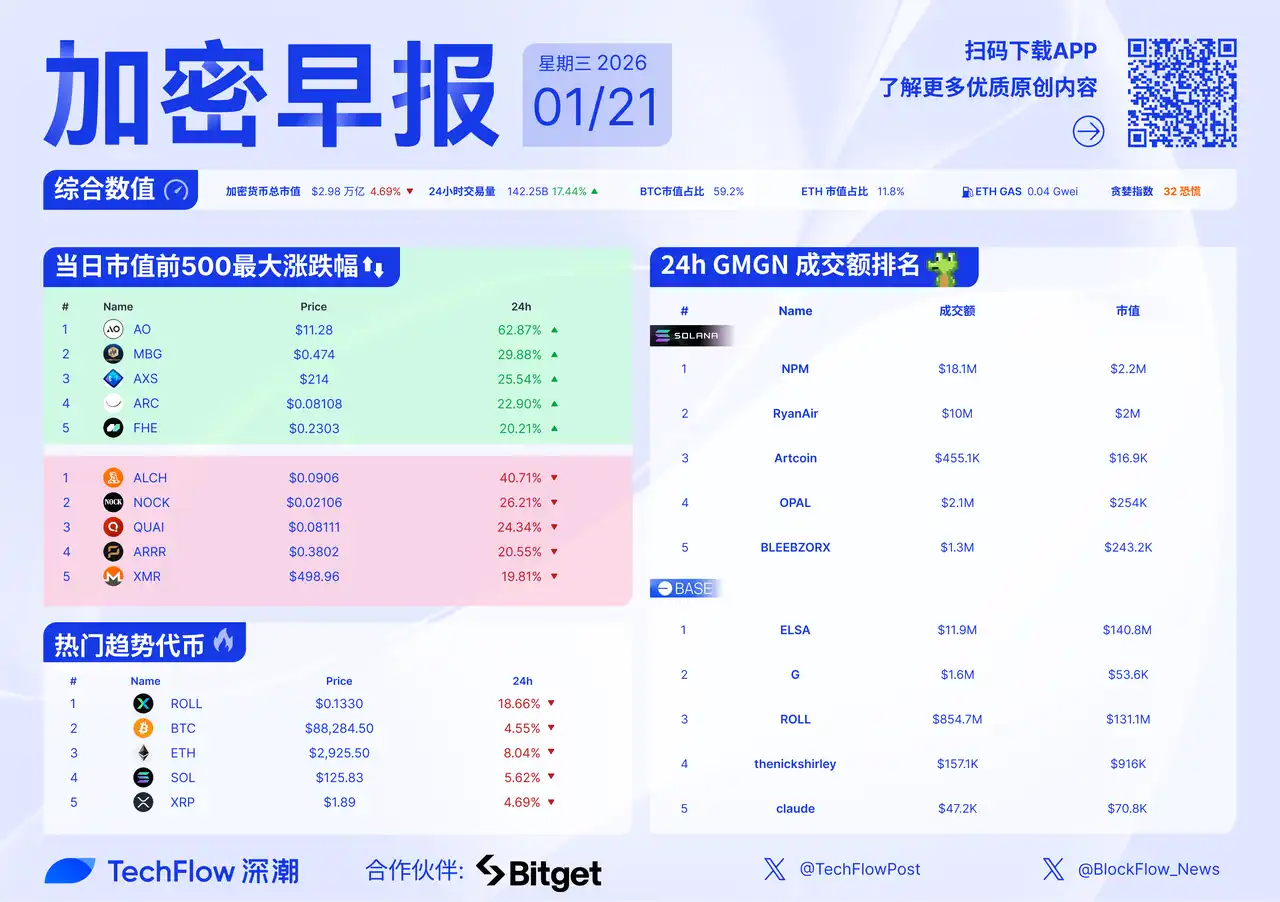
U.S. stock indices plummet across the board, chip stocks and gold/silver hit new highs

U.S. stock indices fell sharply, with the Nasdaq Composite dropping over 2%, the S&P 500 down about 2%+, and the Dow Jones Industrial Average declining approximately 1.7%–1.8%. Market panic sentiment rose, with the VIX fear index climbing to recent highs.

Tech/chip stocks fell broadly, with heavyweight stocks like Nvidia, Tesla, Apple, and Amazon generally under pressure, down 3%–4%+.

U.S. Treasury yields rose to multi-month highs, with significant selling pressure on U.S. bonds; the U.S. dollar index weakened.

Gold and silver prices reached new highs, with spot gold briefly surging to around $4750-4763 per ounce, and silver breaking through the $90 per ounce range.

U.S. Supreme Court issues no ruling on challenge to legality of Trump's global tariffs

The U.S. Supreme Court did not issue a ruling on the challenge to the legality of Trump's global tariffs.

CFTC Chairman launches "Future Proof" plan to upgrade cryptocurrency regulation

According to The Block, the new Chairman of the U.S. Commodity Futures Trading Commission (CFTC), Michael Selig, announced the "Future Proof" plan on January 20, aimed at modernizing the CFTC's approach to digital asset regulation. Selig wrote in a Washington Post op-ed, emphasizing that the existing regulatory framework is no longer suitable for the emerging digital asset market and calling for a "minimum effective dose" regulatory strategy.

Selig stated that if Congress passes legislation expanding the CFTC's regulatory authority, the agency is ready to take over the supervision of the digital asset market.

Trump Media announces record date for digital token program as February 2

Trump Media & Technology Group (Nasdaq, NYSE Texas: DJT) today announced that the record date for its digital token program is set for February 2, 2026. Ultimate beneficial owners and registered holders of at least one share of DJT stock as of this date will be eligible to receive tokens and related rewards. The company will partner with Crypto.com to mint and custody these digital assets.

Hong Kong Securities and Futures Professional Association: Hong Kong has completed initial virtual asset regulatory infrastructure, next step should shift focus to commercialization and application implementation

The Hong Kong government plans to announce the 2026/2027 Fiscal Budget on February 25, focusing on virtual assets and investor protection, among other areas. The Hong Kong Securities and Futures Professional Association stated that Hong Kong has completed the initial regulatory infrastructure for virtual assets, and the next step should shift focus to commercialization and application implementation. By unlocking RWA secondary market liquidity, accelerating product approvals, introducing international liquidity, and strengthening practitioner training, Hong Kong can upgrade from a market with clear regulations to a global virtual asset center with ample liquidity and widespread application, aligning with the national "15th Five-Year Plan" for financial openness and digital economy strategy.

HyperLend unveils HPL tokenomics model: Genesis allocation accounts for 25%, ecosystem growth and incentives account for 30.14%

According to a message from the official X account of digital asset lending platform HyperLend, the protocol has released its HPL token distribution plan:

Ecosystem growth and incentives account for 30.14%;

Genesis allocation accounts for 25%;

Core contributors account for 22.5%;

Strategic investors account for 17.36%;

Liquidity accounts for 5%.

Pendle launches sPENDLE liquid staking token: shortens lock-up period from years to 14 days

According to The Block, DeFi project Pendle announced the launch of the sPENDLE liquid staking token, officially replacing the previous vePENDLE multi-year locking mechanism. The new system reduces the withdrawal period from years to 14 days, while introducing transferable, composable token features to simplify user participation. Pendle revealed that the original vePENDLE system attracted only about 20% of the token supply, the lowest among similar models. The new mechanism will utilize up to 80% of protocol revenue for PENDLE buybacks and introduce an algorithmic emissions model, expected to reduce overall emissions by approximately 30%. Existing vePENDLE holders will receive a maximum 4x reward multiplier based on remaining lock-up time, which will decay linearly over two years.

Analysis: Recent surge in Ethereum network activity may be related to address poisoning attacks

According to Cointelegraph, security researcher Andrey Sergeenkov stated that Ethereum's recent record network activity may be related to a wave of address poisoning attacks exploiting low gas fees.

Since the Ethereum Fusaka network upgrade in December, transaction fees have dropped by over 60%, making such attacks more economically viable. Data shows that in the week starting January 12, the number of new Ethereum addresses reached 2.7 million, with daily transaction volume surging to over 2.5 million.

Address poisoning attacks involve scammers sending small transactions from wallets with addresses similar to legitimate ones, tricking users into copying the wrong address when transacting. Research indicates that some top "poisoners" have sent transactions to over 400,000 recipients, with 116 victims having lost over $740,000 through this method so far.

Chainlink launches 24/5 U.S. stock data service, connecting traditional stock market with blockchain

According to an official announcement, Chainlink recently launched a 24/5 U.S. stock data stream service, providing U.S. stock and ETF market data for blockchain applications, covering standard trading hours and non-standard hours. The service is already live on multiple blockchain platforms, aiming to bridge the gap between traditional stock market trading hours and blockchain operation mechanisms, creating blockchain application scenarios for the U.S. stock market.

Several trading platforms, including Lighter and BitMEX, have adopted this service for applications such as stock perpetual contracts and prediction markets. Beyond price information, this data service also includes bid/ask quotes, trading volume, and market status data, which can be used for pricing and risk management of on-chain financial products. This service represents a technological advancement in blockchain financial infrastructure.

Trend Research purchases another 6,656 Ethereum, currently holds approximately $1.91 billion worth of Ethereum

According to monitoring by Onchain Lens(@OnchainLens), Trend Research borrowed 20 million USDT and purchased 6,656 Ethereum (ETH), then deposited these Ethereum into the Aave V3 protocol.

Currently, Trend Research holds 651,310 Ethereum, worth approximately $1.91 billion.

Bitmine approved to increase cap on issuable shares to enhance future financing flexibility

According to CoinDesk, Bitmine Immersion Technologies received shareholder approval to increase the cap on the number of shares the company can issue, enhancing future financing flexibility. The company currently holds 4.203 million ETH, 193 BTC, a $22 million stake in Eightco Holdings, and nearly $1 billion in cash.

A news release from the company on Tuesday disclosed that Proposal No. 2 was passed with 81% approval at the annual shareholders' meeting on January 15, authorizing the company to increase the number of shares it can issue. This proposal does not mean the company will immediately issue more shares but raises the上限 for future issuances, providing room for subsequent financing, M&A, or supporting continued Ethereum accumulation.

Pump.fun announces establishment of investment division Pump Fund, launches $3 million "Build in Public Hackathon"

According to a disclosure on Pump.fun's official Twitter, the platform announced the establishment of the Pump.fun investment division and launched a $3 million Build in Public Hackathon. This hackathon will fund 12 projects, with each receiving a $250,000 investment at a $10 million valuation, along with guidance from Pump.fun founders.

Participating projects must issue tokens, build publicly, and hold at least 10% of the token supply. Unlike traditional hackathons, this event uses a tokenized model, letting the market rather than judges determine project value. The application deadline is February 18, 2026, with the first winners announced within 30 days.

Market Dynamics
Recommended Reading

Conversation with Wang Qiao: Crypto tokens have little appeal to me currently, went all-in on Google in 2026

This article is a transcript of an interview with Qiao Wang on a podcast, discussing 2026 investment trends, the impact of AI on startups, current market sentiment, and topics like health and time management. Qiao shares his portfolio construction, insights on AI tools, and predictions for future technology and market developments.

Deconstructing X's open-source recommendation algorithm: What content should we write to be more attractive?

This article analyzes the architecture and logic changes in X platform's latest open-source recommendation algorithm, Phoenix, covering the shift from traditional manual features to AI models and the algorithm's impact on content creators. Additionally, the article provides practical advice for creators and discusses the limitations and value of open-sourcing.

NYSE aims for 7x24 stock trading: The world is one big exchange

This article discusses the NYSE's announced plan to launch a tokenized securities platform for 24/7 trading of U.S. stocks and ETFs, with instant settlement via stablecoins. This marks further integration of traditional finance with crypto infrastructure, removing barriers of time, space, and门槛, and推动 seamless global market trading. Although crypto's technical infrastructure is being adopted, its practical application still needs further expansion.

Wintermute: Three necessary conditions for the crypto market to warm up in 2026

This article analyzes how the crypto market failed to achieve the expected broad rebound in 2025, showing extreme polarization. Top market maker Wintermute believes the traditional four-year halving cycle is失效, with market logic shifting from "seasonal rotation" to "liquidity lock-up." Although Bitcoin and Ethereum are becoming institutionalized through ETFs, altcoin lifecycles are shortening, putting overall market pressure. Market recovery in 2026 requires attention to three core variables: expansion of institutional investment scope, wealth effect from mainstream assets, and the return of retail attention from the stock market. Future market performance depends on the diffusion of liquidity and structural changes.

Stop grinding mindlessly, the best airdrops often come "unexpectedly"

This article explores how to obtain high-quality cryptocurrency airdrops through genuine on-chain interaction rather than mechanical operations. It emphasizes the importance of building on-chain reputation and contributing value, citing multiple successful retrospective airdrop cases to reveal their core logic. The article also suggests strategies to avoid "volume fatigue" and encourages users to focus on protocols they like and interact genuinely.

Câu hỏi Liên quan

QWhat was the overall performance of the U.S. stock market as reported in the article?

AThe U.S. stock market saw a significant downturn, with the Nasdaq Composite Index falling over 2%, the S&P 500 dropping about 2%+, and the Dow Jones Industrial Average declining approximately 1.7%–1.8%.

QWhat is the 'Future Proof' plan announced by the CFTC Chairman, and what is its goal?

AThe 'Future Proof' plan, announced by CFTC Chairman Michael Selig, aims to modernize the CFTC's approach to regulating digital assets. It calls for a 'minimum effective dose' regulatory strategy, as the existing framework is no longer suitable for the emerging digital asset market.

QWhat is the new tokenomics model for HPL as announced by HyperLend?

AHyperLend's HPL token allocation is as follows: 30.14% for Ecosystem Growth and Incentives, 25% for Genesis Allocation, 22.5% for Core Contributors, 17.36% for Strategic Investors, and 5% for Liquidity.

QWhat significant change did Pendle make to its staking mechanism with the introduction of sPENDLE?

APendle replaced its vePENDLE multi-year locking mechanism with the new sPENDLE liquid staking token, which shortens the withdrawal period from several years to just 14 days and introduces a transferable, composable token to simplify user participation.

QAccording to the analysis in the article, what is a potential reason for the recent surge in Ethereum network activity?

AThe surge in Ethereum network activity may be related to a wave of 'address poisoning' attacks, which became more economically feasible after the Dencun upgrade reduced transaction fees by over 60%.

Nội dung Liên quan

Nhân viên "đắc dụng" của Nhà Trắng kiếm hơn 100.000 USD nhờ dự đoán dựa trên thông tin nội bộ

Mới đây, một nhân viên Nhà Trắng đã bị phát hiện sử dụng thông tin nội bộ để giao dịch kiếm lời trên thị trường dự đoán. Nhân vật chính là Gabriel Perez, người phụ trách vận hành máy nhắc lời cho các bài phát biểu của cựu Tổng thống Trump từ năm 2016. Với quyền tiếp cận bản thảo bài nói trước, Perez đã đặt cược vào các từ khóa cụ thể mà Trump sẽ "đề cập" trong hơn chục bài phát biểu, thu lợi hơn 100.000 USD chỉ trong khoảng ba tháng. Sàn giao dịch dự đoán Kalshi, nơi Perez thực hiện giao dịch, đã phát hiện hoạt động bất thường, đóng băng tài khoản của anh ta và báo cáo lên Ủy ban Giao dịch Hàng hóa Tương lai Mỹ (CFTC). Perez hiện đã bị đình chỉ công tác không lương. Tuy nhiên, khác với hai vụ buộc tội hình sự trước đó liên quan đến một binh sĩ đặc nhiệm và một kỹ sư Google, Perez chỉ phải đối mặt với hành động dân sự của CFTC, chủ yếu là hoàn trả lợi nhuận và cam kết không tái phạm. Vụ việc làm nổi bật tính dễ bị thao túng của các thị trường dự đoán thể loại "đề cập", nơi người có thông tin nội bộ hoặc chính người phát biểu có thể dễ dàng kiểm soát kết quả. Đây là trường hợp nội gián thứ ba bị công bố trong lĩnh vực này. Để ứng phó, các nền tảng như Kalshi đang siết chặt quy định, yêu cầu người dùng tiết lộ thông tin công việc nhằm hạn chế giao dịch nội gián. Sự kiện này đặt ra câu hỏi về tính toàn vẹn của thị trường dự đoán, vốn được kỳ vọng phản ánh trí tuệ đám đông, nhưng thực tế có thể trở thành công cụ kiếm lời cho số ít người nắm thông tin đặc quyền.

marsbit18 phút trước

Nhân viên "đắc dụng" của Nhà Trắng kiếm hơn 100.000 USD nhờ dự đoán dựa trên thông tin nội bộ

marsbit18 phút trước

Nhân viên sử dụng teleprompter cho Nhà Trắng kiếm hơn 100,000 USD nhờ dự đoán bằng nội bất.

Bài viết tiết lộ vụ bê bối giao dịch nội gián liên quan đến một nhân viên Nhà Trắng. Gabriel Perez, người phụ trách điều khiển máy nhắc lời cho các bài phát biểu của cựu Tổng thống Trump, đã lợi dụng thông tin nội bộ về nội dung bài diễn văn để đặt cược trên thị trường dự đoán Kalshi, kiếm lời hơn 100.000 USD trong ba tháng. Anh ta có thể biết trước các từ khóa cụ thể sẽ được nhắc đến. Tuy nhiên, không phải lần nào cũng thành công vì Trump thường nói ngoài kịch bản. Hành vi của Perez bị phát hiện nhờ hệ thống giám sát của Kalshi, dẫn đến việc tài khoản bị đóng băng và anh ta bị đình chỉ công việc. Mặc dù phải hoàn trả lợi nhuận, Perez không phải đối mặt với truy tố hình sự vì cơ quan chức năng cho rằng hành động này không gây hại cho an ninh quốc gia mà chỉ là vấn đề đạo đức. Bài viết cũng chỉ ra rằng thị trường dự đoán loại "đề cập" rất dễ bị thao túng, với chi phí gian lận thấp và lợi nhuận tiềm năng cao, và dẫn thêm các ví dụ khác như CEO Coinbase Brian Armstrong. Để tăng cường tuân thủ, Kalshi đã yêu cầu người dùng tiết lộ nơi làm việc. Vụ việc của Perez cho thấy nỗ lực thanh lọc giao dịch nội gián trong lĩnh vực thị trường dự đoán, nhưng đồng thời cũng làm dấy lên câu hỏi về tính chính xác và bản chất của các nền tảng này.

Odaily星球日报22 phút trước

Nhân viên sử dụng teleprompter cho Nhà Trắng kiếm hơn 100,000 USD nhờ dự đoán bằng nội bất.

Odaily星球日报22 phút trước

Các trang trại khai thác Bitcoin đang biến thành nhà máy AI

Bài báo phân tích xu hướng chuyển đổi từ lĩnh vực tiền điện tử (Crypto) sang trí tuệ nhân tạo (AI), tập trung vào ba loại tài sản chính được kế thừa từ chu kỳ Crypto trước. **1. Cơ sở hạ tầng từ các trang trại khai thác Bitcoin:** Các công ty khai thác như Crusoe, CoreWeave, TeraWulf và nhiều công ty khác đang chuyển đổi trung tâm dữ liệu của họ để phục vụ AI. Giá trị cốt lõi không nằm ở phần cứng cũ (máy đào ASIC khó tái sử dụng cho AI), mà ở các tài sản như nguồn điện ổn định, đất đai, giấy phép kết nối lưới điện và kinh nghiệm vận hành. Khi lợi nhuận từ khai thác Bitcoin giảm và nhu cầu điện cho AI tăng, những cơ sở hạ tầng này trở thành tài sản chiến lược, với nhiều hợp đồng cho thuê dài hạn trị giá hàng tỷ USD được ký kết với các tập đoàn AI lớn. **2. Con người và kỹ năng từ hệ sinh thái Crypto:** Các kỹ sư và doanh nhân từng làm việc trong lĩnh vực Crypto đang áp dụng kinh nghiệm của họ vào AI. Ví dụ điển hình là Alex Atallah (đồng sáng lập OpenSea) với OpenRouter - một nền tảng tổng hợp API cho hàng trăm mô hình AI, tương tự cách OpenSea kết nối người mua và bán NFT. Một ví dụ khác là Fal.ai (người sáng lập từng làm tại Coinbase), chuyên tối ưu hóa việc triển khai các mô hình sinh ra hình ảnh/video. **3. Vốn từ chu kỳ Crypto trước:** Các khoản lợi nhuận khổng lồ từ Crypto đang được tái đầu tư vào AI. Jed McCaleb (người sáng lập Mt.Gox, Ripple) đã dùng 5 tỷ USD để mua GPU và thành lập Voltage Park. Các quỹ đầu tư mạo hiểm (VC) Crypto như Paradigm cũng đang rót vốn vào các công ty AI như Nous Research. Một trường hợp đặc biệt là khoản đầu tư từ FTX (sàn giao dịch đã phá sản) vào Anthropic và Cursor, sau này tăng giá trị lên rất nhiều lần. Bài báo kết luận rằng bản thân Crypto không "biến thành" AI, mà các nguồn lực (cơ sở hạ tầng, con người, vốn) tích lũy được từ thời kỳ bùng nổ trước đang được chuyển dịch một cách tự nhiên sang lĩnh vực mới đang cần chúng nhất - trí tuệ nhân tạo.

链捕手33 phút trước

Các trang trại khai thác Bitcoin đang biến thành nhà máy AI

链捕手33 phút trước

Morpho Ra Mắt Sản Phẩm Lãi Suất Cố Định Midnight: Người Vay Và Cho Vay Tự Định Giá, Chấm Dứt Thời Đại Mô Hình Lãi Suất

Morpho đã ra mắt sản phẩm lãi suất cố định Midnight, cho phép người cho vay và đi vay tự định giá, tự đặt lãi suất và kỳ hạn, thay vì phụ thuộc vào các mô hình thuật toán lãi suất thả nổi. Bài viết cho rằng thiếu lãi suất cố định và ngày đáo hạn là điểm nghẽn chính hạn chế sự tăng trưởng của thị trường cho vay trên chuỗi, đặc biệt đối với các tổ chức cần sự dự đoán được. Midnight được xây dựng như một nguyên thủy độc lập trên lớp cốt lõi, kế thừa hệ sinh thái từ Morpho Blue - một trong những nền tảng có cơ sở người dùng hoạt động lớn nhất DeFi. Nó giải quyết những hạn chế của các nỗ lực trước đây bằng cách không xây dựng trên các pool lãi suất thả nổi và tận dụng cơ sở người dùng sẵn có để đảm bảo tính thanh khoản. Sản phẩm mang lại giá trị khác nhau cho từng nhóm người tham gia: các tổ chức có được cấu trúc kỳ hạn dự đoán được và toàn quyền kiểm soát; các công ty fintech có thể cung cấp sản phẩm tín dụng được tùy chỉnh; người dùng cá nhân được hưởng lợi từ tính dự đoán và hiệu quả; trong khi các curator có thêm chiều kích mới (kỳ hạn) để phân biệt hóa. Mạng lưới Morpho giờ đây sẽ tồn tại song song hai cấu trúc thị trường: Morpho Blue cho lãi suất thả nổi (linh hoạt) và Morpho Midnight cho lãi suất cố định (dự đoán được), bổ trợ cho nhau. Kế hoạch ra mắt được thực hiện từng bước, bắt đầu với các hợp đồng cốt lõi trên mạng Base với một cặp giao dịch giới hạn (cbBTC/USDC) để đảm bảo an toàn và cho phép thị trường thích nghi.

marsbit37 phút trước

Morpho Ra Mắt Sản Phẩm Lãi Suất Cố Định Midnight: Người Vay Và Cho Vay Tự Định Giá, Chấm Dứt Thời Đại Mô Hình Lãi Suất

marsbit37 phút trước

Thanh toán bằng tiền mã hóa cho peptide thị trường xám tăng 700% trong một năm – Chi tiết

Theo tiết lộ gần đây, Hoa Kỳ đang chứng kiến sự gia tăng đáng kể trong việc sử dụng tiền điện tử, chủ yếu là Bitcoin (BTC) và stablecoin, để mua các peptide thị trường xám. Các peptide này thường được quảng cáo với công dụng chống lão hóa, tăng cơ, giảm cân và kéo dài tuổi thọ, nhưng tồn tại trong khu vực pháp lý mờ ám. Do các ngân hàng và mạng lưới thẻ tín dụng siết chặt hạn chế giao dịch, nhiều nhà cung cấp, đặc biệt từ Trung Quốc, đã chuyển sang chỉ chấp nhận thanh toán bằng tiền điện tử. Điều này thu hút cả những người tiêu dùng chính thống quan tâm đến sức khỏe, vì giá rẻ hơn và dễ tiếp cận hơn, dù họ có thể chưa từng sở hữu Bitcoin trước đây. Số liệu từ Chainalysis cho thấy, trong quý I/2026, các nhà bán lẻ peptide thị trường xám đã nhận được 32 triệu USD tiền điện tử, tăng 700% so với năm trước và đưa thị trường này vào quỹ đạo hơn 100 triệu USD mỗi năm. TRM Labs cũng ghi nhận xu hướng tương tự, với dòng tiền điện tử vào các nhà sản xuất hóa chất Trung Quốc bán peptide đạt 41,4 triệu USD trong năm 2025. Các chuyên gia nhận định đây là thị trường có nhiều người mua lần đầu sử dụng tiền điện tử, khác với thời kỳ chợ đen Silk Road. Sự bùng nổ này diễn ra song song với việc tổng khối lượng giao dịch tiền điện tử toàn cầu trong quý I/2026 giảm 23% so với quý trước, cho thấy một xu hướng sử dụng cụ thể đang nổi lên bên cạnh hoạt động đầu tư tổng thể.

ambcrypto1 giờ trước

Thanh toán bằng tiền mã hóa cho peptide thị trường xám tăng 700% trong một năm – Chi tiết

ambcrypto1 giờ trước

Giao dịch

Giao ngay
活动图片




