Claude Launches 'Invisible Watermark' Amid Criticism: New Model Fully Embedded, Tagging All Text

marsbitXuất bản vào 2026-08-11Cập nhật gần nhất vào 2026-08-11

Tóm tắt

Amidst user backlash, Anthropic announces that its latest Claude models will embed invisible watermarks directly into generated text, a move driven by compliance with the EU's AI Act. This "invisible ink," part of the text itself, is designed to persist through copying, pasting, and even some editing. The measure applies globally to all new models from August 2, 2026, with efforts underway to retroactively apply it to existing models. The system also adds signed metadata to supported image files. The watermarking technique, while not detailed by Anthropic, is speculated to potentially use invisible Unicode characters—a method the company has allegedly used before in Claude Code to discreetly tag content. The company is developing detection tools but acknowledges limitations: a watermark only indicates Claude processed the content, not authorship, and its absence doesn't guarantee human origin. Reactions are largely negative, with users criticizing the "unremovable" nature of the watermark and expressing concerns about potential impacts on output quality. In response, ideas for third-party tools to remove watermarks are already emerging, with some suggesting alternative AI models like Kimi as immediate workarounds.

Another questionable move from Company A has sparked widespread outrage online.

Just now, Anthropic announced: The new Claude will embed invisible watermarks in generated text.

Yes, not just metadata—these "ink marks" will become part of the text itself.

They will be copied and pasted along with the text to other places, and may still remain even after some degree of editing.

It's like a stubborn sticker that just won't come off...
Netizens have already started voicing their anger collectively.
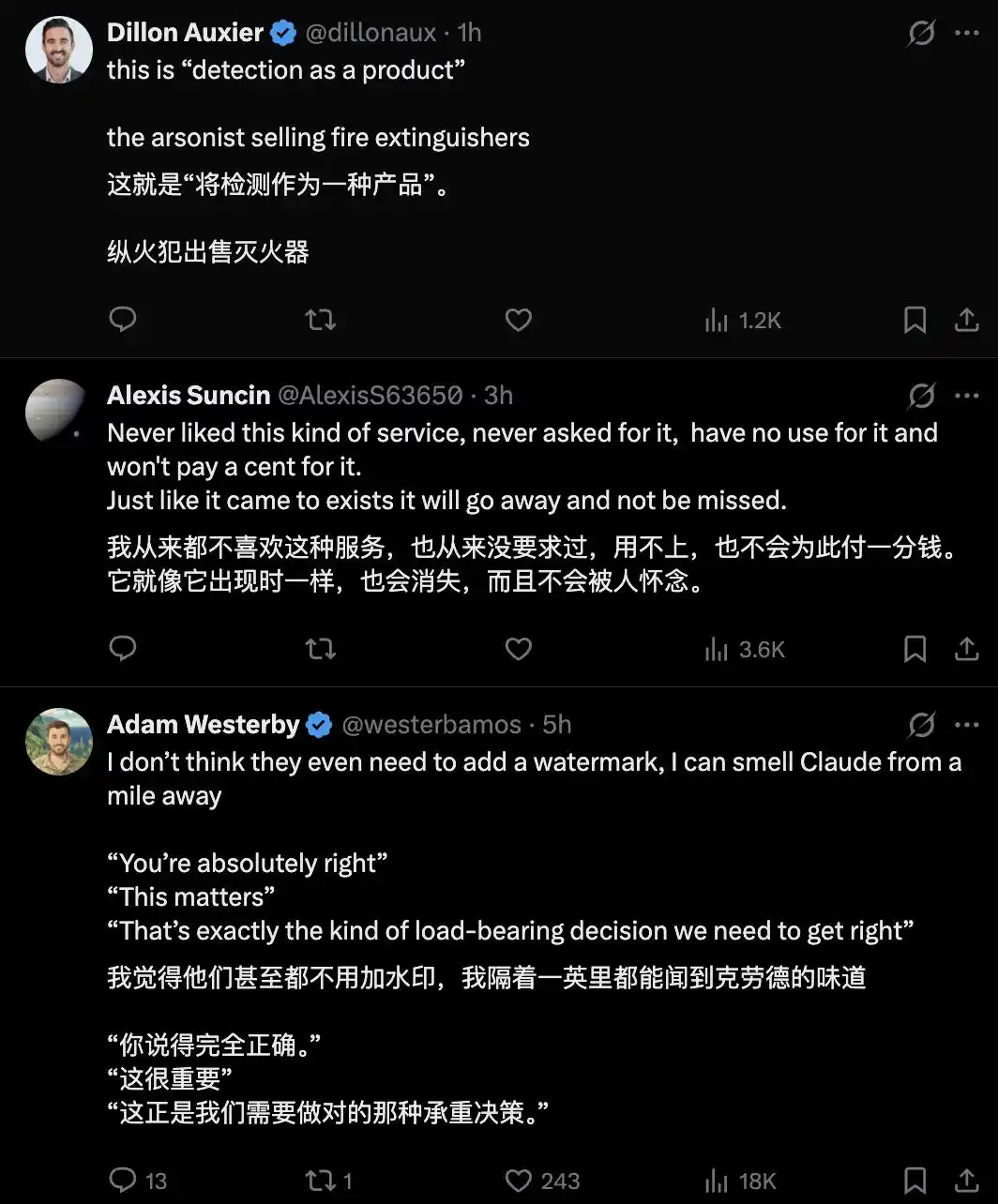
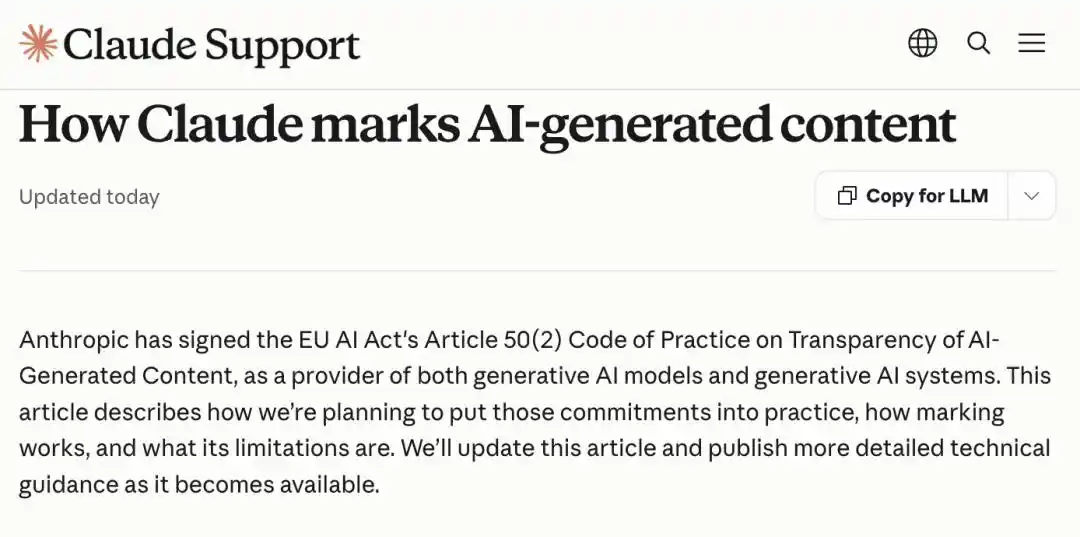
The direct driver of this move is the EU's AI Act, which Anthropic has signed. This mechanism will apply to all models released on or after August 2, 2026.

For Claude models already online, Anthropic is also researching how to add this watermarking mechanism retroactively.

Oh, and one more thing—

This measure will be implemented globally, not limited to the EU.

The great "Watermark Era" is here.

Text Gets Watermarks Too

Recently, Anthropic signed the EU AI Act's Transparency Code of Conduct for AI-Generated Content.

This code was drafted by independent experts, evaluated by the European Commission and the AI Office, and has been signed by about 190 institutions, including Google, Meta, Microsoft, OpenAI, and others.

For Claude, this translates into two specific things.

First, text watermarking.

Supported Claude models will weave a kind of invisible marker directly into the text when generating content.

Yes, completely invisible. You can't see it, and it doesn't change the meaning, quality, or readability of the response.

What's even scarier is that it's hard to get rid of.

The watermark is part of the text, copying and pasting will carry it along, and even edited versions might not be safe.

Second, signed metadata.

When Claude generates supported file types like .svg, .png, .jpg, it will attach digitally signed provenance metadata.

This metadata follows the C2PA open standard, promoted by Adobe, OpenAI, Google, and others. It can indicate the file was processed by Claude and also detect if the file has been tampered with.

The coverage is across the entire product line. API, Claude, Claude Code, Claude Cowork, Claude Tag are all included.

Cloud customers accessing Claude via AWS, Google Cloud, Microsoft Foundry will also be subject to this.

And there are no regional exceptions; it's uniformly implemented worldwide.

Meanwhile, Anthropic stated it is developing detection tools, allowing users and third parties to check whether a piece of text or a file carries the Claude marker.

Detailed technical documentation will be released by the company later.

However, Anthropic also explicitly noted the limitations of this mechanism.

Detecting a mark only indicates the content was processed by Claude, it does not confirm Claude as the original author.

After all, users often use Claude for proofreading, translation, summarization, format conversion—the core ideas and data may come from humans; marked content could also be modified, excerpted, or mixed with other materials afterward.

Conversely, not detecting a mark doesn't mean the content definitely wasn't AI-generated.

It might come from an older model, be heavily edited or rewritten, the paragraph might be too short to identify, or metadata might be stripped due to format conversion or screenshots...

Basically, everyone is under suspicion now...

As of now, Anthropic has not disclosed details of the watermarking algorithm.

In other words, no one knows what the "invisible ink" looks like, or what else Company A might be able to do with it.

Company A's Labeling Tactics

So, is there really such magic that makes watermarks in text completely invisible?

Yes.

And the tricks might be more numerous than you think.

The most famous is something called Unicode.

You can think of it as issuing ID cards to almost every character and symbol in the world: 'A' corresponds to one Unicode number, '中' (Chinese) corresponds to one Unicode number, even '🙂' corresponds to one Unicode number.

But beyond that, there exists a set of characters that are basically invisible to the human eye but distinguishable by computers.

For example, the simplest "Hello"—underneath, one might be H-e-l-l-o, and another might be H-e-invisible character-l-l-o.

They look completely identical to the human eye, but when a program reads the Unicode code points, it can find that the second string has an extra special character.

Amazing.

I wonder if everyone remembers, Company A had already "gracefully followed the trend" and used the Unicode trick before.

On June 30th, a Reddit user discovered a shocking truth after reverse-engineering Claude Code—

Claude Code's packaged files contained a set of Trojan-like code. If it detected you were a Chinese user, it would add two strokes of invisible ink to your system prompt—'Today's date is 2026-06-30'.

1. Changing the date format hyphens to slashes, marking a hit for the Chinese timezone.

2. The single quote in 'Today's' was quietly replaced with three characters that have different Unicode code points but are visually identical.

The result? In any editor, any terminal, this line looks exactly the same as the normal version. But in the program, you are already tagged.

Yes, Company A has been using Unicode to secretly tag users in Claude Code.

The company has not revealed whether the new Claude watermark uses this approach.

Looking at it this way, text watermarks might not be so bad, right? At least you won't get your account banned...

Moreover, various AI detection tools are of mixed quality, often charging dozens per detection and giving an AI-generated probability number with no logical basis. Having an official labeling channel could at least save a lot of wasted money.

The main reason for everyone's anger is Company A's history of similar actions.

But thinking carefully, AIGC content does need a reliable detection system, just like OpenAI adding C2PA metadata and SynthID watermarks to images.

However, does embedding watermarks by restricting the model's sampling distribution really not affect generation quality?

Company A's statement is—

No, it doesn't.

I remain skeptical.

After all, since version 4.6, Claude has been increasingly incomprehensible.

One More Thing

Regardless, the "Avengers Alliance" against Anthropic has already begun to act!

YC founder Paul Graham has already hatched a new startup idea, just waiting for aspiring individuals to join!

Create a third-party regeneration function, rephrase the text, preserving the original meaning while removing the watermark.
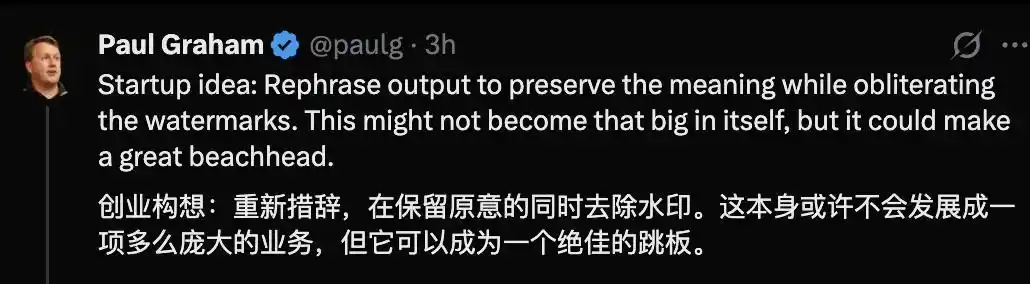
Of course, a more lightweight solution, usable by everyone right now, has also emerged—

Kimi, remove that invisible watermark.

Reference Links:

[1]https://support.claude.com/en/articles/16266773-how-claude-marks-ai-generated-content

[2]https://x.com/atharvabuilds/status/2086920300441268579?s=20

This article is from the WeChat public account "QbitAI", author: Jay

Tiền kỹ thuật số thịnh hành

Câu hỏi Liên quan

QWhat is the main content of the EU's AI Act that Anthropic has signed, as mentioned in the article?

AThe main content is the 'AI-Generated Content Transparency Code of Conduct,' which requires the embedding of invisible watermarks into generated text and adding signed metadata to supported file types like .svg, .png, and .jpg, in compliance with the C2PA open standard.

QAccording to the article, what are the two specific measures Claude will implement regarding content marking?

AThe two measures are: 1) Embedding invisible, non-removable watermarks directly into the generated text itself. 2) Adding digitally signed provenance metadata to supported file types such as .svg, .png, and .jpg.

QWhat is one limitation of the watermarking and metadata system as acknowledged by Anthropic?

AA key limitation is that detecting a mark only proves the content was processed by Claude, but does not confirm Claude as the original author. Conversely, the absence of a mark does not guarantee the content is human-generated, as it could come from an older model, be heavily edited, or have metadata stripped during format conversion.

QWhat technique from the article's past example did Anthropic allegedly use to covertly mark content for Chinese users?

AIt allegedly used Unicode characters—specifically, changing date format hyphens to slashes and replacing a standard apostrophe in "Today's" with three visually identical but different Unicode code points—to invisibly tag content generated for users in the China timezone.

QWhat are two potential user reactions or solutions mentioned in the article regarding the new watermarking policy?

ATwo reactions/solutions mentioned are: 1) A startup idea from YC founder Paul Graham to create a third-party service that rephrases content to remove watermarks while preserving meaning. 2) A suggested immediate workaround of using another AI (like Kimi) with the prompt 'Remove that invisible watermark.'

Nội dung Liên quan

Lưu ý: Dự kiến sẽ có đợt mở khóa token lớn ở 16 đồng altcoin! Đây là danh sách chi tiết từng ngày và từng giờ

Tuần này, thị trường tiền điện tử đã trải qua một đợt tăng giá đáng mong đợi. Bitcoin đã tăng 22%, trong khi các altcoin như Ethereum và XRP cũng tăng trưởng ấn tượng, lần lượt là 30% và 51%. Động lực chính đến từ quyết định của Bộ Tài chính Mỹ về việc tăng mua lại trái phiếu. Tuy nhiên, một sự kiện quan trọng sắp diễn ra là đợi mở khóa token lớn của 16 altcoin, có thể tạo áp lực bán. Lịch trình mở khóa cụ thể như sau (theo giờ Thổ Nhĩ Kỳ, UTC+3): * **Ngày 25/8:** Plasma (XPL), Humanity (H), ChainOpera AI (COAI), Perle Labs (PRL), Iris (IRYS), OVERTAKE (TAKE). * **Ngày 26/8:** GateToken (GT), Huma Finance (HUMA), Sahara AI (SAHARA). * **Ngày 27/8:** AEON (AEON). * **Ngày 28/8:** Grass, Corn, Sign. * **Ngày 29/8:** Falcon Finance (FF), Midnight (NIGHT). * **Ngày 30/8:** BSquared Network (B2). Một số dự án có tỷ lệ mở khóa đáng chú ý so với vốn hóa thị trường là Humanity (H) 14,71%, Huma Finance (HUMA) 26,47% và AEON 26,11%. Sự kiện này cần được các nhà đầu tư theo dõi sát sao do tiềm ẩn tác động đến thanh khoản và giá. *Lưu ý: Đây không phải là lời khuyên đầu tư.

cryptonews.ru4 giờ trước

Lưu ý: Dự kiến sẽ có đợt mở khóa token lớn ở 16 đồng altcoin! Đây là danh sách chi tiết từng ngày và từng giờ

cryptonews.ru4 giờ trước

Tại sao các trang trại tiền điện tử ở Georgia trở thành chủ đề tranh cãi về hệ thống năng lượng

Bài viết thảo luận về những tranh cãi xoay quanh các trang trại khai thác tiền điện tử (cryptocurrency) ở Georgia, dựa trên tuyên bố của chính trị gia đối lập Roman Gotsiridze. Ông chỉ trích rằng các trang trại này tạo ra gánh nặng nguy hiểm cho lưới điện quốc gia, gần như không đóng góp gì cho ngân sách nhà nước và chỉ tồn tại được nhờ các đặc quyền về thuế cùng giá điện. Gotsiridze nhấn mạnh rằng hoạt động khai thác tiền điện tử không phải là vấn đề nếu kinh doanh công bằng, nhưng tại Georgia, ngành này được hưởng ưu đãi bất thường. Ông ước tính các trang trại này tiêu thụ khoảng 6% tổng sản lượng điện, tương đương 1 tỷ kWh mỗi năm – ngang với mức tiêu thụ của thành phố Batumi – trong khi đóng góp tài chính rất ít. Ông còn cho rằng hoạt động liên tục, 24/7 của chúng gây áp lực lớn, dẫn đến các sự cố lưới điện thường xuyên. Bài viết cũng đề cập đến bối cảnh chính trị, với cáo buộc của Gotsiridze rằng các trang trại lớn có liên hệ với giới tinh hoa trong đảng cầm quyền. Cuối cùng, ông kêu gọi cấm hoàn toàn việc khai thác tiền điện tử trong các khu công nghiệp tự do, thay vì chỉ điều chỉnh các điều kiện ưu đãi. Cuộc tranh luận này phản ánh mối quan tâm chung trên toàn cầu về tác động năng lượng của ngành công nghiệp tiền điện tử.

cryptonews.ru4 giờ trước

Tại sao các trang trại tiền điện tử ở Georgia trở thành chủ đề tranh cãi về hệ thống năng lượng

cryptonews.ru4 giờ trước

Nghiên cứu của Fed: Động lực của nhà đầu tư tiền điện tử là niềm tin, lợi nhuận thay đổi quyết định của họ

Một nghiên cứu mới từ Cục Dự trữ Liên bang Cleveland (Mỹ) phát hiện rằng niềm tin cá nhân về lợi nhuận tương lai, chứ không phải đặc điểm nhân khẩu học, là yếu tố chính thúc đẩy các nhà đầu tư mua tiền mã hóa. Người sở hữu tiền mã hóa kỳ vọng lợi nhuận trung bình 22% trong năm tới, cao hơn nhiều so với mức 7% của người không sở hữu, và họ cũng đánh giá tài sản này ít rủi ro hơn. Đáng chú ý, một thử nghiệm ngẫu nhiên cho thấy việc cung cấp thông tin về hiệu suất lợi nhuận trong quá khứ của Bitcoin có thể làm tăng đáng kể mong muốn sở hữu và dẫn đến các giao dịch mua thực tế sau đó, đặc biệt là ở những người trước đây thiếu thông tin. Điều này gợi ý một cơ chế hình thành bong bóng đầu cơ: lợi nhuận tích cực thu hút người mới, đẩy giá lên và lại thu hút thêm nhiều người tham gia. Nghiên cứu cũng chỉ ra rằng sự gia tăng giá trị tiền mã hóa có xu hướng được chi tiêu cho các mặt hàng lâu bền, giống như "tiền thắng cược" hơn là sự gia tăng tài sản vĩnh viễn. Kết luận chung cho thấy sự thiếu hiểu biết chung, quan điểm khác biệt rõ rệt và tác động của thông tin lợi nhuận quá khứ lên hành vi có thể là nguyên nhân khiến biến động giá vẫn là đặc điểm nổi bật của thị trường tiền mã hóa.

cryptonews.ru4 giờ trước

Nghiên cứu của Fed: Động lực của nhà đầu tư tiền điện tử là niềm tin, lợi nhuận thay đổi quyết định của họ

cryptonews.ru4 giờ trước

Giao dịch

Giao ngay

Bài viết Nổi bật

Làm thế nào để Mua MOVE

Chào mừng bạn đến với HTX.com! Chúng tôi đã làm cho mua Movement (MOVE) trở nên đơn giản và thuận tiện. Làm theo hướng dẫn từng bước của chúng tôi để bắt đầu hành trình tiền kỹ thuật số của bạn.Bước 1: Tạo Tài khoản HTX của BạnSử dụng email hoặc số điện thoại của bạn để đăng ký tài khoản miễn phí trên HTX. Trải nghiệm hành trình đăng ký không rắc rối và mở khóa tất cả tính năng. Nhận Tài khoản của tôiBước 2: Truy cập Mua Crypto và Chọn Phương thức Thanh toán của BạnThẻ Tín dụng/Ghi nợ: Sử dụng Visa hoặc Mastercard của bạn để mua Movement (MOVE) ngay lập tức.Số dư: Sử dụng tiền từ số dư tài khoản HTX của bạn để giao dịch liền mạch.Bên thứ ba: Chúng tôi đã thêm những phương thức thanh toán phổ biến như Google Pay và Apple Pay để nâng cao sự tiện lợi.P2P: Giao dịch trực tiếp với người dùng khác trên HTX.Thị trường mua bán phi tập trung (OTC): Chúng tôi cung cấp những dịch vụ được thiết kế riêng và tỷ giá hối đoái cạnh tranh cho nhà giao dịch.Bước 3: Lưu trữ Movement (MOVE) của BạnSau khi mua Movement (MOVE), lưu trữ trong tài khoản HTX của bạn. Ngoài ra, bạn có thể gửi đi nơi khác qua chuyển khoản blockchain hoặc sử dụng để giao dịch những tiền kỹ thuật số khác.Bước 4: Giao dịch Movement (MOVE)Giao dịch Movement (MOVE) dễ dàng trên thị trường giao ngay của HTX. Chỉ cần truy cập vào tài khoản của bạn, chọn cặp giao dịch, thực hiện giao dịch và theo dõi trong thời gian thực. Chúng tôi cung cấp trải nghiệm thân thiện với người dùng cho cả người mới bắt đầu và người giao dịch dày dạn kinh nghiệm.

Tổng lượt xem 1.1kXuất bản vào 2024.12.13Cập nhật vào 2026.08.21

Làm thế nào để Mua MOVE

Thảo luận

Chào mừng đến với Cộng đồng HTX. Tại đây, bạn có thể được thông báo về những phát triển nền tảng mới nhất và có quyền truy cập vào thông tin chuyên sâu về thị trường. Ý kiến ​​của người dùng về giá của MOVE (MOVE) được trình bày dưới đây.

活动图片