Building a Cross-AI Large Model "Privacy Memory Layer", ZetaChain Shapes New AI Experience with Multi-Model Aggregation Application Anuma

marsbitXuất bản vào 2026-01-29Cập nhật gần nhất vào 2026-01-29

Tóm tắt

ZetaChain has launched its 2.0 upgrade, introducing a privacy-focused "Private Memory Layer" designed to unify AI interactions across multiple models. This layer allows users to retain, encrypt, and carry over conversation context seamlessly between different AI platforms, such as ChatGPT and Claude, without losing history or compromising privacy. Accompanying the upgrade is Anuma, a multi-model AI application currently in private beta, which leverages ZetaChain’s decentralized infrastructure to offer end-to-end encrypted, user-controlled conversations. By combining blockchain-based security with AI interoperability, ZetaChain aims to solve issues of data fragmentation and centralization in current generative AI services, offering users greater control, continuity, and privacy.

Author: Zen, PANews

In today's generative AI applications, users often face a fragmented conversational experience. When switching between different models, the context of previous conversations often cannot be continued, forcing users to start over and repeat information each time. For example, details of a project discussed on ChatGPT cannot be directly inherited when switching to Claude or other models, severely impacting efficiency.

Moreover, the conversational data from these large models is typically stored on the platforms' servers, leaving users with little privacy protection and control over their own data. "These real-world issues not only create a disjointed user experience but also raise concerns about user data sovereignty and security.

Addressing this pain point, the industry has begun exploring the concept of a "migratable, user-controlled memory layer," and blockchain technology may be the key to achieving this goal.

Leveraging the open interoperability of blockchain, it might be possible to create a privacy memory layer that saves AI context as a digital asset, allowing seamless transfer across multiple AI platforms. This would eliminate the worry of "forgetting" past interactions every time a tool is changed, while ensuring data privacy and sovereignty.

ZetaChain 2.0 Released, Building a Universal Layer for AI and Web3

Addressing the above needs, ZetaChain, a public chain project focused on cross-chain interoperability, seized the opportunity presented by the convergence of AI and Web3. In its roadmap review at the end of 2025, ZetaChain announced its "2.0" version plan, introducing new features for the AI era on top of its existing universal cross-chain architecture.
On January 27, 2026, ZetaChain 2.0 officially launched, alongside its first AI product—Anuma, a privacy-centric large model aggregation application. According to official introductions, ZetaChain 2.0 revolves around the following three core capabilities:

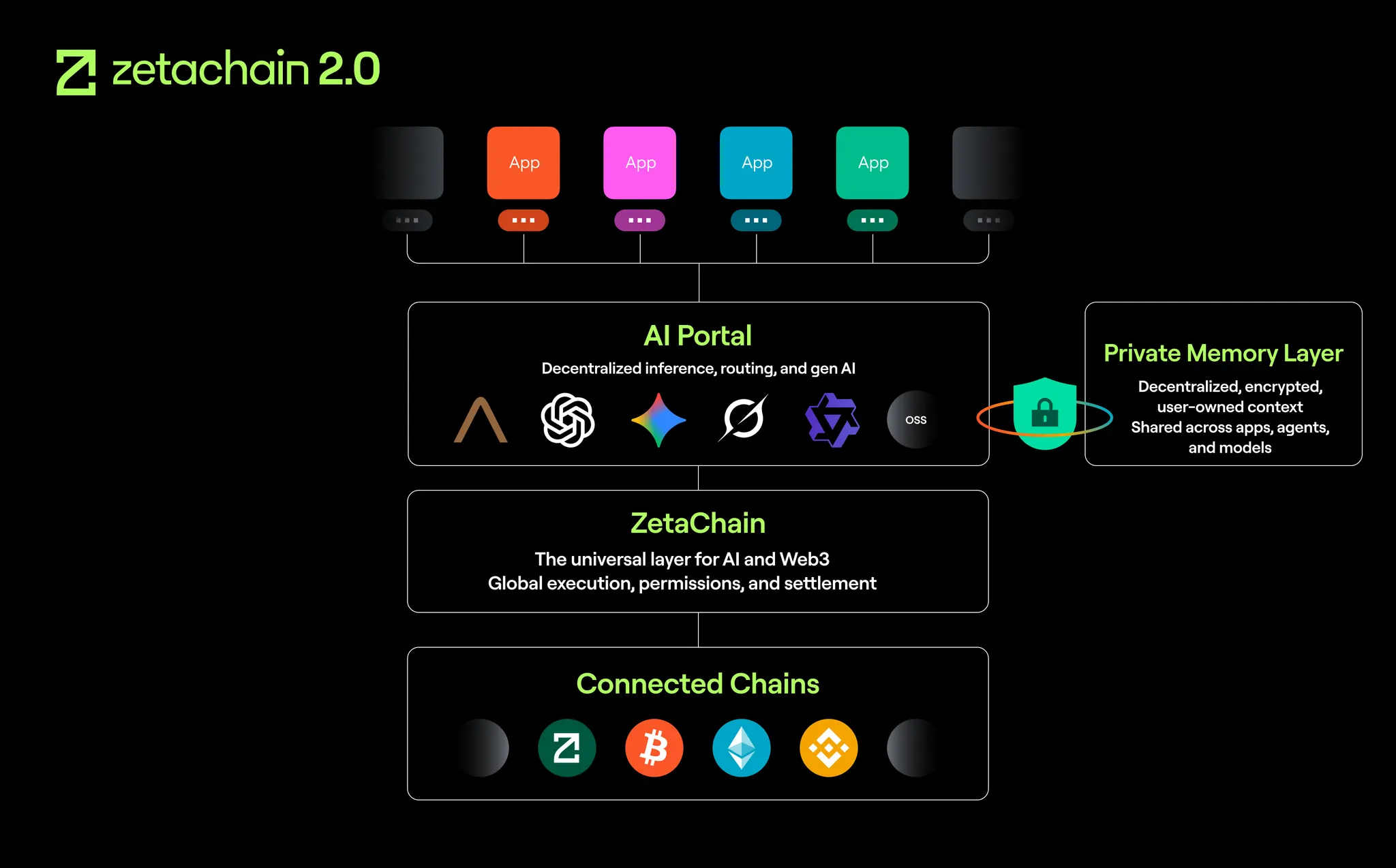
Private Memory Layer is a protocol-level memory system specifically designed for AI interactions, aiming to bridge the contextual gap between AI tools, turning users' digital memories into assets they truly control. Based on the privacy memory layer, all user conversation content is stored encrypted, with only the user holding the key; even the platform itself cannot view it. Valuable information generated across different models and at different times will be controlled by the user, allowing for continuous accumulation and随时 migration to new conversations, without being monopolized by any single AI service.

AI Portal is a unified routing and execution layer, enabling applications to access multiple AI model providers without being locked in, with built-in support for availability, fallback, and cost/performance optimization. The AI Portal handles the underlying model routing and context bridging. Users can freely choose different models like ChatGPT, Anthropic Claude, Google Gemini, etc., to get answers, with previous conversational memories supported by the privacy memory layer.

Beyond the protocol itself, ZetaChain 2.0 also packages its key capabilities into a Software Development Kit (SDK). Developers can directly integrate privacy-persistent memory, cross-model switching, and monetization components into their products. This SDK allows applications or AI Agents to maintain continuous context across different models and call upon different model capabilities on demand, significantly reducing the cost and complexity for teams to build their own infrastructure.

In terms of mechanism design, the three core modules complement each other. The Private Memory Layer provides privacy-first user memory and data support, the AI Portal enables continuous interaction across mainstream large models, and the SDK ecosystem facilitates efficient and rapid participation and expansion by third-party developers. This also allows ZetaChain to expand from a底层 cross-chain protocol to a universal platform serving both Web3 and AI.

Focusing on Privacy and User Sovereignty, Anuma Launches and Opens Applications

Alongside the official launch of ZetaChain 2.0, the project team's other highlight is its first consumer-grade AI product on the platform, Anuma. Currently, Anuma is in a private beta phase, gradually opening up trial access through an invitation-based waitlist; users can apply for early access via the public waitlist.

As a large model aggregation application, Anuma integrates with multiple mainstream large models, allowing users to invoke different AI engines within a single conversation. It offers the convenience of聚合 tools like Poe, while supporting models such as OpenAI's GPT series and Anthropic's Claude.

When a user asks a question, they can specify or change the model used for the response. Switching between engines requires just a click, without needing to migrate to another application. Users can flexibly choose the most suitable model on Anuma to get answers based on the question type, while the entire conversation process continues seamlessly in the same window.

Technically, thanks to ZetaChain's Private Memory Layer, every segment of a user's conversation in Anuma is encrypted and stored as personal memory, seamlessly migrating to new models or new sessions. When a user starts a new conversation or switches AI models within an existing conversation, Anuma can securely inject the relevant context into the target model, enabling it to understand the prior background and user intent. This eliminates the need for users to repeat the same background information across different AIs, greatly improving the efficiency of cross-model collaboration.
Traditional Web2 enterprises exploiting their centralized advantage to misuse user data has long been deeply resented. Practices like platform-based price discrimination and data selling are repeatedly prohibited yet persist. This user vigilance and concern towards centralized platforms has also extended to the rapidly developing AI field.

Anuma places great emphasis on the confidentiality of conversation content and user sovereignty. The entire platform employs an end-to-end encryption scheme to protect user data. From the moment a user inputs a message on the front end, the content is encrypted using the user's key before being passed to the privacy memory layer for storage. When context needs to be provided to an AI model, it is decrypted by the user's client or a trusted execution environment before being sent to the model. Throughout this process, conversation records are always stored on-chain or in transit in ciphertext form; even ZetaChain's nodes or servers cannot窥视 the content.

This stands in stark contrast to traditional AI chat services, where chat logs are typically stored in plain text on servers, posing risks of being viewed by operators or leaked. Anuma, through blockchain and encryption technology, achieves a level of security similar to Web3 wallet private key management—only the user can interpret their data. It can provide a more reassuring choice for sensitive AI applications in fields like law and medicine, encouraging users to engage in more private exchanges.

In fact, even before Anuma's launch, there were already some multi-model aggregated AI conversation products on the market, notably Poe from the "American Quora" Quora, and TypingMind from the open-source community.

Compared to the cloud service model of these two platforms and local deployment, Anuma's on-chain encrypted storage balances privacy and sovereignty. In terms of ease of use and model richness, Anuma eliminates the cumbersome configuration process of the TypingMind model, offering direct access to the convenient multi-model conversation experience similar to Poe.

Behind the Move into AI: ZetaChain's Technical Logic and Natural Evolution

ZetaChain's decision to launch version 2.0 and Anuma at this time is backed by solid technical accumulation and a clear evolutionary logic.

As the first universal L1 blockchain project, ZetaChain has focused on solving the fragmentation problem in the blockchain领域 since its launch in 2021,致力于 building an underlying network connecting all public chains. Built based on Cosmos SDK, it natively supports interoperability with heterogeneous chains like Ethereum, Bitcoin, and Cosmos.

Through innovations like CAF, ZetaChain simplifies traditional cross-chain operations that require bridges and wrapping into a single contract call on one chain, providing users with unified liquidity and user experience. By the end of 2025, the ZetaChain mainnet had integrated ten major mainstream blockchain networks, including Bitcoin, covering tens of millions of users, with累计 on-chain transactions reaching 225 million.

At the ecosystem and capital level, ZetaChain has also gained broad recognition. According to public data, the project raised $27 million in funding from知名 institutions including Blockchain.com, Jane Street, and Sky9 Capital. In 2024-2025, global tech and infrastructure giants like Google Cloud, Deutsche Telekom, and Alibaba Cloud successively joined the network as validator nodes, endorsing its security and compliance.

Entering the second half of 2025, with the explosion of generative AI, the ZetaChain team keenly realized that the industry's multi-chain ecosystem and multi-model AI actually share similar pain points—both involve fragmentation across multiple platforms and systems, requiring a universal layer for integration. Thus, they proposed the strategic concept of an "AI Universal Platform," introducing blockchain's trusted computing and storage into the AI field to build blockchain infrastructure for the AI era.

ZetaChain 2.0 is the realization of this vision. It retains and strengthens the original cross-chain functions while adding new AI privacy memory and interaction capabilities. This aligns with ZetaChain's consistent vision of making Web3 friendly to both humans and AI. The natural evolution from a "Universal Blockchain" to an "AI Universal Platform" is both顺应 the trend of technological convergence and an extension of the project's mission.

"ZetaChain has already achieved scaled unification at the blockchain experience level." As Ankur Nandwani, a core contributor to ZetaChain, stated, "ZetaChain 2.0 extends the same approach to AI, enabling the next generation of applications and Agents to operate between models and blockchains,默认 equipped with private, authorizable memory capabilities and global monetization channels."

New Paradigm of Deep Integration of Blockchain and AI, What are the Prospects?

The launch of ZetaChain 2.0 and its debut product Anuma represents a significant attempt at the deep integration of blockchain and AI. Within this system, we see a new paradigm for multi-model AI applications: privacy-first, user-controlled, cross-platform portability.

Of course, it must be objectively noted that Anuma is currently in a very early Private Beta stage, and the overall ecosystem is also in its initial construction phase. Many features and details await feedback from广大 testers for refinement, such as support for more models, optimization of memory layer capacity and performance, and enrichment of third-party developer tools. This means that in the short term, Anuma is far from replacing the experience of mature individual platforms, and some users will need time to adapt to this new interaction mode.

However, it cannot be ignored that the direction represented by Anuma is pioneering. In the track of multi-model aggregation experience, Anuma offers a different approach from the solutions of large companies. Instead of monopolizing data and model invocation rights by a centralized platform, it returns choice and memory to the user, achieving trust-minimized coordination through blockchain technology.

As Anuma's public beta opens and features iterate, perhaps more innovative applications will emerge on this platform, such as privacy-guaranteed AI advisors, cross-domain intelligent search assistants, and so on. How far this new trend of privacy-first multi-model experience can go remains to be tested by time.


Tiền kỹ thuật số thịnh hành

Câu hỏi Liên quan

QWhat is the main problem that ZetaChain's Anuma application aims to solve in the AI space?

AAnuma addresses the fragmented user experience where switching between different AI models (like ChatGPT and Claude) causes loss of conversation context, requiring users to repeatedly provide the same information. It also tackles privacy concerns and lack of user control over data stored on centralized platforms.

QWhat are the three core capabilities introduced in ZetaChain 2.0 to support AI integration?

AThe three core capabilities are: 1) Private Memory Layer - a protocol-level memory system for encrypted, user-controlled storage of AI conversation context; 2) AI Portal - a unified routing and execution layer for accessing multiple AI models without platform lock-in; 3) SDK - a developer toolkit for integrating privacy, cross-model switching, and monetization features into third-party applications.

QHow does Anuma ensure user privacy and data control compared to traditional AI chat services?

AAnuma uses end-to-end encryption where user messages are encrypted with user-held keys before storage or transmission. Conversations are stored encrypted on-chain, and only the user can decrypt them. This contrasts with traditional AI services where data is often stored in plain text on central servers, exposing it to potential viewing or leakage by operators.

QWhat technical background does ZetaChain have that supports its expansion into AI infrastructure?

AZetaChain has built a universal L1 blockchain focused on interoperability, connecting major chains like Bitcoin, Ethereum, and Cosmos. It uses innovations like CAF to simplify cross-chain operations. With over 225 million transactions and integration with 10+ blockchains by end-2025, plus backing from major investors and infrastructure providers like Google Cloud and Deutsche Telekom, it has the technical and ecosystem foundation to expand into AI as a universal layer.

QHow does Anuma differentiate itself from existing multi-model AI platforms like Poe or TypingMind?

AAnuma combines the convenience of multi-model aggregation (like Poe) with blockchain-based encrypted storage for privacy and user sovereignty. Unlike Poe's cloud service model, Anuma gives users control over their data through encryption. Compared to locally-deployed solutions like TypingMind, Anuma offers easier setup without complex configurations while maintaining similar multi-model flexibility.

Nội dung Liên quan

Dự đoán giá TON/GRAM – Thông báo ra mắt ví Gram của Telegram đẩy giá token tăng: Đợt tăng giá có thể tiếp tục?

Người sáng lập Telegram, Pavel Durov, đã công bố kế hoạch triển khai ví tiền mã hóa Gram không giám sát (non-custodial) bản địa trên tất cả các ứng dụng Telegram. Ông mô tả đây là "đợt ra mắt ví tiền mã hóa không giám sát lớn nhất trong lịch sử nhân loại", hứa hẹn giao dịch tức thì, miễn phí cho hơn một tỷ người dùng. Sau thông báo này, giá token TON (sắp được đổi tên thành GRAM) đã tăng hơn 7%, giao dịch quanh mức 1,53 USD. Tuy nhiên, đồng tiền này vẫn đối mặt với kháng cự quanh 1,60 USD và còn thấp hơn nhiều so với đỉnh tháng 5 (gần 2,80 USD), cho thấy xu hướng giảm tổng thể vẫn chưa đảo ngược. Chỉ số RSI hàng ngày ở khoảng 45 cho thấy động lực giảm đã giảm bớt nhưng vẫn trong vùng yếu. Việc triển khai ví Gram có thể giảm đáng kể rào cản sử dụng tiền mã hóa, đưa thanh toán blockchain vào trực tiếp một nền tảng nhắn tin hàng đầu. Thành công sẽ phụ thuộc vào mức độ tương tác của người dùng, nhưng quy mô người dùng hiện có của Telegram hứa hẹn một trong những đợt triển khai tiền mã hóa hướng đến người tiêu dùng lớn nhất từ trước đến nay.

ambcrypto14 phút trước

Dự đoán giá TON/GRAM – Thông báo ra mắt ví Gram của Telegram đẩy giá token tăng: Đợt tăng giá có thể tiếp tục?

ambcrypto14 phút trước

Làm thế nào 40.8 triệu ETH được stake có thể củng cố ưu thế của Ethereum so với Bitcoin

Hai con cá voi lớn đã tích lũy lần lượt hơn 74.000 ETH và 10.000 ETH, và đặc biệt, họ đã khóa 100% số ETH này vào staking ngay lập tức. Đây không phải là sự kiện riêng lẻ, mà phản ánh một xu hướng rộng lớn hơn: lượng ETH được staking đã đạt kỷ lục 40,8 triệu ETH, tương đương 33,5% tổng nguồn cung. Hàng đợi validator mới đang tăng lên 2,4 triệu ETH, trong khi hàng đợi rút về bằng 0, cho thấy nhu cầu staking mạnh mẽ và làm thắt chặt nguồn cung ETH lưu hành. Song song đó, hệ sinh thái DeFi của Ethereum cũng đang ghi nhận sự gia tăng mạnh mẽ về hoạt động. Số giao dịch cá voi lớn hơn 100.000 USD liên quan đến Wrapped Ethereum (WETH) đạt mức cao nhất kể từ tháng 5/2021, và tổng giá trị bị khóa (TVL) tăng hơn 5 tỷ USD trong chưa đầy mười ngày. Tác động kép từ việc thắt chặt nguồn cung nhờ staking và thanh khoản tăng trong DeFi đang bắt đầu thể hiện trên biểu đồ kỹ thuật. Tỷ lệ ETH/BTC đã phá vỡ mức kháng cự 0,025 và đang tiến gần đến vùng kháng cự quan trọng tiếp theo quanh 0,03, thiết lập nền tảng cho đợt tăng giá vượt trội tiếp theo của Ethereum so với Bitcoin.

ambcrypto46 phút trước

Làm thế nào 40.8 triệu ETH được stake có thể củng cố ưu thế của Ethereum so với Bitcoin

ambcrypto46 phút trước

Điểm bão trong thị trường chứng khoán toàn cầu: Việc giảm đòn bẩy của thị trường chứng khoán Hàn Quốc về cơ bản đã hoàn tất

Thị trường chứng khoán Hàn Quốc gần đây trải qua biến động mạnh, với chỉ số KOSPI giảm tới 32% từ mức đỉnh. Nguyên nhân chính được xác định là cơ cấu vốn vay (leverage) tập trung cao, đặc biệt là từ các quỹ ETF có đòn bẩy và các quỹ phòng hộ. Quy mô của các quỹ ETF có đòn bẩy đã giảm từ khoảng 500 tỷ USD xuống còn 260 tỷ USD, với tiến trình giảm đòn bẩy ước tính đạt khoảng 75%. Song song đó, các quỹ phòng hộ cũng đã giảm đòn bẩy hơn 50%. Trong khi đó, rủi ro từ khoản vay ký quỹ của nhà đầu tư cá nhân được đánh giá là có hạn, chiếm tỷ trọng nhỏ trong tổng vốn hóa thị trường và không có cơ chế bán ép tự động như ETF. Các nhà chức trách Hàn Quốc đã bắt đầu siết chặt quy định đối với các sản phẩm đòn bẩy để ngăn chặn rủi ro hệ thống. Với phần lớn quá trình giảm đòn bẩy cưỡng bức đã hoàn thành, thị trường được kỳ vọng sẽ chuyển từ giai đoạn điều chỉnh do thanh khoản sang định giá dựa trên cơ bản. Bài viết nhấn mạnh rằng xu hướng AI cơ bản vẫn không thay đổi, và sự điều chỉnh này giống như một đợt thanh lọc sau khi giao dịch quá mua hơn là sự kết thúc của làn sóng AI. Sự bất ổn chủ yếu bắt nguồn từ vị thế tập trung vào lĩnh vực chip bán dẫn - trung tâm của chuỗi cung ứng AI. Tác giả kết luận rằng nếu xu hướng AI là đúng đắn, thì những biến động hiện tại chỉ là chi phí phải trả trên con đường dài, tạo cơ hội để tham gia vào một cuộc cách mạng công nghệ mang tính thời đại.

链捕手55 phút trước

Điểm bão trong thị trường chứng khoán toàn cầu: Việc giảm đòn bẩy của thị trường chứng khoán Hàn Quốc về cơ bản đã hoàn tất

链捕手55 phút trước

92,9% token tiền điện tử ra mắt từ năm 2024 giao dịch dưới giá lúc TGE: CryptoRank

Theo dữ liệu mới từ CryptoRank, gần 93% token tiền điện tử được ra mắt từ năm 2024 hiện đang giao dịch dưới mức giá tại thời điểm phát hành token (TGE), cho thấy những thách thức lớn mà các dự án mới phải đối mặt trong việc duy trì định giá ban đầu. Nghiên cứu tập trung vào các token có vốn hóa thị trường trên 100 triệu USD, được ra mắt từ 2024 đến 2026. Kết quả cho thấy chỉ 7,1% (8/113 dự án) vẫn giao dịch trên giá TGE, trong khi 92,9% (105 dự án) đã giảm xuống dưới mức này. Lợi nhuận trung bình của toàn bộ mẫu là -95,7%. Một số ít dự án thành công nổi bật bao gồm Hyperliquid (HYPE) tăng 1.519%, Ondo Finance (ONDO) tăng 101,4%, EverValue Coin (EVA) tăng 20,32% và Midnight Network (NIGHT) tăng 16,50%. Phát hiện này phản ánh thị trường ngày càng trở nên kén chọn. Vốn tập trung vào nhóm nhỏ các dự án chứng minh được sự tăng trưởng sản phẩm, hệ sinh thái hoặc nhu cầu thị trường mạnh mẽ. Nhà đầu tư hiện quan tâm nhiều hơn đến tokenomics, nguồn cung lưu hành, lịch mở khóa và tiện ích dài hạn thay vì chỉ đà tăng ngày ra mắt. Xu hướng này có thể ảnh hưởng đến cách các dự án trong tương lai thực hiện đợt phát hành token, với sự chú trọng hơn vào các mô hình phân phối bền vững và tăng trưởng hệ sinh thái lâu dài, thay vì định giá ban đầu quá cao.

ambcrypto1 giờ trước

92,9% token tiền điện tử ra mắt từ năm 2024 giao dịch dưới giá lúc TGE: CryptoRank

ambcrypto1 giờ trước

Mảnh Vỡ Vĩnh Hằng Của Tiền Tệ: Thanh Toán Bên Thứ Ba Không Có Tính Nguyên Lý Đầu Tiên

Tác giả phân tích tình hình ngành thanh toán hiện tại và chiến lược của Stripe. Stripe, từng đạt định giá 100 tỷ USD, đã bỏ lỡ cơ hội IPO trong đại dịch và giờ đang tìm cách mua lại PayPal để bổ sung thị phần C2C, đồng thời bù đắp cho những nỗ lực chưa thành công trong việc mở rộng sang thị trường stablecoin (qua OUSD, Tempo) và kinh tế Agent. Bài viết chỉ ra hai đặc điểm cố hữu cản trở sự thống trị của ngành: tính phân mảnh cao (theo quốc gia, ngành) và bản chất phụ thuộc vào hệ thống ngân hàng. Các sáng kiến như stablecoin hay Agent vẫn cần đi qua các cổng ngân hàng truyền thống để pháp định hóa. Để thoát khỏi cuộc chiến tranh chiến hào không hồi kết và nâng trần định giá vốn bị giới hạn ở FinTech, Stripe và các công ty tương tự (như Circle) đang chuyển hướng chiến lược. Thay vì chỉ cạnh tranh trên phí giao dịch hay phân chia lợi nhuận từ stablecoin, họ nhắm đến mạng lưới thanh toán bù trừ (clearing network) dựa trên hiệu quả vốn của các blockchain riêng (như Tempo của Stripe). Với giấy phép ngân hàng OCC, họ kỳ vọng hệ thống thanh toán bù trừ hiệu suất cao này có thể cắt giảm sự phụ thuộc vào ngân hàng thương mại và giữ lại lợi nhuận. Tóm lại, tương lai của các công ty thanh toán không nằm ở việc trở thành "cổng vào" duy nhất, mà ở các dịch vụ gia tăng như mạng lưới thanh toán bù trừ dựa trên công nghệ mới, với kỳ vọng Agent và stablecoin sẽ là chất xúc tác cho sự chuyển đổi này.

链捕手1 giờ trước

Mảnh Vỡ Vĩnh Hằng Của Tiền Tệ: Thanh Toán Bên Thứ Ba Không Có Tính Nguyên Lý Đầu Tiên

链捕手1 giờ trước

Giao dịch

Giao ngay

Bài viết Nổi bật

Làm thế nào để Mua LAYER

Chào mừng bạn đến với HTX.com! Chúng tôi đã làm cho mua Solayer (LAYER) trở nên đơn giản và thuận tiện. Làm theo hướng dẫn từng bước của chúng tôi để bắt đầu hành trình tiền kỹ thuật số của bạn.Bước 1: Tạo Tài khoản HTX của BạnSử dụng email hoặc số điện thoại của bạn để đăng ký tài khoản miễn phí trên HTX. Trải nghiệm hành trình đăng ký không rắc rối và mở khóa tất cả tính năng. Nhận Tài khoản của tôiBước 2: Truy cập Mua Crypto và Chọn Phương thức Thanh toán của BạnThẻ Tín dụng/Ghi nợ: Sử dụng Visa hoặc Mastercard của bạn để mua Solayer (LAYER) ngay lập tức.Số dư: Sử dụng tiền từ số dư tài khoản HTX của bạn để giao dịch liền mạch.Bên thứ ba: Chúng tôi đã thêm những phương thức thanh toán phổ biến như Google Pay và Apple Pay để nâng cao sự tiện lợi.P2P: Giao dịch trực tiếp với người dùng khác trên HTX.Thị trường mua bán phi tập trung (OTC): Chúng tôi cung cấp những dịch vụ được thiết kế riêng và tỷ giá hối đoái cạnh tranh cho nhà giao dịch.Bước 3: Lưu trữ Solayer (LAYER) của BạnSau khi mua Solayer (LAYER), lưu trữ trong tài khoản HTX của bạn. Ngoài ra, bạn có thể gửi đi nơi khác qua chuyển khoản blockchain hoặc sử dụng để giao dịch những tiền kỹ thuật số khác.Bước 4: Giao dịch Solayer (LAYER)Giao dịch Solayer (LAYER) dễ dàng trên thị trường giao ngay của HTX. Chỉ cần truy cập vào tài khoản của bạn, chọn cặp giao dịch, thực hiện giao dịch và theo dõi trong thời gian thực. Chúng tôi cung cấp trải nghiệm thân thiện với người dùng cho cả người mới bắt đầu và người giao dịch dày dạn kinh nghiệm.

Tổng lượt xem 591Xuất bản vào 2025.02.11Cập nhật vào 2026.06.02

Làm thế nào để Mua LAYER

Thảo luận

Chào mừng đến với Cộng đồng HTX. Tại đây, bạn có thể được thông báo về những phát triển nền tảng mới nhất và có quyền truy cập vào thông tin chuyên sâu về thị trường. Ý kiến ​​của người dùng về giá của LAYER (LAYER) được trình bày dưới đây.

活动图片












