An AI product blocked by its own platform finally forced Tencent to play its biggest card.
On June 2nd, Tencent Holdings (HK:00700) saw its stock price surge over 10% in a single day, with its market value increasing by approximately HK$415.8 billion (around RMB 360 billion), marking its largest single-day gain since January 2021.
Driving this curve was an unconfirmed report: it was reported that Tencent is conducting final tests for an AI agent embedded in WeChat and plans to initiate the compliance review process as early as this month. Tencent declined to comment, but Citigroup maintained a "Buy" rating with a target price of HK$763. The Hang Seng Tech Index rose 4.72% on the same day, with Meituan gaining over 9%. A single rumor ignited the entire Hong Kong tech sector.
It's hard to trace the last time WeChat triggered market reactions of this magnitude due to a product move. 1.4 billion monthly active users mean any adjustment to WeChat is a big deal, but this time the market's pricing logic went beyond that. It bought into the narrative: WeChat is transforming from a platform where "users actively seek services" to a system where "AI completes tasks for users."
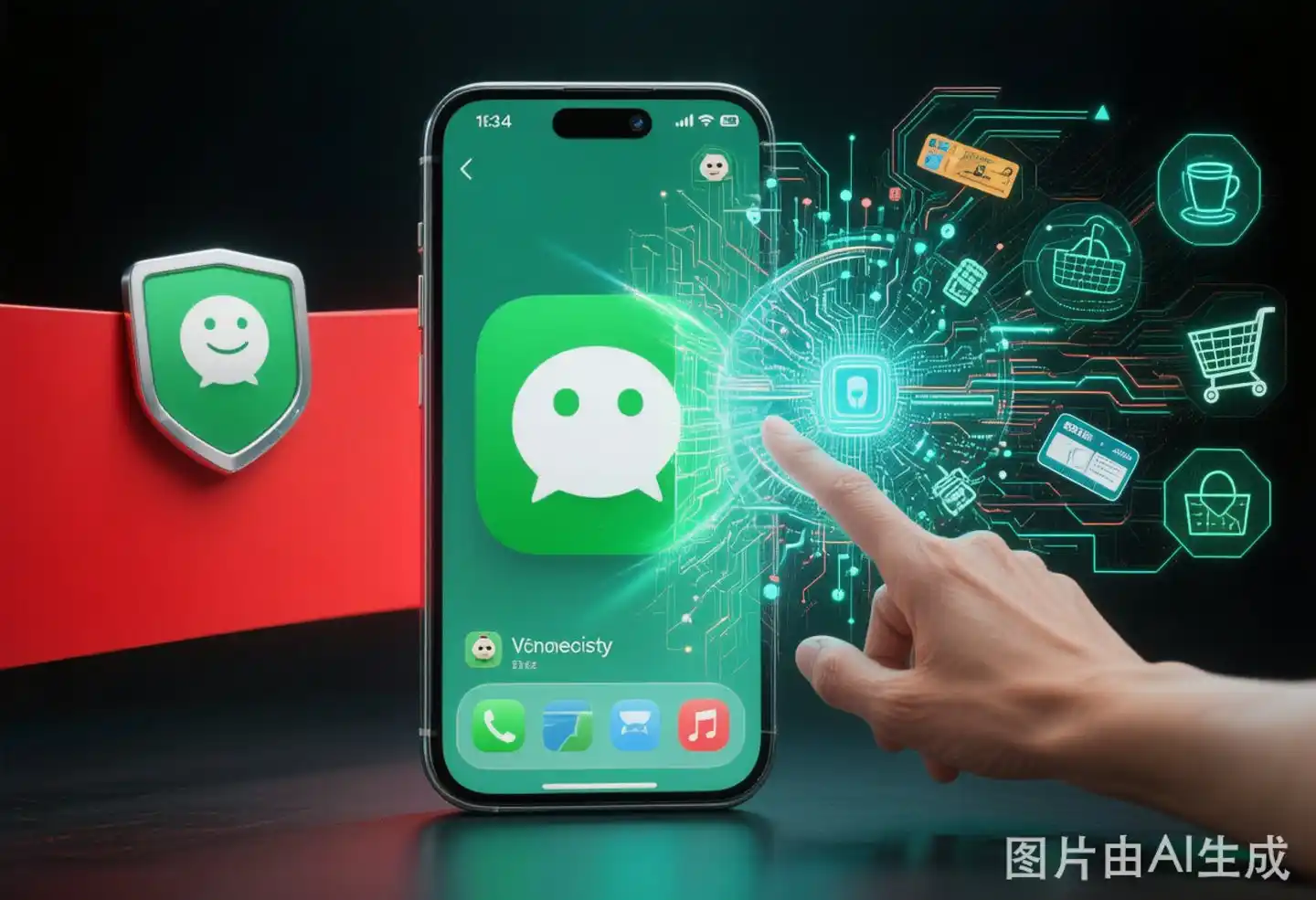
According to informed sources, the interaction entry is planned to be a swipe to the right on WeChat's main interface, bringing up an AI chat window without entering any separate app.
WeChat AI Agent's boundaries extend beyond WeChat itself. It is reported that WeChat is collaborating with smartphone manufacturers like Huawei, Honor, Xiaomi, OPPO, and vivo to launch A2A (Agent-to-Agent collaboration) capabilities. Users can initiate WeChat audio/video calls or send messages to friends directly through their phone's built-in voice assistant. Some Honor models have already implemented this: update YOYO and WeChat to the latest version, wake up YOYO, and simply give voice commands like "Send a WeChat message to Zhang San" or "Make a WeChat voice call to Li Si."
Its positioning is not just a conversational chatbot in a chat window. The system-level voice entry on smartphones combined with WeChat's ecosystem communication and Mini Program capabilities compresses multi-step operations like "Open WeChat → Find contact → Type or dial" into a single sentence.
A Forced Answer
Behind the June 2nd news lies a year and a half of strategic tug-of-war. Tencent took a detour around the question "Should AI be put into WeChat?" and was finally pushed in a direction by an unexpected event.
In May 2024, Tencent Yuanbao launched. An independent app, powered by the Hunyuan large model, following a standard C-end chatbot path. You say something, it replies. By early 2026, Yuanbao's independent app had just over 40 million MAU, while Doubao had surpassed 300 million.
During the 2026 Spring Festival, Tencent conducted a high-investment social fission experiment on Yuanbao. "Go to Yuanbao, share 1 billion RMB in cash red packets," with the core mechanism being sharing Yuanbao links into WeChat groups to attract new users via social connections. For a few days, red packet links flooded WeChat Moments and group chats.
On February 4th, the first day of Yuanbao's red packet withdrawals, something went wrong. The official WeChat account "WeChatPai" issued an announcement: Upon receiving user complaints, Yuanbao's Spring Festival activities involved inducements to share, user harassment, and interference with the ecosystem's order. Accordingly, it restricted the direct opening of its links within WeChat. WeChat's public relations director Zhang Jun added on WeChat Moments: "User experience comes first, everyone is treated equally," accompanied by an emoji saying "When we go crazy, even we hit ourselves." Yuanbao was forced to switch to passcode red packets, requiring users to copy a string of text and switch back to WeChat to paste it, completely breaking the fission chain.
The blocking order came from WeChat, and the blocked party was Yuanbao. Both belong to "Tencent." This meant Yuanbao's allocated 1 billion RMB budget was still burning, but its dissemination path had been blocked by its own people.
The outside world read two meanings. Superficially, WeChat was upholding the rules, unwilling to give preferential treatment even to its own app. The deeper layer was more noteworthy: Tencent internally lacked consensus at the time on "where AI should reside." Zhang Xiaolong's WeChat wouldn't allow any external AI application to leverage its social graph, not even its own.
The blockage forced a simple question: Tencent's AI might not be suitable as a separate app outside WeChat; it might be better suited to live inside WeChat.
In the following months, preparatory actions landed intensively. In March 2026, Tencent dissolved the decade-old AI Lab, integrating its personnel into the Hunyuan system to consolidate efforts on the foundational model. In April, Hunyuan 3.0 was released with 295 billion total parameters, taking an "adequate and affordable" efficiency route, not chasing the trillion-parameter arms race. Meanwhile, Yuanbao quietly entered the WeChat chat interface in the form of a "Red Packet Cover Assistant," no longer a downloadable independent app but a contact within the WeChat dialog box. Downgraded from "external competitor" to "internal component." It wasn't until the June 2nd report that the native WeChat AI agent was in final testing that this fully surfaced.
There is a core difference between Tencent's existing AI product line and the WeChat AI Agent.
Tencent's AI product line is not thin. The Hunyuan large model serves as the underlying engine, Yuanbao as the C-end conversational entry, CodeBuddy and WorkBuddy target developers/enterprises and C-end users respectively, QClaw plus the OS-level assistant Marvis covers other scenarios.
But these products share a commonality: they excel at information and content generation within their respective domains, but their ability for cross-ecosystem coordinated execution is relatively weak. Hunyuan outputs text; Yuanbao provides text/image analysis and advice; tasks like searching information and downloading files are doable. But for tasks involving calling external services or completing transactions across apps, the chain is not yet fully connected.
Meanwhile, competitors have made varying progress on bridging "saying" and "doing."
According to QuestMobile March 2026 data, ByteDance's Doubao had 345 million MAU, capable of completing shopping orders by identifying on-screen elements to simulate user operations. Alibaba's Qianwen had about 166 million MAU, deeply integrated with e-commerce, maps, travel, and Ant Pay, allowing users to directly instruct it to buy flight tickets or book hotels. Yuanbao's product capabilities lagged noticeably. As an independent app, it also had to compete head-on with Doubao and Qianwen for user acquisition costs. With such a vast MAU gap, catching up directly might not be realistic. Tencent's way out might not lie on the independent app track.
The WeChat AI Agent is designed to bridge this mismatch. It's not a WeChat version of Yuanbao but a redesigned product. According to informed sources, the interaction entry is planned to be a swipe right on WeChat's main interface to bring up a chat window. Users issue instructions in natural language, the AI decomposes them into subtasks, automatically calls the corresponding Mini Programs, completing search, price comparison, ordering, and payment, with the entire chain closed within WeChat.
Compared to Tencent's existing AI products, if the WeChat AI Agent functions as disclosed, it effectively addresses Tencent's shortcomings in AI task completion across three levels.
From Output to Execution. Yuanbao focuses on content generation and conversational replies. If the WeChat AI assistant functions as disclosed, it will be able to directly perform practical operations like making hospital appointments, ordering food, buying tickets, and paying bills, with WeChat Pay completing the final step from intent to transaction.
From New User Acquisition to Activating Existing Users. Yuanbao relies on users downloading a brand-new app. The WeChat AI Agent naturally enjoys over 1.4 billion existing users, requiring no download, no registration, and no user education costs. This is the single largest distribution potential in China's mobile internet.
From Screen Simulation to API Calls. Doubao's approach involves GUI recognition of on-screen button positions to simulate human actions. This path already faces the risk of being blocked by some app developers and consumes significant computing resources—estimated at tens of thousands of tokens per operation. WeChat's approach is different: its millions of Mini Programs are essentially a set of standardized structured APIs; the Agent can call them directly, being orders of magnitude more efficient. Coupled with a hybrid architecture processing sensitive data on-device and large model inference in the cloud, data never leaves WeChat's security boundary.
Tencent President Martin Lau stated in the Q1 earnings call: "Beyond foundational large models, AI agents with autonomous execution capabilities have shown breakthrough application value. The WeChat platform inherently possesses multiple advantages for hosting AI agents." WeChat's ecosystem covers communication, social networking, content, commerce, and payment, constituting the skeleton of capabilities required for an "ideal AI assistant."
Why It Has to Be WeChat
The time window is also tightening.
Pony Ma (Ma Huateng) offered an unusually candid self-assessment at the May shareholder meeting: "We thought we were on the boat a year ago, but later found the boat was leaking. Now we feel we've stepped onto it but still can't sit down comfortably; we still hope the boat can speed up."
Three sentences encapsulate three years of twists and turns in Tencent's AI business. Early bets on the Hunyuan direction were correct, but the investment pace was slow. Using Yuanbao to directly confront Doubao and Qianwen didn't meet expectations. The rise of DeepSeek added further pressure: small teams can also create top-tier models, and big tech's position isn't inherently secure.
Data is more direct: Yuanbao independent app MAU was 57.35 million (QuestMobile, March 2026), less than one-fifth of Doubao's. (Note: Yuanbao's full-platform MAU, including the embedded version in WeChat, reached 114 million in February 2026 but DAU declined significantly after the Spring Festival red packet campaign.) ByteDance CEO Liang Rubo set "Scaling New Heights" as the annual keyword in the 2026 all-hands meeting, with the core goal focused on building the "Doubao/Dola" AI assistant application. Qianwen is deeply integrated with Alibaba's core scenarios like Amap, Ant Pay, Fliggy, and Ele.me. The competitive logic has shifted from "whose model scores higher on benchmarks" to "whose Agent can connect to more offline services and form a more complete execution loop." Tencent's response lies not in head-on competition on the independent app track, but at the ecosystem level.
WeChat's own growth has plateaued. MAU is 1.432 billion, with only 2% YoY growth, having hit the ceiling domestically. Usage time is more telling: third-party estimates show WeChat's daily average is around 85 minutes, already surpassed by Douyin's approximately 93 minutes. Daily posts on WeChat Moments have significantly decreased compared to the 2021 peak. User attention is shifting from social networking and chatting to short videos and AI-native tools. Financially, Tencent's Q1 social network revenue was RMB 31.9 billion, down 2% YoY.
A more direct financial signal is that Tencent's Q1 AI capital expenditure was RMB 31.9 billion, up 16% YoY, but the quarterly net loss for new AI products was as high as RMB 8.8 billion, annualizing to about RMB 35 billion, nearly RMB 100 million daily. Tencent management indicated that domestic AI chips will arrive month by month in the second half, and capital expenditures will "increase significantly." Expenditure growth far outpaces revenue growth. Tencent needs to turn massive AI investment into commercial returns. The WeChat AI Agent is the product closest to achieving this goal.
Why must it be WeChat? Over eight years, WeChat built a few things that are currently hard to find assembled elsewhere in the market.
Covering 108 sub-industries, millions of Mini Programs. Transportation, dining, healthcare, government services—almost all daily life scenarios have a set of standardized interfaces. Every merchant that integrates exposes programmatically callable APIs within the WeChat system. For an AI Agent, it can directly call these APIs, without needing to guess button positions on screen like GUI-based approaches. Precise, efficient, with costs and error rates orders of magnitude lower.
Additionally, regarding user identity and payment systems: 1.4 billion real-name authenticated users, deep binding of social graphs and payment accounts. From the first second a task is received, the AI Agent has full context: who the user is, historical consumption records, who can provide the service, how to complete payment. This isn't just about model capability; it's about ecosystem completeness. Doubao can help users find a coffee shop but cannot complete payment—it lacks a payment license and cannot access user identity and bank card information.
Martin Lau positioned the WeChat ecosystem in the earnings call as an "ideal assistant" that can understand user needs and complete tasks within a closed loop. The WeChat AI Agent isn't a brand-new capability built from scratch; it's using AI to reconnect three assets that have existed for eight years (Mini Programs, WeChat Pay, identity system). Leveraging existing stock to drive new growth, reinforcing the existing moat, not digging a new one.
The Last Mile for AI Assistants
But whether advantages materialize depends on three variables.
Model. Hunyuan 3.0 has 295B parameters, placing it in the upper-middle range of the industry, but there's still a visible gap to the top tier. It's reported that the WeChat team hasn't fully bet on the self-developed Hunyuan and has been testing models from Zhipu AI, Alibaba, and DeepSeek, as well as trying self-developed smaller models. The core challenge of introducing external models isn't technical selection but the authorization boundaries for WeChat's internal data. At the scale of 1.4 billion users, this question has no simple answer.
Former OpenAI researcher Yao Shunyu is a key variable. He joined Tencent at the end of 2025 with significant authority to lead Hunyuan's upgrade. It's reported Hunyuan has indeed "gotten on track considerably," but catching up still takes time. WeChat head Zhang Xiaolong's well-known demand for product maturity: if a feature doesn't meet launch standards, the timeline may be adjusted anytime.
Compute Power. Under chip export controls, Tencent failed to stockpile enough high-end Nvidia GPUs in time, and domestic chip production capacity remains tight. The compute consumption of an AI Agent is not on the same level as ordinary conversation. A single natural language instruction goes through intent recognition, task decomposition, multiple Mini Program calls—each step consumes massive tokens. Once rolled out to 1.4 billion users, this inference cost will be enormous.
Martin Lau stated in the Q1 earnings call that inference-side compute requires multiple coordinated strategies. Management concurrently revealed that more domestic AI chips will arrive month by month in the second half. But more challenging than supply is the business model: free service accelerates losses; charging—WeChat has never charged for core features. Doubao plans to launch a paid subscription system in late June; the industry is waiting for its commercialization validation.
Developers. This is the most overlooked but most structurally significant variable. When an AI Agent directly calls Mini Programs to complete services for users, developers lose users' active visits and browsing. A significant portion of the current Mini Program business model relies on the user "browsing" process: homepage, product detail page, checkout page—each step enables conversion and ad monetization. An Agent jumping straight to payment compresses the middle steps. How to redesign developer incentive mechanisms is the core proposition for whether the Agent ecosystem can succeed.
Pony Ma stated at the January 2026 employee conference: "We won't control all entry points; we only provide underlying connections. This is more scientific and reasonable, making ecosystem partners more reassured and accepting, thus more sustainable."
But once it involves redistributing the interests of millions of developers, their choices will directly affect the ecosystem's direction. A more subtle variable: how will companies with independent super-apps like Alibaba, ByteDance, Pinduoduo, and JD.com position their investments within WeChat Mini Programs? Will they tighten interfaces, degrade experience, or gradually migrate core services back to independent apps? Over the past year, there have been scattered signs of such moves. This isn't a technical problem but a redefinition of industrial ecosystem collaboration models.
How will the industrial landscape be reshaped?
The main battlefield of AI competition has shifted from model benchmark scores to whose Agent can connect to more offline services, cover broader scenarios, and form more complete execution loops. Martin Lau specifically pointed out in the earnings call that daily active users are no longer the sole metric for measuring an app's commercial value in the AI era. Tencent doesn't want to compete by others' rules; it wants to redefine the metrics.
Meituan's actions provide an observation angle here. Wang Xing announced that Meituan's AI assistant "Xiaomei" will integrate with Tencent Yuanbao, allowing users to invoke delivery and other local services by stating their needs within Yuanbao. This is the first "interoperability" experiment between super-apps at the AI level. If the WeChat AI Agent rolls out and expands this model (integrating Didi, JD.com, Pinduoduo), it would no longer be just Tencent's Agent.
But the prerequisite is other companies are willing to open their doors. Qianwen is deeply integrating Ant Pay, Amap, and Ele.me; Doubao is also integrating e-commerce and local life scenarios. No major player will willingly cede the position of "user intent distributor" to WeChat. Within the Mini Program ecosystem, the experience of some top companies' Mini Programs has begun to lag behind their independent apps. This isn't necessarily oversight; it's defense before the arrival of AI Agents.
Internal division of labor at Tencent has taken shape: Hunyuan as the underlying engine; CodeBuddy, WorkBuddy, QClaw, OpenClaw experimenting and accumulating experience in their respective scenes; the WeChat Agent ultimately consolidates and becomes the main interface. Let scenario-specific Agents scout first, then let the WeChat Agent unify.
Is the WeChat AI Agent about catching up or upgrading? Superficially, it's a product generation change. But what truly drives it is the effort to keep the daily needs of 1.4 billion users within the WeChat ecosystem as much as possible, from sending messages to getting things done.
When users open Doubao and say "Help me order a coffee," the traffic entry point has already shifted. Even if the coffee shop uses a WeChat Mini Program in the end, the intent to "order coffee" no longer passes through WeChat. Control over intent quietly shifts within a single sentence. This is precisely why WeChat must build an AI Agent—to keep user service demands within WeChat for resolution at the moment they arise, rather than letting them flow to Doubao, Qianwen, or other external entry points. Further, users might not even need to "go somewhere to find a service"; just saying a sentence within WeChat could be enough.
Fifteen years ago, WeChat redefined social networking with voice messages. Nine years ago, it redefined app distribution with Mini Programs. Both times, it leveraged existing ecosystems to enable entirely new experiences. Both succeeded.
This time, WeChat attempts to redefine the connection between people and services with an AI Agent. The irreplaceable daily entry point for 1.4 billion users, the standardized APIs accumulated from millions of Mini Programs. But in 2011 and 2017, WeChat was creating incremental growth. This time, it's making a structural upgrade within a landscape of competition over existing stock, with difficulty and complexity on a completely different level.
It's reported that users only need to swipe right on the main interface to bring up the AI chat window, turning the social entry point into a service entry point. But the outcome of this step isn't just Tencent's affair. All super-apps in China are watching to see if WeChat's AI transformation can blaze a trail. (This article was first published on TMTpost, authored by Jia Yuwei)