Bittensor Goes Left, Virtuals Goes Right: Two Flywheel Paradigms of AI Crypto Projects

marsbitXuất bản vào 2026-03-26Cập nhật gần nhất vào 2026-03-26

Tóm tắt

The article compares two AI crypto project models: Bittensor's subnet ecosystem and Virtuals' agent-based system. Bittensor uses TAO emissions to incentivize subnets, which compete for daily TAO rewards. Subnets require significant capital to launch (e.g., 871 TAO for a subnet slot) and focus on infrastructure like decentralized computing and AI research. Its ecosystem has high entry barriers, complex onboarding, and targets technical users. Virtuals employs a pump.fun-like model where agent tokens gain value through trading volume, enabling rapid capital accumulation during speculative cycles. It has low entry costs for teams, supports quick iteration via a 60-day trial program, and excels at retail distribution due to its Base chain integration and consumer-friendly concepts. Both models share a liquidity flywheel: demand for subnet tokens boosts TAO, while demand for agent tokens boosts VIRTUAL. Bittensor is infrastructure-oriented with high funding potential, while Virtuals is application-focused, leveraging market momentum for consumer AI agents.

Original Author: 0xJeff

Original Compilation: AididiaoJP, Foresight News

This article aims to provide a brief comparison between Bittensor subnets and Virtuals agents to help understand their respective flywheel mechanisms, differences, and similarities.
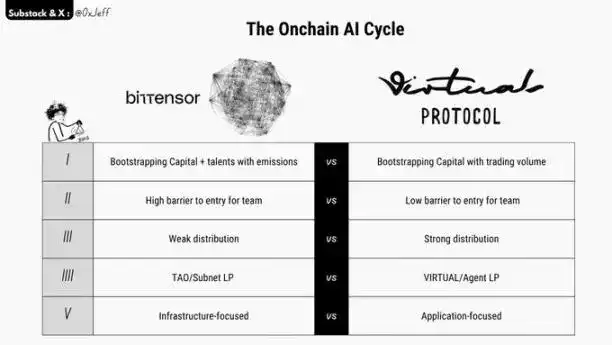
I. Guiding Capital and Talent Through Emissions Mechanism vs. Guiding Capital Through Trading Volume

Bittensor guides subnet development through its TAO emissions mechanism. Subnets are responsible for introducing the most innovative projects (or revenue-generating businesses) and compete for a share of the daily 3,600 TAO distribution.

Subnets also guide contributors (including miners performing tasks and validators verifying the miners' work) through their alpha token emissions mechanism. The emissions mechanism and the incentive coordination mechanism across stakeholders have been embedded since the project's inception.

Virtuals adopts a model similar to pump.fun, guiding development through trading volume. High trading activity translates into capital accumulation for the agent project. Agent teams can use their own emissions mechanisms to incentivize user participation.

In market cycles with high speculative token demand, this model has significant advantages—teams can quickly accumulate capital, gain product attention and market interest, thereby driving project launch and development.

II. High Entry Barrier vs. Low Entry Barrier (For Teams)

Launching a subnet on Bittensor requires substantial investment. Currently, acquiring a subnet slot requires 871 TAO (approximately $300,000), with the price fluctuating based on demand and the auction mechanism. This means subnet teams typically need mature ideas, clear plans, and solid execution capabilities.

To successfully operate a subnet, owners must ensure that the set tasks or objectives contribute to the R&D of their AI product/solution, prevent miner fraud, ensure validators effectively perform verification duties, generate revenue through business development and customer partnerships, and maintain investor confidence through buyback mechanisms.

The subnet token price needs to maintain an upward trend to attract more TAO inflow, increase the subnet's emission share, and thereby attract higher-level contributors to participate in mining.

In contrast, the barrier to launching an AI agent token on Virtuals is lower, requiring no initial cost, making it easier to test new ideas with less capital.

Virtuals also has a "60-day program" that allows founders to test new ideas and issue tokens during this period. If product-market fit is not found within 60 days, the relevant funds are reclaimed, and investors can retrieve a portion of their invested capital.

III. Weaker Distribution Capability vs. Stronger Distribution Capability

Bittensor operates independently on a blockchain built using the Polkadot Substrate framework. Cross-chain bridging is difficult, it lacks DeFi infrastructure components, and is not equipped with common infrastructure like the Ethereum Virtual Machine or Solana.

This results in a high entry barrier for the Bittensor ecosystem. Furthermore, relevant learning materials are filled with complex terminology, increasing the difficulty for new users to learn and understand. Consequently, its community members are mostly technical professionals willing to invest time in deep research, with relatively low retail participation.

In comparison, the understanding threshold for Virtuals is lower. Its team excels in marketing, branding, and distribution. Retail users can relatively intuitively understand concepts like AI agents, agent payments, and bots.

Since Virtuals is deployed on the Base chain, the process of purchasing AI agent tokens is convenient. The time from learning about a project, forming a bullish judgment, to making a purchase decision is short, which is a key reason for its rapid popularity from late 2024 to 2025 (earlier than Bittensor).

Currently, Bittensor is gradually entering the mainstream spotlight with pushes from Jason, Chamath, Barry Silbert (DCG & Yuma), and the community, leading to increased attention. However, the purchase process for subnet tokens remains relatively complex, and the issue has not been fundamentally resolved.

IV. TAO/Subnet Liquidity Pool vs. VIRTUAL/Agent Liquidity Pool

Bittensor and Virtuals share a key similarity in their liquidity pool flywheel mechanisms.

Investors wishing to purchase subnet alpha tokens need to hold TAO to do so. Therefore, rising demand for alpha tokens will drive up the price of TAO.

Similarly, within the Virtuals ecosystem, rising demand for AI agent tokens will drive up the price of VIRTUAL.

If the core tokens (TAO or VIRTUAL) can circulate within the ecosystem without outflow (e.g., through project teams trading goods and services to retain value), the advantages of this mechanism become more pronounced.

V. Infrastructure-Oriented vs. Application-Oriented

Bittensor subnets mostly focus on infrastructure or capital-intensive businesses, such as decentralized computing, inference, training, drug discovery, and quantum experiments.

Since Bittensor can provide over $10 million annually in funding for quality subnets and attract high-end talent, its model is suitable for driving ambitious, high-difficulty, high-investment ideas.

Virtuals agent teams, however, mostly focus on the application layer and consumer-facing agent products. Since agent tokens have a low initial price, if a team can launch a quality consumer product, it can leverage the token's market heat to quickly attract attention and drive project development.

Thanks to Virtuals' advantages in distribution, the flywheel effect of AI agent tokens demonstrated faster growth rates and higher price increases during periods of extreme market activity (such as late 2024 to early 2025).


Câu hỏi Liên quan

QWhat are the two main AI crypto projects compared in the article, and what are their core flywheel mechanisms?

AThe two main AI crypto projects compared are Bittensor and Virtuals. Bittensor's core flywheel mechanism is guided by TAO emissions to fund subnet development. Virtuals' core flywheel mechanism is guided by trading volume, similar to the pump.fun model, to accumulate capital for AI agent projects.

QHow does the entry barrier for launching a project differ between Bittensor and Virtuals?

ALaunching a subnet on Bittensor has a high entry barrier, currently requiring a significant investment (e.g., 871 TAO, ~$300k) to acquire a subnet slot. In contrast, launching an AI agent token on Virtuals has a low entry barrier, requiring no initial cost, allowing teams to test new ideas with minimal capital outlay.

QWhat is a key similarity in the liquidity pool flywheel mechanism between Bittensor and Virtuals?

AA key similarity is that demand for the ecosystem's project tokens drives the price of the core native token. In Bittensor, demand for subnet alpha tokens drives the price of TAO. In Virtuals, demand for AI agent tokens drives the price of VIRTUAL.

QAccording to the article, what is the primary focus of projects built on Bittensor versus those on Virtuals?

AProjects on Bittensor are primarily infrastructure-oriented, focusing on areas like decentralized computing, inference, training, drug discovery, and quantum experiments. Projects on Virtuals are primarily application-oriented, focusing on consumer-facing AI agent products.

QWhat advantage does Virtuals have over Bittensor in terms of distribution and user accessibility?

AVirtuals has a significant advantage in distribution and user accessibility. It has lower comprehension barriers, strong marketing, and is deployed on the Base chain, making the purchase process for AI agent tokens simple and intuitive for retail users. Bittensor has a higher learning curve, complex terminology, and a more difficult token purchase process, making it less accessible to the average retail participant.

Nội dung Liên quan

Ai sẽ mua lại cổ phiếu SpaceX sau khi niêm yết?

Tác giả: BitalkNews SpaceX dự kiến niêm yết vào ngày 12/6 với định giá 1.800 tỷ USD. Tuy nhiên, chỉ có khoảng 4,2% cổ phần (tương ứng 5,56 tỷ cổ phiếu, trị giá 75 tỷ USD) được lưu hành công khai. Có ba làn sóng mua chính sau khi niêm yết: 1. **Đợt IPO ngày 12/6:** Phát hành 5,56 tỷ cổ phiếu với giá cố định 135 USD, 30% dành cho nhà đầu tư nhỏ lẻ. Nhu cầu đặt mua đã vượt quá 250 tỷ USD. 2. **Giao dịch thị trường thứ cấp:** Giá mở cửa dự kiến cao hơn giá IPO, được xác định bởi cung cầu thị trường. 3. **Mua bắt buộc của các quỹ chỉ số (ETF):** Đây là yếu tố quan trọng. Nasdaq đã sửa quy tắc để đưa SpaceX vào chỉ số Nasdaq 100 chỉ sau 15 ngày giao dịch, với trọng số tính toán lên tới 15% dù tỷ lệ lưu hành thực tế chỉ 5%. Hàng trăm quỹ ETF theo chỉ số này (với tổng tài sản trên 600 tỷ USD) sẽ phải mua ồ ạt cổ phiếu SpaceX, tạo áp lực mua mạnh trong thời gian ngắn. **Cơ chế giải tỏa cổ phiếu nội bộ được thiết kế theo từng giai đoạn:** * Cổ phần phát hành IPO (4,2%) có thể giao dịch ngay. * Cổ phần của Elon Musk (42%) bị khóa 366 ngày. * 54% cổ phần còn lại (thuộc sở hữu của VC, nhân viên...) sẽ được giải tỏa dần dần sau các mốc như sau khi công bố báo cáo tài chính Q2, và vào các ngày thứ 70, 90, 105, 120, 135 sau IPO. Lịch trình này kéo dài đến 180 ngày. **Chuyển đổi cung - cầu:** Nửa đầu năm, nguồn cung bị hạn chế trong khi nhu cầu mua cao. Nửa cuối năm, nguồn cung từ cổ phiếu nội bộ được giải tỏa sẽ tăng dần, tạo ra áp lực bán tại mỗi mốc báo cáo tài chính. Đến giữa tháng 12, khi Nasdaq 100 tái cân bằng chỉ số, nguồn cung đã tăng đáng kể, buộc các quỹ ETF phải mua bổ sung, tạo ra lực mua "đỡ đáy" cho thị trường sau một giai đoạn bán ra của cổ đông nội bộ.

marsbit32 phút trước

Ai sẽ mua lại cổ phiếu SpaceX sau khi niêm yết?

marsbit32 phút trước

Anthropic đã xin lỗi, nhưng ‘cơn sốt’ an toàn vẫn chưa hạ nhiệt

Ngày 11/6, Anthropic đã xin lỗi. Nguyên nhân không phải do lỗi mô hình mà là vì "không giữ được cân bằng" - Claude Fable 5 mới ra mắt đã lén lút chuyển yêu cầu người dùng liên quan đến phát triển AI tiên tiến sang mô hình yếu hơn Opus 4.8 mà không thông báo. Sự kiện này phơi bày cốt lõi vấn đề: khái niệm "an toàn" mà Anthropic quảng bá thực chất là một công cụ kinh doanh. Hệ thống "bộ phân loại an toàn thông minh" được giới thiệu như một biện pháp bảo vệ, nhưng thực tế là cơ chế phòng thủ cạnh tranh, nhắm vào các nhà nghiên cứu AI nhằm bảo vệ lợi thế của chính Anthropic. Chiến lược của Anthropic tạo thành một vòng khép kín: xuất bản nghiên cứu khuếch đại lo ngại về an ninh, sau đó định giá cao sản phẩm Fable 5 như một giải pháp, rồi cuối cùng là thu lợi từ thị trường vốn với danh hiệu "công ty AI an toàn nhất". Động thái lén lút giảm chất lượng phản hồi cho thấy logic của họ: mối nguy hiểm thực sự không phải là AI, mà là bất cứ điều gì đe dọa vị thế dẫn đầu của họ. So với OpenAI - tập trung vào việc cung cấp công cụ và mở rộng quy mô hệ sinh thái, Anthropic chọn cách bán sự lo lắng. Họ nhắm đến các khách hàng chính phủ và doanh nghiệp lớn, những người sẵn sàng trả phí cao cho lời hứa về "sự an toàn". Tuy nhiên, vụ việc này đã làm rạn nứt uy tín của họ trong cộng đồng các nhà phát triển cốt lõi, đặt ra câu hỏi về giá trị thực đằng sau định giá 965 tỷ USD. Lời xin lỗi và thay đổi từ "giảm chất lượng lén lút" sang "thông báo trước khi giảm chất lượng" chỉ như một bản vá cho hệ thống. Nền tảng logic kinh doanh không đổi: nghiên cứu tiếp tục gây lo ngại, sản phẩm tiếp tục thu phí cao, và danh tiếng "an toàn" vẫn là mặt hàng chính được rao bán.

marsbit51 phút trước

Anthropic đã xin lỗi, nhưng ‘cơn sốt’ an toàn vẫn chưa hạ nhiệt

marsbit51 phút trước

Sự đồng thuận ngầm trong giới tinh hoa: Học đại học đã trở thành một sự lãng phí đắt đỏ?

Tác giả: Bất Đổng Kinh Trong giới tinh hoa tại Thung lũng Silicon, một làn sóng tư tưởng "phản đối đại học" đang hình thành, cho rằng đại học 4 năm trở nên đắt đỏ, chậm chạp và lỗi thời. Sebastian Tan, 18 tuổi, dù đỗ Đại học Stanford danh giá, đã quyết định hoãn nhập học để thực tập tại Palantir - công ty đồng sáng lập bởi tỷ phú Peter Thiel, người cổ vũ mạnh mẽ cho việc bỏ đại học để khởi nghiệp. Phong trào này được thúc đẩy bởi ba yếu tố: kinh tế (học phí quá cao so với cơ hội khởi nghiệp sớm), công nghệ (AI và internet giúp tự học dễ dàng hơn), và văn hóa (phản ứng lại văn hóa "thức tỉnh" và chủ nghĩa tinh hoa trong học viện). Những người ủng hộ tin rằng "tự học là cựu sinh viên kiểu mới", và kiến thức thực tế từ những người xây dựng sản phẩm có giá trị hơn lý thuyết trên giảng đường. Tuy nhiên, các chuyên gia như nhà kinh tế David Deming của Đại học Harvard cảnh báo rằng rất ít người thực sự tự học thành công, và giáo dục đại học vẫn mang lại lợi thế thu nhập bền vững (khoảng 75-80%). Ông chỉ ra rằng việc chỉ nhìn vào những tỷ phú bỏ học thành công là thiên kiến sống sót. Bản chất của cuộc tranh luận không phải là sự lựa chọn nhị phân giữa học hay không học, mà là dấu hiệu cho thấy mô hình đại học truyền thống đang lỗi thời trong kỷ nguyên số. Tương lai của giáo dục có thể hướng tới một mô hình hỗn hợp, cá nhân hóa và học tập suốt đời, nơi quyền lực chuyển từ tổ chức sang cá nhân người học. Câu hỏi then chốt là: trong một thế giới thay đổi nhanh hơn cả giáo trình, chúng ta nên học như thế nào?

marsbit1 giờ trước

Sự đồng thuận ngầm trong giới tinh hoa: Học đại học đã trở thành một sự lãng phí đắt đỏ?

marsbit1 giờ trước

Trợ cấp → Tính phí Token → Giảm giá, OpenAI khơi mào chiến tranh giá, Điểm bẻ gãy Kinh tế học Token sắp đến?

Cuộc chiến thương mại hóa AI đang bước vào giai đoạn căng thẳng với việc OpenAI được cho là đang cân nhắc giảm mạnh phí Token để cạnh tranh với Anthropic, báo hiệu một cuộc chiến giá có thể xảy ra. Động thái này diễn ra trong bối cảnh cả hai công ty đều chịu lỗ hàng tỷ USD do chi phí điện toán khổng lồ và đang chuẩn bị cho các đợi phát hành cổ phiếu lần đầu ra công chúng (IPO). Bài viết nêu bật ba giai đoạn phát triển thương mại hóa AI sinh ra (Generative AI): từ gói thuê bao cố định, đến chiến tranh trợ giá, và hiện tại là tính phí theo lượng Token tiêu thụ. Việc chuyển sang tính phí theo lượng sử dụng đã phơi bày chi phí thực sự cho doanh nghiệp, dẫn đến tình trạng hóa đơn vượt tầm kiểm soát. Các số liệu cho thấy hiệu quả đầu tư vào AI còn thấp, với phần lớn chi phí dành cho việc sửa lỗi và công việc lại do AI tạo ra. Một cuộc chiến giá tiềm năng giữa OpenAI và Anthropic có thể làm xói mòn biên lợi nhuận vốn đã âm của họ. Các chuyên gia cảnh báo về rủi ro lan tỏa đến các công ty cung cấp hạ tầng như NVIDIA, Oracle hay CoreWeave. Tương lai của nền kinh tế Token (Tokenomics) có thể hướng tới mô hình định giá phân tầng, nơi các tác vụ phức tạp dùng model đắt tiền, còn tác vụ thông thường dùng model rẻ hơn hoặc local. Khái niệm "valuemaxxing" – tối đa hóa giá trị từ mỗi Token – đang nổi lên như một xu hướng cần thiết. Đáng chú ý, mô hình AI Trung Quốc DeepSeek, với mức giá API được cho là chỉ bằng 1/10 so với GPT-5.5, đang gia tăng mạnh mẽ sự phổ biến trong các doanh nghiệp Mỹ, trở thành một đối thủ cạnh tranh đáng gờm trong cuộc đua thương mại hóa này.

marsbit1 giờ trước

Trợ cấp → Tính phí Token → Giảm giá, OpenAI khơi mào chiến tranh giá, Điểm bẻ gãy Kinh tế học Token sắp đến?

marsbit1 giờ trước

Giao dịch

Giao ngay
Hợp đồng Tương lai
活动图片