A New CEO Who Has Worked Exclusively with Hardware for 25 Years Takes Over Apple, Valued at 4 Trillion

marsbitXuất bản vào 2026-04-21Cập nhật gần nhất vào 2026-04-21

Tóm tắt

Apple, the world's most valuable tech firm, has appointed John Ternus as its new CEO, effective September 1, replacing Tim Cook who transitions to executive chairman. Ternus, a 51-year-old mechanical engineer with 25-year tenure at Apple, previously served as senior vice president of hardware engineering. Known for his low public profile and lack of social media presence, he played key roles in developing products like the iPad, AirPods, and led Apple’s transition from Intel to in-house silicon chips. Ternus takes over a company valued at $4 trillion, with Cook having multiplied Apple’s revenue and built a $100 billion services business. However, he inherits significant challenges: Apple’s AI efforts, including the delayed Siri revamp powered by Google’s Gemini, remain unproven, and the company is preparing to launch its first foldable iPhone amid supply constraints. While Ternus’s hardware expertise positions him well for product-driven innovation, his lack of software/AI experience raises questions about Apple’s competitiveness in the AI era. The company’s structure has been adjusted to support him, with Cook remaining in an advisory role. Ternus’s engineer-led approach—emphasizing humility and collaboration—may prove vital in navigating Apple’s next chapter.

Author: David, Deep Tide TechFlow
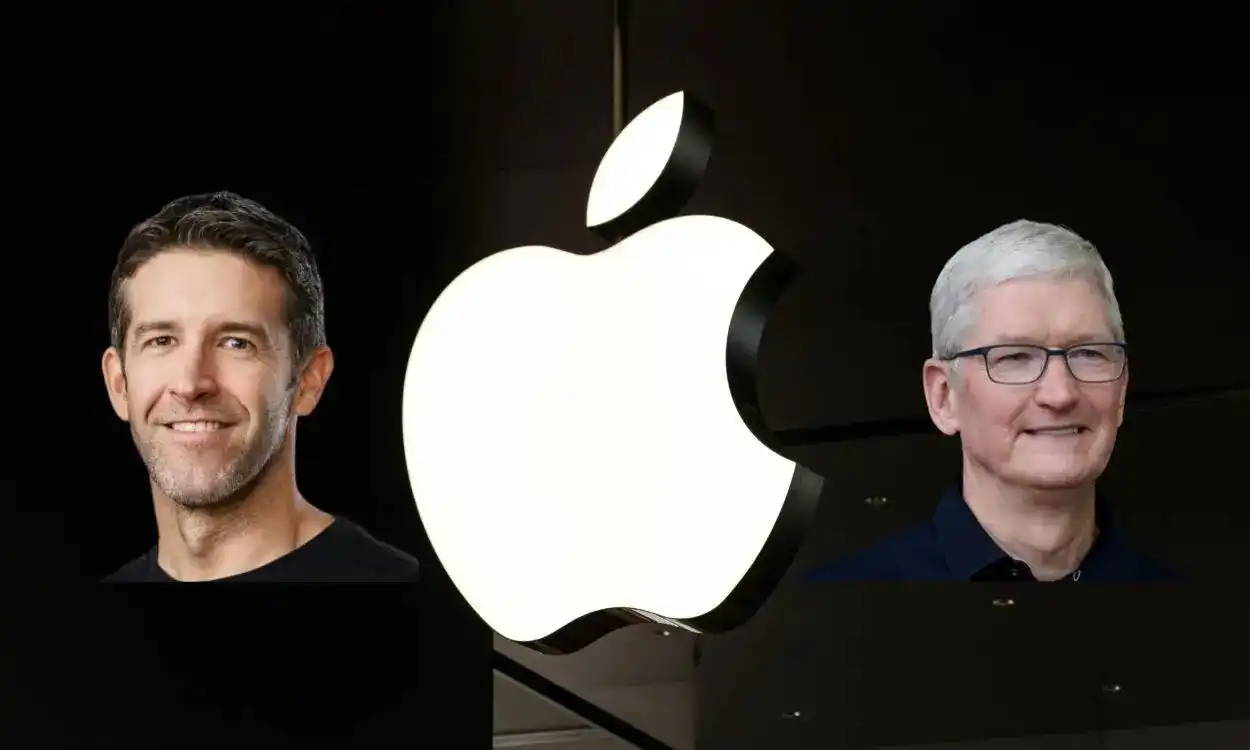
Apple, the world's highest-valued tech company, has just handed over the CEO position to someone with almost no public profile.

On April 20, Apple announced that Tim Cook will step down as CEO on September 1 and transition to the role of Executive Chairman. His successor, John Ternus, is 51 years old, has been with Apple for 25 years, and previously held the title of Senior Vice President of Hardware Engineering.

Following the announcement, Apple's stock price dipped less than 1% in after-hours trading. The market's reaction was calm, perhaps because everyone had already guessed it would be him.

Over the past year, Ternus has appeared more frequently at Apple's product launch events. Last year, when the iPhone 17 was released, he was the one greeting the first customers at the London flagship store.

According to Bloomberg reporter Mark Gurman, Apple's PR team has been deliberately shifting the spotlight to him since last year.

But if you don't pay much attention to Apple's hardware launches, you've probably never seen him. He has no social media accounts, rarely gives interviews, and when asked about succession rumors, he only said five words:

"I love my current job."

The CEOs who left their mark on Apple's history—Steve Jobs, a combination of product intuition and marketing genius, and Tim Cook, an expert in supply chain and operations—have vastly different styles but share one common trait:

Neither was an engineer.

But Ternus is. He has a background in mechanical engineering, and his career has been about parts, molds, and production lines from day one. Before joining Apple, he worked at a little-known small company developing VR headset devices, a technology that still hasn't gone mainstream today.

And at this moment, as he takes over Apple, the company's biggest anxiety might have little to do with hardware.

The Low-Profile Hardware Engineer
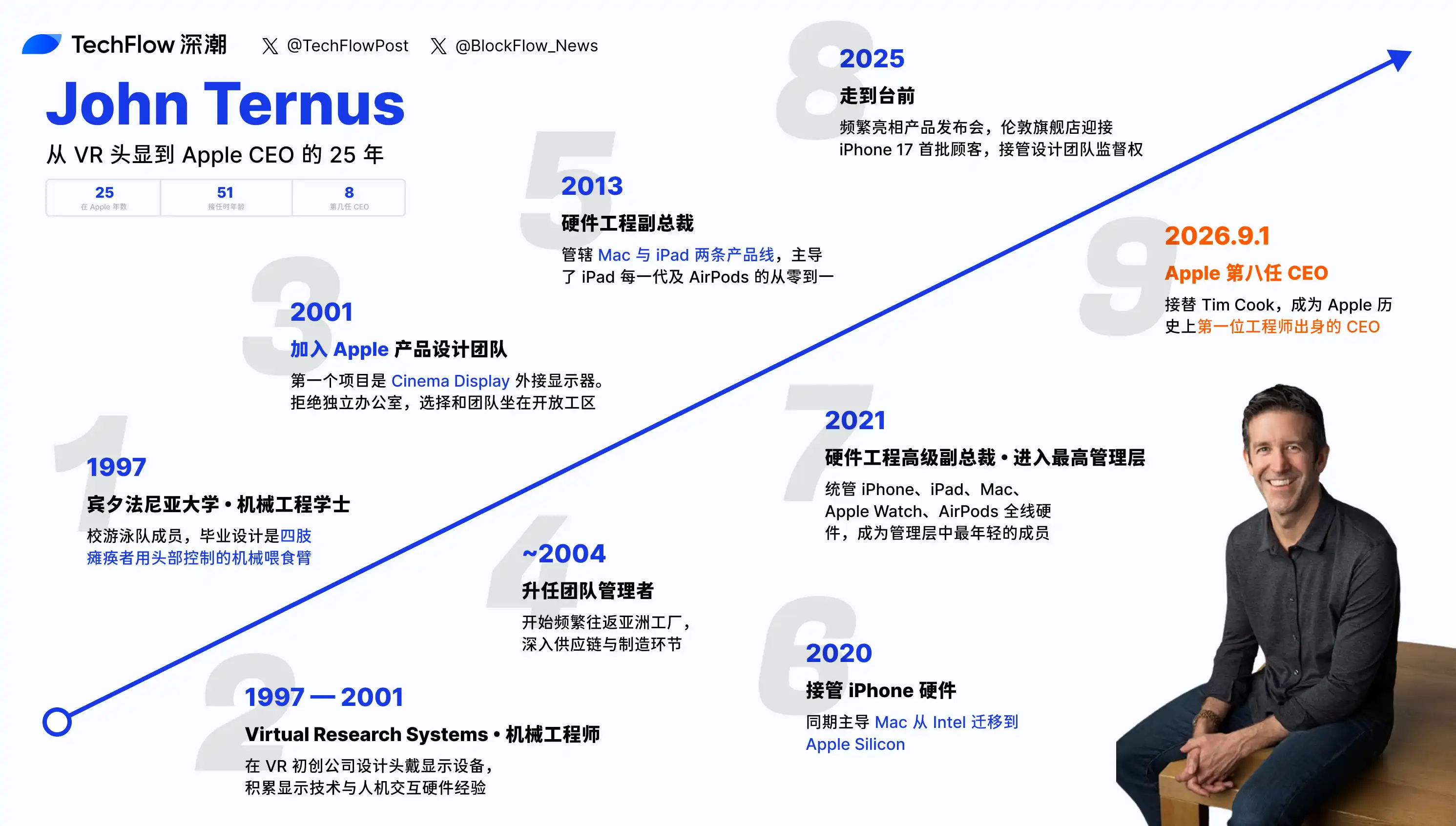
In 1997, Ternus graduated from the University of Pennsylvania with a degree in mechanical engineering. During his college years, he was a member of the university's swim team and won championships in the 50-meter freestyle and 200-meter individual medley.

Public records show that his graduation project was a mechanical feeding arm, designed to allow quadriplegic individuals to control the arm with head movements to eat independently.

After graduation, he joined a company called Virtual Research Systems, working as a mechanical engineer on VR headsets.

In 1997, the VR industry was decades away from Meta investing billions in the metaverse and even further from Apple's own Vision Pro. The company didn't achieve much success, but Ternus stayed there for four years, working daily with display technology and hardware for human-computer interaction.

In 2001, he joined Apple, entering the product design team.

That year, Steve Jobs had just pulled the company back from the brink of collapse. The iPod hadn't been released yet, and the iPhone was still six years away. Ternus's first project was working on the Cinema Display, Apple's external monitor product line at the time.

According to The New York Times, his first supervisor at Apple, Steve Siefert, recalled that when Ternus was promoted to management and offered a private office on a new floor, he chose to stay in the open workspace with his team.

When Siefert retired and offered him his office, Ternus declined again.

Starting with displays, Ternus climbed the ranks. According to Apple's official introduction, he was involved in the development of the iPad from scratch and every subsequent generation, and he led the hardware engineering for AirPods. He was promoted to Vice President of Hardware Engineering in 2013 and succeeded his predecessor as Senior Vice President of Hardware Engineering in 2021, officially entering Apple's top management.

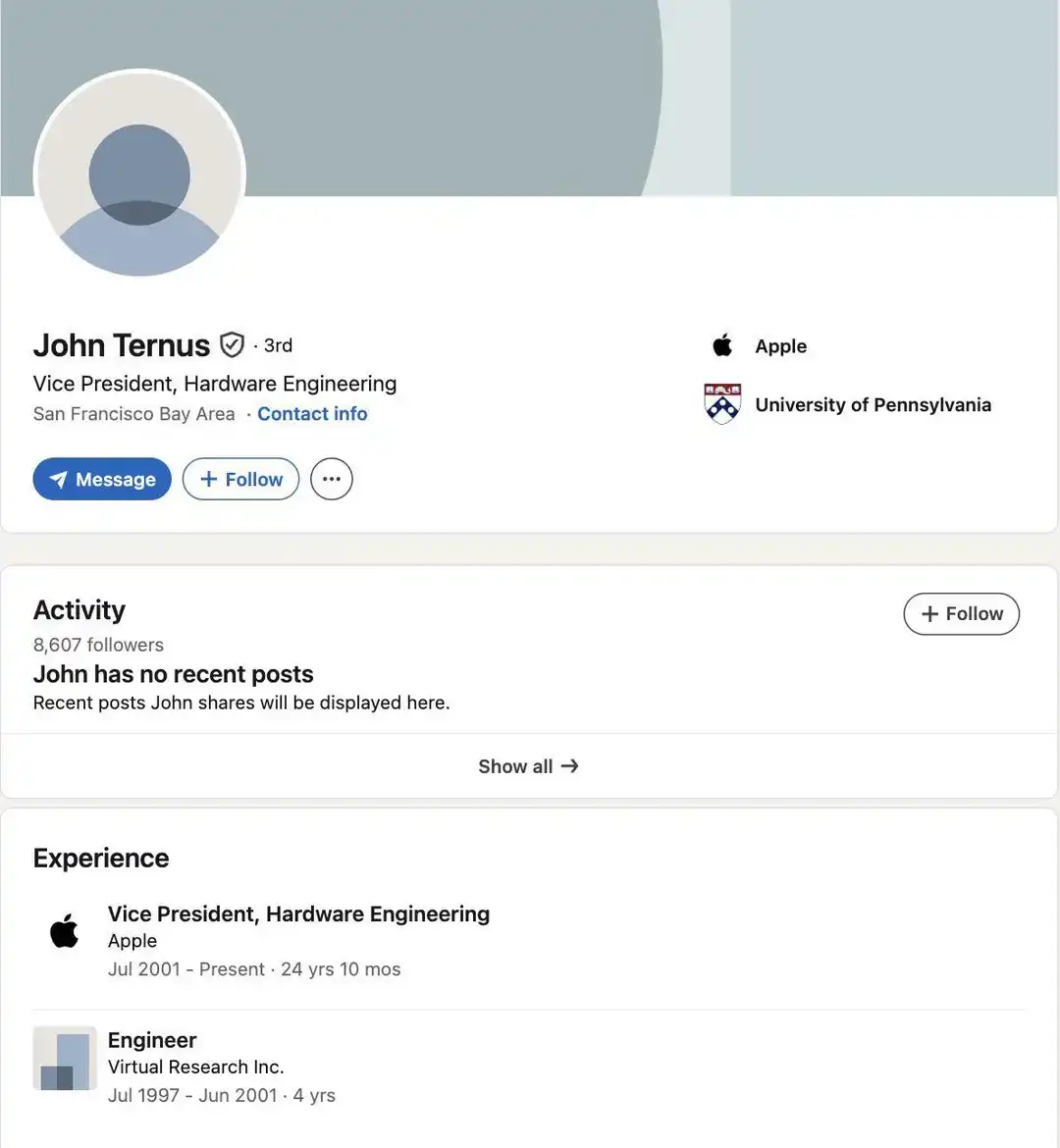
A check of his LinkedIn reveals that Ternus is incredibly low-profile—he doesn't even have a profile picture or any posts. Perhaps until today, he hasn't cared much about maintaining a public image, focusing more on working with hardware.
Internally, he also led a profoundly impactful initiative for Apple: transitioning the Mac product line from Intel chips to Apple's custom silicon.

In 2024, he returned to his alma mater, the University of Pennsylvania, to give a speech to engineering graduates. One line from that speech feels particularly worth pondering today:

"Always assume you are as smart as anyone in the room, but never assume you know more than they do."

This sounds like humility, but for someone about to take over the world's largest tech company, it might be closer to an engineer's survival instinct: you can't know everything, but you must know who does.

And the company he is now taking over has left him a legacy far more complex than an office.

After Cook

Cook served as Apple's CEO for nearly 15 years, and the report card he leaves behind is legendary by any company's standards.

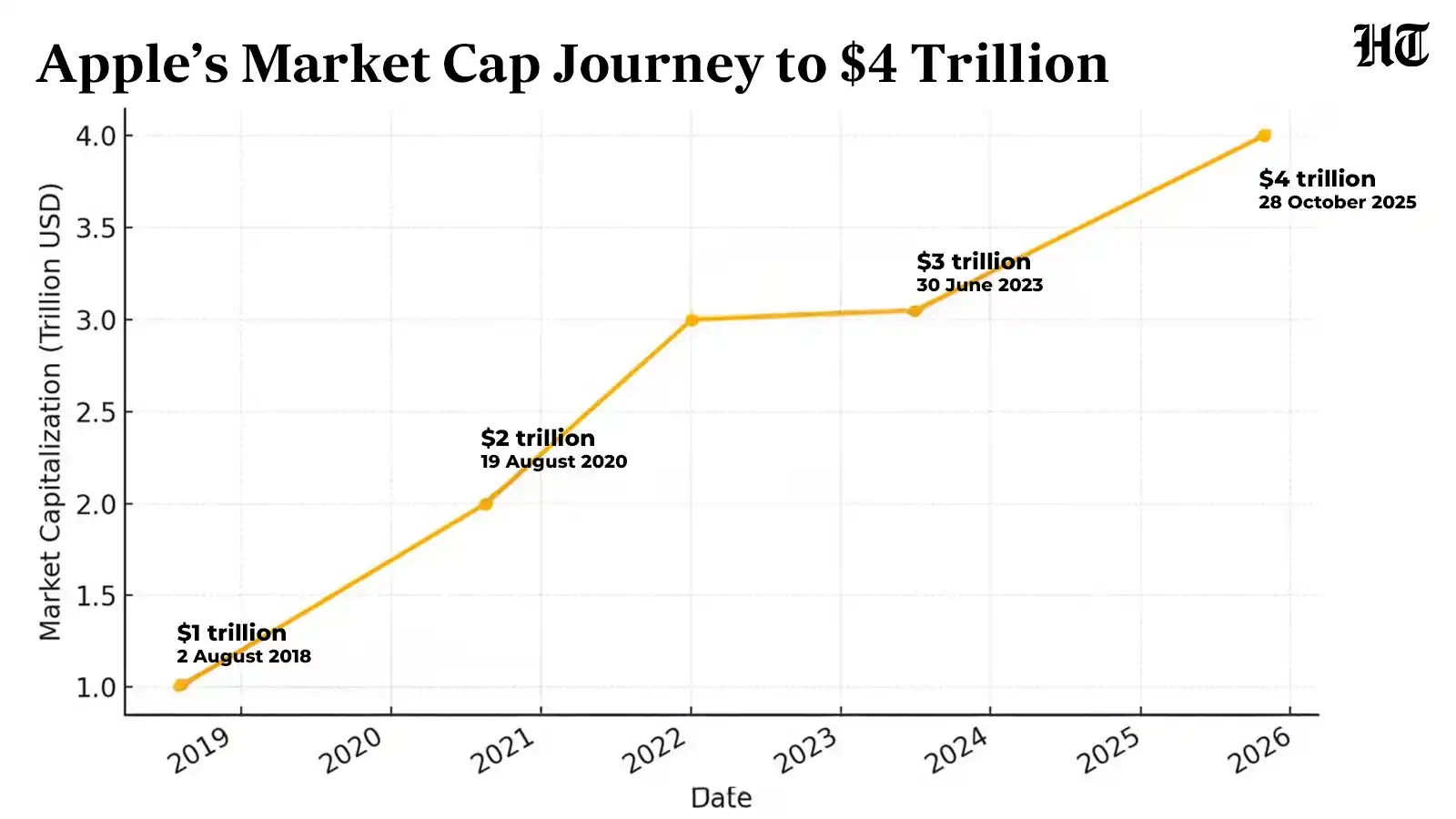
According to CNBC, when he took over the company from Steve Jobs in 2011, Apple's market capitalization was approximately $350 billion. Today, that figure is $4 trillion—an increase of over tenfold.

According to Apple's latest fiscal year data, the company's annual revenue exceeds $400 billion, nearly four times what it was when he took over. He also turned Apple's services business—App Store, iCloud, Apple Music, and other software revenues—into a business generating over $100 billion in annual revenue.

An operations-focused CEO turned a product-driven company into the world's most profitable machine. In my opinion, this alone proves the prophecy that "Apple is finished without Jobs" wrong.
But he also left some unanswered questions.

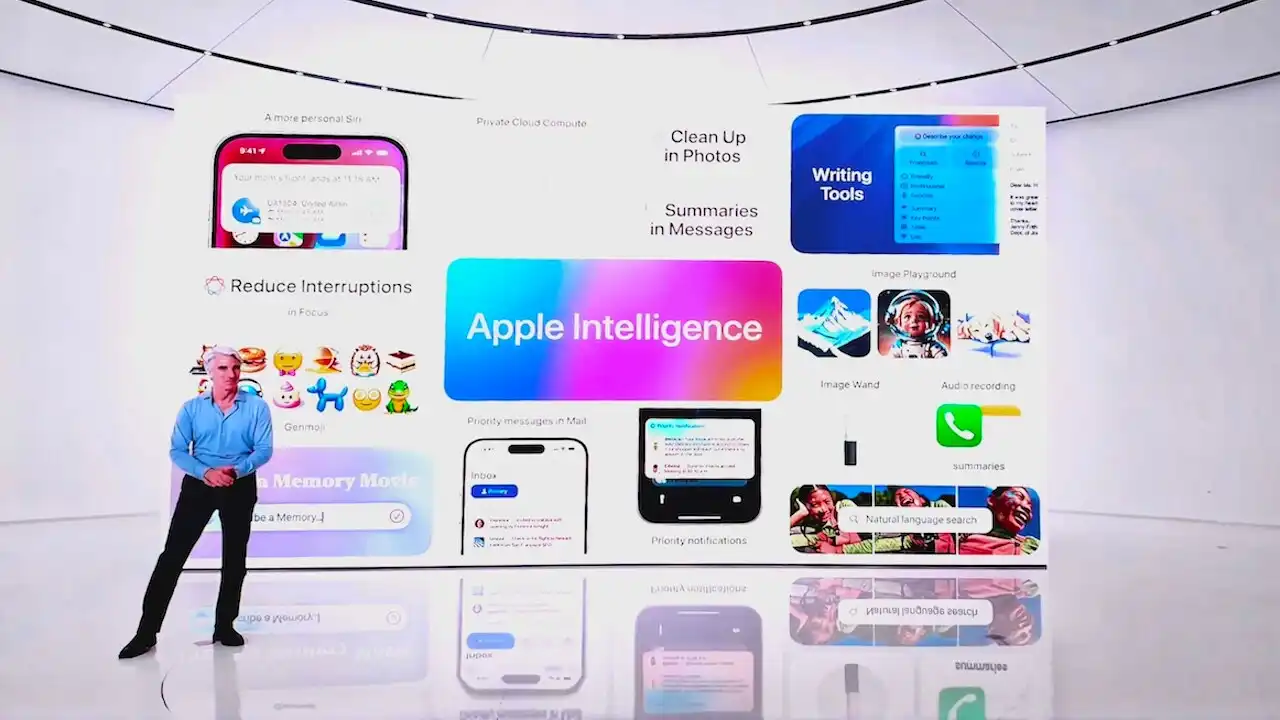
In 2024, Apple high-profile launched Apple Intelligence, the company's formal response to the AI wave. The宣传 focus at the time was a全新的, smarter Siri voice assistant.

But this promise remains unfulfilled. Siri has been mocked for years in the AI race, often failing at simple tasks like setting an alarm, while competitors' AI assistants can already write code, conduct research, and manage schedules.

In January 2026, Apple made a decision that speaks volumes.

According to CNBC, the company announced a multi-year agreement with Google, using Google's Gemini large language model as the technical foundation for Apple's base model to power the next-generation Siri. According to multiple earlier reports, Apple is paying approximately $1 billion annually for this.

Prior to this, Apple had also tested technology from OpenAI and Anthropic, ultimately choosing Google. A company famous for "doing everything itself" chose to pay an external partner for AI.

To make matters more awkward, this external solution itself is also delayed.

The new Siri powered by Gemini was originally planned to launch with iOS 26.4, but some features may now be delayed until September with the release of iOS 27. Apple has been promising core AI features since 2024, yet none have materialized.
Cook also made another less successful big bet: Vision Pro. This mixed reality headset, priced at several thousand dollars, received a lukewarm market response after its 2024 launch. Consumers weren't keen on spending that much to strap a computer weighing over a pound to their faces.

The challenge Cook couldn't solve in this category now falls to someone who understands its hardware better. But the VR headset issue can be addressed gradually; Ternus faces two more urgent matters.

On June 8, Apple will host its annual Worldwide Developers Conference (WWDC), where the new Gemini-powered Siri is expected to officially debut. This is Apple's most important public exam in the AI arena, and the person turning in the paper will be an engineer who has worked with hardware his entire life.

In September, the same month Ternus officially becomes CEO, Apple plans to release the company's first foldable iPhone, potentially priced over $2,000.

According to Bloomberg, mass production plans for this product have already been delayed due to supply chain constraints, and initial supplies will likely be limited.

One software exam, one hardware exam—both intensifying the pressure on the new CEO.

Strong on Hard, Weak on "Soft"?

Apple is handing both exams to someone who has worked in hardware for 25 years. So, the hardware exam might not be a major concern.

The mass production delay for the foldable iPhone is a supply chain issue, and Ternus has been shuttling between Asian factories and production lines since 2004—this is his most familiar battleground.

Apple's choice of him over someone with a finance or software background sends a clear signal. It suggests the board believes that, for the next few years, the physical form of products will remain Apple's core competitiveness.

But the other exam is different.

AI is currently Apple's biggest weakness and is becoming an existential-level problem. The most brutal lesson in the tech industry in recent years is that the impact of AI on software companies has far exceeded everyone's expectations.

Apple is temporarily not on the replacement list because it essentially still sells hardware. But the problem is, if the AI experience on the iPhone is always a step behind Android, consumers will eventually vote with their wallets.

And the new successor, Ternus, has no experience in software or AI in his entire resume. He is the type who can take the magnetic attachment scheme for an iPhone screen from concept to mass production, not the type who decides how Siri should understand a sentence.

All the products he has handled at Apple—iPad, AirPods, Mac, the Apple Silicon transition—are all victories defined by hardware. Whether the software is user-friendly has never been a question he needed to answer.

After September 1, that question belongs to him.

Apple's arrangements show the company is aware of this risk. After Ternus takes office, hardware engineering will be handed over to Johny Srouji, a veteran who has worked on chips for nearly 20 years at Apple, with an upgraded title to Chief Hardware Officer.

Cook remains as Executive Chairman, continuing to manage global policy and government relations. Ternus is being pulled out of the specifics of hardware; his energy must shift towards AI and overall strategy.

The CEO must answer the question of direction. What role does AI play in Apple's products? Is it an ancillary function of the hardware, like the camera, or does hardware become the carrier for AI?

Cook didn't answer this question, or rather, the market didn't buy his answer. Apple's stock price has barely moved this year, while Google's has risen over 20% in the same period.

Cook's departure at this critical moment of Apple's AI transformation itself raises questions.

This question is now passed to Ternus. Someone known internally as "the executive closest to the product" suddenly has to think about the question farthest from the product.

However, I'm actually pessimistic about this choice.

Engineers have an underestimated advantage: they are accustomed to admitting what they don't know and then finding someone who does. In an era where CEOs compete to perform "I know AI better than AI," someone willing to say "I don't know, but I know who does" might actually move more steadily.

Of course, the market and consumers won't give him much time to test this hypothesis.
Câu hỏi Liên quan

QWho is the new CEO of Apple, and what was his previous role?

AJohn Ternus is the new CEO of Apple. His previous role was Senior Vice President of Hardware Engineering.

QWhat significant hardware project did John Ternus lead at Apple?

AJohn Ternus led the transition of the Mac product line from Intel chips to Apple's own custom silicon chips.

QWhat is one of the major challenges Ternus faces regarding software when he takes over as CEO?

AOne major software challenge is revitalizing Apple's AI capabilities, specifically the delayed rollout of a new Siri powered by Google's Gemini model, as AI is currently Apple's biggest短板 (shortcoming).

QWhat hardware product is Apple scheduled to release around the same time Ternus becomes CEO in September?

AApple is scheduled to release its first foldable iPhone, with a potential price exceeding $2000, around the same time Ternus becomes CEO in September.

QHow did the market react to the announcement of Tim Cook's successor?

AThe market reaction was very calm, with Apple's stock price falling less than 1% in after-hours trading, indicating the transition was likely anticipated.

Nội dung Liên quan

Tôi mất một năm mới nhận ra sự thật trần trụi về thanh toán Agent

Tác giả, với một năm kinh nghiệm xây dựng cơ sở hạ tầng cho nền kinh tế Agent, chia sẻ những nhận thức thực tế về thị trường thanh toán Agent hiện nay. **Hiện trạng & Thách thức:** - **Nhu cầu thực tế còn hạn chế:** Dữ liệu từ Stripe, Visa, Coinbase cho thấy khối lượng giao dịch Agent thực sự rất thấp, dù có nhiều quan tâm. Các rào cầu pháp lý (như KYC kéo dài, ngưỡng doanh thu cao từ Visa) khiến chỉ các tập đoàn lớn như Amazon mới có thể triển khai. - **Agent vs Người bán (B2C):** Trải nghiệm mua sắm qua chat kém hiệu quả với các mặt hàng cần so sánh trực quan (quần áo, đồ điện tử). Nhu cầu từ người bán hiện chủ yếu mang tính phòng thủ ("tối ưu hóa cho Agent - AEO") chứ không phải từ làn sóng người dùng thực sự. Các điểm sáng như đặt đồ ăn lại bị cản trở bởi thiếu API mở từ các nền tảng lớn và chi phí vận hành cao. - **Agent vs API (B2B):** Nhu cầu thanh toán vi mô cho API tồn tại nhưng khó mở rộng vì mô hình kinh doanh của nhiều nhà cung cấp SaaS dựa vào hợp đồng doanh nghiệp dài hạn. Các giao thức như MPP, x402 phù hợp với thị trường ngách nhưng quy mô nhỏ. - **Agent vs Agent:** Vẫn là tầm nhìn dài hạn, chưa có khối lượng giao dịch đáng kể. Nếu phát triển, nó sẽ cần cơ sở hạ tầng thanh toán chuyên biệt với tốc độ cao, độ trễ thấp. - **Agent vs Tài chính:** Đây có lẽ là lĩnh vực có nhu cầu hiện tại rõ ràng nhất, với người dùng sẵn sàng trả phí (quản lý quỹ, DeFi). Tuy nhiên, thị trường bị chi phối bởi các định chế lâu năm với lợi thế về giấy phép và quan hệ khách hàng. **Điểm mấu chốt thực sự:** Lý do nhiều công ty vẫn xây dựng là: 1) Động cơ phòng thủ của các gã khổng lồ (họ có đủ nguồn lực để đặt cược vào tương lai), và 2) Tư duy thiên lệch khi nhìn mọi vấn đề qua lăng kính "thanh toán". Tuy nhiên, vấn đề cốt lõi không phải là **thanh toán**, mà là **sự phối hợp (coordination)** giữa Agent và con người - bao gồm xác thực công việc, xử lý kết quả và sau đó mới là thanh toán. Thanh toán chỉ là một phần của giải pháp phối hợp. Các công ty giải quyết được bài toán phối hợp quy mô lớn sẽ chiếm lĩnh thị trường. Đối với startup, cần tìm kiếm thị trường thực sự đang hoạt động và tăng trưởng thay vì chờ đợi làn sóng tương lai.

链捕手21 phút trước

Tôi mất một năm mới nhận ra sự thật trần trụi về thanh toán Agent

链捕手21 phút trước

Claude Opus 4.8 Tìm Thấy Lỗ Hổng 4.5 Tỷ Đô La, Thời Đại AI Đang Sản Xuất Hàng Loạt Tin Tặc

Một nhà nghiên cứu đã sử dụng Claude Opus 4.8 để tìm ra lỗ hổng nghiêm trọng trong giao thức Orchard của Zcash, cho phép tạo token không giới hạn, làm bay hơi 45 tỷ USD vốn hóa thị trường chỉ sau thông báo chính thức. Sự việc cho thấy AI đang hạ thấp đáng kể ngưỡng phát hiện lỗ hổng, biến nó từ công việc của chuyên gia thành khả năng phổ cập. Điều đáng lo ngại không phải là mô hình mạnh nhất (như Claude Mythos), mà là những mô hình đủ mạnh, rẻ và phổ biến như Opus. Chúng cho phép cả người bảo vệ lẫn kẻ tấn công nhanh chóng hiểu hệ thống, dẫn đến hai hệ quả: một là tràn ngập báo cáo lỗi chất lượng thấp do AI tạo ra, làm kiệt quệ đội ngũ bảo trì mã nguồn mở; hai là các lỗ hổng ẩn sâu trước đây bị phát hiện với tốc độ chóng mặt. An ninh mạng vốn dựa vào một chuỗi hợp tác con người dài và mong manh để duy trì trải nghiệm "bình thường" cho người dùng. Tuy nhiên, khi AI làm gia tăng theo cấp số nhân cả lỗ hổng lẫn báo cáo, lực lượng phòng thủ vốn đã thiếu hụt nhân lực trầm trọng (khắp toàn cầu thiếu khoảng 4.8 triệu người) lại càng thêm quá tải. Chi phí phát hiện lỗi giảm, nhưng chi phí sửa chữa, phán đoán và phối hợp vẫn cao như cũ. Kỷ nguyên AI không phá hủy internet, mà giống như bật đèn sáng, cho chúng ta thấy sự thật: sự an toàn kỹ thuật số mà chúng ta hưởng thụ là thành quả của việc liên tục đè nén rủi ro bởi con người. Thứ đắt đỏ và khan hiếm thực sự bây giờ không phải là tìm ra lỗi, mà là có còn đủ người sẵn sàng sửa chữa chúng hay không.

marsbit54 phút trước

Claude Opus 4.8 Tìm Thấy Lỗ Hổng 4.5 Tỷ Đô La, Thời Đại AI Đang Sản Xuất Hàng Loạt Tin Tặc

marsbit54 phút trước

Dự Đoán Giá Ethereum: ETH Có Thể Tăng Gấp Đôi Trong Khi Cardano (ADA) Và Token Mới Này Tiến Gần Đến Mức Tăng Trưởng 500%

Thị trường tiền điện tử đang cho thấy những dấu hiệu khởi sắc khi các nhà đầu tư chuẩn bị cho chu kỳ tăng giá tiếp theo. Trong bối cảnh này, bài viết nêu bật tiềm năng của ba dự án: Ethereum (ETH), hiện giao dịch quanh 2.014,7 USD, được kỳ vọng có thể tăng gấp đôi lên mức 4.000 USD nếu thị trường tích cực vào năm 2026, nhờ vị thế nền tảng hợp đồng thông minh hàng đầu. Cardano (ADA), giao dịch ở mức 0,2329 USD, thu hút nhà đầu tư tin tưởng vào lộ trình phát triển dựa trên nghiên cứu và khả năng mở rộng của mạng lưới. Đáng chú ý là sự xuất hiện của Little Pepe (LILPEPE), một token mới trong giai đoạn bán trước. Dự án này đang xây dựng một blockchain Layer 2 tương thích Ethereum dành cho cộng đồng meme, với mục tiêu giảm phí và tăng tốc độ giao dịch. Được định giá 0,0022 USD ở đợt bán thứ 13 và đã huy động được hơn 28 triệu USD, một số nhà đầu tư kỳ vọng nó có tiềm năng tăng 500%. Sức hút của dự án đến từ nhu cầu bán trước mạnh mẽ, các tính năng hệ sinh thái như staking và sự tham gia tích cực của cộng đồng. Tóm lại, trong khi Ethereum và Cardano được xem là những lựa chọn dài hạn vững chắc, Little Pepe đang thu hút sự chú ý như một dự án mới có thể mang lại cơ hội tăng trưởng cao.

TheNewsCrypto1 giờ trước

Dự Đoán Giá Ethereum: ETH Có Thể Tăng Gấp Đôi Trong Khi Cardano (ADA) Và Token Mới Này Tiến Gần Đến Mức Tăng Trưởng 500%

TheNewsCrypto1 giờ trước

Hướng dẫn sử dụng chế độ Goal của Codex: Cách để AI không ngừng thúc đẩy một mục tiêu cụ thể

Biên tập viên: Bài viết này từ Dominik Kundel, thành viên quan hệ nhà phát triển của OpenAI, tổng kết kinh nghiệm sử dụng tính năng "goal mode / /goal" của Codex. Nó không chỉ nói về kỹ thuật nhắc lệnh thông thường, mà nói về sự thay đổi vai trò của công cụ lập trình AI: Codex không còn chỉ là trợ lý mã hóa phản hồi lệnh đơn lẻ, mà bắt đầu trở thành một tác nhân hành động có thể liên tục thúc đẩy theo đuổi một mục tiêu rõ ràng. Trong chế độ /goal, điều thực sự quan trọng không phải là viết yêu cầu càng dài càng chi tiết, mà là thiết lập tiêu chuẩn thoát rõ ràng, có thể xác minh cho Codex. Ví dụ: "giảm 30% thời gian triển khai", "đạt 100% parity về phạm vi kiểm thử", "LCP xuống dưới 2,5 giây". Những chỉ số này cho phép Codex đánh giá nhiệm vụ đã hoàn thành hay chưa, đồng thời tránh nó thử sai vô hạn trong mục tiêu mơ hồ. Đồng thời, người dùng cần cung cấp đủ định hướng, công cụ và môi trường thực tế để Codex có thể đo lường tiến độ, xác minh kết quả, thay vì chỉ hoàn thành một giải pháp khả thi trong điều kiện giả định cục bộ. Bài viết đặc biệt nhắc nhở, nhiệm vụ liên quan đến hình ảnh dễ khiến Codex sa lầy vào chi tiết nhất. Thay vì yêu cầu "khôi phục chính xác đến từng pixel 100%", nên phân giải mục tiêu hình ảnh thành danh sách chức năng, quy tắc hệ thống thiết kế và chỉ số có thể đánh giá. Đối với nhiệm vụ dài hạn kéo dài hàng giờ thậm chí vài ngày, cũng cần theo dõi liên tục thông qua commit, draft PR, tài liệu tiến độ, cập nhật Slack hoặc side chat, tránh cuối cùng chỉ nhận được một loạt thay đổi không thể truy nguyên. Thông tin tăng thêm của bài viết nằm ở việc định nghĩa lại /goal như một "cơ chế quản lý nhiệm vụ dài hạn". Khi AI có thể thực thi liên tục hàng chục thậm chí hàng trăm giờ, năng lực cốt lõi của nhà phát triển cũng thay đổi: không chỉ là để AI tạo mã, mà là định nghĩa mục tiêu cho nó, thiết lập hệ thống đo lường, cấu hình môi trường thực thi, và cuối cùng hoàn thành xem xét và tổng kết. Nói cách khác, lập trình AI đang chuyển từ "viết lời nhắc" sang "quản lý một tác nhân thực thi kỹ thuật làm việc liên tục".

marsbit2 giờ trước

Hướng dẫn sử dụng chế độ Goal của Codex: Cách để AI không ngừng thúc đẩy một mục tiêu cụ thể

marsbit2 giờ trước

Từ Ethereum đến 'CROPS' của AI: Hệ thống 'biến số chậm' mà Vitalik nhấn mạnh liên tục này rốt cuộc là gì?

Trong thời gian gần đây, Vitalik Buterin đã nhiều lần nhắc tới khái niệm "CROPS" - viết tắt của **C**hống kiểm duyệt, **R**esistance (Chống chiếm đoạt), **O**pen source (Mã nguồn mở), **P**rivacy (Quyền riêng tư), **S**ecurity (Bảo mật). Đây là những giá trị cốt lõi được Ethereum Foundation xác định là định hướng phát triển dài hạn, nhấn mạnh việc trao quyền kiểm soát cuối cùng cho người dùng trong môi trường phi tập trung. Bài viết chỉ ra rằng, trong bối cảnh AI ngày càng tích hợp vào ví và tự động hóa các giao dịch, CROPS không còn chỉ là triết lý của Ethereum mà trở thành vấn đề sống còn đảm bảo người dùng vẫn làm chủ được đời sống số của mình. Một hệ thống AI tuân thủ CROPS cần có khả năng chạy cục bộ, bảo vệ quyền riêng tư và minh bạch, đặc biệt khi xử lý các tác vụ liên quan đến tài sản. Giao điểm giữa "CROPS Ethereum" và "CROPS AI" nằm ở việc xây dựng một lớp truy cập an toàn và riêng tư, chẳng hạn thông qua việc sử dụng bằng chứng không tiết lộ thông tin (ZK) cho các lệnh gọi AI từ xa hay truy vấn dữ liệu Ethereum riêng tư. Điều này định hình tương lai của ví Web3, không chỉ là công cụ ký giao dịch mà còn là bảng điều khiển giúp người dùng hiểu rõ, xác minh và kiểm soát mọi tương tác với DApp và AI Agent. Tóm lại, CROPS đặt ra một khuôn khổ tư duy quan trọng cho kỷ nguyên AI: Làm thế nào để xây dựng các hệ thống số mạnh mẽ mà vẫn bảo toàn quyền tự chủ, quyền riêng tư và sự an toàn tối thượng cho người dùng. Đây chính là biến số tích cực dài hạn cho giá trị của Ethereum.

marsbit2 giờ trước

Từ Ethereum đến 'CROPS' của AI: Hệ thống 'biến số chậm' mà Vitalik nhấn mạnh liên tục này rốt cuộc là gì?

marsbit2 giờ trước

Giao dịch

Giao ngay
Hợp đồng Tương lai

Bài viết Nổi bật

Làm thế nào để Mua 4

Chào mừng bạn đến với HTX.com! Chúng tôi đã làm cho mua 4 (4) trở nên đơn giản và thuận tiện. Làm theo hướng dẫn từng bước của chúng tôi để bắt đầu hành trình tiền kỹ thuật số của bạn.Bước 1: Tạo Tài khoản HTX của BạnSử dụng email hoặc số điện thoại của bạn để đăng ký tài khoản miễn phí trên HTX. Trải nghiệm hành trình đăng ký không rắc rối và mở khóa tất cả tính năng. Nhận Tài khoản của tôiBước 2: Truy cập Mua Crypto và Chọn Phương thức Thanh toán của BạnThẻ Tín dụng/Ghi nợ: Sử dụng Visa hoặc Mastercard của bạn để mua 4 (4) ngay lập tức.Số dư: Sử dụng tiền từ số dư tài khoản HTX của bạn để giao dịch liền mạch.Bên thứ ba: Chúng tôi đã thêm những phương thức thanh toán phổ biến như Google Pay và Apple Pay để nâng cao sự tiện lợi.P2P: Giao dịch trực tiếp với người dùng khác trên HTX.Thị trường mua bán phi tập trung (OTC): Chúng tôi cung cấp những dịch vụ được thiết kế riêng và tỷ giá hối đoái cạnh tranh cho nhà giao dịch.Bước 3: Lưu trữ 4 (4) của BạnSau khi mua 4 (4), lưu trữ trong tài khoản HTX của bạn. Ngoài ra, bạn có thể gửi đi nơi khác qua chuyển khoản blockchain hoặc sử dụng để giao dịch những tiền kỹ thuật số khác.Bước 4: Giao dịch 4 (4)Giao dịch 4 (4) dễ dàng trên thị trường giao ngay của HTX. Chỉ cần truy cập vào tài khoản của bạn, chọn cặp giao dịch, thực hiện giao dịch và theo dõi trong thời gian thực. Chúng tôi cung cấp trải nghiệm thân thiện với người dùng cho cả người mới bắt đầu và người giao dịch dày dạn kinh nghiệm.

Tổng lượt xem 542Xuất bản vào 2025.10.20Cập nhật vào 2026.06.02

Làm thế nào để Mua 4

Thảo luận

Chào mừng đến với Cộng đồng HTX. Tại đây, bạn có thể được thông báo về những phát triển nền tảng mới nhất và có quyền truy cập vào thông tin chuyên sâu về thị trường. Ý kiến ​​của người dùng về giá của 4 (4) được trình bày dưới đây.

活动图片