A Century-Long Journey of an Egg: From Wall Street to Polymarket

marsbitXuất bản vào 2026-03-02Cập nhật gần nhất vào 2026-03-02

Tóm tắt

The article traces the historical journey of egg futures, once one of the most active commodities traded on Wall Street. Beginning at the Chicago Butter and Egg Board (which later became the CME), egg futures were highly active in the early 20th century. However, by the 1980s, industrial farming and improved supply chains reduced price volatility, leading to the decline of egg futures trading in traditional markets. In 2013, China’s Dalian Commodity Exchange revived egg futures due to market volatility. More recently, egg price speculation has moved to Polymarket, a prediction market platform. One trader, "xcnstrategy," reportedly earned significant profits by shorting egg price intervals, likely leveraging expertise in commodity markets or agriculture. The piece highlights a broader trend: crypto and prediction markets like Polymarket and Hyperliquid are increasingly serving as 24/7 trading venues for traditional assets—including oil, gold, and forex—especially during periods when conventional markets are closed. This was evident during recent U.S.-Iran tensions when traders used these platforms to hedge and price assets amid traditional market closures. The evolution reflects an ongoing shift in price discovery power from established exchanges to decentralized, always-on crypto markets—echoing the original purpose of futures markets: to manage risk and determine prices.

"We went from eggs to yen"—this financial reminiscence from CME legend Leo Melamed bears witness to a time when eggs were once one of the world's most active futures products.

In the first half of the 20th century, egg futures were among the hottest trading instruments in Chicago. Trading volume in some years was second only to grain varieties, and there were even instances where futures trading far exceeded the volume of physical circulation.

The predecessor of the Chicago Mercantile Exchange (CME), the world's largest derivatives market, was called the "Chicago Butter and Egg Board." This was the foundation of what would later become a derivatives empire, and as the name implies, the exchange initially traded only two things: butter and eggs.

After the 1970s, the U.S. egg-laying industry rapidly industrialized, cold chains matured, and price fluctuations were gradually "smoothed out." As uncertainty began to fade, the noise in the trading pits quieted down. In 1982, egg futures officially exited the Chicago Mercantile Exchange. It didn’t collapse dramatically; rather, it was as if the times quietly turned off the lights.

In 2013, the Dalian Commodity Exchange in mainland China reignited this product. At that time, mainland China's egg-laying industry was still highly fragmented, with sharp price fluctuations, making hedging needs real and urgent.

Egg futures trading did not disappear; it merely migrated. And today, this migration has taken another step forward. The venue for trading egg prices has moved to Polymarket.
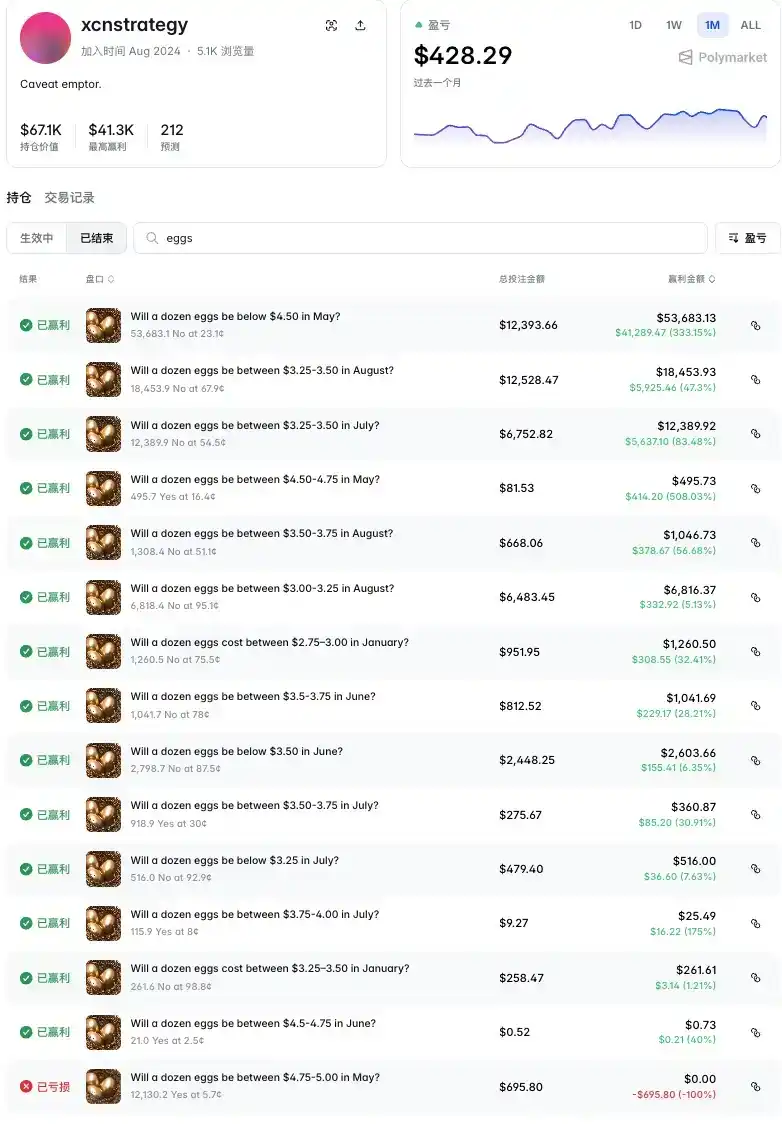
A trader with the ID "xcnstrategy" established positions in multiple expiration months—January, May, June, July, and August—for egg price predictions. The vast majority of these trades were shorting the "Yes" for certain price ranges, meaning betting that eggs would not reach certain price levels. The total betting amount was $44,800, with nearly $100,000 in profits. Out of 15 trades, all but the first were profitable.

The most recent trade was also the most profitable: a $12,393 bet on "No" for "a dozen eggs in May below $4.50," yielding a profit of $41,289 (+333%).

Speculations about xcnstrategy’s true identity, aside from possibly being an "egg enthusiast," include many who believe he is likely someone with a commodities market background or agricultural data research capabilities, analyzing that the U.S. avian flu-induced egg price surge starting in 2025 was a short-term phenomenon and that the market overestimated the probability of sustained high prices. Others think he is an industry insider in the egg supply chain, hedging against the volatility inherent in the industry.
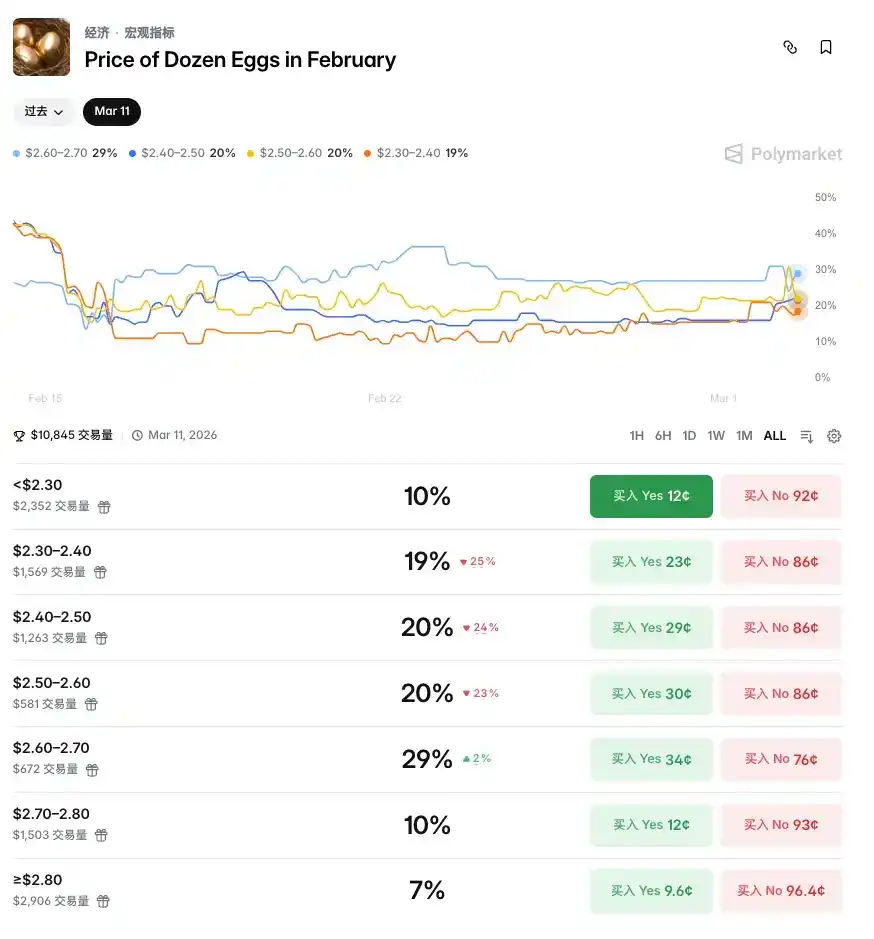
Eggs are just one example. The traditional asset标的 available for trading on Polymarket are far more diverse than one might imagine: from crude oil (CL), gold (GC), silver (SI), and other commodities to various foreign exchange rates and housing data—all can be found as markets on Polymarket.
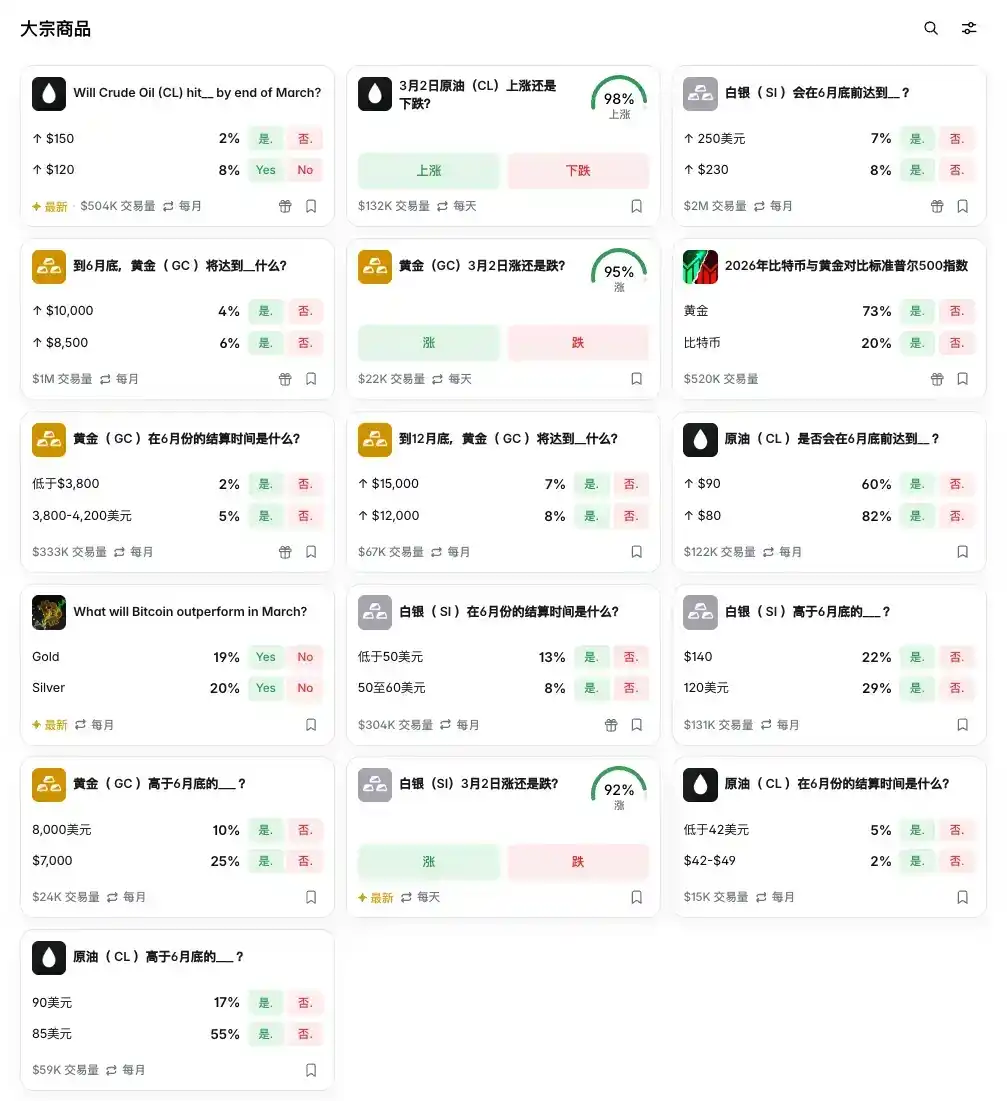
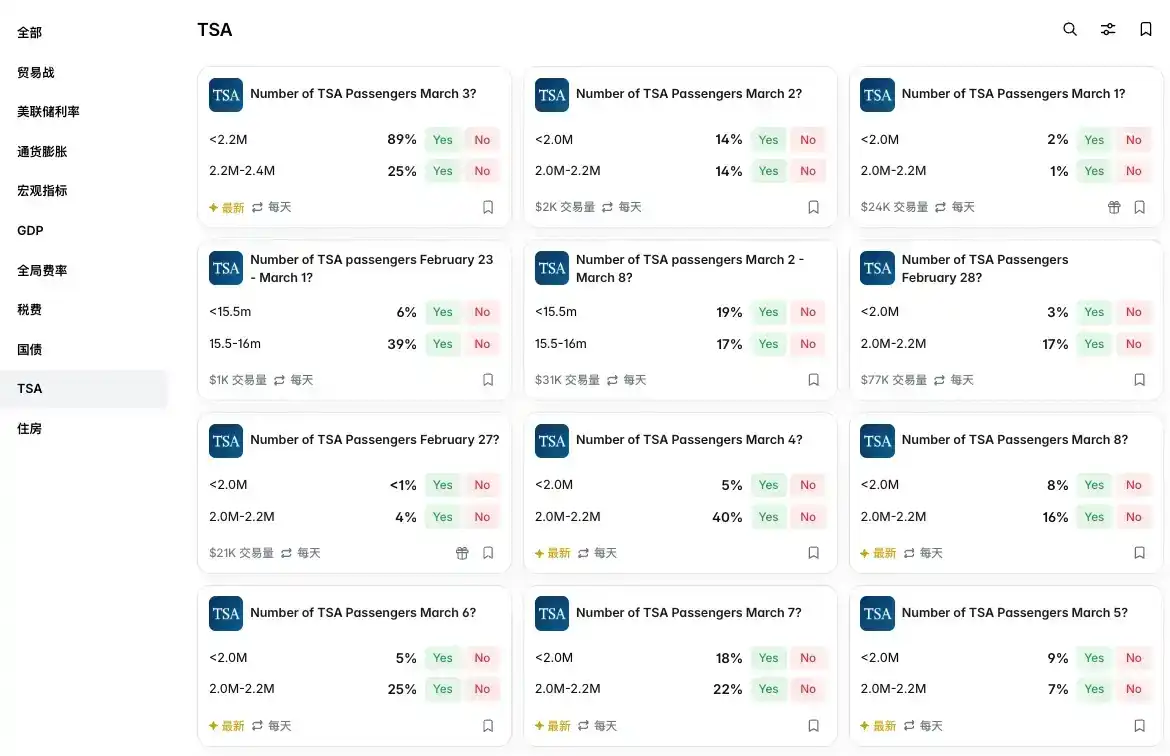
Operating 24/7 without closing is one of the biggest advantages of trading such markets on Polymarket. This advantage is particularly evident during traditional financial market closures, as seen with the U.S.-Iran conflict escalation last weekend.

In this regard, Hyperliquid shares the same advantage. The perpetual contracts on Hyperliquid, linked to crude oil and gold, have no expiration dates and run continuously, 24/7.

This leads to an increasingly hard-to-ignore phenomenon: the crypto market is quietly taking on the price discovery function of traditional financial markets, especially when the latter are closed.

Traditional futures markets have fixed trading hours; CME's crude oil and gold contracts close on weekends, and foreign exchange markets see liquidity dry up late at night. This means that when geopolitical shocks erupt after Friday's close, participants are left in the dark—unable to hedge, express views, or price assets.

Last weekend's U.S.-Iran conflict escalation is the latest validation. According to Bloomberg, around the time the conflict broke out, a large number of traders flocked to Hyperliquid to trade perpetual contracts linked to crude oil and gold to hedge against the geopolitical shock—while traditional markets were shut, crypto derivatives markets were the only place with the lights on. Investment firm executive Avi Felman had previously predicted that "Hyperliquid will become indispensable for fund managers because it’s 24/7." This judgment was concretely validated during this conflict.

At the same time, gold tokenization is accelerating another logic: when gold exists in the form of on-chain tokens and is continuously priced in decentralized markets, it no longer needs to wait for the London Metal Exchange or CME to open. To some extent, the tokenized gold market is acting as a "shadow pre-market" for traditional gold markets, pricing gold over the weekend and allowing price discovery to occur before traditional markets open.

In 2020, then the world's second-largest trading platform, FTX, launched tokenized stocks, allowing platform users to trade Tesla and NVIDIA shares with stablecoins. The idea was to capture pricing power—when U.S. stocks were closed, FTX's Tesla tokens could fill the market void, allowing users to trade Tesla stock when the company announced new models on Saturday, thereby influencing Nasdaq's Monday opening.

Unfortunately, due to liquidity issues, the pricing effect ultimately did not materialize. Six years later, tokenization has come full circle back to this vision. Today, Polymarket and Hyperliquid are viewed not merely as cryptocurrency trading platforms. Polymarket is already officially recognized as a public opinion polling agency and information exchange hub, while Hyperliquid is seen as a new type of full-asset trading platform.

Price discovery power has always been one of the core powers in financial infrastructure.

Back in the day, Chicago butter and egg merchants established the CME because they needed a venue to discover prices and transfer risks. Over a hundred years later, the same logic is replaying on-chain, only the medium has changed.

You might think the market is trading eggs, but in reality, the market is fighting for pricing power.

Câu hỏi Liên quan

QWhat was the original name of the Chicago Mercantile Exchange (CME) and what products did it initially trade?

AThe original name was the Chicago Butter and Egg Board, and it initially traded only two products: butter and eggs.

QWhy did the trading of egg futures decline and eventually cease on the CME in 1982?

AThe decline was due to the rapid industrialization of the U.S. egg-laying industry and the maturation of the cold chain, which smoothed out price volatility, reducing the uncertainty and need for hedging, leading to its quiet discontinuation.

QWhat is the significant advantage of trading assets like eggs, oil, and gold on platforms like Polymarket and Hyperliquid compared to traditional markets?

AThe significant advantage is that they operate 24/7, allowing for continuous trading, price discovery, and risk management even when traditional financial markets are closed, such as during weekends or overnight.

QAccording to the article, how did the recent U.S.-Iran conflict demonstrate the value of crypto derivative markets like Hyperliquid?

AWhen the conflict escalated over a weekend, traditional markets were closed, but traders flocked to Hyperliquid to trade perpetual contracts linked to oil and gold, making it the only available venue to hedge risks and express market views, thus validating its role in pricing during off-hours.

QWhat broader financial function are platforms like Polymarket and Hyperliquid increasingly seen as fulfilling, beyond just trading cryptocurrencies?

AThey are increasingly seen as fulfilling the core financial function of price discovery and acting as information hubs or full-asset trading platforms, effectively competing for pricing power that was traditionally held by established exchanges like the CME.

Nội dung Liên quan

TechFlow Tình Báo Cục: Tỷ Lệ IPO Của Anthropic Trên 80%, Iran Đóng Eo Biển Hormuz Lần Nữa Gây Chấn Động Giá Dầu

Thị trường dự kiến Anthropic sẽ công bố IPO trước tháng 11/2026, đặt câu hỏi về việc liệu định giá nghìn tỷ USD có tương thích với cam kết an toàn AI của họ hay không. Cùng lúc, các thương hiệu đang sử dụng người có ảnh hưởng ảo AI để tiếp thị sản phẩm. Về tiền mã hóa/Web3, quân đội Iran thông báo đóng cửa lại eo biển Hormuz, gây ra biến động giá dầu, mặc dù dữ liệu theo dõi tàu cho thấy một số tuyến đường vẫn hoạt động. Iran cũng đã nối lại hoạt động bốc dầu tại đảo Kharg, có thể đưa tới 20 triệu thùng dầu ra thị trường. Trong lĩnh vực chip/phần cứng, Goldman Sachs cảnh báo đầu tư vốn 5,3 nghìn tỷ USD vào AI có thể đang chạm đến giới hạn bão hòa tín dụng. Các tin tức công nghệ đáng chú ý: Cloudflare ra mắt tính năng tài khoản tạm thời cho AI agent; lưu lượng IPv6 của Google vượt 50%; Tập đoàn Hyundai Motor có kế hoạch mua lại cổ phần của Boston Dynamics. Trên thị trường chứng khoán Mỹ, các nhà đầu tư nhỏ lẻ đã đổ 370 triệu USD vào SpaceX trong ba ngày, tạo ra làn sóng mua vào mạnh mẽ. Về tài chính vĩ mô, thị trường tín dụng châu Âu báo động khi xảy ra vỡ nợ trái phiếu CLO đầu tiên kể từ sau khủng hoảng, trong khi Nomura cảnh báo về khả năng chuyển hướng chính sách thắt chặt từ Fed. Đường dây ngầm của ngày hôm nay chỉ ra rằng các sự kiện như đóng cửa eo biển Hormuz, vỡ nợ CLO ở châu Âu và cảnh báo về chi tiêu vốn AI đều phản ánh một logic chung: thanh khoản toàn cầu đang thắt chặt và chi phí biên đang tăng lên trên nhiều lĩnh vực. Trong bối cảnh đó, vốn vẫn không ngừng tìm kiếm các câu chuyện tăng trưởng mới, như những tầm nhìn lớn về du hành phản vật chất của Musk hay cơn sốt IPO từ Anthropic và SpaceX.

marsbit11 giờ trước

TechFlow Tình Báo Cục: Tỷ Lệ IPO Của Anthropic Trên 80%, Iran Đóng Eo Biển Hormuz Lần Nữa Gây Chấn Động Giá Dầu

marsbit11 giờ trước

Tỷ Lệ ETH/BTC Quay Lại Mức Đầu Năm 2023 Khi Nhà Giao Dịch Tranh Luận Về Giá Trị Của Ethereum

Tỷ lệ ETH/BTC đã giảm xuống mức 0.027, tương đương với các mức đầu năm 2023, trong khi ở đỉnh năm 2021, tỷ lệ này là 0.088. Điều này cho thấy Ethereum hiện đang rẻ một cách lịch sử so với Bitcoin, dấy lên cuộc tranh luận giữa việc đây là cơ hội đầu tư ngược chiều hay dấu hiệu của một sự suy giảm cấu trúc. Trên biểu đồ ETH/USDT, một phân tích riêng biệt chỉ ra rằng Ethereum có nguy cơ điều chỉnh giảm sau khi mở cửa tuần mạnh, với cấu trúc thị trường bị phá vỡ và giá đảo chiều dưới mức cao 1.774 USD. Kế hoạch giao dịch được đề cập tập trung vào việc bán ra khi giá kiểm tra lại vùng nhập lệnh khoảng 1.723 USD. Sự kết hợp giữa tỷ giá ETH/BTC thấp và áp lực điều chỉnh trên biểu đồ ETH/USDT tạo ra một thiết lập cơ hội nhưng cũng đầy rủi ro. Ethereum có thể trông rẻ hơn so với Bitcoin, nhưng sức mạnh kỹ thuật vẫn đang cho thấy dấu hiệu yếu đi. Đối với những nhà đầu tư lạc quan về ETH, nhiệm vụ trước mắt là chứng minh được sức mạnh kỹ thuật và bắt đầu thể hiện hiệu suất vượt trội so với Bitcoin một lần nữa.

bitcoinist11 giờ trước

Tỷ Lệ ETH/BTC Quay Lại Mức Đầu Năm 2023 Khi Nhà Giao Dịch Tranh Luận Về Giá Trị Của Ethereum

bitcoinist11 giờ trước

Giao dịch

Giao ngay
Hợp đồng Tương lai
活动图片