My Coding Betting Dashboard is Profiting, but Polymarket is Truly Not a Good Place for 'Arbitrage'

marsbitXuất bản vào 2026-06-18Cập nhật gần nhất vào 2026-06-18

Tóm tắt

The author built a custom monitoring dashboard for Polymarket, a prediction market platform, and tested it with $1,600, achieving over 30% returns. However, the core argument is that Polymarket is not a good venue for traditional arbitrage. The dashboard has two main sections: a "Portfolio Dashboard" for tracking active positions with key metrics like total capital, P&L, and a risk-control module using a tier system (T1, T2, T3), and an "Opportunity Watchlist" for monitoring markets. The article details a critical structural trap in binary markets: a bet with a high perceived probability of success still carries a 100% loss risk if wrong. The author's T1/T2/T3 system is designed to manage this by limiting position sizes based on conviction and time horizon, emphasizing that high confidence should not equal high concentration. A key insight is the danger of "pseudo-diversification"—betting on different markets driven by the same underlying variable. The author concludes that Polymarket offers few true low-risk, arbitrage opportunities. It is instead a high-risk environment where wins can create a false sense of mastery, leading to large losses. The platform is better viewed as a training ground for honing judgment through disciplined, framework-driven betting rather than a reliable income source. The tools help transform intuition into structured, rule-based decisions to mitigate the risk of catastrophic errors.

Author: Too Happy Tyler

A couple of days ago, in the article "I Built an Investment Workstation for Myself Using AI," I shared several tools I coded: a cross-market asset dashboard, an investment map, a personal content operations console, and a Polymarket betting monitoring dashboard that I've been using frequently lately.

Over the past half month, I used about $1600 in principal for real-world testing and generated over 30% return. The real-time statistics on the dashboard and the final actual net profit basically matched, with only a discrepancy of around $6, which was due to small errors like limit orders/liquidity rewards and such.

But what I actually want to say in this article is not "Polymarket is great for making money," and I certainly don't want to package it as some arbitrage tutorial.

On the contrary, after running through this round, I increasingly feel that Polymarket is not a place suitable for charging in with the notion of 'arbitrage' in mind.
1. First, let's talk about what this dashboard is about

I started manually building this dashboard around May 21.

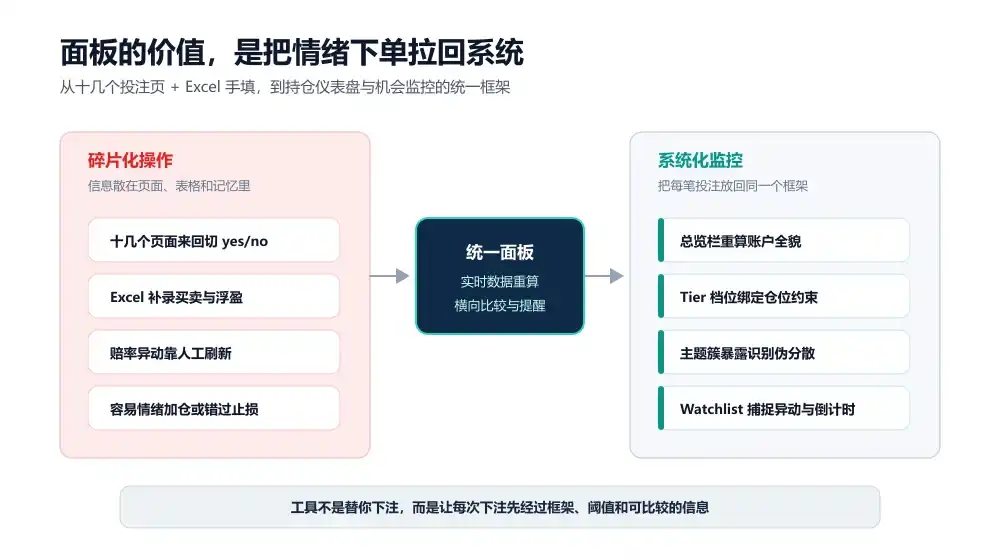
The initial need was simple: I didn't want to open a dozen betting pages each time and switch back and forth between yes/no price changes, and I also didn't want to manually record everything in Excel anymore.

Yes, before this, I was using Excel to record buys/sells, floating P&L, settlement dates, event types—the clumsy method for a clumsy person.

But as those who have actually played on it know, many bets on Polymarket are extremely prone to getting out of control precisely because manual recording methods are functionally poor. For example, you might initially just want to buy a little, but when the odds move, you might want to add more, given the lack of an intuitive feel. Or, if a specific betting event suddenly moves and you don't update the spreadsheet data in time, it's easy to miss the window for stop-loss/adding positions, and so on.

Ultimately, the whole process is too fragmented. Without a system, it's easy for people to rely on emotions to place orders.

So from the start of building this dashboard, my goal was to place every bet back into a unified framework, turning that feeling into a relatively visualizable and horizontally comparable information presentation.
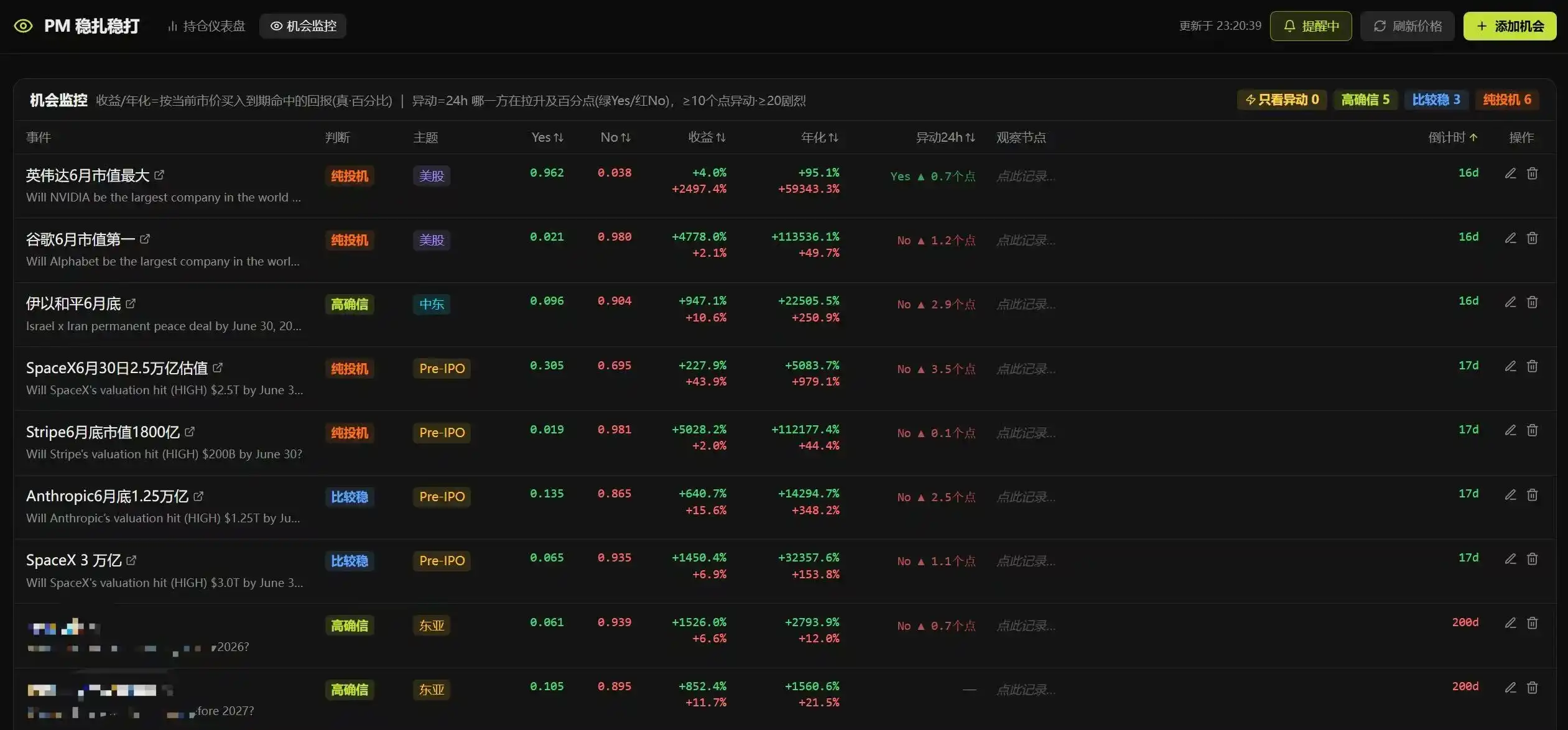
After several iterations, I split it into two tabs: "Portfolio Dashboard" + "Opportunity Monitor."

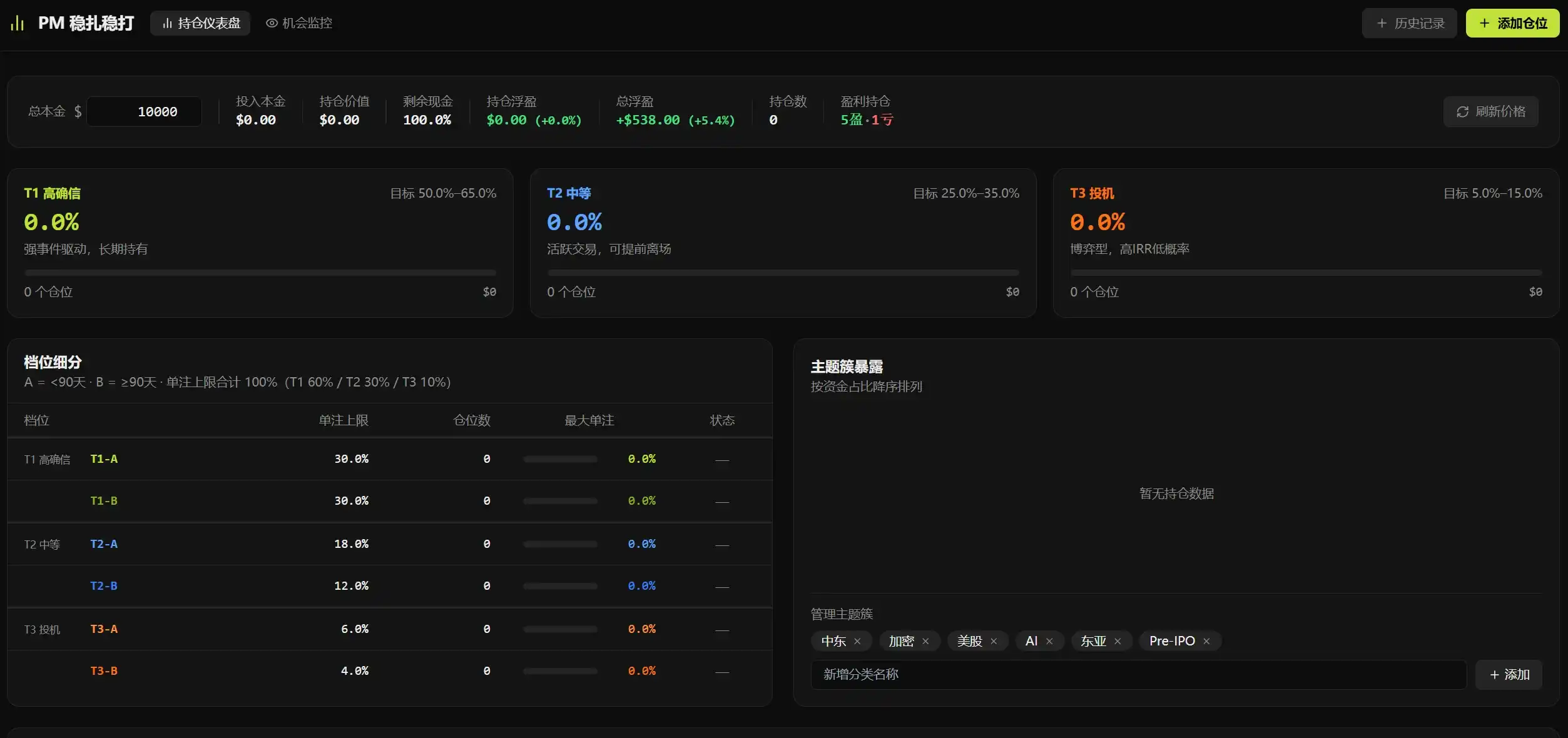
"Portfolio Dashboard" is the core of the entire panel, a dynamic system that can fetch PM's real-time data and recalculate. It's divided into several functional areas (you can refer to the image at the beginning of the article):

  • Overview Bar: Total principal (planned, actual reference is minimal), invested principal, portfolio value, portfolio floating P&L, total floating P&L (including closed positions)—a quick glance at the full account picture.
  • Tier Allocation: This is the core risk management module of the dashboard, and in my opinion, the most counterintuitive yet important area. I'll keep you in suspense and explain it in detail in the next section.
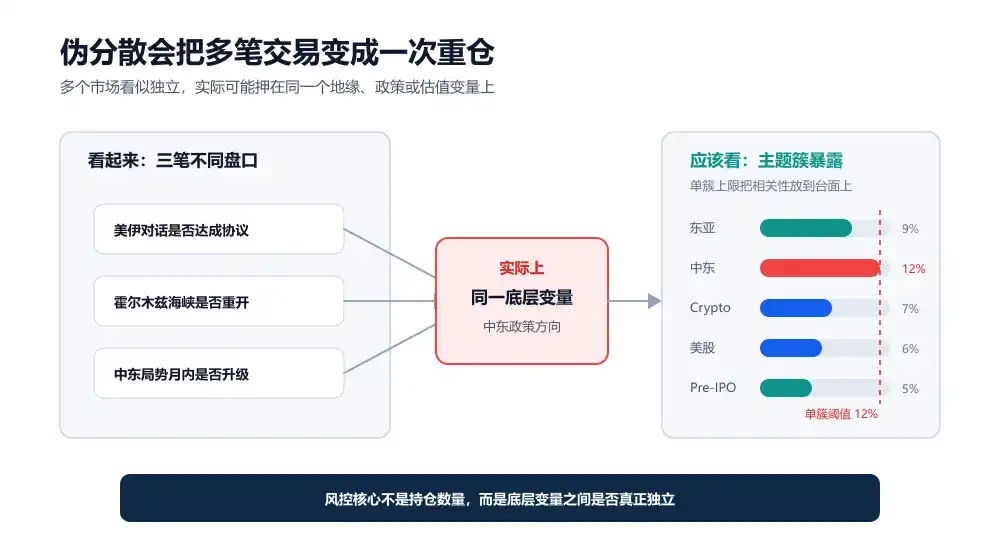
  • Theme Cluster Exposure: I tagged each bet with a "Theme Cluster" label, categorized into East Asia, Middle East, Crypto, US Stocks, Pre-IPO (customizable, can add/delete). The dashboard automatically aggregates the proportion of each cluster and sets a 12% single-cluster upper limit threshold. Why design it this way? Mainly to combat the most hidden trap on PM—pseudo-diversification. More on that later.
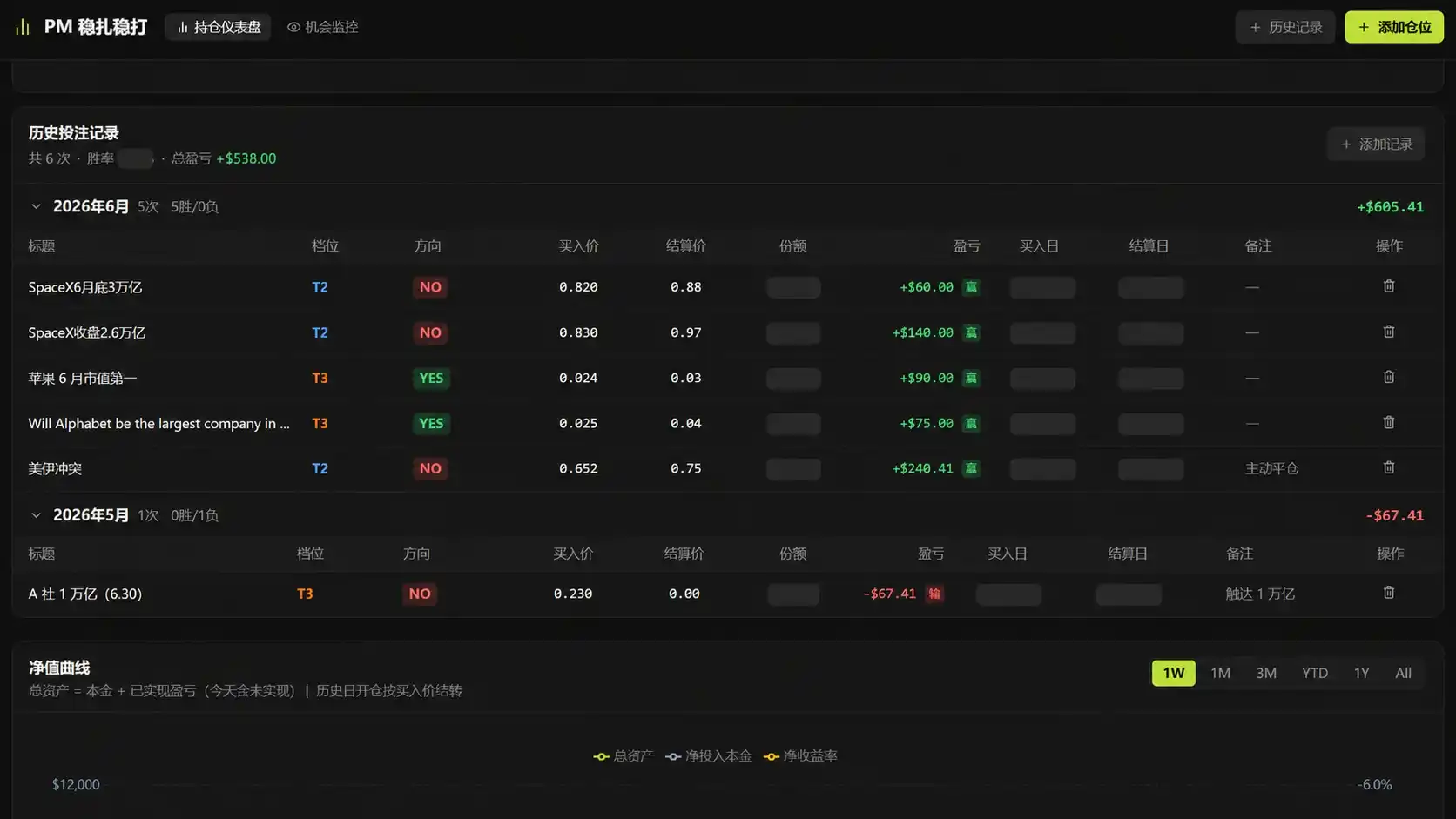
  • Single Position Details: Tier, direction (yes/no), buy price, settlement price, shares, profit/loss, buy date, settlement date, notes, etc. Each line is clear at a glance, and it supports sorting ascending/descending and filtering by tags.
"Opportunity Monitor" is a watchlist where I put markets I'm watching but haven't bet on yet.

Each market records several key fields, including event name (with a hyperlink directly to the trading page), T1/T2/T3 stratification judgment, current yes/no price, return, annualized return, anomalies (customizable thresholds, e.g., anomalies exceeding 20% within 24 hours trigger a pop-up as long as the webpage is open), my set observation nodes, and a countdown to bet expiration.

There are two small design features I'm quite satisfied with: First, I found a suitable PM interface to parse the webpage link of the betting event. It automatically prompts for yes/no options, corresponding prices, and categorizes different options under the same event, greatly reducing manual entry hassle. Second, the Tier assignment for the same bet automatically rearranges as the remaining days change.

Not long ago, before Anthropic released Mython, there were obvious price anomalies in the watchlist, basically indicating a high-probability, high-certainty event. Entering at that time could have yielded about a 10-point gain—such opportunities are hard to capture consistently without a watchlist.
2. PM's Mathematical Expectation Trap and the "T1, T2, T3" Design Principle

The above is a simple introduction. What I really want to discuss is a thought I had after practical testing.

That is, in binary markets like PM, there exists a significant structural trap that is very unfriendly to players who like "single large positions" but is more suitable for those accustomed to "opening a supermarket, buying a whole bunch"—diversified allocation.

I'll try to explain my thinking clearly. If there are any errors or omissions, just pretend you didn't see them:

Suppose the yes price c for a betting event is 0.80, meaning the market believes there's about an 80% probability this event will happen. If I judge the true probability q of this event occurring is 0.90, then the expected return rate for this bet can be roughly calculated as:

EV = q / c - 1 = 0.90/0.80 - 1 = 12.5%

This looks good, but PM is not a bond. Behind this 12.5% lies a sharp tail risk: if your judgment is wrong, the loss isn't 12.5%, but 100%.

So in my dashboard, I don't just look at "expected return rate." I also monitor two things simultaneously:

  • One is the gap between my own probability judgment and the market price, i.e., q - c (I have an automatic profit-taking reminder target set, which is the midpoint between the buy price and 100). This is the core of whether an edge truly exists.
  • The other is the impact on the total account if this event is wrong and the single position goes to zero.
The second reason is also the origin of the T1, T2, T3 stratification I mentioned in the first chapter.

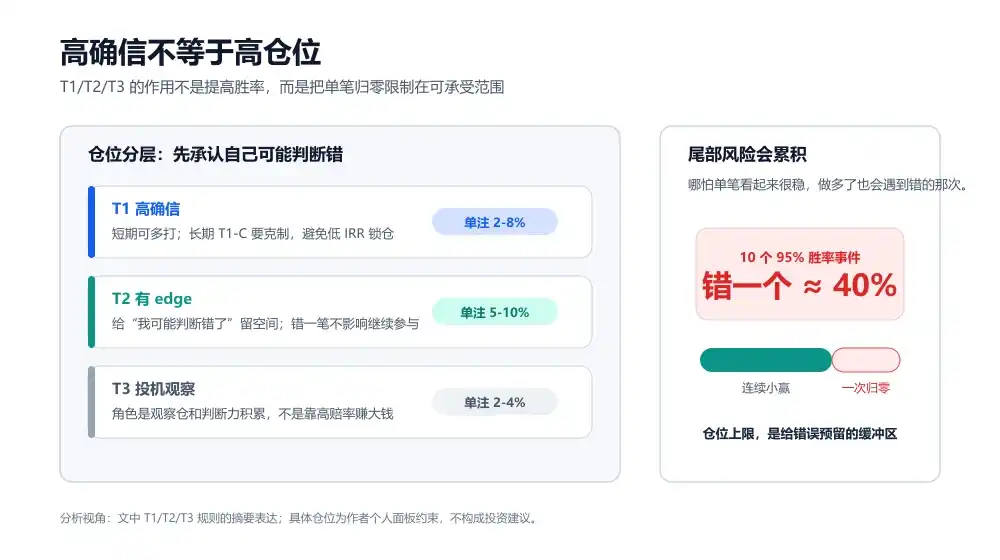
Simply put, I divided them into three categories:

  • T1 High Conviction: For me, the comfort zone lies in matters involving East Asia and some geopolitics where I feel there's an information gap between East and West. After repeated verification, I add these.
  • T2 Relatively Stable: Some where I feel the current implied probability is significantly higher/lower than the actual yes/no pricing.
  • T3 Pure Speculation: Those with very high odds, and these shouldn't be held long. Best for betting against the trend (搏反搏), expecting them to revert to a certain price to capture short-term gains.

But it's also important to note that T1 has hidden costs, especially in long-term bets. For example, a T1-level bet might have a static return of 18%, but if settlement is in 180 days, the annualized IRR might only be 3–4%, worse than leaving the money idle. During that time, the capital is locked up, and you might miss later high-IRR opportunities.

So within T1, I further break it down into several time brackets (this part is purely personal thinking, so I won't share it further). Anyway, short-term T1-A can be allocated more, long-term T1-C needs restraint. Allocating too many low-IRR long-term bets is a hidden drag on capital efficiency.

T2 has edge, but leave room for "being wrong." The single-bet upper limit is 8–10%, meaning even if this bet loses completely, the total account loss is controlled within 10%, not affecting participation in future opportunities.

T3 odds are tempting, but use minimal position size to observe. Don't expect to make big money from it. Instead, it's for betting against the trend and capturing short-term reversion—keeping yourself continuously tracking high-odds events to accumulate a feel for such markets.

Overall, position limits are essentially about leaving space for the acceptable cost of "I might be wrong."

Here's a very counterintuitive but particularly important point: high conviction does not equal high position size. Even if you think an event has a 95% probability of happening, as long as there's a 5% chance of it going to zero, the position size must be restricted.

Take an extreme example: Suppose you make 10 consecutive bets you think have a 95% win rate. Each sounds very safe, but as long as they are independent of each other, the probability of getting at least one wrong is roughly 1 - 0.95^10 ≈ 40%.

If you do it enough, you'll eventually encounter that wrong one.

And that's just for independent events. In reality, many PM markets are not independent; they often have correlations. For example, "Will US-Iran talks reach an agreement?", "Will the Strait of Hormuz reopen?", "Will Middle East tensions escalate within the month?" These three bets look like three independent markets, but the underlying variable is almost the same—Middle East geopolitical policy direction. Once the judgment on that direction is wrong, all three bleed simultaneously.

This has been the biggest help for me—not improving win rate, but limiting myself from making big mistakes. Frankly, the core value of this dashboard isn't profit statistics; it's risk control.

3. My Real View on Polymarket After This Round

After this half-month of deep, hands-on testing, my biggest takeaway is: There are opportunities on Polymarket, but it's absolutely not the arbitrage paradise many imagine it to be.

Previously, when we played with on-chain arbitrage, the rules were mostly clear, and price misalignments could be locked in. But Polymarket is different. It heavily tests your logical understanding of the shifts in sentiment around a particular bet (this point feels hard to express precisely in words).

For example, regarding East Asian-related political and economic dynamics, Chinese-speaking users might indeed have some information gap advantage, which is worth exploring. But this doesn't guarantee you'll win. Polymarket ultimately settles not based on "your understood reality" but based on market rules and designated data sources (UMA's manipulation issues are also not uncommon).

Moreover, just because you think something is a sure thing in the Chinese context doesn't mean the definition is the same in the English rules, especially since the rule settings for each bet often contain textual traps.

So based on my actual experience, PM doesn't have that many arbitrage opportunities. It mainly relies on information gaps and position diversification. Even high-conviction bets can encounter black swans.

Once you encounter one, the principal is completely gone.

As a friend said, "In investment, even if there's only a 1% chance of going to zero, one shouldn't be complacent."

Because the mathematical expectation of that, in the long run, is negative.
So my understanding of PM is now more conservative:

  • First, don't treat it as a stable income tool, even for high-conviction bets. Especially after you win several times in a row, don't think you've found a cash machine. The scariest thing about binary markets is that they make you, after consecutive wins, mistakenly believe you can judge everything, leading to one large final position that wipes out all previous profits.
  • Second, don't equate high win rate with a good trade. An event with a 90% win rate, if the market price is already 0.95, might actually have negative expectation. Conversely, an event with only a 40% win rate, if the market only prices it at 0.20, might have positive expectation.
  • Third, don't ignore tail risk. This is especially important. Many people see 10%, 20% returns and think it's stable. But as long as being wrong on that trade means going to zero, it's not a low-risk return in the traditional sense (from this perspective, I even think there are no so-called low-risk opportunities on PM; every one is high-risk).
  • Fourth, avoid pseudo-diversification. Buying multiple different markets isn't necessarily diversification. For example, the three bets mentioned earlier—"Will US-Iran talks reach an agreement?", "Will the Strait of Hormuz reopen?", "Will Middle East tensions escalate within the month?"—look like three independent markets, but the underlying variable is almost the same.

So I'm now more willing to treat PM as a judgment training ground.

It happens to complement the political, economic, tech, and financial news I, as a homebody, love to browse daily, turning those judgments that usually stay at the "I think" level into something that can provide positive feedback.

These abilities are useful outside of PM as well.

By the way, besides this PM betting dashboard, I also used Codex to build a private market valuation dynamic monitoring dashboard, mainly tracking valuation changes of pre-IPO unicorn companies—Anthropic, OpenAI, Stripe, Kraken, etc.—in the private market, and the relationship between these changes and the corresponding bets on PM.

Polymarket is essentially a prediction market. Sometimes signals in the private market are already changing, but PM prices haven't moved yet. Other times, PM prices move first, and real-world data hasn't caught up. The misalignment between the two is worth continuous observation.

Of course, there's no risk-free arbitrage here either. Private market valuations themselves aren't fully transparent, and there might be discrepancies between different data sources. But as an observation framework, it's quite interesting. I'll find an opportunity to write a separate article about it later.

Too Happy's Summary

From beginning to end, what this article wants to say is never "I made 30% with my dashboard, you can too."

I think what's more useful is being able to create a tool that helps you turn feeling into a framework, and turn framework into discipline. Often, when many people make money, it doesn't mean they've found some secret formula; it only means their judgment happened to be right this round.

This distinction is important.

I also recommend everyone start trying Vibe Coding. It doesn't necessarily have to be with Claude Code; you can try Codex, or even Kimi Work recently launched by Kimi. If anyone has difficulties subscribing to overseas services, I can share some smooth methods I use later.


Câu hỏi Liên quan

QWhat is the author's primary conclusion about Polymarket after their test run?

AThe author concludes that Polymarket is not a good place for traditional 'arbitrage' seeking. They found it is not about locking in risk-free price differences, but is more suited for exploiting information advantages and requires strict discipline in position sizing and diversification due to high tail risks, where any single bet can result in a 100% loss.

QWhat is the core function and value of the 'Position Dashboard' the author built?

AThe core function and value of the 'Position Dashboard' is risk control. It visualizes all bets within a unified framework to combat emotional decision-making. Its key risk modules include position sizing based on T1/T2/T3 confidence tiers and monitoring 'theme cluster' exposure to prevent false diversification on correlated events.

QAccording to the author, what is the 'structural trap' in binary markets like Polymarket?

AThe 'structural trap' is the mismatch between expected return and potential loss. While a bet might show a positive expected value based on a perceived probability edge, the actual risk is not that percentage gain but a potential 100% loss of the staked amount if the prediction is wrong, which is a sharp tail risk.

QHow does the author define and handle T1, T2, and T3 bets in their strategy?

AThe author defines bets in three tiers: T1 (High Conviction - e.g., events with an East-West information gap), T2 (Relatively Stable - events with a clear edge between implied and actual probability), and T3 (Pure Speculation - high-odds bets for short-term mean reversion). The handling involves strict position caps (e.g., 8-10% for T2) and awareness that high conviction does not equal high position size, to limit the damage from being wrong.

QWhat important distinction does the author make between 'high win rate' and a 'good trade' on Polymarket?

AThe author states that a high win rate does not necessarily mean a good trade. An event with a 90% perceived probability is a negative expectation trade if the market price is 0.95. Conversely, an event with only a 40% chance could be a positive expectation trade if the market prices it at 0.20. The key is the discrepancy between one's judgment and the market price.

Nội dung Liên quan

Giới thiệu: La bàn Thị trường

Glassnode ra mắt Market Compass, một công cụ tổng hợp dữ liệu giải quyết thách thức trong việc chọn lọc chỉ báo giữa hàng ngàn số liệu. Nó sử dụng bảy "lăng kính" (lens) để đánh giá thị trường Bitcoin, mỗi lăng kính được chấm điểm từ 0-100 và phân loại thành các trạng thái cụ thể. Bốn lăng kính có tính dự báo (Vĩ mô, Dòng vốn, Hành vi Nhà đầu tư, Cơ bản On-Chain) được kết hợp thành điểm tổng hợp (headline score) từ "Risk-Off" đến "Risk-On". Ba lăng kính độc lập (Vị trí Chu kỳ, Phái sinh, Luân chuyển Tài sản) mô tả cấu trúc thị trường hiện tại. Bản đọc hiện tại (với Bitcoin quanh 64.400 USD) cho thấy điểm tổng hợp là 14/100 (Risk-Off), phản ánh giai đoạn thị trường giảm thực sự. Điểm này chủ yếu bị kéo xuống bởi lăng kính Vĩ mô (23 - Thắt chặt) do đồng USD mạnh. Tuy nhiên, ba trong số bốn lăng kính dự báo khác đang cho thấy dấu hiệu phục hồi nhẹ từ đáy, cho thấy sự sửa chữa nội tại. Các lăng kính độc lập bổ sung bối cảnh: vị trí chu kỳ ở trạng thái "Capitulation", sổ đặt hàng phái sinh ở trạng thái "Light" (được phòng ngừa rủi ro tốt), và chỉ số luân chuyển cho thấy vốn đang nghiêng về altcoin chủ yếu do chúng giảm ít hơn Bitcoin chứ không phải do một đợt tăng mới. Tóm lại, Market Compass mô tả một thị trường đang trong giai đoạn tìm đáy nhưng chưa có sự đảo chiều rõ ràng, với chìa khóa then chốt là đồng USD cần giảm trở lại dưới đường trung bình 200 ngày.

insights.glassnode4 giờ trước

Giới thiệu: La bàn Thị trường

insights.glassnode4 giờ trước

Nvidia CPU áp sát, RISC-V Trung Quốc đối đầu: Quan sát sâu về bán dẫn (Phần 4)

Tuần này, tin tức về việc NVIDIA chuẩn bị cung cấp CPU Vera cho khách hàng Trung Quốc từ tháng 8, với giá hơn 20.000 USD mỗi chip, một lần nữa làm nổi bật bài toán về sự phụ thuộc vào kiến trúc Arm và nhu cầu cấp thiết về một lựa chọn thay thế tự chủ, kiểm soát được cho hạ tầng AI. Trong bối cảnh đó, RISC-V đang nổi lên như một con đường tiềm năng, được thúc đẩy mạnh mẽ tại Trung Quốc đại lục bởi nhu cầu an ninh chuỗi cung ứng, giảm chi phí, chủ quyền công nghệ và làn sóng ứng dụng AI. Mặc dù đã thành công trong lĩnh vực nhúng, RISC-V đang chinh phục thách thức lớn nhất: điện toán hiệu năng cao (HPC) cho máy chủ và trung tâm dữ liệu. Ngành công nghiệp coi điểm chuẩn SPECint 15 (trên mỗi GHz) là "tấm vé vào cửa" cho câu lạc bộ HPC. Nhiều công ty Trung Quốc, cả từ cộng đồng mã nguồn mở lẫn thương mại, tuyên bố đã đạt hoặc vượt ngưỡng này, với xung nhịp vượt 3 GHz. Sự tiến bộ không chỉ dừng ở lõi đơn lẻ; trọng tâm đã chuyển sang toàn bộ "hệ thống con tính toán", bao gồm mạng NoC nhất quán, các tính năng RAS, quản lý từ xa (BMC/IPMI) và khả năng chịu lỗi (Partial Goods). Một bước ngoặt quan trọng là sự xuất hiện của bộ xử lý máy chủ RISC-V 40 lõi, tuân thủ 100% tiêu chuẩn RVA23 mà không có tập lệnh tùy chỉnh, thể hiện cam kết về khả năng tương thích phần mềm lâu dài thay vì tối ưu hóa điểm chuẩn ngắn hạn. Lợi thế cốt lõi của RISC-V nằm ở kiến trúc mô-đun mở, cho phép tùy chỉnh sâu cho các tải AI đa dạng và tiềm năng thống nhất ngăn xếp phần mềm, giảm gánh nặng trùng lặp cho các nhà phát triển chip AI. Tuy nhiên, con đường phía trước vẫn còn nhiều thách thức "cứng": hệ sinh thái phần mềm chưa hoàn thiện và bị phân mảnh, công cụ EDA và xác minh thiết kế còn hạn chế, hiệu suất và hiệu suất năng lượng trên mỗi lõi cần được cải thiện, cùng với những ràng buộc về công nghệ bán dẫn tiên tiến. Tóm lại, khi NVIDIA với Vera tiếp tục thống trị, RISC-V đại diện cho một con đường chiến lược dài hạn cho Trung Quốc. Cánh cửa vào thị trường HPC đã mở với những tiến bộ đáng kể về phần cứng và tư duy hệ thống. Tuy nhiên, hành trình để phá vỡ "tam giác bất khả thi" (thịnh vượng, kiểm soát, tự chủ) và xây dựng một hệ sinh thái cạnh tranh với các pháo đài như CUDA của NVIDIA vẫn còn dài và đòi hỏi sự kiên trì giải quyết những công việc khó khăn, kém hào nhoáng trong nhiều năm tới.

marsbit5 giờ trước

Nvidia CPU áp sát, RISC-V Trung Quốc đối đầu: Quan sát sâu về bán dẫn (Phần 4)

marsbit5 giờ trước

Stratosphere, Pudgy Penguins và Streamex Đồng Tổ Chức Bữa Tối VIP Founders Table Trong Khuôn Khổ ETHConf 2026 và NYC Tech Week

Vào ngày 9 tháng 6 năm 2026 tại New York, Stratosphere cùng với Pudgy Penguins và Streamex đã tổ chức bữa tối VIP Founders Table kín trong khuôn khổ ETHConf 2026 và NYC Tech Week. Sự kiện chỉ dành cho khách mời đã quy tụ các nhà lãnh đạo từ nhiều lĩnh vực bao gồm tài sản kỹ thuật số, công nghệ, AI, tài chính truyền thống và vốn tổ chức. Các khách mời tham dự đến từ các tổ chức hàng đầu như Citi, BitMine, BitGo, Pyth Network, Delphi Digital và nhiều công ty khác. Mục tiêu của hình thức Founders Table là tạo một không gian riêng tư, không có chương trình nghị sự sân khấu, để các cuộc trò chuyện diễn ra tự nhiên giữa những người có ảnh hưởng. Stratosphere đóng vai trò kết nối mạng lưới nhà sáng lập và nhà đầu tư, Pudgy Penguins mang thương hiệu cộng đồng mạnh mẽ, trong khi Streamex tập trung vào chủ đề token hóa vàng và hàng hóa. CEO Stratosphere, Hassan Shaikh, chia sẻ lạc quan về giai đoạn phát triển tiếp theo của tài sản kỹ thuật số, đặc biệt là token hóa hàng hóa. Bữa tối này củng cố vị thế của Stratosphere như một đối tác hệ sinh thái, giúp các dự án kết nối và phát triển bền vững. Chuỗi sự kiện Founders Table dự kiến sẽ tiếp tục được tổ chức xung quanh các hội nghị lớn trên toàn cầu.

TheNewsCrypto7 giờ trước

Stratosphere, Pudgy Penguins và Streamex Đồng Tổ Chức Bữa Tối VIP Founders Table Trong Khuôn Khổ ETHConf 2026 và NYC Tech Week

TheNewsCrypto7 giờ trước

Phân Tích Tăng Trưởng Notion: Từ Công Cụ Ghi Chú Đến 100 Triệu Người Dùng, Notion Xây Dựng Ba Vòng Xoáy Tăng Trưởng Về Sản Phẩm, Mẫu Và Cộng Đồng Như Thế Nào

Trong suốt hành trình 10 năm, Notion đã phát triển từ một công cụ ghi chú thành một nền tảng quản lý tri thức và cộng tác với 100 triệu người dùng, nhờ vào một hệ thống tăng trưởng phức tạp nhưng tự nhiên. Bài viết phân tích ba bánh đà tăng trưởng chồng lớp của Notion. **Bánh đà 1: Tăng trưởng dẫn dắt bởi Sản phẩm (Product-Led Growth):** Notion giảm thiểu rào cản bằng chiến lược miễn phí, cho phép người dùng cá nhân dễ dàng trải nghiệm giá trị ngay lập tức. Sản phẩm có tính lan truyền tự nhiên qua chia sẻ trang, mẫu và đặc biệt là cơ chế cộng tác, khiến người dùng tự mời đồng nghiệp tham gia, tạo ra hiệu ứng viral dựa trên nhu cầu công việc thực tế. **Bánh đà 2: Kinh tế Mẫu (Template Economy):** Để giải quyết vấn đề người dùng mới bối rối trước sự tự do của công cụ, hệ sinh thái mẫu đã ra đời. Các mẫu (từ chính thức và cộng đồng) biến khả năng trừu tượng thành giải pháp cụ thể, giảm chi phí kích hoạt và tạo kênh tăng trưởng SEO hiệu quả. Nó cũng tạo ra một cộng đồng người sáng tạo có lợi ích gắn liền với sự thành công của Notion. **Bánh đà 3: Tăng trưởng được Cộng đồng Thúc đẩy:** Cộng đồng Notion vượt xa một diễn đàn hỗ trợ, trở thành một tổ chức tăng trưởng phân tán. Người dùng không chỉ học hỏi mà còn cùng nhau sản xuất hướng dẫn, mẫu mã, case study và dịch thuật địa phương. Các chương trình như Đại sứ giúp Notion mở rộng toàn cầu một cách tự nhiên và đáng tin cậy. Cộng đồng biến người dùng thành nhà giáo dục và người truyền bá, tạo ra vòng tuần hoàn tự củng cố. **Mở rộng và Tương lai:** Notion tiến vào thị trường doanh nghiệp một cách tự nhiên theo hướng "từ dưới lên", thông qua việc thâm nhập từ các nhóm nhỏ và người dùng cá nhân trước. Trong thời đại AI, Notion tích hợp AI trực tiếp vào luồng công việc hiện có, nâng cấp giá trị sản phẩm và mẫu mã, mở ra cơ hội trở thành hệ điều hành công việc trong kỷ nguyên AI. Điều khó sao chép nhất ở Notion không phải là chức năng, mà là hệ sinh thái tổng thể đã được xây dựng: tài sản tri thức khổng lồ của người dùng, mạng lưới người sáng tạo, văn hóa cộng đồng và ba bánh đà tăng trưởng liên kết chặt chẽ, biến người dùng thành động lực phát triển liên tục cho chính nền tảng.

marsbit10 giờ trước

Phân Tích Tăng Trưởng Notion: Từ Công Cụ Ghi Chú Đến 100 Triệu Người Dùng, Notion Xây Dựng Ba Vòng Xoáy Tăng Trưởng Về Sản Phẩm, Mẫu Và Cộng Đồng Như Thế Nào

marsbit10 giờ trước

Hướng dẫn trải nghiệm thực tế thẻ AI WeChat: Liệu kỷ nguyên AI Shopping đã tới?

Tác giả: Alan | Biteye Content Team Ngày 17/6, WeChat chính thức ra mắt thẻ AI chuyên dụng. Theo mô tả, người dùng có thể đưa ra nhu cầu chi tiêu trong cuộc trò chuyện với Workbuddy (một Agent AI) và hoàn thành thanh toán qua thẻ này. Trải nghiệm thực tế cho thấy, đây không phải là tính năng "chi tiêu tự động hoàn toàn", mà là một lớp khả năng thanh toán được mở ra cho AI Agent, với mỗi giao dịch vẫn cần người dùng xác nhận. **Thẻ AI là gì?** Thẻ hoạt động như một "ví nhỏ" tách biệt với ví WeChat chính. Người dùng cần liên kết và nạp tiền vào thẻ này. Các giao dịch do AI khởi tạo sẽ ưu tiên trừ từ số dư độc lập này. **Cách kích hoạt:** Trong chat với Workbuddy, hỏi "Làm thế nào để sử dụng thẻ thanh toán AI chuyên dụng của WeChat?" -> Nhấp liên kết được cung cấp -> Quét mã QR bằng WeChat để liên kết và nạp tiền. **Các tình huống sử dụng được đề xuất:** Mua nội dung trả phí (báo cáo, dữ liệu), gọi API/tools trả phí, đăng ký/gia hạn dịch vụ. Tuy nhiên, tính năng này vẫn đang trong giai đoạn thử nghiệm và chưa dễ dàng tìm thấy các ứng dụng cụ thể. **Kiểm tra thực tế: Dùng Workbuddy đặt trà sữa Hi Tea (THẤT BẠI)** - Workbuddy không thể tự đặt hàng mà cần gọi Skill "Trợ lý sống Meituan". - Chỉ riêng việc tạo mã QR đăng nhập tài khoản Meituan đã tiêu tốn 185.37 điểm (vượt quá 150 điểm miễn phí nhận được mỗi ngày). - Sau khi đăng nhập và yêu cầu đặt trà, AI tạo được liên kết thanh toán qua thẻ AI. - Tuy nhiên, sau khi thanh toán, phát hiện AI đã mua nhầm một loại phiếu mua hàng (deal) trên Meituan không đúng với nhu cầu. **Nguyên nhân thất bại:** Vấn đề không nằm ở khả năng thanh toán của thẻ AI, mà ở chuỗi thực thi của Agent. Một tác vụ như "đặt trà sữa" đòi hỏi nhiều bước: hiểu nhu cầu, gọi đúng nền tảng, ủy quyền tài khoản, chọn đúng sản phẩm, xác nhận phương thức giao hàng,... Thẻ AI chỉ giải quyết được bước "thanh toán". Phần còn lại phụ thuộc hoàn toàn vào năng lực của Agent và Skill bên thứ ba. **Cơ chế an toàn hiện tại:** - **Nguồn tiền:** Chỉ sử dụng số dư trong thẻ AI. - **Xác nhận thanh toán:** Mỗi giao dịch đều cần người dùng xác nhận trên điện thoại. - **Tài khoản chính:** Không trực tiếp trừ tiền từ ví WeChat chính. - **Sản phẩm tại cửa hàng:** Sau thanh toán, người dùng vẫn cần đến cửa hàng để xác nhận sử dụng. **Kết luận:** Thẻ AI chuyên dụng của WeChat hiện giống một "ví nhỏ" có hạn mức kiểm soát được, cần xác nhận từng giao dịch và tách biệt với tài khoản chính. Nó đánh dấu một bước tiến trong việc tích hợp thanh toán cho AI, nhưng kỷ nguyên "AI Shopping" thực sự vẫn chưa bắt đầu, vì khả năng thực thi nhiệm vụ phức tạp của Agent vẫn còn nhiều hạn chế. Người dùng muốn trải nghiệm nên bắt đầu với số tiền nhỏ, các dịch vụ số và luôn kiểm tra kỹ thông tin sản phẩm trước khi xác nhận thanh toán.

marsbit10 giờ trước

Hướng dẫn trải nghiệm thực tế thẻ AI WeChat: Liệu kỷ nguyên AI Shopping đã tới?

marsbit10 giờ trước

Giao dịch

Giao ngay
Hợp đồng Tương lai
活动图片