[Featured Research]Data: A Volatility Slumber

GlassnodeXuất bản vào 2023-01-16Cập nhật gần nhất vào 2023-01-16

Tóm tắt

The digital asset market has opened the new year...by staying asleep. Realized volatility for the two major assets has fallen to extreme lows. Such periods have historically preceded explosive market moves, with past examples both cutting asset valuations in half, and triggering new bull markets.

The digital asset market has opened the new year...by staying asleep. Since our final newsletter edition on 12-December (WoC 50, 2022), the markets are almost exactly where we left them.

With that as context, and from the whole Glassnode team, we hope you had a refreshing, and low voilatility break, and welcome you back to the 2023 series of The Week, On-chain.

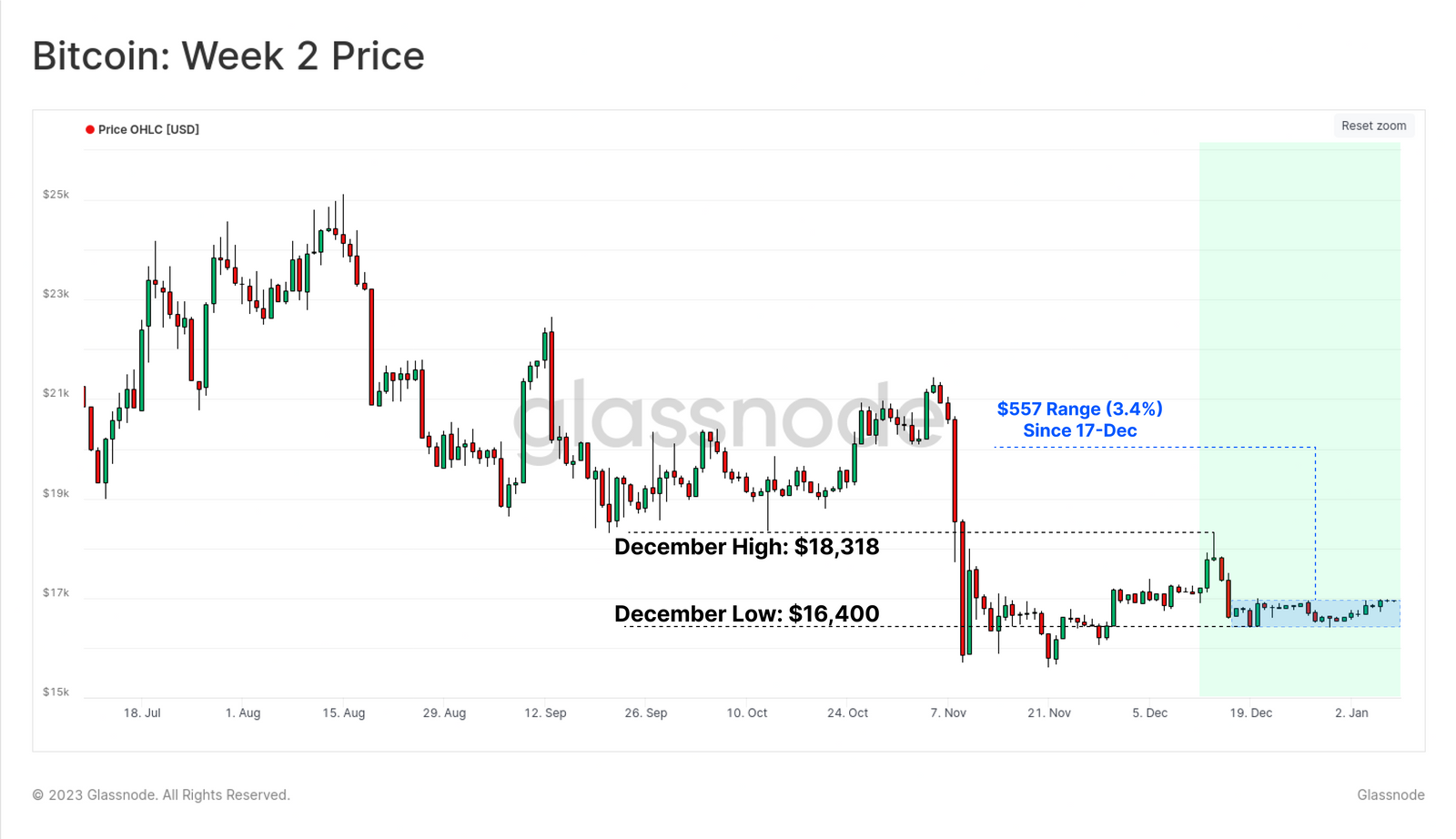
In a rarely seen feat, Bitcoin managed to trade within a price range of just $557 for over three weeks, with the highest price ($16.9k) just 3.4% above the range low of $16.4k. The end of year period is typically a quiet one for all markets, and in this instance, the digital asset space was no exception.

In this first edition of the year, we will cover the following topics:

1.Extremely low realized volatility, which historically precedes explosive market moves (in both directions), with latest examples of Nov 2018, and Apr-2019.

2.Softness in on-chain activity for BTC and ETH, coincident with low overall market volatility, and setting up weak a baseline for the new year.

Drawdowns in the Realized Cap indicating 2022 is comfortably one of the deepest bear markets to date with respect to capital losses.
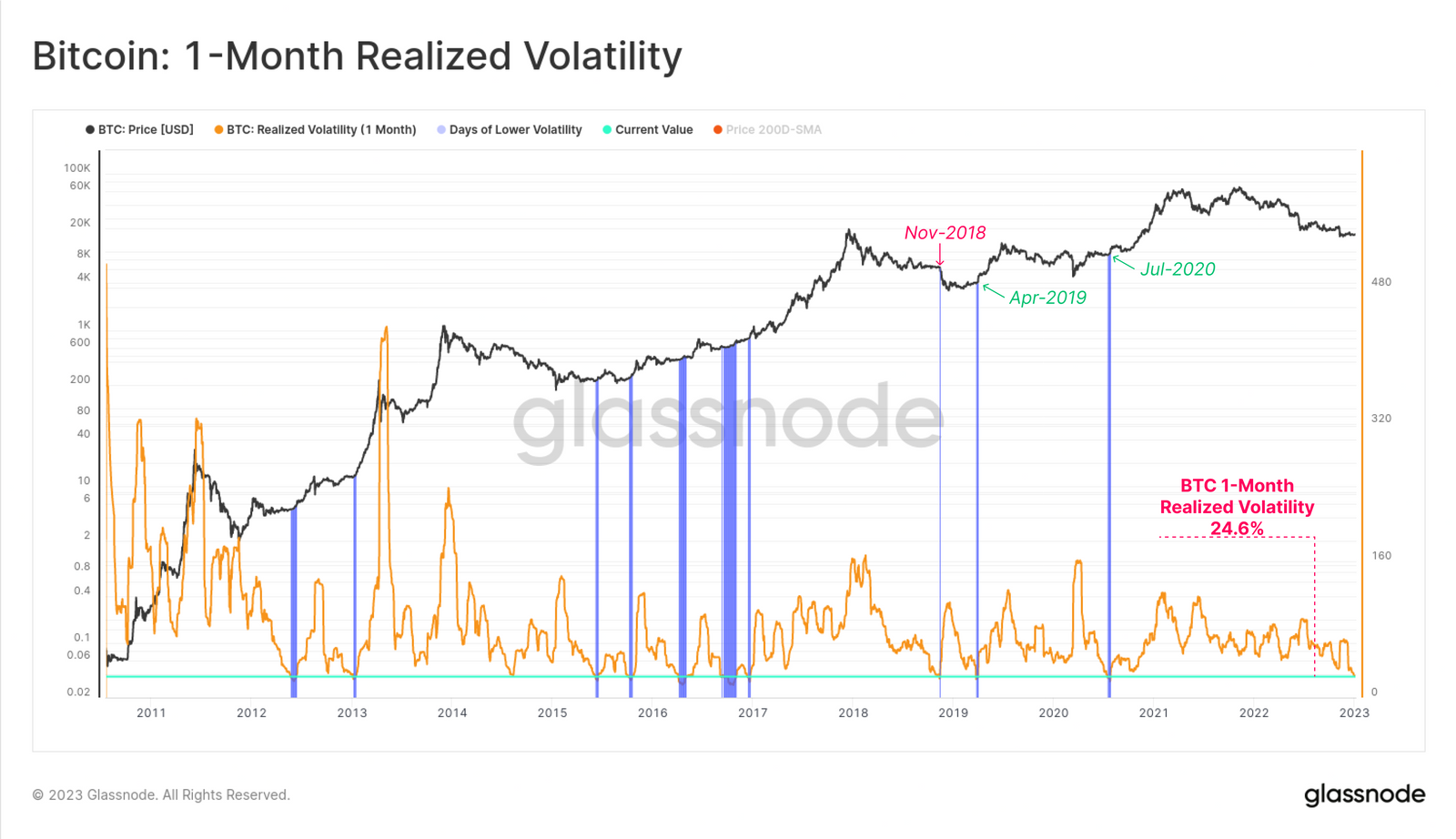
Bitcoin markets are infamous for their volatility, however in spite of this, the holiday break was exceptionally quiet. Realized volatility over the last month for BTC declined to multi-year lows of 24.6%, of which there are very few instances with similar levels (marked in 🟦). However, all prior examples preceded much higher volatility environments on the road ahead, with most trading higher, and just one (Nov 2018) trading dramatically lower.

1.Early bull market in 2012-13 where BTC prices were between $5 and $14.

2.Late bear market in 2015 and at several stages through the bull run 2016.

3.Nov-2018 immediately preceding a -50% drawdown in 1-month.

4.Apr-2019 prior to a rally from $4.2k to a peak of $14k in July-2019.

5.Jul-2020 in the lead up to what became the 2020-21 bull run to $64k.
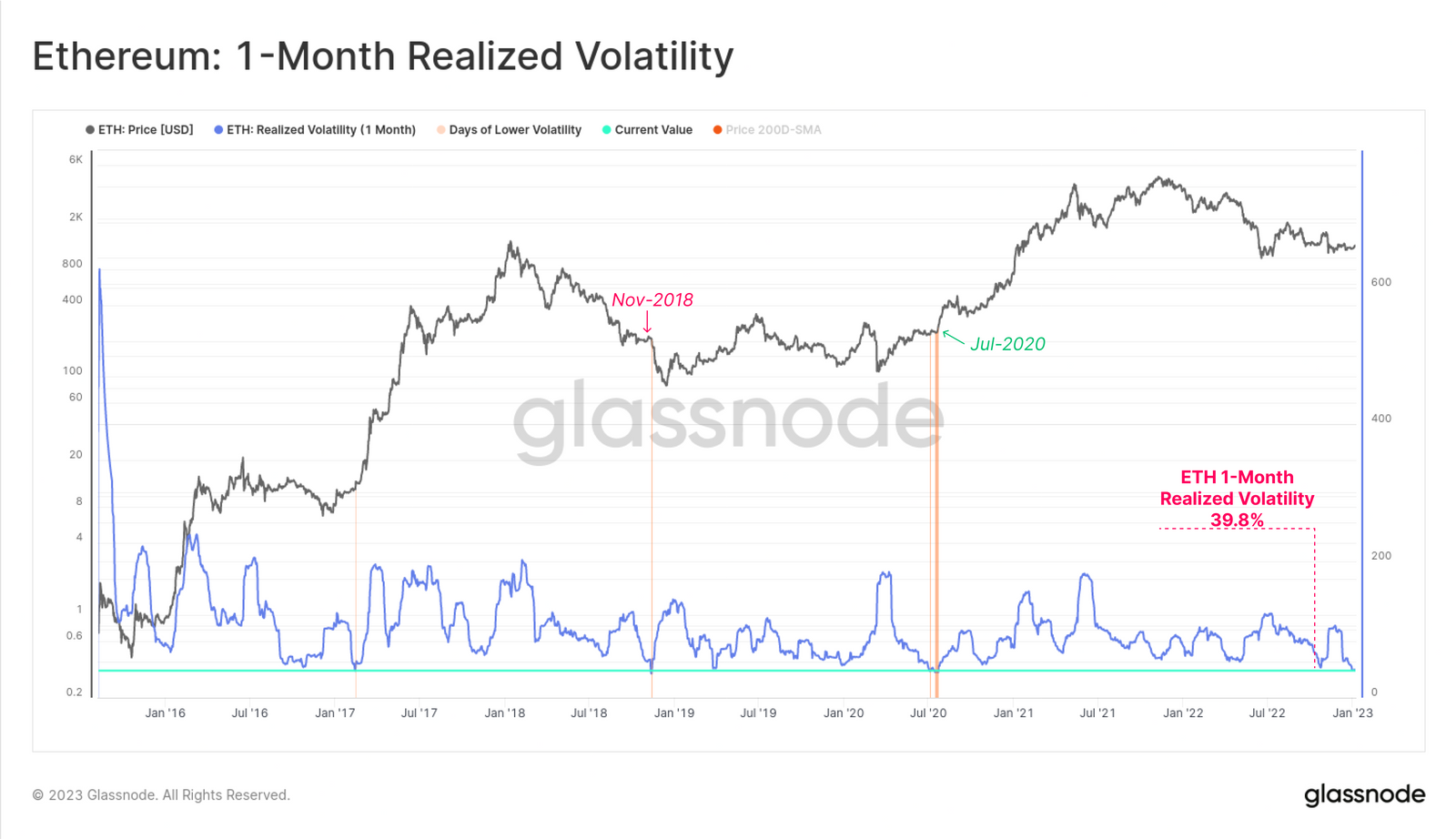
There are even fewer historically quiet periods for ETH, which has seen monthly realized volatility collapse to 39.8%. All primary instances of similarly low market volatility also preceded extreme volatility, with Nov-2018 (-58% sell-off) and Jul-2020 (2020-21 bull) being the primary examples.
A Weak Bitcoin Baseline

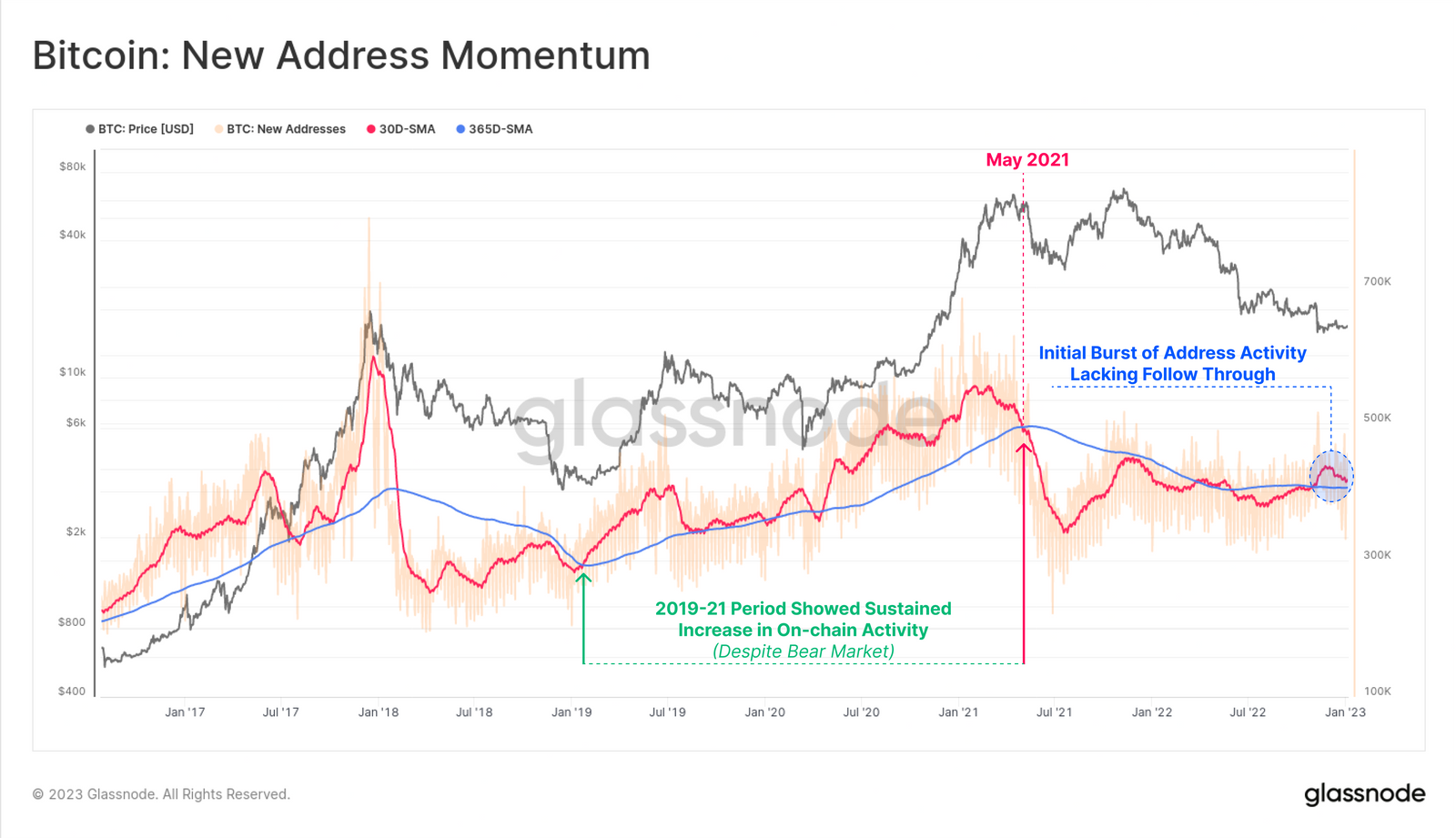
Shifting our focus into the on-chain activity space, we can see that a short-term burst of Bitcoin new addresses occurred followed the FTX fiasco, but has since cooled off noticeably. The monthly average 🔴 of New Addresses is returning towards the yearly average baseline 🔵, indicating that network usage is yet to establish a convincing and sustained recovery.

The momentum of on-chain activity metrics is a powerful tool to monitor a recovery in network fundamentals, with the 2019-20 period being a key example from the past.
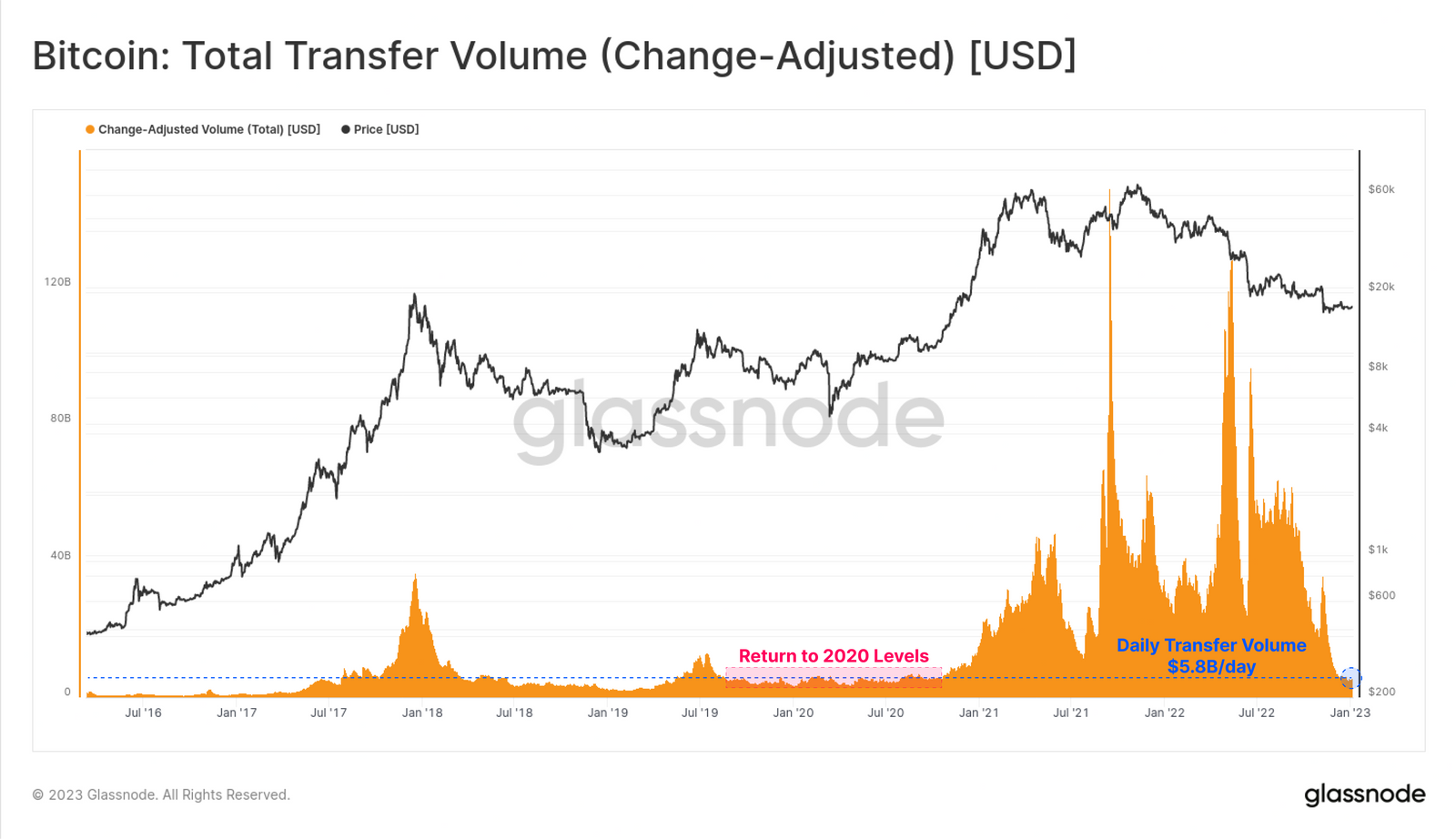
Despite this short burst of address activity, the total USD value processed by the Bitcoin network has been in free-fall. Daily transfer volume has collapsed from the ~$40B heights in Q3-2022, to just $5.8B/day today.

This returns daily settlement volumes to pre-bull 2020 levels, and largely indicates an expulsion of institutional sized capital flowing across the network.
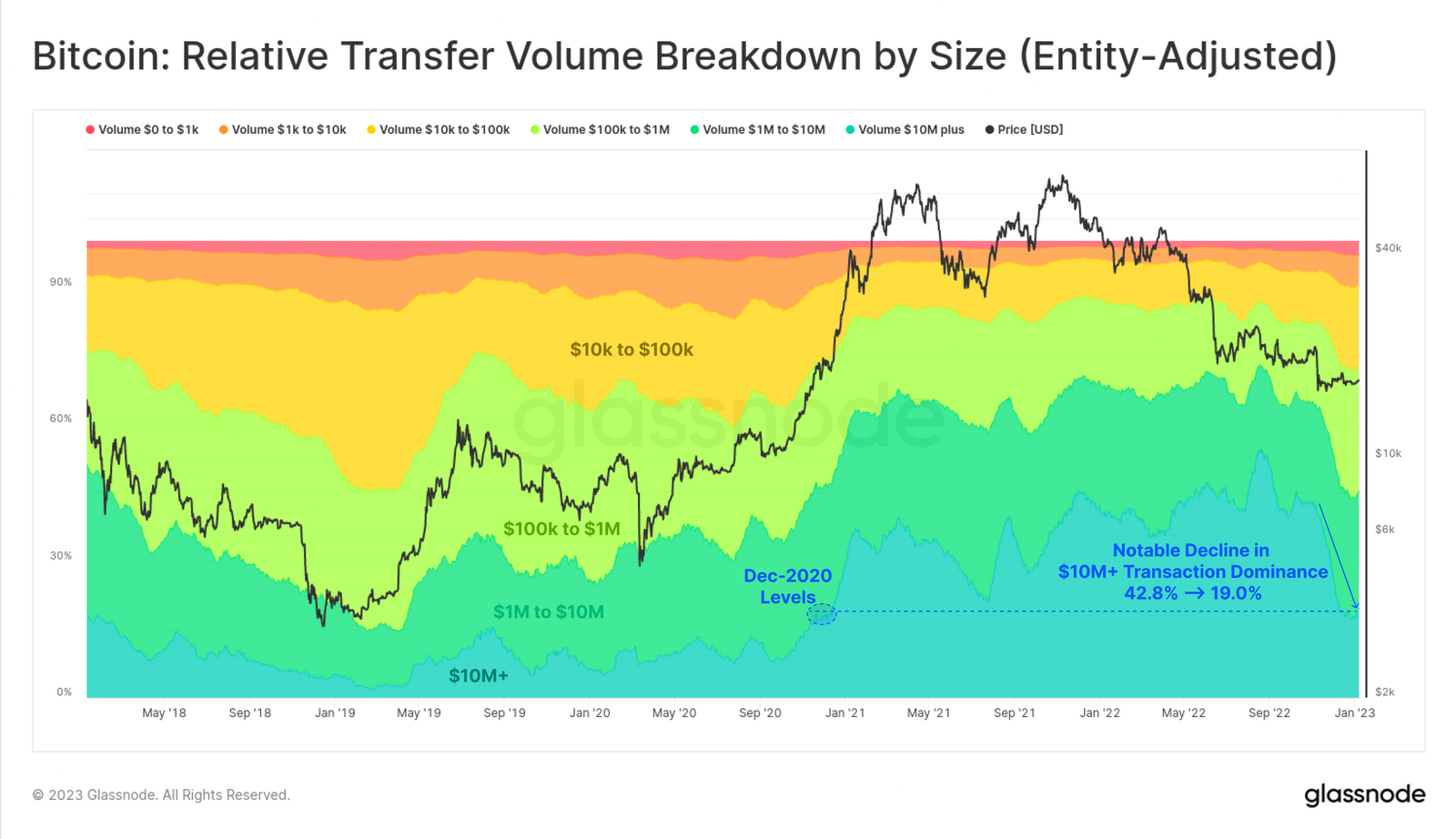
We can see this in the relative breakdown of transfer volume, where the dominance of $10M+ sized transactions has been a primary contributor to this decline. Large size transfers have fallen from 42.8% dominance prior to the FTX collapse, to just 19.0% today.

This suggests a significant lull in institutional sized capital flows, and perhaps a serious shaking of confidence occurring amongst this cohort. It may also reflect, in part, and sadly, an expulsion of the questionable capital flows associated with the FTX/Alameda entities.
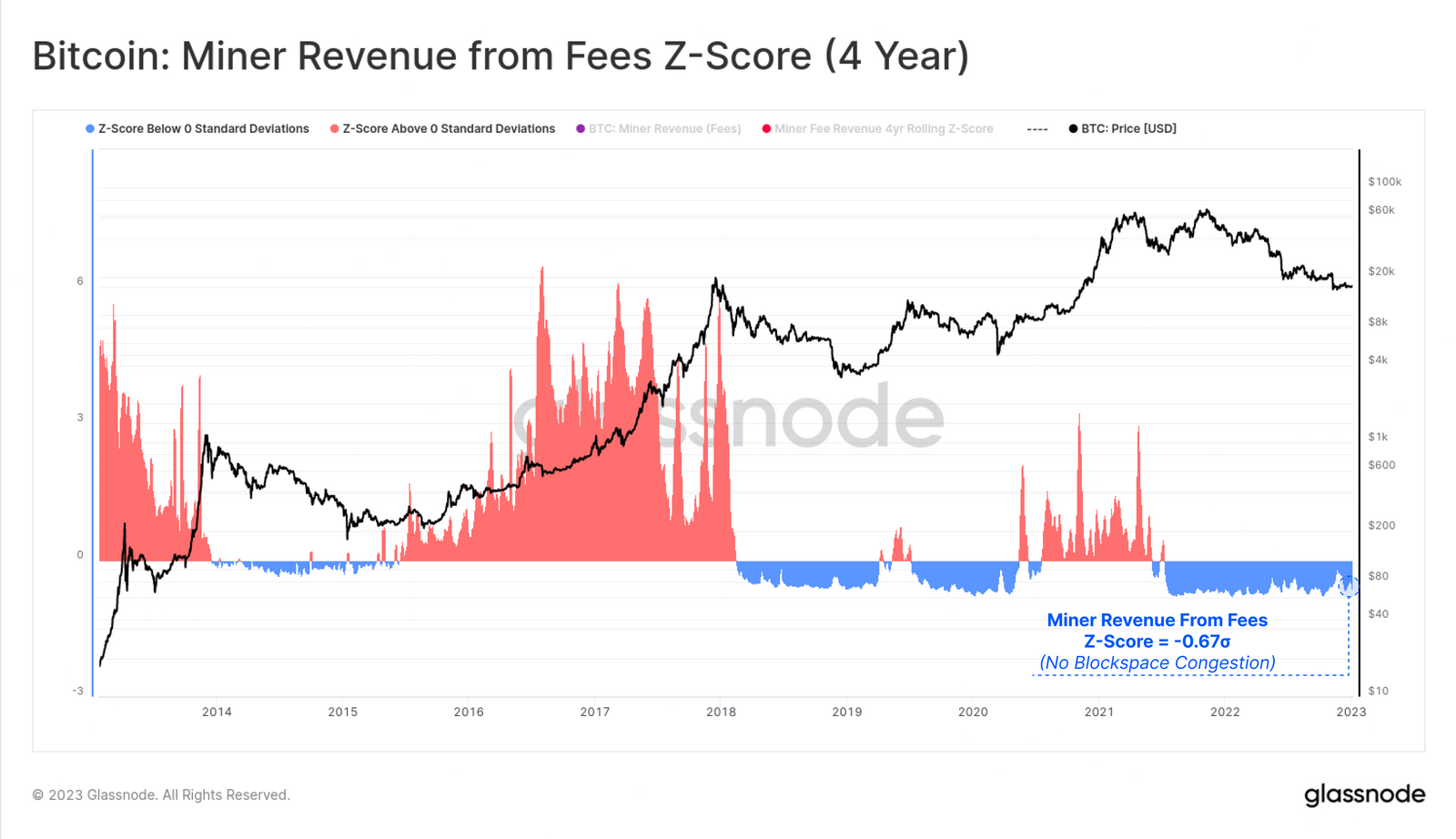
Demand for Bitcoin blockspace continues to remain weak, with negligible upwards pressure on the Bitcoin fee market. The 4-yr Z-Score of miner revenues is yet to make any noteworthy progress back towards positive territory, and remains -0.67 standard deviations below the mean.
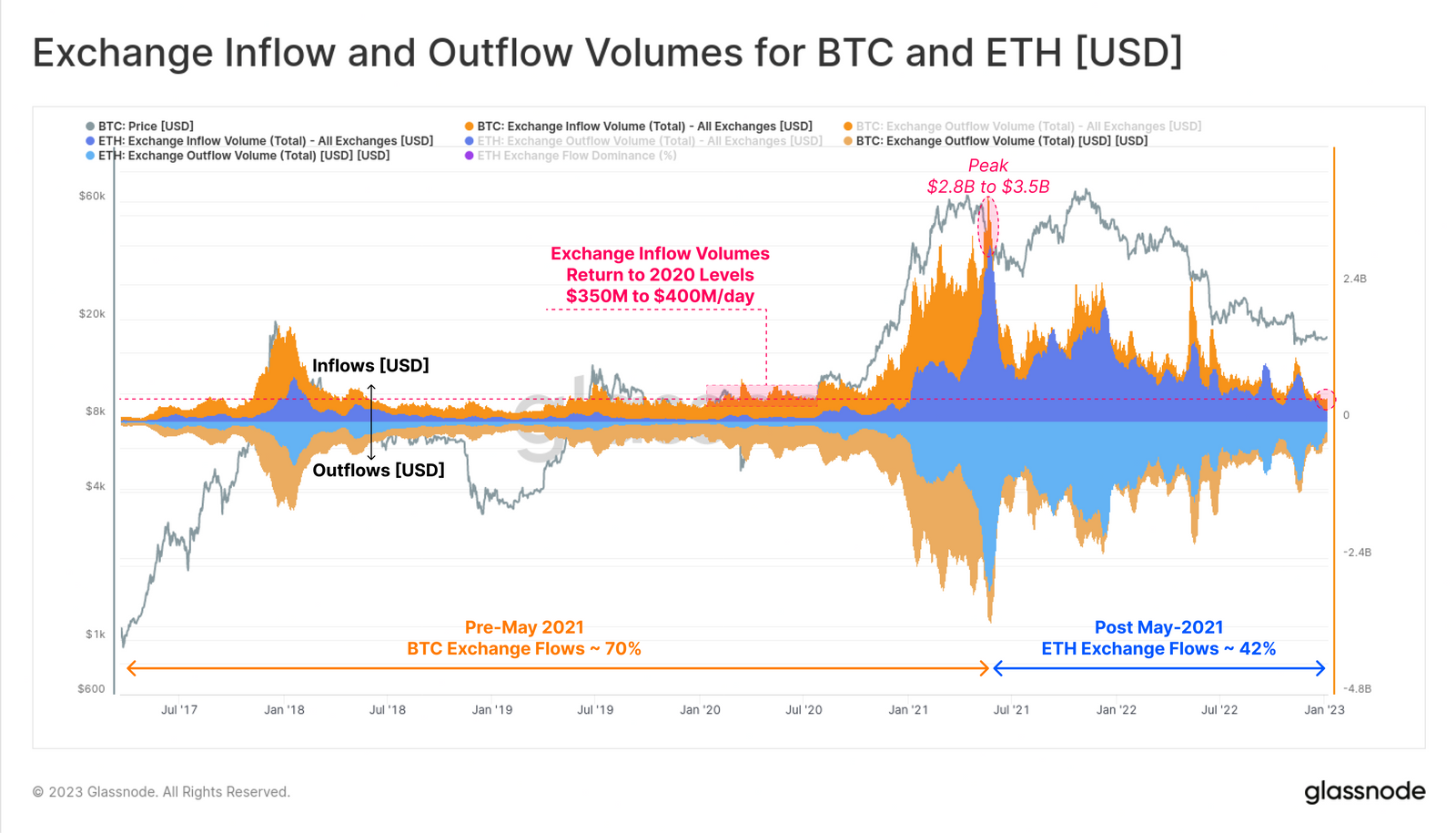
This quiet on-chain activity can also be seen in the compressing USD denominated exchange flows for both BTC and ETH. The chart below presents Inflows (+ve) and Outflows (-ve) for Bitcoin 🟠 and Ether 🔵 related to exchange entities we monitor.

Bitcoin inflow volumes are currently between $350M and $400M/day, which are a far cry from the multi-billion dollar levels seen throughout in 2021-22. Also of note is the expanded scale of ETH exchange flows, which have grown from just 30% dominance up to May-2021, to 42% today. Note ETH dominance here considers the total USD exchange flows (in and out), and calculated as ETH / (BTC+ETH).
Ethereum Remains Quiet

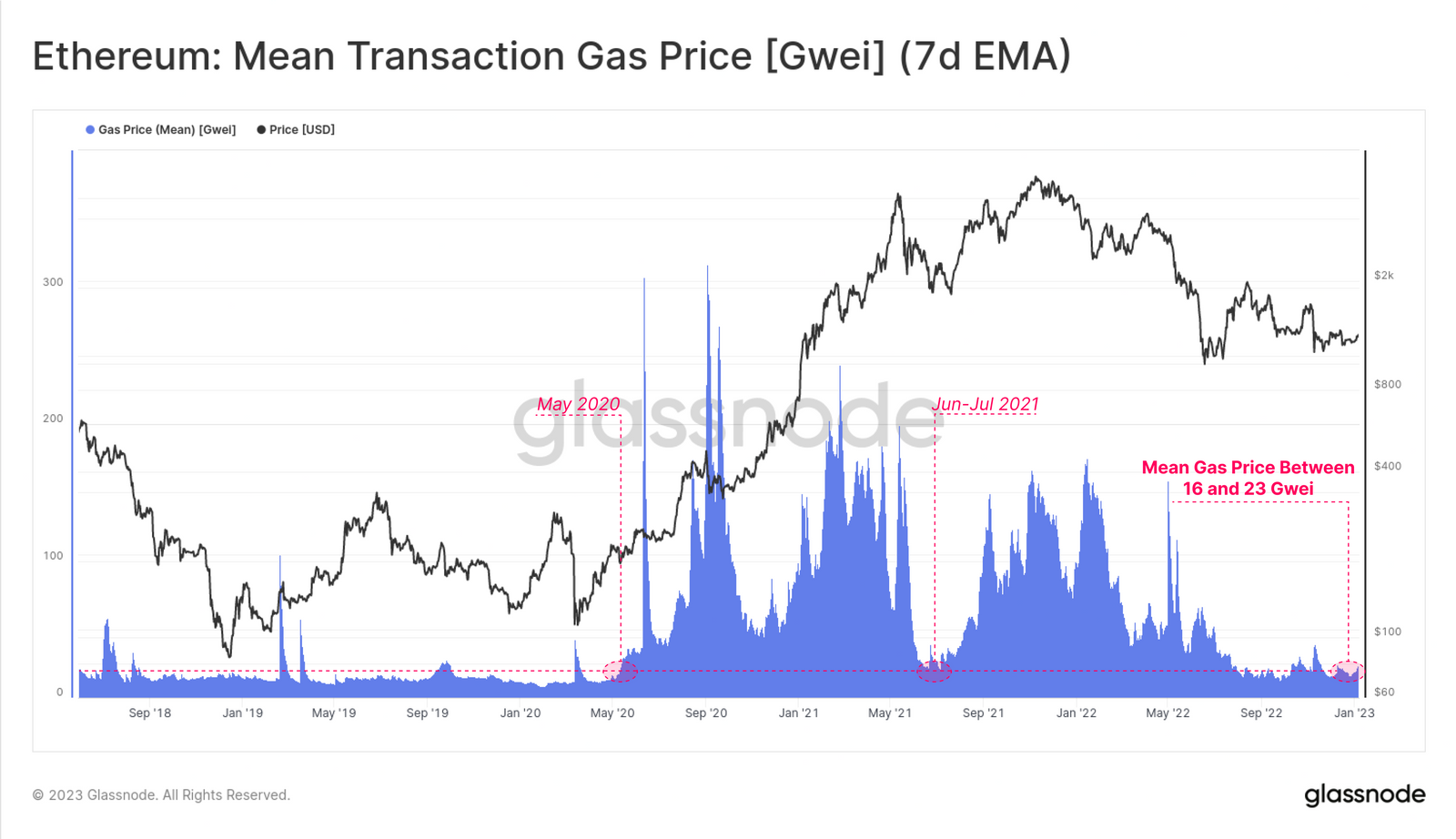
The Bitcoin network is not alone in experiencing this extremely light on-chain utilization, with the average gas price paid on the Ethereum chain remaining near cycle lows. The mean gas price since September has ranged between 16 and 23 Gwei, levels last seen during in the June-July 2021 consolidation, and in May 2020 shortly after the COVID market panic.
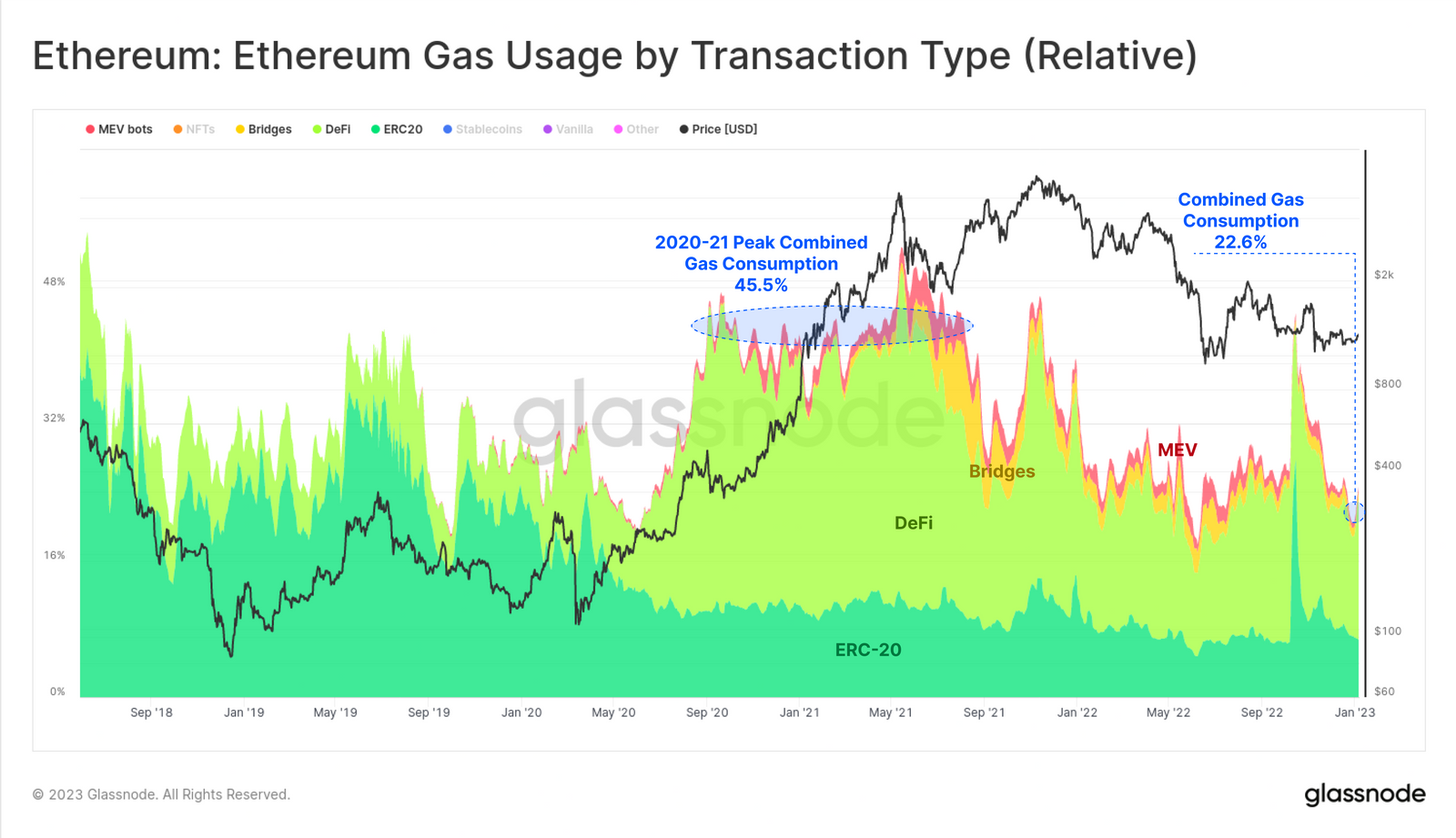
Breaking down gas consumption by sector, we can see that several domains are declining in their relative gas consumption dominance: MEV bots, Bridges, DeFi protocols, and ERC-20 tokens. Between Sept-2020 and Sept-2021, these four sectors represented a combined 45.5% of gas consumption, with DeFi protocols commanding the majority of this.

Today however, these four sectors represent for less than half of their peak dominance, and account for 22.6% of network gas consumption.
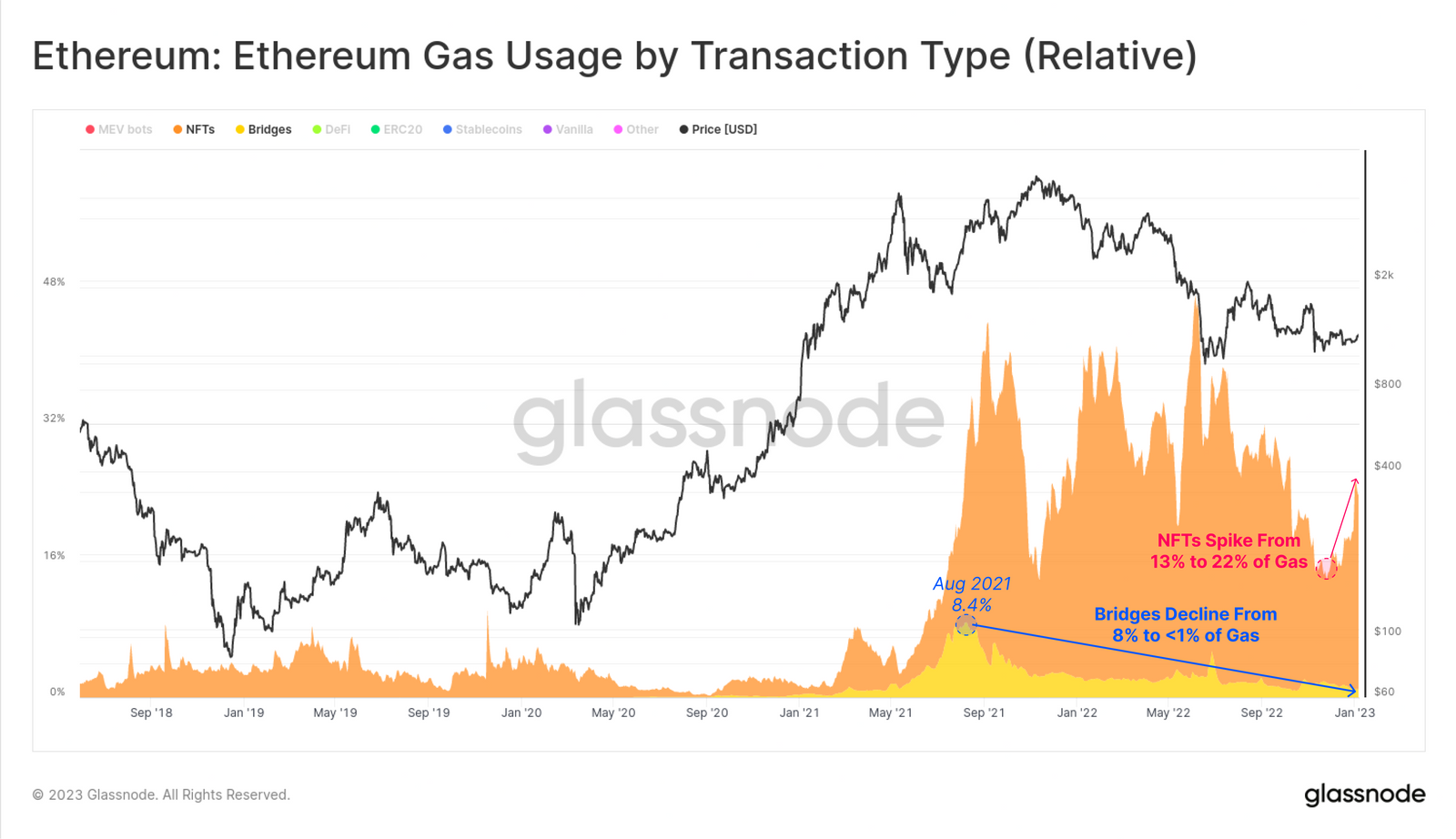
The sector which has seen a recent influx of activity and attention are NFTs, which dominated gas consumption throughout 2022, and have recently increased from 13% to 22% dominance.

By and large, the leading NFT markets and projects have maintained a primary foothold on the Ethereum main-chain, and as yet, there has not been a notable migration of existing NFTs towards bridges and other chains. This is potentially a result of several high profile bridge hacks throughout 2022, as well as lower gas fees on main-chain at present.
A Realized Drawdown

The Realized Cap remains one of the most important metrics in on-chain analysis, providing an elegant tool to monitor capital inflows and outflows from digital assets. The underlying assumption being that when coins transact, their value is pricestamped, and thus avoids valuing long lost coins (like Satoshi's) at the spot price, as it is via Market Cap.

Whilst not perfect, the Realized Cap is arguably one of the better tools available to measure true capital inflows, to compare valuations between assets. It acts to both filter out lost coins, partially account for volume churn (where the same coins constantly transact), and better reflects the true invested value by the market.

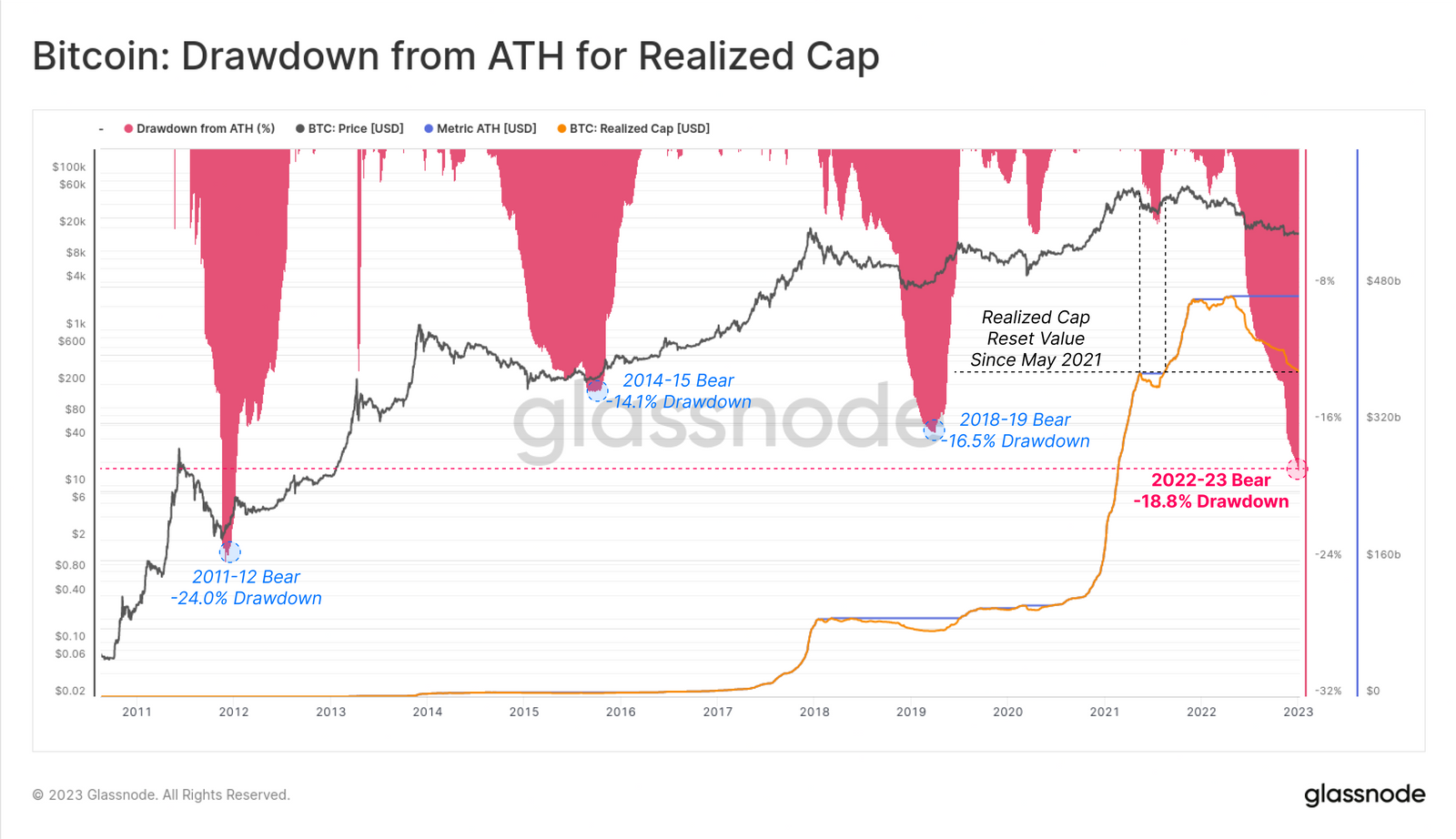
With this as context, the Bitcoin Realized Cap has declined by -18.8% since the ATH, representing a net capital outflow of -$88.4B from the network. This makes for the second largest relative decline in history, and the largest in terms of USD realized losses. This resets the Realized cap to May 2021 levels, expelling all invested value throughout the second peak of H2-2021.
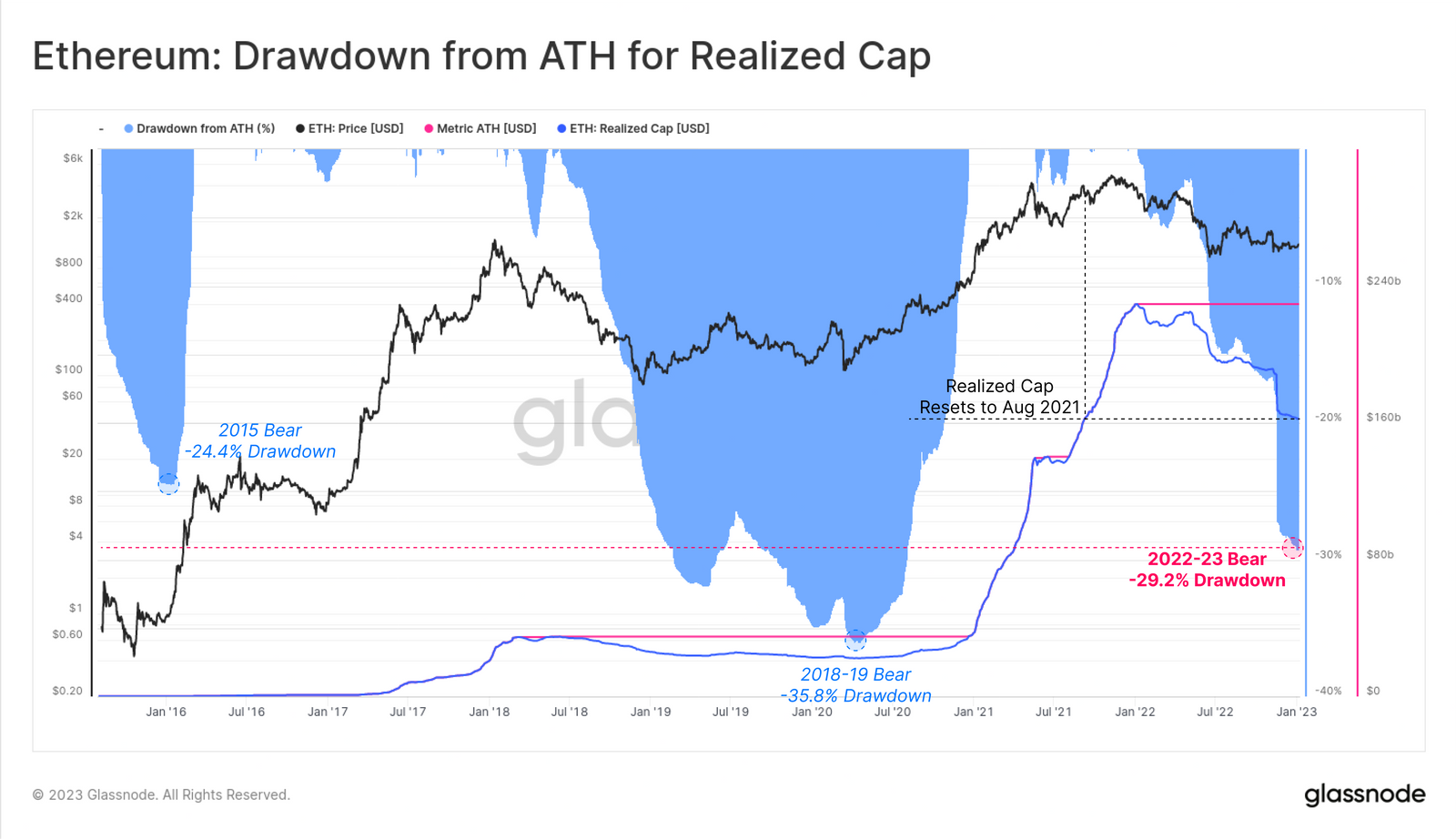
The Ethereum Realized Cap has drawndown by an even larger relative scale, declining by -29.2% since the ATH set in Jan-2022. Ether investors have locked in a total of -$67.1B in net realized losses over the course of 2022.

This also puts the prevailing bear market as the worst in history on a USD denominated realized loss basis, but not yet on a relative scale, eclipsed by the 2018-19 bear market at a 35.8% drawdown.
Live Advanced Chart

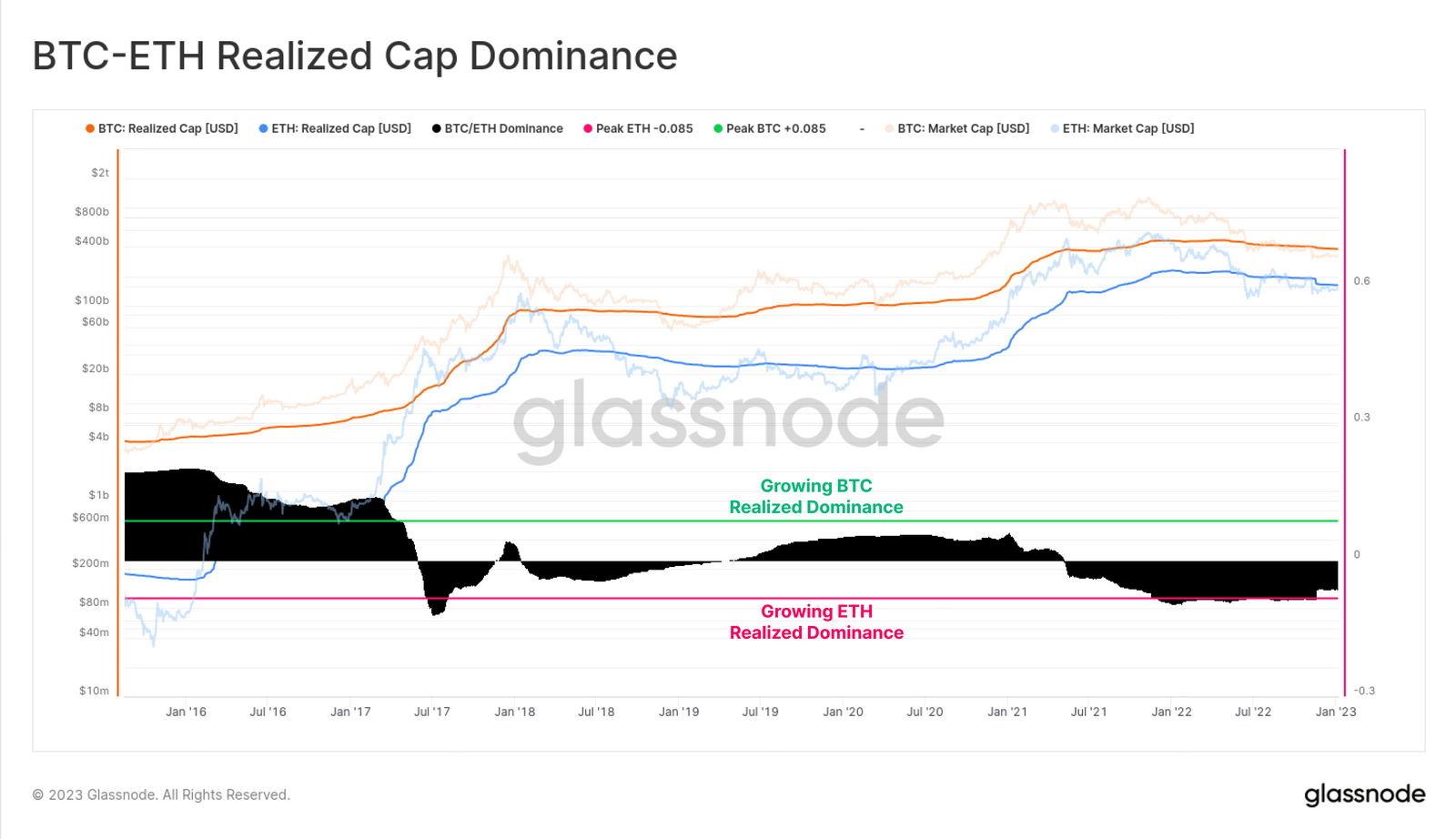
Finally, we close with a new interpretation of market dominance, aimed at addressing some of the aforementioned shortcomings associated with Market Cap dominance. The principle issue with the widely used 'Bitcoin dominance' metric is that the market cap of relatively illiquid tokens are prone to manipulation (such as FTT and others supported by the FTX entity). As such, entities with large and often illiquid stakes can support inflated valuations on paper, but which diverge significantly from underlying market realities.

The model below presents the simplest implementation of Realized Cap Dominance, which is a counterpart to the the more traditional Market Cap Dominance. It is designed to track the relative structural capital inflow/outflows across the two major and most liquid digital assets, BTC and ETH.

This tool, and principle can be applied to any basket of coins and tokens to track structural changes in dominance, better reflecting real capital flows, and discounting illiquid supply (such as un-vested token allocations, protocol treasuries, or lost supply).
Summary and Conclusions

The 2022-23 holiday period has been historically quiet, and it is rare for such conditions to stick around for long. Past occasions where BTC and ETH volatility was this low have preceded extremely volatile market environments, with past examples trading both higher and lower.

On-chain activity for the two majors remains extremely weak, despite a short-term bump following FTX. Using both on-chain activity, and realized cap drawdowns, it is safe to say that the excesses of H2-2021 has been largely expelled from the system. This process has been painful for investors, however has brought market valuations closer to their underlying fundamentals.

Thank you for returning as a reader of The Week On-chain, and we look forward to documenting all that 2023 holds in store for us.


Nội dung Liên quan

Vụ Bê Bối Gian Lận Nghiêm Trọng Của Kỳ Lân Mã Hóa Blockstream: Toàn Bộ Cốt Truyện

Từ đầu năm, Blockstream - công ty do Bitcoin tiên phong Adam Back đồng sáng lập - liên tục đối mặt với tranh cãi. Gần đây, tài khoản điều tra NatInfoSec đưa ra cáo buộc nghiêm trọng rằng các ghi chú khai thác Bitcoin (BMN) của Blockstream có dấu hiệu lừa đảo hình xoắn ốc (Ponzi). Cáo buộc tập trung vào bốn điểm chính: 1. **Năng lực khai thác và thanh toán bị nghi ngờ:** NatInfoSec tính toán để đáp ứng nghĩa vụ BMN, Blockstream cần vận hành công suất khai thác (hashrate) từ 20-45 EH/s, nhưng bảng điều khiển của họ chỉ hiển thị 15 EH/s. Không có bằng chứng công khai nào (hồ sơ lưới điện, dữ liệu hải quan, chia sẻ từ mining pool) xác nhận công suất khai thác đủ lớn như vậy. Điều khoản "Substitute Performance BTC" trong hợp đồng cho phép Blockstream sử dụng BTC từ bất kỳ nguồn nào để thanh toán, làm dấy lên lo ngại về tính minh bạch của nguồn tiền. 2. **Lợi suất cao bất thường:** Các ghi chú BMN được phát hành thông qua nền tảng STOKR với lợi suất cố định lên tới gần 20%/năm, một mức rất cao và khó duy trì trong ngành khai thác Bitcoin vốn biến động mạnh. 3. **Tiền sử pháp lý của lãnh đạo và vấn đề công bố thông tin:** Christopher William Cook, cựu lãnh đạo quan trọng trong mảng khai thác của Blockstream và hiện là CEO của Exacore (công ty được tách ra từ hoạt động khai thác), có tiền án lừa đảo qua thư từ năm 2008. Thông tin này không được tiết lộ trong các tài liệu phát hành BMN. Hồ sơ của Cook tại NASA trong tài liệu marketing cũng bị thổi phồng. 4. **Liên hệ đến BSTR và việc phát hành SPAC:** Có lo ngại rủi ro từ BMN có thể ảnh hưởng đến Bitcoin Standard Treasury Company (BSTR) - một công ty liên quan đến Adam Back đang chuẩn bị niêm yết qua SPAC. Tuy nhiên, BitMEX Research chỉ ra rằng về mặt pháp lý, các rủi ro này có thể được tách biệt nếu không có điều khoản bảo lãnh tập đoàn. Phản ứng từ cộng đồng và BitMEX: BitMEX Research thừa nhận tiền án của Cook là có thật và bày tỏ lo ngại về lợi suất cao, nhưng cho rằng nhiều cáo buộc khác thiếu bằng chứng hoặc gây hiểu nhầm, đặc biệt là về mối liên hệ pháp lý giữa BMN và BSTR. Samson Mow, cựu CSO của Blockstream, bảo vệ hoạt động khai thác là có thật. Tuy nhiên, các nhà phê bình như Matthew R. Kratter và Chris Guida tiếp tục đặt câu hỏi về khả năng xác minh độc lập công suất khai thác và nguồn thanh toán thực tế. Tóm lại, mặc dù chưa có bằng chứng kết luận về hành vi lừa đảo, sản phẩm BMN của Blockstream vẫn còn nhiều câu hỏi cần làm rõ về quy mô thực tế, năng lực khai thác đủ để chi trả, nguồn gốc của lợi suất cao cố định, tính minh bạch trong thanh toán và mức độ ảnh hưởng của cá nhân có tiền án. Blockstream chưa có phản hồi chính thức toàn diện về các cáo buộc này.

marsbit1 giờ trước

Vụ Bê Bối Gian Lận Nghiêm Trọng Của Kỳ Lân Mã Hóa Blockstream: Toàn Bộ Cốt Truyện

marsbit1 giờ trước

Nhóm Reddit từng gây 'ép buộc mua vào' phố Wall, đã tìm ra GME tiếp theo?

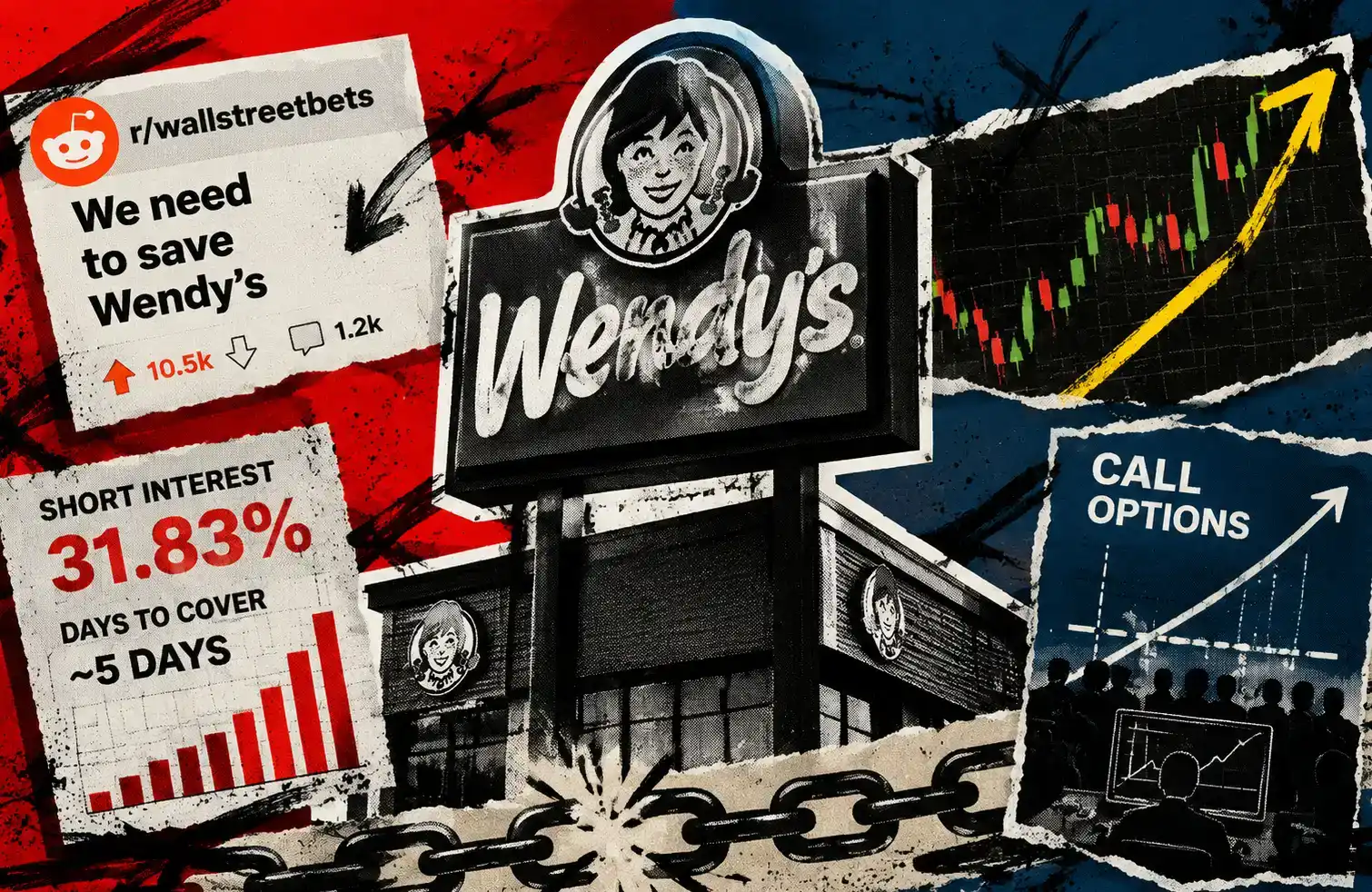
Tóm tắt: Vào ngày 24/6, cổ phiếu Wendy's (WEN) đã tăng mạnh sau khi một bài đăng trên cộng đồng Reddit r/wallstreetbets với tiêu đề "We need to save Wendy's" thu hút sự chú ý và được thảo luận như một ứng cử viên "meme squeeze" mới. Bài đăng khai thác một meme văn hóa lâu năm trong WSB về việc làm tại Wendy's sau khi thua lỗ. WEN hiển thị một số đặc điểm bề ngoài của cổ phiếu meme: giá gần mức thấp nhất trong năm, tỷ lệ bán khống công khai khá cao ở mức 31.83%, và khối lượng giao dịch tăng đột biến. Tuy nhiên, phân tích cho thấy cấu trúc hiện tại khác xa so với đợt bức ép bán khống (short squeeze) có hệ thống như GameStop (GME) năm 2021. Mặc dù tỷ lệ bán khống đủ cao để tạo ra một đợt bức ép nhẹ, nó không ở mức cực đoan như GME trước đây. Yếu tố then chốt để biến động giá kéo dài - một vòng xoáy gamma squeeze từ việc các nhà tạo lập thị trường phải mua cổ phiếu để phòng ngừa rủi ro khi nhà đầu tư bán lẻ mua ồ ạt quyền chọn mua - vẫn chưa có đủ bằng chứng chắc chắn. Lịch sử cho thấy Wendy's từng là chủ đề meme trước đây nhưng không duy trì được đà tăng. Sức hấp dẫn của câu chuyện "cứu Wendy's" có thể dễ lan truyền, nhưng khả năng biến thành hành động nắm giữ kỷ luật lâu dài của cộng đồng vẫn chưa rõ. Về cơ bản, không có dấu hiệu công ty gần phá sản. Kết luận, đợt biến động này chứng minh sức ảnh hưởng của dòng tiền nhà đầu tư bán lẻ vẫn có thể kích hoạt biến động giá ngắn hạn cho cổ phiếu có thanh khoản trung bình. Tuy nhiên, WEN hiện giống một đợt tăng giá meme (meme pop) nhanh chóng được thúc đẩy bởi sự chú ý hơn là một đợt bức ép bán khống bền vững. Câu trả lời cuối cùng sẽ phụ thuộc vào việc khối lượng giao dịch cao và sự nhiệt tình trên diễn đàn có được duy trì trong những ngày tới hay không, và liệu hoạt động trên thị trường quyền chọn có tạo ra hiệu ứng gamma mạnh mẽ hay không.

marsbit1 giờ trước

Nhóm Reddit từng gây 'ép buộc mua vào' phố Wall, đã tìm ra GME tiếp theo?

marsbit1 giờ trước

Hàn Quốc Nhắm Mục Tiêu 40 Nhà Khai Thác Tiền Mã Hóa Chưa Đăng Ký Trong Đợt Siết Chặt Quy Định

Đơn vị Tình báo Tài chính Hàn Quốc (FIU) đã chuyển hồ sơ khoảng 40 nhà cung cấp dịch vụ tài sản ảo chưa đăng ký cho cơ quan cảnh sát, thể hiện nỗ lực siết chặt quản lý trong nước. Theo luật Hàn Quốc, mọi sàn giao dịch tiền mã hóa phải có Chứng nhận ISMS và đăng ký với FIU trước khi hoạt động. Hiện chỉ 28 thực thể đã đăng ký hợp pháp. Các nền tảng nước ngoài bị phát hiện thu hút khách hàng địa phương qua ứng dụng nhắn tin, trong khi các đổi tiền tư nhân chuyển đổi stablecoin sang won cho khách du lịch, sinh viên. Hành động này là một phần của chiến dịch rộng lớn hơn nhằm tăng cường tiêu chuẩn tuân thủ toàn cầu thông qua các biện pháp của FATF. Giám đốc FIU Lee Hyung-joo kêu gọi các quốc gia thành viên FATF bỏ ngưỡng giao dịch theo Quy tắc Di chuyển (Travel Rule). Hàn Quốc dự kiến áp dụng kiểm tra danh tính cho mọi giao dịch tiền mã hóa từ tháng 8, thay vì chỉ các giao dịch trên 1 triệu won (~730 USD) như hiện nay. Năm 2026, các biện pháp thực thi quy định về tiền mã hóa tại Hàn Quốc tiếp tục được mở rộng, bao gồm khởi tố hình sự các vụ thao túng thị trường và tăng cường hợp tác với các tổ chức tài chính để ngăn chặn giao dịch bất hợp pháp xuyên biên giới.

TheNewsCrypto2 giờ trước

Hàn Quốc Nhắm Mục Tiêu 40 Nhà Khai Thác Tiền Mã Hóa Chưa Đăng Ký Trong Đợt Siết Chặt Quy Định

TheNewsCrypto2 giờ trước

Toàn bộ sự việc về tình trạng gian lận nghiêm trọng tại Blockstream - 'Kỳ lân mật mã'

Đầu năm nay, Adam Back, người tiên phong về Bitcoin và công ty Blockstream của ông, liên tục trở thành tâm điểm chú ý trong cộng đồng tiền mã hóa. Tháng 6, tài khoản điều tra NatInfoSec đã đăng một bài viết cáo buộc Blockstream có thể đang huy động hàng tỷ USD từ nhà đầu tư dưới danh nghĩa lợi nhuận khai thác, nhưng tính xác thực của trang trại khai thác và hashrate bị nghi ngờ, với cấu trúc mang đặc điểm Ponzi. Các cáo buộc chính bao gồm: 1. **Năng lực hashrate và thanh toán bị nghi ngờ:** Để đáp ứng nghĩa vụ từ các ghi chú khai thác (BMN) đã phát hành, Blockstream được cho là cần vận hành hơn 20 EH/s, nhưng bảng điều khiển của họ chỉ hiển thị 15 EH/s. Các bằng chứng công khai về việc mua điện, nhập khẩu thiết bị hoặc phân bổ hashrate trong mining pool không tương xứng với quy mô này. Điều khoản "Substitute Performance BTC" trong BMN2 cho phép Blockstream sử dụng BTC từ bất kỳ nguồn nào để thanh toán. 2. **Lợi suất cao và rủi ro:** Các ghi chú được phát hành qua nền tảng STOKR có lợi suất cố định lên tới khoảng 20%, điều này là bất thường trong ngành khai thác Bitcoin biến động mạnh. Một số khoản thanh toán khi đáo hạn có thể được chuyển sang ghi chú mới với lợi suất cao hơn thay vì hoàn trả gốc. 3. **Tiền án và vấn đề công bố thông tin của Christopher Cook:** Christopher William Cook, cựu lãnh đạo quan trọng trong bộ phận khai thác của Blockstream và hiện là CEO của Exacore (công ty được tách ra từ hoạt động khai thác), đã bị kết án 41 tháng tù vào năm 2008 vì tội lừa đảo qua thư tín. Thông tin này không được tiết lộ trong các tài liệu phát hành BMN. Hồ sơ tòa án liên bang Mỹ xác nhận vụ án (số 06-80187) với khoản bồi thường khoảng 1,85 triệu USD. 4. **Liên quan đến BSTR/SPAC:** Mối lo ngại được đặt ra về việc các nghĩa vụ tiềm ẩn lớn từ BMN và tiền án của Cook không được đề cập trong hồ sơ đăng ký SEC của Bitcoin Standard Treasury Company (BSTR) - công ty có liên quan đến Adam Back và đang chuẩn bị niêm yết qua SPAC. Phản ứng từ cộng đồng: * **BitMEX Research** xác nhận tiền án của Cook có thể là thật và bày tỏ lo ngại về lợi suất cao, nhưng cho rằng các cáo buộc khác thiếu bằng chứng hoặc gây hiểu nhầm, chỉ ra rằng Cook không phải là giám đốc của BSTR và BMN về mặt cấu trúc pháp lý là độc lập. * **Samson Mow** (cựu CSO Blockstream) bảo vệ lập trường, khẳng định Blockstream thực hiện khai thác thật với thiết bị và hợp đồng mua điện riêng. * Các nhà phê bình như **Matthew R. Kratter** và **Chris Guida** nhấn mạnh nhu cầu **xác minh độc lập** về hashrate, nguồn thanh toán và tính minh bạch. Tóm lại, mặc dù chưa có bằng chứng trực tiếp về hành vi lừa đảo, sản phẩm ghi chú khai thác BMN của Blockstream vẫn còn nhiều câu hỏi cần làm rõ về quy mô thực tế, khả năng thanh toán dựa trên hashrate, nguồn gốc lợi suất cao, tính xác minh được của việc thanh toán bằng BTC/L-BTC, cũng như mức độ công bố thông tin liên quan đến tiền án của nhân vật chủ chốt. Tính minh bạch là yếu tố then chốt để giải tỏa nghi ngờ. Tính đến thời điểm này, Blockstream chưa có phản hồi chính thức hệ thống về những cáo buộc trên.

链捕手2 giờ trước

Toàn bộ sự việc về tình trạng gian lận nghiêm trọng tại Blockstream - 'Kỳ lân mật mã'

链捕手2 giờ trước

Giao dịch

Giao ngay
Hợp đồng Tương lai
活动图片