Fields Medalist Stumped, Claude Solves 78-Year Mystery, Possibly the Most Important AI Achievement in Mathematics

marsbitXuất bản vào 2026-08-24Cập nhật gần nhất vào 2026-08-24

Tóm tắt

A 78-year-old mathematical problem—whether the six-dimensional sphere (S6) admits a complex structure—has been answered affirmatively in just three days by Harvard mathematician Levent Alpöge with the assistance of Claude, an AI system. The work constructs an explicit complex manifold X and rigorously proves it is diffeomorphic to S6, bypassing decades of inconclusive theoretical debate. Previous attempts by distinguished mathematicians, including Fields Medalist Michael Atiyah, had fallen short. The 108-page proof details a novel geometric construction: starting with a (3,4,∞) triangle group acting on the upper half-plane to form a base sphere with three singular points, then attaching a family of complex 2-tori over most points. The three singularities are filled using distinct classical techniques (Mumford's toric degeneration and Kodaira's logarithmic transformations with multiplicities 3 and 4). The resulting compact complex threefold X is shown to be simply connected with trivial fundamental group, matching the homology of S6. Applying established results by Smale, and Kervaire & Milnor, it is concluded that X is indeed the standard smooth 6-sphere. This achievement is part of a rapid series of breakthroughs by Alpöge using Claude, including a claimed counterexample to the 87-year-old Jacobian conjecture in July and significant progress on the Riemann zeta function in early August. Experts note that while prior AI contributions involved searching or combining existing...

A century-old puzzle that remained unsolved for 78 years was cracked in just three days!

The question was whether a complex structure exists on the 6-dimensional sphere, a problem dating back to 1948. The answer is now: yes.

The solution was presented by Harvard mathematician Levent Alpöge and Claude.
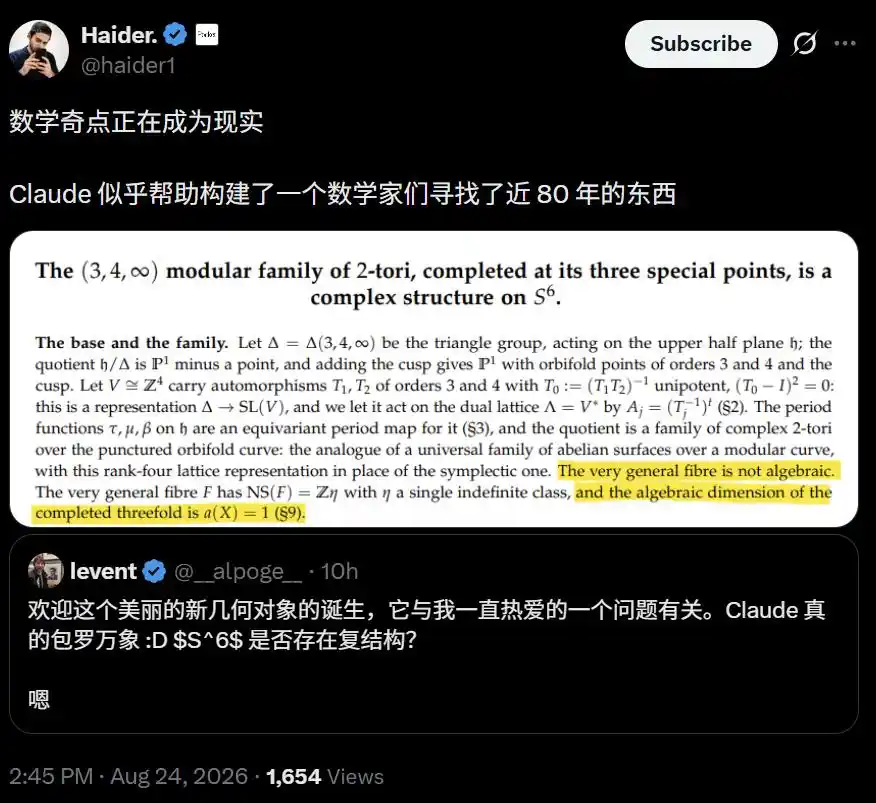
What's even more remarkable is the method they used to break through.

They bypassed the well-trodden paths followed for decades and directly constructed the object, then pointed to it and declared, 'This is the complex structure on S6.'

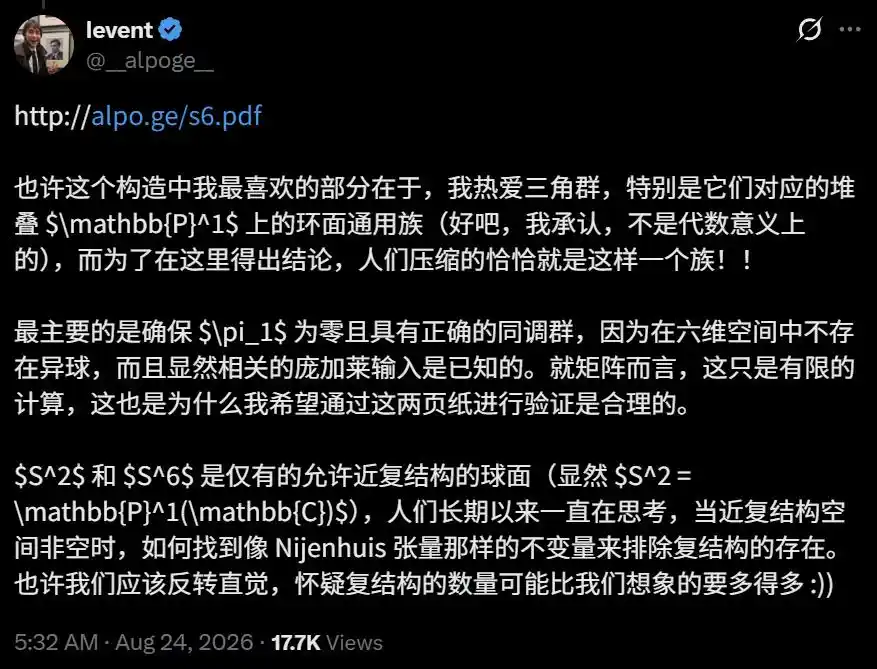
When Alpöge announced it on X, his opening line sounded more like announcing the arrival of a new life—

Welcome this beautiful new geometric object into the world.
Over 70 Years, All Hanging on This One Sphere

Among all spheres, only two qualify to discuss complex structures: S2 and S6; others were ruled out long ago.

S2 is no surprise; it's the most fundamental building block in complex geometry.
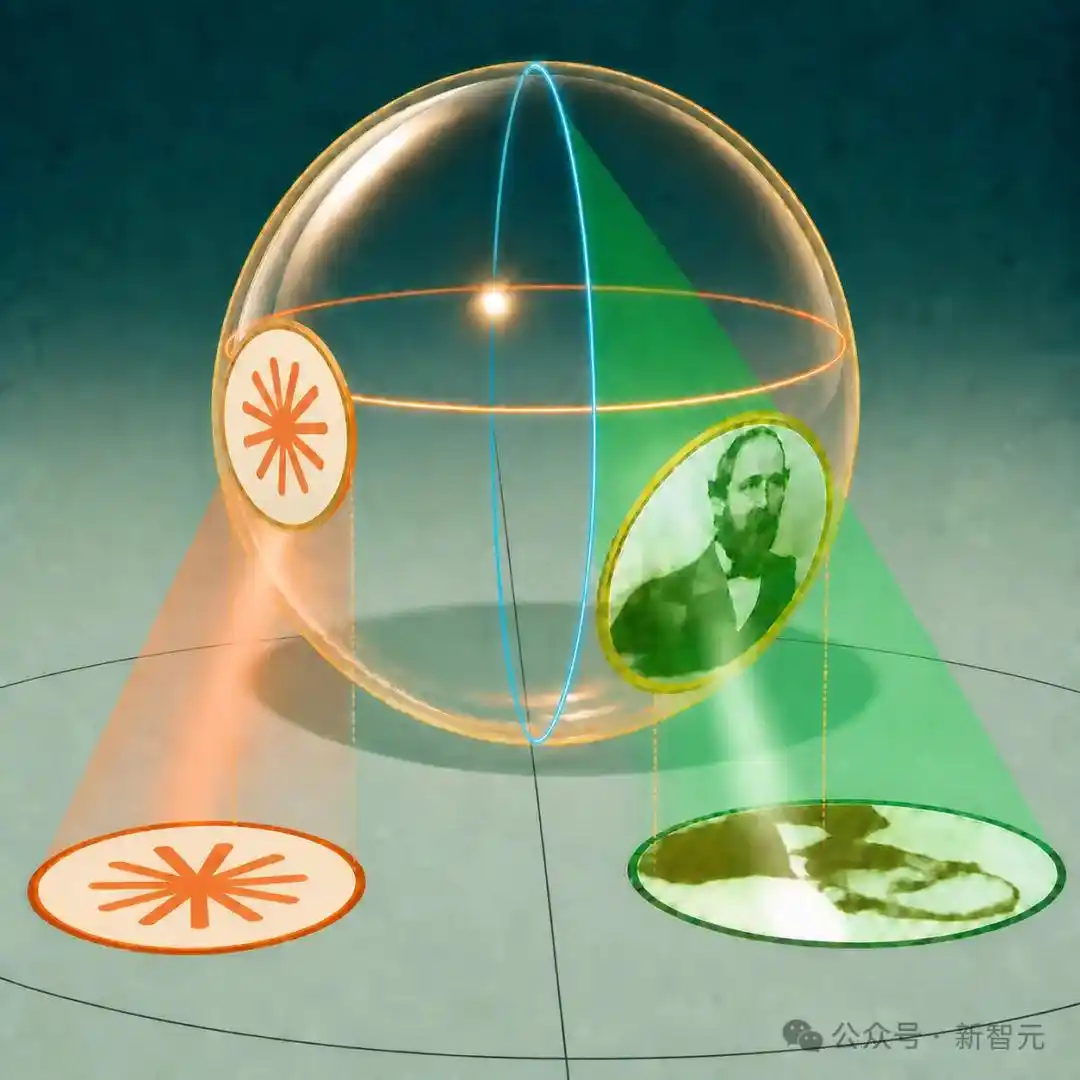
So, for over 70 years, all eyes were fixed on this sole candidate, S6.

Some claimed it existed, while others swore it absolutely did not, but both sides stumbled.
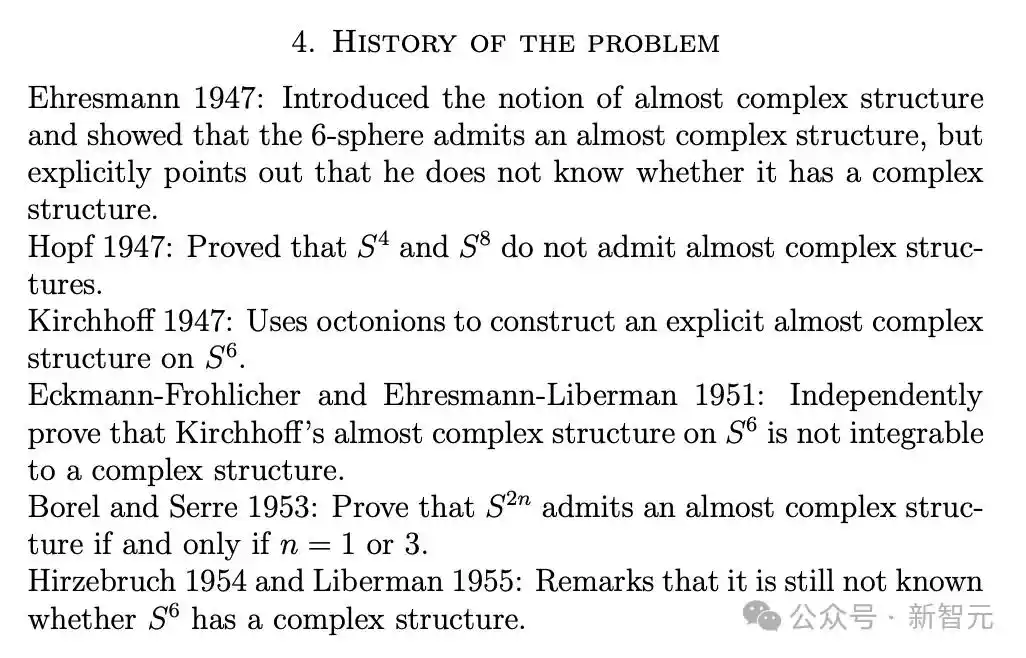
For example, Michael Francis Atiyah, one of the greatest living mathematicians and a Fields Medalist, claimed to have solved it in 2016, but his proof was found to have gaps.
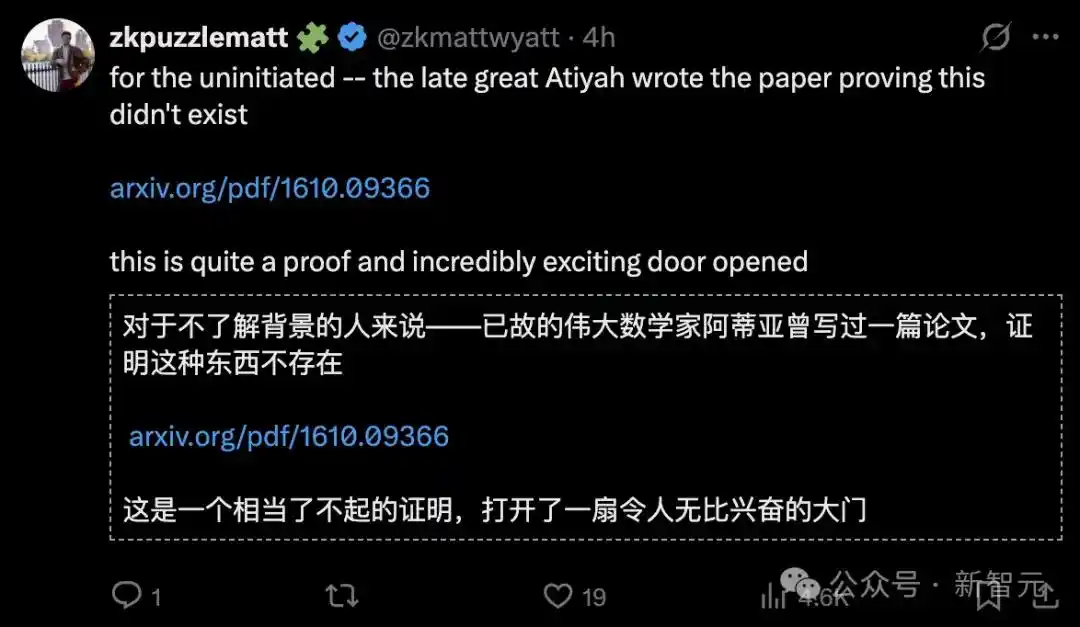
Master mathematician Shiing-Shen Chern also studied this problem in his later years.
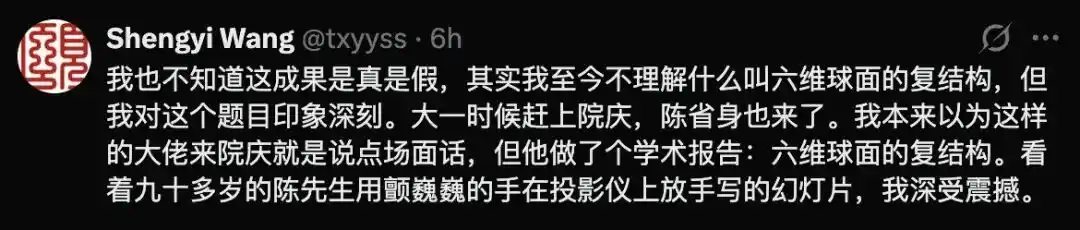
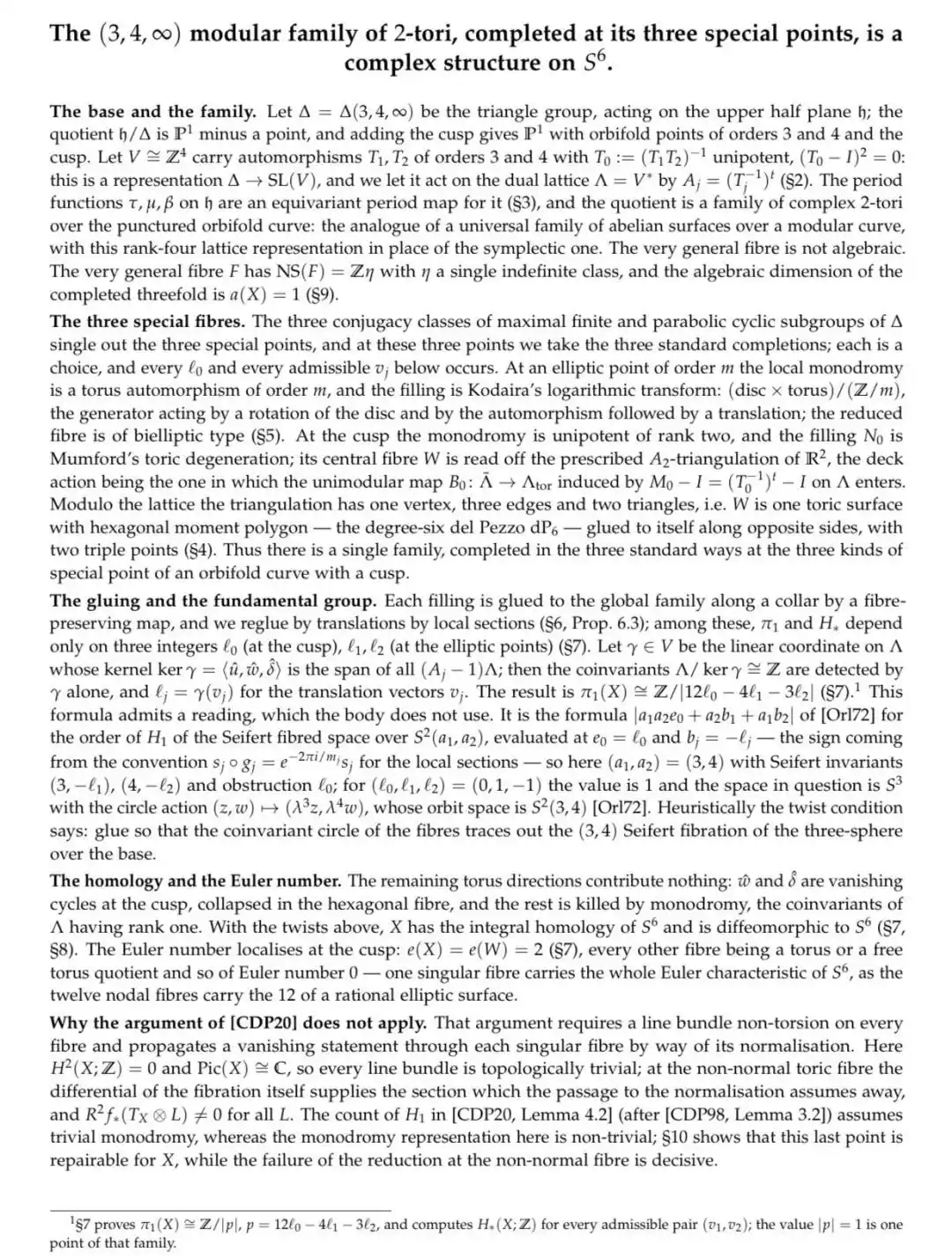
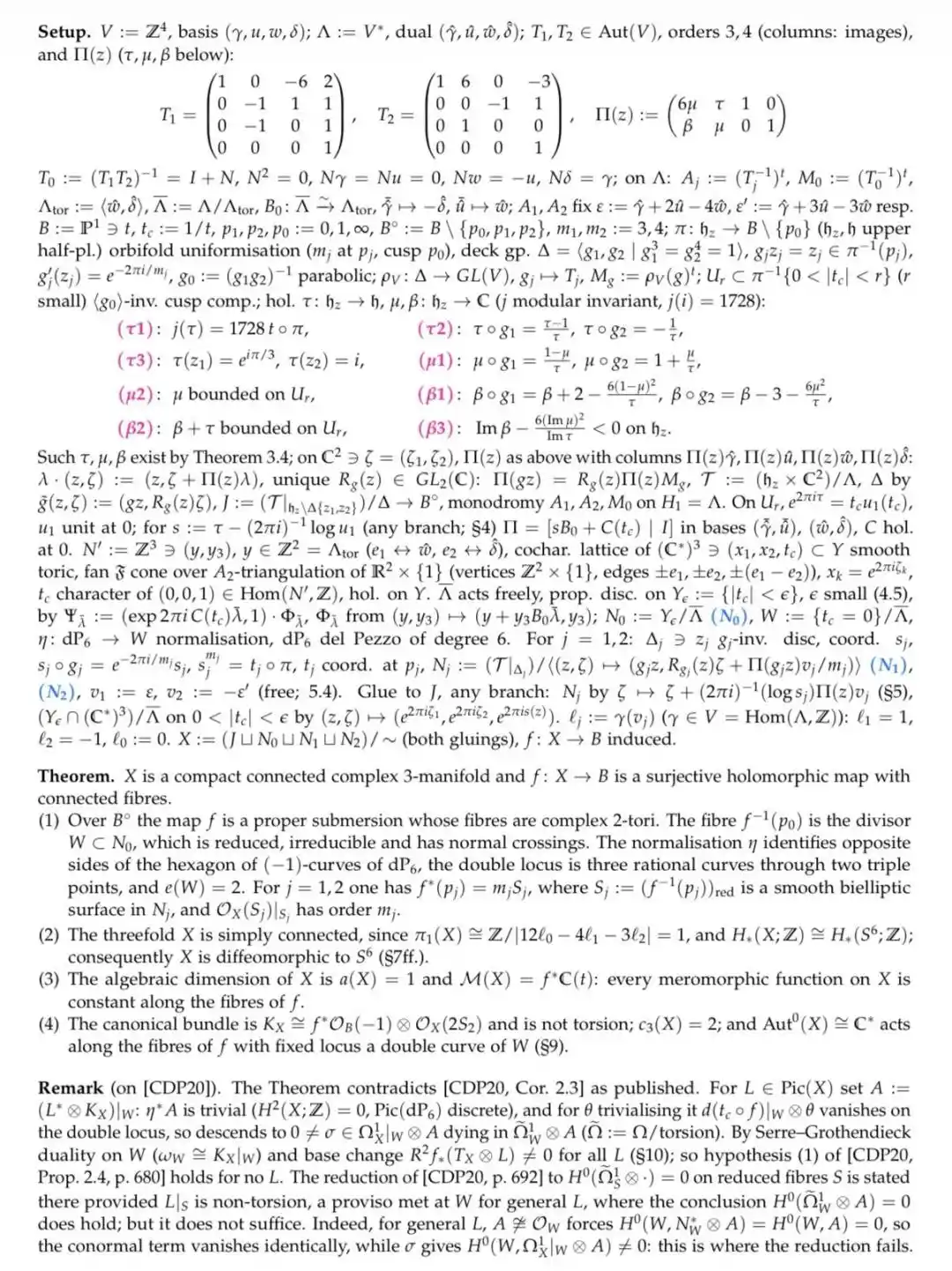
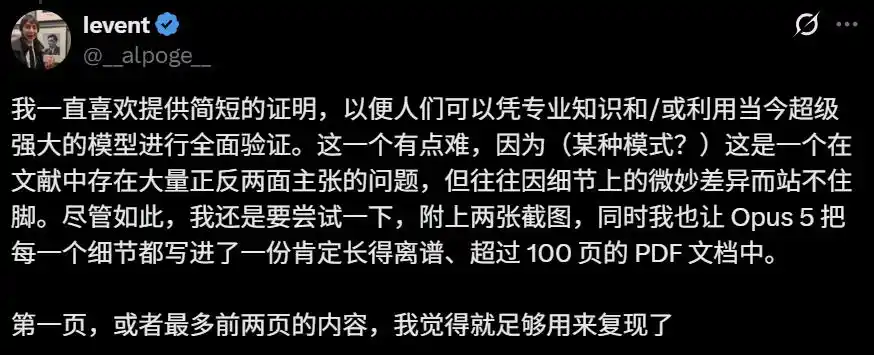
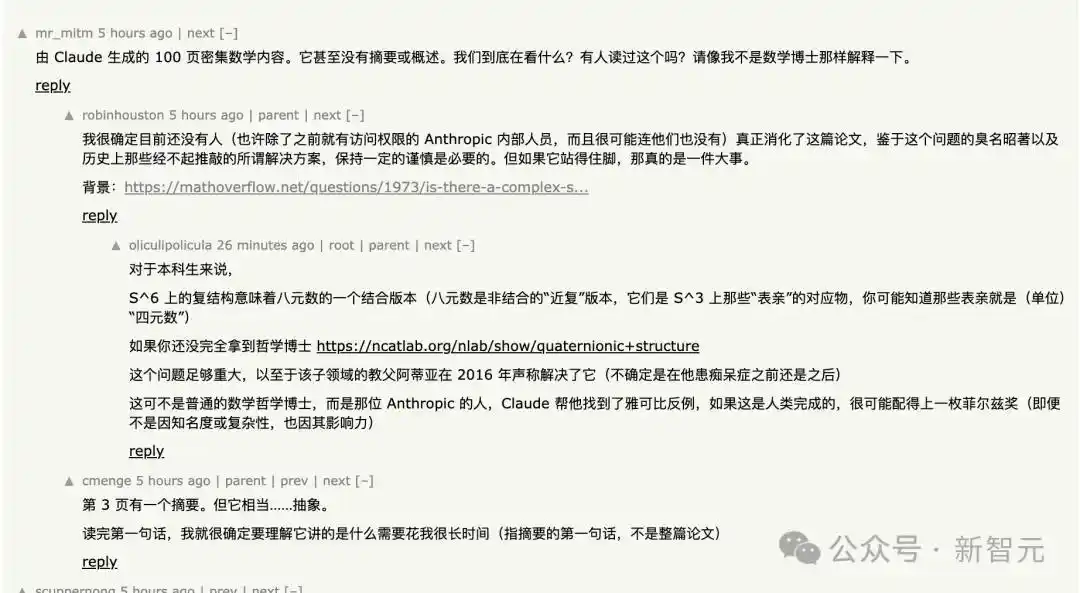
What Alpöge presented this time is a hefty 108-page document.

Every matrix, coordinate chart, and gluing method used in the construction is laid out in black and white.

Mathematician Qiaochu Yuan deliberately tried to find flaws using GPT-5.6 Sol. After scrutinizing it for 6 minutes, he found none.

Undeterred, he examined it for another 15 minutes but still couldn't find any issues; instead, he gained a deeper understanding of the argument.

Sol concluded that if these 108 pages hold their ground, this could be the most significant AI achievement in mathematics to date.
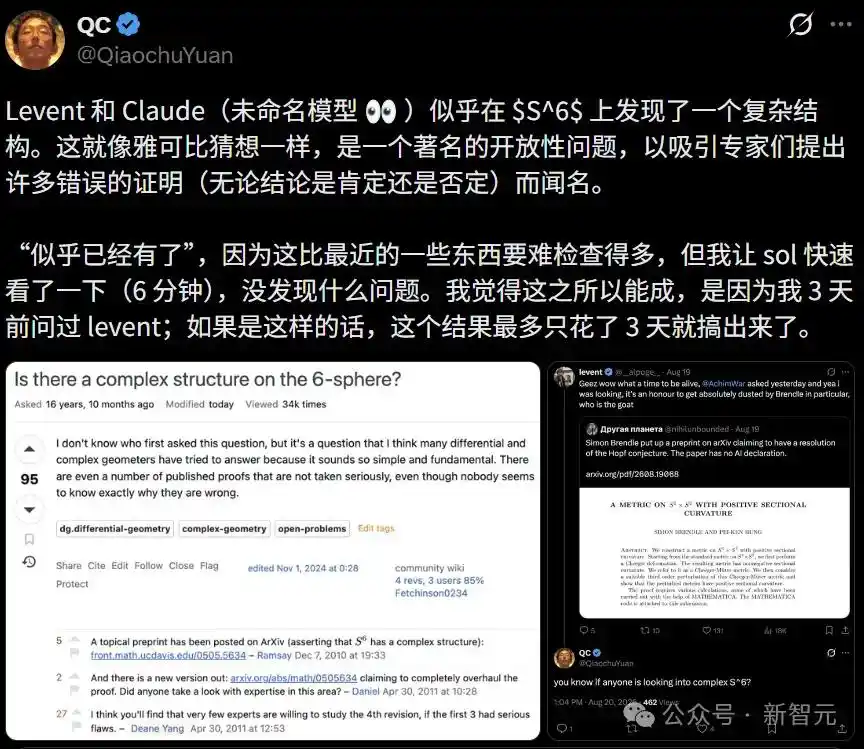
If this work were purely human, it would likely win a Fields Medal, if not for its difficulty or fame, then at least for its impact.
Three Integers That Decided the Fate of the Problem

So, how exactly was this new object constructed?

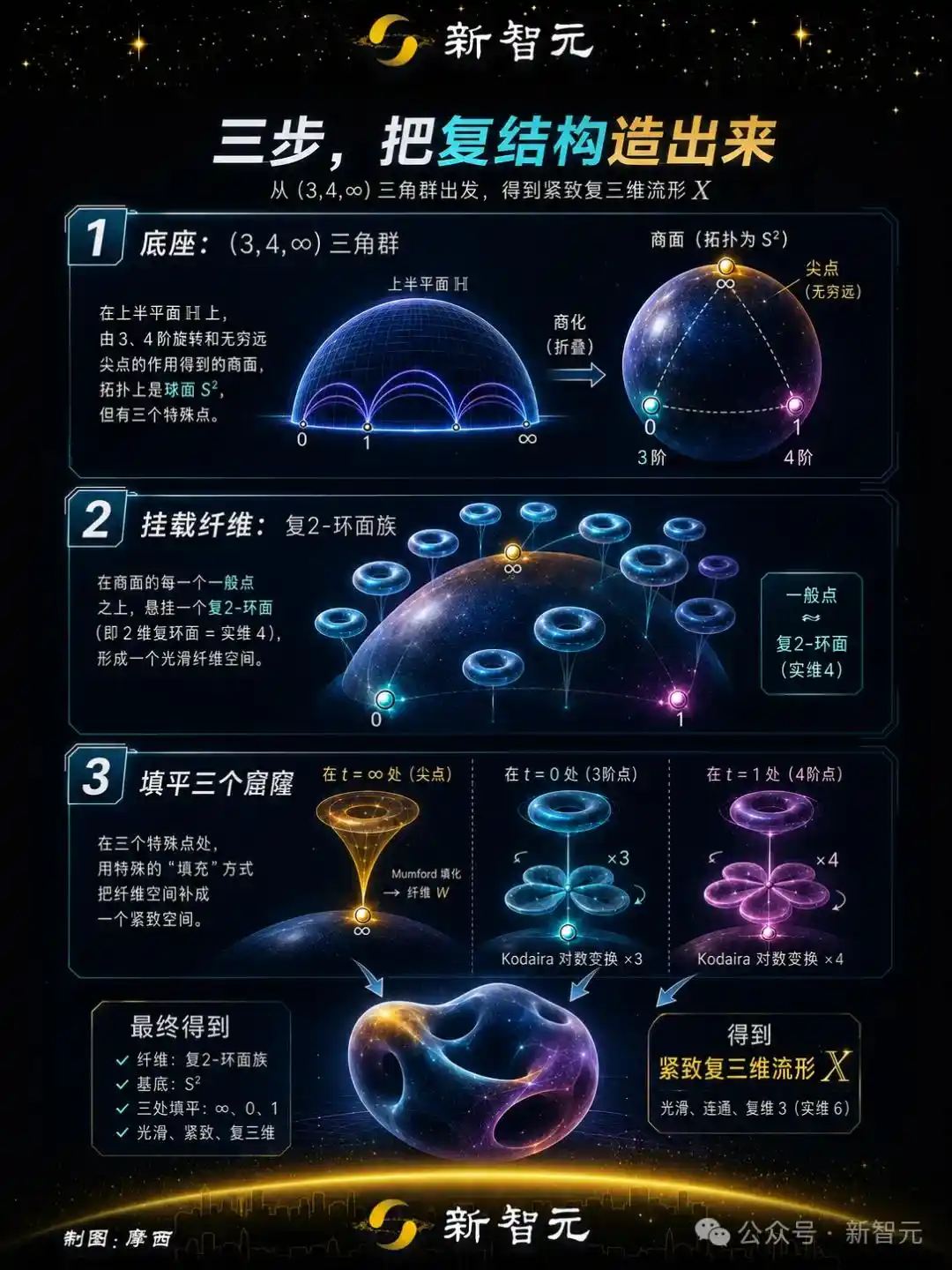
Step 1: Lay the foundation.

Take a (3,4,∞) triangle group and use it to tessellate the upper half-plane. The resulting shape, intuitively, is a sphere.

However, this sphere has three special points pinned to it: a point of order 3, a point of order 4, and a cusp, located at t = 0, t = 1, and t = ∞, respectively.

Alpöge didn't hide his favoritism, stating outright that the triangle group and the family of tori attached to it were his proudest touch.

Step 2: Attach tori to the foundation.

At every point on the base except for the three special ones, attach a complex 2-torus, a structure that is 2-dimensional over the complex numbers (4-dimensional over the reals).

This object attached above a point is called the fiber at that point. The whole X is constructed fiber by fiber in this manner.

After this step, the spots above the three special points remain empty, effectively punching three holes in the sphere.

Step 3: Fill the three holes.

Filling these holes means assigning a fiber to each of these vacant points and stitching them together to form a complete compact manifold.

The clever part is that the three holes are not filled using the same method; each hole precisely falls within the scope of a classical filling technique.

The cusp at t = ∞ is filled using Mumford's toric degeneration; the fiber inserted there is called W, obtained by taking a hexagon boundary of a degree 6 del Pezzo surface and gluing opposite edges in pairs.

The remaining points at t = 0 and t = 1 are filled using Kodaira's logarithmic transformation, with multiplicities 3 and 4, matching the orders 3 and 4 of the base points.

The moment the three holes are filled, a compact complex threefold named X comes into existence.
The Object Is Constructed, But Is It S6?

At this point, X is a perfectly legitimate complex manifold, but the interrogation isn't over.

Section 7 of the paper rigorously computes the fundamental group of X: π1(X) ≅ Z / |12l0 − 4l1 − 3l2|.

Roughly speaking, the fundamental group tells you if there are unavoidable holes in the space. Any loop drawn on a sphere can be contracted to a point, so the sphere's fundamental group is trivial.

The three integers (l0, l1, l2) in the formula record the twisting of the fibers when filling the three holes.

Substituting (0, 1, −1) gives 12×0 − 4×1 − 3×(−1) = −1, whose absolute value is firmly 1.

Z modulo 1 is the trivial group. The fundamental group vanishes here, satisfying the first condition matching X with the sphere.

Since X itself is simply connected, its integral homology matches S6 exactly. Applying the Hurewicz and Whitehead theorems, it is indeed a homotopy 6-sphere. Combined with Smale's generalized Poincaré conjecture from 1961, it is homeomorphic to S6.

Finally, only the smooth structure remains to be verified.

In topology, homeomorphism does not imply diffeomorphism. Two objects might look identical, but the ways calculus works on them might not align. Such imposters have a special name: exotic spheres.

Fortunately, as early as 1963, Kervaire and Milnor settled this account: the six-dimensional world is clean, having exactly zero exotic spheres. In contrast, seven dimensions can produce up to 28 of them.

Thus, homeomorphism here directly upgrades to diffeomorphism. X's true identity is S6.

The Solver Wasn't Originally a Complex Geometer

Alpöge is a Junior Fellow at the Harvard Society of Fellows and concurrently a postdoctoral researcher at Anthropic. His primary field is number theory and arithmetic geometry; he doesn't typically wade into the waters of complex geometry.

Yuan revealed that just three days before solving this problem, he had discussed this deadlock with him.

From Finding Answers to Creating Answers

Solving a 70-year-old problem in three days is already absurd enough.

But this was actually the third time within 35 days.

July 20: Alpöge, using Claude Fable 5, produced a fatal counterexample to the Jacobian conjecture, a problem posed in 1939 that had remained unsolved for 87 years.

Only three weeks later, on August 10: An unreleased research version of Claude, whose identity remains undisclosed, increased the proven proportion of zeros of the Riemann zeta function lying on the critical line from 41.6% to 67.2%.

In that computational battle, it mobilized about 60 sub-agents, executed roughly 2400 shell commands, and consumed 31 million output tokens.

Then came August 24: this S6 result.

For the first two instances, you could still argue that the AI was merely a powerful search engine—one exploring known solution spaces for a counterexample, the other forcibly stitching together two existing papers already in the literature.

This time, however, the nature fundamentally changed.

This geometric object did not previously exist; the model literally created it.

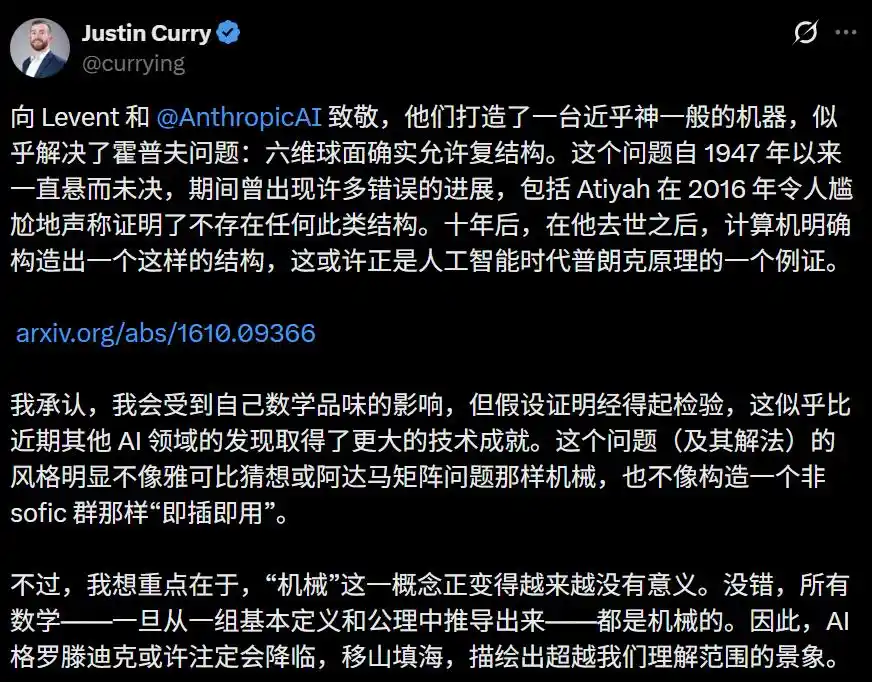
Justin Curry, Associate Professor of Mathematics and Statistics at the University at Albany, SUNY, stated plainly: If the proof holds, this is certainly the most impressive AI achievement in recent memory.
For the past 78 years, everyone was asking the same question: does a complex structure exist on S6?

From this moment on, the question might already be a different one.

How many more are hidden there?

Reference: https://alpo.ge/s6.pdf

This article is from the WeChat public account "Xinzhiyuan"; author: ASI Apocalypse; editor: Moses David


Câu hỏi Liên quan

QWhat is the key mathematical result presented in the article regarding the six-dimensional sphere?

AThe article presents a purported proof, achieved by mathematician Levent Alpöge and AI Claude, that the six-dimensional sphere (S6) admits a complex structure. This construction and proof is claimed to solve a 78-year-old open problem in mathematics.

QHow did the researchers approach the problem of S6's complex structure differently from previous attempts?

AInstead of following the traditional theoretical approaches to prove or disprove the existence of a complex structure on S6, they directly constructed a specific geometric object (a compact complex threefold X) and then mathematically proved that this object is diffeomorphic to S6.

QWhat role did the AI Claude reportedly play in this discovery according to the article?

AAccording to the article, Claude was a co-author and instrumental tool used by Levent Alpöge. The AI was heavily involved in the reasoning and computational processes that led to the construction and proof, working over a very short timeframe. This is presented as a landmark achievement in AI-assisted mathematical discovery.

QWhich other long-standing mathematical problems were mentioned as being tackled by Levent Alpöge and Claude in recent weeks?

AThe article mentions two other significant results achieved in a short period prior: 1) A counterexample to the 87-year-old Jacobian Conjecture (July 20). 2) Increasing the proven proportion of Riemann zeta function zeros on the critical line from 41.6% to 67.2% (August 10).

QWhy is proving the existence of a complex structure on S6 considered particularly difficult and significant?

AIt has been a major open question in complex and differential geometry for 78 years. Many renowned mathematicians, including Fields Medalist Michael Atiyah, attempted and failed to definitively answer it. The S2 sphere is the only other sphere known to have a natural complex structure, making S6 a unique and critical case. Solving it would fundamentally expand the understanding of complex geometry on spheres.

Nội dung Liên quan

Bài phát biểu mới nhất của Warsh: Thời đại của chúng ta

Bài phát biểu của Chủ tịch Fed Kevin Walsh tại Hội nghị Jackson Hole mang tín hiệu thận trọng thiên hướng diều hâu. Walsh nhấn mạnh nền kinh tế và thị trường lao động Mỹ vẫn mạnh mẽ, môi trường tài chính chưa thực sự hạn chế, và lạm phát vẫn cao hơn đáng kể so với mục tiêu 2%. Do đó, kiểm soát giá cả phải tiếp tục là ưu tiên hàng đầu của chính sách tiền tệ. Ông nêu rõ tiêu chuẩn của mình: Fed cần có sự tin tưởng rằng lạm phát cơ bản đang tiến về mục tiêu một cách rõ ràng và đủ nhanh; nếu không, vẫn còn công việc phải làm. Dù dữ liệu CPI và PCE mùa hè tích cực, chúng không khiến ông tin rằng xu hướng lạm phát cơ bản đã được cải thiện một cách có ý nghĩa. Walsh cũng trình bày quan điểm về "hướng dẫn triển vọng". Ông cho rằng trong thời kỳ bình thường, việc này nên được hạn chế, vì cam kết sớm về lộ trình lãi suất có thể gây hiểu lầm, hạn chế không gian linh hoạt của Fed và tạo ra "vấn đề sảnh gương", nơi thị trường và Fed có thể bỏ qua những thay đổi kinh tế mới. Bài phát biểu đã tác động đến thị trường: kỳ vọng về khả năng tăng lãi suất của Fed vào tháng 9 tăng lên gần 60%, và giá vàng giảm mạnh. Trong phần kết luận, Walsh cam kết một cách tiếp cận có kỷ luật, tập trung vào dữ liệu và các nguyên tắc vững chắc để thực hiện nhiệm vụ kép của Fed là ổn định giá cả và tối đa hóa việc làm.

marsbit1 giờ trước

Bài phát biểu mới nhất của Warsh: Thời đại của chúng ta

marsbit1 giờ trước

Truy cập vào các phiên hoạt động thay vì cơ sở dữ liệu: Thị trường chợ đen ở Nga đã thay đổi như thế nào

Thị trường ngầm ở Nga đang chuyển hướng từ bán cơ sở dữ liệu khổng lồ sang buôn bán quyền truy cập ngắn hạn, tích cực vào tài khoản người dùng. Giá thông tin bị đánh cắp bởi phần mềm độc hãi từ thiết bị nhiễm bệnh đã tăng gần 13% trong năm qua. Các gói dữ liệu mới chứa token phiên hoạt động, mật khẩu hiện hành, thông tin đăng nhập VPN, kho lưu trữ đám mây và quyền truy cập mạng công ty, cho phép xâm nhập tức thì mà có thể bỏ qua xác thực hai yếu tố. Trong khi đó, số lượng các vụ rò rỉ cơ sở dữ liệu lớn mới đã giảm sau các biện pháp trừng phạt nghiêm khắc của chính phủ. Tuy nhiên, các cơ chế quản lý hiện tại tỏ ra không hiệu quả trước mô hình đe dọa mới này, vì phần mềm độc hại đánh cắp dữ liệu từ thiết bị cá nhân sau khi chúng rời khỏi hệ thống công ty, mà không vi phạm trực tiếp đến cơ sở dữ liệu tập trung. Các chuyên gia chỉ ra rằng mô hình này lặp lại kịch bản tội phạm mạng toàn cầu, chẳng hạn như thị trường Genesis Market đã bị đóng cửa. Tình hình nhấn mạnh lỗ hổng nằm giữa thiết bị cá nhân và hệ thống công ty, nơi giá trị của token ngắn hạn ngày càng tăng nhưng lại nằm ngoài phạm vi kiểm soát của các quy định bảo vệ hiện hành.

cryptonews.ru4 giờ trước

Truy cập vào các phiên hoạt động thay vì cơ sở dữ liệu: Thị trường chợ đen ở Nga đã thay đổi như thế nào

cryptonews.ru4 giờ trước

Bitfinex Báo Hiệu Khởi Đầu Xu Hướng Tăng Giá Bitcoin Trong Bối Cảnh Mức Tương Quan Đạt Đỉnh Với Vàng

Các nhà phân tích từ sàn Bitfinex chỉ ra rằng Bitcoin đang bắt đầu hành xử như "vàng kỹ thuật số" khi nhà đầu tư tìm kiếm công cụ phòng ngừa rủi ro trước nợ và thao túng tiền tệ. Mối tương quan giữa giá Bitcoin và vàng đã đạt đến mức đỉnh hiếm khi duy trì lâu dài, báo hiệu một sự thay đổi xu hướng sắp tới. Cả hai tài sản đều được giao dịch như một phương tiện phòng ngừa sự mất giá tiền tệ, với Bitcoin là phiên bản có hệ số beta cao hơn. Bitfinex nhấn mạnh rằng bối cảnh giảm rủi ro tiềm năng sẽ cho thấy liệu Bitcoin sẽ giữ vững cùng vàng hay giảm theo cổ phiếu. Báo cáo cũng ghi nhận sự thay đổi môi trường vĩ mô, từ cơn sốt AI sang giao dịch phòng ngừa mất giá, do những diễn biến gần đây liên quan đến nợ công Mỹ. Đồng thời, Bitfinex xác định Bitcoin đã thoát khỏi pha tích lũy và bước vào pha tăng trưởng, với chỉ số Delta-Thermo Market Multiple là 2.03, tiến gần ngưỡng 2.5x đánh dấu bắt đầu pha tăng. Tình huống hiện tại được so sánh với cấu hình tương tự năm 2024, liên quan đến lo ngại về "xói mòn nợ" và sự đa dạng hóa rộng rãi gây bất lợi cho đồng USD. Tuy nhiên, Chủ tịch Fed Kevin Warsh gần đây đã bác bỏ lập luận này, giữ lập trường "diều hâu" và ám chỉ khả năng tăng lãi suất.

cryptonews.ru4 giờ trước

Bitfinex Báo Hiệu Khởi Đầu Xu Hướng Tăng Giá Bitcoin Trong Bối Cảnh Mức Tương Quan Đạt Đỉnh Với Vàng

cryptonews.ru4 giờ trước

SlowMist đánh dấu kho lưu trữ giả mạo Qwen 3.8 27B trên GitHub ẩn chứa thông tin về StealC

SlowMist đã phát hiện một kho lưu trữ GitHub giả mạo dữ liệu trọng lượng cho mô hình AI Qwen 3.8 27B của Alibaba, thực chất chứa mã độc đánh cắp thông tin có tên StealC. Kho lưu trữ giả này có tập tin ZIP chỉ nặng 487KB - một dung lượng bất thường so với kích thước thực tế của mô hình (trên 16GB). Tập tin độc hại, được tải lên ngày 20/8/2026, chứa mã độc StealC ngụy trang dưới dạng file chứng chỉ. Khi kích hoạt, nó thu thập thông tin hệ thống, chụp ảnh màn hình, đánh cắp dữ liệu trình duyệt, mật khẩu email và thông tin ví tiền mã hóa từ máy nạn nhân. SlowMist cũng ghi nhận ít nhất 23 kho lưu trữ GitHub khác sử dụng phương pháp tấn công tương tự. Theo báo cáo từ Island.io, chiến dịch FakeGit hoạt động từ tháng 3/2025 đã tạo ra khoảng 7.600 kho lưu trữ độc hại, với 800 kho nhắm mục tiêu đặc biệt vào các công cụ AI thông qua kỹ thuật "AgentBaiting". Các tin tặc thường sao chép dự án thật, tạo trang README thuyết phục, sử dụng danh tính bị đánh cắp và đăng ký trên các nền tảng AI công cộng để tăng độ tin cậy. Người dùng được cảnh báo nên kiểm tra kỹ kích thước tệp và nguồn gốc khi tải xuống các mô hình AI từ nguồn mở.

cryptonews.ru4 giờ trước

SlowMist đánh dấu kho lưu trữ giả mạo Qwen 3.8 27B trên GitHub ẩn chứa thông tin về StealC

cryptonews.ru4 giờ trước

Giao dịch

Giao ngay
活动图片