Bernstein Interprets MRNA's 177% Surge: What's Fundamentals and What's Hype?

marsbitXuất bản vào 2026-08-21Cập nhật gần nhất vào 2026-08-21

Tóm tắt

Bernstein's analysis of Moderna's 177% stock surge following positive Phase 3 results for its individualized neoantigen therapy (INT) in melanoma distinguishes fundamental drivers from market speculation. The clinical breakthrough is real: the INTerpath-001 trial met its primary and key secondary endpoints, providing crucial validation for mRNA technology in oncology beyond infectious diseases. However, Bernstein argues the magnitude of the stock move cannot be justified by this single trial's fundamentals alone. The surge was amplified by three key factors: 1) A re-rating of Moderna's mRNA platform potential for expansion into other cancers, 2) A massive short squeeze, given ~15% of shares were sold short pre-announcement, and 3) The compelling "cancer vaccine" narrative that fueled broader investor enthusiasm. While the melanoma success is significant, Bernstein cautions that replication in lung, kidney, and bladder cancers—which have different immunogenicity—is not guaranteed. Furthermore, INT's commercial model faces challenges: it's a personalized treatment, not a mass-market vaccine, implying higher production costs and potential margin pressures despite a projected multi-billion dollar peak sales opportunity. The report also notes sector rotation, with some funds moving from crowded AI/semiconductor trades into defensive healthcare stocks, adding further momentum. In conclusion, Bernstein maintains a "Market-Perform" rating and a $45 price target, far below the po...

On August 19, Moderna and Merck announced the Phase 3 topline results for the personalized neoantigen therapy intismeran autogene (referred to as INT) in combination with Keytruda for the treatment of high-risk melanoma.

INTerpath-001 enrolled a total of 1,137 patients with stage IIB to IV cutaneous melanoma who had completed surgical resection and had not previously received systemic treatment. At the first interim analysis, the trial simultaneously met its primary endpoint of Recurrence-Free Survival (RFS) and the key secondary endpoint of Distant Metastasis-Free Survival (DMFS). Overall Survival (OS) data is not yet mature, and the trial will continue.

The company has so far only confirmed that the results are statistically significant and clinically meaningful, without disclosing specific hazard ratios, confidence intervals, patient subgroups, and full safety data. In other words, the market has confirmed the trial's success but does not yet know exactly how strong the efficacy is.

Following the announcement, Moderna's stock closed up about 177% to $174.38, with its market capitalization increasing by approximately $45 billion in a single day; Merck's stock rose about 13% to $152.20, with its market cap increasing by about $50 billion. The market debate quickly shifted from "Will the trial succeed?" to "Can such a scale of gains be justified by fundamentals?"

Clinical Breakthrough is Real, But Insufficient to Explain the 177% Surge

Bernstein believes that INTerpath-001 meeting both the RFS and DMFS endpoints at the first interim analysis suggests the efficacy is likely quite robust.

Interim analyses typically need to cross a higher statistical threshold. Based on this, the report speculates that the Phase 3 trial's RFS hazard ratio could be in the range of 0.50 to 0.65, and the DMFS hazard ratio might be close to 0.40, roughly consistent with previous Phase 2 data.

A hazard ratio below 1 means the relative risk of recurrence, distant metastasis, or death events is lower in the combination therapy group compared to the Keytruda monotherapy group. For example, a hazard ratio of 0.50 roughly represents an approximate 50% reduction in the relative risk of the relevant event, but does not equate to half of the patients being cured.

The above ranges are merely Bernstein's speculation based on statistical thresholds and past data, not the Phase 3 results announced by the companies. Specific efficacy, safety, and overall survival trends still await complete data.

However, the significance of this trial extends beyond melanoma. It is Moderna's first pivotal trial success outside of respiratory vaccines and the first personalized neoantigen regimen proven to further improve Keytruda's efficacy in a Phase 3 study.

This provides critical clinical evidence for expanding mRNA from infectious disease vaccines to cancer treatment and marks the starting point for the market's revaluation of Moderna's platform value.

The Market is Trading on Platform Revaluation and Short Covering

Clinical results can explain a stock price increase but are insufficient to explain its magnitude.

Bernstein believes that even with optimistic success expectations for all of INT's later-stage projects, it is difficult to justify Moderna's approximately 177% single-day surge. This rally is primarily driven by the convergence of three forces:

Clinical success reduces the residual risk for the melanoma project;

Investors begin pricing in the platform potential of mRNA expansion to more cancer types;

High short interest triggers short covering, amplifying short-term buying pressure.

Prior to the results announcement, approximately 14% to 15% of Moderna's float was sold short. After the clinical results exceeded pessimistic expectations, short sellers were forced to buy to cover their positions, and previously underweight investors also started chasing the rally. Moderna's trading volume that day approached 200 million shares, roughly equivalent to half of the company's total outstanding shares.
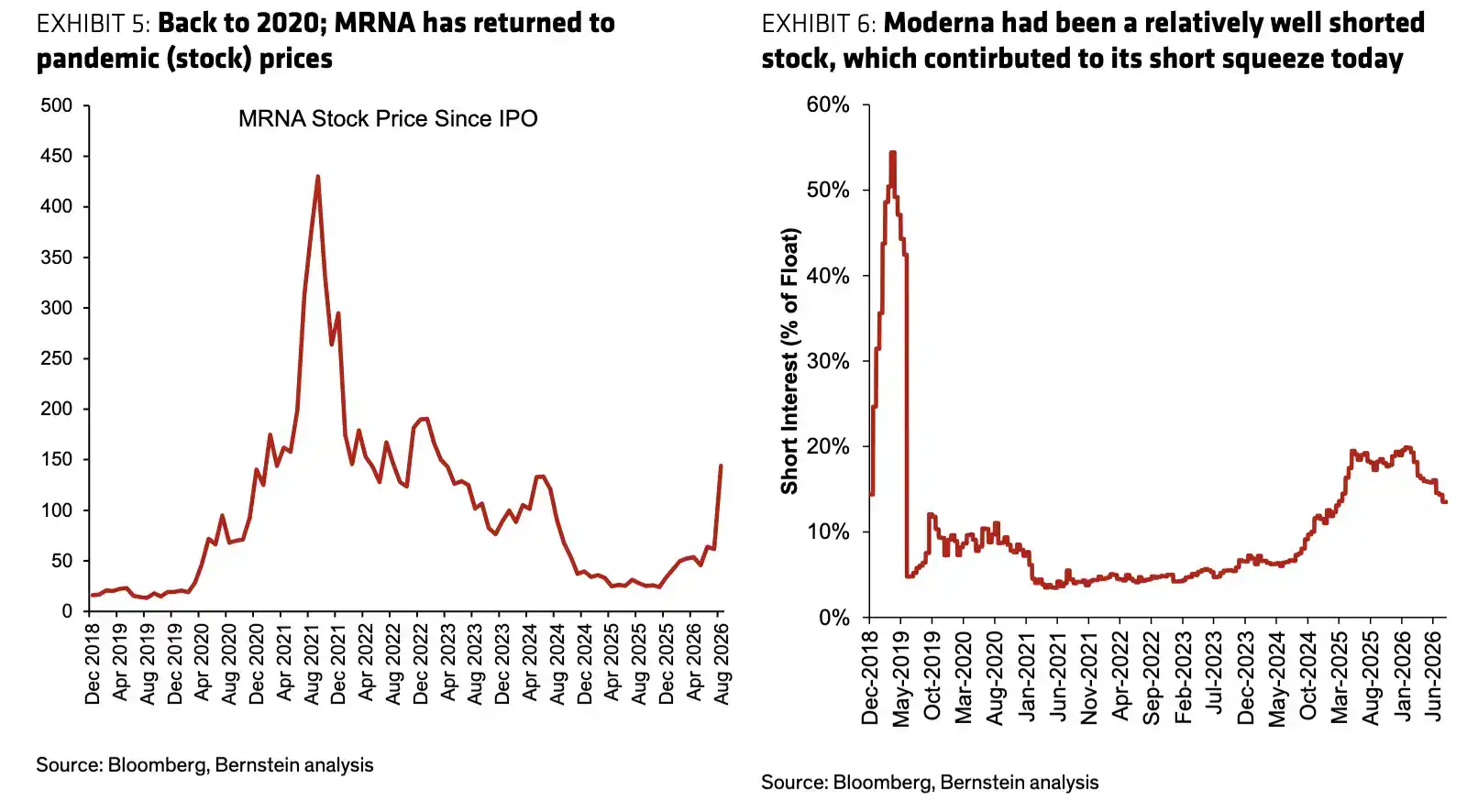
MRNA stock price chart (left) and short interest chart (right). MRNA's stock price surged on August 19, 2026, returning to pre-pandemic levels, while previously about 14-15% of its float was shorted, creating conditions for a short squeeze. Clinical data triggered the rise, but short covering further amplified the gains.

The news tag "cancer vaccine success" further amplified the spread effect. Compared to "personalized neoantigen therapy meets Phase 3 endpoints," this phrasing more easily leads the market to envision a large platform covering multiple cancer types.

Therefore, clinical data was the trigger for the rise, while platform narrative, short covering, and news effects amplified the gains. The amount of stock price increase does not mean the market has already confirmed that INT can generate equivalent levels of revenue and profit.

Melanoma is Just the Starting Point; Platform Replication Remains to Be Proven

Moderna and Merck currently have four Phase 3 studies and five Phase 2 studies around INT, covering melanoma, non-small cell lung cancer (NSCLC), renal cell carcinoma, and bladder cancer, and are beginning to enter unresectable or metastatic tumors.

Bernstein estimates that INTerpath-001 corresponds to a U.S. potential patient population of approximately 13,000 to 19,000 people, representing about 30% of the accessible patient population for the current Phase 3 and potential registration-enabling Phase 2 projects, and about 17% of all Phase 2 and Phase 3 projects.
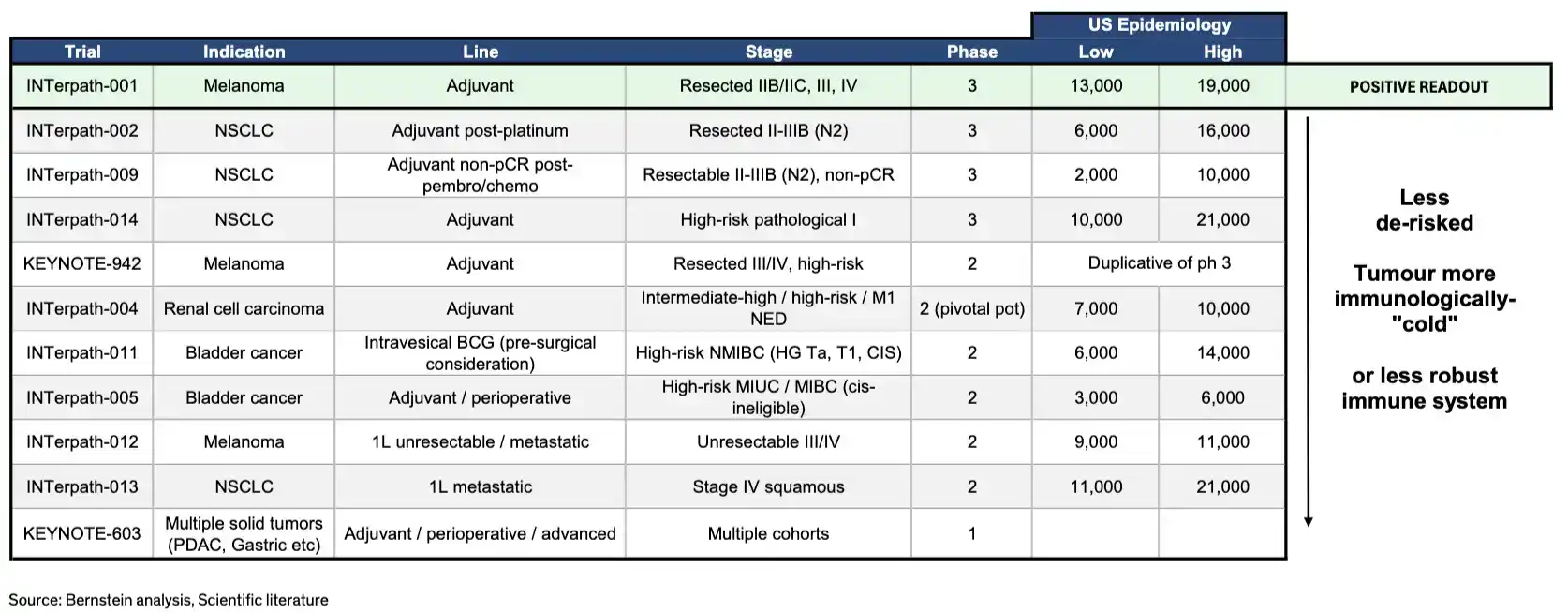
The U.S. accessible patient population for INTerpath-001 is approximately 13,000 to 19,000 people, representing only about 30% of the accessible patient total for current pivotal projects and about 17% of all Phase II and Phase III INT studies. Success in melanoma does not automatically guarantee the same results can be replicated in lung cancer, kidney cancer, and other cancer types.

If projects in lung cancer, kidney cancer, and bladder cancer can replicate the success in melanoma, INT's market potential will expand significantly. Bernstein currently gives an un-risk-adjusted sales forecast for early-stage melanoma and lung cancer of approximately $2.4 billion.

The report also uses Keytruda as an upside reference: its early-stage cancer indications generated about $7.9 billion in revenue in 2025, with an estimated $9.2 billion in 2028, and INT's future pricing could potentially be higher than Keytruda's.

But $2.4 billion is an un-risk-adjusted sales forecast, not profit, and certainly not realized performance. INT also has not yet covered several important Keytruda indications like triple-negative breast cancer, cervical cancer, and head and neck cancer.

More critically, melanoma typically has strong immunogenicity. Its success cannot be directly extrapolated to tumors with different immune microenvironments, such as lung cancer, kidney cancer, and bladder cancer.

INTerpath-001 proves the platform's *potential* for replication but does not prove replication *will* necessarily occur. The market has already started trading the endgame of success in other cancer types, but the relevant clinical data is still on the way.

Bernstein therefore maintains its "Market-Perform" rating and $45 price target for Moderna, far below the August 19 closing price of $174.38.

The "Cancer Vaccine" Label Blurs Commercial Realities

INT is not a preventive vaccine for healthy populations but a personalized treatment for cancer patients. At this stage, it is used as adjuvant therapy after patients have completed tumor resection, with the goal of reducing the risk of recurrence and distant metastasis caused by residual disease.

Tumor tissue and blood samples must be individually collected from each patient, followed by gene sequencing and algorithm analysis. The system selects up to 34 patient-specific neoantigens from the patient's tumor mutations, then produces the corresponding mRNA construct to induce a T-cell response against the tumor.
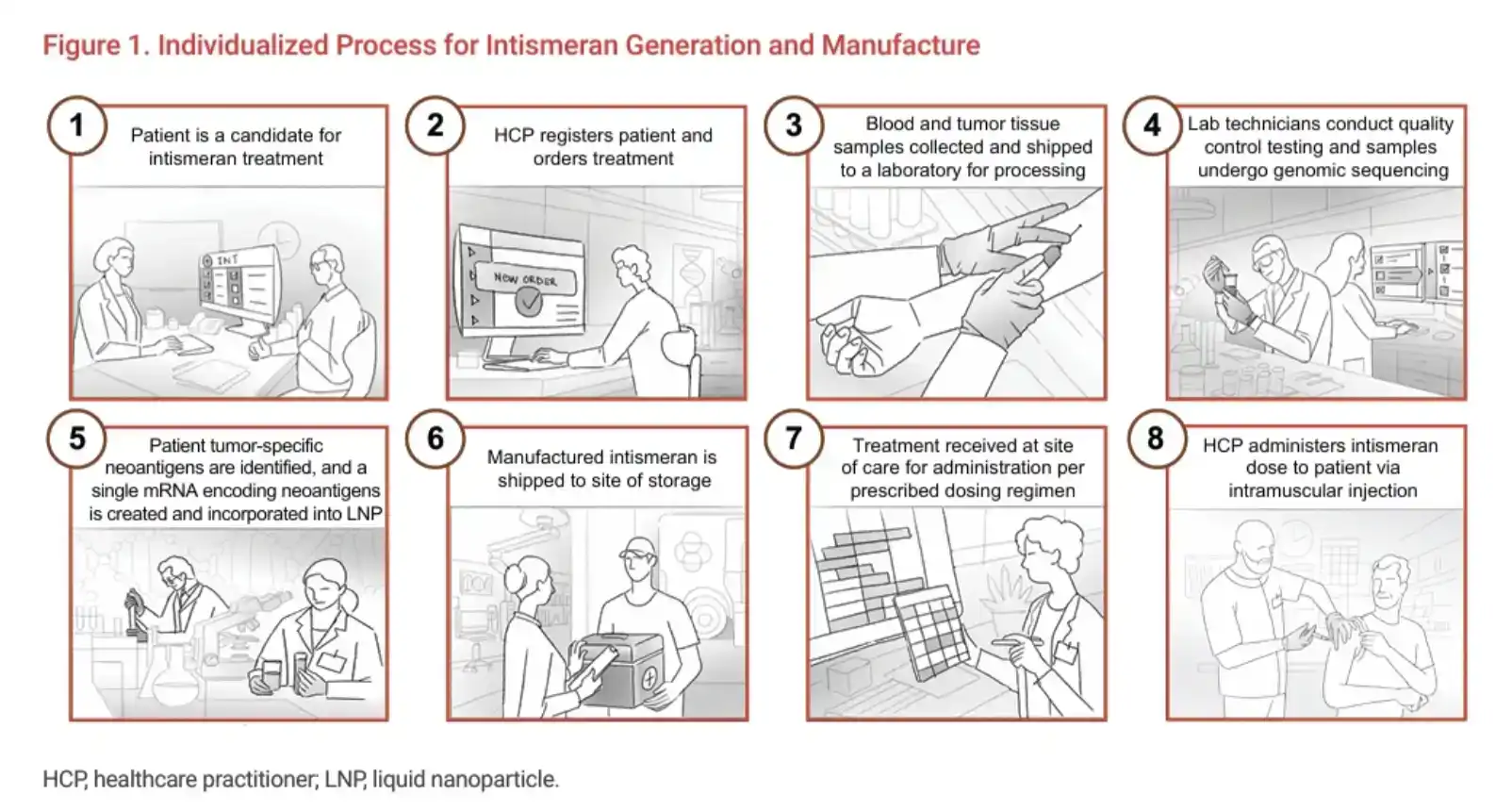
Therefore, while INT uses Moderna's mRNA platform, its business model is closer to that of a personalized oncology drug:

The target patient population is in the tens of thousands, not tens or hundreds of millions like traditional vaccines;

Each patient requires separate sequencing, design, and production;

Production costs are difficult to scale down rapidly like batch-produced vaccines;

Regulatory, pricing, and reimbursement will follow the oncology drug pathway.

"Cancer vaccine" is an easily communicable label, but it may amplify market imagination about patient scale while downplaying real-world constraints like personalized production costs and commercialization efficiency. The incremental impact of INT's success on traditional vaccine raw material suppliers is also relatively limited.

For Billions in Revenue, How Much Profit Ultimately Remains?

Compared to sales potential, Bernstein is more concerned about INT's profit margins.

Merck will be responsible for global commercialization. Moderna will participate in co-promotion in the U.S., while Merck will independently handle marketing and sales in markets outside the U.S. The two parties will share costs and profits per the agreement.

Bernstein uses the single melanoma indication as an example, assuming INT's peak sales reach $1.2 billion, with gross margins gradually improving from 35% at launch to 60%. After deducting approximately $250 million in SG&A expenses and profit sharing, the mature-stage contribution to Moderna's EPS would be about $0.60.

This is Bernstein's scenario calculation, not company guidance. It illustrates that even if INT becomes a billion-dollar product, personalized production costs and profit sharing will limit profit realization.

The market's current pricing, however, already implies multiple favorable conditions: success in other cancer types, smooth expansion of custom manufacturing, favorable pricing and reimbursement, and continuously improving gross margins. None of these conditions have yet been fully verified.

For Merck, INT's strategic value lies primarily in expanding Keytruda's usage. Most trials use an "INT + Keytruda" vs. "Keytruda monotherapy" design, so INT is first and foremost an add-on therapy, not a replacement for Keytruda.

If the combination regimen becomes the new standard of care, Bristol-Myers Squibb's Opdivo, Roche's Tecentriq, and AstraZeneca's Imfinzi could face market share pressure in some melanoma and NSCLC markets. However, the low initial gross margins and profit sharing could also weigh on INT's contribution to Merck's operating profit margin.

Therefore, Merck's approximately $50 billion market cap increase is similarly difficult to explain solely by the profits from the current melanoma project.

Pharma Sector Rally Also Influenced by AI Trading Rotation

Bernstein believes this rally is not entirely Moderna's individual stock story.

The report observes that the pharmaceutical and semiconductor sectors have recently shown a certain inverse trading characteristic. Against a backdrop of increasingly concentrated AI and semiconductor holdings, pharmaceuticals have started to be viewed by some investors as a relatively clean defensive option: demand is less affected by economic cycles, while potentially benefiting long-term from AI's application in drug discovery and clinical trials.
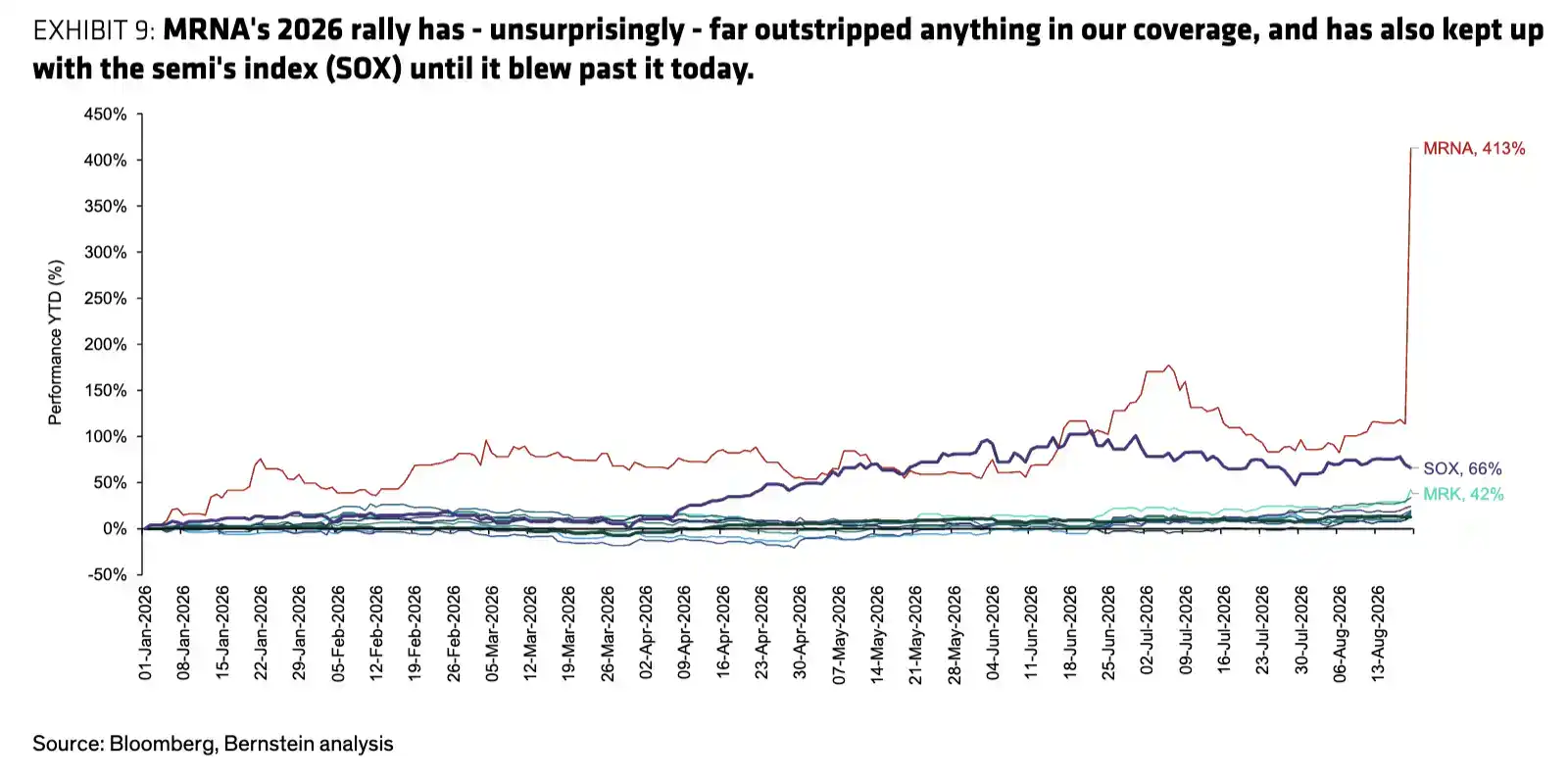
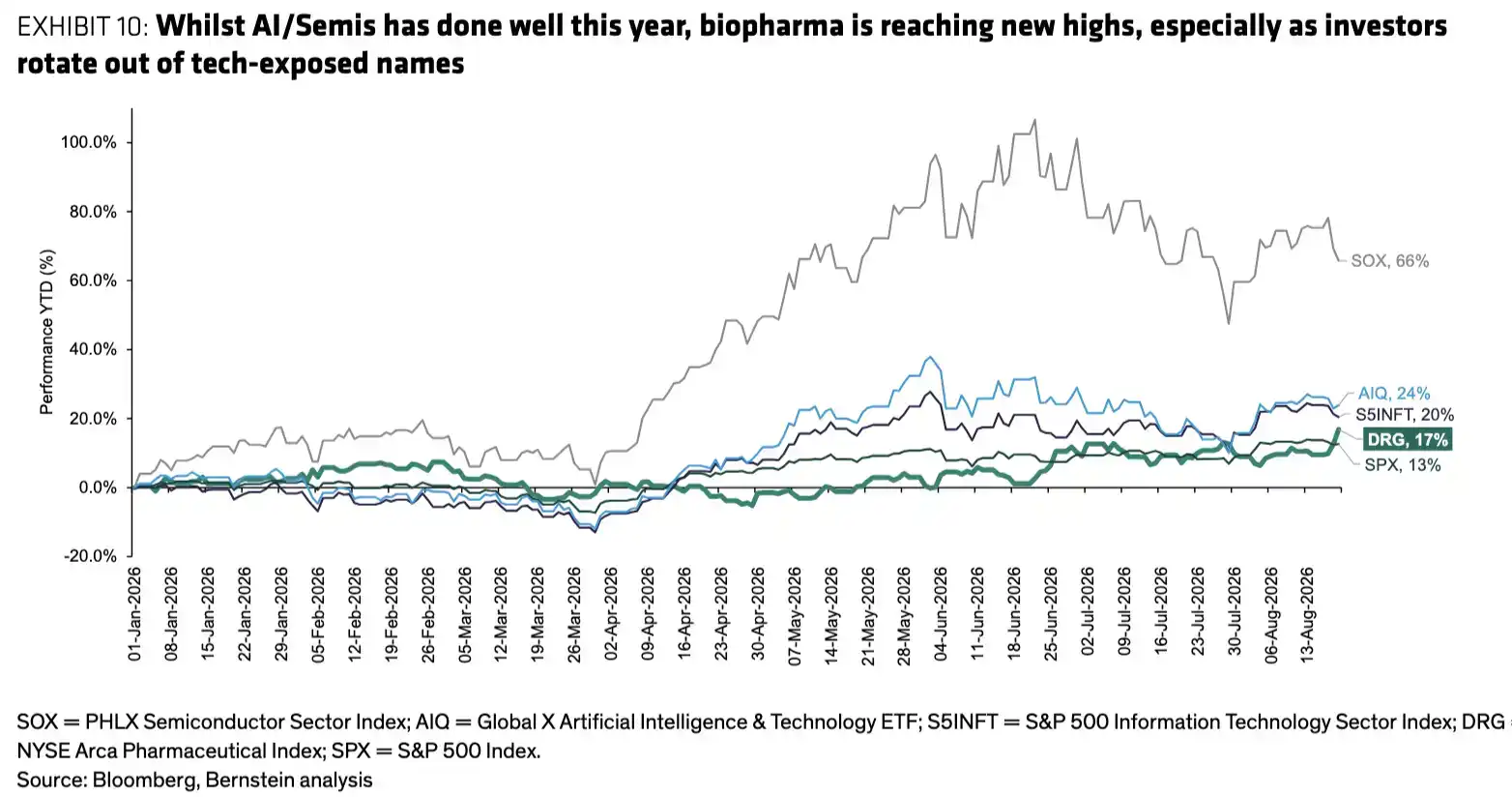
In 2026, the pharmaceutical sector (DRG) and the semiconductor index (SOX) show a clear inverse trading characteristic. When the AI theme experiences volatility and capital flows out of the tech sector, the pharmaceutical sector, as a defensive asset, sees capital inflows. Moderna's rise is not just an individual stock story but also a result of sector rotation.

This is merely Bernstein's interpretation of capital flows and does not imply a stable negative correlation between pharmaceuticals and semiconductors. However, when tech stock volatility rises, sector rotation can provide additional buying pressure for the pharma sector and amplify the market impact of INT's clinical results.

Thus, Moderna's rise contains three layers of trading: the foundation is the Phase 3 melanoma success, the middle layer is mRNA platform revaluation, and the outer layer consists of short covering and sector rotation. The further from the core, the greater the distance from quantifiable fundamentals.

From Clinical Breakthrough to Earnings Inflection Point: Three Validations Remain

INTerpath-001 has proven that mRNA personalized neoantigen therapy can succeed in a large Phase 3 trial. But to define it as Moderna's earnings inflection point, at least three more validations are needed:

First, complete Phase 3 data. The specific hazard ratios, safety profile, patient subgroups, and OS trends will determine INT's real advantage over Keytruda monotherapy.

Second, cross-cancer replication. Results from subsequent lung, kidney, and bladder cancer trials will determine whether melanoma is just a favorable indication or the starting point for a broader oncology platform.

Third, commercialization efficiency. Custom manufacturing cycles, capacity, pricing, reimbursement, and gross margins will determine whether sales can be converted into profits sufficient to support the valuation.

Bernstein does not deny the clinical value of INTerpath-001. Its real warning is: the market has rapidly jumped from a successful melanoma trial to endgame pricing based on a multi-cancer platform and long-term profit realization.

A clinical breakthrough has occurred, but an earnings inflection point is not yet confirmed. The current stock price is trading more on the imagination of platform success and short-term demand amplified by high short interest.


Tiền kỹ thuật số thịnh hành

Câu hỏi Liên quan

QAccording to the article, what clinical trial results did Moderna and Merck announce that led to Moderna's stock surging by approximately 177%?

AModerna and Merck announced positive topline results from the Phase 3 INTerpath-001 trial. The trial evaluated the combination of intismeran autogene (INT), an individualized neoantigen therapy, with Keytruda (pembrolizumab) for the adjuvant treatment of high-risk melanoma (stage IIB to IV) after complete resection. At its first interim analysis, the trial met both its primary endpoint of Recurrence-Free Survival (RFS) and a key secondary endpoint of Distant Metastasis-Free Survival (DMFS), demonstrating statistical significance and clinical meaning.

QBesides the positive clinical data, what other three key factors does Bernstein cite as drivers of Moderna's extreme stock price increase?

ABernstein identifies three additional factors that amplified the stock price movement beyond the clinical results: 1) The clinical success triggered a market re-evaluation of Moderna's mRNA platform potential beyond infectious diseases into oncology. 2) A high short interest (14-15% of float) led to forced short covering, which intensified buying pressure. 3) The use of the compelling but potentially oversimplified 'cancer vaccine' news label enhanced market excitement and broad investor attention.

QWhat does Bernstein estimate as the potential US patient population for the INT therapy based solely on the successful melanoma trial (INTerpath-001), and what does this represent relative to the broader program?

ABernstein estimates that the US addressable patient population for the INT therapy based on the successful melanoma trial (INTerpath-001) is approximately 13,000 to 19,000 patients. This represents about 30% of the patient population in the late-stage (Phase 3 and potential registrational Phase 2) projects and only about 17% of the patient population across all ongoing Phase 2 and Phase 3 INT studies.

QAccording to Bernstein's analysis, what are the key commercial and logistical differences between INT and a traditional mass-market vaccine?

AINT operates more like a personalized cancer drug than a traditional vaccine. Key differences include: 1) Its target patient population is in the tens of thousands, not millions or billions. 2) Each treatment is customized for an individual patient based on sequencing their tumor and blood samples to identify up to 34 specific neoantigens. 3) Its production cannot achieve the same economies of scale as batch-produced vaccines, keeping manufacturing costs higher. 4) Its regulatory path, pricing, and reimbursement will follow the model for oncology drugs, not vaccines.

QWhat three future validations does Bernstein argue are necessary to confirm the clinical breakthrough as a true inflection point for Moderna's business?

ABernstein states that three key validations are still required: 1) The release of full Phase 3 data, including specific hazard ratios, safety profiles, patient subgroups, and overall survival trends, to define the true advantage over Keytruda monotherapy. 2) Successful replication of the results across other cancer types (e.g., non-small cell lung cancer, renal cell carcinoma, bladder cancer) to prove the platform's broad applicability. 3) Demonstration of commercial efficiency, encompassing the therapy's custom production cycle, capacity, pricing, reimbursement, and ultimately, its gross margins, to ensure sales can translate into profits that justify the valuation.

Nội dung Liên quan

Alexander Shokhin: Giới kinh doanh cần lãi suất dưới 10% và đồng đô la ở mức 90–95 rúp

Alexander Shokhin, Chủ tịch Liên minh Công nghiệp và Doanh nhân Nga (RSPP), cho rằng có thể sử dụng các công cụ "phi thị trường" để giữ đồng rúp trong một biên độ nhất định nhằm tránh biến động quá mức, dù ông thừa nhận đây là một chủ đề phức tạp cần thảo luận riêng. Ông Shokhin trước đó đã nhiều lần đề cập đến ý tưởng về một biên độ tỷ giá cho đồng rúp, lý do là thị trường ngoại hối hiện tại bị hạn chế về khối lượng và nhu cầu ngoại tệ giảm, khiến tỷ giá khó có thể coi là hoàn toàn theo cơ chế thị trường. Nhiều doanh nghiệp ủng hộ việc cố định biên độ, dù bằng các biện pháp không hoàn toàn thị trường, để tạo ra sự ổn định và dự báo được. Về các mục tiêu kinh tế, từ cuối năm 2025, Shokhin đã nêu ra những kỳ vọng của giới doanh nghiệp cho cuối năm 2026: lãi suất chính sách chính ở mức 12%, lạm phát trong khoảng 4-5% và tỷ giá USD/RUB ở mức 90-95. Tuy nhiên, ông cho biết mức lãi suất thực sự thoải mái cho hoạt động kinh doanh phải thấp hơn 10%. Ông nhấn mạnh tầm quan trọng của việc có một đồng tiền quốc gia ổn định và dự báo được đối với các quyết định đầu tư. Phân tích từ góc độ dữ liệu cho thấy, cơ chế biên độ tỷ giá không phải là mới đối với Nga. Cơ chế tương tự đã được áp dụng từ năm 1995 đến 1998, khi Ngân hàng Trung ương Nga (CBR) cố định tỷ giá USD trong một biên độ hẹp thông qua các can thiệp thường xuyên. Chế độ này kéo dài ba năm và sụp đổ sau cuộc khủng hoảng nợ tháng 8/1998, minh chứng cho tính mong manh của các mục tiêu cố định cứng nhắc khi đối mặt với các cú sốc bên ngoài. Mối liên hệ kinh tế vĩ mô ở đây rất rõ ràng: biên độ càng cứng nhắc thì càng cần nhiều dự trữ để bảo vệ nó khi đồng tiền chịu áp lực. Một khía cạnh kỹ thuật chưa được làm rõ là nguồn lực và quy mô can thiệp cụ thể trong điều kiện thanh khoản thị trường ngoại hối còn hạn chế. Liệu cuộc thảo luận hiện tại sẽ chỉ dừng lại ở lý thuyết hay sẽ chuyển thành các thông số biên độ cụ thể vẫn cần được theo dõi trong những tháng tới.

cryptonews.ru46 phút trước

Alexander Shokhin: Giới kinh doanh cần lãi suất dưới 10% và đồng đô la ở mức 90–95 rúp

cryptonews.ru46 phút trước

Chuyến tàu đến Bitcoin đã rời ga? Chỉ báo của người dùng không còn phát tín hiệu!

Giá Bitcoin tăng đã đưa chỉ báo AHR999, được các nhà đầu tư dài hạn theo dõi, ra khỏi vùng "mua khi đáy". Chỉ báo này đã trở lại phạm vi mua sắm bình thường sau khoảng 82 ngày. Theo dữ liệu từ các nguồn bên thứ ba, chỉ báo Ahr999 đạt mức 0,5073 sau đợt tăng giá gần đây của Bitcoin. Điều này đưa chỉ báo ra khỏi vùng "mua đáy" dưới 0,45 và chuyển nó vào vùng trung bình chi phí đô la (DCA) trong khoảng từ 0,45 đến 1,20. Trong chu kỳ hiện tại, khoảng thời gian chỉ báo Ahr999 duy trì dưới 0,45 bắt đầu từ ngày 29 tháng 5 và kết thúc vào ngày 19 tháng 8. Theo chỉ báo này, cửa sổ để mua Bitcoin ở mức thấp nhất kéo dài khoảng 82 ngày. Chỉ báo AHR999 đánh giá cả lợi nhuận ngắn hạn, ổn định từ việc mua Bitcoin và mức độ chênh lệch giữa giá hiện tại với định giá ước tính. Chỉ báo này đặc biệt hữu ích cho các nhà đầu tư sử dụng chiến lược mua dần dài hạn, giúp xác định các giai đoạn thị trường tương đối rẻ hoặc đắt. Theo lịch sử, chỉ số dưới 0,45 được hiểu là "mua khi đáy", trong khoảng 0,45 đến 1,20 là mua ổn định, và trên 1,20 là khu vực giá có thể tương đối cao. Tuy nhiên, bản thân chỉ báo này không được coi là tín hiệu mua hoặc bán rõ ràng. *Đây không phải là khuyến nghị đầu tư.

cryptonews.ru46 phút trước

Chuyến tàu đến Bitcoin đã rời ga? Chỉ báo của người dùng không còn phát tín hiệu!

cryptonews.ru46 phút trước

Vương quốc Bhutan chuyển 490 BTC trị giá 32,7 triệu USD sang các ví mới

Theo dữ liệu từ Onchain Lens, trong vòng 24 giờ qua, chính quyền Vương quốc Bhutan đã chuyển 490,87 Bitcoin, trị giá khoảng 32,74 triệu USD, sang các ví mới. Giao dịch lớn nhất là 485 BTC, tương đương gần 32,31 triệu USD, các giao dịch còn lại có giá trị nhỏ hơn. Trước đây, chính phủ Bhutan từng chuyển Bitcoin đến các địa chỉ không rõ hoặc ví liên quan đến các công ty giao dịch, nên mục đích thường khá rõ ràng. Tuy nhiên, lần này, các nhà phân tích chưa xác định được chủ sở hữu của các ví mới và cũng chưa thể khẳng định liệu các giao dịch này có liên quan đến việc bán coin hay không. Vào ngày 18 tháng 8, Vương quốc này đã chuyển 300 Bitcoin (trị giá 19,28 triệu USD) sang một địa chỉ khác để bán, tiếp tục làm giảm dự trữ tiền mã hóa hàng đầu của họ. Theo Arkham, vào tháng 10/2024, Bhutan nắm giữ hơn 13.000 BTC, nhưng đến tháng 3/2026, con số này chỉ còn 4.453 coin và đang tiếp tục giảm. Dự trữ Bitcoin quốc gia của Bhutan chủ yếu được tích lũy thông qua hoạt động khai thác (mining), nhờ nguồn điện giá rẻ từ các nhà máy thủy điện. Các giao dịch mới nhất diễn ra trong bối cảnh Bitcoin đang phục hồi, giao dịch quanh mức 77.600 USD tại thời điểm viết bài, tăng 7,8% trong ngày và 24% trong tuần theo số liệu từ CoinGecko.

cryptonews.ru2 giờ trước

Vương quốc Bhutan chuyển 490 BTC trị giá 32,7 triệu USD sang các ví mới

cryptonews.ru2 giờ trước

HYPE từ Hyperliquid vượt trội thị trường trong xu hướng giảm, giữa lúc AQAv2 chuẩn bị ra mắt

Mã token $HYPE của sàn phái sinh Hyperliquid được trader Pentosh1 đánh giá là "tài sản sinh lời nhất trong thị trường giảm", nhờ cơ chế phân phối doanh thu độc đáo. Gần như toàn bộ phí giao dịch từ thị trường phái sinh và spot được dùng để mua lại và đốt token $HYPE trên thị trường mở. Kể từ tháng 11/2024, 462 triệu token (trị giá ~1,27 tỷ USD) đã bị đốt, với khoảng 99% phí giao dịch dùng cho việc này. Một yếu tố thúc đẩy quan trọng khác là cơ chế AQAv2 (Aligned Quote Asset v2) dự kiến kích hoạt sau 6 ngày. Cơ chế này sẽ chuyển khoảng 90% thu nhập từ khoản dự trữ hơn 5 tỷ USD $USDC của nền tảng vào Quỹ Hỗ trợ Hyperliquid, ước tính tăng thêm 135-160 triệu USD cho hoạt động mua lại token hàng năm, bổ sung cho cơ chế hiện tại. Gần đây, giá $HYPE cũng biến động mạnh sau tuyên bố của cựu Tổng thống Donald Trump về nỗ lực hợp pháp hóa Hyperliquid tại Mỹ, khiến giá tăng 20-25% trong 24 giờ. Sự tăng trưởng của token được cho là dựa trên cơ chế mua lại và đốt token có khả năng mở rộng theo hoạt động giao dịch thực tế, thay vì phụ thuộc vào các chu kỳ hype thị trường.

cryptonews.ru2 giờ trước

HYPE từ Hyperliquid vượt trội thị trường trong xu hướng giảm, giữa lúc AQAv2 chuẩn bị ra mắt

cryptonews.ru2 giờ trước

Giao dịch

Giao ngay

Bài viết Nổi bật

AGENT S là gì

Agent S: Tương Lai của Tương Tác Tự Động trong Web3 Giới thiệu Trong bối cảnh không ngừng phát triển của Web3 và tiền điện tử, các đổi mới đang liên tục định nghĩa lại cách mà cá nhân tương tác với các nền tảng kỹ thuật số. Một dự án tiên phong như vậy, Agent S, hứa hẹn sẽ cách mạng hóa tương tác giữa con người và máy tính thông qua khung tác nhân mở của nó. Bằng cách mở đường cho các tương tác tự động, Agent S nhằm đơn giản hóa các nhiệm vụ phức tạp, cung cấp các ứng dụng chuyển đổi trong trí tuệ nhân tạo (AI). Cuộc khám phá chi tiết này sẽ đi sâu vào những phức tạp của dự án, các tính năng độc đáo của nó và những tác động đối với lĩnh vực tiền điện tử. Agent S là gì? Agent S đứng vững như một khung tác nhân mở đột phá, được thiết kế đặc biệt để giải quyết ba thách thức cơ bản trong việc tự động hóa các nhiệm vụ máy tính: Thu thập Kiến thức Cụ thể theo Miền: Khung này học một cách thông minh từ nhiều nguồn kiến thức bên ngoài và kinh nghiệm nội bộ. Cách tiếp cận kép này giúp nó xây dựng một kho lưu trữ phong phú về kiến thức cụ thể theo miền, nâng cao hiệu suất của nó trong việc thực hiện nhiệm vụ. Lập Kế Hoạch Qua Các Tầm Nhìn Nhiệm Vụ Dài Hạn: Agent S sử dụng lập kế hoạch phân cấp tăng cường kinh nghiệm, một cách tiếp cận chiến lược giúp phân chia và thực hiện các nhiệm vụ phức tạp một cách hiệu quả. Tính năng này nâng cao đáng kể khả năng quản lý nhiều nhiệm vụ con một cách hiệu quả và hiệu suất. Xử Lý Các Giao Diện Động, Không Đều: Dự án giới thiệu Giao Diện Tác Nhân-Máy Tính (ACI), một giải pháp đổi mới giúp nâng cao tương tác giữa các tác nhân và người dùng. Sử dụng các Mô Hình Ngôn Ngữ Lớn Đa Phương Thức (MLLMs), Agent S có thể điều hướng và thao tác các giao diện người dùng đồ họa đa dạng một cách liền mạch. Thông qua những tính năng tiên phong này, Agent S cung cấp một khung vững chắc giải quyết các phức tạp liên quan đến việc tự động hóa tương tác giữa con người với máy móc, mở ra nhiều ứng dụng trong AI và hơn thế nữa. Ai là Người Tạo ra Agent S? Mặc dù khái niệm về Agent S là hoàn toàn đổi mới, thông tin cụ thể về người sáng lập vẫn còn mơ hồ. Người sáng lập hiện vẫn chưa được biết đến, điều này làm nổi bật giai đoạn sơ khai của dự án hoặc sự lựa chọn chiến lược để giữ kín các thành viên sáng lập. Bất chấp sự ẩn danh, sự chú ý vẫn tập trung vào khả năng và tiềm năng của khung này. Ai là Các Nhà Đầu Tư của Agent S? Vì Agent S còn tương đối mới trong hệ sinh thái mã hóa, thông tin chi tiết về các nhà đầu tư và những người tài trợ tài chính của nó không được ghi chép rõ ràng. Sự thiếu vắng thông tin công khai về các nền tảng đầu tư hoặc tổ chức hỗ trợ dự án dấy lên câu hỏi về cấu trúc tài trợ và lộ trình phát triển của nó. Hiểu biết về sự hỗ trợ là rất quan trọng để đánh giá tính bền vững và tác động tiềm năng của dự án. Agent S Hoạt Động Như Thế Nào? Tại cốt lõi của Agent S là công nghệ tiên tiến cho phép nó hoạt động hiệu quả trong nhiều bối cảnh khác nhau. Mô hình hoạt động của nó được xây dựng xung quanh một số tính năng chính: Tương Tác Giống Như Con Người: Khung này cung cấp lập kế hoạch AI tiên tiến, cố gắng làm cho các tương tác với máy tính trở nên trực quan hơn. Bằng cách bắt chước hành vi của con người trong việc thực hiện nhiệm vụ, nó hứa hẹn nâng cao trải nghiệm người dùng. Ký Ức Tường Thuật: Được sử dụng để tận dụng các trải nghiệm cấp cao, Agent S sử dụng ký ức tường thuật để theo dõi lịch sử nhiệm vụ, từ đó nâng cao quy trình ra quyết định của nó. Ký Ức Tình Huống: Tính năng này cung cấp cho người dùng hướng dẫn từng bước, cho phép khung này cung cấp hỗ trợ theo ngữ cảnh khi các nhiệm vụ diễn ra. Hỗ Trợ OpenACI: Với khả năng chạy cục bộ, Agent S cho phép người dùng duy trì quyền kiểm soát đối với các tương tác và quy trình làm việc của họ, phù hợp với tinh thần phi tập trung của Web3. Tích Hợp Dễ Dàng với Các API Bên Ngoài: Tính linh hoạt và khả năng tương thích với nhiều nền tảng AI khác nhau đảm bảo rằng Agent S có thể hòa nhập liền mạch vào các hệ sinh thái công nghệ hiện có, làm cho nó trở thành lựa chọn hấp dẫn cho các nhà phát triển và tổ chức. Những chức năng này cùng nhau góp phần vào vị trí độc đáo của Agent S trong không gian tiền điện tử, khi nó tự động hóa các nhiệm vụ phức tạp, nhiều bước với sự can thiệp tối thiểu của con người. Khi dự án phát triển, các ứng dụng tiềm năng của nó trong Web3 có thể định nghĩa lại cách mà các tương tác kỹ thuật số diễn ra. Thời Gian Phát Triển của Agent S Sự phát triển và các cột mốc của Agent S có thể được tóm tắt trong một dòng thời gian nêu bật các sự kiện quan trọng của nó: 27 tháng 9, 2024: Khái niệm về Agent S được ra mắt trong một bài nghiên cứu toàn diện mang tên “Một Khung Tác Nhân Mở Sử Dụng Máy Tính Như Một Con Người,” trình bày nền tảng cho dự án. 10 tháng 10, 2024: Bài nghiên cứu được công bố công khai trên arXiv, cung cấp một cái nhìn sâu sắc về khung và đánh giá hiệu suất của nó dựa trên tiêu chuẩn OSWorld. 12 tháng 10, 2024: Một video trình bày được phát hành, cung cấp cái nhìn trực quan về khả năng và tính năng của Agent S, thu hút thêm sự quan tâm từ người dùng và nhà đầu tư tiềm năng. Những dấu mốc trong dòng thời gian không chỉ minh họa sự tiến bộ của Agent S mà còn chỉ ra cam kết của nó đối với sự minh bạch và sự tham gia của cộng đồng. Những Điểm Chính Về Agent S Khi khung Agent S tiếp tục phát triển, một số thuộc tính chính nổi bật, nhấn mạnh tính đổi mới và tiềm năng của nó: Khung Đổi Mới: Được thiết kế để cung cấp cách sử dụng máy tính trực quan giống như tương tác của con người, Agent S mang đến một cách tiếp cận mới cho việc tự động hóa nhiệm vụ. Tương Tác Tự Động: Khả năng tương tác tự động với máy tính thông qua GUI đánh dấu một bước tiến tới các giải pháp tính toán thông minh và hiệu quả hơn. Tự Động Hóa Nhiệm Vụ Phức Tạp: Với phương pháp mạnh mẽ của nó, nó có thể tự động hóa các nhiệm vụ phức tạp, nhiều bước, làm cho các quy trình nhanh hơn và ít sai sót hơn. Cải Tiến Liên Tục: Các cơ chế học tập cho phép Agent S cải thiện từ các trải nghiệm trước đó, liên tục nâng cao hiệu suất và hiệu quả của nó. Tính Linh Hoạt: Khả năng thích ứng của nó trên các môi trường hoạt động khác nhau như OSWorld và WindowsAgentArena đảm bảo rằng nó có thể phục vụ một loạt các ứng dụng rộng rãi. Khi Agent S định vị mình trong bối cảnh Web3 và tiền điện tử, tiềm năng của nó để nâng cao khả năng tương tác và tự động hóa quy trình đánh dấu một bước tiến quan trọng trong công nghệ AI. Thông qua khung đổi mới của mình, Agent S minh họa cho tương lai của các tương tác kỹ thuật số, hứa hẹn một trải nghiệm liền mạch và hiệu quả hơn cho người dùng trên nhiều ngành công nghiệp khác nhau. Kết luận Agent S đại diện cho một bước nhảy vọt táo bạo trong sự kết hợp giữa AI và Web3, với khả năng định nghĩa lại cách chúng ta tương tác với công nghệ. Mặc dù vẫn còn ở giai đoạn đầu, những khả năng cho ứng dụng của nó là rộng lớn và hấp dẫn. Thông qua khung toàn diện của mình giải quyết các thách thức quan trọng, Agent S nhằm đưa các tương tác tự động lên hàng đầu trong trải nghiệm kỹ thuật số. Khi chúng ta tiến sâu hơn vào các lĩnh vực tiền điện tử và phi tập trung, các dự án như Agent S chắc chắn sẽ đóng một vai trò quan trọng trong việc định hình tương lai của công nghệ và sự hợp tác giữa con người với máy tính.

Tổng lượt xem 1.3kXuất bản vào 2025.01.14Cập nhật vào 2025.01.14

AGENT S là gì

Làm thế nào để Mua S

Chào mừng bạn đến với HTX.com! Chúng tôi đã làm cho mua Sonic (S) trở nên đơn giản và thuận tiện. Làm theo hướng dẫn từng bước của chúng tôi để bắt đầu hành trình tiền kỹ thuật số của bạn.Bước 1: Tạo Tài khoản HTX của BạnSử dụng email hoặc số điện thoại của bạn để đăng ký tài khoản miễn phí trên HTX. Trải nghiệm hành trình đăng ký không rắc rối và mở khóa tất cả tính năng. Nhận Tài khoản của tôiBước 2: Truy cập Mua Crypto và Chọn Phương thức Thanh toán của BạnThẻ Tín dụng/Ghi nợ: Sử dụng Visa hoặc Mastercard của bạn để mua Sonic (S) ngay lập tức.Số dư: Sử dụng tiền từ số dư tài khoản HTX của bạn để giao dịch liền mạch.Bên thứ ba: Chúng tôi đã thêm những phương thức thanh toán phổ biến như Google Pay và Apple Pay để nâng cao sự tiện lợi.P2P: Giao dịch trực tiếp với người dùng khác trên HTX.Thị trường mua bán phi tập trung (OTC): Chúng tôi cung cấp những dịch vụ được thiết kế riêng và tỷ giá hối đoái cạnh tranh cho nhà giao dịch.Bước 3: Lưu trữ Sonic (S) của BạnSau khi mua Sonic (S), lưu trữ trong tài khoản HTX của bạn. Ngoài ra, bạn có thể gửi đi nơi khác qua chuyển khoản blockchain hoặc sử dụng để giao dịch những tiền kỹ thuật số khác.Bước 4: Giao dịch Sonic (S)Giao dịch Sonic (S) dễ dàng trên thị trường giao ngay của HTX. Chỉ cần truy cập vào tài khoản của bạn, chọn cặp giao dịch, thực hiện giao dịch và theo dõi trong thời gian thực. Chúng tôi cung cấp trải nghiệm thân thiện với người dùng cho cả người mới bắt đầu và người giao dịch dày dạn kinh nghiệm.

Tổng lượt xem 2.6kXuất bản vào 2025.01.15Cập nhật vào 2026.06.02

Làm thế nào để Mua S

Thảo luận

Chào mừng đến với Cộng đồng HTX. Tại đây, bạn có thể được thông báo về những phát triển nền tảng mới nhất và có quyền truy cập vào thông tin chuyên sâu về thị trường. Ý kiến ​​của người dùng về giá của S (S) được trình bày dưới đây.

活动图片