Terence Tao's Remote Dialogue with Wang Hong: Mathematics Must Learn to 'Digest' AI

marsbitXuất bản vào 2026-08-20Cập nhật gần nhất vào 2026-08-20

Tóm tắt

Two Fields Medalists, Terence Tao and Maryna Viazovska, share a common view on the flood of AI-generated proofs in mathematics: the community must learn to "digest" them. While AI can rapidly produce and even formally verify proofs, Tao argues that a correct proof is only the first step. For a result to become usable knowledge, it must be understood, absorbed, and integrated into the existing mathematical framework by human mathematicians. He illustrates this by spending several days "digesting" an AI-assisted proof of the long-standing Sendov conjecture. His process involved tracing sources, identifying key ideas, simplifying the argument, and rewriting it into a human-readable narrative. This digestion not only verified the proof but also revealed it could solve a stronger conjecture and be presented with more elementary tools. Tao criticizes the current race for priority based solely on who announces a proof first, often skipping verification and explanation. He proposes shifting value to the crucial work of interpreting, reviewing, and consolidating results. In his recent ICM talk, he emphasized that if authors cannot explain their AI-generated proof to peers, it shouldn't be published. To facilitate this new workflow, Tao introduced "Palomar," a registry for Lean-verified results. It serves as a digestion hub, cataloging problems, proof code, and AI involvement, aiming to coordinate efforts and ensure completeness. Under this model, full credit for a result would requ...

Too many AI-generated proofs isn't necessarily a good thing... the mathematics community can hardly keep up with reading them.

But there's good news—

In the face of this crisis, two generations of Fields Medalists, Terence Tao and Wang Hong, have offered nearly identical judgments:

Digest.
The School of Mathematical Sciences at Peking University recently released a lengthy 10,000-word interview with Wang Hong, where she offered quite pertinent advice:

The mathematics community cannot ignore the counterexamples or proofs generated by AI; we need to learn to use them, but also understand and digest them.

Terence Tao, on the other hand, spent several days thoroughly digesting a proof that involved AI from start to finish.

This proof solves the Sęndov conjecture, which had been pending for 67 years.
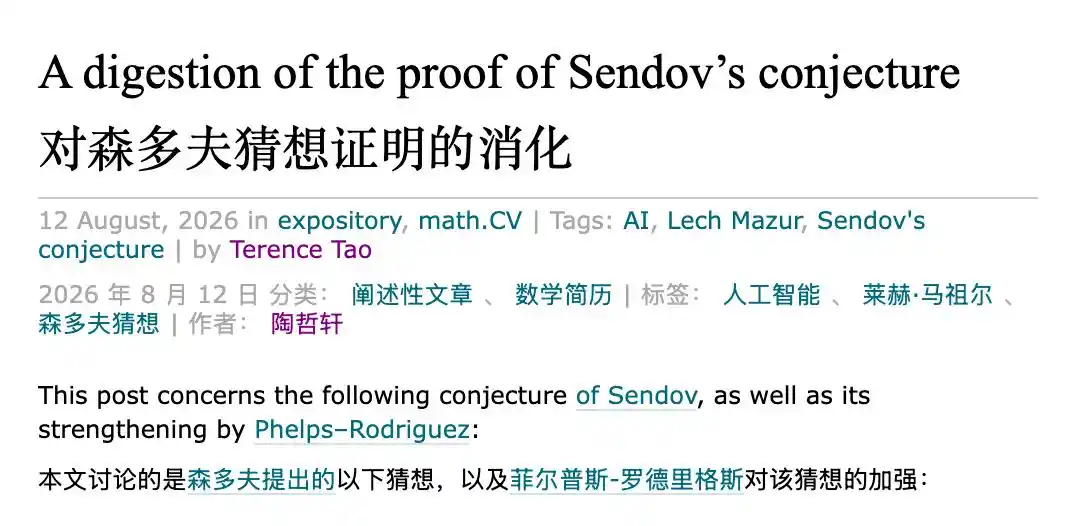
This sounds somewhat counterintuitive. If AI is here to help mathematicians solve problems and the answer is already out, why digest it again?

The answer from 'whistleblower' Terence Tao is:

A correct proof is only the first hurdle for a mathematical result; it must be understood and absorbed by professional mathematicians to be fully usable.
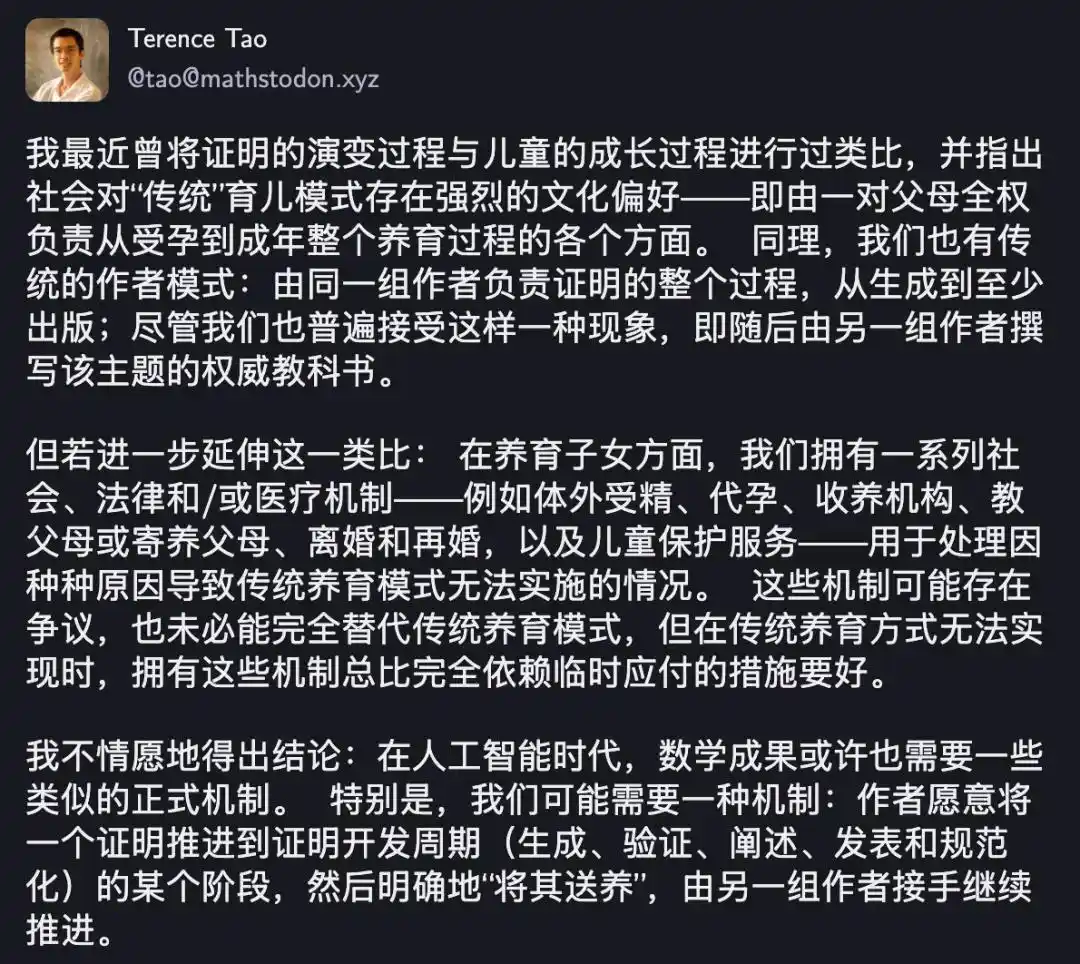
To use an analogy, traditional authors are like responsible parents, fully accompanying a proof from birth to publication. But moving forward, working with AI, this relationship may be more like 'adoption':

Someone uses AI to advance a proof to the generation or verification stage, then formally hands it off to another group for professional interpretation, organization, and publication.

Mathematicians still have much to do.

Digestion is the Next Step in Solving Mathematics' Century-Old Crisis

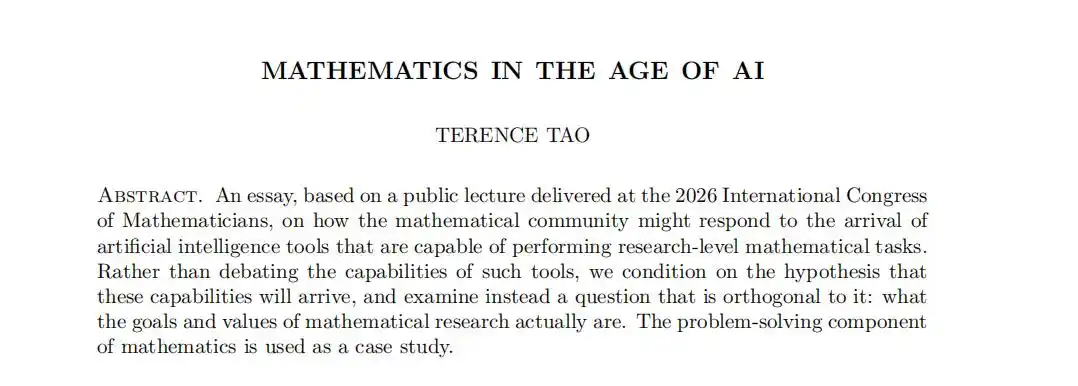
To put it bluntly, this is also Terence Tao's response to the question he left in his ICM lecture a month ago:

If answers can be mass-produced by AI, what is mathematical research really pursuing?

OpenAI's new model Astra solved 10 challenging problems in mathematics and theoretical computer science in a row, spanning high-dimensional geometry, coding theory, group theory, and more.

A neurosurgeon without formal higher mathematics training had ChatGPT 5.6 autonomously run for about 16 hours, producing a key proof for Crouzeix's conjecture in numerical linear algebra.

......
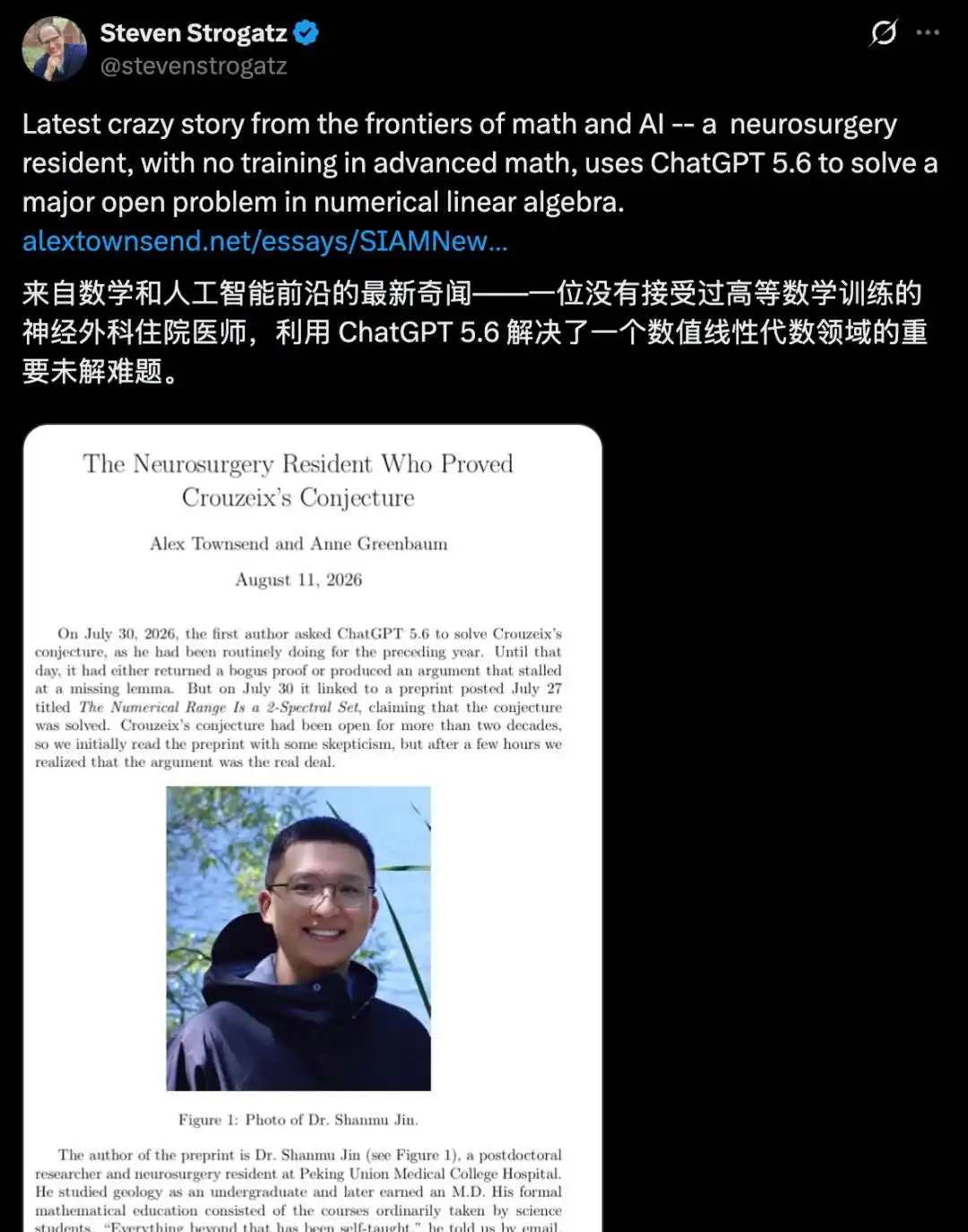
The high wall of mathematics seems to have had a back door chiseled open by AI.

Even laypeople can use it to break through cutting-edge problems. Is mathematics about to get its "next civil engineering" script? (doge)

Not at all! In fact, a complete mathematical achievement is never just about 'obtaining a proof'.

Terence Tao breaks it down into five stages:

First, generate the argument; then verify its correctness; next, explain the idea to peers, letting it undergo publication and community verification; finally, reorganize the results, find their relationship to old theories, and solidify them into standard knowledge for future use.

AI currently excels at accelerating the first two steps. The further along you go, the more you need mathematicians to judge what's truly core and what the results mean.
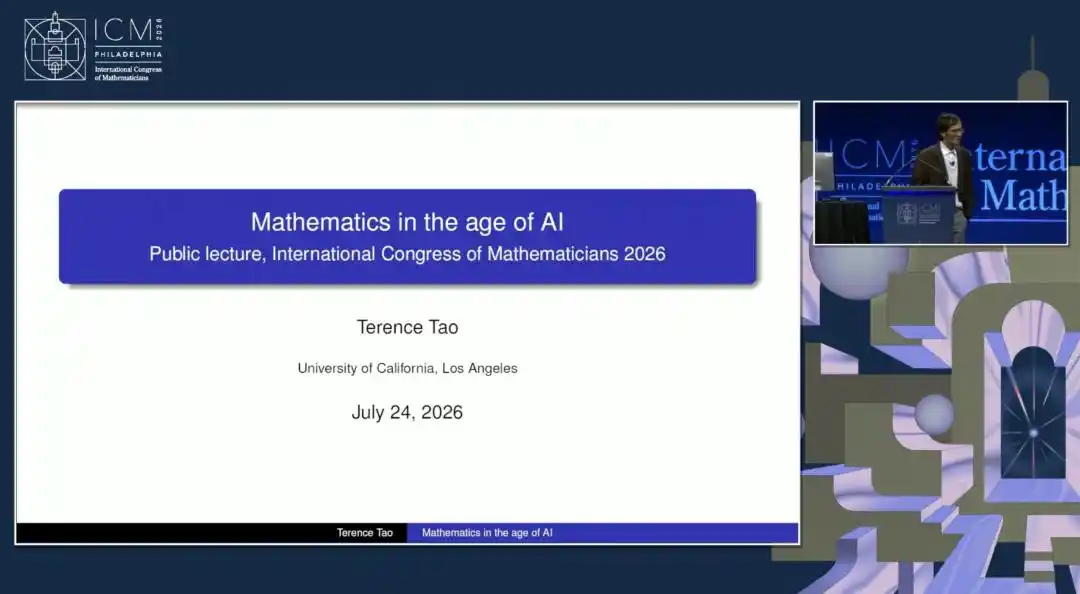
And the Sęndov conjecture Tao just processed is almost a 1:1 live demonstration of this workflow.

The conjecture studies the distance between polynomial zeros and critical points. Lower-degree cases and sufficiently high-degree cases had already been solved, but the middle range remained vacant for a long time.

A few days ago, math enthusiast Lech Mazur used AI to fill this gap, providing a formalized proof verified by Lean.

It seemed the story should end there. But Terence Tao noted that this original proof hadn't been organized into mathematical text suitable for human reading and publication, meaning the mathematical result was not yet usable.

So he spent several days, with the assistance of both ChatGPT and pen-and-paper derivation, conducting a complete digestion of the result:

Tracing literature sources → Extracting the identities that truly mattered → Removing detours → Rewriting the machine-discovered argument into a version showing a clear main line.
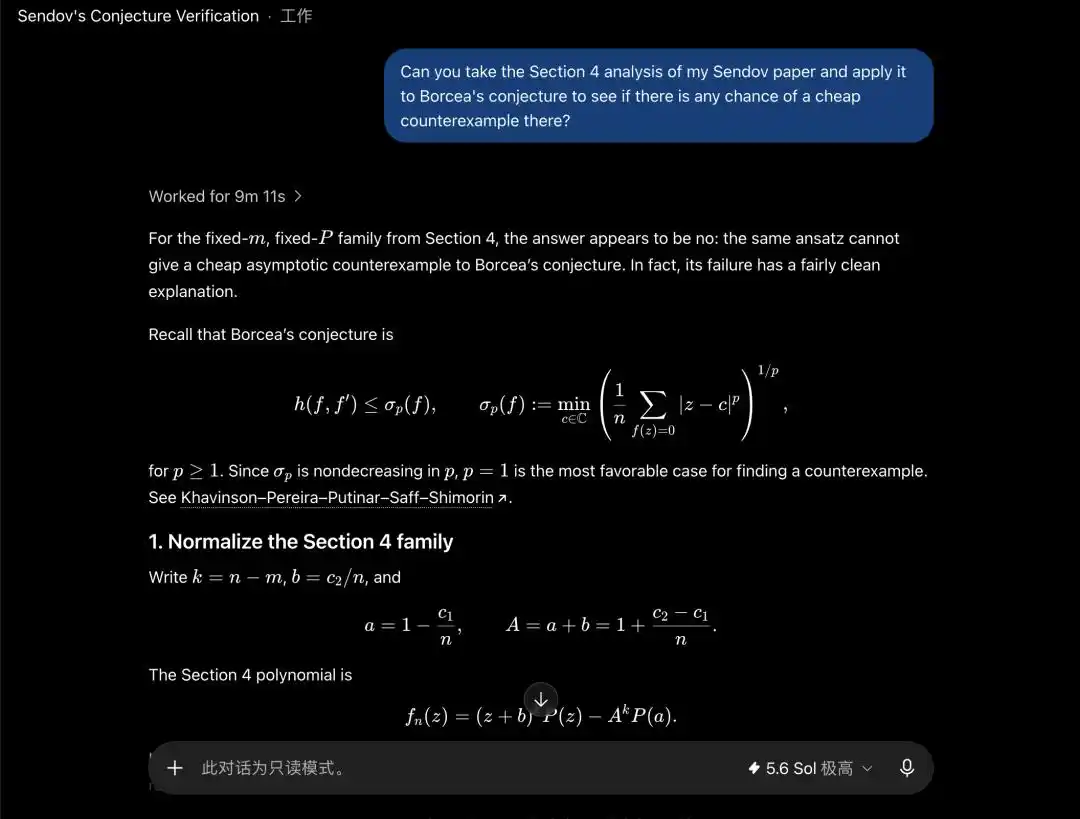
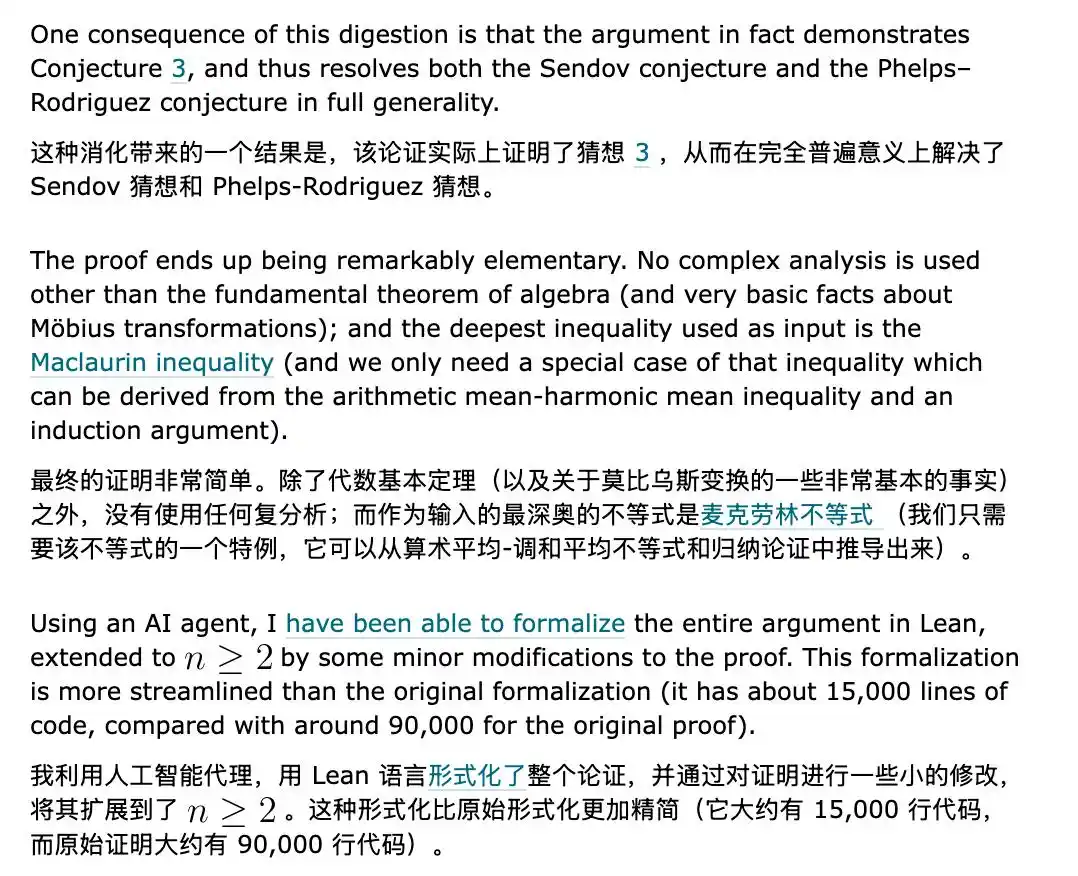
Reading it this way, he actually uncovered something new.

The reorganized argument not only solves the Sęndov conjecture but can also cover the stronger Phelps–Rodriguez conjecture. The core tools required are also much more elementary than what the original formalization presented, compressing the Lean code from about 90,000 lines to 15,000 lines.

In other words, digestion is not just a re-verification of an AI proof, but also an effective way to broaden mathematical achievements.
More importantly, Tao wants to use digestion to overturn the old rule in mathematics of "whoever announces first gets priority."

The attribution of mathematical results was first based on journal publication date, then changed to arXiv timestamp.

Now AI proofs come too fast, and even arXiv is considered too slow by some. Some results are thrown onto social platforms immediately after generation. In the race to be first, verification and interpretation are all skipped, ultimately creating an artificial burden for the mathematics community.

Therefore, in his ICM speech, Tao argued that the mathematics community should stop blindly celebrating "the first person to give a proof" and elevate the status of "digesting and organizing proofs."

Work like explaining proofs, peer review, and organizing results into classical theory should also be valued; not only producing new theorems counts as merit.

If the paper's authors themselves cannot give a competent lecture at a professional level to explain the results clearly, no matter how correct the AI verification is, this achievement should not be published.

If even humans can't understand the proof, how can it be considered a complete result?

So Tao calls on the academic community to calmly sit down, engage in a profound discussion about AI's capability limits and the values of mathematics, while emphasizing those parts of mathematical work that cannot be replaced by machines.
One More Thing

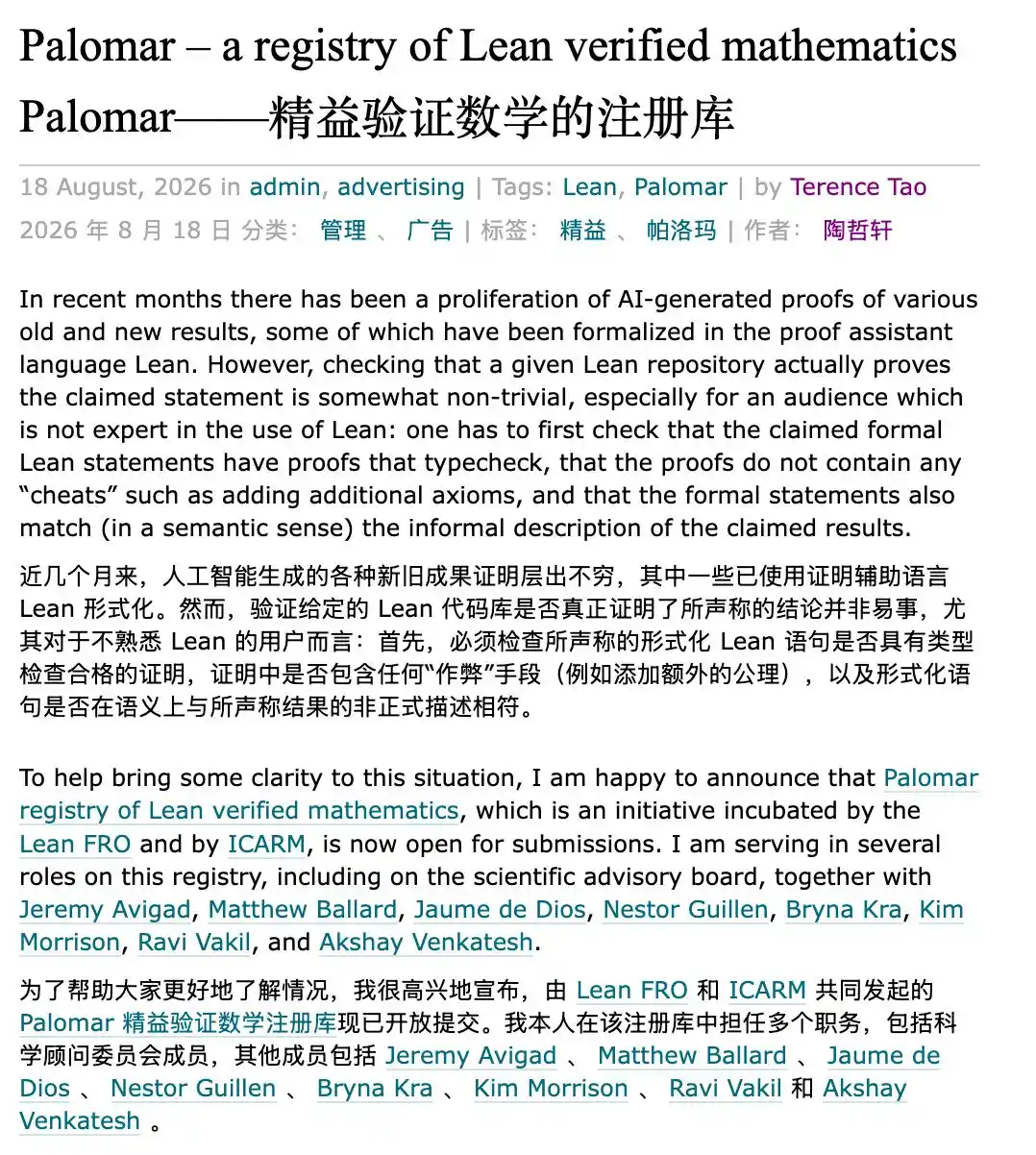
Meanwhile, Terence Tao has also publicly released a real registry for Lean verification results — Palomar.

Palomar clearly registers the problem statement, proof code, AI involvement method, and version information. After independent kernel re-evaluation, it gathers AI proofs scattered across GitHub, social media, and news in one place.

It will serve as a digestion relay station between verification and publication, letting future researchers know where AI and peers have reached and what work remains to be done.
Teams interested in the same problem can collaborate via Palomar.

Notably, Palomar does not judge the importance of a particular result, nor does it replace peer review.

The attribution of specific results will be determined in the future by the chronological order of four key stages:

Generative achievement documenting how the proof was produced, e.g., AI chat logs;

Verification achievement confirming logical correctness, e.g., Lean code;

Interpretation achievement clearly explaining the idea, e.g., public lecture;

Publication achievement formally presenting the result, e.g., paper.

In other words, priority is granted to whoever first submits a complete set of all achievements.

Currently, Terence Tao's digested version of the Sęndov conjecture has become one of the first entries in Palomar's archives.

References:

[1]https://arxiv.org/abs/2608.16753

[2]https://mathstodon.xyz/@tao/117123957813926355

[3]https://www.youtube.com/watch?v=M0--ZH1lOzg

[4]https://mp.weixin.qq.com/s/w-UfVMmwTZqXjNsC81CzYw

This article is from the WeChat public account "QbitAI", author: Focus on Frontier Technology

Câu hỏi Liên quan

QAccording to the article, what is the main challenge faced by the mathematics community regarding AI-generated proofs?

AThe mathematics community is struggling to keep up with the sheer volume of AI-generated proofs and counterexamples, creating a need to 'digest' this information effectively.

QHow did Terence Tao and June Huh suggest the mathematics community should approach AI-generated mathematical content?

ABoth Terence Tao and June Huh emphasized the need for the mathematics community to 'digest' AI outputs—meaning they must learn to use, understand, and integrate these AI-generated proofs or counterexamples into the field's knowledge base.

QWhat are the five stages of a complete mathematical result as outlined by Terence Tao in the article?

ATerence Tao outlined five stages: 1) Generating the argument, 2) Verifying its correctness, 3) Explaining the idea to colleagues, 4) Getting it published and passing community scrutiny, and 5) Reorganizing the result, relating it to existing theory, and solidifying it as standard, reusable knowledge.

QWhat is 'Palomar' and what is its intended purpose, as mentioned in the article?

A'Palomar' is a registry, proposed by Terence Tao, for formalized (e.g., Lean-verified) mathematical results. It serves as a 'digestion relay station' between verification and publication, providing a centralized record of AI-assisted proofs, their source code, and verification details to prevent duplication and facilitate collaboration.

QAccording to Tao's proposed new framework, what determines the attribution of priority for a mathematical result in the age of AI?

APriority would be determined by who first completes a full set of four milestones: the generative work (e.g., AI chat logs), the verification work (e.g., Lean code), the expository work (e.g., a clear public lecture), and the published work (e.g., a formal paper). The complete suite, not just the initial proof, grants priority.

Nội dung Liên quan

Kỳ lân trăm tỷ ở Thượng Hải sắp lên sàn

Thông tin về Cánh bướm của thung lũng Silicon: Carmona Microelectronics chuẩn bị IPO Công ty kỳ lân Trung Quốc Carmona Microelectronics (Thượng Hải), chuyên về chip radar milimét tiêu chuẩn ô tô, chính thức nộp hồ sơ lên Sở giao dịch chứng khoán Thượng Hải để niêm yết trên STAR Market. Công ty được thành lập vào năm 2014 bởi Tiến sĩ Chen Jiashu và giáo sư hướng dẫn của ông, Ali Niknejad, từ Đại học California, Berkeley. Công ty đã đi theo con đường công nghệ CMOS thay vì công nghệ GaAs hoặc SiGe truyền thống. Carmona đã đạt được những cột mốc quan trọng: sản xuất chip thu phát 77GHz đầu tiên trên thế giới vào năm 2015, chip RF 77GHz đầu tiên đạt chuẩn ô tô vào năm 2017 và chip radar milimét hệ thống trên chip (SoC) với ăng-ten trong gói (AiP) vào năm 2019. Chiến lược này đã giảm đáng kể chi phí, giúp radar milimét trở nên phổ biến trên các dòng xe giá cả phải chăng. Đến năm 2025, Carmona nắm giữ 31,1% thị phần trong nước và đứng thứ tư toàn cầu, với hơn 30 triệu chip đã được xuất xưởng. Khách hàng bao gồm BYD, Geely, NIO và Volvo. Công ty đã trải qua 11 vòng gọi vốn, thu hút các nhà đầu tư lớn như Quỹ Đầu tư Công nghiệp Mạch tích hợp Quốc gia II, Walden International và Capital Today. Đợt phát hành IPO dự kiến huy động 3,489 tỷ NDT, định giá công ty khoảng 14 tỷ NDT. Mặc dù doanh thu tăng trưởng mạnh từ 206 triệu NDT năm 2023 lên 632 triệu NDT năm 2025, Carmona vẫn đang trong tình trạng thua lỗ, với khoản lỗ ròng tích lũy là 903 triệu NDT trong 3 năm rưỡi, chủ yếu do đầu tư mạnh vào R&D. Tỷ suất lợi nhuận gộp duy trì ở mức trên 47%. Các rủi ro chính bao gồm sự phụ thuộc cao vào một vài khách hàng lớn (như BYD chiếm hơn 50% doanh thu năm 2025) và chuỗi cung ứng. Mục tiêu của đợt IPO là gây quỹ để mở rộng sản xuất, đa dạng hóa khách hàng và giảm sự phụ thuộc.

marsbit17 phút trước

Kỳ lân trăm tỷ ở Thượng Hải sắp lên sàn

marsbit17 phút trước

Phân tích vĩ mô mới nhất của Ray Dalio: Mua nhiều vàng hơn, mua thêm một chút Bitcoin

Ray Dalio, tác giả cuốn sách "How Countries Go Broke: The Big Cycle", phân tích các dấu hiệu của một chu kỳ nợ lớn đang tiến tới giai đoạn cuối, đặc biệt là tại Mỹ. Ông chỉ ra ba chỉ số chính: 1) Chi trả nợ của chính phủ so với thu nhập ngày càng tăng, 2) Nguồn cung trái phiếu chính phủ vượt xa cầu, và 3) Ngân hàng trung ương buộc phải in tiền để mua nợ, dẫn đến mất giá tiền tệ. Tình hình Mỹ được tóm tắt: thu nhập 5,5 nghìn tỷ USD, chi tiêu 7,5 nghìn tỷ USD (thâm hụt 2 nghìn tỷ USD), nợ tích lũy ~32 nghìn tỷ USD (gấp 6 lần thu nhập). Chi phí lãi vay là 1 nghìn tỷ USD, và tổng thanh toán nợ (gốc + lãi) lên tới ~11 nghìn tỷ USD. Dalio dự báo nếu không thay đổi, một cuộc khủng hoảng nợ có thể xảy ra trong vòng 3 năm (+/- 2 năm). Giải pháp của ông là "Công thức 3% và ba phần": giảm thâm hụt ngân sách xuống còn 3% GDP thông qua cân bằng cắt giảm chi tiêu, tăng thuế và giảm lãi suất cơ bản. Về đầu tư, ông khuyến nghị đa dạng hóa tài sản toàn cầu, giảm nắm giữ trái phiếu, tăng tỷ trọng vàng (khoảng 10-15% danh mục) và một lượng nhỏ Bitcoin, vì chúng là tài sản không do chính phủ kiểm soát và có thể hoạt động tốt trong bối cảnh tiền tệ mất giá.

marsbit1 giờ trước

Phân tích vĩ mô mới nhất của Ray Dalio: Mua nhiều vàng hơn, mua thêm một chút Bitcoin

marsbit1 giờ trước

Bộ trưởng Tài chính Mỹ đè nén lợi suất trái phiếu Mỹ khơi mào 'giao dịch phá giá tiền tệ'! Vàng lập đỉnh 3 tháng, Bitcoin tăng hơn 25% trong tuần

Bộ trưởng Tài chính Mỹ Janet Yellen đã nỗ lực kiềm chế lợi suất trái phiếu dài hạn, nhưng tác động chỉ tồn tại trong thời gian ngắn. Hành động này làm suy yếu đồng USD, đồng thời thúc đẩy vàng và Bitcoin tăng mạnh - củng cố logic giao dịch "phá giá tiền tệ". Động lực chính đến từ thâm hụt ngân sách Mỹ khổng lồ và lo ngại sâu sắc về chính sách kinh tế. Lợi suất trái phiếu nhanh chóng hồi phục sau khi giảm nhẹ, trong khi Bitcoin tăng hơn 25% trong tuần, vượt 78.000 USD và vàng đạt mức cao nhất trong ba tháng. Các nhà phân tích cho rằng đây là "van xả áp lực" khi lo ngại thị trường chuyển hướng sang các tài sản khác. Mối tương quan giữa Bitcoin và vàng ở mức cao nhất kể từ đại dịch, tăng cường nhận định về tiền mã hóa như một công cụ phòng ngừa mất giá. Tuy nhiên, áp lực cơ bản lên lãi suất vẫn tồn tại: thâm hụt ngân sách lớn, nhu cầu vay mượn cho quốc phòng và chuyển đổi năng lượng, cùng làn sóng phát hành trái phiếu doanh nghiệp - đặc biệt từ các công ty công nghệ để tài trợ cho AI. Bộ Tài chính có thể điều chỉnh cung trái phiếu nhưng không thể loại bỏ nhu cầu vốn toàn cầu. Ray Dalio cảnh báo nhà đầu tư nên giảm nắm giữ trái phiếu, chuyển sang vàng và Bitcoin để phòng ngừa rủi ro nợ công. Dù vậy, một số chuyên gia nghi ngờ động thái của Bộ trưởng Yellen sẽ tạo ra đà tăng bền vững cho các tài sản này, vì chủ đề cơ cấu không mới và thiếu chất xúc tác mạnh. Căng thẳng giữa Bộ Tài chính (muốn chi phí vay thấp) và Fed (thận trọng với lạm phát) trong bối cảnh kinh tế vững vàng sẽ tiếp tục là điểm then chốt được theo dõi.

华尔街日报3 giờ trước

Bộ trưởng Tài chính Mỹ đè nén lợi suất trái phiếu Mỹ khơi mào 'giao dịch phá giá tiền tệ'! Vàng lập đỉnh 3 tháng, Bitcoin tăng hơn 25% trong tuần

华尔街日报3 giờ trước

Alexander Shokhin: Giới kinh doanh cần lãi suất dưới 10% và đồng đô la ở mức 90–95 rúp

Alexander Shokhin, Chủ tịch Liên minh Công nghiệp và Doanh nhân Nga (RSPP), cho rằng có thể sử dụng các công cụ "phi thị trường" để giữ đồng rúp trong một biên độ nhất định nhằm tránh biến động quá mức, dù ông thừa nhận đây là một chủ đề phức tạp cần thảo luận riêng. Ông Shokhin trước đó đã nhiều lần đề cập đến ý tưởng về một biên độ tỷ giá cho đồng rúp, lý do là thị trường ngoại hối hiện tại bị hạn chế về khối lượng và nhu cầu ngoại tệ giảm, khiến tỷ giá khó có thể coi là hoàn toàn theo cơ chế thị trường. Nhiều doanh nghiệp ủng hộ việc cố định biên độ, dù bằng các biện pháp không hoàn toàn thị trường, để tạo ra sự ổn định và dự báo được. Về các mục tiêu kinh tế, từ cuối năm 2025, Shokhin đã nêu ra những kỳ vọng của giới doanh nghiệp cho cuối năm 2026: lãi suất chính sách chính ở mức 12%, lạm phát trong khoảng 4-5% và tỷ giá USD/RUB ở mức 90-95. Tuy nhiên, ông cho biết mức lãi suất thực sự thoải mái cho hoạt động kinh doanh phải thấp hơn 10%. Ông nhấn mạnh tầm quan trọng của việc có một đồng tiền quốc gia ổn định và dự báo được đối với các quyết định đầu tư. Phân tích từ góc độ dữ liệu cho thấy, cơ chế biên độ tỷ giá không phải là mới đối với Nga. Cơ chế tương tự đã được áp dụng từ năm 1995 đến 1998, khi Ngân hàng Trung ương Nga (CBR) cố định tỷ giá USD trong một biên độ hẹp thông qua các can thiệp thường xuyên. Chế độ này kéo dài ba năm và sụp đổ sau cuộc khủng hoảng nợ tháng 8/1998, minh chứng cho tính mong manh của các mục tiêu cố định cứng nhắc khi đối mặt với các cú sốc bên ngoài. Mối liên hệ kinh tế vĩ mô ở đây rất rõ ràng: biên độ càng cứng nhắc thì càng cần nhiều dự trữ để bảo vệ nó khi đồng tiền chịu áp lực. Một khía cạnh kỹ thuật chưa được làm rõ là nguồn lực và quy mô can thiệp cụ thể trong điều kiện thanh khoản thị trường ngoại hối còn hạn chế. Liệu cuộc thảo luận hiện tại sẽ chỉ dừng lại ở lý thuyết hay sẽ chuyển thành các thông số biên độ cụ thể vẫn cần được theo dõi trong những tháng tới.

cryptonews.ru5 giờ trước

Alexander Shokhin: Giới kinh doanh cần lãi suất dưới 10% và đồng đô la ở mức 90–95 rúp

cryptonews.ru5 giờ trước

Giao dịch

Giao ngay
活动图片