The Logic Behind Circle's $50 Billion Valuation: The Market Only Sees USDC, But Overlooks the Payment Network

marsbitXuất bản vào 2026-08-20Cập nhật gần nhất vào 2026-08-20

Tóm tắt

Circle's $50 billion valuation logic: The market sees only USDC but overlooks its payment network. While Circle is perceived as a simple stablecoin issuer, its potential as a full-stack monetary platform is undervalued. The article argues Circle's moat is deeper than recognized, with first-mover advantages in liquidity and network effects making its position hard to challenge. The stablecoin market is projected to grow at 40% CAGR, surpassing $1 trillion by 2030, with Circle well-positioned to capture significant share. Competitors like the Open Standard (OUSD) alliance face significant hurdles in governance and aligned incentives. Currently valued at $18 billion (6.7x P/S), Circle's revenue is heavily tied to interest income. However, its expanding payment network (showing explosive growth) and Arc chain could diversify revenue streams. By 2030, with $40B in interest income, $4B from payments, and $5B from Arc, total revenue could approach $50B. A re-rating to a 10x multiple on more diversified, less rate-sensitive revenue could justify a $500 billion market cap.

Author: Artemis Analytics

Compiled by: Deep Tide TechFlow

Deep Tide Introduction: The market views Circle as merely a stablecoin issuer, but the potential of its payment network and full-stack currency platform is far from being priced in. This article deconstructs Circle's moat and the scenario for a $50 billion market capitalization, serving as a key reference for investors focused on the stablecoin and payment sectors.
Last week, we invited ARK Invest's Lorenzo Valente on our podcast to discuss why Circle is undervalued by the market. This week's Thesis continues this line of thought.

Argument: The market believes Circle's moat is weak, stablecoins are homogeneous commodities, and consortia like Open Standard will capture the majority share. We believe Circle's moat is deeper and harder to breach than the market perceives, and its first-mover advantage is undervalued.

Core drivers:

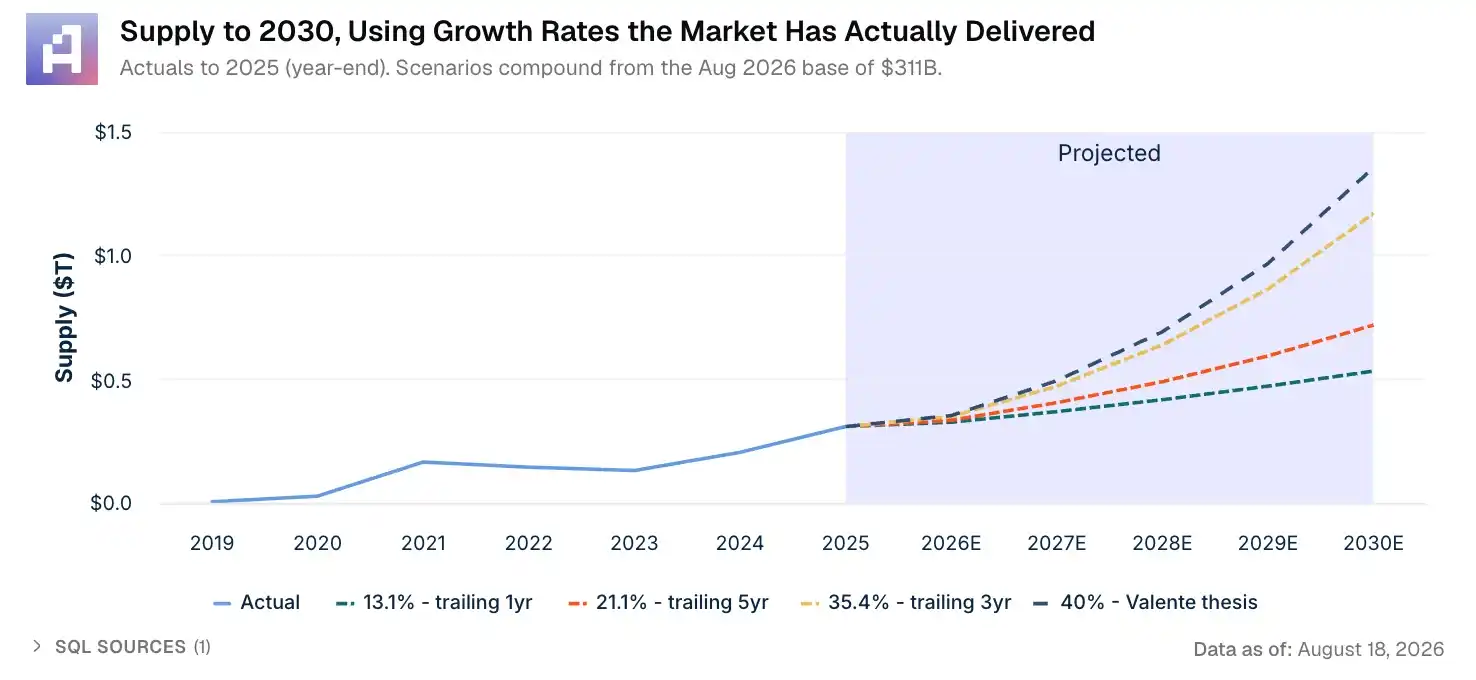
Stablecoins will grow at a 40% CAGR, exceeding $1 trillion by 2030.

The market shows a winner-take-all dynamic in terms of liquidity and network effects, making it difficult for alliances like OUSD to steal share.

The market prices Circle as a stablecoin issuer, not a full-stack currency platform.

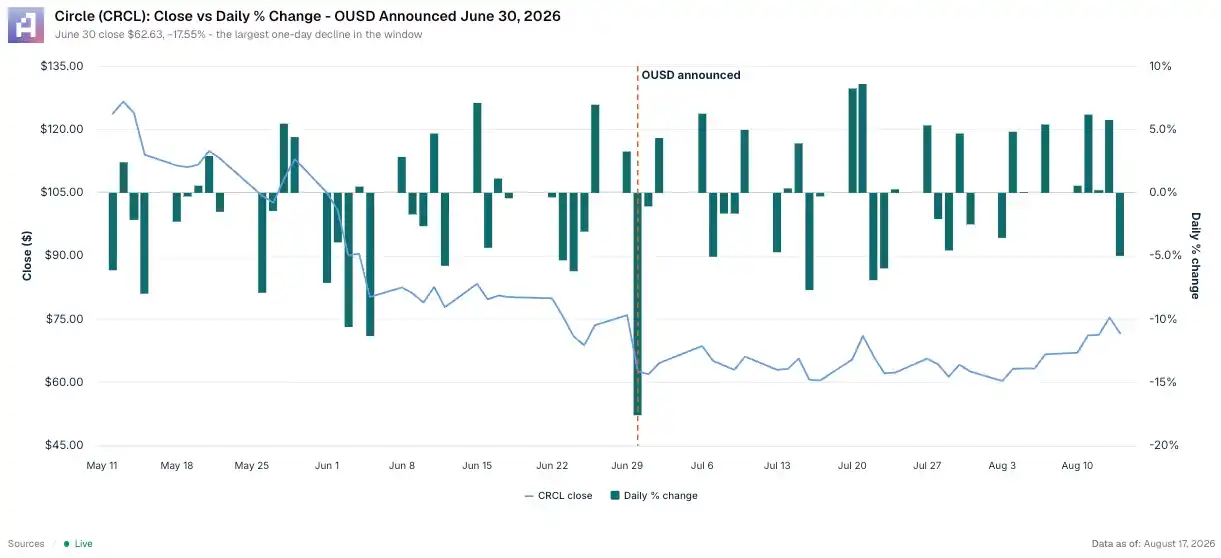
Circle's second-worst trading day in history occurred when Open Standard was announced. This is a consortium-backed stablecoin supported by over 140 companies, including Stripe, Visa, Mastercard, and Google, among others. The stock fell 17% after the news. The market's reaction is telling: Stripe will rally the troops, overthrow the Circle/Tether duopoly, and distribute stablecoin revenue proportionally to consortium members. This news drove CRCL's price near its all-time low.
Stablecoin Growth

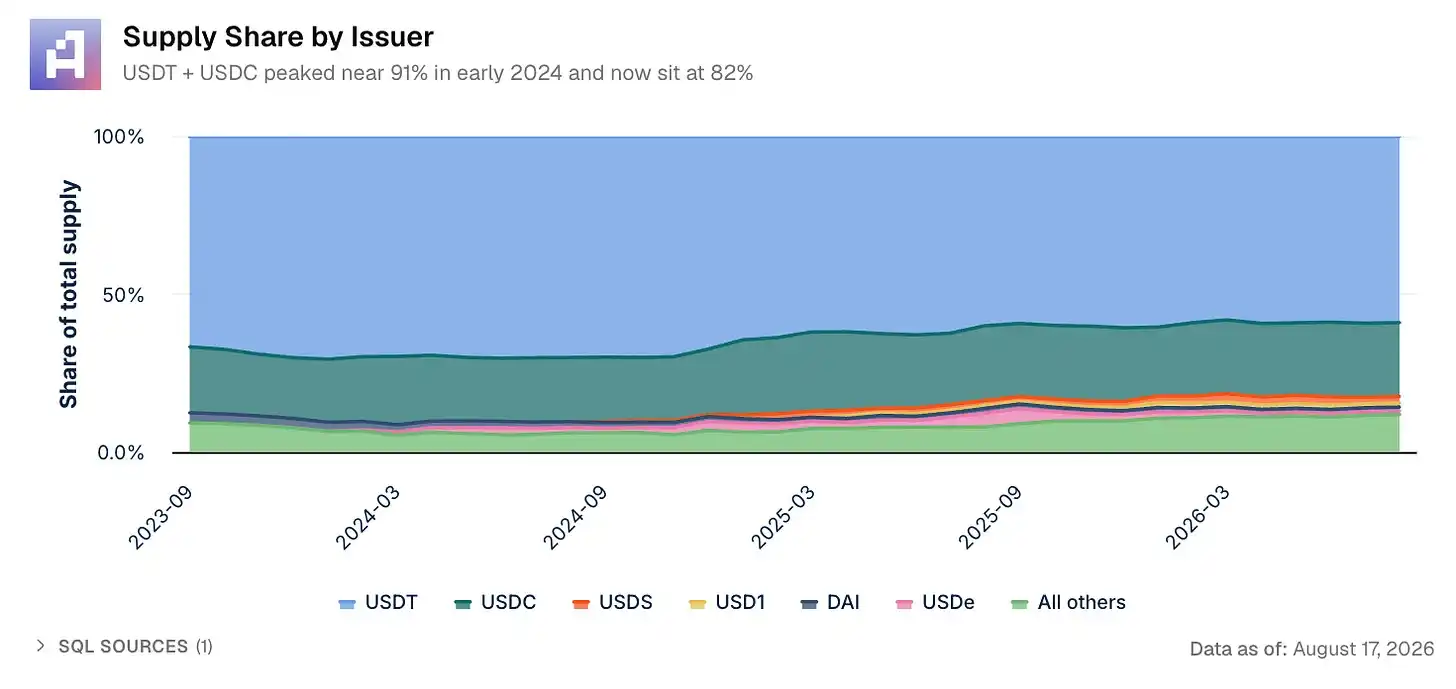
We believe many investors don't think stablecoins will reach $1 trillion by 2030. They might point to stagnant growth. However, stablecoin supply has decoupled from crypto prices for the first time ever. Despite crypto prices falling 50-70% from recent highs, stablecoin supply has remained flat, indicating it has become its own category. If stablecoin supply continues to grow at the rate of the past 3 years, global supply will exceed $1 trillion by 2030.
Winner-Take-All Stablecoin Market, Liquidity and Network Effects are Crucial

Over the past few years, dozens of issuers have tried to dismantle the Circle/Tether duopoly. Despite hundreds of stablecoins being issued now, these two giants still command over 80% of the supply share. The first-mover advantage gained by these players is extremely difficult to overcome. Building liquidity from scratch across chains, applications, and exchanges is hard, and Circle is far ahead of challengers.
Looking Specifically at OUSD

The market clearly views OUSD as a significant threat to Circle's business. However, history shows that consortia rarely succeed. A successful consortium requires:

Aligned incentives among members – OUSD achieves this to some extent through interest income distribution.

Clear governance – Open Standard appears weak here, with several announced "partners" revealing they were not consulted and have not yet made commitments.

Existential pressure – I don't think most institutions yet see stablecoins as a matter of survival, though Stripe may be the exception.

Therefore, based on current information, Open Standard meets roughly only one-third of the necessary conditions.

Circle is Priced as a Stablecoin Issuer, Not a Full-Stack Currency Platform

The market views Circle merely as the issuer of USDC. It underestimates Circle's revenue, which is almost entirely interest income subject to Federal Reserve policy.

In reality, Circle is building a full-stack currency product for the future of the internet. At its core, it's a technology company.

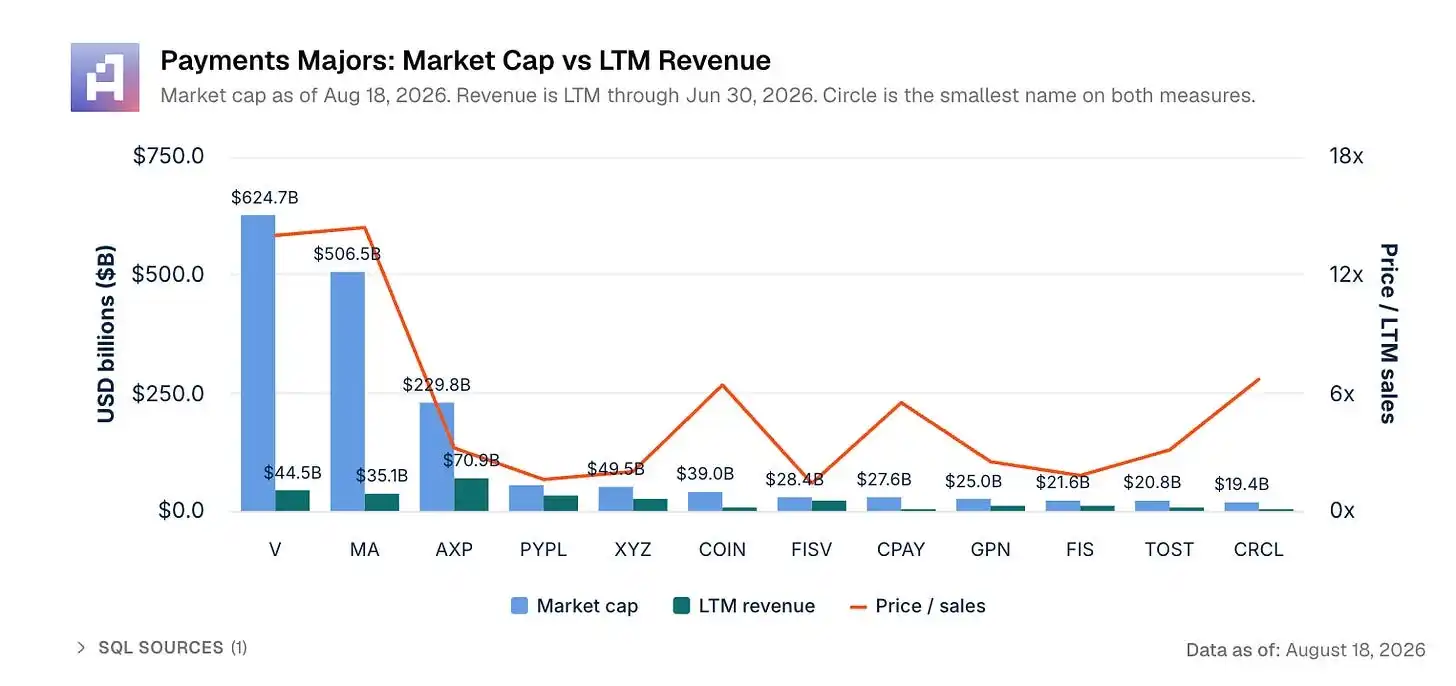
Circle's valuation compared to payment peers. There is a clear gap between credit card networks and other companies. If Circle builds the next-generation, full-stack payment system, its market cap and valuation would be closer to credit card networks, charging basis points on transaction volume, rather than relying on float.
Envisioning a $50 Billion Circle

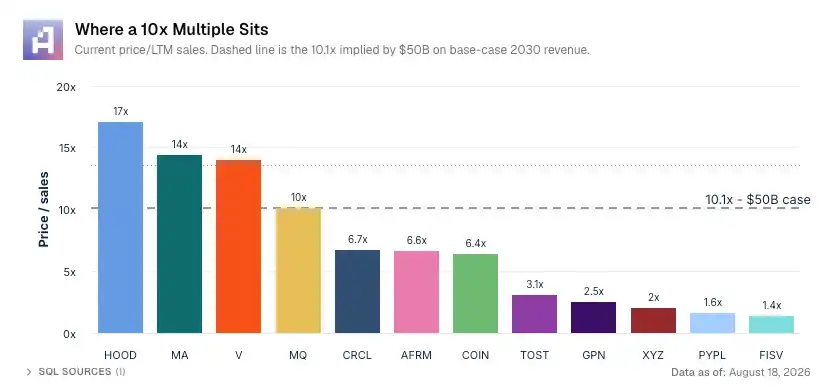
Today, Circle's annualized revenue is approximately $2.8 billion, with a valuation of $18 billion, a P/S ratio of 6.7x—far below payment networks (14x) and high-growth fintechs like HOOD (17x). Its valuation multiple is almost identical to COIN's, which is primarily viewed as a crypto exchange.

The market sees Circle as a company tied to the crypto cycle, with rate-sensitive revenue. Circle will shed this label and its fragile revenue structure, allowing for a higher valuation multiple—10x is conservative and reasonable.

If our prediction is correct and, as we assume, liquidity and network effects create a strong moat, with stablecoin supply reaching $1 trillion by 2030, USDC share at 20%, and interest rates at 2%, CRCL could generate $4 billion in interest income.

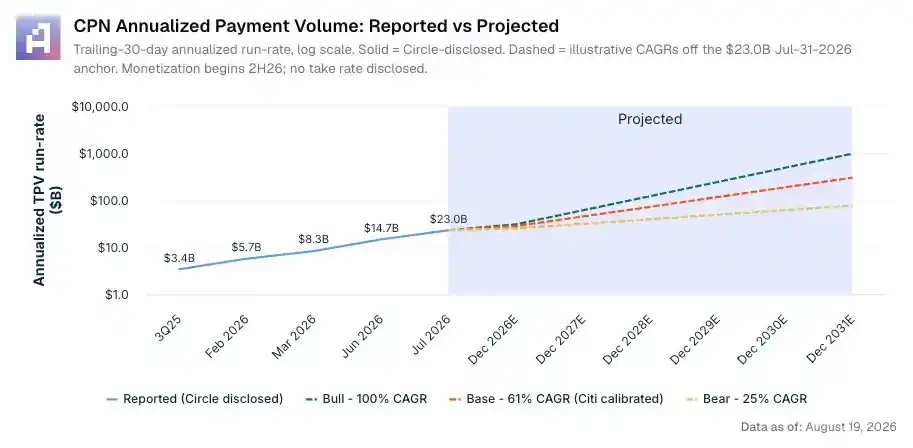
In terms of revenue diversification, Circle's key growth products are gaining momentum, such as the Circle Payments Network. Despite persistent low crypto prices and flat stablecoin supply, transaction volume on the Circle Payments Network is growing at an explosive pace, with the latest disclosed annualized volume as of July 2026 reaching $23 billion—up 6.8x year-over-year (admittedly from a small base) and 70% quarter-over-quarter. If growth stays at a 60-65% CAGR, transaction volume would reach approximately $200 billion by 2030. At a 20 basis point take rate, this would generate an additional $400 million in revenue.
Looking at the Arc chain, if it reaches the scale of Tron (another stablecoin-focused chain), Arc would generate $500 million in fees.

The above estimates bring CRCL's revenue close to $5 billion, with 20% coming from the rapidly growing payment/settlement-related business lines. This mix gives investors reason to assign a higher valuation multiple. Combining the above revenue growth and multiple expansion, we get $5 billion multiplied by 10 equals $50 billion. A $50 billion market cap for CRCL is not a fantasy.


Câu hỏi Liên quan

QWhat are the three main factors that the author believes support Circle's strong moat and undervalued position?

A1. The stablecoin market will grow at a 40% CAGR, exceeding $1 trillion by 2030. 2. The market exhibits winner-takes-most dynamics due to liquidity and network effects, making it hard for competitors like the Open Standard alliance to gain share. 3. The market prices Circle as a mere stablecoin issuer, not as a full-stack monetary platform with a high-growth payment network.

QWhy does the author argue that the stablecoin market is a winner-takes-most environment, and how does this benefit Circle?

AThe author argues that achieving deep liquidity across multiple blockchains, applications, and exchanges is a massive hurdle. Circle's first-mover advantage has allowed it to build this critical liquidity and network effect, creating a significant barrier for new entrants like the Open Standard alliance, which would have to build liquidity from scratch.

QAccording to the article, what are the three key requirements for a successful consortium like the Open Standard (OUSD), and how does OUSD currently measure up?

AThe three requirements are: 1. Aligned incentives among members. 2. Clear governance. 3. A sense of existential pressure for members. The author states that based on current information, Open Standard only meets about one-third of these necessities, citing weak governance and lack of commitment from some announced 'partners' as key weaknesses.

QWhat is the core difference between how the market currently values Circle and how the author believes it should be valued?

AThe market currently values Circle as a stablecoin issuer whose revenue is primarily interest income tied to Federal Reserve policy, giving it a low, cyclical valuation multiple similar to a crypto exchange like Coinbase. The author argues Circle should be valued as a high-growth, full-stack monetary platform and payment network, deserving a valuation multiple closer to established payment networks, which trade at higher revenue multiples.

QWhat are the key revenue projections and assumptions that lead the author to a potential $50 billion valuation for Circle by 2030?

AThe author's $50B valuation scenario assumes: 1. $1T total stablecoin supply by 2030, with USDC holding a 20% share and generating $4B in interest income at a 2% yield. 2. Circle Payments Network growing at a 60-65% CAGR to $200B in transaction volume, generating an additional $400M in revenue at a 20 bps take rate. 3. The Arc blockchain generating $500M in fees if it scales to Tron's size. This totals ~$5B in diversified revenue, which at a conservative 10x multiple (justified by its growing payment business mix) yields a $50B valuation.

Nội dung Liên quan

Hỗ trợ thanh khoản của Mỹ đã tới, đây mới là lợi ích cốt lõi

Ngày 19/8, Bộ Tài chính Mỹ công bố mở rộng hỗ trợ thanh khoản cho trái phiếu kho bạc dài hạn, nâng giới hạn mua lại đối với trái phiếu cũ (non-on-the-run) kỳ hạn 10-20 năm và 20-30 năm từ 2 tỷ lên ít nhất 4 tỷ USD cho mỗi lần. Biện pháp có hiệu lực từ ngày 9/9 đến ngày 4/11. Thị trường phản ứng tích cực. Lợi suất trái phiếu dài hạn giảm, hỗ trợ tài sản rủi ro như cổ phiếu công nghệ, vàng và tiền mã hóa nhờ áp lực chiết khấu giảm. Tuy nhiên, đây không phải là nới lỏng định lượng (QE) từ Cục Dự trữ Liên bang mà là hoạt động quản lý nợ, mua lại trái phiếu cũ thanh khoản kém để cải thiện điều kiện giao dịch ở phần dài của đường cong lợi suất. Phản ứng thị trường chủ yếu dựa trên kỳ vọng áp lực lợi suất dài hạn giảm bớt, kích hoạt việc mua lại để phòng ngừa rủi ro. Tuy nhiên, quy mô hỗ trợ (tối đa khoảng 14 tỷ USD mới) và nguồn vốn vẫn bị ràng buộc bởi nhu cầu tài trợ thâm hụt. Nó giống như một "tấm đệm" giảm biến động ngắn hạn hơn là thay đổi căn bản định giá vĩ mô dài hạn dựa trên lạm phát, chính sách Fed và phí kỳ hạn. Độ bền của đợt phục hồi này sẽ phụ thuộc vào thông báo tái tài trợ quý tiếp theo vào ngày 4/11. Nếu Bộ Tài chính tiếp tục hỗ trợ với khối lượng thực tế và điều chỉnh cơ cấu phát hành giảm áp lực cung dài hạn, tài sản rủi ro có thể duy trì đà hồi phục. Ngược lại, nếu chỉ là biện pháp tình thế, áp lực lợi suất dài hạn vẫn có thể quay trở lại.

marsbit22 phút trước

Hỗ trợ thanh khoản của Mỹ đã tới, đây mới là lợi ích cốt lõi

marsbit22 phút trước

SEC ban hành quy định mới, bò tới

Ngày 19/8 (giờ Bắc Kinh), Chủ tịch SEC Paul Atkins công bố dự thảo "Quy định về Tài sản Mã hóa", cho phép các dự án khởi nghiệp huy động tối đa 5 triệu USD trong 4 năm, các dự án lớn hơn có thể huy động 20 triệu hoặc 75 triệu USD mỗi 12 tháng mà không cần đăng ký chứng khoán đầy đủ. Nhà Trắng cũng ủng hộ chính sách này. Bản dự thảo thiết lập một cơ chế "Cảng an toàn Hợp đồng Đầu tư". Các dự án, sau khi hoàn thành hoặc chấm dứt vĩnh viễn các "nỗ lực quản lý thiết yếu" đã cam kết, có thể tự nộp Đơn TR để chứng nhận đã đủ điều kiện. Quyền lực chính của SEC không phải là phê duyệt trước mà là quyền giám sát và thách thức sau này. Dự thảo làm rõ, các cam kết công khai trong đợt gây quỹ sẽ trở thành căn cứ quan trọng để đánh giá liệu hợp đồng đầu tư đã kết thúc hay chưa. Các đội ngũ cam kết ít và giao quyền kiểm soát nhanh sẽ có lợi thế. Các quy định cũng nhấn mạnh việc phát hành thực thể phải đăng ký tại Mỹ, điều này nhằm thu hút các hoạt động phát hành trở lại Mỹ. Một chi tiết đáng chú ý là cơ chế miễn trừ cho các công ty khởi nghiệp định nghĩa "giao dịch được quy định" bao gồm cả các hình thức phân phối phi tiền mặt như airdrop và phần thưởng mạng, nghĩa là giá trị của chúng có thể được tính vào giới hạn huy động vốn. Động thái này của SEC đánh dấu sự thay đổi trong cách tiếp cận, từ "quản lý bằng hành pháp" sang thiết lập quy tắc rõ ràng trước, đồng thời tạo áp lực lên Quốc hội Mỹ đang chậm trễ trong việc thông qua Đạo luật CLARITY. Điểm mấu chốt của dự thảo không chỉ nằm ở hạn mức huy động vốn mà ở việc SEC lần đầu tiên thiết lập một quy trình tương đối rõ ràng cho việc "tốt nghiệp" của token - chuyển từ trạng thái hợp đồng đầu tư sang tài sản độc lập. Điều này có thể chuyển hướng cạnh tranh trong tương lai sang việc dự án nào có thể hoàn thành bước chuyển đổi này nhanh hơn. Dự thảo hiện đang trong giai đoạn lấy ý kiến công chúng.

marsbit31 phút trước

SEC ban hành quy định mới, bò tới

marsbit31 phút trước

Giao dịch trên Savedex.com – Những điều bạn cần biết trước khi nạp tiền

Savedex, một sàn giao dịch tiền điện tử tập trung thành lập từ 2018 và có trụ sở tại Cyprus (đăng ký số HE 358928, được cho là chịu sự quản lý của CySEC), đang thu hút sự chú ý nhờ giao diện đơn giản, phí giao dịch thấp và quy trình xác minh nhanh chóng. Nền tảng cung cấp các công cụ cho giao dịch spot, futures và margin (đòn bẩy lên đến 1:20), cùng với API cho giao dịch tự động. Tuy nhiên, Savedex chỉ chấp nhận tiền gửi và rút tiền bằng tiền điện tử, không hỗ trợ tiền pháp định. Mặc dù có một loạt tài sản kỹ thuật thuật cơ bản, danh mục altcoin còn hạn chế và thanh khoản trên một số cặp giao dịch có thể không cao. Bảo mật được nhấn mạnh với xác thực hai yếu tố (2FA), ví lạnh và mã hóa dữ liệu. Người dùng cũng được nhắc nhở rằng dịch vụ hỗ trợ khách hàng đôi khi có phản hồi chậm. Nền tảng còn cung cấp các sản phẩm thu nhập thụ động với lợi nhuận tiềm năng và chương trình giới thiệu. Tóm lại, Savedex phù hợp cho những nhà giao dịch tìm kiếm một nền tảng gọn gàng với nhiều tính năng, nhưng cần lưu ý những hạn chế về loại tiền gửi và thanh khoản.

TheNewsCrypto37 phút trước

Giao dịch trên Savedex.com – Những điều bạn cần biết trước khi nạp tiền

TheNewsCrypto37 phút trước

Giao dịch

Giao ngay
活动图片