Trillion-Dollar Chip Giant Executive States: Wafer Prices Will Not Drop Within the Year

marsbitXuất bản vào 2026-08-14Cập nhật gần nhất vào 2026-08-14

Tóm tắt

China's leading semiconductor foundry, SMIC, reports record-breaking Q2 2026 results, with revenue surpassing $3 billion for the first time. Co-CEO Zhao Haijun stated that wafer prices will not decrease within the year, citing strong demand and full order books extending into Q4. The quarter saw revenue growth of 20% QoQ and 36.1% YoY, driven by increased shipments and higher average selling prices. Zhao noted that price increases contributed more to the improved gross margin (25.3%) than capacity optimization. The surge in demand is primarily fueled by AI-related chips, alongside growth in computing, industrial, and automotive segments. Capacity utilization reached 93.7%, with China accounting for 90.2% of regional revenue. Zhao highlighted that future demand will be even greater in computing power segments like data centers and AI. Despite some inventory buildup in areas like mobile chips, overall supply remains tight. For Q3, SMIC forecasts continued shipment growth and stable prices, with revenue expected to grow 2-4% QoQ and gross margin projected between 26% and 28%.

"Orders are already booked through the fourth quarter. We do not see the possibility of wafer prices dropping this year. Current gross margins and capacity utilization rates are sustainable," said Zhao Haijun, Co-CEO of SMIC, during the earnings conference held on the morning of the 14th.

SMIC's 2026 second-quarter earnings, released on the 13th, show that the company's Q2 revenue exceeded $3.006 billion (approximately RMB 20.273 billion) for the first time, setting a historical record, with a sequential increase of 20% and a year-on-year increase of 36.1%. Meanwhile, gross profit, gross margin, and capacity utilization rate all achieved sequential and year-on-year growth.

Zhao Haijun stated that the growth in the company's revenue was primarily driven by a combination of increased shipments and price hikes.

Price Increases Contributed More Than Capacity Optimization

SMIC is an integrated circuit wafer foundry enterprise, providing 8-inch and 12-inch wafer foundry services and technical support to global customers.

According to the announcement, SMIC's second-quarter gross margin was 25.3%, up from 20.1% in Q1 and 20.4% in the same period last year; net profit attributable to shareholders was $479 million (approximately RMB 3.230 billion), up 142.7% sequentially and 399.9% year-on-year.

Zhao Haijun explained during the earnings conference that the 5.2 percentage point sequential increase in Q2 gross margin was mainly due to higher average selling prices and better-than-expected capacity utilization, offsetting the drag from increased depreciation. The average selling price increased 5.7% sequentially this year. He particularly pointed out that among the factors contributing to the gross margin growth, price increases played a larger role than capacity optimization.

The announcement shows that the company's monthly capacity increased from 1,078.3k 8-inch equivalent wafers in Q1 this year to 1,096.5k 8-inch equivalent wafers in Q2. Wafer sales volume in Q2 was 2,869.5k 8-inch equivalent wafers, up 14.4% sequentially and 20.1% year-on-year. Capacity utilization reached 93.7%, higher than the 92.5% in the same period last year.

Zhao Haijun said the increase in shipments in Q2 mainly stemmed from the boost in demand for supporting chips from artificial intelligence and the pull from other customer shipment demands. The company added 8,000 units of monthly capacity (12-inch equivalent), and capacity utilization increased by 0.6% sequentially.

The announcement shows that in Q2, SMIC's main business revenue, categorized by region, was China, the United States, and Euraisa, accounting for 90.2%, 8.2%, and 1.6% respectively. Zhao Haijun noted that revenue amounts increased in all regions, with China seeing the largest growth at 22%, mainly benefiting from strong demand for AI-supporting chips, the return of overseas orders, and continued strengthening of manufacturing capabilities.

By wafer size, revenue from 12-inch and 8-inch wafers accounted for 78.2% and 21.8% respectively.

In the second quarter of 2026, SMIC's capital expenditures were $1.836 billion (approximately RMB 12.382 billion), a sequential increase of 17.5%; cash and cash equivalents were $8.216 billion (approximately RMB 55.410 billion), a sequential increase of 12.9%.

Greater Demand for Computing-Power Related Segments

In Q2, SMIC's wafer revenue by application was categorized as smartphones, computers & tablets, consumer electronics, IoT & wearables, and industrial & automotive, accounting for 16.9%, 15.6%, 44.2%, 6.8%, and 16.5% respectively. In the same period last year, the revenue share for each application was 25.2%, 15.0%, 41.0%, 8.2%, and 10.6% respectively.

Zhao Haijun stated that the company allocated more capacity to areas with tight demand, leading to revenue growth of about 40% sequentially for AI-supporting chips, computers & tablets, and industrial & automotive. Although other applications were affected by the overall downturn in end markets, customers' early stockpiling offset some of the impact, resulting in growth in revenue from smartphones, consumer electronics, and IoT & wearables as well.

The share of automotive and industrial revenue increased from 10.6% in the same period last year to 16.5% in Q2. Zhao Haijun explained that related customer product lines cover multiple fields. Recently, they prioritized placing orders for automotive and industrial chips, leading to an absolute decline in shipments for smartphones and consumer categories, thereby increasing the former's proportion.

During the analyst Q&A session, Zhao Haijun stated that the demand for computing-power related market segments, especially chips for data centers and artificial intelligence, will be greater in the future. With the increase in global AI investment, supporting chips such as logic circuits, BCD (single-chip integration process technology), and optical modules are in short supply, with prices continuing to rise.

Zhao Haijun said that AI-related fields will also be a key investment area for SMIC going forward. However, regarding customer supply, the company will maintain a "first-come, first-served" principle and will not prioritize supply for latercomers even if they offer higher prices.

The announcement shows that in Q2 2026, the company's inventory was $4.361 billion (approximately RMB 29.411 billion), a 20.1% increase from the $3.630 billion (approximately RMB 24.481 billion) at the end of 2025.

Addressing inventory issues, Zhao Haijun noted that within the industry, destocking pressure for smartphone chips is currently apparent, while inventory for consumer products like display driver chips is low but demand is weak. Due to tight capacity supply, there is widespread concern that if demand for smartphones and consumer products recovers next year, existing reserves will be insufficient. Coupled with expectations of supply chain price increases, manufacturers are seeking a balance, moderately stocking up in advance to avoid the risk of difficulty securing capacity and rising costs next year.

Looking ahead to Q3 2026, Zhao Haijun stated that the company expects shipments to continue growing, with prices remaining stable. The revenue guidance is a sequential increase of 2% to 4%, and the gross margin guidance is 26% to 28%. After offsetting the additional depreciation in Q3 and peak summer electricity costs, gross margin is expected to continue improving sequentially.

On August 14, SMIC's A-share closing price was RMB 132.87 per share, up 2.65%, with a total market capitalization of approximately RMB 1.14 trillion.

This article is from the WeChat public account "Zhongxin Jingwei" (ID: jwview), author: Xie Jingwen


Tiền kỹ thuật số thịnh hành

Câu hỏi Liên quan

QWhat reason did SMIC co-CEO Zhao Haijun give for the increase in gross margin in the second quarter?

AZhao Haijun explained that the sequential increase of 5.2 percentage points in Q2 gross margin was mainly due to an increase in average selling price (ASP) and better-than-expected capacity utilization, which offset the drag from increased depreciation. He specifically pointed out that the contribution from price hikes was greater than that from capacity optimization in driving the gross margin growth.

QWhat factors contributed to the record-high revenue of SMIC in Q2 2026?

AThe record-high revenue in Q2 2026 was attributed to a dual push from increased shipments and price hikes. Shipment growth was driven by rising demand for AI-companion chips and pull-in orders from customers in other segments.

QWhich application segment saw its revenue share increase significantly from 10.6% to 16.5% in Q2 compared to the same period last year?

AThe Industrial & Automotive application segment saw its revenue share increase significantly from 10.6% in Q2 2025 to 16.5% in Q2 2026.

QWhat is SMIC's outlook for wafer prices and its own performance in the third quarter of 2026?

AFor Q3 2026, SMIC expects shipment volume to continue growing and prices to remain stable. The revenue guidance is a sequential growth of 2% to 4%, and the gross margin guidance is 26% to 28%. After offsetting costs from new depreciation and peak summer electricity rates, the gross margin is expected to increase sequentially.

QAccording to Zhao Haijun, what principle will SMIC adhere to regarding customer supply in the AI sector?

AZhao Haijun stated that regarding customer supply in the AI sector, SMIC will maintain the principle of 'first come, first served.' The company will not prioritize supply to later customers even if they offer higher prices.

Nội dung Liên quan

Grayscale: "Nếu các đề xuất được thông qua, giá của hai altcoin này có thể tăng"

Trưởng bộ phận nghiên cứu tại Grayscale, Zach Pandl, cho biết nếu các đề xuất thay đổi tokenomics trong cộng đồng Ethereum ($ETH) và Solana ($SOL) được thông qua, tốc độ tăng nguồn cung của cả hai tài sản crypto này có thể chậm lại đáng kể, từ đó tác động tích cực đến giá. Các thay đổi được đề cập nhằm giảm tỷ lệ lạm phát token hàng năm của $ETH và $SOL. Việc nguồn cung tăng chậm hơn có thể làm giảm lượng token mới lưu hành, làm tăng tính khan hiếm. Grayscale ước tính nếu được áp dụng, lạm phát nguồn cung hàng năm của Ethereum có thể giảm xuống khoảng 0.4% vào cuối năm 2031, gần với tốc độ tăng nguồn cung của Bitcoin. Dự kiến lạm phát nguồn cung hàng năm của Solana sẽ giảm xuống khoảng 1.1%. Tuy nhiên, việc giảm lạm phát token cũng có thể dẫn đến phần thưởng staking thấp hơn cho các nhà đầu tư, vì phần lớn thu nhập từ staking $ETH và $SOL đến từ việc phát hành token mới. Pandl lưu ý rằng việc tăng trưởng nguồn cung chậm lại có thể làm tăng tính khan hiếm, tạo áp lực tăng giá, đặc biệt có lợi cho những nhà đầu tư nắm giữ token mà không staking.

cryptonews.ru8 phút trước

Grayscale: "Nếu các đề xuất được thông qua, giá của hai altcoin này có thể tăng"

cryptonews.ru8 phút trước

Các chuyên gia chỉ ra nguyên nhân Bitcoin giảm sau khi lạm phát Mỹ hạ nhiệt

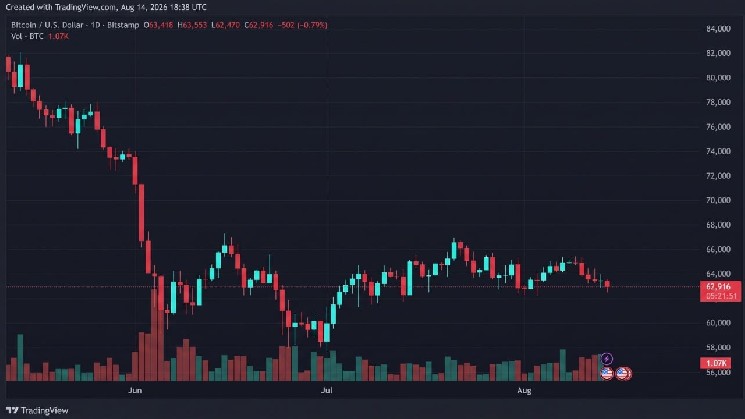
Các chuyên gia CryptoQuant cho rằng tin tốt về lạm phát Mỹ không thể hỗ trợ giá Bitcoin vì nhu cầu giao ngay yếu. Dữ liệu CPI và PPI tháng 7 của Mỹ đáp ứng hoặc vượt kỳ vọng, khiến lợi tức trái phiếu giảm và thị trường chứng khoán tăng, nhưng Bitcoin vẫn giao dịch quanh mức 63.000-64.000 USD. Nguyên nhân chính là dòng vốn đổ vào các ETF Bitcoin Mỹ vẫn thấp và chỉ số Coinbase Premium (phản ánh chênh lệch giá) âm từ tháng 5, cho thấy áp lực mua từ nhà đầu tư Mỹ hạn chế. Trong khi đó, vị thế trên thị trường tương lai vẫn cao, tạo ra sự mất cân bằng giữa nhu cầu giao ngay yếu, thanh khoản thấp và khối lượng vị thế ký quỹ lớn. Các chuyên gia cảnh báo trong điều kiện này, tin tích cực vĩ mô có thể không kích thích tăng giá. Nếu giá không phản ứng, các nhà giao dịch có thể đóng vị thế mua ký quỹ, gây thêm áp lực giảm. Mức kháng cự quan trọng là 68.700 USD - giá vốn trung bình của các nhà nắm giữ ngắn hạn. Theo CryptoQuant, để thị trường hồi phục mạnh mẽ cần: dòng tiền mạnh trở lại vào ETF Bitcoin Mỹ, chỉ số Coinbase Premium chuyển sang dương, khối lượng giao dịch giao ngay tăng và Bitcoin vượt vững chắc trên 68.700 USD.

cryptonews.ru59 phút trước

Các chuyên gia chỉ ra nguyên nhân Bitcoin giảm sau khi lạm phát Mỹ hạ nhiệt

cryptonews.ru59 phút trước

Giá Bitcoin giảm xuống 62.470 USD khi người bán thử thách lại ngưỡng hỗ trợ 63.000 USD

Giá Bitcoin giảm xuống 62.470 USD vào thứ Sáu, lần thứ hai liên tiếp phá vỡ ngưỡng 63.000 USD. Sau một thời gian củng cố quanh 63.400 USD, đợt bán tháo bắt đầu sau nửa đêm đã đẩy giá xuống đáy 62.470 USD trong phiên, trước khi phục hồi nhẹ lên trên 63.000 USD. Biến động mạnh dẫn đến việc thanh lý hàng loạt các vị thế mua ký quỹ, với tổng giá trị vị thế Bitcoin bị thanh lý trong 24h là 32 triệu USD. Áp lực bán càng gia tăng do dòng tiền ròng rút khỏi các Quỹ ETF Bitcoin, với mức rút hơn 131 triệu USD, đánh dấu ngày thứ hai liên tiếp có dòng tiền ra. Yếu tố khác gây lo ngại là đề xuất tiêu chí mới từ nhà cung cấp chỉ số MSCI, có thể dẫn đến việc loại các công ty nắm giữ tài sản kỹ thuật số như Bitcoin (ví dụ: MicroStrategy) ra khỏi các chỉ số chính. MicroStrategy đã phản đối mạnh mẽ đề xuất này, cho rằng các nhà cung cấp chỉ số không nên quyết định loại tài sản nào công ty được phép nắm giữ. Quyết định cuối cùng của MSCI dự kiến vào giữa tháng Mười, và nếu được thông qua, có thể kích hoạt đợt bán tháo từ các quỹ chỉ số từ tháng Mười một, gây thêm áp lực giảm cho thị trường Bitcoin.

cryptonews.ru1 giờ trước

Giá Bitcoin giảm xuống 62.470 USD khi người bán thử thách lại ngưỡng hỗ trợ 63.000 USD

cryptonews.ru1 giờ trước

Bí mật khai thác 1 BTC trên máy tính công ty: Nhân viên hãng tiền mã hóa đối mặt án tù

Christopher Renkin, 40 tuổi, từ bang Washington, đã nhận tội vì truy cập trái phép vào máy tính của một công ty khai thác bitcoin và đánh cắp tiền điện tử. Anh ta đã chuyển hướng khoảng 100 thiết bị sang nhóm khai thác (mining pool) riêng của mình và chiếm đoạt 1,0668 BTC. Theo công tố viên, Renkin bắt đầu làm việc tại công ty ở Niagara Falls, New York vào tháng 7/2021. Anh ta đã tự ý truy cập, khởi động lại máy tính công ty và chuyển chúng sang pool khai thác do mình tạo ra, sau đó chuyển bitcoin thu được vào ví tiền điện tử dưới sự kiểm soát của mình. Không chỉ vậy, Renkin còn chuyển máy tính sang chế độ "hiệu suất cao", gây thiệt hại cho phần cứng, làm giảm đáng kể tuổi thọ thiết bị và xâm phạm tính toàn vẹn, khả năng truy cập thông tin lưu trữ. Hành động này khiến công ty mất 1,06 BTC, trị giá 53.315 USD tại thời điểm phạm tội. Renkin bị kết tội truyền chương trình, thông tin, mã hoặc lệnh vào máy tính được bảo vệ và gây thiệt hại cho nó. Mức hình phạt tối đa có thể lên đến một năm tù và phạt 100.000 USD. Bản án dự kiến được tuyên vào ngày 17 tháng 11 năm 2026.

cryptonews.ru1 giờ trước

Bí mật khai thác 1 BTC trên máy tính công ty: Nhân viên hãng tiền mã hóa đối mặt án tù

cryptonews.ru1 giờ trước

Giao dịch

Giao ngay

Bài viết Nổi bật

Làm thế nào để Mua CHIP

Chào mừng bạn đến với HTX.com! Chúng tôi đã làm cho mua USD.AI (CHIP) trở nên đơn giản và thuận tiện. Làm theo hướng dẫn từng bước của chúng tôi để bắt đầu hành trình tiền kỹ thuật số của bạn.Bước 1: Tạo Tài khoản HTX của BạnSử dụng email hoặc số điện thoại của bạn để đăng ký tài khoản miễn phí trên HTX. Trải nghiệm hành trình đăng ký không rắc rối và mở khóa tất cả tính năng. Nhận Tài khoản của tôiBước 2: Truy cập Mua Crypto và Chọn Phương thức Thanh toán của BạnThẻ Tín dụng/Ghi nợ: Sử dụng Visa hoặc Mastercard của bạn để mua USD.AI (CHIP) ngay lập tức.Số dư: Sử dụng tiền từ số dư tài khoản HTX của bạn để giao dịch liền mạch.Bên thứ ba: Chúng tôi đã thêm những phương thức thanh toán phổ biến như Google Pay và Apple Pay để nâng cao sự tiện lợi.P2P: Giao dịch trực tiếp với người dùng khác trên HTX.Thị trường mua bán phi tập trung (OTC): Chúng tôi cung cấp những dịch vụ được thiết kế riêng và tỷ giá hối đoái cạnh tranh cho nhà giao dịch.Bước 3: Lưu trữ USD.AI (CHIP) của BạnSau khi mua USD.AI (CHIP), lưu trữ trong tài khoản HTX của bạn. Ngoài ra, bạn có thể gửi đi nơi khác qua chuyển khoản blockchain hoặc sử dụng để giao dịch những tiền kỹ thuật số khác.Bước 4: Giao dịch USD.AI (CHIP)Giao dịch USD.AI (CHIP) dễ dàng trên thị trường giao ngay của HTX. Chỉ cần truy cập vào tài khoản của bạn, chọn cặp giao dịch, thực hiện giao dịch và theo dõi trong thời gian thực. Chúng tôi cung cấp trải nghiệm thân thiện với người dùng cho cả người mới bắt đầu và người giao dịch dày dạn kinh nghiệm.

Tổng lượt xem 1.0kXuất bản vào 2026.04.21Cập nhật vào 2026.06.02

Làm thế nào để Mua CHIP

Thảo luận

Chào mừng đến với Cộng đồng HTX. Tại đây, bạn có thể được thông báo về những phát triển nền tảng mới nhất và có quyền truy cập vào thông tin chuyên sâu về thị trường. Ý kiến ​​của người dùng về giá của CHIP (CHIP) được trình bày dưới đây.

活动图片