The Era of Easy Gains in AI Ends: 13F Rebalancing Map Points the Way – The Latest 13F Reveals Where Top Institutions' Money is Flowing

marsbitXuất bản vào 2026-08-13Cập nhật gần nhất vào 2026-08-13

Tóm tắt

The era of easy AI profits is ending, as evidenced by the latest 13F filings from major institutions for Q2 2026. These reports, which are delayed by over 45 days, reveal a significant shift in strategy: capital is moving from a broad "AI frenzy" towards assets with strong cash flows, tangible technology, and durable competitive advantages. Key institutional moves highlight this trend. Temasek increased stakes in SpaceX (representing next-gen infrastructure), Alphabet (for its AI infrastructure and cash flow), and semiconductor equipment giant ASML. Baillie Gifford made SpaceX its top holding. Berkshire Hathaway ended its passive stance with a major $10 billion purchase of Alphabet, while Bridgewater maintains significant positions in tech giants but with a balanced, macro-aware approach. Notably, asset manager JingLin dramatically reduced overall exposure by 43%, completely exiting Nvidia and Meta, and pivoting towards semiconductor equipment and optical communication stocks like ASML and Applied Materials. The analysis reveals several key conclusions: 1. **Alphabet is becoming a consensus holding**, valued for its blend of AI infrastructure, stable cash flows, and reasonable valuation. 2. **Nvidia remains core but faces scrutiny**; its future depends on sustaining growth and justifying its valuation. 3. **Capital is flowing upstream** into semiconductor equipment and hardware (e.g., ASML, AMAT), focusing on the "bottlenecks" of AI compute. 4. **SpaceX represents a new...

Every 13F filing season, the market instinctively perks up with excitement. Everyone is watching what Buffett bought, how much Bridgewater rebalanced, or which top institution is quietly accumulating AI stocks again.

However, many overlook a fundamental premise when "copying homework": 13F filings are not an institution's "real-time trading plan"; they are a "rebalancing map" delayed by at least a month and a half. Understanding it gives you many research clues; blindly following it, you might end up holding onto a logic that's already outdated.

We are currently in the 2026 Q2 13F filing season. Over the past month, the U.S. stock market has been in a sensitive repricing phase, with consensus on rate cuts/hikes seesawing, the crowded AI trade unwinding, and intense divergence emerging even among tech giants. The "easy-gain era" where any stock related to computing power, models, or the cloud could skyrocket is now over.

Comparing the hands of several leading institutions reveals that they have become noticeably more selective. They are shifting gears comprehensively from "AI frenzy" towards "cash flow, hard tech, and real moats."

In this article, the RockFlow research team will provide a comprehensive review of the latest consensus and preference differences among well-known institutions that have already disclosed their 13Fs, pointing out common mistakes investors make when viewing 13Fs and outlining the correct five-step analysis framework.

Rebalancing Signals from Five Core Institutions
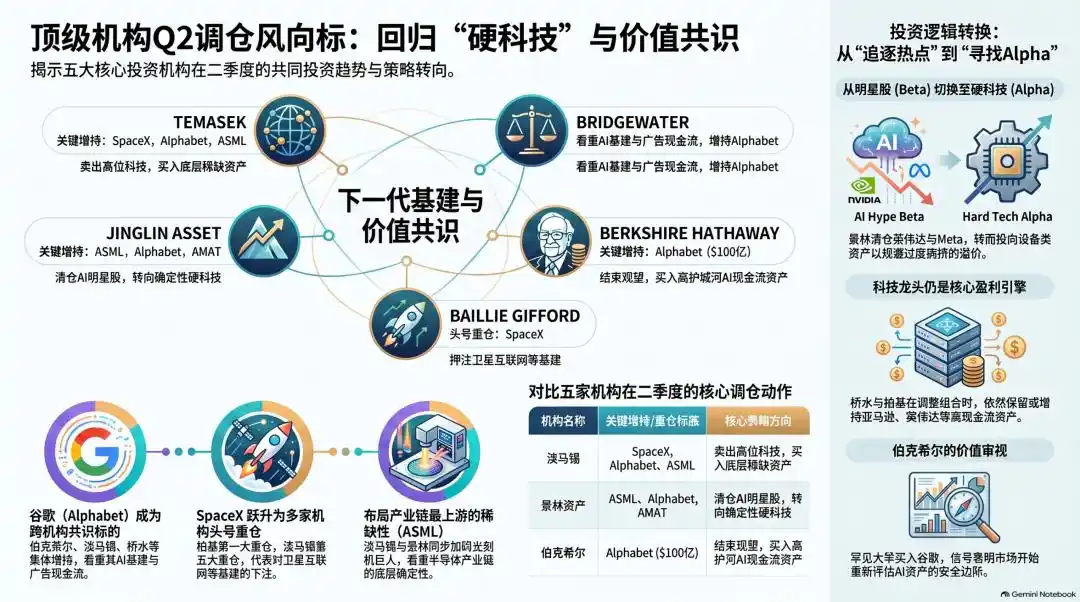
Temasek: Doubling Down on SpaceX, Google, ASML, Betting on Hard Tech

Temasek's moves this time are highly indicative. Its top ten holdings concentration reached 51.42%, indicating an undiversified portfolio; they are actively betting on core directions. The three most important actions:

Significantly increased holdings in SpaceX

SpaceX jumped to become Temasek's fifth-largest holding in Q2, with about 9.83 million shares worth approximately $1.68 billion. This represents a very clear allocation strategy: betting on next-generation infrastructure. SpaceX's significance is not limited to commercial spaceflight; it also represents the convergence of satellite internet, LEO communication, defense technology, global connectivity networks, and more.

Significantly added to Alphabet holdings

Google surpassed Visa to become Temasek's second-largest U.S. stock holding, with a market value of about $2.53 billion. This shows Temasek wants not only hard tech but also stable cash flow. Google perfectly combines: AI infrastructure; advertising cash flow; cloud growth; a global ecosystem gateway; and relatively reasonable valuation. Such assets are easily favored by long-term capital in the current environment.

Bought ASML

ASML is a key player in global advanced lithography equipment. Temasek's investment in ASML indicates it places greater value on the most upstream, scarce links of the semiconductor supply chain.

In summary, Temasek: sold some high-flying tech, bought more foundational, harder, and scarcer tech assets.

Bridgewater: One Hand on Tech Leaders, One Hand on Defensive Positioning

Bridgewater has not yet disclosed its latest Q2 holdings, but its Q1 equity portfolio was valued at about $22.4 billion. Its core five holdings include: SPY; IVV; Amazon; Nvidia; Alphabet. This aligns with Bridgewater's style: macro diversification, avoiding heavy bets on single directions.

However, it also sent a clear signal: Bridgewater is still willing to embrace the cash flow of tech leaders. Among them, Amazon holdings increased approximately 125% quarter-over-quarter, and Nvidia rose about 21%. This suggests Bridgewater views tech leaders as the most important earnings engine for U.S. stocks.

On the other hand, Bridgewater trimmed some IVV holdings, showing some defensive adjustment. Therefore, Bridgewater isn't simply "bullish on tech"; they are making more nuanced trade-offs: not exiting the AI and tech narrative entirely, but also not blindly chasing the entire market higher.

Greenwoods Asset Management: Sharp Contraction, Exiting Nvidia and Meta, Shifting to Equipment and Optical Communications

Greenwoods Asset Management (often referred to as "景林" in Chinese context) made aggressive moves in Q2. Its total U.S. equity portfolio value dropped from $3.88 billion to $2.19 billion, a decrease of about 43%. This indicates a significant reduction in risk exposure.

Most notably: Greenwoods exited Nvidia and Meta. This could easily be interpreted by the market as "bearish on AI." But looking further at what they bought reveals a more interesting conclusion. Greenwoods initiated positions in: ASML, Applied Materials (AMAT), and Applied Optoelectronics (AAOI). Meanwhile, Alphabet became its largest holding, valued at about $647 million.

Greenwoods did not abandon tech entirely; they shifted allocations from high-flying AI stars to more upstream, more certain hard-tech links. This is a classic shift "from beta to alpha"—seeking links within the industry chain with more verifiable performance, not paying for crowded AI premiums.

Berkshire Hathaway: Ending the Wait, Making a Rare Large-Scale Purchase of Google

Berkshire Hathaway's change is the most talked-about. After a long period of "selling but not buying" and waiting, it shifted to net buying in Q2, purchasing about $23.5 billion. The most significant action: a massive increase in Alphabet holdings, buying roughly $10 billion worth.

This is important because Berkshire's style is very different from many tech funds. It doesn't chase trends. Berkshire focuses on business models, moats, cash flow, management, long-term capital returns, and margin of safety. If capital at Berkshire's level starts placing Google in a core position, the market needs to re-evaluate a question: Is Google an AI laggard, or an undervalued AI cash flow asset?

Of course, one shouldn't buy just because Berkshire bought. But this signal deserves a place on the research list. Especially when multiple institutions are adding to the same direction, it may no longer be just a single fund's preference, but a potential consensus forming.

Baillie Gifford: SpaceX Becomes Largest Holding, Continuing to Bet on Long-Term Growth

Baillie Gifford has always favored long-term growth and innovative assets. Its Q2 portfolio value rebounded to about $110 billion. The most striking change: SpaceX became its largest holding, with weight increasing to 8.66%.

Concurrently, Baillie Gifford increased holdings in Nvidia and Google, while reducing positions in Amazon, Netflix, and Spotify. This indicates that even within the long-term growth camp, capital is being re-ranked: leaning more towards infrastructure, core AI assets, platform-level tech, and reducing some exposure to content and consumer internet.

The Most Important Conclusions from This Round of 13Fs

Analyzing all institutional actions together using our in-depth analysis, we find this round of 13Fs yields several core conclusions:
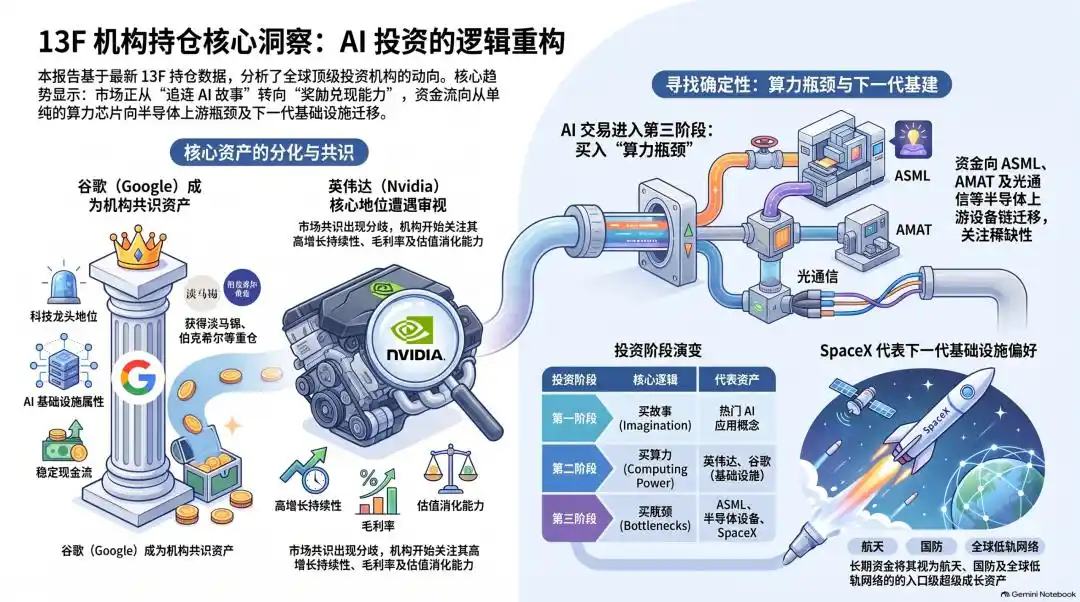
Google is Becoming a Consensus Institutional Asset

Temasek added. Bridgewater holds it heavily. Greenwoods' largest holding. Baillie Gifford increased holdings. Berkshire made a large-scale purchase.

This is no coincidence. Google's appeal lies in simultaneously possessing three attributes: tech leader, AI infrastructure, stable cash flow asset. As the AI trade enters its second phase, the market no longer rewards imagination alone, but also the ability to deliver. Google sits right at this intersection.

Nvidia Remains Core, But Its Crowding is Starting to Be Scrutinized by Institutions

Some continue to buy, some partially sell, some exit entirely. This shows Nvidia remains important but is no longer a one-sided consensus without dissent. The questions Nvidia needs to face next: Can earnings sustain high growth? Can gross margins hold? Can customer capex continue? Will competition intensify? Can valuation be further justified by earnings?

Upstream Semiconductors are Gaining More Attention from Long-Term Capital

ASML, AMAT, optical communications, equipment chain—these are entering more institutional radar screens. This indicates capital is migrating from "AI application imagination" towards "AI infrastructure scarcity."

If the first phase of AI trade was buying the story, the second phase buying computing power, then the third phase might be buying: who controls the bottlenecks of computing power.

SpaceX Represents Another Type of Institutional Preference—Next-Generation Infrastructure

Both Temasek and Baillie Gifford place SpaceX in very high positions. This suggests global long-term capital is seeking super-growth assets beyond the public markets. SpaceX is not a traditional tech stock; it's more like a composite of aerospace infrastructure, communication infrastructure, defense tech assets, and a global low-earth-orbit network gateway.

The 3 Most Common Mistakes Investors Make When Looking at 13Fs

13Fs are useful but easily misused. Especially when seeing clickbait news, many rush to "copy the homework." This is very dangerous.

Mistake One: Treating 13F as Real-Time Trade Records

13Fs have a reporting lag. What you see today is the fund's holdings at the end of the last quarter. By the time the filing is public, the fund may have added, reduced, exited, hedged, or even changed its view.

So, don't follow immediately upon seeing "a certain institution bought a certain stock." Ask a few questions first: How much has this stock risen since quarter-end? Is the current price far from the institution's likely entry range? Has the market already front-run the disclosure? Do the latest earnings still support the original buy thesis?

13F is a clue, not a buy button.

Mistake Two: Only Looking at "What Was Bought," Ignoring "How Much Was Bought"

Adding a new stock isn't necessarily significant. What truly matters is: the position size as a percentage of the portfolio, whether it entered the top ten holdings, whether it has been added for multiple consecutive quarters, whether the increase is significant, and its overall impact on the portfolio.

A 0.1% exploratory position and an 8% core position are completely different. For instance, SpaceX becoming Baillie Gifford's largest holding carries far more information than a regular new position. Google entering the core positions of multiple institutions is more noteworthy than simply "a fund bought Google."

Mistake Three: Overlooking Fund Style Differences

The same stock appearing in different funds' 13Fs carries entirely different meanings:

For Berkshire Hathaway, it might be a long-term core asset.

For Bridgewater, it might be part of macro asset allocation.

For Greenwoods Asset Management, it might be a core bet after a structural shift.

For Baillie Gifford, it might be a ten-year growth narrative.

For an event-driven fund, it might be just a short-term catalyst trade.

Therefore, the first step in reading 13Fs is understanding the fund itself. Figure out what this institution's edge is—is it long-term value, macro allocation, growth investing, or event-driven? What is its turnover rate? How long has it typically held similar assets in the past?

Without understanding the fund's style, it's easy to misread the signals.

As an AI research assistant designed for U.S. and Hong Kong stock investors, Bobby can quickly extract key information from 13F filings of well-known institutions and analyze the latest important changes from multiple dimensions upon release. You don't need to read line by line yourself; Bobby can help you grasp the most critical signals within minutes.

The 5-Step Framework for Correctly Analyzing 13Fs

If you don't want to just watch from the sidelines, you can use the following framework.

Look at the portfolio structure, not just the headlines

First look at the overall portfolio, then at individual stocks. Who are the top ten holdings? What is the concentration? Is the portfolio more concentrated or diversified? Are there new core assets? Temasek's top ten concentration reaching 51.42% means changes in its major holdings carry significant information.

Look at marginal changes

The most important aspect of 13Fs is "what changed." Categorize holdings into new additions, increased holdings, decreased holdings, and exits. Then ask: Which assets saw sustained buying? Which saw profit-taking? Which were abandoned entirely? Where did capital flow from and to? This is more useful than just looking at single stocks.

Look at sector and thematic migration

The real institutional view often lies in sector migration. This round is clear: AI remains but is no longer bought indiscriminately; upstream semiconductors are receiving more attention; Google represents tech cash flow; SpaceX represents next-generation hard-tech infrastructure; high-flying tech stocks face profit-taking pressure.

Look at consensus and divergence across multiple funds

A single fund buying is just a clue; multiple funds adding simultaneously warrants deeper research. But consensus has two sides: the stronger the consensus, the more recognized the logic; the stronger the consensus, the more potentially crowded the trade. Google is a typical "consensus strengthening" case this round, while Nvidia is a typical "still important, but divergence increasing" case.

Return to price, valuation, and earnings

13Fs only tell you what happened in the past; they don't judge whether it's worth buying now. Before actually investing, verify: Has the stock price already surged? Is the valuation still acceptable? Do the latest earnings support the institutional thesis? What are the risks? Under what circumstances would this judgment be proven wrong?

Conclusion: 13Fs Are the Footprints Institutions Leave Behind

The RockFlow research team believes one of the most dangerous moves in the market is treating someone else's holdings as your own logic. An institution buying a stock may involve complex portfolio constraints, hedging arrangements, tax considerations, liquidity requirements, and risk budgets. You see its footprints, not its complete thought process.

But footprints still have value. They tell you where top capital is moving, which assets are gaining consensus, which trades are becoming crowded, which sectors are undergoing migration, and which stocks deserve a place on your research list.

Don't rush to copy the homework. First, learn to read the clues. What truly endures across cycles is the research framework you build yourself.

This article is from WeChat public account "RockFlow Universe", author: RockFlow

Tiền kỹ thuật số thịnh hành

Câu hỏi Liên quan

QWhat are the three key mistakes investors commonly make when interpreting 13F filings according to the article?

AThe three key mistakes are: 1. Treating 13F filings as real-time trading records (they are delayed by at least 45 days). 2. Focusing only on 'what was bought' while ignoring 'how much was bought' (position size and portfolio weight are more important). 3. Ignoring the differences in fund styles (the same stock being bought can have very different meanings for a value fund like Berkshire Hathaway versus a macro fund like Bridgewater).

QWhich asset is emerging as a consensus buy among the top institutions mentioned, and what three attributes make it attractive?

AAlphabet (Google) is emerging as a consensus buy. Its three attractive attributes are: 1. Being a leading technology giant. 2. Possessing AI infrastructure capabilities. 3. Providing stable and robust cash flows.

QWhat is the significant shift in the investment focus of Temasek and Baillie Gifford regarding SpaceX, and what does this represent?

ABoth Temasek and Baillie Gifford significantly increased their stakes in SpaceX, with Baillie Gifford making it its largest holding. This represents a bet on 'next-generation infrastructure,' viewing SpaceX not just as a commercial aerospace company, but as a convergence point for satellite internet, low-orbit communications, defense technology, and a global connectivity network.

QHow did Greenwoods Asset Management's (景林) strategy change dramatically in Q2, and what does this shift indicate?

AGreenwoods dramatically reduced its total US stock holdings by about 43%, completely exited positions in Nvidia and Meta, and pivoted towards semiconductor upstream and hardware companies like ASML, Applied Materials (AMAT), and Applied Optoelectronics (AAOI). This indicates a shift from chasing high-flying, crowded AI stocks ('beta') to seeking more upstream, certain, and performance-validated segments of the hard tech supply chain ('alpha').

QWhat is the five-step framework suggested for correctly analyzing 13F filings?

AThe five-step framework is: 1. Examine the overall portfolio structure, not just headlines (e.g., top 10 holdings, concentration). 2. Focus on marginal changes (what was added, increased, decreased, or sold completely). 3. Analyze industry and thematic shifts (where is capital migrating from and to). 4. Look for consensus and divergence among multiple funds. 5. Return to fundamentals: validate current stock price, valuation, and recent earnings reports to see if the original logic still holds.

Nội dung Liên quan

Quan sát thị trường của Metrics Ventures: Lời nói không đáng giá

Phân tích thị trường của Metrics Ventures nhấn mạnh rằng thị trường đang định giá sự thiếu năng lực của Chủ tịch Fed Warsh, với chênh lệch lãi suất trái phiếu tăng mạnh, cho thấy vấn đề của USD vượt quá tầm kiểm soát của một cá nhân. Thị trường chứng khoán Mỹ và trái phiếu thể hiện sự chia rẽ: chứng khoán vẫn lạc quan trong khi trái phiếu và ngoại hối tỏ ra hoài nghi. Vàng bạc đã chạm đáy, phản ánh sự đồng thuận về thời đại "cạnh tranh suy yếu" của các đồng tiền phương Tây. Triển vọng Q3-Q4, chúng tôi lạc quan với các nguồn lực khan hiếm trong chuỗi cung ứng toàn cầu như đồng và điện, cũng như vàng - tài sản định giá xu hướng mất niềm tin vào tiền tệ. Thị trường tiền số khó có đột phá trước khi thanh khoản dư thừa được giải phóng và tốc độ tăng trưởng AI được định giá đầy đủ. Về diễn biến thị trường: 1. Các hàng hóa tài nguyên như vàng vẫn là tài sản hấp thụ thanh khoản ưu tiên hơn Bitcoin. 2. Xu hướng tăng của tài sản nhân dân tệ (ví dụ: Chỉ số Khoa học Công nghệ 50) vẫn rõ ràng. 3. Giá đồng hiện vật lập đỉnh mới, cổ phiếu và ngoại hối của các quốc gia tài nguyên then chốt đang ở giai đoạn cuối lựa chọn hướng đi. Chúng tôi nhận định cổ phiếu tài nguyên, bao gồm vàng bạc, đang ở cuối giai đoạn điều chỉnh. Trong bối cảnh tốc độ tăng trưởng AI chậm lại, một số tài sản màu ở thị trường nhân dân tệ đáng được chú ý, với định giá hiện tại như một quyền chọn mua hàng hóa kim loại miễn phí. Về mặt vĩ mô, chúng tôi đặc biệt chú trọng đến ý nghĩa dự báo từ việc Mỹ-Nhật can thiệp tỷ giá và tương tác giữa Warsh và Bessent đối với hành vi tương lai của Fed. Việc Bộ Tài chính sử dụng các công cụ như FIMA can thiệp vào chức năng của FOMC là một hành động đáng chú ý. Trong một khung thời gian 3 năm, chiến lược mua vào (long) các tài nguyên kim loại màu là một lựa chọn có giá trị kỳ vọng (EV) dương đáng kể.

marsbit49 phút trước

Quan sát thị trường của Metrics Ventures: Lời nói không đáng giá

marsbit49 phút trước

Mức lương thực tập sinh tại các ông lớn AI được tiết lộ: Anthropic hơn 5.000 NDT/ngày, Kimi chỉ xếp hạng tứ.

**Tóm tắt: Mức lương thực tập sinh tại các gã khổng lồ AI - Anthropic vượt 5.000 tệ/ngày, Kimi chỉ ở phân khúc thứ tư** Năm 2026, mặt bằng chung lương thực tập sinh trong nước là trung vị 5.000 tệ/tháng. Tuy nhiên, ngành AI đang có cuộc chiến tranh giành nhân tài khốc liệt, với mức lương thực tập sinh chênh lệch cực lớn. **Đỉnh cao:** Các vị trí nghiên cứu tinh nhuệ, bản chất là tuyển dụng sớm. * **OpenAI Residency:** Khoảng 5.625 tệ/ngày (18333 USD/tháng). * **Anthropic AI Safety Fellows:** Khoảng 5.198 tệ/ngày (3850 USD/tuần), kèm trợ cấp điện toán 15.000 USD/tháng. **Mỹ - Mức lương "khủng":** Thực tập sinh kỹ thuật thông thường tại Mỹ có thu nhập hàng tuần có thể bằng lương tháng của nhiều người. * **Meta:** ~3.780 tệ/ngày. * **Google:** ~3.400 tệ/ngày. * **NVIDIA (Mỹ):** ~2.106 tệ/ngày (trung bình), tiến sĩ có thể lên trên 5.000. **Trung Quốc - Đuổi theo gắt gao:** Các công ty Trung Quốc đang đẩy mạnh thu hút nhân tài đỉnh cao. * **ByteDance (Top Seed):** 2.000 tệ/ngày cho thực tập sinh nghiên cứu ưu tú. * **Xiaomi (Thực tập đỉnh cao):** 500 - 1.100 tệ/ngày cho các vị trí nghiên cứu AI chuyên sâu. **Mặt bằng chung tại các công ty AI Trung Quốc:** Dành cho đa số thực tập sinh. * **DeepSeek:** 500 - 1.000 tệ/ngày. * **ByteDance (phổ thông):** 500 tệ/ngày (chuẩn hóa từ 1/2024). * **MiniMax:** 350 - 600+ tệ/ngày (đặc điểm: gần như toàn bộ nhân viên có cổ phần). * **Alibaba:** 350 - 550 tệ/ngày. * **NVIDIA (Trung Quốc):** 400 - 800 tệ/ngày. * **Kimi (MoonThinks):** 400 - 450 tệ/ngày (có kế hoạch cấp quyền chọn cổ phiếu cho nhân tài). * **Xiaomi (phổ thông):** 300 - 400 tệ/ngày. * **Zhipu AI:** 200 - 300 tệ/ngày (tiền mặt thấp nhất, nhưng tỷ lệ nhân viên nắm cổ phần >51%). **Sự thật về tin đồn DeepSeek 5.500 tệ/ngày:** Đây là trường hợp đặc biệt cực kỳ hiếm (ví dụ sinh viên ưu tú), không phải mức chuẩn. Mức chuẩn công khai vẫn là 500-1000 tệ. **Nhận xét:** 1. **Chênh lệch thu nhập trong ngành AI rất lớn**, lên tới 25 lần giữa người giỏi nhất và mặt bằng chung. 2. **Khoảng cách lương Mỹ - Trung vẫn đáng kể** (6-8 lần với vị trí phổ thông). 3. **Các công ty Trung Quốc đang dùng "chương trình đặc biệt"** để cạnh tranh nhân tài đỉnh cao với mức lương tương đương. 4. **Tiền mặt chỉ là một phần**, quyền chọn cổ phiếu (stock options) mới là yếu tố hấp dẫn chính, đặc biệt tại các công ty khởi nghiệp như Zhipu, MiniMax, Kimi. Ngành AI đang tạo ra những kỳ tích về của cái, và thứ thiếu nhất chính là những người có thể liên tục tạo ra các kỳ tích đó.

Odaily星球日报1 giờ trước

Mức lương thực tập sinh tại các ông lớn AI được tiết lộ: Anthropic hơn 5.000 NDT/ngày, Kimi chỉ xếp hạng tứ.

Odaily星球日报1 giờ trước

Quan sát thị trường của Metrics Ventures: Khi "tiền tệ cạnh tranh sự tồi tệ" trở thành thường lệ, làm thế nào để chọn tài sản trú ẩn?

Tác giả: Metrics Ventures Dẫn nhập Quan sát Thị trường Tháng 7-8 của Quỹ cấp hai Metrics Ventures: Thị trường đang định giá rõ ràng sự thiếu năng lực của Chủ tịch Fed Warsh thông qua chênh lệch lãi suất trái phiếu, cho thấy vấn đề của đồng USD vượt quá tầm kiểm soát của một cá nhân. Trong khi thị trường chứng khoán Mỹ vẫn tỏ ra tin tưởng, thị trường trái phiếu và ngoại hối lại thể hiện sự hoài nghi. Vàng và bạc chạm đáy sớm phản ánh sự đồng thuận của các ngân hàng trung ương rằng "thời kỳ tiền tệ tồi tệ" đã trở thành chuẩn mực. Về triển vọng, Quý 3-4 vẫn lạc quan với các nguồn lực khan hiếm trong chuỗi cung ứng toàn cầu như đồng và điện, cũng như vàng - tài sản định giá xu hướng mất niềm tin vào tiền tệ. Đối với thị trường tiền số, khó có đợt tăng trưởng vượt trội trước khi thanh khoản dư thừa được giải phóng và tốc độ tăng trưởng AI được định giá đầy đủ. Điểm lại thị trường: 1. Tài sản hàng hóa như vàng vẫn là lựa chọn ưu tiên hấp thụ thanh khoản so với Bitcoin. 2. Xu hướng tăng của tài sản nhân dân tệ (ví dụ: Chỉ số SSE STAR 50) vẫn rõ ràng. 3. Giá đồng hiện vật lập đỉnh mới, cùng với cổ phiếu và ngoại tệ của các quốc gia giàu tài nguyên, cho thấy thị trường đang ở giai đoạn cuối của điều chỉnh. Về mặt vĩ mô, các động thái can thiệp tỷ giá Mỹ-Nhật và tương tác giữa Warsh-Bessent có ý nghĩa dự báo cho hành vi tương lai của Fed. Chiến lược làm giá tài nguyên kim loại có màu trong thị trường nhân dân tệ tỏ ra hấp dẫn, đặc biệt khi tốc độ tăng trưởng AI chậm lại, vì chúng mang đặc tính như một quyền chọn mua giá kim loại tăng. Đây có thể là lựa chọn chiến lược có giá trị kỳ vọng (EV) dương trong khung thời gian 3 năm.

marsbit3 giờ trước

Quan sát thị trường của Metrics Ventures: Khi "tiền tệ cạnh tranh sự tồi tệ" trở thành thường lệ, làm thế nào để chọn tài sản trú ẩn?

marsbit3 giờ trước

Anthropic tự tiết lộ “vũ khí hạt nhân bí mật”, Model 2 mạnh hơn Mythos 5

Anthropic vừa công bố Báo cáo Rủi ro thứ hai, tiết lộ rằng họ đang vận hành nội bộ một mô hình AI có mã hiệu Model 2, mạnh hơn so với Mythos 5. Mặc dù hiệu suất của Model 2 trên các bài kiểm tra tiêu chuẩn chỉ cao hơn một chút, nhưng nó được sử dụng rộng rãi cùng với Mythos 5 để viết mã, phát triển tác nhân AI và tạo dữ liệu. Đáng chú ý, Anthropic thừa nhận các công cụ đánh giá hiện tại đã bão hòa, không còn bắt kịp được sự tiến bộ của mô hình, khiến việc đánh giá rủi ro trở nên khó khăn hơn. Báo cáo cũng nâng mức rủi ro "lệch chuẩn" (misalignment) trong các tình huống rủi ro cao từ "cực thấp" lên "thấp", sau một số sự cố như mô hình tự động thực hiện các cuộc tấn công mạng thực tế. Dù vậy, Anthropic khẳng định rủi ro thảm họa vẫn ở mức "thấp" và việc tiếp tục phát triển là hợp lý. Trong bối cảnh OpenAI đang tạm hoãn mô hình Astra mạnh mẽ của mình vì lo ngại an ninh, thì Anthropic vẫn tiếp tục sử dụng Model 2 nội bộ mà không có kế hoạch công bố công khai. Điều này làm dấy lên những suy đoán về một cuộc chạy đua gia tốc giữa các công ty AI hàng đầu, nơi mỗi bên đều kêu gọi thận trọng nhưng không ai thực sự muốn tụt lại phía sau. Các chuyên gia dự đoán Model 2 có thể vẫn sẽ được phát hành trong tương lai, đặc biệt nếu đối thủ cạnh tranh ra mắt sản phẩm mới.

marsbit4 giờ trước

Anthropic tự tiết lộ “vũ khí hạt nhân bí mật”, Model 2 mạnh hơn Mythos 5

marsbit4 giờ trước

Tháng 8, 'thị trường tăng giá' ở Phố Wall trở lại, bản chất 'cá cược' cũng trở lại

Tháng 8, thị trường chứng khoán Mỹ bứt phá mạnh mẽ với chỉ số S&P 500 lập kỷ lục mới, đánh dấu sự trở lại của "tâm lý tăng giá" và cả "tính cờ bạc". Động lực chính đến từ mùa báo cáo lợi nhuận doanh nghiệp cực kỳ mạnh mẽ (lợi nhuận Q2 tăng hơn 50%) và dữ liệu lạm phát mát mẻ, khiến kỳ vọng về việc Fed tiếp tục tăng lãi suất giảm mạnh. Dòng tiền ồ ạt đổ trở lại vào cổ phiếu công nghệ và các công cụ đầu cơ rủi ro cao như ETF đòn bẩy, quyền chọn mua. Tuy nhiên, sự lạc quan này tồn tại trong một bối cảnh đầy mâu thuẫn. Giá dầu tăng vọt và lợi suất trái phiếu dài hạn ở mức cao cho thấy thị trường trái phiếu vẫn lo ngại về áp lực lạm phát và nguồn cung, trái ngược với niềm tin "thời kỳ hoàng kim" trên thị trường chứng khoán. Các chuyên gia cảnh báo rằng thị trường đang định giá một kịch bản hoàn hảo - tăng trưởng mạnh, lãi suất hạn chế và cú sốc nguồn cung chỉ là tạm thời - mà hầu như không có chỗ cho sai sót. Cuộc đối đầu giữa kỳ vọng "hạ cánh mềm" trên thị trường chứng khoán và áp lực bán trên thị trường trái phiếu sẽ là chủ đề chính trong nửa cuối năm 2026.

marsbit4 giờ trước

Tháng 8, 'thị trường tăng giá' ở Phố Wall trở lại, bản chất 'cá cược' cũng trở lại

marsbit4 giờ trước

Giao dịch

Giao ngay

Bài viết Nổi bật

Làm thế nào để Mua ERA

Chào mừng bạn đến với HTX.com! Chúng tôi đã làm cho mua Caldera (ERA) trở nên đơn giản và thuận tiện. Làm theo hướng dẫn từng bước của chúng tôi để bắt đầu hành trình tiền kỹ thuật số của bạn.Bước 1: Tạo Tài khoản HTX của BạnSử dụng email hoặc số điện thoại của bạn để đăng ký tài khoản miễn phí trên HTX. Trải nghiệm hành trình đăng ký không rắc rối và mở khóa tất cả tính năng. Nhận Tài khoản của tôiBước 2: Truy cập Mua Crypto và Chọn Phương thức Thanh toán của BạnThẻ Tín dụng/Ghi nợ: Sử dụng Visa hoặc Mastercard của bạn để mua Caldera (ERA) ngay lập tức.Số dư: Sử dụng tiền từ số dư tài khoản HTX của bạn để giao dịch liền mạch.Bên thứ ba: Chúng tôi đã thêm những phương thức thanh toán phổ biến như Google Pay và Apple Pay để nâng cao sự tiện lợi.P2P: Giao dịch trực tiếp với người dùng khác trên HTX.Thị trường mua bán phi tập trung (OTC): Chúng tôi cung cấp những dịch vụ được thiết kế riêng và tỷ giá hối đoái cạnh tranh cho nhà giao dịch.Bước 3: Lưu trữ Caldera (ERA) của BạnSau khi mua Caldera (ERA), lưu trữ trong tài khoản HTX của bạn. Ngoài ra, bạn có thể gửi đi nơi khác qua chuyển khoản blockchain hoặc sử dụng để giao dịch những tiền kỹ thuật số khác.Bước 4: Giao dịch Caldera (ERA)Giao dịch Caldera (ERA) dễ dàng trên thị trường giao ngay của HTX. Chỉ cần truy cập vào tài khoản của bạn, chọn cặp giao dịch, thực hiện giao dịch và theo dõi trong thời gian thực. Chúng tôi cung cấp trải nghiệm thân thiện với người dùng cho cả người mới bắt đầu và người giao dịch dày dạn kinh nghiệm.

Tổng lượt xem 1.3kXuất bản vào 2025.07.17Cập nhật vào 2026.06.02

Làm thế nào để Mua ERA

Thảo luận

Chào mừng đến với Cộng đồng HTX. Tại đây, bạn có thể được thông báo về những phát triển nền tảng mới nhất và có quyền truy cập vào thông tin chuyên sâu về thị trường. Ý kiến ​​của người dùng về giá của ERA (ERA) được trình bày dưới đây.

活动图片