Does Every Great Financial Infrastructure Begin with a Speculative Frenzy?

marsbitXuất bản vào 2026-08-10Cập nhật gần nhất vào 2026-08-10

Tóm tắt

The article "Does Every Great Financial Infrastructure Begin with a Speculative Frenzy?" explores the dual role of speculation in the development of financial markets, drawing parallels between historical examples and the current crypto industry. The author argues that while speculation is often dismissed as mere gambling, it frequently serves as a crucial precursor and foundation for building sustainable financial infrastructure. This is illustrated by historical cases like the 19th-century Chicago grain market, where speculators provided the necessary liquidity for the nascent futures market to function, eventually establishing a global price discovery system for wheat. Keynes's nuanced view is cited, highlighting that speculation becomes dangerous only when it detaches from underlying value; when anchored to real assets, it can play a constructive role. This pattern is now evident in crypto. Platforms like Hyperliquid, initially built for leveraged crypto speculation, have successfully expanded their model to perpetual contracts for real-world assets like equities and commodities. Similarly, Robinhood Chain, designed for tokenized stock trading, has leveraged a surge in Meme coin activity (exemplified by the FRONG token) to attract initial users and liquidity, which could later support its core securities trading vision. The piece contrasts this with purely speculative phenomena, like many short-lived Meme coins, which often fail to create lasting value. The central the...

Written by: Prathik Desai

Compiled by: Saoirse, Foresight News

"When the capital development of a country becomes a by-product of the activities of a casino, the job is likely to be ill-done." – John Maynard Keynes, 1936

The crypto industry is often criticized, with many outsiders viewing it as purely driven by speculation, labeling it a casino with no fundamental support. However, what many fail to realize is that speculation is often a precursor signal to market evolution. A group of speculators, scorned by the mainstream, gather together, coalescing into liquidity. It is upon this foundation of liquidity that mature, compliant businesses are later built.

In this article, I will analyze this evolutionary path in light of recent phenomena in the crypto market: a public chain originally intended for stock trading launches a Meme coin issuance platform; a perpetual futures trading platform pivots to building commodity trading infrastructure; and a brokerage firm uses capital generated by a frog-themed token to support its on-chain stock trading system.

Thus, the story unfolds...

In the crypto space, speculation goes by many names: market noise, bubbles, casinos. But one point is rarely acknowledged: speculation can become the bedrock upon which upper-layer business models grow as the industry matures.

However, it must be clarified: not all bubbles can transform into foundations. Bubbles that remain purely speculative will eventually burst quickly. But if a bubble can combine with a sustainable trading scenario, generating ongoing trading activity, it can become a foundation, capable of supporting the establishment of more businesses.

This is not a new phenomenon; it has played out repeatedly throughout the long history of finance.

Consider the Chicago grain market of the 1840s. The Chicago Board of Trade established a futures market with the original purpose of helping farmers, whose harvests were full of uncertainty, lock in prices in advance to minimize losses. But for every farmer wanting to sell grain forward, there needed to be a counterparty willing to take on the long forward position and bear the price risk. Speculators filled this gap. The risk transfer market functions precisely because speculative capital willingly absorbs the price risk that farmers seek to shed.

The key to the birth of the futures market was the separation of "physical grain" and "grain as a tradable commodity." American historian William Cronon termed this process the abstraction of grain. Once grain trading was simplified into warehouse receipts, ownership could be freely transferred, allowing speculators to participate in trading on a large scale. Massive speculative trading created ample liquidity, enabling farmers to always find counterparties. This abundance of liquidity ultimately allowed Chicago to grow into the global wheat pricing center.

Interestingly, at the time, a significant portion of the populace resisted and despised such trading. The Granger Movement openly criticized exchange speculators, accusing them of profiting from farmers' labor. Yet, this mechanism eventually evolved into an essential price discovery infrastructure for the global agricultural economy. If there had been no speculators acting as counterparties in the 1870s, the global wheat market today would not have a mature pricing system.

Economist John Maynard Keynes' discourse on speculation is widely known, but his complete view more clearly reveals the dual role of speculation. Keynes divided market activities into two categories: enterprise, which is forecasting the prospective yield of assets over their whole life; and speculation, which is forecasting the psychology of the market. He worried that in markets with ample liquidity, speculation would cannibalize enterprise.

A deeper reading of his arguments shows the two-sided nature of speculation.

"Speculators may do no harm as bubbles on a steady stream of enterprise. But the position is serious when enterprise becomes the bubble on a whirlpool of speculation. When the capital development of a country becomes a by-product of the activities of a casino, the job is likely to be ill-done."

Speculation detached from any underlying asset is highly risky; but if speculation is anchored to valuable underlying assets, it can play a positive role.

As early as the first known work on securities markets – Joseph de la Vega's *Confusión de Confusiones* written in 1688 – the author noted that the Amsterdam Exchange attracted both investors and gamblers. Most existing exchanges started this way. But over time, this history faded, and a stereotype formed: that serious investment needs were the original purpose of exchanges. This is not the case.

Looking at the Present

On August 5th, the crypto industry's largest decentralized exchange, Uniswap, launched the Pools platform, allowing users to issue and trade Meme coins on Robinhood Chain. This blockchain was built by the brokerage firm of the same name, with the initial goal of serving its 30 million funded accounts for tokenized stock trading.

The story goes much further. Before the official launch of the Pools platform, traders unearthed the unpublished smart contract and executed over $150 million in trades through it. This forced Uniswap to support both the test and official contract versions and delay the launch plan. The platform's top token, FRONG, named after the filename of a frog video used in Uniswap's promotional material, was minted using the same contract six days early; on the day the platform officially opened, the token had 12,141 holders.

One can interpret this as they wish: approximately $150 million in capital traded a frog-themed token on infrastructure not yet officially operational, on a public chain originally built for securities trading. FRONG has now also become the unofficial mascot of the Pools platform. It's hard not to suspect this was a deliberate action to drive traffic to Uniswap's latest V4 version chain. Even if not planned, the on-chain Uniswap V4 daily trading volume surged from $86.2 million to $228.3 million, nearly tripling.

But as stated at the beginning of the article, not all bubbles and speculation can foster sustainable business models. Whether a speculative venture can endure depends crucially on what it is speculating on. We can look at shturl.c as a reference.

For years, shturl.c has made speculation its core product and is now one of the largest Meme coin issuance platforms. On this platform, 70% of Meme coins have a lifespan of less than a day, with only a tiny fraction surviving more than a month.
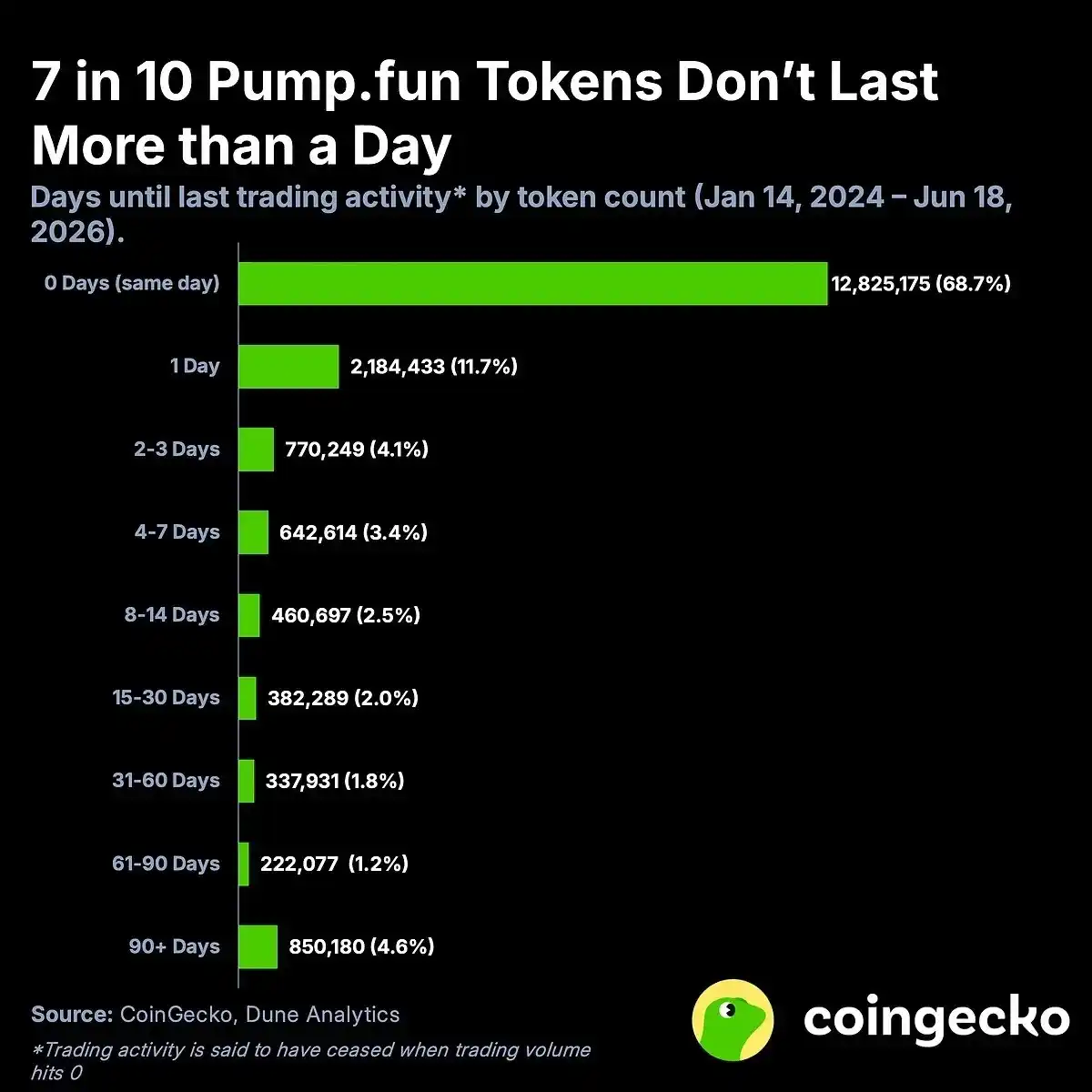
@Coingecko

From January to July 2026, the protocol's fee revenue nearly halved compared to the same period last year, reaching only $420 million. Despite this, it remains one of the highest-revenue-generating protocols in crypto, with full-year 2025 revenue of $620 million and a net profit of $584 million.

A similar platform is Hyperliquid. It initially focused on high-leverage cryptocurrency trading, catering to traders' directional bets. Later, the platform extended its leverage trading model to various assets for all-weather trading, unrelated to crypto. Under the HIP-3 governance framework, the platform has now launched perpetual contracts for tracking instruments of Nvidia, Tesla, Nasdaq, gold, crude oil, silver, stock indices, and more. When oil-related news breaks on a Sunday, traders can immediately establish positions, while traditional markets wait until Monday to open.

In early July, for the first time in the platform's history, trading volume for real-world asset perpetual contracts surpassed that of cryptocurrencies, accounting for 52% of total volume.

Although Hyperliquid's overall trading volume has shrunk by nearly half from its 2025 peak, growth in real-world asset trading has offset the decline in crypto pairs. This is precisely the value speculation can create: Hyperliquid migrated the leverage trading model that attracts native crypto users to assets like gold, pre-IPO company equity, and stock indices, building a new all-weather pricing layer. Many traditional trading platforms are now emulating this model.

Robinhood Chain is replicating this development path in real-time.

Although the team positions this public chain as the underlying infrastructure for on-chain stock trading, CEO Vlad Tenev is quite pleased with the traffic brought by Meme coin traders.

"We built Robinhood Chain with the goal of being the best public chain for real-world asset trading... but it's also great for trading Meme coins."

Riding the wave of Meme coin trading, the chain surpassed Base chain in daily active users just three weeks after launch. The traffic and capital generated by Meme coin speculation are the seed capital for the future development of the on-chain stock trading system.

Of course, this doesn't guarantee that speculation will ultimately upgrade into a mature business. Whether this transformation is completed depends on the platform's own choices.

Robinhood, with its 30 million funded users and multiple business lines, has powerful distribution capabilities that could potentially convert the traffic from Meme coin trading into a user base for on-chain securities trading. We can see that its Q2 prediction market revenue skyrocketed over tenfold year-over-year to $156 million, accounting for 20% of the platform's total trading revenue.

The Nature of Speculation

Many people never truly understand speculation. Speculation itself is neither inherently good nor bad. Stripped of all labels, it is simply one of humanity's oldest instincts.

Speculation naturally arises when people convert their views into financial bets.

In its most primitive form, speculation is about seeking liquidity for a pricing instrument; wherever liquidity flows, it prices that instrument. The instrument can be a sack of wheat, Nvidia stock, a frog video named frong.mp4, the outcome of a football match, or the probability of a presidential candidate winning.

The nature of the underlying asset determines the direction and boundaries of speculation. Once speculation loses the support of a valuable underlying asset, the same capital-fueled hype ultimately struggles to precipitate long-term, valuable outcomes. This rule runs through the history of finance, and the crypto industry is walking the same path.

Hyperliquid bound leverage trading to assets like gold, building a new pricing system in just two years; Robinhood leverages the unexpected traffic from Meme coin speculation to simultaneously construct the underlying channels for on-chain securities trading.

What kind of system speculation ultimately builds depends on how much value the underlying asset can bear.


Tiền kỹ thuật số thịnh hành

Câu hỏi Liên quan

QAccording to the article, what is the historical example used to illustrate how speculation can lay the foundation for a mature financial market?

AThe article cites the Chicago grain market of the 1840s. The Chicago Board of Trade created a futures market to help farmers hedge price risks, which required speculators to act as the counterparties willing to take on that risk. The high volume of speculative trading created the necessary liquidity, allowing Chicago to evolve into a global wheat pricing center.

QWhat key distinction does John Maynard Keynes make in his critique of speculation?

AKeynes distinguishes between speculation that is a 'bubble on a steady stream of enterprise' (which is not severely harmful) and enterprise that becomes 'the bubble on a whirlpool of speculation' (which is very dangerous). He argues that capital development fails when it becomes 'the by-product of the activities of a casino.'

QWhat recent event on the Robinhood Chain demonstrates the initial role of speculation in attracting users and liquidity?

AThe launch of the Uniswap Pools platform on Robinhood Chain, which allowed users to create and trade meme coins. Even before the official launch, traders discovered the unreleased smart contract and executed over $150 million in trades. A frog-themed token called FRONG became an unofficial mascot, and this speculative activity helped the chain surpass Base in daily active users within three weeks.

QHow has Hyperliquid evolved from its initial offering, and what does this demonstrate about speculation?

AHyperliquid started as a high-leverage cryptocurrency trading platform. It later expanded its leveraged trading model to non-crypto assets like gold, crude oil, stocks (e.g., Nvidia, Tesla), and indices through its HIP-3 governance framework. In July, trading volume for these real-world asset perpetual contracts surpassed its crypto trading volume for the first time. This demonstrates how a speculative product (crypto leverage trading) can be the foundation for building a new, broader pricing layer for traditional assets.

QWhat is the core condition that determines whether speculative activity can transform into a sustainable financial infrastructure, according to the article?

AThe critical condition is whether the speculation is anchored to an underlying asset of value. The article states: 'The attribute of the underlying asset itself determines the direction and boundaries of speculation's development. Once it loses the support of a valuable underlying asset, the hype fueled by the same capital struggles to precipitate lasting, valuable outcomes.'

Nội dung Liên quan

Giá Cổ Phiếu Tăng Chóng Mặt 655%, Cặp Anh Em Tứ Xuyên Tạo Ra Một IPO Bán Dẫn Trị Giá 50 Tỷ

Công ty Cổ phần Vật liệu Ứng dụng Siêu tinh khiết Thành Đô (gọi tắt là Siêu tinh khiết Ứng tài) đã chính thức lên sàn tại Sở Giao dịch Chứng khoán Thâm Quyến. Giá phát hành cổ phiếu A là 65,99 nhân dân tệ, huy động tổng cộng khoảng 1,68 tỷ nhân dân tệ. Khi mở cửa thị trường, giá cổ phiếu đã tăng mạnh, đạt mức cao nhất 498 nhân dân tệ/cổ phiếu, tăng 654,66% so với giá phát hành, với tổng vốn hóa thị trường vượt 50 tỷ nhân dân tệ. Được thành lập năm 2005, công ty chuyên nghiên cứu, sản xuất và kinh doanh linh kiện phủ đặc biệt cho thiết bị bán dẫn và linh kiện quang học chính xác. Đây là một doanh nghiệp "Kỳ lân chuyên môn hóa, tinh vi hóa, đặc trưng hóa, sáng tạo hóa" trọng điểm cấp quốc gia và là một trong số ít nhà cung cấp linh kiện lõi cho thiết bị khắc bán dẫn tiến trình 5nm trở xuống tại Trung Quốc. Theo báo cáo của Frost & Sullivan, năm 2024, thị phần của công ty trong lĩnh vực linh kiện phủ đặc biệu cho thiết bị bán dẫn trong nước đứng đầu, đạt 5,7% tại thị trường đại lục. Doanh thu chủ yếu đến từ linh kiện phủ đặc biệt cho thiết bị bán dẫn, chiếm hơn 95% doanh thu chính vào năm 2025. Từ năm 2023 đến 2025, doanh thu và lợi nhuận của công ty tăng trưởng nhanh chóng. Tuy nhiên, công ty cũng đối mặt với rủi ro tập trung khách hàng và nhà cung cấp tương đối cao. Người kiểm soát thực tế, Chủ tịch kiêm Tổng giám đốc là Sài Kiệt, cùng anh trai Sài Lâm, Giám đốc kiêm Tổng công trình sư, là những người đồng sáng lập. Các cổ đông nổi bật khác bao gồm Tập đoàn Đầu tư Quốc gia, BYD và Công ty Trung Vi. Kế hoạch sử dụng tiền huy động được là đầu tư vào các dự án mở rộng sản xuất, nghiên cứu và phát triển, nhằm thúc đẩy hơn nữa quá trình thay thế sản phẩm nội địa trong lĩnh vực linh kiện thiết bị bán dẫn, nơi mà các tập đoàn quốc tế hiện vẫn đang chiếm vị thế thống trị.

marsbit29 phút trước

Giá Cổ Phiếu Tăng Chóng Mặt 655%, Cặp Anh Em Tứ Xuyên Tạo Ra Một IPO Bán Dẫn Trị Giá 50 Tỷ

marsbit29 phút trước

Quan điểm: Đồng tiền ảo (Altcoin) có lẽ còn hy vọng, nhưng đồng tiền VC thì thực sự hết thời rồi

Tác giả Haotian chia sẻ góc nhìn về chiến lược đầu tư trong chu kỳ thị trường tiền điện tử hiện tại, nhấn mạnh sự chuyển dịch từ việc "nghe câu chuyện, đầu cơ vào kỳ vọng" sang "xem dòng tiền, xác minh ứng dụng thực tế". Bài viết đưa ra bốn nguyên tắc chính: 1) Ưu tiên các dự án có khả năng thu giữ giá trị thực, tạo ra doanh thu bền vững và sử dụng phí để mua lại, đốt hoặc chia cổ tức cho người nắm giữ token (ví dụ: $UNI, $PUMP, $PONS, $HYPE). 2) Lựa chọn dự án đã đạt Product-Market Fit (PMF) và có vòng kinh doanh khép kín, đặc biệt trong các lĩnh vực như token hóa tài sản và nền kinh tế agentic (ví dụ: $ONDO, $VVV, $VIRTUAL), tập trung vào số liệu như khối lượng giao dịch và khả năng tạo doanh thu. 3) Chọn tài sản có "sự đồng thuận" mạnh mẽ, được hình thành tự nhiên và có khả năng tồn tại qua nhiều chu kỳ, như các meme coin lâu đời ($DOGE, $PEPE, $PEOPLE) hoặc tài sản hàng đầu trong các phân khúc ($ZEC, $TAO). 4) Tránh xa các token VC thuần túy (do các quỹ mạo hiểm hậu thuẫn) vì chúng thường có định giá cao khi phát hành (FDV), tỷ lệ lưu thông thấp và bị áp lực bán lớn khi token được mở khóa, gây bất lợi cho nhà đầu tư nhỏ lẻ. Tác giả kết luận rằng trong khi các altcoin (tiền điện tử thay thế) vẫn có cơ hội, thì các token VC đã không còn triển vọng trong bối cảnh thị trường hiện nay. Lưu ý: Đây là quan điểm cá nhân, các ví dụ token chỉ để minh họa và không phải là lời khuyên đầu tư.

marsbit57 phút trước

Quan điểm: Đồng tiền ảo (Altcoin) có lẽ còn hy vọng, nhưng đồng tiền VC thì thực sự hết thời rồi

marsbit57 phút trước

Nhà Trắng cam kết đưa Đạo luật CLARITY vượt qua 'vạch đích' vào tháng 9

Chính quyền Tổng thống Mỹ Donald Trump vẫn cam kết thông qua Đạo luật CLARITY vào tháng 9, bất chấp việc Thượng viện quyết định trì hoãn hành động cho đến sau kỳ nghỉ tháng 8, theo quan chức chính sách tiền mã hóa hàng đầu của Nhà Trắng. Patrick Witt, Giám đốc điều hành Hội đồng Cố vấn của Tổng thống về Tài sản Kỹ thuật số, cho biết chính quyền sẽ tiếp tục đàm phán với đảng Dân chủ cho đến tận cuộc bỏ phiếu tháng 9, đồng thời nhấn mạnh "chúng ta cũng không thể chờ đợi mãi". Dự luật CLARITY nhằm thiết lập cấu trúc thị trường liên bang cho tài sản kỹ thuật số, bao gồm các quy tắc xác định khi nào tiền mã hóa thuộc luật chứng khoán hay hàng hóa và cách các nền tảng giao dịch được quản lý. Tuy nhiên, một số bất đồng vẫn chưa được giải quyết, như các yêu cầu của đảng Dân chủ về điều khoản đạo đức nghiêm ngặt hơn liên quan đến lợi ích tiền mã hóa gắn với ông Trump, và các đề xuất thay đổi quy tắc cho phép công ty trả thưởng cho người nắm giữ stablecoin. Thượng viện dự kiến tổ chức một cuộc bỏ phiếu kết thúc tranh luận về dự luật vào giữa tháng 9.

cointelegraph1 giờ trước

Nhà Trắng cam kết đưa Đạo luật CLARITY vượt qua 'vạch đích' vào tháng 9

cointelegraph1 giờ trước

Giao dịch

Giao ngay

Bài viết Nổi bật

Làm thế nào để Mua CAP

Chào mừng bạn đến với HTX.com! Chúng tôi đã làm cho mua Cap (CAP) trở nên đơn giản và thuận tiện. Làm theo hướng dẫn từng bước của chúng tôi để bắt đầu hành trình tiền kỹ thuật số của bạn.Bước 1: Tạo Tài khoản HTX của BạnSử dụng email hoặc số điện thoại của bạn để đăng ký tài khoản miễn phí trên HTX. Trải nghiệm hành trình đăng ký không rắc rối và mở khóa tất cả tính năng. Nhận Tài khoản của tôiBước 2: Truy cập Mua Crypto và Chọn Phương thức Thanh toán của BạnThẻ Tín dụng/Ghi nợ: Sử dụng Visa hoặc Mastercard của bạn để mua Cap (CAP) ngay lập tức.Số dư: Sử dụng tiền từ số dư tài khoản HTX của bạn để giao dịch liền mạch.Bên thứ ba: Chúng tôi đã thêm những phương thức thanh toán phổ biến như Google Pay và Apple Pay để nâng cao sự tiện lợi.P2P: Giao dịch trực tiếp với người dùng khác trên HTX.Thị trường mua bán phi tập trung (OTC): Chúng tôi cung cấp những dịch vụ được thiết kế riêng và tỷ giá hối đoái cạnh tranh cho nhà giao dịch.Bước 3: Lưu trữ Cap (CAP) của BạnSau khi mua Cap (CAP), lưu trữ trong tài khoản HTX của bạn. Ngoài ra, bạn có thể gửi đi nơi khác qua chuyển khoản blockchain hoặc sử dụng để giao dịch những tiền kỹ thuật số khác.Bước 4: Giao dịch Cap (CAP)Giao dịch Cap (CAP) dễ dàng trên thị trường giao ngay của HTX. Chỉ cần truy cập vào tài khoản của bạn, chọn cặp giao dịch, thực hiện giao dịch và theo dõi trong thời gian thực. Chúng tôi cung cấp trải nghiệm thân thiện với người dùng cho cả người mới bắt đầu và người giao dịch dày dạn kinh nghiệm.

Tổng lượt xem 676Xuất bản vào 2026.06.26Cập nhật vào 2026.06.26

Làm thế nào để Mua CAP

Thảo luận

Chào mừng đến với Cộng đồng HTX. Tại đây, bạn có thể được thông báo về những phát triển nền tảng mới nhất và có quyền truy cập vào thông tin chuyên sâu về thị trường. Ý kiến ​​của người dùng về giá của CAP (CAP) được trình bày dưới đây.

活动图片