On L1 Value Capture from Two Solana Proposals

marsbitXuất bản vào 2026-08-05Cập nhật gần nhất vào 2026-08-05

Tóm tắt

The article, "Discussing L1 Value Capture Through Two Solana Proposals," by Max Resnick, explores how Layer 1 (L1) blockchain tokens derive their fundamental value, drawing parallels to traditional asset pricing theory. Resnick argues that L1 token value, like stock value, stems from claims on future income streams for holders, not merely from network activity or technological promise. This value is captured when fees are either burned (economically akin to a buyback) or distributed to stakers (akin to dividends). Inflationary staking rewards, by contrast, redistribute value among holders rather than creating it. The core challenge is the quality and defensibility of fee-based revenue. High-quality fees come from sustainable, recurring demand for the network's economic utility (e.g., long-term financial activity), not from transient speculation (e.g., meme coins, airdrops). The strength of a blockchain's network effects—liquidity, applications, users—can make its revenue more defensible and grant it greater pricing power than often assumed. The article proposes a foundational valuation framework for L1s, separating revenue (fees captured for token holders), costs, and total token supply. A key accounting principle is that inflationary rewards should not be counted as a cost unless the newly minted tokens are symmetrically counted as a value input; otherwise, it misrepresents profitability. Finally, Resnick discusses the economics of increasing protocol fees to boost reven...

Author: Max Resnick, Chief Economist at Anza

Compiled by: Jiahuan, ChainCatcher

I am publishing this article as SIMD 550 (doubling the rate of inflation reduction) and SIMD 553 (resource costs) are about to enter the voting stage. This piece is not a specific commentary on these two proposals; I have already left my comments on the respective GitHub proposals. Here, I primarily discuss how the problems these proposals aim to address relate to the valuation of L1s.

Part 1: The Establishment of Asset Pricing Theory

Before asset pricing theory was formally established, investors were not short of methods to value companies. Some focused on hard assets and liquidation value, others emphasized profits, dividends, growth, management quality, or market psychology. There were many metrics available; what was truly missing was a rigorous framework to explain exactly which metrics determine value and how these metrics should be weighed against each other.

By the late 1920s, on the eve of the Great Depression, this ambiguity had become dangerous. Investors could cite facts like profit growth, market expansion, new technologies, and improved corporate governance, but these facts were often used to justify market prices rather than to derive asset value.

Graham and Dodd (1934) later described that era as one where analysis gave way to "potential and prophecy." Even when data was presented, it became "pseudo-analysis to support the illusions of the moment."

Anyone who frequently indulges in Crypto Twitter should find this scene familiar. Today's discussions around L1 tokens are similarly filled with the potential, prophecy, and pseudo-analysis that characterized the stock market of the late 1920s.

The number of people participating in blockchain development is at a record high. Transaction activity is at an all-time peak. Tokens will become currency, collateral, digital oil, or a call option betting on the future financial system.

Some of these claims may be true and could even imply upside for the underlying network. But if they cannot explain how these factors translate into token holder surplus, they do not constitute a coherent valuation framework.

John Burr Williams was the first to push asset pricing towards rigor. In "The Theory of Investment Value," Williams (1938) argued that value is "the present worth of future dividends, or of future coupons and principal in the case of a bond."

Gordon (1959) later expressed the same idea more succinctly: "A stock, like any other asset, is worth to a buyer only the benefits he expects to receive from it in the future."

Equity has value not because a company is impressive, active, important, or technologically irreplaceable. It has value because equity grants shareholders a claim on future income.

For L1 tokens, value can accrue in two ways. The first is fee burning, which economically resembles a buyback. The second is distributing fees to stakers, which economically resembles a dividend.

Staking rewards funded by issuance are different. They are neither income created by the network nor a cost borne by the network. The protocol creates new tokens and distributes them to stakers while diluting the holdings of non-stakers.

This mechanism may be necessary to secure the network and may determine who gradually comes to own the network over time. But from the perspective of all token holders, it neither creates nor destroys value.

A blockchain can process millions of transactions while creating almost no value for token holders because the surplus may be captured by users, applications, validators, or other intermediaries. Conversely, a chain with less activity may be more valuable if it converts a larger proportion of economic activity into token holder value.

But not all fees are created equal. The 'R' in ARR stands for recurring, meaning sustainable and repeatable income. Dichev, Graham, Harvey, and Rajgopal (2013) noted that high-quality earnings should be "sustainable and repeatable." The same standard applies to L1 fees.

One dollar of fees generated by long-term financial activity is not the same as one dollar generated by airdrops, meme coin mania, cascading liquidations, or temporary network congestion.

Some fees come from users' ongoing demand for scarce block space. Others are merely exhaust from speculative cycles. Once incentives disappear, volatility subsides, or users run out of money, these activities also vanish.

Fee quality depends on persistence and defensibility.

Are users paying because the chain provides long-term economic utility, or because a short-term activity happens to be on this chain? Can the protocol continue to charge these fees without driving users, applications, or order flow elsewhere? Can the token continue to capture these profits, or will this value eventually be competed away by validators, applications, searchers, block builders, users, or other chains?

Historically, crypto investors have often made two opposite errors regarding earnings quality simultaneously.

On one hand, they overestimated earnings quality because much crypto activity is speculative, reflexive, and episodic.

On the other hand, they underestimated earnings quality because they did not fully appreciate the strength of L1 network effects. Liquidity, applications, wallets, infrastructure, users, developers, assets, and order flow reinforce each other.

These network effects may make certain fees harder for competitors to capture than they initially appear. They also suggest that dominant blockchains like Solana and Ethereum may have stronger pricing power than the market generally believes, potentially benefiting from raising fees.

Part 2: Accounting Standards for Revenue, Inflation, and Total Supply

The next step is to specify a minimal fundamental model for L1s that can lead to valuation multiples.

It may be premature to call it the "standard model" now. There is currently no universally accepted standard model for L1 valuation. But the categorization below is the form I believe a standard model should take. It intentionally mirrors the methods stock analysts use to value companies.

The reason this needs to be explicitly written down is that there isn't even consensus on the most basic accounting objects.

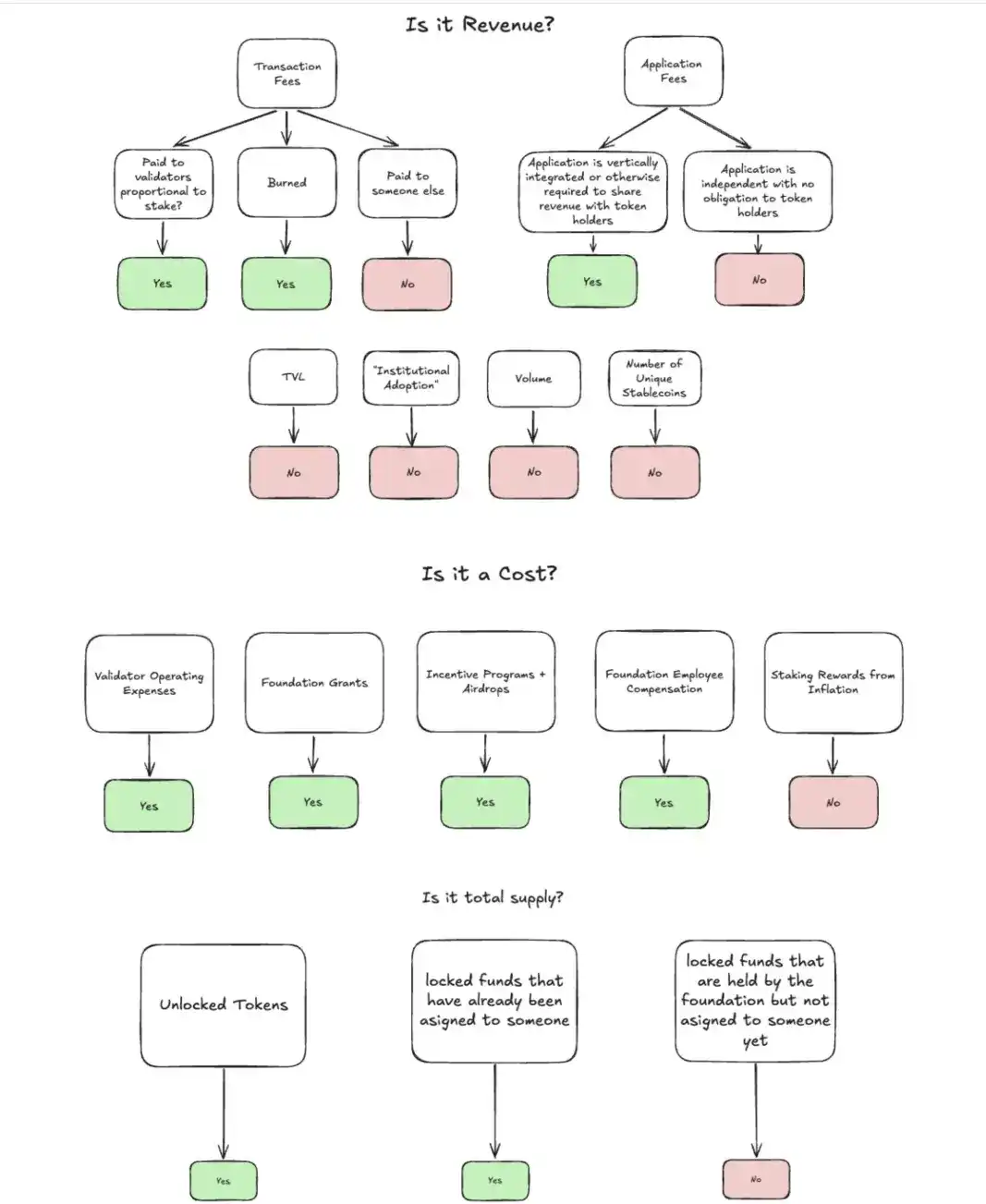
I've discussed this framework with some of the smartest people I know, and they often disagree on fundamental questions. Are validator rewards funded by inflation considered a cost? Should foundation expenditures be treated as operating expenses? Should the unspent portion of foundation tokens be included in the token supply? Should MEV paid to validators count as protocol revenue, validator revenue, or neither?

Some of the confusion may stem from the fact that there can be more than one correct way to write a valuation model. Accounting classifications are not unique. As long as the corresponding offsetting items are also adjusted, you can move an item from one side of the ledger to the other while keeping the model correct.

But this flexibility is also dangerous. Many models are internally consistent, but many are not. Having multiple correct methods does not mean there are fewer incorrect ones.

Inflation rewards are the simplest example.

Staking rewards funded by issuance are essentially rewards paid by token holders to stakers via dilution. From the perspective of all token holders combined, the two offset each other. The protocol does not earn revenue when it mints new tokens, nor does it incur a real external cost when distributing these tokens to stakers.
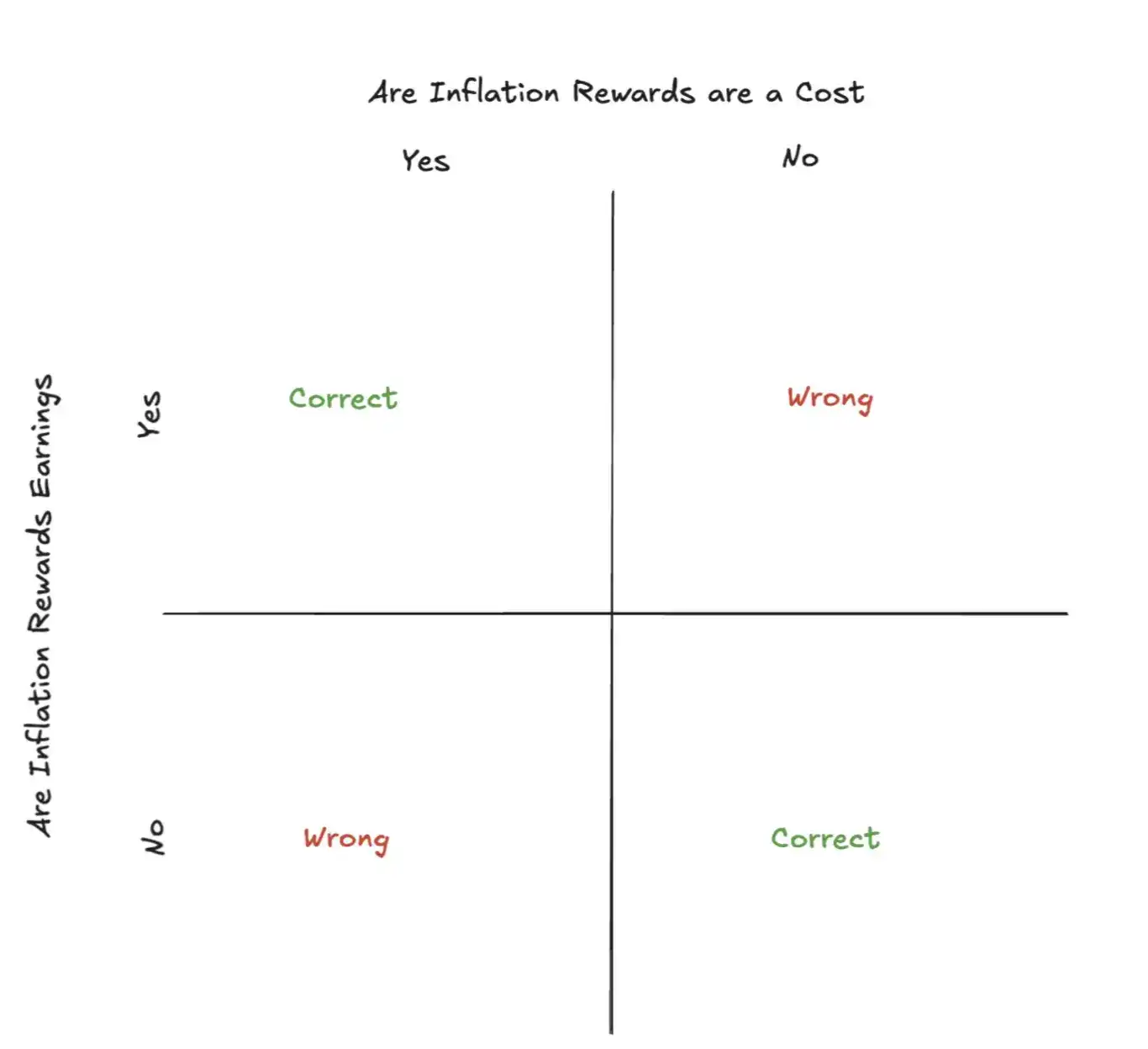
You can create a correct model that treats inflation rewards as a cost, but only if you simultaneously count newly issued tokens as a source of value to offset that cost. Otherwise, the model leads to absurd conclusions, such as Solana being unprofitable because it pays large staking rewards.

The categorization below is my proposed baseline. It separates three objects: revenue, costs, and total supply.

I believe these definitions most closely resemble the models stock analysts are already familiar with, making them easier to understand and reason about.

Other classifications may be correct, but deviations from this one must have clear justification. Proprietary models come with two costs.

First, they are harder for others to understand. Second, it is easy to miss dependencies between items.

For example, if foundation expenditures are classified as a cost, then the unspent portion of foundation tokens cannot also be included in the total supply, or it would be double-counted. If inflation rewards are classified as a cost, newly issued tokens must be treated symmetrically.
Part 3: Supply, Demand, and Price

Recently, several blockchains have explicitly raised fees with the goal of increasing revenue. However, revenue equals price multiplied by quantity.

Raising fees increases the revenue contributed by transactions that remain, but it also causes some transactions to disappear. Therefore, the net effect of a fee increase on revenue is uncertain; it hinges on the price elasticity of demand for transactions.

To understand the reasoning behind these adjustments, I spoke with some of the decision-makers involved. They believed the fees on these chains were originally too low, so demand was relatively inelastic within that price range.

This argument might apply to specific cases but is not universally true.

I have done some past research utilizing randomness in EIP-1559 pricing. The analysis showed that the price elasticity of gas demand is roughly between 0.6 and 0.8. That is, a 10% price increase leads to a 6% to 8% decrease in quantity demanded.

Moreover, this data only reflects short-term price fluctuations and does not capture the aggregate effects of applications migrating off-chain or optimizing their programs.
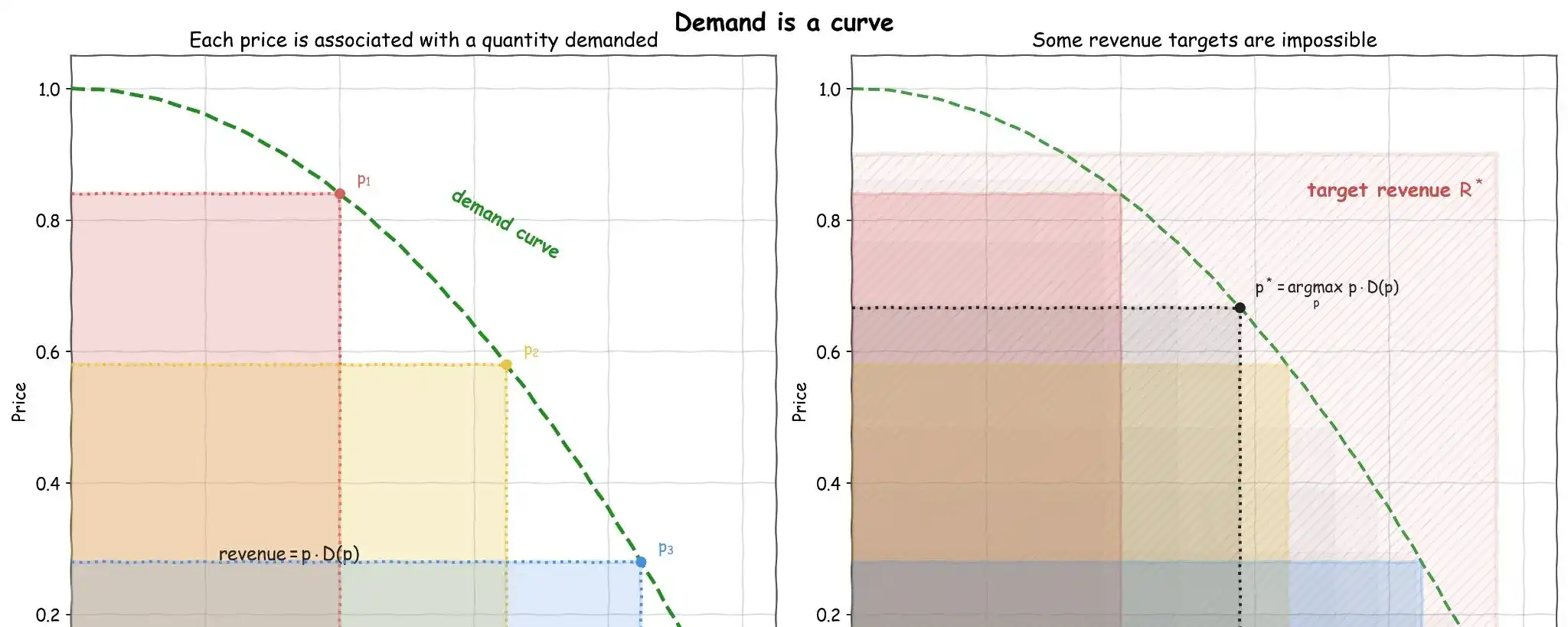
Therefore, a flat fee is a rather blunt instrument for generating revenue. Different types of on-chain transactions have different willingness to pay.

A small wallet transfer, a large stablecoin transfer, and a liquidation may consume the same block space, but they generate different total surplus and have different willingness to pay.
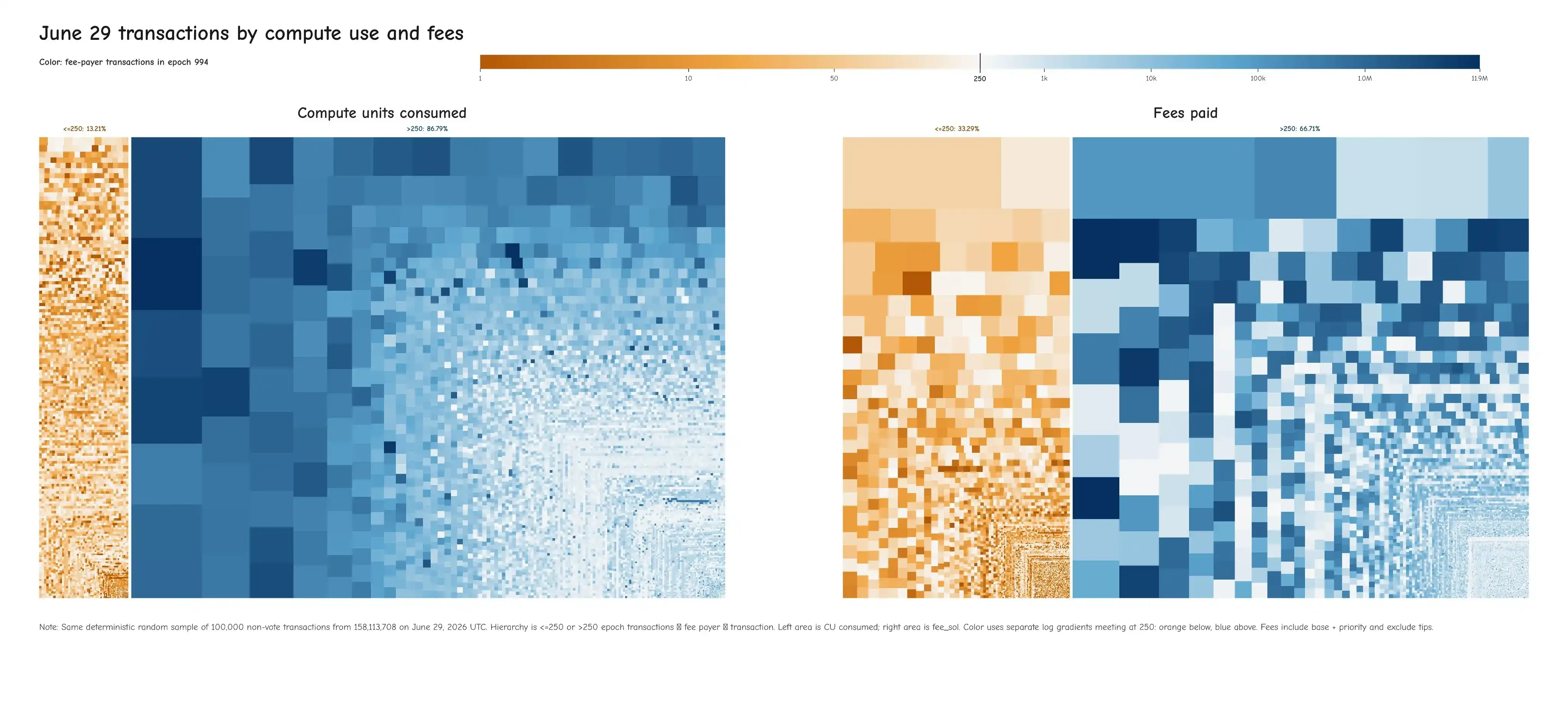
Note: Blue dots represent fee payers who initiated more than 250 transactions in the period, suggesting they are more likely to be bots and thus have higher price elasticity. Bots typically have thin profit margins, so they tend to reduce resource consumption significantly when prices rise.

Protocols want to charge higher fees for transactions with a higher willingness to pay. Computation-based fees are a step in this direction but not thorough enough.

For financial activity, the nominal transaction amount is often a better indicator of willingness to pay than computational load. This is why exchanges typically charge fees based on basis points.

Token programs can provide a way to charge fees proportional to transaction value. By modifying token programs, a small percentage-based fee can be levied on token transfers. This way, even if a high-value transfer uses similar computational resources as a low-value one, the high-value transfer still pays more.


Tiền kỹ thuật số thịnh hành

Câu hỏi Liên quan

QAccording to the article, what are the two primary ways that value can be aggregated to L1 token holders, and how do they differ economically from staking rewards funded by inflation?

AAccording to the article, value can be aggregated to L1 token holders in two primary ways: 1) Burning fees, which is economically equivalent to a share buyback, and 2) Distributing fees to stakers, which is economically equivalent to paying a dividend. These differ from staking rewards funded by inflation, which are neither network income nor a real external cost. They represent a redistribution from non-stakers to stakers through dilution, not the creation of value for token holders as a whole.

QWhat is the key difference between 'high-quality' fees and lower-quality fees for an L1 blockchain, as discussed in the article?

AThe key difference lies in the sustainability and defensibility of the fees. High-quality fees are recurring and repeatable, stemming from persistent demand for scarce block space due to long-term economic utility. Lower-quality fees are temporary and non-recurring, often generated by speculative activities like airdrop farming, memecoin frenzies, liquidations, or temporary network congestion that can disappear when incentives fade or volatility subsides.

QIn the author's proposed 'standard model' for L1 accounting, how should inflationary staking rewards and new token issuance be treated, and why?

AIn the author's proposed standard model, inflationary staking rewards should not be treated as a network cost, and newly issued tokens should not be treated as network income. This is because, from the perspective of all token holders, they are offsetting internal transfers—the dilution from new issuance is the 'cost' paid by holders to fund the staking rewards. Treating them as a cost without a corresponding income entry would incorrectly suggest the network is unprofitable.

QWhat caution does the article offer regarding the strategy of increasing protocol fees to raise revenue, and what economic concept is central to this caution?

AThe article cautions that increasing protocol fees does not automatically lead to higher revenue because revenue equals price multiplied by quantity. Raising fees can reduce the quantity of transactions. The central economic concept is the price elasticity of demand. If demand is elastic, a fee increase will lead to a proportionally larger drop in transactions, reducing total revenue. The article cites research suggesting Ethereum gas demand has a price elasticity between 0.6 and 0.8, meaning it is somewhat elastic.

QWhat is the proposed alternative to a uniform fee structure that the author suggests could better capture value from high-willingness-to-pay transactions?

AThe author suggests that a more effective alternative to a uniform fee structure would be to implement fees based on the nominal transaction value, similar to how exchanges charge basis points. This could be done by modifying token programs to levy a small proportional fee on token transfers. This way, a high-value transfer pays more than a low-value transfer even if they consume similar computational resources, better capturing value from transactions with a higher willingness to pay.

Nội dung Liên quan

Nhà đầu tư bắt đầu “thay bàn chơi”

Một bước ngoặt mới đang diễn ra trong giới đầu tư mạo hiểm (VC) Trung Quốc: nhiều nhà đầu tư chuyển hướng sang làm việc trực tiếp tại các doanh nghiệp công nghệ. Bối cảnh thị trường vốn đầu tư mạo hiểm sôi động, đặc biệt ở các lĩnh vực công nghệ cốt lõi như AI và robotics, với nhu cầu gọi vốn tăng mạnh. Tuy nhiên, sự cạnh tranh khốc liệt giữa các quỹ, những thay đổi trong quy định và rủi ro từ chênh lệch định giá khi phát hành cổ phiếu lần đầu (IPO) khiến nhiều nhà đầu tư cân nhắc lại con đường sự nghiệp. Khác với những đợt chuyển dịch trước đây do áp lực, lần này là sự lựa chọn chủ động. Các nhà đầu tư kỳ cựu, bao gồm cả đối tác quỹ, đang được các công ty công nghệ hàng đầu săn đón cho các vị trí quan trọng như Phó Chủ tịch, Giám đốc Điều hành, thậm chí là Đồng sáng lập, với mức đãi ngộ hấp dẫn. Ngược lại, các doanh nghiệp đang trong giai đoắc gọi vốn nhanh và lớn cần những chuyên gia am hiểu thị trường vốn để quản lý quá trình này. Đây được xem là cuộc "chuyển bến" hai chiều. Các doanh nghiệp tiếp cận được nguồn nhân lực chất lượng cao, trong khi các nhà đầu tư tìm thấy cơ hội mới trực tiếp tham gia vào hoạt động sản xuất kinh doanh, thoát khỏi áp lực cạnh tranh và bất định trong môi trường quỹ. Tuy nhiên, sự chuyển đổi này cũng đi kèm thách thức về việc thích ứng với văn hóa doanh nghiệp và tư duy vận hành khác biệt. Dù vậy, xu hướng này cho thấy ranh giới nghề nghiệp của nhà đầu tư đang được mở rộng, phản ánh sự biến chuyển năng động của hệ sinh thái khởi nghiệp và đầu tư.

marsbit1 giờ trước

Nhà đầu tư bắt đầu “thay bàn chơi”

marsbit1 giờ trước

Giao dịch

Giao ngay

Bài viết Nổi bật

SOLANA là gì

```html HarryPotterWifHatMyroWynn10Inu,$solana: Một cái nhìn sâu sắc về Dự án Coin Meme Thịnh hành Giới thiệu Trong bối cảnh không ngừng phát triển của tiền điện tử, các dự án sáng tạo liên tục xuất hiện, thu hút trí tưởng tượng của các nhà đầu tư và những người đam mê. Một trong những dự án như vậy là HarryPotterWifHatMyroWynn10Inu,$solana, một coin meme đã bắt đầu khẳng định chỗ đứng của mình trong cộng đồng crypto. Bài viết này nhằm cung cấp cho bạn cái nhìn tổng quan về dự án, làm sáng tỏ mục đích, cấu trúc, người sáng lập, các nhà đầu tư và những cột mốc đáng chú ý trong hành trình. HarryPotterWifHatMyroWynn10Inu,$solana là gì? Tổng quan HarryPotterWifHatMyroWynn10Inu,$solana là một dự án coin meme được cấu trúc trên blockchain Solana – một nền tảng nổi tiếng với khả năng mở rộng và tốc độ. Nhằm mang lại niềm vui và sự sáng tạo vào không gian crypto, dự án này không chỉ đóng vai trò như một token thương mại mà còn là chất xúc tác cho việc tạo ra và chia sẻ nội dung meme. Cộng đồng là tâm điểm của nó được khuyến khích tham gia tích cực, tạo ra một hệ sinh thái năng động nơi sáng tạo và hợp tác phát triển. Mục tiêu và Định hướng Về bản chất, dự án nhằm thúc đẩy một môi trường nơi những người đam mê meme có thể tụ tập, chia sẻ và tạo ra nội dung meme mới. Cách tiếp cận dựa trên câu chuyện này thổi hồn sự phấn khích vào cộng đồng, thúc đẩy sự tham gia đồng thời làm nổi bật các chức năng mạnh mẽ vốn có của blockchain Solana. Bằng cách xây dựng một dự án tập trung vào cộng đồng, HarryPotterWifHatMyroWynn10Inu,$solana cũng muốn khám phá tác động xã hội của tiền tệ kỹ thuật số như một phương tiện biểu đạt. Ai là người sáng lập HarryPotterWifHatMyroWynn10Inu,$solana? Danh tính của người sáng lập đứng sau HarryPotterWifHatMyroWynn10Inu,$solana vẫn chưa được tiết lộ. Dự án đã được cấu trúc theo cách mà quyền sở hữu đã được từ bỏ; do đó, nó phát triển như một sáng kiến do cộng đồng dẫn dắt. Sự phi tập trung này thúc đẩy tính minh bạch và sự tham gia dân chủ giữa tất cả các bên liên quan. Cách tiếp cận này ngày càng phổ biến trong thế giới coin meme, nơi sự tương tác của cộng đồng đóng vai trò chủ đạo. Ai là các nhà đầu tư của HarryPotterWifHatMyroWynn10Inu,$solana? Tính đến thời điểm hiện tại, không có thông tin công khai nào về các nhà đầu tư hoặc quỹ cụ thể nào hỗ trợ HarryPotterWifHatMyroWynn10Inu,$solana. Việc thiếu nhà đầu tư nổi tiếng càng nhấn mạnh bản chất tập trung vào cộng đồng của dự án, vì nó đứng độc lập khỏi các khung tài chính truyền thống. Sự độc lập này cho phép dự án phát triển bản sắc của mình mà không chịu áp lực từ bên ngoài, mà thay vào đó dựa vào sự quan tâm tập thể từ cơ sở người dùng. HarryPotterWifHatMyroWynn10Inu,$solana hoạt động như thế nào? Mô hình kinh tế Dự án áp dụng một mô hình kinh tế độc đáo, nền tảng cho chức năng và sự tham gia của người dùng. Các giao dịch trong HarryPotterWifHatMyroWynn10Inu,$solana được thiết kế để mang lại lợi ích cho tất cả các bên liên quan. Mỗi giao dịch sẽ phát sinh một khoản phí, sau đó được phân phối lại cho các chủ sở hữu hiện tại trong khi đồng thời gia tăng quỹ thanh khoản. Các thành phần chính của mô hình này bao gồm: Cơ chế phản chiếu: Một phần phí giao dịch được trả lại cho các chủ sở hữu, khuyến khích đầu tư lâu dài vào token. Gia tăng quỹ thanh khoản: Quỹ được phân bổ để tăng cường thanh khoản, đảm bảo rằng các hoạt động mua và bán có thể được thực hiện một cách suôn sẻ. Cơ chế đốt: Một phần token có thể được đốt để tạo ra sự khan hiếm, tiềm năng làm tăng giá trị khi nhu cầu tăng lên. Thiết kế này khuyến khích một hệ sinh thái tự duy trì, phát triển dựa trên sự tương tác và đầu tư của cộng đồng. Tham gia của cộng đồng Tại trung tâm của HarryPotterWifHatMyroWynn10Inu,$solana là giá trị gắn liền với sự tham gia của cộng đồng. Bằng cách cho phép người dùng tham gia vào sự phát triển của dự án thông qua các hoạt động khác nhau, như tạo meme và quảng bá, dự án thúc đẩy một hệ sinh thái sống động nơi sáng tạo có thể nở rộ. Thời gian của HarryPotterWifHatMyroWynn10Inu,$solana Quá trình phát triển của HarryPotterWifHatMyroWynn10Inu,$solana có nhiều sự kiện đáng chú ý đã định hình vị thế hiện tại của nó trong cộng đồng crypto: Sự ra đời: Ngày ra đời cụ thể chưa được công bố, nhưng sự khởi đầu của dự án gắn liền với văn hóa meme thấm nhuần trong thời đại kỹ thuật số. Thay quyền điều hành cộng đồng: Sau khi quyền sở hữu được từ bỏ bởi người sáng lập, dự án đã chuyển sang mô hình do cộng đồng dẫn dắt, cho phép tất cả những người tham gia có cổ phần trong sự thành công của nó. Kiểm toán và bộ sưu tập NFT: Nhằm tăng cường tính đáng tin cậy, dự án đã hoàn thành một cuộc kiểm toán kỹ lưỡng, đồng thời ra mắt một bộ sưu tập NFT nhằm thể hiện tinh thần tập trung vào meme của nó. Đối tác và phát triển: Dự án hiện đang trong quá trình tìm kiếm các đối tác tiềm năng với các token khác và tổ chức phát triển một trang web độc đáo cùng các phương án hàng hóa dựa trên các meme huyền thoại của nó. Những điểm chính Tóm lại, HarryPotterWifHatMyroWynn10Inu,$solana đứng vững như một nhân tố đáng chú ý trong lĩnh vực coin meme của tiền điện tử. Dưới đây là một số điểm chính: Sáng kiến do cộng đồng dẫn dắt: Dự án phát triển như một nỗ lực hợp tác, khuyến khích các đóng góp tích cực từ các thành viên cộng đồng trong khi tách biệt khỏi các yêu cầu sở hữu. Mô hình kinh tế sáng tạo: Sử dụng cơ chế phản chiếu, tăng cường thanh khoản và đốt token, nó tạo ra một môi trường tài chính vững mạnh và hấp dẫn cho người dùng. Tham gia NFT và hàng hóa: Với việc ra mắt một bộ sưu tập NFT, dự án mong muốn tăng cường sự tương tác trong cộng đồng của mình, củng cố mối liên kết giữa văn hóa meme và tiền điện tử. Khám phá các đối tác: Sáng kiến này không ngừng phát triển – việc phát triển và tìm kiếm các đối tác tiềm năng cho thấy một cách tiếp cận hướng tới tương lai nhằm duy trì tăng trưởng. Kết luận Khi HarryPotterWifHatMyroWynn10Inu,$solana tiếp tục thu hút sự chú ý trong cảnh quan tiền điện tử, sự kết hợp độc đáo giữa sự tham gia của cộng đồng, cấu trúc kinh tế sáng tạo và sự hội nhập của văn hóa meme đã vạch ra con đường tiềm năng phía trước. Ngay cả với sự bí ẩn bao quanh sự khởi đầu và các mối liên kết với nhà đầu tư, dự án vẫn mang đến một câu chuyện thú vị, phản ánh bản chất của đổi mới phi tập trung. Trong một thế giới mà tiền điện tử thường bị nhìn nhận qua lăng kính tài chính, HarryPotterWifHatMyroWynn10Inu,$solana chứng minh rằng phong trào crypto cũng bao hàm sáng tạo, cộng đồng và hợp tác. Dù bạn là một nhà đầu tư dày dạn hay một người mới, hành trình đang mở ra của dự án coin meme này chắc chắn là một nghiên cứu tình huống hấp dẫn đáng để chú ý. ```

Tổng lượt xem 895Xuất bản vào 2024.04.04Cập nhật vào 2024.12.03

SOLANA là gì

SOLANA 2.0 là gì

BarbieCrashBandicootRFK777Inu, $SOLANA 2.0: Một Người Chơi Mới Trong Cảnh Quan Crypto Giới thiệu về BarbieCrashBandicootRFK777Inu, $SOLANA 2.0 Trong cảnh quan tiền điện tử luôn biến đổi, những người mới tham gia liên tục thu hút sự chú ý của các nhà đầu tư và những người đam mê. Trong số những dự án mới nổi này là BarbieCrashBandicootRFK777Inu, được đại diện bởi biểu tượng tiền điện tử $SOLANA 2.0. Sáng kiến độc đáo này kết hợp các yếu tố của sự quyến rũ, phiêu lưu, và văn hóa meme, với mục tiêu vượt qua kỳ vọng trong một lĩnh vực cạnh tranh khốc liệt. Với kỳ vọng về sự phát triển và đổi mới, dự án này nắm bắt tinh thần của một kẻ yếu thế đang chiến đấu chống lại những gã khổng lồ đã được thiết lập. BarbieCrashBandicootRFK777Inu, $SOLANA 2.0 là gì? Tại cốt lõi, BarbieCrashBandicootRFK777Inu là một dự án tiền điện tử được lấy cảm hứng từ nhiều tài liệu văn hóa mang tính biểu tượng khác nhau. Bao gồm sự thanh lịch và quyến rũ liên quan đến Barbie, năng lượng năng động của Crash Bandicoot, và động lực không ngừng nghỉ đại diện bởi RFK, dự án nhằm cung cấp một trải nghiệm đa chiều trong thế giới tiền điện tử. Mục tiêu chính của dự án BarbieCrashBandicootRFK777Inu là kết hợp những yếu tố khác nhau này thành một hệ sinh thái thống nhất hấp dẫn đối với một đối tượng rộng lớn. Bằng cách chấp nhận tính kỳ quặc của văn hóa meme trong khi vẫn giữ nguyên các nguyên tắc của sự phân cấp và quyền lực tài chính, dự án đã tự định vị mình như một lựa chọn hấp dẫn cho cả những nhà đầu tư dày dạn kinh nghiệm và những người mới tham gia vào thế giới crypto. Ai là người sáng tạo ra BarbieCrashBandicootRFK777Inu, $SOLANA 2.0? Mặc dù sự quan tâm ngày càng tăng đối với BarbieCrashBandicootRFK777Inu, thông tin liên quan đến người sáng tạo của nó vẫn chủ yếu không rõ ràng. Sự ẩn danh của người sáng lập hoặc nhóm phát triển đặt ra nhiều câu hỏi về cấu trúc và quản trị của dự án. Trong thế giới tiền điện tử, không phải hiếm khi các dự án hoạt động mà không có những người sáng tạo công khai. Việc thiếu thông tin này có thể làm nản lòng một số nhà đầu tư tiềm năng, trong khi những người khác có thể xem đó như một cơ hội để chấp nhận tinh thần phân cấp mà nhiều sáng kiến tiền điện tử dựa vào. Ai là các nhà đầu tư của BarbieCrashBandicootRFK777Inu, $SOLANA 2.0? Tính đến thời điểm hiện tại, có rất ít thông tin về nền tảng đầu tư hoặc các tổ chức hỗ trợ BarbieCrashBandicootRFK777Inu. Việc thiếu thông tin chi tiết về đầu tư của dự án làm nổi bật tính độc lập của nhiều loại tiền điện tử. Trong trường hợp này, vẫn chưa rõ nguồn tài trợ cho dự án sẽ đến từ sự hỗ trợ cộng đồng grassroots hay là sự ủng hộ từ các thực thể tài chính lớn hơn. BarbieCrashBandicootRFK777Inu, $SOLANA 2.0 hoạt động như thế nào? BarbieCrashBandicootRFK777Inu được thiết kế với nhiều tính năng góp phần vào sự độc đáo của nó trong không gian tiền điện tử đông đúc. Trong khi các chi tiết kỹ thuật cụ thể vẫn được giữ kín, dự án được kỳ vọng sẽ bao gồm các chức năng nhằm nâng cao sự tương tác của người dùng và thúc đẩy sự phát triển cộng đồng. Sự kết hợp của nhiều ảnh hưởng — từ thời trang và phiêu lưu đến trò chơi — khuyến khích một bầu không khí bao trùm, phục vụ cho các sở thích đa dạng. Ngoài ra, mối liên hệ của dự án với hệ sinh thái $SOLANA 2.0 gợi ý về những lợi thế công nghệ tiềm năng. Điều này có thể bao gồm tốc độ giao dịch đổi mới, khả năng mở rộng và tính hiệu quả về chi phí, phù hợp với khả năng kỹ thuật của blockchain Solana. Những người sáng lập dự án dường như đang dựa vào nền tảng công nghệ này để tạo ra một trải nghiệm cộng đồng bền vững và một sản phẩm đáng kể. Dòng thời gian của BarbieCrashBandicootRFK777Inu, $SOLANA 2.0 Hành trình của BarbieCrashBandicootRFK777Inu chứa nhiều mốc quan trọng, cung cấp cái nhìn về quá trình phát triển của dự án cho đến nay: Khái niệm Dự án: Những ý tưởng ban đầu đã xuất hiện xoay quanh việc kết hợp vẻ đẹp, phiêu lưu và văn hóa meme, tạo ra khung cho khái niệm độc đáo của dự án. Tạo Token: Token biểu tượng $SOLANA 2.0 đã được thiết lập, được thiết kế để thể hiện những kỳ vọng của dự án và thu hút sự chú ý từ các nhà đầu tư tiềm năng. Phát triển Dự án: Hiện tại, dự án đang trong quá trình phát triển thêm, với sự nhấn mạnh vào việc thách thức các người chơi đã được thiết lập trong không gian tiền điện tử và cung cấp các sản phẩm đổi mới. Những cột mốc này phản ánh quỹ đạo phát triển của dự án trong khi nhấn mạnh cam kết của nó trong việc phát triển một trải nghiệm cryptocurrency tiên phong. Những điểm chính về BarbieCrashBandicootRFK777Inu, $SOLANA 2.

Tổng lượt xem 298Xuất bản vào 2024.04.05Cập nhật vào 2024.12.03

SOLANA 2.0 là gì

Làm thế nào để Mua SOL

Chào mừng bạn đến với HTX.com! Chúng tôi đã làm cho mua Solana (SOL) trở nên đơn giản và thuận tiện. Làm theo hướng dẫn từng bước của chúng tôi để bắt đầu hành trình tiền kỹ thuật số của bạn.Bước 1: Tạo Tài khoản HTX của BạnSử dụng email hoặc số điện thoại của bạn để đăng ký tài khoản miễn phí trên HTX. Trải nghiệm hành trình đăng ký không rắc rối và mở khóa tất cả tính năng. Nhận Tài khoản của tôiBước 2: Truy cập Mua Crypto và Chọn Phương thức Thanh toán của BạnThẻ Tín dụng/Ghi nợ: Sử dụng Visa hoặc Mastercard của bạn để mua Solana (SOL) ngay lập tức.Số dư: Sử dụng tiền từ số dư tài khoản HTX của bạn để giao dịch liền mạch.Bên thứ ba: Chúng tôi đã thêm những phương thức thanh toán phổ biến như Google Pay và Apple Pay để nâng cao sự tiện lợi.P2P: Giao dịch trực tiếp với người dùng khác trên HTX.Thị trường mua bán phi tập trung (OTC): Chúng tôi cung cấp những dịch vụ được thiết kế riêng và tỷ giá hối đoái cạnh tranh cho nhà giao dịch.Bước 3: Lưu trữ Solana (SOL) của BạnSau khi mua Solana (SOL), lưu trữ trong tài khoản HTX của bạn. Ngoài ra, bạn có thể gửi đi nơi khác qua chuyển khoản blockchain hoặc sử dụng để giao dịch những tiền kỹ thuật số khác.Bước 4: Giao dịch Solana (SOL)Giao dịch Solana (SOL) dễ dàng trên thị trường giao ngay của HTX. Chỉ cần truy cập vào tài khoản của bạn, chọn cặp giao dịch, thực hiện giao dịch và theo dõi trong thời gian thực. Chúng tôi cung cấp trải nghiệm thân thiện với người dùng cho cả người mới bắt đầu và người giao dịch dày dạn kinh nghiệm.

Tổng lượt xem 1.9kXuất bản vào 2024.12.12Cập nhật vào 2026.06.02

Làm thế nào để Mua SOL

Thảo luận

Chào mừng đến với Cộng đồng HTX. Tại đây, bạn có thể được thông báo về những phát triển nền tảng mới nhất và có quyền truy cập vào thông tin chuyên sâu về thị trường. Ý kiến ​​của người dùng về giá của SOL (SOL) được trình bày dưới đây.

活动图片