Can Generative Models Finally Be Trained End-to-End? The Core Is a For Loop

marsbitXuất bản vào 2026-08-03Cập nhật gần nhất vào 2026-08-03

Tóm tắt

This article introduces a novel training paradigm for generative models called Explorative Modeling (XM), which enables true end-to-end training. Traditionally, powerful generative models like autoregressive and diffusion models are not trained end-to-end. They are trained to predict a single small step but require iterative multi-step sampling for inference. This "exposure bias" leads to error accumulation and limits performance. The core challenge XM addresses is "mode blurring." In generative tasks, a single input (e.g., "generate a dog") corresponds to many valid outputs (multiple modes). Standard training objectives like reconstruction loss force the model to average these modes, producing unrealistic, blurry outputs. To avoid this, existing models break generation into many small, almost deterministic steps, sacrificing end-to-end training. XM tackles this by restructuring the training loop itself. Its key insight is to amplify "generative expressivity." For each training input, instead of generating one sample, the model generates K candidate outputs. Only the candidate closest to the real data is used for computing the loss and updating the model via backpropagation. This simple "best-of-K" mechanism is implemented as a short for-loop. By exploring multiple possibilities, the model learns to distribute its guesses across different modes rather than collapsing to their uninformative average. The paper demonstrates that "exploration" acts as a new, powerful scaling a...

In 2012, AlexNet decisively ended an era with an overwhelming victory. Before that, image recognition relied on manually designed, multi-stage feature extraction pipelines. AlexNet proved something that would be repeatedly validated later: handing the entire task to the model to learn end-to-end almost always outperforms human-designed, staged workflows.

From image classification to object detection to image segmentation, behind every leap in deep learning was the same mantra: let it learn everything in one go.

There has been only one consistent exception: generative models.

Today's strongest, most scalable generative models (whether autoregressive or diffusion models) are not end-to-end.

During training, they only learn to predict "one small step," but during inference, they have to recurrently unfold this step hundreds or thousands of times.

The sampling methods used for training and inference are not the same. This discrepancy leads to an old problem: errors from one step are fed into the next, the input gradually drifts away from the distribution seen during training, and errors accumulate layer by layer. Academically, this is called "exposure bias."

In other words, the core tenet of deep learning—"end-to-end is better"—has for over a decade failed to fully materialize in generative modeling.

Recently, however, a paper from UIUC and Harvard University attempts to complete this final piece of the puzzle.
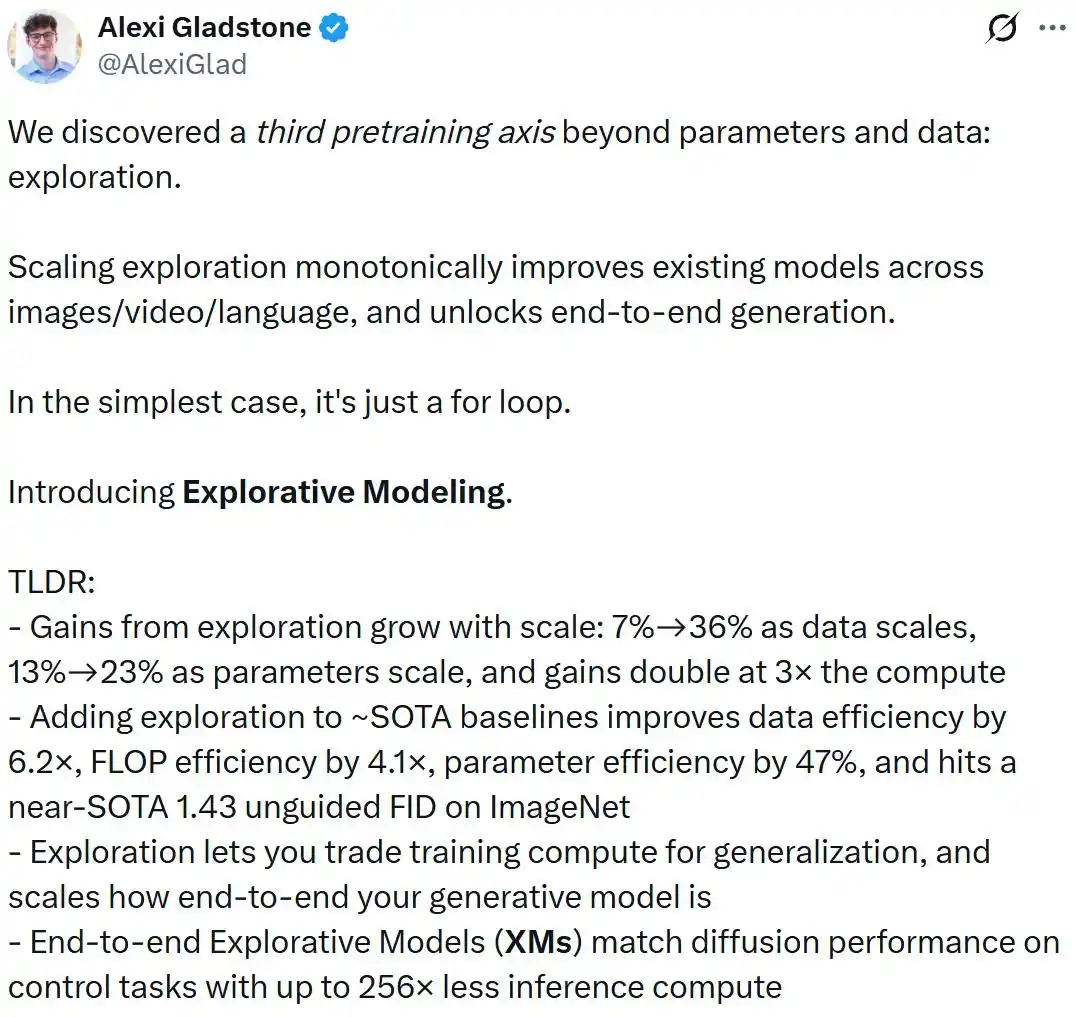
The authors named this new paradigm Explorative Modeling, abbreviated as XM. Its idea is so simple it borders on naive, yet points to a bold conclusion: Beyond parameters and data, generative models actually have a third axis that can be scaled.
Project Website: https://explorative-modeling.github.io

Paper: https://arxiv.org/abs/2607.27372

Code Repository: https://github.com/alexiglad/XM

The Root Problem: Models Only Know How to "Take the Average"

To understand what this paper solves, one must first understand why generation is hard.

In ordinary supervised learning (e.g., classification), each input essentially has only one correct answer; the model learns a deterministic mapping.

But generation is different. When you ask a model to "generate a dog," there can be infinitely many correct answers. These valid outputs are the many modes (i.e., distinct peaks) within the data distribution. Generation is difficult precisely because it must capture all these modes simultaneously.

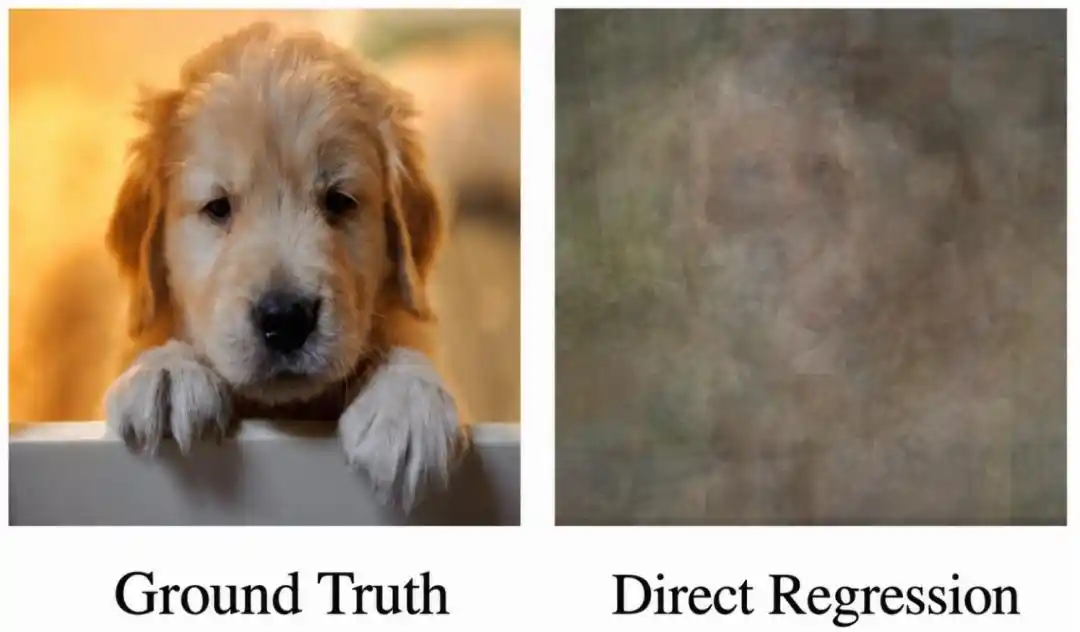
The trouble is, mainstream generative models are trained with reconstruction losses (e.g., squared error). When an input is paired with many different valid targets at random, the optimal solution for a reconstruction loss is the average of those targets. For most real-world data, this average does not lie on the data manifold but falls between modes, resembling none of them.

A figure in the paper illustrates this clearly: when asked to regress directly end-to-end without any tricks, three clusters of points would be predicted as a single point in the middle, a photo of a dog would blur into a smudge, and a sentence would degenerate into endless repetitions of "the." This is "mode blurring," where the optimal solution is precisely the answer least resembling real data.
How do existing models circumvent this? By breaking the "generation" process into tiny pieces. Autoregressive models predict only one element at a time; diffusion models remove a little noise at each step. Each small-step target is sliced until it contains essentially a single mode, preventing the reconstruction loss from averaging.

This strategy of "splitting the generative process" is precisely why diffusion and autoregressive models can produce high-quality samples, but it is also why they cannot be end-to-end.

The authors thus pose a crucial question: A generative model has only two things that can be broken down—how it generates and how it trains.

Since breaking the generation process destroys end-to-end capability, why not break the training instead?
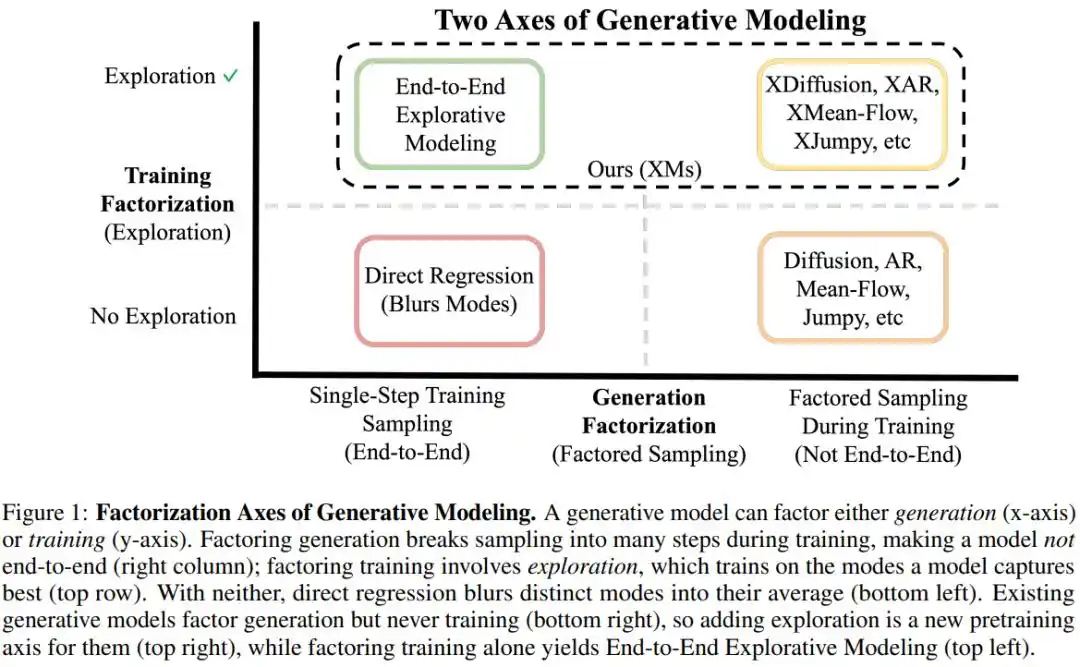
A For Loop: The Entire Essence of Explorative Modeling

Explorative Modeling breaks down the training loop itself.

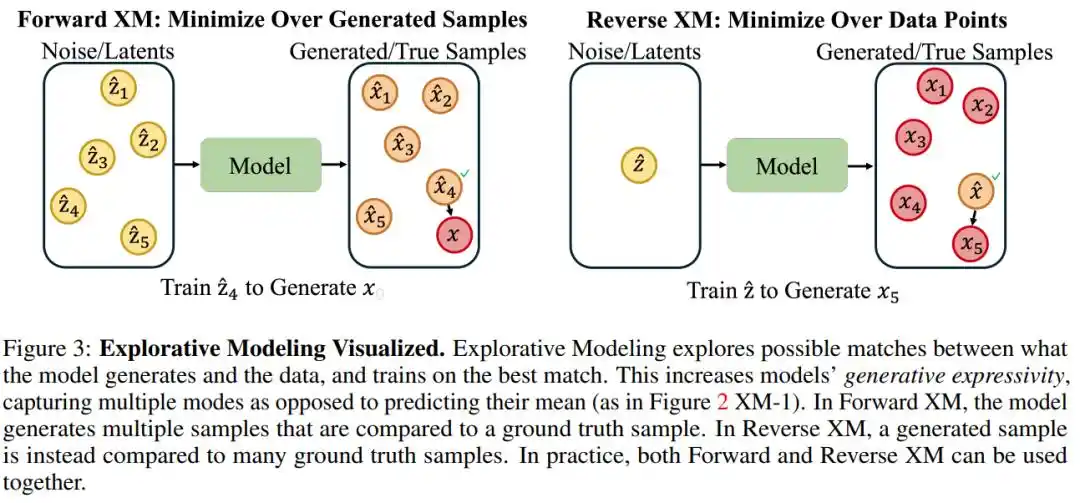
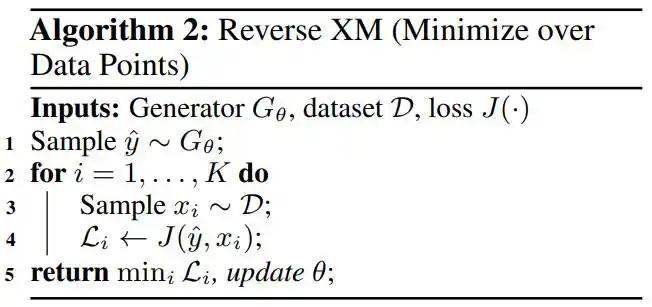
Its mechanism can be stated in one sentence: In each training step, instead of generating one sample to fit the target, the model generates K candidates and then selects only the one closest to the real data for training and gradient backpropagation. The paper implements this as a 3-5 line for loop, so simple it's almost suspicious (Algorithm 1).
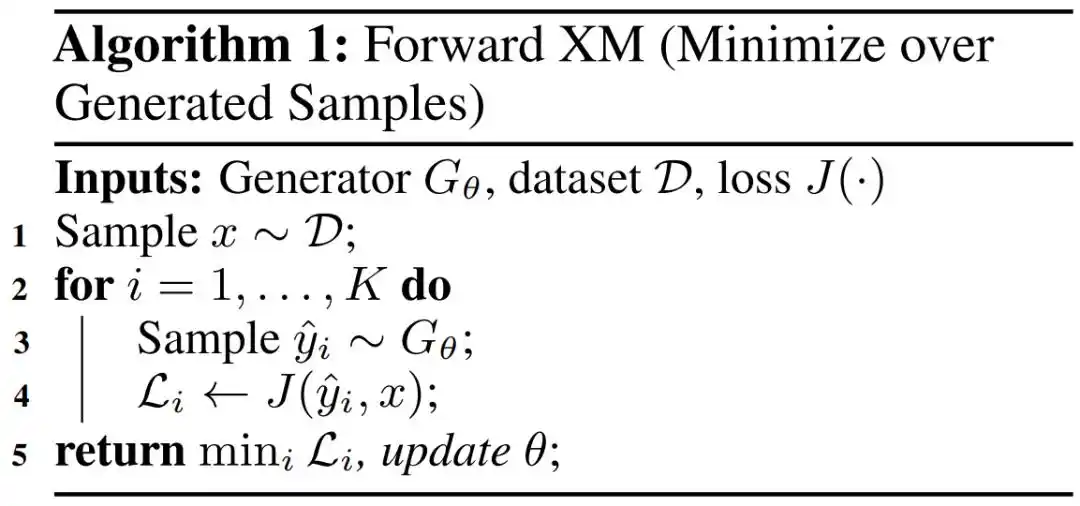
Why does this solve mode blurring?

Think of a real-life analogy: guessing dart landing positions. If you are only allowed one guess, your optimal strategy is to guess the average position of all darts—but that's often a spot on the board where few darts actually land. However, if you are allowed K guesses and are scored only on your closest guess, the optimal strategy immediately changes: you would spread your guesses, letting each cover a different cluster of landing points.
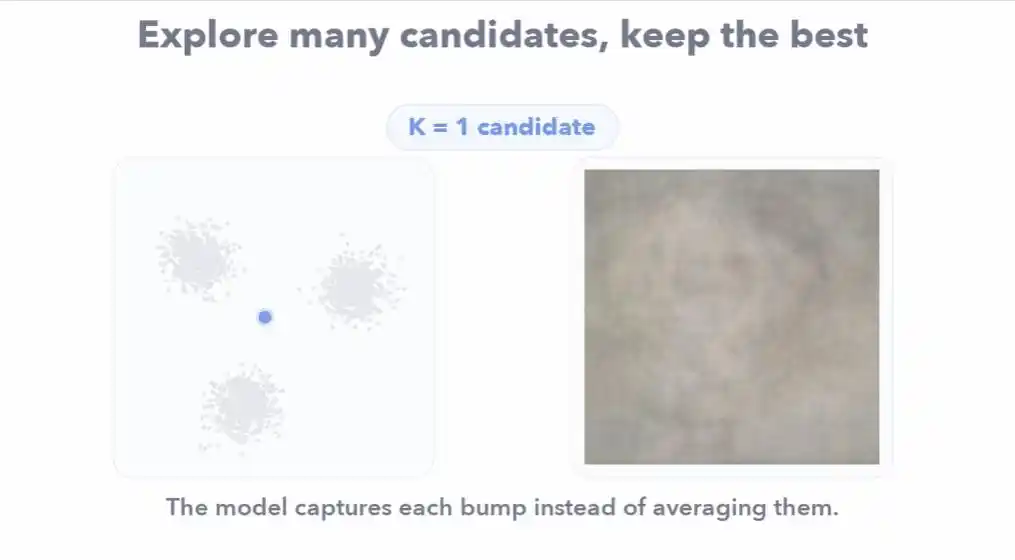
The model behaves similarly. When allowed to explore K candidates, different input noises will "claim" different modes, instead of all crowding towards the middle to take the average. The number of explorations directly determines how many modes the model can stably capture.
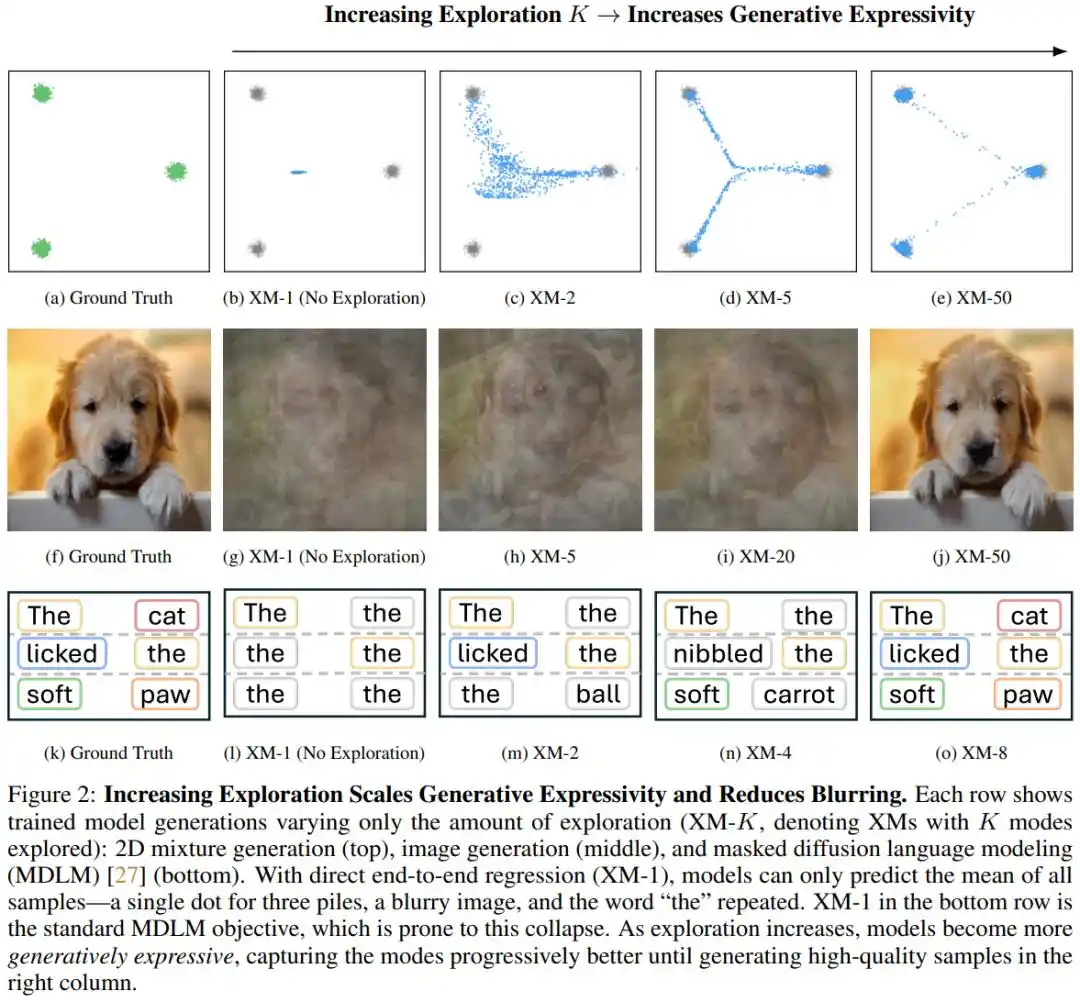
The authors name this long-overlooked capability "generative expressivity," noting that it is determined by the training objective itself—no matter how much you scale parameters and data, it won't increase on its own.

This also explains a phenomenon long observed in the field: why today's best models are so reliant on "guidance" techniques.

Classifier-free guidance essentially "pushes" the prediction away from that blurry average. But if the model itself weren't blurry, why push it? The usefulness of guidance stems precisely from the lingering disease of mode blurring.

The paper also introduces Forward and Reverse exploration directions. Forward fixes a real target and searches among its own generations for the closest one, favoring "recall" (covering all modes). Reverse fixes a generation and searches among real data for the closest one, favoring "precision," and incurs almost no additional computational cost, at the risk of collapsing to a few modes. The two are complementary and can be used in combination.
The Third Axis: Greater Gains as You Scale

The most substantial conclusion of this paper is that it validates "exploration" as a genuine scaling axis.

The authors applied exploration to diffusion/flow models, Jumpy models, and even masked diffusion language models, observing consistent, monotonic performance improvements across image, video, and language modalities. More importantly, the trend of gains with scale: the bigger you go, the greater the benefit.

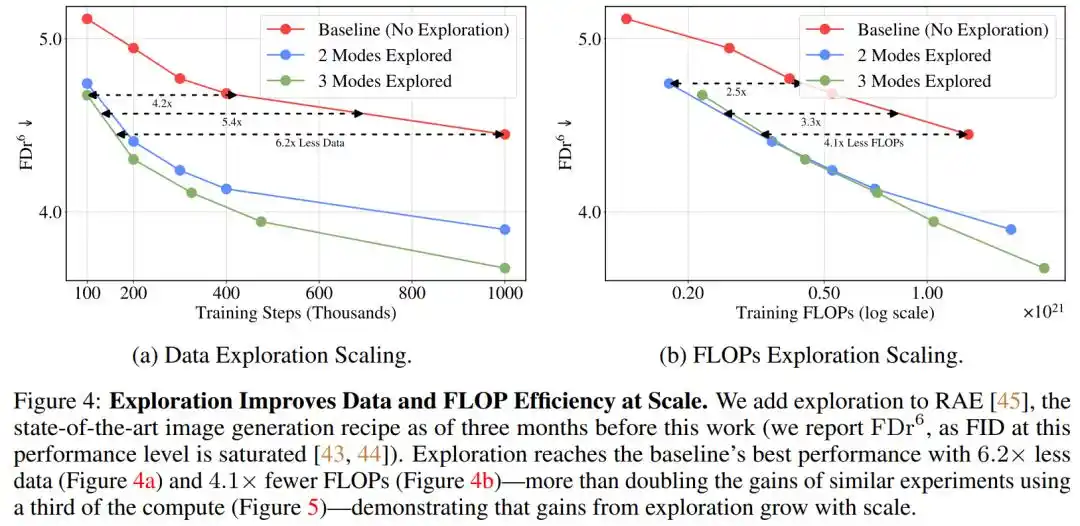
The numbers reported in the paper show: as data scale increases, gains from exploration rise from 7% to 36%; as model size grows, from 13% to 23%; when compute is tripled, efficiency gains more than double.

Specifically in efficiency, exploration improved FLOP efficiency by 4.1x, sample efficiency by 6.2x, and parameter efficiency by 47%. In image generation, it pushed the current strongest RAE formulation to an unguided FID of 1.43 on ImageNet, nearing the state-of-the-art.
A Large model exploring 5 modes can even outperform an XLarge model with 47% more parameters but no exploration.
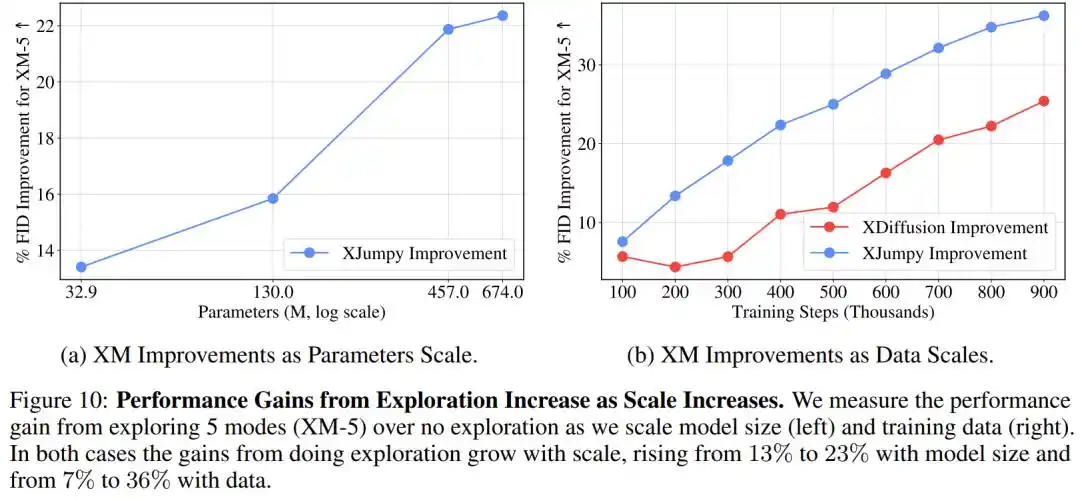
The implications of this trend are significant. The authors explain: at small scale, models are primarily bottlenecked by parameters and data; generative expressivity isn't the limiting factor yet. But once parameters and data are scaled to the point where they are "no longer the limit," generative expressivity increasingly becomes the real bottleneck. And that is exactly what exploration directly scales.

Considering that true foundation model training today uses roughly four orders of magnitude more compute than the largest experiment in this paper, the authors believe the reported numbers likely represent only a lower bound for the gains at larger scales.

Truly End-to-End Generation

If exploration is pushed to the extreme, what happens? The answer circles back to the opening suspense: Generative models can finally be end-to-end.

The authors used XM as a standalone end-to-end model for robot control tasks. In Behavior Cloning, their Explorative Policy matched or even surpassed Diffusion Policy (which requires 100 forward passes) using only a single network forward pass. In goal-directed world modeling, the Explorative World Model achieved better average performance than Diffuser, using 16 to 256 times less inference compute.
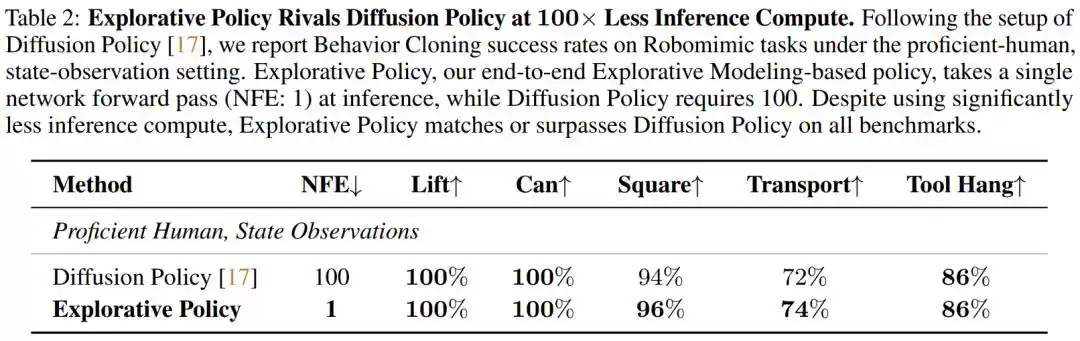
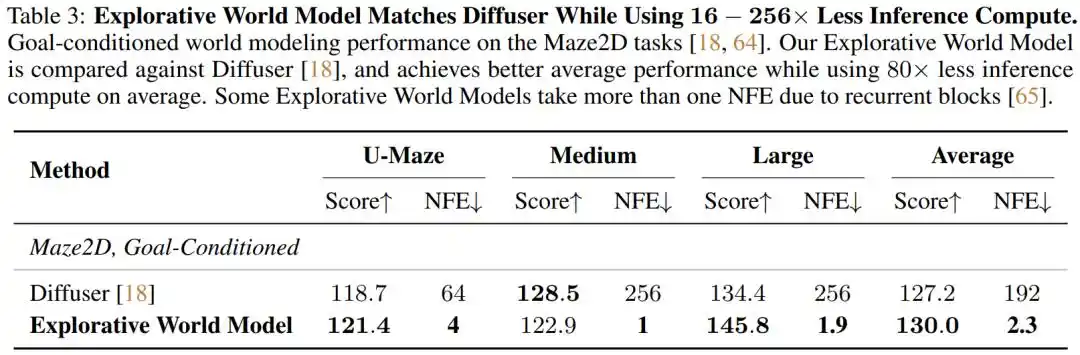
The source of this gap is clear: diffusion models trade hundreds of inference steps for expressivity, while end-to-end XM shifts this cost to exploration during training, allowing inference with just one forward pass. "Handling multi-modality"—the same thing—can be done either by breaking it down slowly during inference or by exploring it thoroughly once during training; this paper chooses the latter.

About the Authors

The first author of this paper, Alexi Gladstone, is not a newcomer. As recently as July 2025, his work on Energy-Based Transformers (EBT) sparked considerable discussion on social platforms.

That work claimed to "beat" the scaling curve of standard feedforward Transformers on multiple dimensions for the first time and attempted to generalize "System 2 thinking" to arbitrary modes. See the Machine Heart report: "New Paradigm Arrived! New Energy Model Breaks Transformer++ Scaling Limits, Training Scaling Rate 35% Faster."
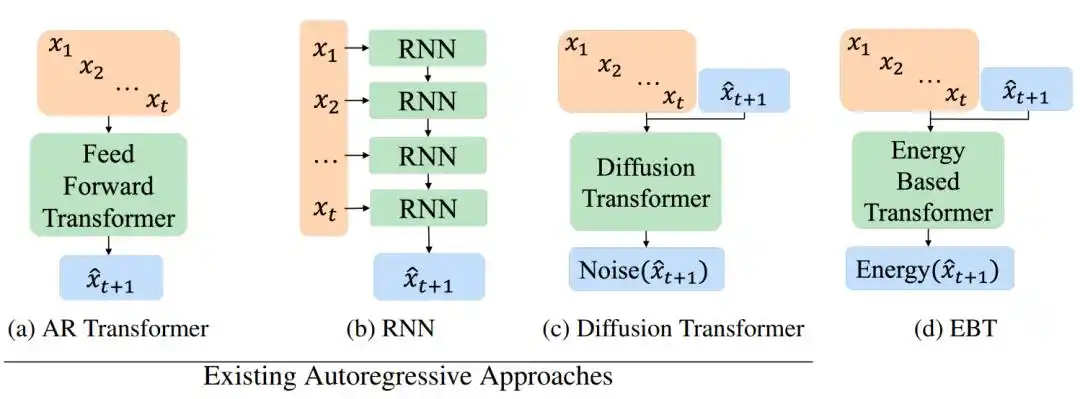
Explorative Modeling aligns with his consistent line of thinking: questioning "whether a model can, through some form of search or exploration, achieve what a single forward pass cannot." Furthermore, this paper builds upon another theory, Mode Forcing, by him and his collaborators (Yilun Du and Heng Ji). The paper candidly states that because of that prior theoretical foundation, most of XM's results were theoretically predicted first and then experimentally verified, which is relatively rare in the deep learning field, where the norm is often "run experiments first, explain later."
The authors are also frank about limitations: the best-of-K idea itself is not new and has been tried many times before; their real contribution is clarifying what this simple loop actually does: it directly amplifies generative expressivity without breaking down the generative process.

Additionally, autoregressive language models remain the toughest challenge, and pure end-to-end Forward XM is still too expensive for highly multi-modal distributions (like image generation), leaving room for future work.

For over a decade, we've grown accustomed to tuning generative models with two knobs: making them bigger and feeding them more data.

The third knob proposed in this paper is remarkably simple: let the model guess multiple times and keep only the best one. But if the trend it reveals holds true, then as scale continues to expand, the first two knobs will eventually be maxed out, while the third has only just begun to turn.

Reference Links

https://x.com/AlexiGlad/status/2083230922196107288

This article is from the WeChat public account "Machine Heart" (ID: almosthuman2014), author: Panda


Tiền kỹ thuật số thịnh hành

Câu hỏi Liên quan

QWhat is the core idea behind 'Explorative Modeling (XM)' as described in the article?

AThe core idea is to modify the training loop by having the model generate K candidate samples for each training step and then backpropagate gradients only from the candidate closest to the real data. This simple 'best-of-K' for-loop strategy helps the model capture multiple modes of the data distribution, solving the 'mode blurring' problem that plagues direct end-to-end generative modeling.

QAccording to the article, what is the 'third axis' for scaling generative models introduced by Explorative Modeling?

AThe 'third axis' is 'generative expressivity,' which is the inherent ability of a model to capture multiple modes in a data distribution. The paper argues that this expressivity is determined by the training objective itself and does not automatically scale with more parameters or data. Explorative Modeling directly amplifies this axis by increasing the exploration factor K during training.

QWhat problem do current powerful generative models (like autoregressive and diffusion models) have that prevents them from being truly end-to-end?

ACurrent powerful generative models are not truly end-to-end because they train to predict only 'one small step' (e.g., the next token or a denoising step), but during inference, they must unroll this step hundreds or thousands of times iteratively. This creates a mismatch between training and inference distributions, leading to the 'exposure bias' problem where errors accumulate step-by-step.

QWhat key advantage does an end-to-end Explorative Model (XM) demonstrate in the robotics control tasks mentioned in the article?

AIn robotics control tasks like Behavior Cloning, the Explorative Policy, using a single network forward pass, matched or exceeded the performance of Diffusion Policy, which required 100 forward passes. For goal-directed world modeling, the Explorative World Model achieved better average performance using 16 to 256 times less inference compute than a Diffuser model, highlighting its efficiency gains from shifting the computational cost from inference to training-time exploration.

QWho is the first author of the Explorative Modeling paper, and what was their related prior work mentioned in the article?

AThe first author is Alexi Gladstone. His related prior work is 'Energy-Based Transformers (EBT),' which claimed to surpass the scaling curves of standard feedforward Transformers across multiple dimensions. His research consistently explores how models can use search or exploration mechanisms to achieve what a single forward pass cannot.

Nội dung Liên quan

SEC và CFTC cùng ngày kiện Goliath: Lộ diện kẻ lừa đảo tiền mã hóa 400 triệu USD theo mô hình Ponzi, không còn kẽ hở cho các nền tảng dùng lãi cao để kéo người mới

Tác giả: Claude, Shenchao TechFlow Hai cơ quan quản lý Mỹ SEC và CFTC cùng trong ngày 9/7 đã khởi kiện dân sự chống lại Goliath Ventures cùng nhà sáng lập Christopher Delgado, liên quan đến một kế hoạch lừa đảo Ponzi tiền mã hóa trị giá khoảng 400 triệu USD. Theo cáo trạng, Goliath đã huy động ít nhất 397 triệu USD từ khoảng 1600 nhà đầu tư cá nhân với lời hứa lợi nhuận hàng tháng từ 3-10% từ việc cung cấp thanh khoản cho các pool giao dịch tiền mã hóa và đảm bảo hoàn vốn. Tuy nhiên, SEC và CFTC xác định công ty không đầu tư tiền thật vào bất kỳ pool thanh khoản hay giao dịch nào. Thay vào đó, họ sử dụng tiền của nhà đầu tư mới để trả lợi nhuận cho người cũ, đồng thời làm giả số dư tài khoản và báo cáo hiệu suất. Nhà sáng lập Delgado bị cáo buộc chiếm đoạt ít nhất 51 triệu USD cho mục đích cá nhân như mua nhà siêu sang, xe hơi đắt tiền và đồ xa xỉ. Đến tháng 11/2025, mô hình này sụp đổ khi không thể huy động đủ tiền mới để duy trì thanh toán. Đáng chú ý, Delgado đã nhận tội vào ngày 30/6 trước Bộ Tư pháp Mỹ về các tội danh âm mưu gian lận viễn thông, gian lận viễn thông và rửa tiền. Anh ta thừa nhận gây thiệt hại ít nhất 250 triệu USD cho nhà đầu tư và đồng ý bị tịch thu tài sản. Tuy nhiên, khả năng các nhà đầu tư thu hồi được khoản lỗ là rất thấp. Vụ việc này cho thấy sự phối hợp chặt chẽ chưa từng có giữa SEC và CFTC, nhằm loại bỏ khoảng trống quy định mà các nền tảng tiền mã hóa có thể lợi dụng khi tự hỏi sản phẩm của họ là chứng khoán hay hàng hóa. Hành động đồng thời của hai cơ quan gửi đi tín hiệu rõ ràng: các nền tảng dựa vào lãi suất cao, đảm bảo hoàn vốn và mô hình giới thiệu người mới để phát triển đang trở thành mục tiêu chính của giám sát.

marsbit9 phút trước

SEC và CFTC cùng ngày kiện Goliath: Lộ diện kẻ lừa đảo tiền mã hóa 400 triệu USD theo mô hình Ponzi, không còn kẽ hở cho các nền tảng dùng lãi cao để kéo người mới

marsbit9 phút trước

Phố Wall Bắt Đầu Nghi Ngờ Câu Chuyện AI Của Các Gã Khổng Lồ Công Nghệ

Phố Wall đang nghi ngờ câu chuyện AI của các gã khổng lồ công nghệ, chuyển trọng tâm từ câu chuyện tăng trưởng dài hạn sang phân tích kỹ lưỡng khả năng sinh lời và dòng tiền trong ngắn hạn. Sự kiện NVIDIA công bố kế hoạch huy động 5000 tỷ USD cho cơ sở hạ tầng AI cùng phản ứng thận trọng của thị trường cho thấy mối lo ngại về chi phí đầu tư khổng lồ. Báo cáo quý II/2026 của Alphabet (Google) và Microsoft làm nổi bật sự thay đổi này. Dù doanh thu tăng trưởng mạnh, Alphabet ghi nhận dòng tiền tự do (FCF) âm lần đầu tiên do chi tiêu vốn khổng lồ, khiến cổ phiếu giảm. Ngược lại, Microsoft có FCF dương mạnh mẽ cùng tốc độ tăng trưởng doanh thu Azure vững chắc, được thị trường đón nhận tích cực. Điều này cho thấy nhà đầu tư không còn chỉ xem xét nhu cầu hay doanh thu AI, mà đang đánh giá sâu hơn: tốc độ chuyển đổi nhu cầu thành doanh thu, lợi nhuận và tiền mặt có theo kịp tốc độ đầu tư vốn hay không. Áp lực dòng tiền đang trở thành thước đo quan trọng. Một trung tâm dữ liệu xây hôm nay có thể mất hơn một thập kỷ để thu hồi vốn, trong khi chip bên trong có thể bị lỗi thời sau vài năm. Wall Street giờ đây đặt câu hỏi về lợi tức đầu tư vốn (ROIC) trong kỷ nguyên AI, bắt đầu bằng việc sàng lọc thông qua thấu kính dòng tiền tự do.

marsbit13 phút trước

Phố Wall Bắt Đầu Nghi Ngờ Câu Chuyện AI Của Các Gã Khổng Lồ Công Nghệ

marsbit13 phút trước

Vitalik Buterin Đưa Vấn Đề Quyền Riêng Tư Và An Toàn Lượng Tử Lên Vị Trí Cao Hơn Trong Lộ Trình Phát Triển Của Ethereum

Đồng sáng lập Ethereum, Vitalik Buterin, đã chia sẻ một bản so sánh giữa lộ trình cũ của Ethereum và một "Bản phác thảo L1" mới, trong đó nhấn mạnh quyền riêng tư và khả năng chống lại máy tính lượng tử là các lĩnh vực nghiên cứu được ưu tiên cao hơn. Bài đăng chỉ ra một số thay đổi đáng chú ý, bao gồm tập trung nhiều hơn vào các yêu cầu về quyền riêng tư gốc, nonce có khóa, bể giao dịch được bảo vệ, an toàn lượng tử và việc chuyển hướng khỏi cây Verkle sang cây nhị phân Poseidon. Điều quan trọng cần lưu ý là bản phác thảo này là một công cụ nghiên cứu và lập kế hoạch, không phải một cam kết hard fork hay quyết định quản trị cuối cùng. Lộ trình của Ethereum phát triển thông qua nghiên cứu, triển khai và tranh luận cộng đồng. Việc nâng cao mức độ ưu tiên cho quyền riêng tư phản ánh nhu cầu thực tế từ người dùng thông thường, những người không muốn lịch sử tài chính đầy đủ của họ bị công khai. Trong khi đó, việc đẩy mạnh nghiên cứu về an toàn lượng tử cho thấy mạng lưới đang lên kế hoạch dài hạn để bảo vệ chống lại các mối đe dọa mật mã trong tương lai, dù mối đe dọa này hiện chưa cấp bách. Sự thay đổi kỹ thuật từ cây Verkle sang cây nhị phân Poseidon liên quan đến các lựa chọn cấu trúc dữ liệu ảnh hưởng đến khả năng mở rộng và tương thích lâu dài. Điều này cho thấy cộng đồng nghiên cứu đang tinh chỉnh các giả định kỹ thuật, một quá trình bình thường trong sự phát triển của Ethereum. Tóm lại, so sánh này cung cấp một cái nhìn về sự trưởng thành trong các ưu tiên dài hạn của Ethereum, hướng tới mục tiêu trở thành một cơ sở hạ tầng bền vững với quyền riêng tư mạnh mẽ hơn và khả năng chống lại các thách thức tương lai.

bitcoinist30 phút trước

Vitalik Buterin Đưa Vấn Đề Quyền Riêng Tư Và An Toàn Lượng Tử Lên Vị Trí Cao Hơn Trong Lộ Trình Phát Triển Của Ethereum

bitcoinist30 phút trước

Bitcoin Policy Institute kêu gọi nhà phát triển AI cung cấp cho các nhà bảo vệ cơ sở hạ tầng tiền mã hóa quyền truy cập vào các mô hình tiên tiến

Viện Chính sách Bitcoin (BPI) kêu gọi các nhà phát triển trí tuệ nhân tạo (AI) cung cấp quyền truy cập vào các mô hình tiên tiến cho những người bảo vệ cơ sở hạ tầng mã nguồn mở trong lĩnh vực tiền mã hóa. Trong một bức thư ngỏ, BPI cảnh báo rằng các hệ thống AI hiện đại có khả năng phân tích mã nguồn lớn và phát hiện lỗ hổng, nhưng những kẻ tấn công có thể tiếp cận các công cụ này sớm hơn các nhà bảo vệ. Điều này tạo ra rủi ro lớn cho cơ sở hạ tầng tài sản kỹ thuật số, bao gồm ví, sàn giao dịch, thư viện mã hóa và phần mềm nút, vốn đang quản lý hàng nghìn tỷ USD. Đặc biệt, các nhà phát triển cốt lõi của Bitcoin hiện không có quyền truy cập vào các mô hình AI mạnh nhất và các chương trình bảo mật chuyên dụng. BPI đề xuất các phòng thí nghiệm AI hàng đầu thiết lập chương trình truy cập đặc quyền cho các nhà phát triển và nhà nghiên cứu đáng tin cậy. Các đề xuất bao gồm: cấp quyền truy cập sớm, có kiểm soát vào các mô hình AI mạnh; cung cấp đủ tài nguyên điện toán; tạo môi trường an toàn để phân tích mã riêng tư; và mở rộng quyền truy cập cho cả các nhóm nhỏ, tổ chức phi lợi nhuận. Việc này nhằm giúp họ tìm và sửa lỗi bảo mật trước khi bị khai thác. BPI cũng kêu gọi ngành công nghiệp tiền mã hóa hỗ trợ xác định các đối tác đáng tin cậy và phối hợp ứng phó với các mối đe dọa.

cryptonews.ru32 phút trước

Bitcoin Policy Institute kêu gọi nhà phát triển AI cung cấp cho các nhà bảo vệ cơ sở hạ tầng tiền mã hóa quyền truy cập vào các mô hình tiên tiến

cryptonews.ru32 phút trước

Bitwise cắt giảm 14% nhân sự trong bối cảnh thị trường tiền mã hóa suy giảm

Công ty quản lý tài sản Bitwise (Bitwise Asset Management) đã cắt giảm 14% nhân sự, tương đương khoảng 25 người, trong bối cảnh thị trường tiền mã hóa suy giảm. Theo CEO Hunter Horsley, quy mô công ty sau đợt sa thải này giảm từ 180 xuống 155 người, mặc dù ông không tiết lộ các bộ phận bị ảnh hưởng. Lãnh đạo Bitwise vẫn bày tỏ sự tự tin về triển vọng tăng trưởng dài hạn của thị trường, coi việc tinh gọn tổ chức là sự chuẩn bị cho giai đoạn phát triển sắp tới. Horsley cho rằng động lực tăng trưởng chính sẽ đến từ sự hội nhập ngày càng sâu rộng của tài sản tiền mã hóa vào nền kinh tế toàn cầu. Bitwise là nhà cung cấp lớn các sản phẩm giao dịch trao đổi (ETP), quản lý khoảng 70 quỹ ETF với tổng tài sản trị giá 9 tỷ USD, bao gồm cả các quỹ dựa trên tiền mã hóa như quỹ ETF Bitcoin (BITB) với tài sản 2,3 tỷ USD. Sự kiện này nằm trong xu hướng củng cố và cắt giảm chi phí đang diễn ra trên toàn ngành công nghiệp tiền mã hóa, ảnh hưởng đến cả những đối thủ lớn như Hashdex (đã đóng cửa một quỹ ETF Bitcoin) và Grayscale Investments (rút một số đơn đăng ký sản phẩm mới).

cryptonews.ru32 phút trước

Bitwise cắt giảm 14% nhân sự trong bối cảnh thị trường tiền mã hóa suy giảm

cryptonews.ru32 phút trước

Giao dịch

Giao ngay

Bài viết Nổi bật

Làm thế nào để Mua CORE

Chào mừng bạn đến với HTX.com! Chúng tôi đã làm cho mua CORE (CORE) trở nên đơn giản và thuận tiện. Làm theo hướng dẫn từng bước của chúng tôi để bắt đầu hành trình tiền kỹ thuật số của bạn.Bước 1: Tạo Tài khoản HTX của BạnSử dụng email hoặc số điện thoại của bạn để đăng ký tài khoản miễn phí trên HTX. Trải nghiệm hành trình đăng ký không rắc rối và mở khóa tất cả tính năng. Nhận Tài khoản của tôiBước 2: Truy cập Mua Crypto và Chọn Phương thức Thanh toán của BạnThẻ Tín dụng/Ghi nợ: Sử dụng Visa hoặc Mastercard của bạn để mua CORE (CORE) ngay lập tức.Số dư: Sử dụng tiền từ số dư tài khoản HTX của bạn để giao dịch liền mạch.Bên thứ ba: Chúng tôi đã thêm những phương thức thanh toán phổ biến như Google Pay và Apple Pay để nâng cao sự tiện lợi.P2P: Giao dịch trực tiếp với người dùng khác trên HTX.Thị trường mua bán phi tập trung (OTC): Chúng tôi cung cấp những dịch vụ được thiết kế riêng và tỷ giá hối đoái cạnh tranh cho nhà giao dịch.Bước 3: Lưu trữ CORE (CORE) của BạnSau khi mua CORE (CORE), lưu trữ trong tài khoản HTX của bạn. Ngoài ra, bạn có thể gửi đi nơi khác qua chuyển khoản blockchain hoặc sử dụng để giao dịch những tiền kỹ thuật số khác.Bước 4: Giao dịch CORE (CORE)Giao dịch CORE (CORE) dễ dàng trên thị trường giao ngay của HTX. Chỉ cần truy cập vào tài khoản của bạn, chọn cặp giao dịch, thực hiện giao dịch và theo dõi trong thời gian thực. Chúng tôi cung cấp trải nghiệm thân thiện với người dùng cho cả người mới bắt đầu và người giao dịch dày dạn kinh nghiệm.

Tổng lượt xem 585Xuất bản vào 2024.12.13Cập nhật vào 2026.06.02

Làm thế nào để Mua CORE

Thảo luận

Chào mừng đến với Cộng đồng HTX. Tại đây, bạn có thể được thông báo về những phát triển nền tảng mới nhất và có quyền truy cập vào thông tin chuyên sâu về thị trường. Ý kiến ​​của người dùng về giá của CORE (CORE) được trình bày dưới đây.

活动图片