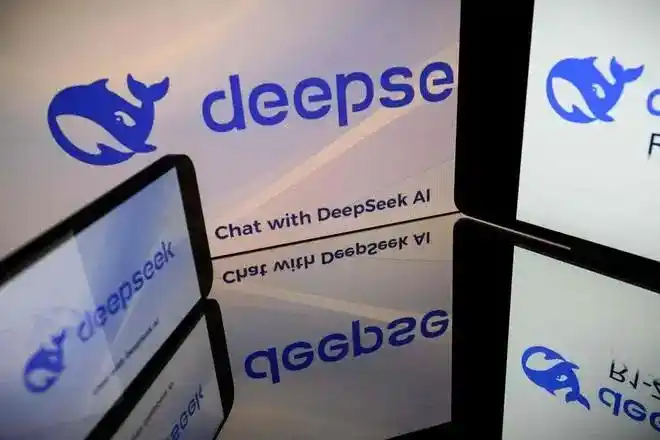
DeepSeek V4 Official Version Arrives, New Capabilities Emerge, Value-for-Money King Enters the Fray

marsbitXuất bản vào 2026-07-31Cập nhật gần nhất vào 2026-07-31

Tóm tắt

On July 31st, DeepSeek officially launched the public API beta for its DeepSeek-V4-Flash model. A key highlight is its performance on multiple Agent benchmark tests, reportedly nearing or even surpassing the level of the V4-Pro preview version from three months ago. Notably, the Flash model achieves this with significantly smaller scale (130B active parameters vs. Pro's 490B), suggesting that post-training optimization and data quality may be as crucial as raw model size. DeepSeek emphasized that the V4-Flash-0731 uses the same model architecture and size as its preview version, with improvements attributed solely to "re-trained post-training." The update also marks the official debut of DeepSeek's self-developed Agent framework, "Harness." The move signals DeepSeek's strategic push to position its cost-effective Flash model as a competitive base for Agent applications—scenarios requiring autonomous planning, tool usage, and complex task execution—where inference speed and cost are critical. By natively supporting OpenAI's Responses API format and adapting for code-generation scenarios, DeepSeek aims not just to be a cheaper alternative but to establish its own ecosystem in the Agent era. This release follows DeepSeek's record-breaking ~$50 billion fundraising round roughly two months prior, underscoring market confidence in its technology and commercialization prospects. The company is reportedly preparing for another funding round at a valuation of approximately $71 bill...

On the afternoon of July 31st, Phoenix Net Technology discovered upon checking the DeepSeek official website that the DeepSeek-V4-Flash official version API has been launched for public beta testing. Unlike the previous hierarchical logic of “Pro strong, Flash weak”, this update signals a noteworthy shift—the performance of the Flash official version in multiple Agent benchmark tests has approached or even surpassed the level of the V4-Pro preview version from three months ago.
The official update log shows that the V4-Flash official version scored 82.7 points on Terminal Bench 2.1, 54.2 points on NL2Repo, 76.7 points on Cybergym, and 70.3 points on Toolathlon verified. In contrast, the V4-Pro preview version scored 67.9 points on Terminal Bench 2.0.
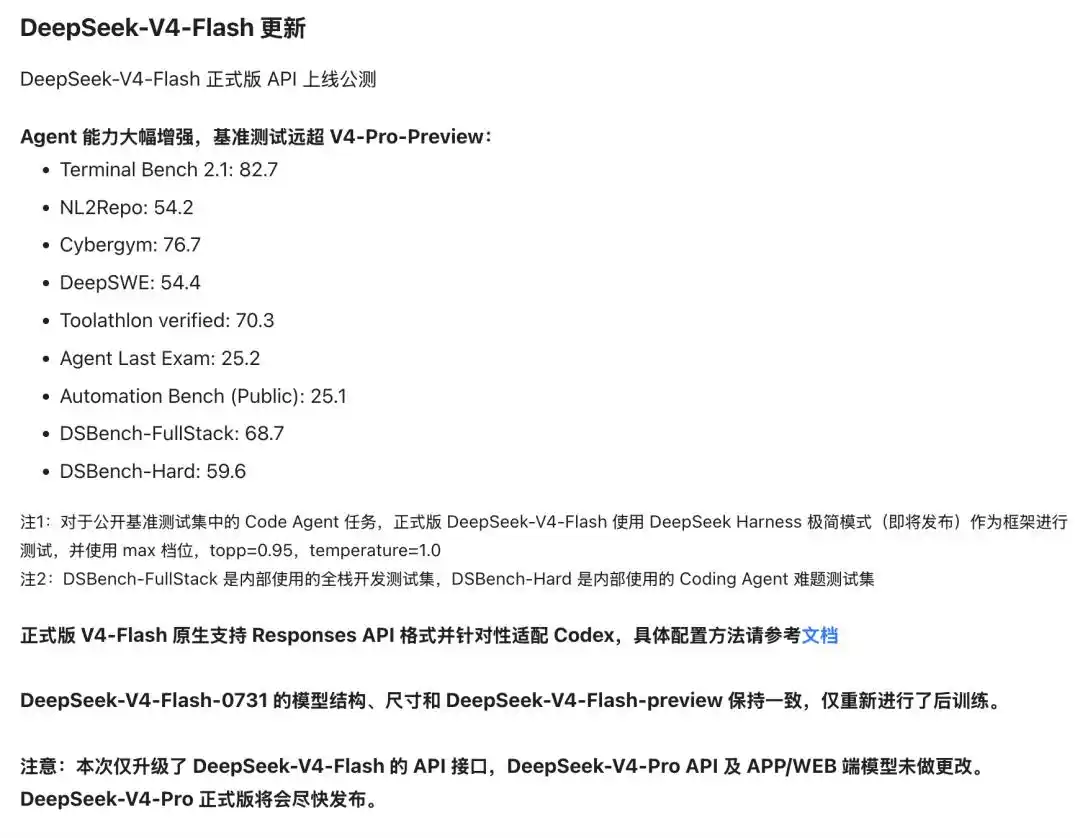
It is important to note that Terminal Bench 2.0 and 2.1 are not the same version of the test suite, so a direct comparison is not entirely fair. However, for a lightweight version with only 13 billion activation parameters to achieve such scores in Agent capabilities suggests that the optimization space in the post-training phase might offer greater leverage than simply scaling up parameters.

Additionally, DeepSeek also specifically noted that the current public beta is limited to the API, and the latest capabilities are not yet available on the App and web interface. The DeepSeek-V4-Pro official version will be released as soon as possible.

“Only Underwent Post-Training Again”

The DeepSeek official statement in the update log indicates, “The model architecture, size, and parameters of DeepSeek-V4-Flash-0731 remain consistent with DeepSeek-V4-Flash-preview; only post-training was conducted again.”

According to DeepSeek's official technical report, V4-Flash has 284 billion total parameters and 13 billion activation parameters; V4-Pro has 1.6 trillion total parameters and 49 billion activation parameters. The two differ by an order of magnitude in model scale. If Flash can bring its Agent capabilities close to Pro's level through post-training, it implies that for specific tasks, model scale is not the decisive factor—the weight of training methods and data quality is rising.

The official also specially noted that for the Code Agent tasks in the public benchmark tests, the DeepSeek Harness minimal mode was used as the framework for testing, with max setting, topp=0.95, temperature=1.0. This detail suggests that DeepSeek may have made targeted optimizations at the Agent framework level, not just improvements in the model itself.

This is also the first time DeepSeek's self-developed Harness has appeared under an official name. Previously, Liang Wenfeng compared the path to AGI to climbing stairs: language models are the first step, CoT (Chain-of-Thought) was addressed last year, this year's step is Agent, and the problem that must be solved after Agent is continuous learning—enabling models to accumulate experience over time like humans, rather than requiring the full context to be fed in every time to work. Beyond that lies the “singularity” of self-iteration and embodied intelligence. “AI currently lacks not taste or intuition, but the ability for continuous learning,” he said. “Investors look at Agent; we look at how to solve learning.”

Continuous learning sounds like a model-level proposition, but its engineering focal point lies precisely in the Harness. DeepSeek's Agent Harness team was formed in March this year. Leading it is Cui Tianyi, born in the 1990s, a Zhejiang University computer science graduate, holder of six ACM Asia Regional Competition gold medals, who previously worked for nine years at top quantitative firm Jane Street, joined DeepSeek in March this year, and subsequently aggressively recruited in May.

It is reported that DeepSeek plans to launch the Harness concurrently with the V4 official version release. Furthermore, as DeepSeek stated at the end of the log, “The DeepSeek-V4-Pro official version will be released as soon as possible.”

A Direct Confrontation at the Ecosystem Level

If large model competition in 2023 was about “competing on general capabilities” and 2024 was about “competing on long context,” then the keyword for 2026 is undoubtedly Agent.

Agent capability—the model's ability to autonomously plan, call tools, and execute complex tasks—is becoming the new yardstick for measuring large model strength. From Terminal Bench (terminal operations) and NL2Repo (code repository generation) to Cybergym (cybersecurity tasks) and SWE-bench (software engineering), a series of Agent benchmark tests are redefining what makes a good model.

Globally, the first tier of Agent capability is still dominated by closed-source giants. According to data from third-party evaluation platforms like benchlm.ai, GPT-5.6 Sol and the Claude Opus series rank at the top in most Agent benchmark tests. Among domestic players, GLM, Qwen, and others are also catching up quickly.

DeepSeek's significant boost to Flash's Agent capabilities this time has a clear strategic intent: to enter the vast market of Agent applications with a high-value, lightweight model.

After all, Agent scenarios are far more sensitive to inference speed and cost than pure dialogue scenarios. An Agent task requiring repeated tool calls and multi-step reasoning could cost several times or even tens of times more to run on a flagship model compared to Flash. If Flash's Agent capability reaches a level that is “sufficient or even good,” its cost-performance advantage will be highly disruptive.

The two internal test sets officially released also have clear targets. DSBench-FullStack (internal full-stack development test set) scored 68.7, and DSBench-Hard (internal Coding Agent difficult problem test set) scored 59.6. This indirectly confirms DeepSeek's positioning—to build Flash as the preferred foundation for developers and Agent applications.

A quiet ecosystem battle is also brewing. The official V4-Flash natively supports the Responses API format and is specifically adapted for Codex.

The Responses API is a new-generation API format strongly promoted by OpenAI. Compared to the traditional Chat Completions, it is more suitable for Agent scenarios—supporting more flexible tool calls, more complex multi-turn interactions, and finer-grained output control.

DeepSeek's native support for this format means developers can migrate Agent applications developed based on the OpenAI ecosystem to DeepSeek at a lower cost. This will be a direct confrontation between the two at the ecosystem level.

The adaptation for Codex targets the vertical scenario of code generation and software development. Codex is OpenAI's model for the code domain. DeepSeek's targeted adaptation is a direct challenge in OpenAI's traditional area of strength.

Viewed together, these moves indicate that DeepSeek's ambition is not just to be a “cheap alternative” but to establish its own niche in the Agent era.

After the 50 Billion RMB Financing: Time Window Under High Valuation

This update comes less than two months after DeepSeek completed its first round of external financing.

A little over a month ago, DeepSeek completed its first external financing round since its founding nearly three years ago, raising over 50 billion RMB, setting a single-round financing record in China's AI industry, with a post-money valuation of approximately $52 billion (about 350 billion RMB). Investors included industry giants like Tencent, CATL, JD.com, as well as several state-owned industrial funds.
In mid-July, DeepSeek intended to advance a new round of private financing with a pre-money valuation of about $71 billion (approximately 480 billion RMB), a roughly 37% increase from the $52 billion valuation after the first round. The interval from $52 billion to $71 billion was less than six weeks.

Behind the high valuation lies market recognition of DeepSeek's technical strength and bets on its commercialization prospects. However, high valuation also means high expectations and high pressure.

According to multiple media reports, DeepSeek founder Liang Wenfeng personally contributed approximately 20 billion RMB in the first financing round, maintaining firm control of the company through a special structure. This founder, who emerged from the quantitative firm Phantom, had insisted on self-funding for nearly three years previously. The shift from “no financing, no IPO” to actively embracing capital is itself a strong signal—DeepSeek is accelerating toward commercialization and an IPO.

The launch of the Flash official version can perhaps be seen as a technological realization by DeepSeek under the support of capital. But the real test lies ahead: Can the Pro official version arrive on schedule? Can the improvement in Agent capability translate into solid revenue? Under the pressure from giants like OpenAI and Anthropic, how will DeepSeek leverage its high-value route?

The curtain on the Agent war has just risen. DeepSeek, with a significant evolution of a lightweight model, poses a new question to the industry—when the dividends of post-training are fully exploited, when efficiency gains begin to offset the parameter gap, the competitive logic of large models may need to be rewritten.

This article is from the WeChat public account “Phoenix Net Technology,” author: Phoenix Net Technology


Tiền kỹ thuật số thịnh hành

Câu hỏi Liên quan

QWhat key feature of DeepSeek-V4-Flash's official release is highlighted by the updated benchmark scores, and how does it compare to the V4-Pro preview?

AThe key feature is the significant enhancement of Agent capabilities. Although direct comparison is limited because Terminal Bench 2.0 and 2.1 are different versions, the article notes that the smaller V4-Flash model (with 130B activated parameters) achieved benchmark scores that approach or even surpass those of the much larger V4-Pro preview model (with 490B activated parameters) from three months prior, particularly in Agent-related tests. This suggests that post-training optimizations can be highly effective, challenging the notion that model size alone determines performance.

QAccording to the article, what does the release of the DeepSeek-V4-Flash official version represent in the broader AI model competition landscape?

AThe release represents a strategic move in the Agent-centric competition era of 2026. By boosting the Agent performance of its more cost-effective, lighter Flash model, DeepSeek aims to capture the growing market for Agent applications where inference speed and cost are critical. This positions it as a high-value, 'good enough' alternative to more expensive flagship models like GPT-5.6 Sol and Claude Opus, directly challenging OpenAI and others on their home turf, especially in tool-use and code generation scenarios.

QWhat role does the newly named DeepSeek Harness play, as mentioned by CEO Liang Wenfeng, in the path toward AGI?

ACEO Liang Wenfeng likens the path to AGI to climbing stairs. While 2023 focused on language models and 2024 on long-context, the current step is Agent capability. Beyond that, he identifies 'sustained learning'—the ability for models to accumulate experience like humans without needing full context every time—as the critical next challenge. The DeepSeek Harness, their self-developed Agent framework, is identified as the key engineering tool for enabling this crucial 'sustained learning' capability, making it central to their long-term AGI strategy.

QHow does the DeepSeek-V4-Flash's native support for the Responses API format and Codex adaptation impact its competitive position?

AIt represents a direct ecosystem-level challenge to OpenAI. Native support for OpenAI's Responses API format lowers the barrier for developers to migrate Agent applications built on OpenAI's ecosystem to DeepSeek's platform. Additionally, targeted adaptation for Codex, OpenAI's code-specific model, indicates a direct assault on OpenAI's traditional stronghold of code generation. These moves are part of a strategy for DeepSeek to establish its own ecosystem in the Agent era, moving beyond just being a cost-effective alternative to becoming a primary platform.

QWhat recent financial event for DeepSeek does the article connect to this technical release, and what pressures does it imply?

AThe article connects the V4-Flash release to DeepSeek's recent record-breaking fundraising of over 50 billion RMB (~$5.2 billion post-money valuation) and its subsequent plans for a new round at a valuation of approximately $71 billion. The high valuation reflects market confidence in its technology and commercialization potential but also creates significant pressure to deliver results. This technical release is seen as an initial 'delivery on the promise' following the capital influx. The true test will be whether improved Agent capabilities can translate into real revenue growth and if the upcoming V4-Pro official version can meet high expectations amidst intense competition.

Nội dung Liên quan

Đầu tư ít không phải là lá bài miễn tử của Apple

Bài viết phân tích tình hình tài chính và chiến lược AI của Apple trong bối cảnh cạnh tranh công nghệ. Mặc dù bị chỉ trích vì chậm trễ trong phát triển AI so với các gã khổng lồ như Meta, Google, Microsoft (vốn đang chi tiêu khổng lồ cho AI), Apple lại được thị trường đánh giá cao nhờ sự kiềm chế trong chi tiêu vốn, giúp dòng tiền hoạt động mạnh mẽ. Gần đây, cổ phiếu Apple tăng mạnh, đưa vốn hóa lên trên 5 nghìn tỷ USD. Báo cáo tài chính quý III năm tài chính 2026 (quý II năm 2026) của Apple cho thấy doanh thu và lợi nhuận kỷ lục, chủ yếu nhờ iPhone và Mac tăng trưởng mạnh (21.7% và 28.7%). Tuy nhiên, dự báo tăng trưởng quý tiếp theo thấp hơn kỳ vọng, dẫn đến giá cổ phiếu giảm mạnh sau giờ giao dịch. Nguyên nhân chính là áp lực từ chuỗi cung ứng, đặc biệt là chip và bộ nhớ, do nhu cầu AI toàn cầu tăng vọt làm tăng chi phí và hạn chế nguồn cung. Điều này buộc Apple phải tăng giá sản phẩm và tích trữ hàng tồn kho. Dù tránh được cuộc đua chi tiêu AI lớn, Apple vẫn bị ảnh hưởng gián tiếp. Trong khi các đối thủ tăng chi tiêu vốn (capex) cho AI, Apple lại tăng mạnh chi phí nghiên cứu & phát triển (R&D) lên 32.5%, nhưng kết quả cụ thể về AI còn hạn chế. Đây là báo cáo cuối cùng của CEO Tim Cook trước khi ông nghỉ hưu vào tháng 9.

marsbit43 phút trước

Đầu tư ít không phải là lá bài miễn tử của Apple

marsbit43 phút trước

PA Đồ Họa | Một hình ảnh hiểu rõ sự kiện lớn Web3 tháng 8 năm 2026

Tháng 8 năm 2026, thị trường Web3 sẽ đón nhận nhiều sự kiện quan trọng từ nhiều khía cạnh: 📌 **Dữ liệu vĩ mô:** Dữ liệu CPI và việc làm phi nông nghiệp của Mỹ tháng 7 sẽ được công bố. Cùng với đó là bản ghi nhớ cuộc họp của Fed và Hội nghị thượng đỉnh Ngân hàng Trung ương toàn cầu Jackson Hole. 🏛️ **Tiến triển quy định:** Thượng viện Mỹ dự kiến công bố dự thảo mới của *Đạo luật CLARITY*. Lệnh cấm tiền mã hóa mở rộng của EU đối với Belarus chính thức có hiệu lực. 🪙 **Giải phóng token:** Một lượng lớn token như ENA, AVAX, STRK, ZRO, KAITO sẽ được mở khóa tập trung, cần theo dõi chặt chẽ để ứng phó với biến động thị trường tiềm năng. ⚠️ **Điều chỉnh dự án:** Một số nền tảng/dịch vụ như Exchange Art, Ctrl Wallet, Zapper, NFTfi, Summer.fi sẽ ngừng hoạt động hoặc điều chỉnh, người dùng cần xử lý tài sản kịp thời. 💼 **Tài chính doanh nghiệp:** Các công ty như SpaceX, Circle, NVIDIA sẽ công bố báo cáo tài chính Quý 2. Unitree Robotics bắt đầu chào bán cổ phần IPO trên STAR Market, trong khi Moonshot AI lên kế hoạch cho vòng gọi vốn Pre-IPO. 🌐 **Sự kiện ngành:** Các hội nghị Bitcoin Asia 2026 và 2026 Digital Expo sẽ được tổ chức. Tóm lại, chủ đề chính của thị trường trong tháng 8 sẽ xoay quanh kỳ vọng vĩ mô, việc triển khai quy định, giải phóng token và sự đào thải trong ngành. Độc giả có thể trải nghiệm Lịch tiền mã hóa phiên bản mới của PANews để theo dõi toàn diện và thuận tiện hơn.

marsbit55 phút trước

PA Đồ Họa | Một hình ảnh hiểu rõ sự kiện lớn Web3 tháng 8 năm 2026

marsbit55 phút trước

Ông ‘Quạ đen’ nổi tiếng nhất phố Wall lần này lại nhắm vào Nvidia

Một bản tiết lộ giao dịch mới nhất một lần nữa đưa Michael Burry, nhà quản lý quỹ nổi tiếng với vụ bán khống chính xác thị trường thế chấp dưới chuẩn, vào tâm điểm dư luận. Ngày 30/6, thông qua bản tin "Cassandra Unchained", ông đã công bố một danh sách bán khống bao gồm NVIDIA (giá vào lệnh 198.09 USD), Tesla, Applied Materials, Caterpillar và ETF bán dẫn Philadelphia (SOXX). Ngày 1/7, ông mở thêm vị thế bán khống Micron Technology. Ngày 25/7, Burry tiếp tục mở rộng vị thế bán khống đối với NVIDIA, Micron và SOXX. Lý do ông đưa ra xoay quanh hai vấn đề trong xây dựng cơ sở hạ tầng AI: "tài trợ vòng tuần hoàn ngoại bảng" và "báo cáo khấu hao không chính xác". Ông lo ngại cách xử lý tài chính từ phía khách hàng của NVIDIA có thể khiến lợi nhuận trên sổ sách của toàn chuỗi cung ứng trông tốt hơn thực tế. Phản ứng trên mạng xã hội gần như là phản xạ có điều kiện: lại một lập luận bi quan. Giá cổ phiếu NVIDIA biến động mạnh sau các tiết lộ. Sau lần công bố thứ hai của Burry vào 25/7, một bài báo cho biết NVIDIA đang thảo luận về việc cung cấp bảo lãnh tài chính khoảng 250 tỷ USD cho OpenAI, khiến giá giảm mạnh. Burry bình luận rằng điều này tương đương với "NVIDIA bảo lãnh cho khách hàng mua chip của chính mình", làm dấy lên thêm lo ngại. Tuy nhiên, thành tích của Burry sau chiến thắng huyền thoại năm 2008 không ổn định. Ông từng bán khống Tesla và chịu lỗ, bỏ lỡ đợt tăng giá mạnh của GameStop, và các vị thế bán khống NVIDIA/Palantir trước đây cũng gặp khó khăn. Phương pháp phân tích của ông tập trung vào dòng tiền tự do và kiểm tra chứng từ tài chính gốc, giỏi phát hiện rủi ro cấu trúc nhưng không thể dự đoán thời điểm rủi ro bùng phát. Tỷ lệ bán khống NVIDIA hiện ở mức thấp, khoảng 1.3-1.4% cổ phiếu lưu hành, nhưng tổng giá trị tuyệt đối vẫn lớn. Các tổ chức bán khống NVIDIA tính đến tháng 2 được cho là đã lỗ hơn 50 tỷ USD. Các lập luận của Burry có sức thuyết phục khác nhau: 1. **Khấu hao:** Lập luận vững chắc nhất, nghi ngờ các công ty đám mây như Microsoft, Google kéo dài thời gian khấu hao chip AI (6 năm) so với vòng đời thực tế ngắn hơn (2-3 năm), làm đẹp lợi nhuận. 2. **Tài trợ vòng tuần hoàn ngoại bảng:** Nghi ngờ nhu cầu chip một phần được tạo ra bởi các vòng tài trợ mà NVIDIA có thể cung cấp cho khách hàng, làm méo mó nhu cầu thực. Khó xác minh hơn. 3. **Mua lại cổ phiếu làm pha loãng EPS:** Bị NVIDIA bác bỏ do sai sót trong tính toán, là lập luận yếu nhất. Các nhà đầu tư huyền thoại khác có quan điểm khác biệt: * **Steve Eisman** (cũng là nhân vật trong "The Big Short"): Không bán khống NVIDIA vì doanh thu tăng trưởng mạnh, nhưng cảnh giác và đã giảm sở hữu. * **Jim Chanos:** Đồng ý với Burry về rủi ro kế toán, nhưng không bán khống NVIDIA hay Micron. Thay vào đó, ông tập trung vào các công ty cổ phần tư nhân có đòn bẩy tài chính cao liên quan đến AI. Bài học chính cho các nhà đầu tư không nằm ở việc sao chép vị thế của một nhà đầu tư nào, mà là học hỏi cách họ đặt câu hỏi: những con số nào dễ bị "đẹp hóa", những rủi ro cấu trúc nào dễ bị bỏ qua, và cần kiểm tra điều gì khi mọi người đều nói "lần này khác". Việc dự đoán thời điểm thị trường điều chỉnh phụ thuộc vào nhiều yếu tố không thể kiểm soát được.

marsbit1 giờ trước

Ông ‘Quạ đen’ nổi tiếng nhất phố Wall lần này lại nhắm vào Nvidia

marsbit1 giờ trước

Chọn Lọc Trong Tuần | Thị trường chứng khoán biến động kịch tính, Changxin Technology lên sàn thay đổi cục diện lưu trữ, Saylor đặt mục tiêu đưa STRC trở lại neo vào khoảng 8/9

**Tóm tắt nội dung bài viết:** PANews tổng hợp các nội dung chất lượng trong tuần, tập trung vào các chủ đề nóng trong lĩnh vực tiền mã hóa và tài chính công nghệ. **Các xu hướng chính:** * **AI & Tài chính:** Các ví thông minh AI trở thành chiến trường mới, đáp ứng nhu cầu thanh toán lập trình. Các gã khổng lồ như Coinbase đang tận dụng cơ hội này. Tuy nhiên, thị trường chứng khoán Hàn Quốc trải qua nhiều lần "ngắt mạch", một phần do cổ phiếu công nghệ AI và sự sụt giảm của SK Hynix. * **Bối cảnh vĩ mô:** Trung tâm của sự chú ý là đợt IPO của Changxin Technology (Trường Tân Kỹ Thuật), với vốn hóa thị trường khổng lồ 3.35 nghìn tỷ, đánh dấu bước đột phá trong ngành bán dẫn. Cục Dự trữ Liên bang Mỹ (Fed) giữ nguyên lãi suất nhưng phát đi tín hiệu "diều hâu", gây áp lực lên tài sản rủi ro. * **Góc nhìn chuyên gia:** Nhiều nhân vật nổi tiếng như Tom Lee và Raoul Pal chia sẻ quan điểm. Họ cho rằng đợt điều chỉnh của AI chỉ là "giải phóng đòn bẩy cưỡng chế", logic dài hạn của ngành vẫn vững chắc. Đồng thời, các kênh đầu tư cho nhà đầu tư nhỏ lẻ Trung Quốc đang thu hẹp, mở ra cơ hội cho tài sản mã hóa. * **Cơ hội đầu tư:** Bài viết đề cập đến các hiện tượng như giao thức "bốc thăm" NFT FWA, cơ chế "phí ưu tiên" của Hyperliquid tạo ra doanh thu lớn, và thực trạng tài sản RWA (Tài sản trong thế giới thực) quy mô lớn nhưng chưa được sử dụng hiệu quả trên chuỗi. * **Tin tức Web3:** Tầm nhìn Ethereum đến năm 2030 hướng đến tốc độ nhanh hơn, bảo mật lượng tử và quyền riêng tư gốc. Lido thực hiện đợt nâng cấp lớn, di chuyển số lượng stETH khổng lồ. Cuộc chiến stablecoin tiếp tục gia tăng. **Thông tin đáng chú ý:** * Michael Saylor đặt mục tiêu tái neo giữ STRC vào khoảng ngày 8/9. * Cổ phiếu các công ty khai thác tiền mã hóa chuyển hướng sang AI (như IREN, Bitdeer) tăng mạnh. * Thị trường chứng khoán Hàn Quốc và cổ phiếu Changxin Technology (C Trường Tân) tại Trung Quốc ghi nhận mức tăng kỷ lục. * Coinbase báo cáo doanh thu quý II thấp hơn kỳ vọng.

marsbit1 giờ trước

Chọn Lọc Trong Tuần | Thị trường chứng khoán biến động kịch tính, Changxin Technology lên sàn thay đổi cục diện lưu trữ, Saylor đặt mục tiêu đưa STRC trở lại neo vào khoảng 8/9

marsbit1 giờ trước

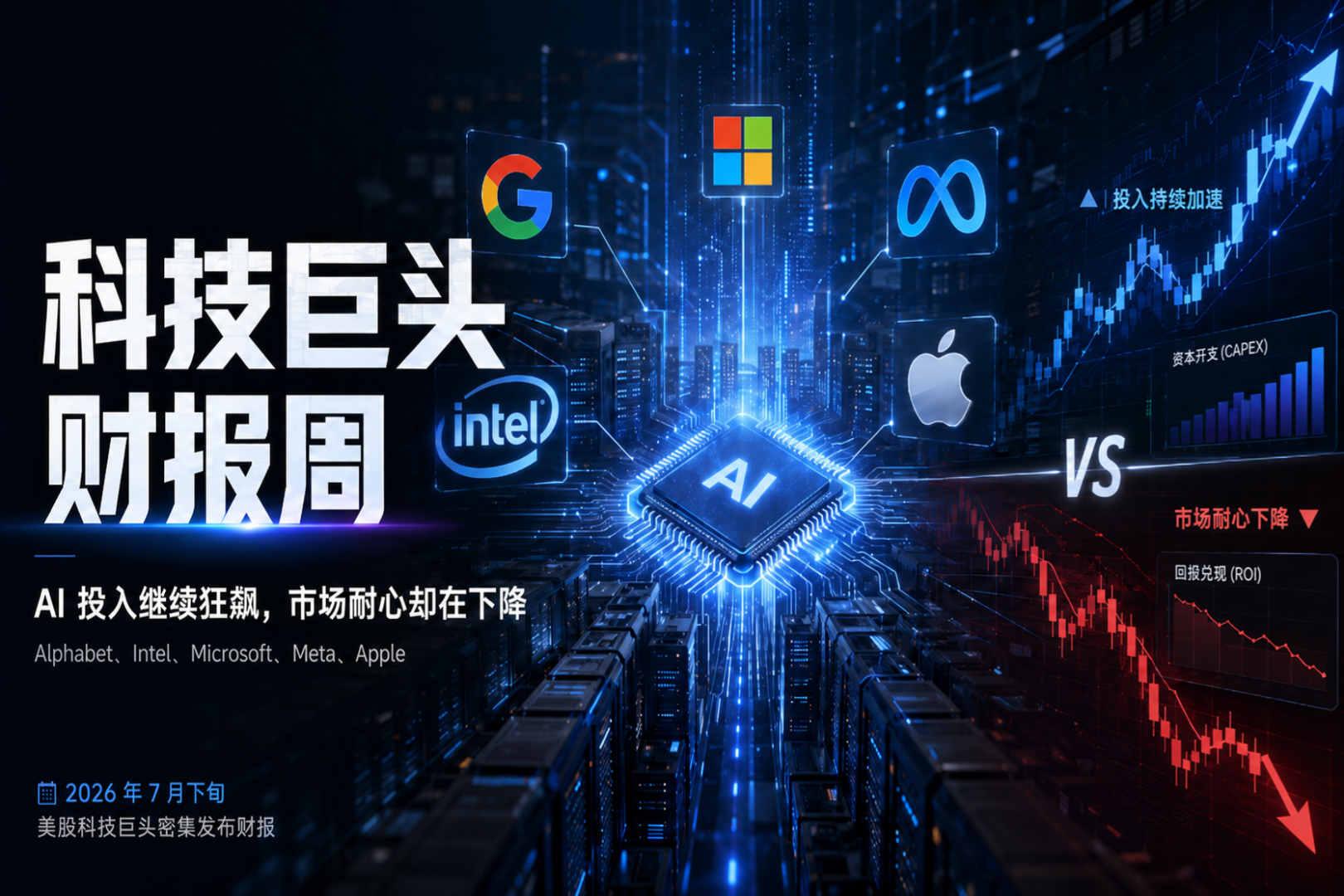
Khi thị trường bắt đầu hoài nghi về chi tiêu vốn cho AI: Phân tích toàn diện báo cáo tài chính quý 2 của năm công ty công nghệ lớn

Trong tuần công bố báo cáo tài chính quý 2/2026, báo cáo của năm gã khổng lồ công nghệ Mỹ (Alphabet, Intel, Microsoft, Meta, Apple) cho thấy một chủ đề chung: đầu tư mạnh mẽ vào cơ sở hạ tầng AI vẫn tiếp tục tăng tốc, nhưng thị trường đang mất kiên nhẫn với việc chờ đợi khoản chi tiêu khổng lồ này chuyển hóa thành lợi nhuận thực tế. Mặc dù hầu hết doanh thu và lợi nhuận đều vượt kỳ vọng, phản ứng của nhà đầu tư lại phân hóa rõ rệt dựa trên triển vọng dòng tiền tự do (FCF). Alphabet (Google) và Intel đều báo cáo tăng trưởng doanh thu ấn tượng (24% và 25%) nhưng đồng thời điều chỉnh tăng mạnh dự báo chi tiêu vốn (CapEx) cho năm 2026, khiến FCF bị áp lực, dẫn đến sự sụt giảm về giá cổ phiếu. Đặc biệt, Alphabet lần đầu tiên ghi nhận FCF âm theo quý. Meta là trường hợp tiêu cực nhất, với lợi nhuận giảm 14% do chi phí tăng 55% và FCF sụt giảm hơn 90%. Việc công ty điều chỉnh tăng hướng dẫn CapEx và CEO Mark Zuckerberg nhấn mạnh sẽ tiếp tục đầu tư mạnh vào năng lực tính toán đã khiến cổ phiếu chịu đợt bán tháo mạnh nhất. Ngược lại, Microsoft trở thành điểm sáng nhờ điều chỉnh *giảm* dự báo CapEx cho năm 2026 và cam kết duy trì FCF dương trong năm tài chính 2027, giúp cổ phiếu tăng mạnh. Apple, dù có quý tháng 6 tốt nhất lịch sử với doanh thu và lợi nhuận kỷ lục, lại đưa ra hướng dẫn tăng trưởng quý tiếp theo thấp hơn kỳ vọng, chủ yếu do thách thức về chuỗi cung ứng, khiến giá cổ phiếu lao dốc. Tóm lại, báo cáo quý này cho thấy thị trường không còn chỉ tập trung vào sức mạnh của nhu cầu AI, mà đã chuyển sang đánh giá kỹ lưỡng lộ trình và thời điểm hoàn vốn từ các khoản đầu tư khổng lồ này. Khả năng quản lý và giải thích rõ ràng về nhịp độ chi tiêu vốn và con đường tạo ra dòng tiền sẽ là yếu tố then chốt định hình phản ứng thị trường trong các mùa báo cáo tài chính sắp tới.

Odaily星球日报1 giờ trước

Khi thị trường bắt đầu hoài nghi về chi tiêu vốn cho AI: Phân tích toàn diện báo cáo tài chính quý 2 của năm công ty công nghệ lớn

Odaily星球日报1 giờ trước

Giao dịch

Giao ngay

Bài viết Nổi bật

Làm thế nào để Mua T

Chào mừng bạn đến với HTX.com! Chúng tôi đã làm cho mua Threshold Network Token (T) trở nên đơn giản và thuận tiện. Làm theo hướng dẫn từng bước của chúng tôi để bắt đầu hành trình tiền kỹ thuật số của bạn.Bước 1: Tạo Tài khoản HTX của BạnSử dụng email hoặc số điện thoại của bạn để đăng ký tài khoản miễn phí trên HTX. Trải nghiệm hành trình đăng ký không rắc rối và mở khóa tất cả tính năng. Nhận Tài khoản của tôiBước 2: Truy cập Mua Crypto và Chọn Phương thức Thanh toán của BạnThẻ Tín dụng/Ghi nợ: Sử dụng Visa hoặc Mastercard của bạn để mua Threshold Network Token (T) ngay lập tức.Số dư: Sử dụng tiền từ số dư tài khoản HTX của bạn để giao dịch liền mạch.Bên thứ ba: Chúng tôi đã thêm những phương thức thanh toán phổ biến như Google Pay và Apple Pay để nâng cao sự tiện lợi.P2P: Giao dịch trực tiếp với người dùng khác trên HTX.Thị trường mua bán phi tập trung (OTC): Chúng tôi cung cấp những dịch vụ được thiết kế riêng và tỷ giá hối đoái cạnh tranh cho nhà giao dịch.Bước 3: Lưu trữ Threshold Network Token (T) của BạnSau khi mua Threshold Network Token (T), lưu trữ trong tài khoản HTX của bạn. Ngoài ra, bạn có thể gửi đi nơi khác qua chuyển khoản blockchain hoặc sử dụng để giao dịch những tiền kỹ thuật số khác.Bước 4: Giao dịch Threshold Network Token (T)Giao dịch Threshold Network Token (T) dễ dàng trên thị trường giao ngay của HTX. Chỉ cần truy cập vào tài khoản của bạn, chọn cặp giao dịch, thực hiện giao dịch và theo dõi trong thời gian thực. Chúng tôi cung cấp trải nghiệm thân thiện với người dùng cho cả người mới bắt đầu và người giao dịch dày dạn kinh nghiệm.

Tổng lượt xem 625Xuất bản vào 2024.12.13Cập nhật vào 2026.06.02

Làm thế nào để Mua T

Thảo luận

Chào mừng đến với Cộng đồng HTX. Tại đây, bạn có thể được thông báo về những phát triển nền tảng mới nhất và có quyền truy cập vào thông tin chuyên sâu về thị trường. Ý kiến ​​của người dùng về giá của T (T) được trình bày dưới đây.

活动图片