Misjudged A-Shares: Resilience, Expectations, and Confidence

marsbitXuất bản vào 2026-07-22Cập nhật gần nhất vào 2026-07-22

Tóm tắt

China's A-share market recently faced selling pressure, especially in tech sectors, initially triggered by a global tech sell-off that began in South Korea. However, the article argues this is a case of "mistaken injury" and highlights the market's underlying resilience. This resilience stems from three main pillars: **1) Tech Sector Fundamentals:** Unlike Korea's market dominated by a few memory chip stocks, China's tech sector is diversified across computing, communications, electronics, and semiconductors, supported by dual narratives of global AI supply chains and domestic substitution. Core areas like optical modules and fiber optics continue to show strong earnings growth. **2) "National Team" Support:** State-backed institutions and large corporations have made significant market purchases and announced buybacks, providing liquidity and signaling confidence. This is seen as a stabilizing policy signal, often associated with market bottoms. **3) Broader Market Pillars:** Other major sectors are showing endogenous recovery momentum. Consumer stocks benefit from stabilizing CPI and signs of sector recovery (e.g., liquor price hikes). Cyclical sectors like aluminum have high earnings, potential price increases due to tight supply, and low valuations. The financial sector offers stable dividends and low valuations. The conclusion is that the sell-off was driven by external contagion, not a collapse in fundamentals. With strong policy support and recovering momentum across k...

By Market Cap Observation

Entering July, global tech stocks suddenly weakened. Korea's leading memory chip manufacturers faced concentrated selling first, which quickly spread to markets like the US and Japan. Subsequently, A-share tech sectors came under pressure, with the STAR 50 and ChiNext indices declining successively.

However, under external shocks, A-shares have not lost their support. The underlying logic of prosperity for the tech industry has not reversed, and long-term funds and market stabilizing forces have begun to step in. Meanwhile, consumption, cyclical, and financial sectors are also accumulating momentum for repair.

This round of adjustment is both a release of risk and a test of the true resilience of A-shares.

01 Tech Adjustment and Resilience

From April to the end of June this year, A-share tech sectors experienced a remarkable rally. This rise was anchored by two major logics. The first was reflecting high earnings growth. In the first half of the year, net profit growth for core tech tracks like optical modules, chip manufacturing, packaging & testing, and optical fiber & cable mostly exceeded 50%.

National Bureau of Statistics data corroborates this in the first five months, profits in the computer, communication, and other electronic equipment manufacturing industry increased by 103.9% year-on-year, contributing 43% to the growth of industrial profits.

The second was the spillover effect from the surge in overseas tech stocks. Particularly, the rise and fall rhythms of A-share tech and Korean tech stocks were highly synchronized.

But the tone changed abruptly since July, with A-share tech stocks adjusting continuously. The core reason was not a deterioration in their own fundamentals, but rather the transmission of external risks such as deleveraging in the Korean stock market.

However, the market resilience of A-share tech and Korean tech is not on the same level. A-shares do not have the foundation for a systemic decline. The most core difference lies in their vastly different tech sector structures.

Samsung Electronics and SK Hynix account for about 50% of the total market capitalization of the KOSPI index. Moreover, about 60% of the total market's leveraged funds are betting on these two stocks. Thus, the entire Korean stock market is deeply tied to the memory chip super cycle narrative. Any withdrawal of leveraged funds or any flaw in earnings growth expectations could trigger violent selling.

In contrast, A-share tech encompasses numerous sectors like computers, communications, electronics, etc. Even narrowed down to the semiconductor sector, the industrial chain covers multiple segments like materials, equipment, design, manufacturing, and packaging & testing.

More importantly, A-share tech follows a dual narrative logic. One anchors to the global tech giants' supply chain — "Yizhongtian" is bound to chain leaders like NVIDIA, trading on the massive global AI capital expenditure. The other anchors to domestic substitution, where leading companies like Hygon Information, SMIC, and Cambricon target domestic computing infrastructure.

One internal, one external — this provides greater risk resistance than Korea's single narrative centered on the memory super cycle.

At the same time, the fundamental earnings logic for core areas of the tech sector has not been disproven.

For example, in the optical module sector, Suzhou Everbright's H1 net profit attributable to shareholders reached 7-8 billion yuan, nearly doubling again on a high base of 235% growth in the same period last year. In the optical fiber & cable sector, Yangtze Optical Fibre and Cable's net profit attributable to shareholders reached 2.4-3 billion yuan, up 711% to 914% year-on-year.

Thus, this round of A-share tech decline is directly related to the transmission of external risks, and the risk has been released to a considerable extent. Notably, Citi issued a report on July 20 downgrading Korean equities and upgrading Chinese equities, also indicating significant differences in the resilience of the two markets.

In fact, after continuous adjustments, A-share tech stocks staged a recovery on July 21 — the STAR 50 surged 10.7%, and the ChiNext Index jumped 7%.

02 The "National Team" Sets the Tone

Facing market volatility, the "National Team" (state-backed institutions) decisively stepped in again to support the market.

Specifically, China Reform Holdings announced that its subsidiary, Guoxin Investment, has invested over 50 billion yuan into the market. China Chengtong and its platforms have cumulatively purchased nearly 10 billion yuan and stated they will continue to use their own funds, stock buybacks, and special relending facilities to increase holdings of state-owned central enterprise and tech company stocks and ETFs.

At the listed company level, central SOEs like Aluminum Corporation of China and CRRC announced buybacks. A new wave of buyback tides also started among securities firms like Huaan Securities and Guolian Minsheng.

On the institutional level, quantitative private equity firms with tens of billions under management like Lingjun Investment and Square Sum announced self-purchases. Insurers like Ping An, China Pacific Insurance, PICC, New China Life Insurance, and China Life successively voiced support for the capital market, stating they will continue to increase their equity allocation ratio.

Among them, China Life Asset Management recently made active allocations, with net purchases of A-share and on/off-exchange fund market equity assets exceeding 10 billion yuan in a single day.

The "National Team" taking the lead, followed by other market participants, can easily form a powerful upward force. Especially, the heavyweight move by the "National Team" holds very positive significance for the market, mainly reflected in three aspects.

First, genuine capital injections through share purchases help alleviate part of the market's liquidity pressure through concrete actions.

Second, guiding market expectations is more crucial. The "National Team" holds strong influence in A-shares. Acting counter-cyclically at this time sends a signal of a potential bottoming phase, providing a strong example for a market dominated by institutions.

Currently, major funds like active equity public funds, passive ETFs, insurance capital, northbound, and QFII hold over 3 trillion yuan each, with a combined scale exceeding 15 trillion yuan, accounting for about 40% of free-float market capitalization. Compared to the 2015 market and earlier periods dominated by retail investors, these institutional investors pay more attention to market pricing factors like macro policies, fundamentals, and monetary liquidity.

Generally speaking, "National Team" intervention is seen as counter-cyclical adjustment for the stock market, often having a quasi-stabilization fund effect. The movements of these large funds tend to have a stronger exemplary effect on institutional investors (with less emotionalism), making it easier to drive long-term funds like social security, insurance capital, and SOE buybacks to resonate.

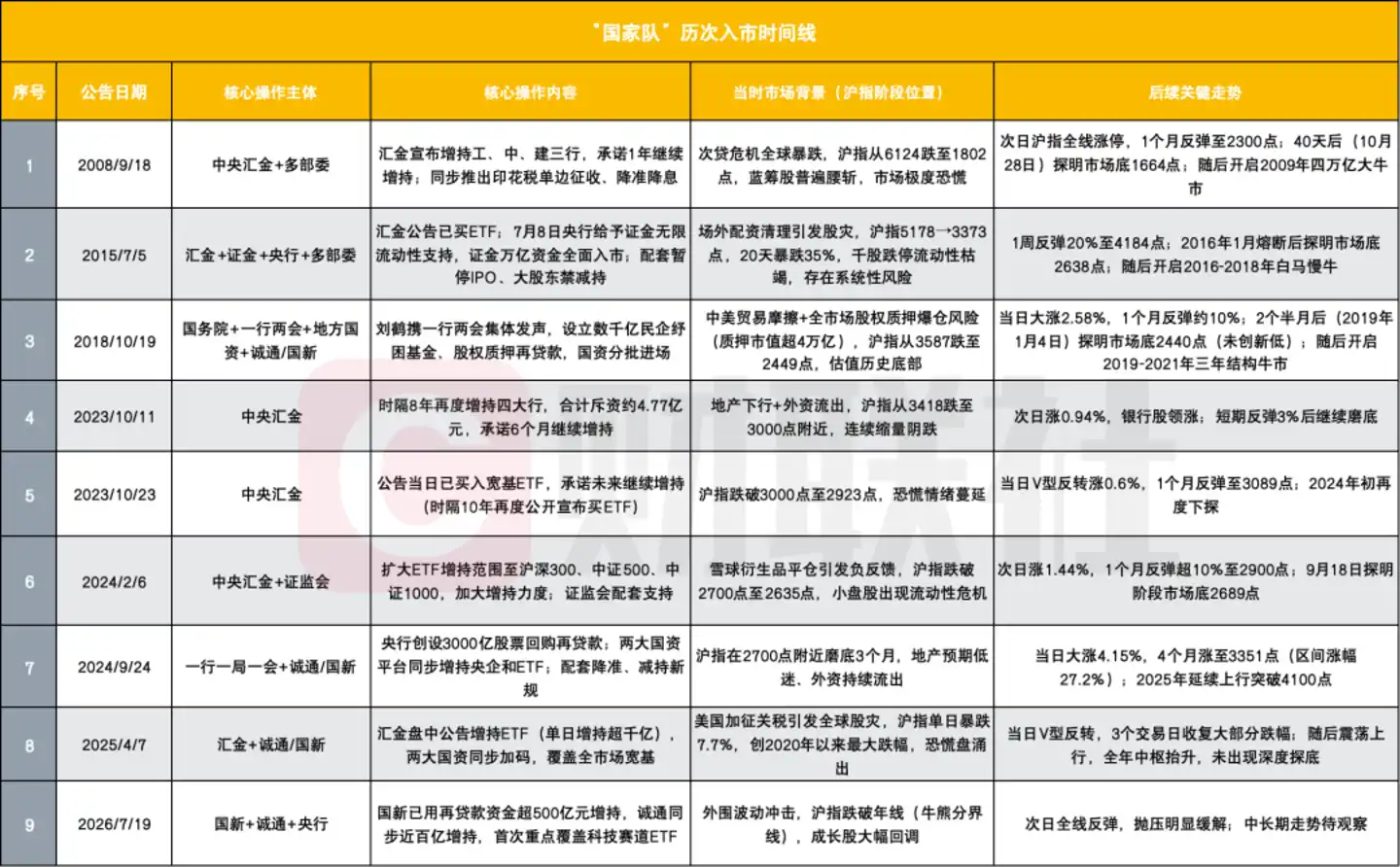
Third, historical experience shows that the market is often at a stage bottom after the "National Team" enters.

Since 2008, in multiple counter-cyclical interventions by the "National Team", although short-term trends varied, looking at longer cycles, the win rate of following the National Team's rhythm hasn't been poor. Particularly after the interventions on September 24, 2024, and April 7, 2025, the market stabilized quickly and embarked on sustained trending rallies.
Source: Cailian Press

Notably, another innovative tool has been added to the policy toolkit for stabilizing the capital market — the Special Relending Facility for Stock Buybacks and Shareholding Increases (established in September 2024, first phase 300 billion yuan), integrating capital market stability into the macro-policy regulatory framework.

This facility, combined with the 500 billion yuan swap line quota, brings the total available pool to 800 billion yuan. Currently, the actual utilization rate is not high; collectively, hundreds of billions of yuan in backup funds remain available.

Therefore, this intervention is not simple market-propping, but a clear signal of policy intent.

03 Three Lines Supporting the Market: Where Does the Confidence Come From?

Beyond the capital logic, A-shares have sufficient resilience, and intrinsic upward momentum is not lacking.

Strategically categorized, A-shares can be divided into four core types: finance, consumption, cyclical, and tech. Their combined force determines the market's direction. Not just tech, but consumption, cyclical, and financial lines all possess strong intrinsic recovery momentum.

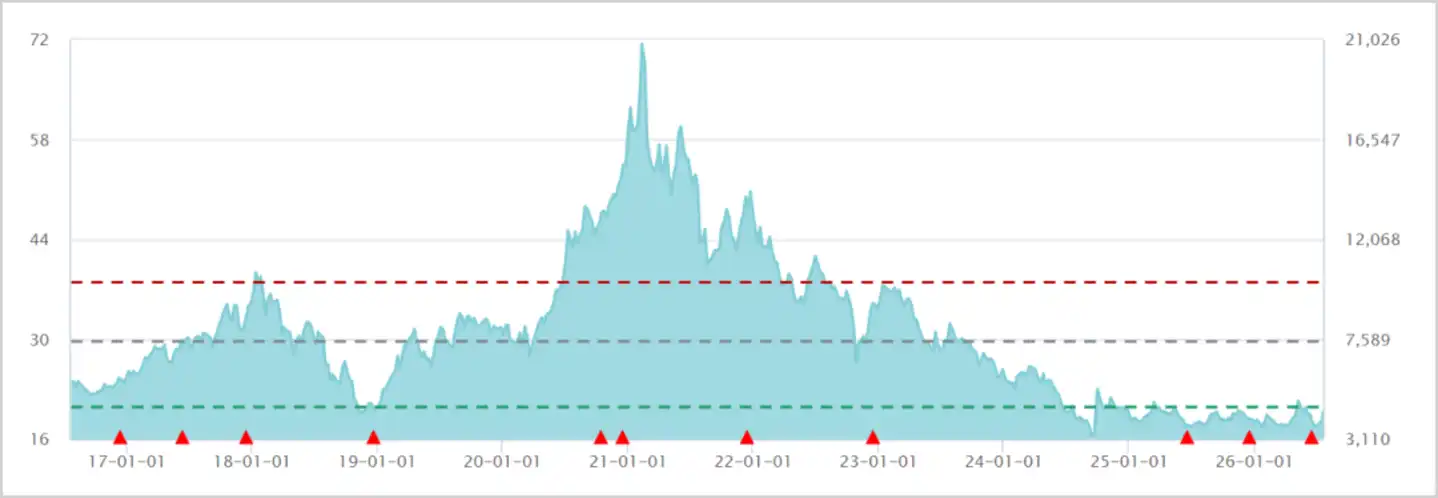
First, consumption. From a macro perspective, the CPI has stabilized above 1% for five consecutive months, whereas it fluctuated between -0.8% and 0.8% for nearly three years prior. Continuous price increases for consumer goods indicate marginal improvement in the profit predicament of consumer stocks. For consumer stocks that have fallen for five years, with valuations at absolute lows over the past decade, this could be a beam of light illuminating the darkness.
CSI Liquor Index PE Chart, Source: Wind

From a corporate perspective, Kweichow Moutai, as a bellwether for the baijiu and even the entire food & beverage sector, has raised prices twice consecutively this year, with a cumulative increase exceeding 10%. This action indicates that after years of continuous inventory destocking, channel inventories have largely normalized. The deep adjustment in baijiu may be nearing its end, with signs of recovery emerging.

In the first half of this year, retail sales of tobacco and alcohol performed strongly, reaching a cumulative 354.7 billion yuan, up 13.2% year-on-year. This also supports the view that the most difficult period for baijiu consumption may be over.

Next, look at cyclical sectors led by aluminum, which may be facing a triple resonance.

First, high earnings momentum. In the first five months, non-ferrous metal profits grew 117% year-on-year, even faster than tech sectors like computing. Looking at specific companies, Yunnan Aluminium and Tianshan Aluminium saw net profit attributable to shareholders grow 171%–182% and 101.5% year-on-year, respectively.

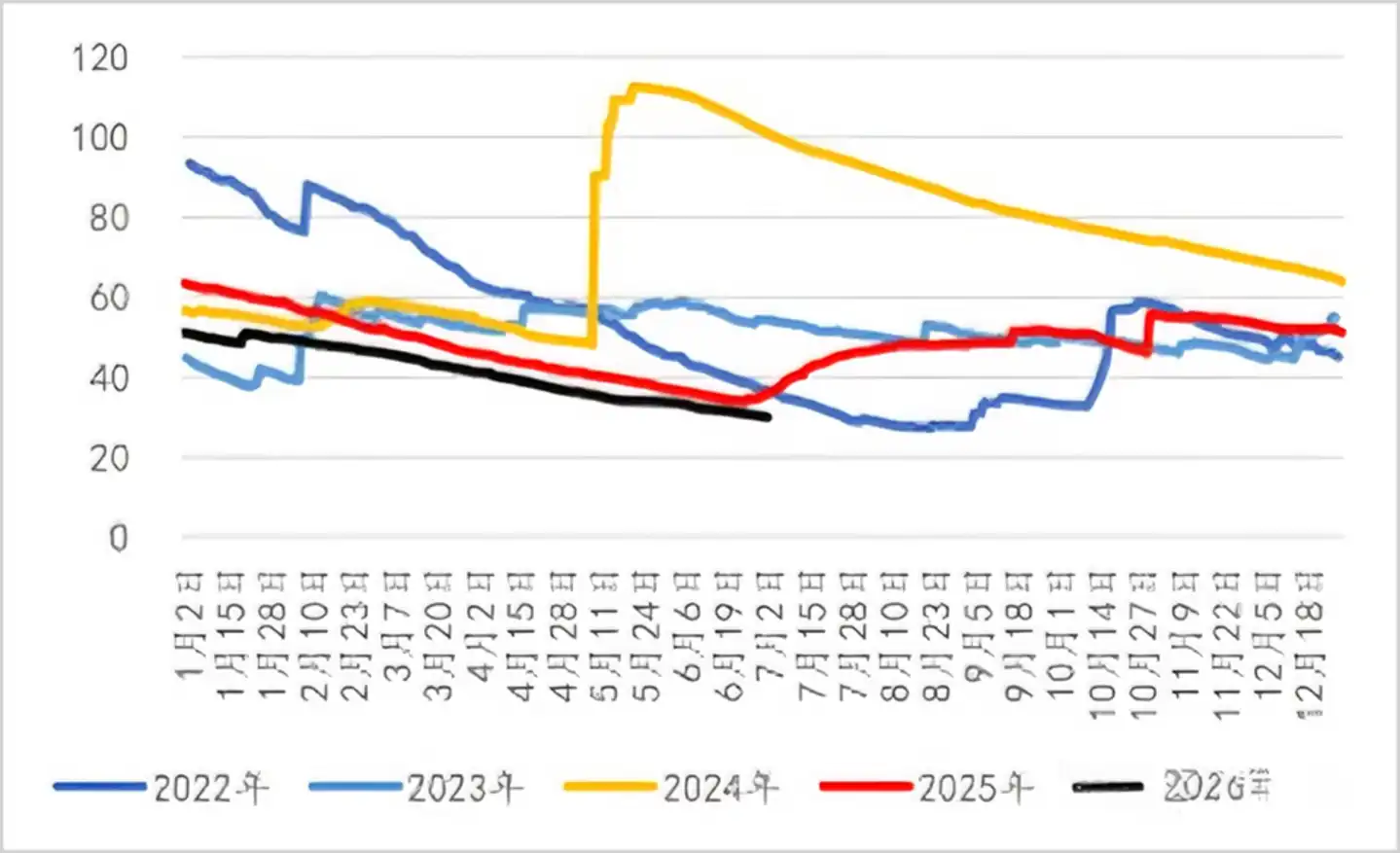
Second, there may still be price increase expectations in the second half of the year. On one hand, the global aluminum market remains in tight balance — demand continues to grow at 3%-5% overall driven by new energy vehicles, power, and "aluminum for copper" substitution in home appliances. On the supply side, China firmly maintains the 45-million-ton capacity ceiling. Against this backdrop, global aluminum inventories continue to decline, with LME aluminum stocks hitting multi-year lows.
LME Total Aluminum Inventory Chart, Source: Wind

On the other hand, there is significant uncertainty regarding the previously aggressive expectations for Fed rate hikes. For example, June's non-farm payroll and CPI data both came in below expectations, suggesting the pace of hikes may be delayed.

Third, since the end of January, aluminum companies have generally experienced maximum drawdowns of around 40% or more. Currently, the forward PE (2026E) for leading companies like Aluminum Corporation of China, Yunnan Aluminium, and Tianshan Aluminium is only 6-7 times. High earnings momentum, coupled with price increase expectations and low valuations, naturally provides recovery momentum for the future.

In fact, besides aluminum, metals like gold, silver, copper, and lithium share similar underlying logics.

Finally, look at the financial sector. Banks, as typical dividend assets, have stable fundamentals and relatively high dividend yields. Meanwhile, securities firms and insurers, benefiting from capital market activity, generally see high earnings growth, yet their valuations remain at multi-year lows.

Certainly, the rapid development of China's tech industry, especially continuous technological breakthroughs in the semiconductor, AI, and other industrial chains, achieving domestic substitution across multiple fields and expanding exports to capture overseas market share, leads to continuously improving earnings fundamentals and solid long-term value. Coupled with the intrinsic recovery momentum of the three major lines — consumption, cyclical, and financial assets, A-shares possess a fairly strong foundation for resilience.

Overall, this round of tech adjustment stems from external risk transmission, not a collapse in the growth cycle. The "National Team" decisively intervened to stabilize the bottom line of expectations. As the intrinsic momentum of consumption, cyclical, and financial sectors gradually takes over, the market may not be far from regaining stability.


Tiền kỹ thuật số thịnh hành

Câu hỏi Liên quan

QWhat are the two main reasons that support the resilience of A-shares in the face of external shocks, as discussed in the article?

AThe article highlights two key reasons for A-share resilience: 1) Strong fundamentals in key sectors like technology, where industries such as optical modules and chips maintain high profitability and growth (e.g., profit in the computer and electronic equipment manufacturing sector grew over 100% year-on-year in the first five months). 2) The 'national team' (state-backed institutions) actively intervened to stabilize the market by making substantial purchases (e.g., over 500 billion RMB by Guoxin Investment) and providing policy support, which boosted market confidence and liquidity.

QHow does the structure of China's technology sector differ from South Korea's, making it potentially more resilient according to the article?

AThe article explains that South Korea's stock market is heavily concentrated in a few memory chip giants (Samsung and SK Hynix account for about 50% of the market cap), making it vulnerable to sector-specific risks and leverage unwinding. In contrast, China's A-share technology sector is more diversified, spanning computers, communications, electronics, and within semiconductors, covering the entire supply chain from materials to design and manufacturing. It also has dual growth narratives—participating in the global AI supply chain and driving domestic substitution—making it less dependent on a single segment and more resilient to external shocks.

QWhat specific actions did the 'national team' take to support the A-share market during the recent volatility?

AThe 'national team' took several concrete actions: 1) State-owned institutions like Guoxin Investment announced market purchases exceeding 500 billion RMB, and China Chengtong bought nearly 100 billion RMB. 2) Central state-owned enterprises (e.g., China Aluminum, CRRC) announced share buybacks. 3) Major insurers (Ping An, CPIC, etc.) pledged to increase equity allocations, with China Life Asset Management alone making net purchases of over 100 billion RMB in a single day. 4) The policy tool of 'stock repurchase and增持 special relending' (with a total potential scale of 800 billion RMB) was also mentioned as a stabilizing measure.

QBeyond technology, what other major sectors in the A-share market does the article identify as having endogenous recovery momentum?

AThe article identifies three other major sectors with strong endogenous recovery momentum: 1) Consumer: Indicated by a stabilizing CPI (above 1% for five months) and leading companies like Kweichow Moutai raising prices, signaling easing inventory pressure and a potential end to the downturn. 2) Cyclicals (e.g., aluminum): Supported by high profit growth, potential price increases due to tight supply-demand balance, and low valuations after significant corrections. 3) Finance: Banks offer stable fundamentals and high dividends, while brokers and insurers benefit from capital market activity but trade at low valuations.

QWhat is the article's overall conclusion regarding the recent adjustment in A-shares, particularly the technology sector?

AThe article concludes that the recent adjustment in A-shares, especially in technology, was primarily caused by the spillover of external risks (like deleveraging in South Korean stocks) and not by a collapse in fundamental industry prosperity. It argues that with the 'national team' stepping in to stabilize expectations and provide a floor, and with the inherent recovery momentum in consumer, cyclical, and financial sectors, the market possesses strong resilience and is likely to return to a steady state in the near future.

Nội dung Liên quan

Sau ba quý liên tiếp suy giảm, thị trường tiền điện tử có thể đón cửa sổ ổn định trong quý III?

Thị trường tiền mã hóa vừa trải qua quý tồi tệ nhất kể từ năm 2022, với vốn hóa giảm 12.6% xuống 2.1 nghìn tỷ USD, khối lượng giao dịch sụt giảm và dòng tiền rút mạnh khỏi các quỹ ETF Bitcoin. Bitcoin và Ethereum lần lượt giảm 14.2% và 25.4% trong quý, đánh dấu sự đảo ngược so với mối tương quan trước đây với các tài sản rủi ro như Nasdaq. Dòng vốn ETF chứng khoán Mỹ ghi nhận dòng ròng rút khoảng 46.7 tỷ USD trong quý II, báo hiệu áp lực bán. Tuy nhiên, dấu hiệu tích cực ban đầu xuất hiện khi các nhà đầu tư dài hạn bắt đầu tích lũy trở lại và dòng ETF có đợt thu hút ngắn hạn. Toàn bộ thị trường hiện tập trung vào cuộc họp của Cục Dự trữ Liên bang Mỹ (FOMC) vào cuối tháng 7. Các tín hiệu chính sách tiền tệ sẽ quyết định xu hướng: tín hiệu ôn hòa có thể đẩy Bitcoin lên vùng 68,000-84,000 USD, trong khi lập trường cứng rắn có thể kéo giá về vùng 50,000-56,000 USD. Tiến trình pháp lý của Đạo luật CLARITY gần như đình trệ, làm giảm kỳ vọng và gia tăng phí rủi ro cho toàn ngành. Trong bối cảnh ảm đạm, hai lĩnh vực nổi bật là thị trường dự đoán (tăng trưởng 48.7%) và bộ sưu tập kỹ thuật số được mã hóa (tăng ~143%), cho thấy sự chuyển dịch nhu cầu thực tế. Nhìn chung, thị trường thiếu động lực cho một đợt tăng trưởng mạnh dựa trên tâm lý. Các quyết định giao dịch trong quý III sẽ chủ yếu xoay quanh diễn biến giá, lựa chọn chính sách và kỳ vọng lãi suất.

marsbit12 giờ trước

Sau ba quý liên tiếp suy giảm, thị trường tiền điện tử có thể đón cửa sổ ổn định trong quý III?

marsbit12 giờ trước

Giao Dịch SpaceX, Đã Mở Khóa: SPCXON Được Giao Dịch Trên WEEX

SpaceX đã thực hiện đợt IPO lớn nhất lịch sử vào tháng 6/2026, nhưng nhiều nhà giao dịch không thể tiếp cận do các rào cản như hạn chế môi giới và khu vực. Sàn giao dịch tiền điện tử WEEX đã giới thiệu SPCXON/USDT, một công cụ token hóa cho phép tiếp cận biến động giá của SpaceX thông qua tài khoản crypto được quyết toán bằng USDT, mà không cần môi giới Mỹ hay tài khoản ngân hàng. Sản phẩm này, xây dựng trên nền tảng cổ phiếu token hóa của Ondo, dành cho các nhà giao dịch bên ngoài Hoa Kỳ. Trường hợp đầu tư dựa trên đà tăng doanh thu Starlink và các cột mốc Starship, trong khi các yếu tố cần thận trọng bao gồm định giá cao, lượng cổ phiếu lưu hành công chúng ít và sự kiện mở khóa cổ phiếu nội bộ sắp tới. Lưu ý quan trọng: SPCXON cung cấp mức tiếp xúc với hiệu quả kinh tế, không phải quyền sở hữu cổ phiếu trực tiếp, và có thể giao dịch ở mức cao hơn hoặc thấp hơn giá trị tài sản ròng. WEEX tích hợp SPCXON cùng các sản phẩm TradFi token hóa khác như MicroStrategy (MSTRON) và Micron (MUON) vào một tài khoản thống nhất, cho phép luân chuyển giữa crypto và cổ phiếu dễ dàng. Sàn cũng đang chạy chiến dịch TradFi Trading Challenge với quỹ thưởng $50,000.

TheNewsCrypto12 giờ trước

Giao Dịch SpaceX, Đã Mở Khóa: SPCXON Được Giao Dịch Trên WEEX

TheNewsCrypto12 giờ trước

BIT Trading Hours: BTC Vẫn Chịu Áp Lực Từ Đường MA 200 Tuần, Bị Từ Chối Có Thể Tái Khởi Động Đợt Giảm, Ngành Lưu Trữ và Bán Dẫn Tăng Mạnh Đêm Qua Bắt Đầu Giảm Trong Khung Giờ Giao Dịch Ban Đêm

Bitcoin (BTC) hiện giao dịch quanh mức $66,000, đối mặt với vùng kháng cự mạnh gần $68,000 - nơi tập trung nhiều lệnh mua trước đó có thể chốt lời. Về mặt kỹ thuật, BTC đang nằm giữa đường trung bình động 200 tuần (MA ~$63,333) và đường trung bình động hàm mũ 200 tuần (EMA ~$68,328). Việc không thể vượt qua mức $68,000 có thể kéo giá về kiểm tra lại vùng hỗ trợ $63,000. Thị trường hiện có tính thanh khoản thấp và được xem là đang trong đợt phục hồi nhẹ. Trên thị trường chứng khoán Mỹ, các chỉ số tương lai giảm nhẹ. Nhóm cổ phiếu bán dẫn và lưu trữ, vốn tăng mạnh vào đêm trước, đã điều chỉnh giảm trong phiên giao dịch ngoài giờ. Tuy nhiên, Super Micro Computer (SMCI) tăng mạnh sau báo cáo doanh thu và đơn đặt hàng tích cực. Dầu thô tăng (trên $91) và lợi suất trái phiếu kho bạc Mỹ tăng cao tiếp tục gây áp lực lên thị trường cổ phiếu và làm dấy lên lo ngại lạm phát. Tại châu Á, thị trường Hàn Quốc phục hồi nhẹ cùng với cổ phiếu công nghệ, trong khi Nhật Bản thận trọng do đồng Yên yếu kỷ lục. Các sự kiện quan trọng sắp tới bao gồm báo cáo thu nhập từ các gã khổng lồ công nghệ như Alphabet, Tesla, IBM; sự kiện AI của AMD; và cuộc họp chính sách tiền tệ của Ngân hàng Trung ương châu Âu.

marsbit12 giờ trước

BIT Trading Hours: BTC Vẫn Chịu Áp Lực Từ Đường MA 200 Tuần, Bị Từ Chối Có Thể Tái Khởi Động Đợt Giảm, Ngành Lưu Trữ và Bán Dẫn Tăng Mạnh Đêm Qua Bắt Đầu Giảm Trong Khung Giờ Giao Dịch Ban Đêm

marsbit12 giờ trước

Chủ tịch CFTC cũ, Chủ tịch Circle Tarbert: Một mặt khuyên bạn chủ nghĩa dài hạn, mặt kia tự mình thoái vốn 30 triệu USD

Tác giả: Zen, PANews Trước tình cảnh cổ phiếu Circle (CRCL) giảm 70% so với đỉnh và bị hạ xếp hạng, Chủ tịch Heath Tarbert - cựu Chủ tịch CFTC - trong một cuộc phỏng vấn ngày 14/7 đã kêu gọi các nhà đầu tư kiên nhẫn và tập trung vào tầm nhìn dài hạn của công ty. Tuy nhiên, hành động của ông lại trái ngược hoàn toàn. Kể từ khi Circle IPO, Tarbert đã không ngừng bán cổ phiếu CRCL thông qua kế hoạch giao dịch 10b5-1 được lập trước, thu về tổng cộng khoảng 30 triệu USD. Ông chưa từng mua lại cổ phiếu trên thị trường mở, ngay cả khi giá cổ phiếu lao dốc. Bài viết nêu bật sự mâu thuẫn giữa lời nói "chủ nghĩa dài hạn" và hành động "thoái vốn" mạnh tay của Tarbert. Sự nghiệp của ông được mô tả là điển hình của "cánh cửa xoay" chính trị-thương mại Mỹ: từ các vị trí cấp cao tại Bộ Tài chính và CFTC, ông nghỉ hưu chỉ 27 ngày trước khi gia nhập Citadel Securities - một nhà tạo lập thị trường lớn - vào thời điểm công ty này đang đối mặt với cuộc điều tra của Quốc hội sau sự kiện GameStop. Sau đó, ông chuyển sang Circle, nơi ông được cho là đã sử dụng kinh nghiệm và quan hệ quản lý để giúp công ty vượt qua các rào cản pháp lý và niêm yết thành công. Bài báo đặt câu hỏi liệu Tarbert có thực sự tin vào tương lai dài hạn của Circle hay không, khi mà ông liên tục chốt lời trong khi lại khuyên các cổ đông nhỏ lẻ giữ vị thế. Nó gợi ý rằng mô hình của ông là tận dụng tối đa kiến thức về chu kỳ chính sách và cơ hội thị trường để biến các nguồn lực và uy tín tích lũy được thành lợi thế nghề nghiệp và tài chính cá nhân, trong khi rủi ro dài hạn được chuyển sang cho các nhà đầu tư tin tưởng vào những tường thuật công khai của ông.

marsbit13 giờ trước

Chủ tịch CFTC cũ, Chủ tịch Circle Tarbert: Một mặt khuyên bạn chủ nghĩa dài hạn, mặt kia tự mình thoái vốn 30 triệu USD

marsbit13 giờ trước

Gate Research: Làn sóng "phố Wall hóa" trong các sản phẩm tài chính tiền điện tử - Cạnh tranh hay Hội tụ?

Gate Research Institute: Sự hòa hợp hay cạnh tranh trong làn sóng "phố Wall hóa" các sản phẩm tài chính tiền mã hóa? Từ tầm nhìn ban đầu về một hệ thống tài chính phi tập trung, loại bỏ trung gian của Bitcoin, thị trường tiền mã hóa đang chứng kiến sự hội tụ mạnh mẽ với tài chính truyền thống (TradFi). Các quỹ ETF Bitcoin, tài sản thế giới thực được mã hóa (RWA) và trái phiếu chính phủ trên chuỗi cho thấy các tổ chức như BlackRock, Fidelity đang đưa tài sản mã hóa vào hệ thống phát hành, định giá, lưu ký và phân phối truyền thống. Tuy nhiên, đây không phải là một trò chơi tổng bằng không. Xu hướng này thể hiện sự bổ sung lẫn nhau: TradFi cung cấp khung pháp lý, mạng lưới phân phối rộng và sự tin cậy, trong khi Crypto mang lại tính mở, thanh khoản toàn cầu 24/7 và khả năng thanh toán lập trình được. Hai hướng đi tiêu biểu minh chứng cho sự hội tụ hai chiều: các sàn giao dịch tiền mã hóa (CEX) như Gate mở rộng sang giao dịch cổ phiếu thực, ETF thông qua cơ sở hạ tầng môi giới truyền thống; trong khi các công ty môi giới truyền thống như Robinhood tích hợp tài sản mã hóa và phát triển tài sản mã hóa (như cổ phiếu mã hóa) để thu hút người dùng. Mục tiêu chung của cả hai hướng là tranh giành "tài khoản tài chính tổng hợp" thế hệ tiếp theo - một điểm vào duy nhất nơi người dùng có thể giao dịch đa dạng tài sản từ cổ phiếu, tiền mã hóa đến RWA. Sự tăng trưởng mạnh mẽ của thị trường RWA, đặc biệt là cổ phiếu mã hóa, bất chấp xu hướng thị trường giảm, cho thấy đây là một xu hướng cấu trúc thực sự. Kết luận, "phố Wall hóa" không có nghĩa là thị trường tiền mã hóa bị TradFi thôn tính. Thay vào đó, đây là một sự chuyển đổi hai chiều, nơi cả hai hệ thống đang cùng nhau định hình lại thị trường vốn thành một cấu trúc hỗn hợp hiệu quả và toàn cầu hơn, với trải nghiệm người dùng liền mạch cho nhiều loại tài sản khác nhau.

marsbit13 giờ trước

Gate Research: Làn sóng "phố Wall hóa" trong các sản phẩm tài chính tiền điện tử - Cạnh tranh hay Hội tụ?

marsbit13 giờ trước

Giao dịch

Giao ngay

Bài viết Nổi bật

Làm thế nào để Mua CAP

Chào mừng bạn đến với HTX.com! Chúng tôi đã làm cho mua Cap (CAP) trở nên đơn giản và thuận tiện. Làm theo hướng dẫn từng bước của chúng tôi để bắt đầu hành trình tiền kỹ thuật số của bạn.Bước 1: Tạo Tài khoản HTX của BạnSử dụng email hoặc số điện thoại của bạn để đăng ký tài khoản miễn phí trên HTX. Trải nghiệm hành trình đăng ký không rắc rối và mở khóa tất cả tính năng. Nhận Tài khoản của tôiBước 2: Truy cập Mua Crypto và Chọn Phương thức Thanh toán của BạnThẻ Tín dụng/Ghi nợ: Sử dụng Visa hoặc Mastercard của bạn để mua Cap (CAP) ngay lập tức.Số dư: Sử dụng tiền từ số dư tài khoản HTX của bạn để giao dịch liền mạch.Bên thứ ba: Chúng tôi đã thêm những phương thức thanh toán phổ biến như Google Pay và Apple Pay để nâng cao sự tiện lợi.P2P: Giao dịch trực tiếp với người dùng khác trên HTX.Thị trường mua bán phi tập trung (OTC): Chúng tôi cung cấp những dịch vụ được thiết kế riêng và tỷ giá hối đoái cạnh tranh cho nhà giao dịch.Bước 3: Lưu trữ Cap (CAP) của BạnSau khi mua Cap (CAP), lưu trữ trong tài khoản HTX của bạn. Ngoài ra, bạn có thể gửi đi nơi khác qua chuyển khoản blockchain hoặc sử dụng để giao dịch những tiền kỹ thuật số khác.Bước 4: Giao dịch Cap (CAP)Giao dịch Cap (CAP) dễ dàng trên thị trường giao ngay của HTX. Chỉ cần truy cập vào tài khoản của bạn, chọn cặp giao dịch, thực hiện giao dịch và theo dõi trong thời gian thực. Chúng tôi cung cấp trải nghiệm thân thiện với người dùng cho cả người mới bắt đầu và người giao dịch dày dạn kinh nghiệm.

Tổng lượt xem 173Xuất bản vào 2026.06.26Cập nhật vào 2026.06.26

Làm thế nào để Mua CAP

Thảo luận

Chào mừng đến với Cộng đồng HTX. Tại đây, bạn có thể được thông báo về những phát triển nền tảng mới nhất và có quyền truy cập vào thông tin chuyên sâu về thị trường. Ý kiến ​​của người dùng về giá của CAP (CAP) được trình bày dưới đây.

活动图片












