Bernstein Analysis: Can the $142 Billion Long-Term Order Hold Up the Memory Cycle?

marsbitXuất bản vào 2026-07-21Cập nhật gần nhất vào 2026-07-21

Tóm tắt

Bernstein revisits long-term agreements (LTAs) in the memory industry, highlighting new contracts with purchase commitments, minimum prices, and financial guarantees signed by Micron and SanDisk. These aim to provide an earnings floor for the coming years. Micron has 16 strategic customer agreements, with 14 representing approximately $100 billion in minimum revenue and about $22 billion in cash deposits/commitments. SanDisk has contracts for around $42 billion in minimum revenue and over $11 billion in guarantees. Combined, these ~$33 billion in guarantees make it more costly for major clients to walk away. However, Bernstein models that the potential revenue needing protection over 3-5 years is around $5.2 trillion. The existing guarantees thus cover only about 0.6% of that scale. While LTAs provide a cushion, they cannot fully shield profits in a severe downturn, as clients may still find it cheaper to breach contracts if spot prices fall deeply below floor prices. LTAs are most suitable for large, credit-worthy customers like U.S. cloud service providers with stable, high-volume AI infrastructure needs. Consumer segments (phones, PCs) and some Chinese clients are less likely to adopt them, leaving an estimated 30-50% of the DRAM/NAND market exposed to spot price volatility. AI demand (e.g., HBM for training, storage for inference) supports higher valuations and makes LTAs more attractive for locking in high-demand customers. Yet, Bernstein stresses that LTAs soften, b...

In a recent report, Bernstein has brought the long-term purchase agreements in the memory industry back into the spotlight. Micron and SanDisk have signed new LTAs (Long-Term Agreements) with purchase commitments, minimum price floors, and financial guarantees, attempting to add a floor to profits for the coming years.

This floor is not as thick as it appears.

According to public filings and conference call comments from Micron and SanDisk, Micron has signed 16 strategic customer agreements. Of these, 14 agreements represent cumulative minimum revenue of approximately $100 billion calculated at minimum contract prices, with related cash deposits and financial commitments totaling about $22 billion. SanDisk disclosed that three contracts signed in the quarter correspond to around $42 billion in minimum contracted revenue, and five agreements collectively have financial guarantees exceeding $11 billion.

The combined $33 billion in guarantees from the two companies indeed makes it more expensive for large customers to walk away. However, Bernstein's model estimates the potential revenue that might need LTA protection over the next 3-5 years at approximately $5.2 trillion. By this report's metric, the existing guarantees only amount to about 0.6%.

This is precisely the divergence the report seeks to highlight: LTAs are changing the negotiation dynamics between memory companies and large customers, but they act more as a cushion for the downside of the cycle rather than transforming DRAM and NAND into utility-like businesses.

Major Customers Locked into Long-Term Agreements, Guarantees Begin to Translate into Real Money

LTAs are not complex. Customers commit to future purchase volumes years in advance, while suppliers provide supply assurances and pricing mechanisms. If a customer fails to purchase, they may forfeit prepaid guarantees or bear other economic costs.

What's different this time compared to the purchase intentions common in the memory industry's past is the emphasis on financial guarantees being incorporated into the contract structure.

Micron has signed 16 strategic customer agreements valid through June 2026, including 4 mega-customers and 3 mid-sized customers. Fourteen of these agreements represent cumulative minimum revenue of about $100 billion based on minimum contract prices, with expected cash deposits and related financial commitments of approximately $22 billion. This figure includes agreements signed both during and after the quarter and is not entirely equivalent to the RPO (Remaining Performance Obligation) on the balance sheet at period-end.

SanDisk disclosed an RPO of $41.6 billion as of April 3, 2026. The company also mentioned on its conference call that three contracts signed in the quarter provide about $42 billion in minimum contracted revenue, and five agreements collectively have over $11 billion in financial guarantees, covering over one-third of bit supply in FY27.

The mechanisms differ between the two companies. Micron's guarantees are more back-end weighted. As contracts progress and the customer's remaining purchase obligations decrease, the proportion of guarantees relative to RPO increases, making the cost of walking away heavier later in the contract. SanDisk's guarantees are closer to fixed amounts, expected to remain relatively stable throughout the contract period.
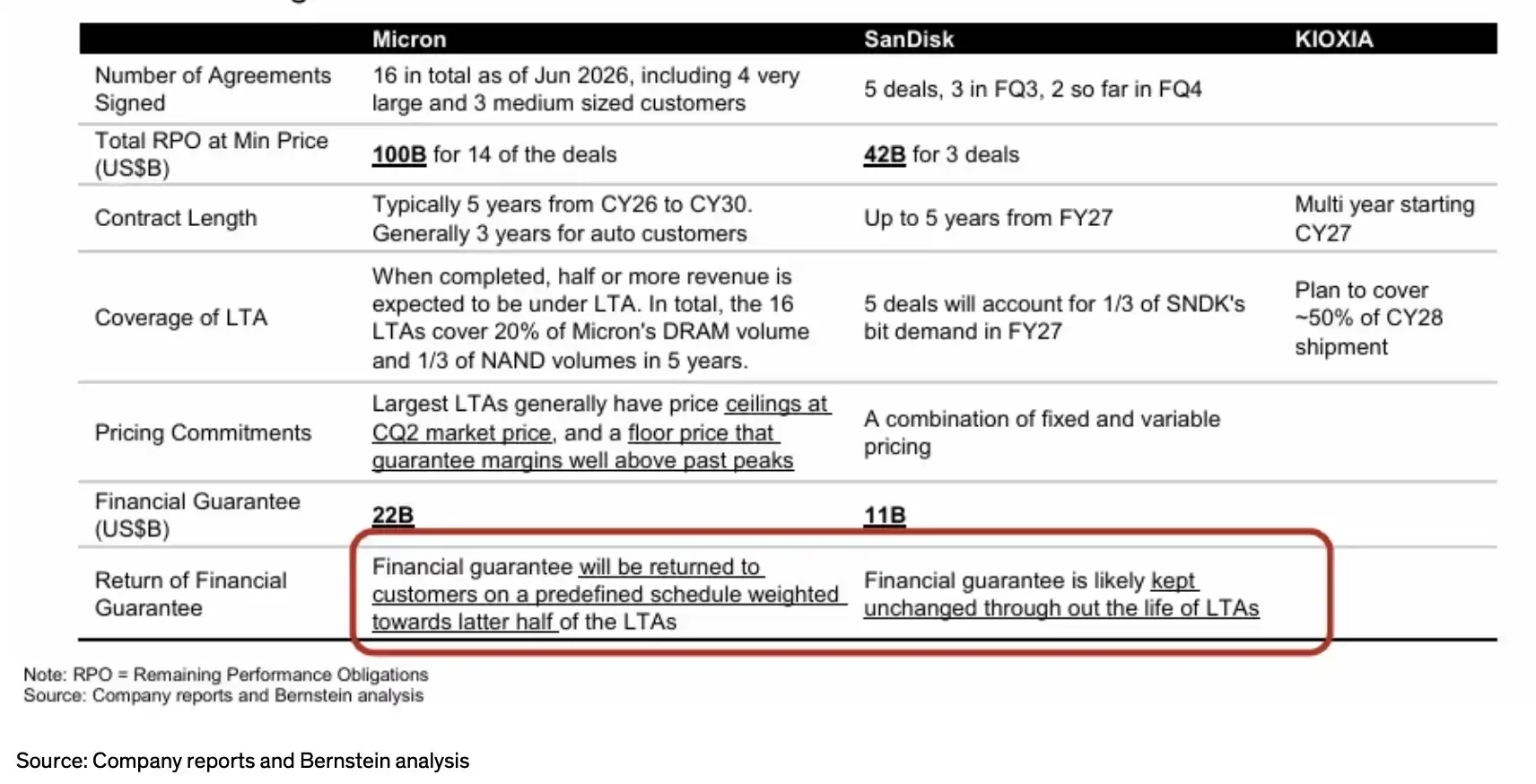
Micron: 16 agreements, ~$100 billion RPO, ~$22 billion guarantees; SanDisk: 5 agreements, ~$42 billion RPO, >$11 billion guarantees.

This is the point bulls focus on most. The biggest problem for the memory industry in the past has been the rapid collapse of profits when prices fall. If large customers are willing to pay guarantees for long-term supply, suppliers can at least gain a clearer revenue floor, and their capital expenditures and capacity planning need not be entirely dictated by spot prices.

$33 Billion in Guarantees Is Not Thin, But It Can't Fully Cushion a Deep Downturn

The scale of guarantees and the scale of revenue needing protection are not on the same order of magnitude.

Using its model, Bernstein estimates that if LTAs were to cover potential revenue over the next 3-5 years, the corresponding protection scale would be around $5.2 trillion. This figure is based on the report's model; public company filings do not directly disclose a similar industry-wide revenue metric, and distinctions need to be made between memory, total semiconductor revenue, and supplier sample revenue.

Nevertheless, the 0.6% guarantee ratio still indicates one thing: LTAs cannot prop up profits under all price scenarios.

If spot prices fall only mildly, it is not economical for customers to walk away. The costs of losing the guarantee, damaging the supply relationship, and potentially losing access to scarce capacity in the future are enough to keep customers fulfilling their obligations. Customers like AI server, cloud, and data center clients also have a stronger need for stable supply than typical consumer electronics customers.

However, if prices fall deeply enough, customers will still do the economic math. If the remaining purchase volume is still large and the spot price falls sufficiently below the contractual floor price, customers may find it cheaper to buy on the open market, even after accounting for the lost guarantee.

The back-end weighting mechanism can mitigate this issue. As the contract nears its end and the remaining RPO declines, the proportion of the guarantee relative to the remaining obligation rises, increasing the customer's cost of abandoning the contract. Protective power may be stronger in the later stages of the contract, which is precisely when the memory cycle often needs it most.

It is still not unconditional insurance. The protective power of LTAs depends on three numbers: how low spot prices fall, how much purchase obligation the customer has left, and how much guarantee balance remains.
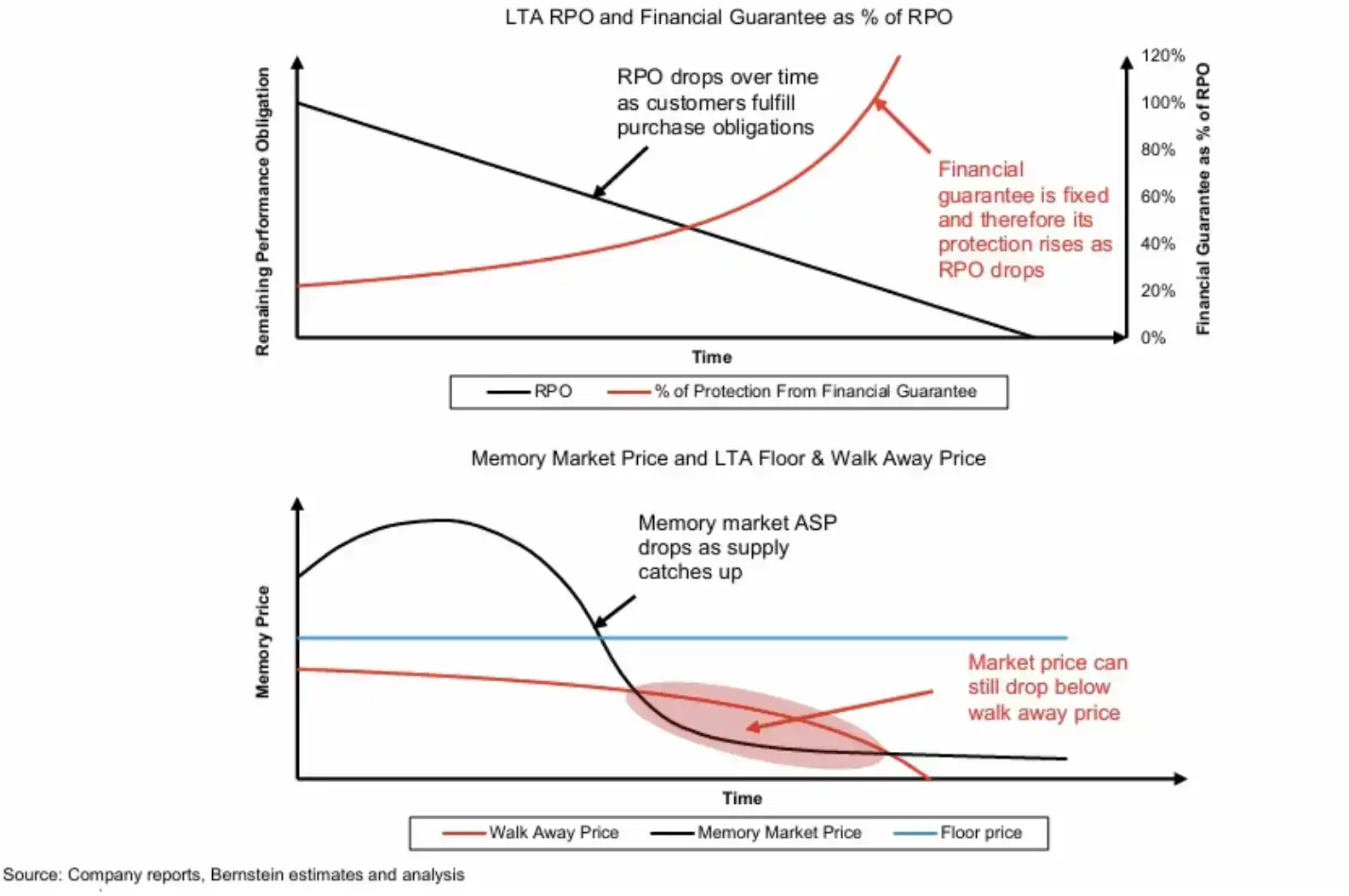
RPO declines over time, guarantee/RPO ratio rises; if spot ASP falls too far below the contract floor price, customers may still choose to walk away.

This is also the core of the bull-bear divergence. Bulls see memory companies finally securing long-term commitments backed by real money from customers. Bears worry that the scale of these commitments is still insufficient to protect peak profits, and that customers will still act based on cost if the downturn is deep enough.

Not All Memory Demand Is Willing to Be Locked into LTAs

LTAs also have a practical limit: not all customers are suitable for long-term agreements.

U.S. cloud service providers are ideal candidates. They have large demand, strong credit, are sensitive to supply stability for AI infrastructure, and have more incentive to lock in supply via long-term agreements. Micron has largely completed negotiations with U.S. CSPs and is still progressing with Chinese CSPs, enterprises, and some other customers.

The consumer business is different. SanDisk's CFO has stated that the consumer business is "more transactional" and LTAs are "not applicable." Mobile phones, PCs, and consumer storage channels are more accustomed to purchasing based on price and inventory cycles. Once prices fall, customers naturally want to maintain flexibility rather than being locked into multi-year floor prices.

Chinese customers may also not become stable buyers under LTAs. On one hand, Chinese cloud vendors and end customers may prefer local suppliers. On the other hand, the expansion of local DRAM and NAND supply adds uncertainty to long-term purchase commitments.

Bernstein estimates that approximately 30%-50% of the total DRAM and NAND end-market share may be difficult to cover with LTAs. Even if leading suppliers lock in major U.S. customers, a significant portion of the market will continue to operate based on spot prices, short-term orders, and cycle expectations.
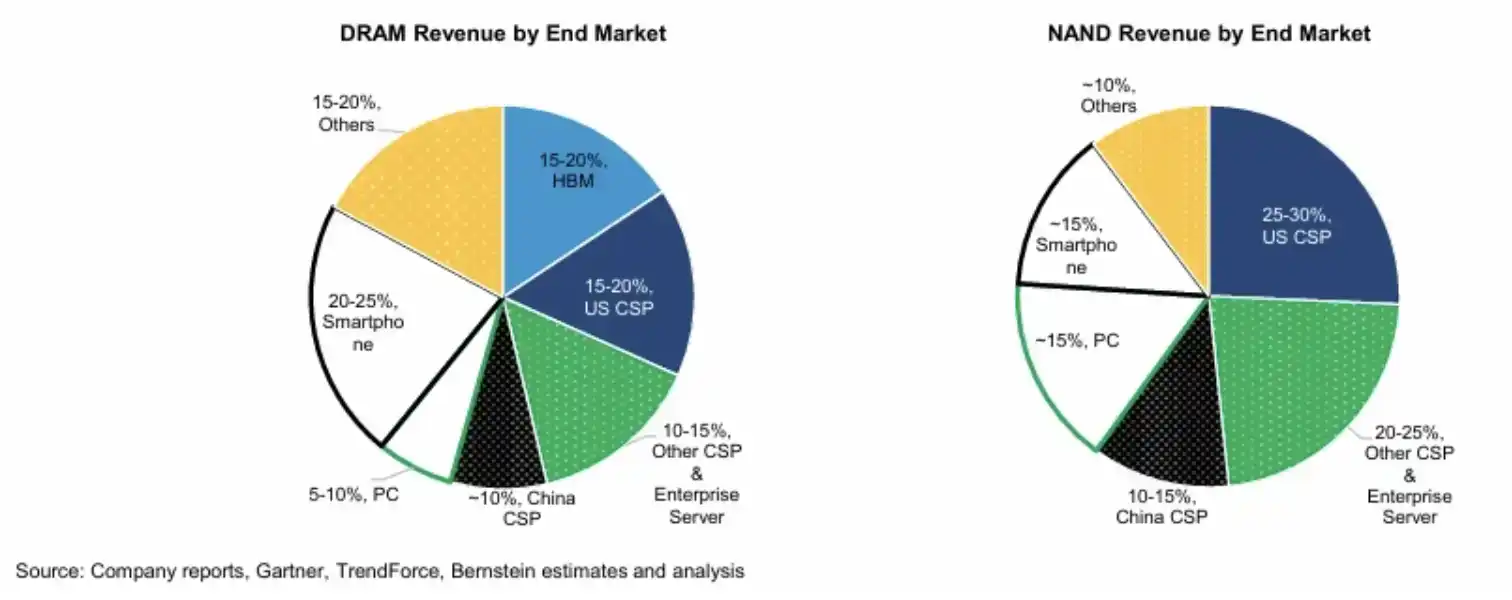
A breakdown of the DRAM/NAND end-market shows that beyond U.S. CSPs, there is demand from Chinese CSPs, enterprise servers, consumer/PCs, smartphones, etc. About 30%-50% of the market may be difficult to cover with LTAs.

As long as a sufficiently large proportion of demand remains in the spot or short-term contract system, price signals will not disappear. As long as price signals exist, supplier capacity expansion, customer inventory destocking, and channel order cuts will still amplify cyclical fluctuations.

AI Demand Supports Valuations, But Peak Profits Cannot Be Simply Extrapolated

The market's willingness to assign higher valuations to memory companies is partly due to AI demand altering the shape of this cycle's bottom.

On the DRAM side, HBM demand remains strong. Bernstein's Asia team predicts HBM prices in 2027 could be 2-2.5 times higher than in 2026. Commercial prices for conventional DRAM have already risen significantly and may remain elevated over the next 12 months. While HBM is more stable than ordinary memory, it shares some production capacity with conventional DRAM, and capacity allocation decisions affect other product lines.

On the NAND side, AI inference and longer context windows also bring new demand potential. Early AI training primarily consumed HBM and DRAM, but as inference, Agentic AI, and long-context applications increase, storage demand may continue to rise. It should be noted that references to Vera Rubin-related capacity should not simply be written as "GPU NAND capacity"; Nvidia's official page discloses 20.7TB of HBM4 GPU memory.

In this environment, the value of LTAs is more akin to locking down a portion of high-growth revenue. If AI demand remains strong, suppliers can secure purchases from some large customers via long-term agreements. If prices retreat, the guarantees and floor prices can slow the profit decline.

SanDisk's stress tests point to similar conclusions. Bernstein's model shows that under stringent assumptions, LTAs can still result in FY29-FY30 EPS being higher than in a no-LTA scenario across most penetration rate scenarios, with protection being particularly stronger in later periods. However, the same set of stress tests also indicates that peak profits cannot be simply extrapolated. Under lower operating margin scenarios, EPS could be significantly below current run-rate levels.
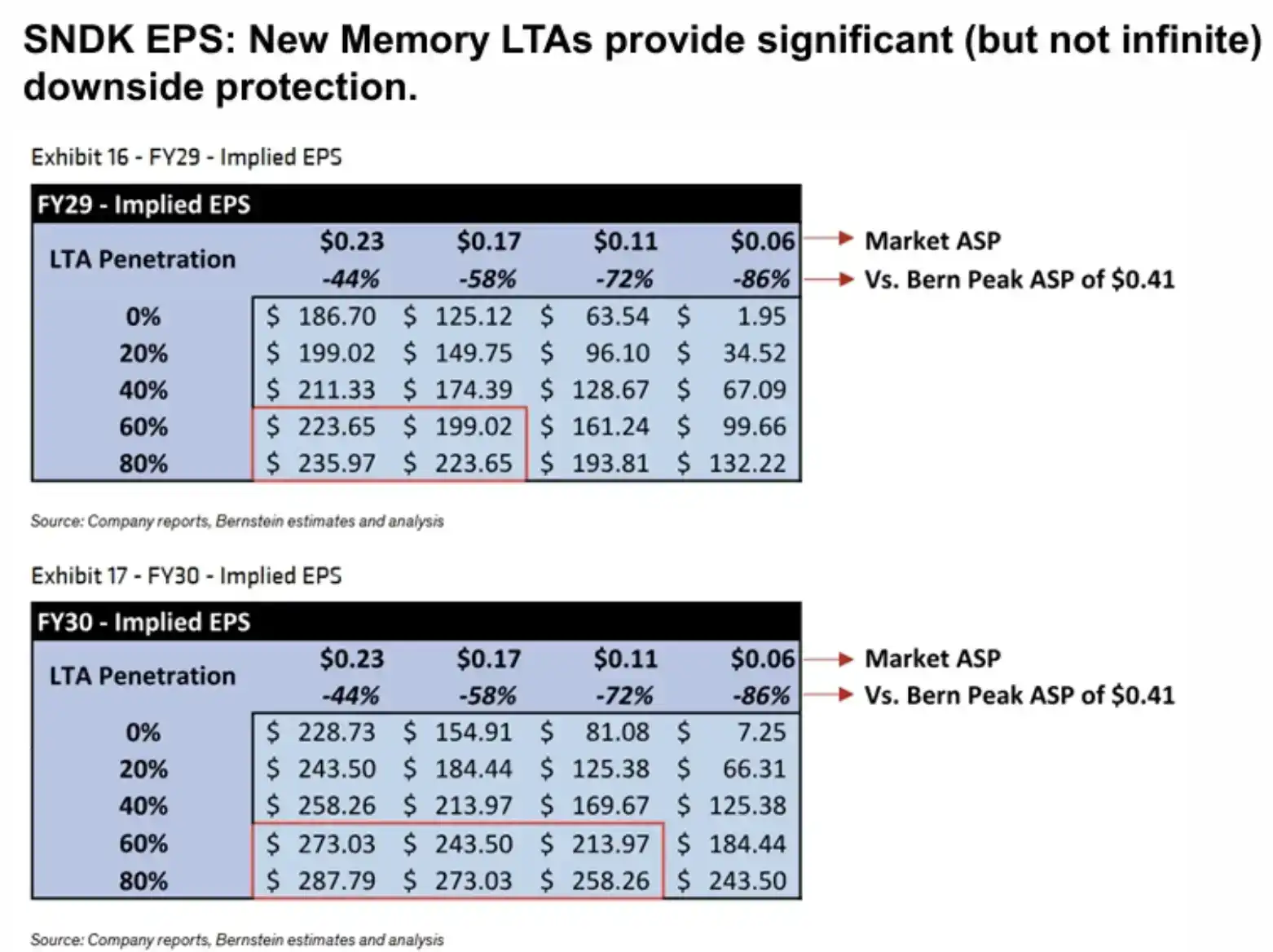
SanDisk FY29-FY30 EPS sensitivity table shows a wide EPS range under different ASP and LTA penetration rate scenarios. LTAs improve downside scenarios but cannot lock in peak profits.

The most valuable takeaway from this report is not "the memory cycle is over," but rather "the downside of the cycle may be softened."

The fact that Micron and SanDisk have secured long-term agreements with financial guarantees indicates that major customers are willing to pay for supply certainty in the AI era. For memory companies, this improves revenue visibility for the coming years and makes it easier for capital markets to believe in a higher profit floor than in the past.

The limitations are equally clear. $33 billion in guarantees can only provide a partial buffer; consumer, Chinese customer, and some transactional demand will not all enter long-term agreements. Bernstein also estimates that China's DRAM share could rise from about 8% to 16% in the coming years, and NAND may face stronger supply pressure post-2028.

What LTAs truly need to prove is not whether they can be signed during an upturn, but whether customers will honor them in the next downturn, whether the guarantees will be painful enough, and whether suppliers will maintain capacity discipline. Until these questions are answered, LTAs are a new cushion for the memory industry, not the button that ends the cycle.

Tiền kỹ thuật số thịnh hành

Câu hỏi Liên quan

QWhat is the main argument presented by Bernstein regarding the Long-Term Agreements (LTAs) in the memory industry?

ABernstein argues that LTAs, backed by financial guarantees, provide a buffer against downturns in the memory cycle but do not eliminate the cyclical nature of the industry. They change negotiation dynamics and improve revenue visibility for suppliers, yet the scale of guarantees (around $33 billion) is insufficient to fully protect earnings during a deep downturn, as it only covers about 0.6% of the potential revenue needing protection over 3-5 years.

QHow do the LTA mechanisms of Micron and SanDisk differ according to the report?

AMicron's guarantees are more back-end weighted; as the contract progresses and the customer's remaining purchase obligations decrease, the guarantee becomes a larger proportion of the remaining obligation, making it more costly to breach later. SanDisk's mechanism involves more fixed-amount guarantees, where the guarantee amount remains relatively stable throughout the contract period.

QWhat portion of the DRAM and NAND end-market is estimated to be difficult to cover with LTAs, and why?

AApproximately 30%-50% of the DRAM and NAND end-market is estimated to be difficult to cover with LTAs. This includes consumer segments (like smartphones and PCs), Chinese customers, and other transactional demand, which prefer flexibility and short-term orders based on price and inventory cycles rather than being locked into long-term floor prices.

QUnder what conditions might a customer still choose to breach an LTA despite the financial guarantees?

AA customer might choose to breach an LTA if the spot price falls significantly below the contract floor price to a point where the cost of buying on the spot market, even after forfeiting the financial guarantee, becomes cheaper than fulfilling the remaining purchase obligations under the contract.

QWhat role does AI demand play in the context of LTAs and memory cycle valuation, according to the Bernstein report?

AAI demand, particularly for HBM in DRAM and potential growth in NAND for AI inference and long-context applications, supports higher valuations for memory companies. LTAs help lock in a portion of this high-demand revenue from major clients (like US cloud providers). However, the report cautions that peak profitability from the AI cycle cannot be simply extrapolated, as LTAs provide a floor but do not guarantee sustained peak earnings, especially if broader market conditions deteriorate.

Nội dung Liên quan

Vụ ly hôn của Choi Tae-won chính thức kết thúc: Tiết lộ tuyến kế thừa ẩn sau đế chế nghìn tỷ SK Hynix

Vào tháng 11/2024, trong một sự kiện kỷ niệm, Chủ tịch SK Group Choi Tae-won đã cho các con xem hình ảnh AI tái hiện người cha quá cố của mình, nhấn mạnh về việc kế thừa di sản. Trong bối cảnh SK Hynix trở thành tài sản trị giá nhất Hàn Quốc, câu chuyện kế thừa thế hệ thứ ba của tập đoàn này lại không đi theo kịch bản truyền thống. Choi Yun-jung (sinh 1989), trưởng nữ, được coi là ứng viên kế thừa rõ ràng nhất. Cô có nền tảng học thuật về sinh học, từng làm tư vấn, hiện đang học tiến sĩ và giữ chức vụ lãnh đạo tại SK Bioscience và bộ phận hỗ trợ tăng trưởng của SK Inc. Cuộc hôn nhân của cô với một doanh nhân khởi nghiệp AI cũng phản ánh sự thay đổi trong các mối liên kết giữa các giới tinh hoa. Choi Min-jung (sinh 1991), con gái thứ, có hành trình khác biệt: học đại học tại Bắc Kinh, tình nguyện gia nhập Hải quân Hàn Quốc và từng làm việc tại SK Hynix ở Washington về các vấn đề chính sách quốc tế. Cô hiện là nhà sáng lập một công ty chăm sóc sức khỏe AI và kết hôn với một cựu sĩ quan Thủy quân Lục chiến Mỹ, cho thấy mạng lưới toàn cầu và an ninh chuỗi cung ứng ngày càng quan trọng đối với các tập đoàn bán dẫn. Choi In-geun (sinh 1995), con trai trưởng, có lộ trình học vấn tương đồng với cha (vật lý) và đang làm việc tại McKinsey sau thời gian ở SK E&S. Dù mang hình mẫu người kế thừa truyền thống, anh lại là người ít lộ diện công khai nhất. Cuộc chiến ly hôn kéo dài giữa Choi Tae-won và vợ cũ Roh So-young, với giá trị tài sản tranh chấp lên tới hàng nghìn tỷ won, là bối cảnh phức tạp mà thế hệ thứ ba phải đối mặt. Cả ba người con đều đã đệ đơn lên tòa án trong vụ việc này, dù nội dung không được tiết lộ. Tóm lại, trong kỷ nguyên AI khi SK Hynix trở thành tài sản địa chính trị toàn cầu, việc kế thừa tại SK Group không còn là chuyện nội bộ gia đình hay chỉ xoay quanh cổ phần và quyền trưởng nam. Thế hệ thứ ba được định vị thông qua năng lực chuyên môn, mạng lưới quốc tế và khả năng giải quyết những thách thức của thời đại công nghệ và địa chính trị mới.

marsbit4 giờ trước

Vụ ly hôn của Choi Tae-won chính thức kết thúc: Tiết lộ tuyến kế thừa ẩn sau đế chế nghìn tỷ SK Hynix

marsbit4 giờ trước

Các ngân hàng phản đối thỏa thuận lợi suất stablecoin – Liệu Đạo luật CLARITY có thể giành được 60 phiếu?

Viện Chính sách Ngân hàng Hoa Kỳ (BPI) đã phản đối dự thảo Đạo luật CLARITY mới, chỉ ra những thiếu sót về quy định lợi suất stablecoin và chống tài trợ bất hợp pháp. Ngành ngân hàng muốn cấm hoàn toàn mọi hình thức khuyến khích từ stablecoin, trong khi dự thảo hiện tại chỉ cho phép dựa trên hoạt động tài khoản, không phải số dư nhàn rỗi. Sự phản đối này ảnh hưởng đến cơ hội thông qua đạo luật tại Thượng viện, nơi cần 60 phiếu. Sự ủng hộ từ đảng Cộng hòa có thể giảm xuống còn 49 phiếu nếu các Thượng nghị sĩ John Curtis và John Cornyn rút lại hỗ trợ, đòi hỏi 11 phiếu từ đảng Dân chủ. Tuy nhiên, một số nhà lập pháp Dân chủ ủng hộ tiền mã hóa cũng phản đối dự luật do lo ngại về đạo đức và chống rửa tiền. Lãnh đạo đa số Thượng viện John Thune tỏ ra hoài nghi về khả năng thông qua dự luật trước kỳ nghỉ tháng Tám, chỉ còn hai tuần. Cố vấn trưởng về Tiền mã hóa của Nhà Trắng, Patrick Witt, kêu gọi tiến hành bỏ phiếu ngay. Kỳ vọng thị trường về việc thông qua đạo luật trong năm 2026 đã giảm xuống còn 32%.

ambcrypto4 giờ trước

Các ngân hàng phản đối thỏa thuận lợi suất stablecoin – Liệu Đạo luật CLARITY có thể giành được 60 phiếu?

ambcrypto4 giờ trước

Giá trị gia tăng từ 88 tỷ lên 680 tỷ chỉ sau 2 tháng! OpenRouter, trạm trung chuyển AI lớn nhất sắp được mua lại

Theo tờ Wall Street Journal và The Information, Stripe - nền tảng thanh toán hàng đầu - đang đàm phán mua lại startup AI OpenRouter với giá khoảng 10 tỷ USD. Chỉ hai tháng trước, định giá của OpenRouter là 1,3 tỷ USD, tức giá chào mua cao hơn gần 7 lần. Thương vụ có thể được công bố trong vòng một tháng nhưng vẫn có nguy cơ đổ vỡ. OpenRouter hoạt động như một "trung tâm chuyển tiếp" AI, cung cấp một API duy nhất để các nhà phát triển truy cập vào hơn 400 mô hình lớn (như GPT, Claude). Nó tự động lựa chọn mô hình phù hợp dựa trên độ phức tạp, chi phí và tốc độ, giúp các ứng dụng AI tối ưu hóa hiệu quả chi phí. Được đồng sáng lập bởi Alex Atallah (cựu đồng sáng lập OpenSea), OpenRouter hiện có hơn 1 triệu nhà phát triển và doanh thu hàng năm đạt 50 triệu USD, tăng gấp 5 lần trong nửa năm. Đây là bước đi chiến lược tiếp theo của Stripe trong việc mở rộng sang hạ tầng AI, sau khi họ mua lại nền tảng định giá theo lượng sử dụng Metronome vào cuối năm 2025. Mục tiêu của Stripe là kết hợp khả năng định tuyến mô hình của OpenRouter với hệ thống thanh toán và đo lường sử dụng hiện có, để trở thành "trung tâm điều phối và thu ngân" toàn diện cho nền kinh tế AI. Điều này cho phép doanh nghiệp quản lý toàn bộ việc sử dụng và hóa đơn AI qua một nhà cung cấp duy nhất.

链捕手4 giờ trước

Giá trị gia tăng từ 88 tỷ lên 680 tỷ chỉ sau 2 tháng! OpenRouter, trạm trung chuyển AI lớn nhất sắp được mua lại

链捕手4 giờ trước

Từ OpenSea Đến OpenRouter: Kịch Bản “Chốt Lời Đỉnh Cao” Của Alex Atallah Lại Lặp Lại?

Tác giả: Nancy, PANews Hơn bốn năm trước, Alex Atallah rời đi trước đỉnh bong bóng NFT; giờ đây, anh lại tỏa sáng trong cơn sốt AI và chuẩn bị bán nền tảng tổng hợp mô hình AI OpenRouter với giá cao. Ngày 23/7, theo Wall Street Journal, gã khổng lồ thanh toán Stripe đang đàm phán mua lại OpenRouter, với định giá giao dịch có thể lên tới gần 100 tỷ USD. Nếu thành công, đây sẽ là lần thứ hai Alex Atallah xây dựng một công ty trị giá hàng trăm tỷ USD, sau sàn giao dịch NFT OpenSea. OpenRouter, được mô tả là "Stripe của lĩnh vực AI", đã kết nối hơn 400 mô hình AI, có khoảng 10 triệu người dùng và xử lý hơn 200 nghìn tỷ token mỗi tháng. Tuy nhiên, mô hình kinh doanh chủ yếu dựa vào phí dịch vụ nền tảng (5%-5.5%) từ việc gọi API, với doanh thu hàng năm khoảng 50 triệu USD (tính đến tháng 4/2026). Đây là một mô hình kênh dẫn có quy mô lớn nhưng biên lợi nhuận hạn chế, dễ bị ảnh hưởng bởi sự cạnh tranh, mô hình nguồn mở và áp lực giảm giá. Giá trị thực sự của OpenRouter đối với các nhà mua tiềm năng như Stripe có thể nằm ở kho dữ liệu sử dụng AI thực tế khổng lồ mà nó tích lũy được, cung cấp insights quý giá về hiệu suất mô hình, sở thích nhà phát triển và quan hệ thay thế trên thị trường. Từ NFT đến AI, Alex Atallah hai lần bắt đúng xu hướng thời đại. Việc OpenRouter được định giá 100 tỷ USD đặt ra câu hỏi: đây là sự định giá lại giá trị cơ sở hạ tầng AI hay một tín hiệu đỉnh chu kỳ mới? Thời gian sẽ trả lời.

链捕手5 giờ trước

Từ OpenSea Đến OpenRouter: Kịch Bản “Chốt Lời Đỉnh Cao” Của Alex Atallah Lại Lặp Lại?

链捕手5 giờ trước

Pons V2 mang đến các cặp giao dịch RWA khi Robinhood Chain mở rộng tham vọng

Pons, một launchpad được xây dựng trên Robinhood Chain, đã ra mắt bản nâng cấp V2 với các thay đổi nhằm cải thiện thanh khoản, loại bỏ hạn chế giao dịch và hỗ trợ tài sản thực được mã hóa (RWA). Bản cập nhật này diễn ra trong bối cảnh Robinhood Chain tiếp tục tăng trưởng nhanh, vượt 300 triệu USD tổng giá trị bị khóa và nổi lên như một trong những mạng Lớp 2 Ethereum sôi động nhất cho giao dịch đầu cơ. Pons V2 giải quyết các phàn nàn chính của người dùng về thanh khoản bằng cách giới thiệu đường cong liên kết định danh bằng ETH, đồng thời cho phép hầu hết ví giao dịch tự do. Cấu trúc phí cũng được thiết kế lại để nhà phát triển có thể nhận phí bằng ETH mặc định. Robinhood Chain đã thu hút sự chú ý của thị trường, với khối lượng DEX tích lũy vượt 9 tỷ USD, trong đó 80% đến từ memecoin rủi ro cao. Tuy nhiên, lợi nhuận tập trung vào số ít, với 63% nhà giao dịch thua lỗ. Việc Pons V2 bổ sung các cặp giao dịch RWA tùy chỉnh trực tiếp hỗ trợ trọng tâm phát triển tài sản thực của Robinhood Chain, có thể thúc đẩy việc áp dụng mạng lưới một cách hữu cơ trong tương lai.

ambcrypto5 giờ trước

Pons V2 mang đến các cặp giao dịch RWA khi Robinhood Chain mở rộng tham vọng

ambcrypto5 giờ trước

Giao dịch

Giao ngay

Bài viết Nổi bật

Làm thế nào để Mua ORDER

Chào mừng bạn đến với HTX.com! Chúng tôi đã làm cho mua Orderly (ORDER) trở nên đơn giản và thuận tiện. Làm theo hướng dẫn từng bước của chúng tôi để bắt đầu hành trình tiền kỹ thuật số của bạn.Bước 1: Tạo Tài khoản HTX của BạnSử dụng email hoặc số điện thoại của bạn để đăng ký tài khoản miễn phí trên HTX. Trải nghiệm hành trình đăng ký không rắc rối và mở khóa tất cả tính năng. Nhận Tài khoản của tôiBước 2: Truy cập Mua Crypto và Chọn Phương thức Thanh toán của BạnThẻ Tín dụng/Ghi nợ: Sử dụng Visa hoặc Mastercard của bạn để mua Orderly (ORDER) ngay lập tức.Số dư: Sử dụng tiền từ số dư tài khoản HTX của bạn để giao dịch liền mạch.Bên thứ ba: Chúng tôi đã thêm những phương thức thanh toán phổ biến như Google Pay và Apple Pay để nâng cao sự tiện lợi.P2P: Giao dịch trực tiếp với người dùng khác trên HTX.Thị trường mua bán phi tập trung (OTC): Chúng tôi cung cấp những dịch vụ được thiết kế riêng và tỷ giá hối đoái cạnh tranh cho nhà giao dịch.Bước 3: Lưu trữ Orderly (ORDER) của BạnSau khi mua Orderly (ORDER), lưu trữ trong tài khoản HTX của bạn. Ngoài ra, bạn có thể gửi đi nơi khác qua chuyển khoản blockchain hoặc sử dụng để giao dịch những tiền kỹ thuật số khác.Bước 4: Giao dịch Orderly (ORDER)Giao dịch Orderly (ORDER) dễ dàng trên thị trường giao ngay của HTX. Chỉ cần truy cập vào tài khoản của bạn, chọn cặp giao dịch, thực hiện giao dịch và theo dõi trong thời gian thực. Chúng tôi cung cấp trải nghiệm thân thiện với người dùng cho cả người mới bắt đầu và người giao dịch dày dạn kinh nghiệm.

Tổng lượt xem 546Xuất bản vào 2024.12.10Cập nhật vào 2026.06.02

Làm thế nào để Mua ORDER

Thảo luận

Chào mừng đến với Cộng đồng HTX. Tại đây, bạn có thể được thông báo về những phát triển nền tảng mới nhất và có quyền truy cập vào thông tin chuyên sâu về thị trường. Ý kiến ​​của người dùng về giá của ORDER (ORDER) được trình bày dưới đây.

活动图片