With Mining Profits Depressed, What Kind of Mining Companies Can Survive a Bear Market?

Foresight NewsXuất bản vào 2026-07-07Cập nhật gần nhất vào 2026-07-07

Tóm tắt

Mining Profitability Slumps: Which Miners Can Survive the Bear Market? A comprehensive Bitcoin miner stress indicator has recently hit a historically low "extreme stress" zone, aligning with the typical market cycle pattern where industry bottoms coincide with severe miner pressure. The current situation presents a direct survival test: if hashprice (daily USD revenue per PH/s of computing power) remains weak, only the most robust mining firms will endure. Hashprice, which incorporates block rewards, transaction fees, network difficulty, and BTC price, is the core metric for mining profitability. Despite Bitcoin's price holding above previous lows, profitability is shrinking due to rising difficulty and low fees. Recent data shows hashprice around $32-33/PH/s/day, with a significant divide: newer, energy-efficient rigs (<19 J/TH) generate ~$81 per megawatt, while older, inefficient models (25-38 J/TH) make only ~$43/MW. This gap is forcing inefficient operators to shut down. The industry has a self-correcting mechanism. As high-cost miners power down, the network's total computing power (hashrate) drops. This eventually triggers a downward adjustment in mining difficulty, increasing the rewards for remaining miners. Data from Q2 2026 shows the hashrate has already fallen by 5.8%, with an estimated 252 EH/s of inefficient mining capacity idled. Firms at risk of淘汰 (elimination) are those reliant on old hardware, high electricity costs, and significant debt. Survivors will l...


Author: Liam Akiba Wright

Compiled by: Chopper, Foresight News


Recently, a comprehensive Bitcoin miner stress indicator circulated on X platform dropped to a historically rare zone of extreme pressure, once again confirming a classic bull-bear cycle logic: market bottoms are often accompanied by collective pressure on miners.


The practical impact of this cycle is more direct. If the hash price continues to weaken, the industry will face a survival test. Only high-quality mining companies can maintain continuous operation of their hash rate equipment, avoid forced Bitcoin sales, and wait for mining revenue to recover.


Analyst Gaah issued a recent signal that the Bitcoin miner cycle comprehensive stress indicator has dropped to a new low in 2026, entering a historically deeply undervalued zone. BitcoinNewsCom supplemented this view, describing it as a composite indicator of the Puell Multiple and the Inverse Miner Capitulation Index.
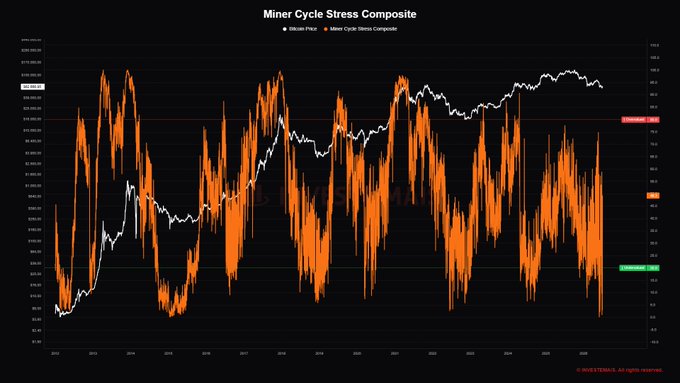

The comparison between the Bitcoin miner cycle comprehensive stress indicator and the Bitcoin price shows a temporal correlation between mining profitability pressure and major turning points in the market cycle. Source: Investemais


This composite indicator is an observation tool for miner stress built by the analyst. Its core underlying indicators remain hash price, network difficulty, total network hash rate, and mining company balance sheets. It can only reflect the degree of industry pressure and cannot alone determine if the market has bottomed out. What truly determines the industry's direction is the profit pressure that forces miners into actions like shutdowns and coin sales.


Hash Price: The Core Yardstick for Mining Profitability


The Puell Multiple is used to calculate the ratio of miners' block reward income to the annual average price of newly issued Bitcoin, intuitively reflecting the current cash flow status of mining.


This perspective is very applicable for miners because they run cash-based businesses. Electricity, server hosting, debt repayments, machine maintenance, repairs, and personnel costs all compete for market share with block reward income. When the dollar value of rewards declines, weaker miners are often the first to be eliminated.


However, hash price is a more intuitive measure of profitability. According to Luxor's Hashrate Index definition, hash price refers to the daily USD revenue that 1 PH/s of hash rate can generate, comprehensively including four variables: block subsidy, transaction fees, network difficulty, and the current BTC price. Even if the Bitcoin price hasn't broken below previous lows, unit hash rate revenue can still continuously shrink as long as difficulty increases, transaction fees remain low, and machine energy consumption is high.


Mining profitability has been tightening recently. The June 1st Hashrate Index weekly report showed hash price fell 9% weekly to $32.56 / PH/s/day, with the six-month forward average price only $31.71. Two weeks later on June 15th, data showed a slight rebound to $33.74, but the forward average remained at $32.13.


This slight rebound did not erase industry differentiation. Hashrate Index calculations show that new-generation low-power miners with unit energy consumption below 19 J/TH earn about $81 per megawatt of hash rate, while older, high-power models (25–38 J/TH) earn only $43 per megawatt. Under the same Bitcoin price environment, low-cost new mining farms can operate stably, while older, high-energy-consumption farms approach shutdown thresholds.


This huge profit gap transforms paper bottom indicators into real survival tests for companies. Mining companies holding new-generation miners, enjoying low electricity costs, having flexible curtailment agreements, and possessing sufficient cash flow can withstand the cycle and wait for difficulty adjustments. Companies relying on old equipment, facing high hosting costs, and operating with high debt have almost no buffer; once hash price remains low, they can only passively reduce production.


Who Will Be Eliminated?


Miner pressure has a self-adjusting mechanism, but the process accompanies industry pains. After a large number of miners shut down, the total network hash rate declines. If the hash rate contraction continues until the difficulty adjustment window, Bitcoin's network mining difficulty automatically decreases, and the unit block reward for surviving miners increases accordingly.


This is also the underlying logic behind the miner capitulation wave often seen at bear market bottoms: inefficient players exit first, and surviving mining companies share more block rewards after difficulty decreases. As long as the Bitcoin price and transaction fees don't keep falling, industry profit margins can gradually stabilize.


Second-quarter 2026 data has confirmed the effectiveness of this adjustment mechanism. The Hashrate Index's Q2 heatmap shows this round of hash rate decline stems primarily from profit pressure at the economic level. The network's 30-day moving average hash rate fell from 1066 EH/s in Q1 to 1004 EH/s in Q2, a quarterly decline of 5.8%. The report estimates that many old miners above 25 J/TH have turned gross profit negative, with approximately 252 EH/s of marginal inefficient hash rate in a shutdown state.


The Bitcoin price itself remains the cornerstone of the economic system. CryptoSlate market data shows that as of July 6, 2026, Bitcoin traded at $63,007, with a market capitalization of $1.26 trillion and a market share of 58.0%. However, miner profitability depends on a specific combination of factors: price, transaction fees, mining difficulty, electricity costs, and machine efficiency.


If the hash price remains at low levels around $30, the primary source of pressure is miner curtailment. Miners with high electricity costs or old machines may shut down hash power during unprofitable periods, especially if electricity can be resold or redirected. The second is miner cash flow. Miners holding Bitcoin can sell it or use it as collateral for loans, further increasing pressure during periods of already tight liquidity.


The third point is consolidation. Low-cost miners, better-capitalized public companies, and operators with newer machines can hold out longer than weaker competitors and potentially acquire mining farms, power contracts, or market share after difficulty decreases and reward distribution becomes fairer.


The fourth trend is the transition to AI and high-performance computing. Many mining companies are no longer solely reliant on Bitcoin mining for profits, using bear markets to host AI servers and open a second growth curve. However, only mining companies possessing land, power, cooling facilities, stable clients, and sufficient funds have practical value in implementing this transition; persistently low hash prices significantly increase the strategic value of this transition path. Wall Street capital has already positioned itself in mining company targets with AI computing businesses, even if the related data centers haven't been built yet.


Signals to Watch


The mining industry stress composite indicator is more suitable as an early warning signal; it cannot precisely predict the timing of the bottom. It indicates that mining industry revenue pressure has reached levels seen in previous stress cycles. But it does not indicate whether the market has fully repriced this pressure.


The subsequent signals are more specific: whether the hash price can recover to levels just above $30, whether mining difficulty will continue to decrease, whether the hash rate will stabilize, whether miners will sell more Bitcoin, and whether mining companies' AI computing deployments are genuine growth narratives or mere fundraising tools.


If the above indicators improve simultaneously, looking back, this round of miner pressure will have been just a bottoming phase. If the data continues to deteriorate, the industry will undergo a deeper round of reshuffling, with inefficient hash rate share continuously shrinking, benefiting surviving players after network-wide difficulty decreases.


Therefore, this bottom signal can also serve as a solvency test. Although the chart may be eye-catching due to its similarity to past cycle lows, if the recovery takes longer than expected, the hash price will determine which miners can continue to survive.

Câu hỏi Liên quan

QWhat is the core factor that determines which mining enterprises can survive a bear market according to the article?

AAccording to the article, the core factor determining survival is hash price. Enterprises with new, low-power mining machines, low electricity costs, flexible power curtailment agreements, and sufficient cash flow can endure cycles and wait for difficulty adjustments. Conversely, those relying on old equipment, high hosting costs, and high debt have little buffer and may be forced to shut down if hash prices remain low.

QWhat self-regulation mechanism exists for miner pressure, and what is its consequence?

AThe self-regulation mechanism is that when a large number of inefficient mining machines shut down, the overall network hashrate drops. If this decline continues until the next difficulty adjustment window, the Bitcoin mining difficulty automatically decreases. This increases the per-block rewards for the remaining miners. The consequence is industry consolidation, where inefficient players are eliminated first, allowing surviving miners to share a larger portion of the rewards.

QBesides hash price, what other key metric is mentioned as a direct measure of mining profitability?

AThe article mentions the Puell Multiple as another key metric. It measures the ratio of miners' block reward income (in USD) to the 365-day moving average of newly issued Bitcoin's price, providing an intuitive reflection of current mining cash flow health.

QWhat are the four main trends or pressures that miners face if hash prices remain around $30?

AThe four main trends or pressures are: 1) Curtailment: Miners with high electricity costs or old machines may shut off hashrate during unprofitable times. 2) Capital flows: Miners may sell Bitcoin or use it as collateral for loans, adding pressure in tight liquidity periods. 3) Consolidation: Low-cost, well-capitalized miners with newer machines can outlast weaker competitors and potentially acquire assets post-difficulty adjustment. 4) Diversification into AI/HPC: Some miners are pivoting to host AI servers, but this requires significant existing infrastructure and capital.

QWhat specific signals should be monitored to assess whether the mining industry is recovering from its stressed state?

AThe signals to monitor are: whether the hash price can recover to levels above $30, whether the mining difficulty continues to decrease, whether the network hashrate stabilizes, whether miners sell more Bitcoin, and whether the AI computing power布局 of mining companies represents genuine growth or is merely a fundraising narrative.

Nội dung Liên quan

‘Kích thích dân chủ’ với cái giá là an ninh? Bên trong vụ khai thác 20 triệu đô la của Bonk

BonkDAO vừa trở thành nạn nhân mới nhất của một vụ tấn công tiền mã hóa, với thiệt hại khoảng 20 triệu USD. Vụ việc xảy ra do một "đề xuất quản trị độc hại" được kẻ tấn công tạo ra sau khi tích lũy đủ token BONK. Với ngưỡng phê duyệt chỉ 1%, đề xuất này đã cho phép chuyển 4,4 nghìn tỷ BONK từ kho bạc vào ví của hacker. Các nhà phân tích bảo mật chỉ trích cấu hình ngưỡng bỏ phiếu quá thấp và thiếu các biện pháp an toàn như thời gian khóa hay yêu cầu nhiều lần phê duyệt cho các giao dịch lớn. Một chuyên gia nhận định, đây là một lỗ hổng bảo mật vận hành điển hình, đồng thời đặt câu hỏi về việc đánh đổi an ninh để "khuyến khích tính dân chủ" thông qua mô hình DAO. Ngay sau thông tin vụ việc, giá đồng BONK đã giảm 10%. Tuy nhiên, dữ liệu on-chain cho thấy các ví cá voi (lớn) vẫn tiếp tục tích lũy từ giữa tháng 6 và nhu cầu không bị ảnh hưởng đáng kể. Tương lai giá sẽ phụ thuộc vào diễn biến thị trường và tâm lý sau sự kiện này. Dự án cho biết đang phối hợp với cơ quan thực thi pháp luật, Quỹ Solana và các sàn giao dịch để xử lý sự cố.

ambcrypto40 phút trước

‘Kích thích dân chủ’ với cái giá là an ninh? Bên trong vụ khai thác 20 triệu đô la của Bonk

ambcrypto40 phút trước

Zoomex X Space Tóm Tắt Với David James Và Ban Giao Dịch World Cup

Zoomex đã tổ chức tập thứ ba của X Space Phiên bản World Cup với sự tham gia của thủ môn huyền thoại David James và các nhà giao dịch Crypto Kid, Farouk Bashar, Theo Mercier. James chia sẻ sâu về tâm lý thi đấu, đặc biệt là trong những tình huống đối mặt với áp lực và loạt đá luân lưu. Ông nhấn mạnh tầm quan trọng của sự chuẩn bị kỹ lưỡng, phân tích thông tin và việc luyện tập tinh thần – những yếu tố quyết định trong khoảnh khắc then chốt, đồng thời so sánh trực tiếp với sự chuẩn bị cần thiết trong giao dịch tài chính. James cũng đánh giá về các đội bóng tại World Cup, chỉ ra sức mạnh đa dạng của Pháp và thách thức tâm lý với những đội chưa để thủng lưới. Ông bày tỏ niềm tin mạnh mẽ rằng Anh Quốc có đầy đủ khả năng để vô địch giải đấu. Chương trình là một phần trong cam kết từ thiện của Zoomex, với 1.000 USDT sẽ được quyên góp cho UEFA Foundation nếu dự đoán vô địch của James thành hiện thực. Xuyên suốt buổi thảo luận, chủ đề chính được khẳng định: thành công, dù trên sân cỏ hay thị trường, đều bắt nguồn từ sự chuẩn bị kỹ càng để biến bản năng thành hành động quyết đoán và chính xác.

TheNewsCrypto50 phút trước

Zoomex X Space Tóm Tắt Với David James Và Ban Giao Dịch World Cup

TheNewsCrypto50 phút trước

Unitree hối hả lên sàn, bí ẩn thực sự là 42 tỷ nhận được sẽ tiêu như thế nào

Ngày 6/7, Ủy ban Chứng khoán Trung Quốc phê duyệt đơn đăng ký phát hành lần đầu ra công chúng (IPO) trên STAR Market của Unitree Robotics. Công ty này, với biệt danh "công ty làm chó robot", dự kiến huy động khoảng 4,202 tỷ nhân dân tệ (42,02 tỷ Yên), định giá sau IPO có thể lên tới 50 tỷ nhân dân tệ. Khởi đầu từ robot bốn chân, Unitree đã nhanh chóng mở rộng sang lĩnh vực robot hình người, với tốc độ ra mắt sản phẩm ấn tượng. Họ đã xây dựng một ma trận sản phẩm toàn diện, từ mức giá tiêu dùng 26.900 Yên (R1) đến phiên bản công nghiệp cao cấp. Sự tăng trưởng thương mại hóa của Unitree rất nổi bật, doanh thu năm 2025 đạt 1,71 tỷ nhân dân tệ, lợi nhuận 288 triệu, với hơn 5.500 robot hình người và hơn 30.000 robot bốn chân đã xuất xưởng. Thị trường nước ngoài đóng góp khoảng 40% doanh thu. Số tiền huy động được từ IPO sẽ được sử dụng để tăng cường nghiên cứu, phát triển sản phẩm mới và xây dựng cơ sở sản xuất, nhằm mục tiêu tiếp tục giảm chi phí và nâng cao trí tuệ cho robot. Tuy nhiên, Unitree đối mặt với thách thức lớn trong một thị trường cạnh tranh ngày càng khốc liệt, với các đối thủ như Ubtech, Tesla Optimus, Fourier và 1X Technologies. Tương lai của Unitree sẽ phụ thuộc vào ba yếu tố chính: 1) Tìm được ứng dụng ngành then chốt thứ hai ngoài robot bốn chân (ví dụ: hậu cần sân bay như thử nghiệm tại Sân bay Haneda Tokyo); 2) Duy trì lợi thế về giá cả trong khi đảm bảo chất lượng và độ ổn định; 3) Phát triển thành công trí tuệ thể hiện (embodied AI), như hợp tác với NVIDIA trên nền tảng H2 Plus. Con đường chiến lược có khả năng nhất của họ là kết hợp "công cụ phát triển + trường hợp điển hình ngành", sử dụng sản phẩm giá thấp để mở rộng thị phần và tích lũy dữ liệu, đồng thời xây dựng các dự án tiêu biểu trong các ngành công nghiệp cụ thể. Việc IPO thành công chỉ là bước khởi đầu, cuộc đua thực sự trong ngành robot hình người mới chỉ bắt đầu.

marsbit1 giờ trước

Unitree hối hả lên sàn, bí ẩn thực sự là 42 tỷ nhận được sẽ tiêu như thế nào

marsbit1 giờ trước

Đi Sâu Vào Đội Hình Các Đối Tác Của Open USD: Nhìn Vào Ai Đang Tham Gia Là Có Thể Thấy Rõ Dòng Tiền Đang Chảy Về Đâu

Bài viết phân tích sâu về danh sách hơn 140 đối tác sáng lập của Open USD, một stablecoin mới, lập luận rằng danh sách này quan trọng hơn chính đồng tiền và tiết lộ dòng chảy vốn trong tương lai. Sự tham gia của các công ty hàng đầu từ nhiều lĩnh vực - như BlackRock (quản lý tài sản), Visa, Mastercard (mạng lưới thanh toán), nhiều ngân hàng lớn (Bank of New York Mellon, Standard Chartered...), Shopify, Google, IBM, và các công ty crypto như Coinbase, Ripple - cho thấy stablecoin đang trở thành hạ tầng tài chính chung thiết yếu. Mỗi nhóm tham gia với động cơ riêng: các công ty quản lý tài sản nhắm đến khoản dự trữ sinh lời; người bán lẻ muốn giảm chi phí thanh toán; ngân hàng muốn bảo vệ dòng tiền gửi; các công ty công nghệ tìm kiếm phương tiện thanh toán lập trình được; còn các doanh nghiệp crypto tìm kiếm sự hợp pháp hóa. Việc các đối thủ trực tiếp cùng ngồi chung một bàn cho thấy nỗi sợ bị bỏ lại phía sau lớn hơn sự khó chịu khi phải hợp tác. Bài viết kết luận rằng sự liên minh rộng rãi này là mối đe dọa trực tiếp đối với các stablecoin độc lập như USDC của Circle hay USDT của Tether, bởi nó đánh dấu sự chuyển dịch: stablecoin không còn là sản phẩm của một công ty riêng lẻ, mà đang trở thành hạ tầng cơ sở được cả ngành công nghiệp cùng sở hữu và kiểm soát.

Foresight News1 giờ trước

Đi Sâu Vào Đội Hình Các Đối Tác Của Open USD: Nhìn Vào Ai Đang Tham Gia Là Có Thể Thấy Rõ Dòng Tiền Đang Chảy Về Đâu

Foresight News1 giờ trước

Giao dịch

Giao ngay
活动图片