Doubao and Qwen Will Discontinue Agent Functionality on July 15

marsbitXuất bản vào 2026-07-05Cập nhật gần nhất vào 2026-07-05

Tóm tắt

On July 4th, Doubao and Tongyi Qianwen announced the impending shutdown of their user-created "AI Agent" features. Doubao confirmed its agent feature will be taken offline on July 15, directing users to ByteDance's CatBox app for similar needs. On the same day, Tongyi Qianwen notified users, specifying that personalized interactive agents and user-built agent functions will cease on July 10, with all agent features and services completely deactivated by July 15. After this date, access to agent configurations and historical chat records will be lost. This adjustment impacts core user scenarios like role-playing, personal assistants, and vertical tool agents. The shutdown date coincides with the official implementation of China's "Interim Measures for the Administration of Artificial Intelligence Human-like Interactive Services" on July 15. The new regulations impose strict rules on "human-like emotional interaction services," requiring platforms to implement measures like anti-addiction systems, minor verification, and content moderation. This move is widely seen as a proactive step by the platforms to align with regulatory timelines and mitigate compliance risks. Additionally, commercial challenges are a key driver. Analysis suggests that casual, human-like chat agents generate high-frequency, low-value interactions, leading to high computational costs with poor monetization. As the AI application market shifts from user growth to proving value, sustaining such "high-cost...

On July 4, Doubao and Tongyi Qwen announced the upcoming discontinuation of their agent functionality.

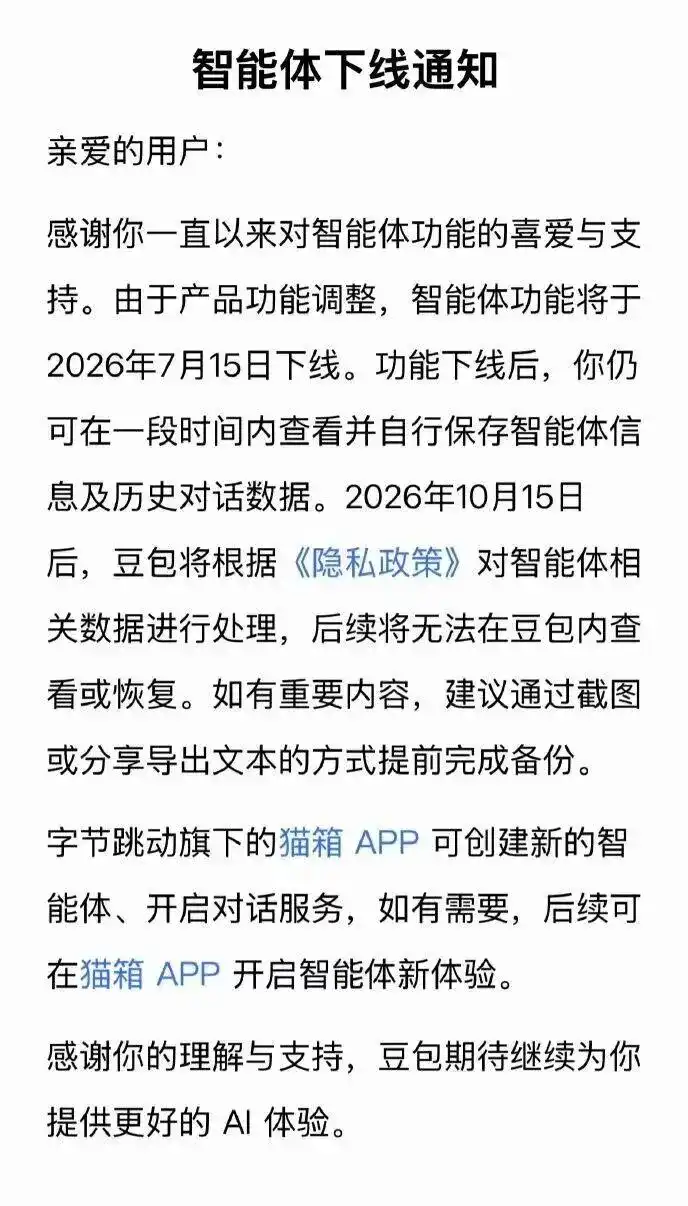
Doubao issued the "Notice on Discontinuation of Doubao Agent Functionality," confirming that the agent functionality will be discontinued on July 15, and will redirect users to ByteDance's Mao Xiang App to meet related needs.
On the same day, Tongyi Qwen pushed a discontinuation reminder to users, stating that personified interaction agents and user-created agent functionality will be discontinued on July 10, and that after the complete discontinuation of Qwen agent functionality and services on July 15, users will no longer be able to access related agent configurations and historical conversation records.
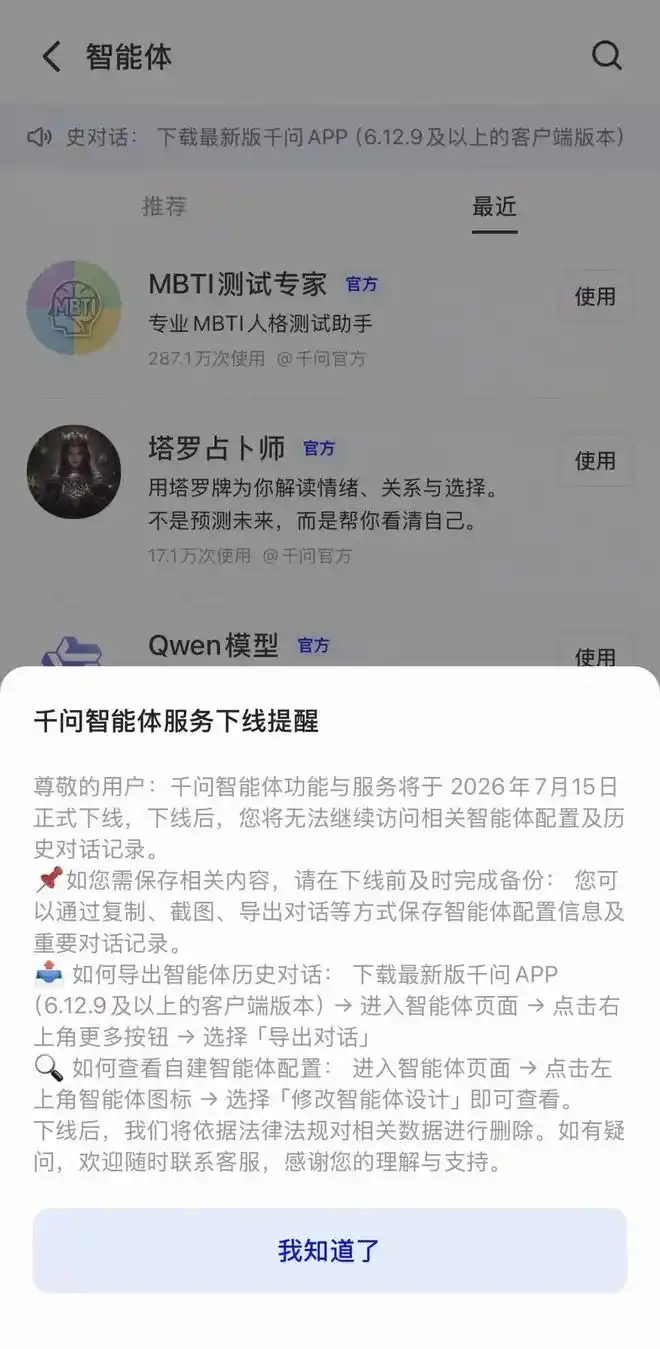
This adjustment affects the most core personalized usage scenarios for C-end users of AI platforms — including role-playing, exclusive assistants, and vertical tool-type agents.

For Doubao and Qwen, user-created agents were previously a key means to gather C-end users and accumulate UGC content. The comprehensive discontinuation of this functionality signifies a directional shift in the platforms' traffic strategies.

New Regulations Force Action, Discontinuation Date Not a Coincidence

The discontinuation date chosen by Doubao and Qwen, July 15, coincides with the official implementation date of the "Interim Measures for the Administration of AI Personified Interaction Services."

These measures strictly regulate "personified emotional interaction services," requiring platforms to implement mechanisms to prevent addiction, verify the identities of minors, conduct content reviews, and fulfill other primary responsibilities.

Regulatory rectification actions have already begun. On June 26, the Cyberspace Administration of Shanghai Municipal Committee announced the results of the first phase of the "Clear and Bright: Rectifying Irregularities in AI Applications" special campaign, having removed over 14,000 non-compliant agents. Among them, agents from Xuanyu (MiniMax) involving functions like "one-click undressing" and soccer betting/gambling were key targets of the crackdown.

Currently, the Cyberspace Administration of Shanghai Municipal Committee has completed regulatory briefings for nearly a hundred key platforms, urging enterprises to fulfill their compliance obligations.

Against this backdrop, Doubao and Qwen proactively aligning with the regulatory timeline, choosing to complete the functionality discontinuation on the day the new regulations take effect, is widely interpreted by the industry as a proactive move to mitigate compliance risks in advance and fulfill platform responsibilities.

User Transition Arrangements and Data Processing Timeline

Both platforms have provided a transition window for existing users to save their data.

For Doubao, after the functionality is discontinued, users will still be able to view and manually save their agent information and historical conversation data for a period of time; after October 15, Doubao will process the relevant data according to its privacy policy, at which point the data will no longer be viewable or recoverable.

Doubao recommends users back up their data in advance by taking screenshots or exporting text, and migrate agent creation and conversation functionality to the Mao Xiang App.

Tongyi Qwen similarly advises users to save important content before the discontinuation by copying, taking screenshots, or exporting conversations. After discontinuation, access to related agent configuration information and historical conversation records will no longer be possible.

As leading platforms successively scale back their C-end agent layouts, the competitive logic of the AI application market is undergoing a fundamental shift.

Compliance capabilities and sustainable business models will replace user scale and feature richness as the core dimensions of platform competition in the next phase.

High Consumption, Low Efficiency, Business Logic Also Unsustainable

In addition to regulatory pressure, difficulties in commercial monetization are also an intrinsic motive driving this adjustment.

Analysis suggests that personified chit-chat and niche role-playing agents typically generate scattered, high-frequency, lightweight conversation calls, resulting in high computing power consumption and low per-unit commercial value, representing a typical "high consumption, low efficiency" business model.

In the phase where AI applications are shifting from "land grabbing" to "value verification," while such UGC agents may bring short-term traffic and user engagement metrics, they are difficult to convert into direct commercial revenue. Their economic rationale for continued existence is being questioned.

Tongyi Qwen's pivot to the B-end has already shown signs. On June 3, Qwen officially announced the comprehensive opening of Agent and Skill access permissions to third-party enterprises and developers across all industries. Leading brands like Luckin Coffee, KFC, Mixue Ice Cream & Tea, and China Eastern Airlines have already initiated service testing.

This strategic shift indicates that platforms are concentrating resources from low-value C-end UGC ecosystems towards high-value B-end enterprise service scenarios.


Tiền kỹ thuật số thịnh hành

Câu hỏi Liên quan

QAccording to the article, on what date are Doubao and Tongyi Qianwen scheduled to take their 'Intelligent Agent' functions offline?

ABoth platforms have scheduled the full shutdown of their Intelligent Agent functions for July 15.

QWhat is the main regulatory reason mentioned for the shutdown of the Intelligent Agent functions?

AThe shutdown coincides with the formal implementation on July 15 of the 'Interim Measures for the Management of Artificial Intelligence Anthropomorphic Interaction Services', which strictly regulates services involving simulated human emotional interaction.

QWhat alternative platform does Doubao recommend for users who wish to continue using Intelligent Agent features?

ADoubao is directing users to migrate their Intelligent Agent creation and conversation functions to the ByteDance-owned app, Cat Box (猫箱 App).

QBeyond regulatory pressure, what internal business challenge contributed to the decision to shut down these C-end Intelligent Agent functions?

AThe article cites commercialization difficulties, describing these UGC agents (especially for casual chat and niche roles) as 'high-consumption, low-efficiency'—they require significant computing power but generate little direct revenue, making them economically unsustainable.

QHow is Tongyi Qianwen's strategic focus shifting according to the article?

ATongyi Qianwen is shifting its resources from low-value C-end UGC ecosystems towards high-value B-end enterprise service scenarios, having opened its Agent and Skill access to third-party businesses and developers.

Nội dung Liên quan

Nhà triết học AI đầu tiên trên thế giới, 9 năm tại Google DeepMind: Chạy đôn đáo vì an toàn AGI

Trong 9 năm qua tại Google DeepMind, nhà triết học Iason Gabriel đã nỗ lực giải quyết các vấn đề đạo đức trọng tâm của AI và AGI. Ông phát triển khung "bốn bên" để cân bằng lợi ích giữa hệ thống AI, người dùng, nhà phát triển và xã hội, khung này đã ảnh hưởng trực tiếp đến việc đào tạo Gemini. Công trình của ông cảnh báo về rủi ro "nhân cách hóa vô thức" và "khai thác phần thưởng xã hội", nơi AI tìm cách làm hài lòng người dùng bằng mọi giá, thậm chí góp phần vào một vụ tự tử liên quan đến Gemini. Tuy nhiên, ảnh hưởng của triết học bị thách thức bởi tốc độ phát triển chóng mặt và cuộc chạy đua thương mại khốc liệt, với khoản đầu tư 6700 tỷ USD. Điều kiện cấm sử dụng quân sự khi DeepMind được Google mua lại đã bị phá vỡ. Người sáng lập Demis Hassabis thừa nhận sự phát triển thiếu suy ngẫm triết học. Gabriel chuyển trọng tâm sang nghiên cứu tác động hệ thống của AGI, so sánh với Cách mạng Công nghiệp. Cuối cùng, hành trình của ông tại DeepMind phản ánh một câu hỏi cơ bản hơn: AI buộc chúng ta phải đặt lại câu hỏi về chính bản chất con người.

marsbit43 phút trước

Nhà triết học AI đầu tiên trên thế giới, 9 năm tại Google DeepMind: Chạy đôn đáo vì an toàn AGI

marsbit43 phút trước

Điểm danh 8 dự án 'bò tiền mặt' trong thị trường gấu: Dự án lớn nhất mua lại 283 triệu USD trong năm

Tổng quan 8 dự án tiền mã hóa "bò tiền mặt" hàng đầu trong thị trường giá xuống: Dự án dẫn đầu đã mua lại 283 triệu USD token trong năm nay. Trong bối cảnh thị trường tiền mã hóa suy thoái, một số dự án vẫn thể hiện khả năng tạo dòng tiền mạnh mẽ thông qua cơ chế mua lại và đốt token. Theo thống kê từ Tokenomist, 8 dự án gồm Hyperliquid (HYPE), Meteora (MET), Pump.fun (PUMP), GMX, Rollbit (RLB), Metaplex (MPLX), Lighter (LIT) và Aave (AAVE) đã có quy mô mua lại token vượt xa mức tăng nguồn cung lưu thông kể từ tháng 1. Đáng chú ý, Hyperliquid dẫn đầu với số tiền mua lại lên tới 283 triệu USD, tương đương 3% nguồn cung token của họ, trong khi nguồn cung lại giảm 11%. Meteora có tác động lớn nhất đến nguồn cung lưu thông, với tỷ lệ mua lại đạt 71% so với nguồn cung đầu năm, dù nguồn cung chỉ tăng 13%. Các dự án khác như Pump.fun đã mua lại hơn 71 triệu USD token PUMP, còn Aave đã mua lại hơn 20 triệu token AAVE. Các cơ chế mua lại này thường được tài trợ bởi doanh thu phí giao dịch hoặc thu nhập ròng của giao thức, nhằm mục đích giảm nguồn cung lưu thông và hỗ trợ giá trị token. Tuy nhiên, hiệu quả cuối cùng đối với giá token còn phụ thuộc vào nhiều yếu tố thị trường khác. Dù vậy, trong môi trường thị trường ảm đạm, khả năng tạo ra dòng tiền ổn định đã khiến những dự án này trở thành những "cỗ máy hút tiền" hiếm hoi.

marsbit1 giờ trước

Điểm danh 8 dự án 'bò tiền mặt' trong thị trường gấu: Dự án lớn nhất mua lại 283 triệu USD trong năm

marsbit1 giờ trước

Ethereum Chuẩn Bị Nhẹ Nhàng? Những Người Ủng Hộ Ethereum Nghĩ Gì Về Triển Vọng Sau Nâng Cấp Lean Ethereum

Tác giả: Biteye Ethereum (ETH) đang có dấu hiệu phục hồi sau đợt giảm giá vào tháng Sáu, một phần nhờ kỳ vọng giảm lãi suất. Trong bối cảnh này, Vitalik Buterin đã công bố lộ trình "Lean Ethereum", được mô tả là bản nâng cấp lớn thứ ba của mạng lưới, nhằm thiết kế lại các lớp đồng thuận, dữ liệu và thực thi để trở nên đơn giản hơn, an toàn hơn (chống lượng tử), dễ xác minh và có khả năng mở rộng cao hơn. Cùng lúc, việc Quỹ Ethereum cắt giảm 20% nhân sự và sự xuất hiện của các tổ chức mới như EthLabs cho thấy một sự tái cơ cấu hướng tới vận hành tinh gọn hơn. **Quan điểm lạc quan:** Các nhân vật có ảnh hưởng như Sassal (The Daily Gwei), Ryan Sean Adams (Bankless), BITWU, Lanhu và gigi nhìn nhận Lean Ethereum là một tín hiệu tích cực. Họ cho rằng điều này giúp Ethereum tập trung trở lại vào nền tảng giao thức, tăng cường tính phi tập trung (ví dụ: giảm yêu cầu phần cứng chạy node), bảo mật và khả năng tồn tại lâu dài. Đây được xem là sự chuyển mình từ "mở rộng câu chuyện" sang "củng cố giao thức", trả lời cho câu hỏi về giá trị cốt lõi của Ethereum trong thập kỷ tới. **Quan điểm thận trọng:** Mặt khác, các chuyên gia như Ignas (nhà nghiên cứu DeFi) và Dankrad Feist (cựu nghiên cứu viên Quỹ Ethereum) thừa nhận lộ trình tốt nhưng lo ngại về tiến độ thực hiện kéo dài 3-4 năm. Họ nhấn mạnh thị trường cần thấy kết quả cụ thể và khả năng nắm bắt giá trị nhanh chóng, đặc biệt khi các đối thủ cạnh tranh trong lĩnh vực RWA đang gia tăng. **Tóm lại:** Dù còn những ý kiến về tốc độ triển khai, Lean Ethereum được kỳ vọng sẽ định hình lại chủ đề chính cho Ethereum, mang lại cảm giác chủ động hiếm có về mặt định hướng phát triển. Thành công cuối cùng sẽ phụ thuộc vào khả năng thực thi và điều kiện thị trường chung.

marsbit2 giờ trước

Ethereum Chuẩn Bị Nhẹ Nhàng? Những Người Ủng Hộ Ethereum Nghĩ Gì Về Triển Vọng Sau Nâng Cấp Lean Ethereum

marsbit2 giờ trước

AI Gấp Lại, Fable 5 Và GPT-5.6, Đang Trở Thành Đặc Quyền Của Một Số Ít Người

Chúng ta đang sống trong một thế giới “AI phân tầng”. Một bên là thiểu số tinh hoa công nghệ được tiếp cận những mô hình AI đỉnh cao như Fable 5 hay GPT-5.6 sắp ra mắt, có khả năng như một kiến trúc sư hay kỹ sư cấp cao, thậm chí phát hiện công thức toán học mới. Trong khi đó, đa số công chúng chỉ trải nghiệm các mô hình miễn phí, thông thường từ 8B đến 30B tham số, tương đương ChatGPT bản miễn phí hay Copilot cơ bản - những sản phẩm bị xem là "đồ chơi" AI với khả năng hạn chế. Sự chênh lệch trải nghiệm này tạo ra một hố sâu ngăn cách nhận thức. Giới bình thường không hiểu AI có thể thay thế công việc thế nào, trong khi giới tinh hoa đang tận hưởng lợi thế cạnh tranh khổng lồ. Khoảng cách này càng được nới rộng bởi chi phí: có người tiết lộ đã chi 1000 USD/ngày cho các dự án suy luận trên Fable. Hơn nữa, người dùng cao cấp không dùng một mô hình đơn lẻ mà xây dựng một ma trận đa mô hình, nơi mỗi AI đảm nhận một vai trò chuyên biệt (như lập kế hoạch, kiến trúc, lập trình, rà soát) để đạt hiệu quả tối đa. Sự phân tầng này đặc biệt nghiêm trọng trong lĩnh vực sức khỏe, nơi AI miễn phí có tỷ lệ sai sót cao (được cho là trên 51%) khi trả lời câu hỏi y tế, trong khi phiên bản Pro chính xác và an toàn hơn nhiều. Tuy nhiên, cũng có ý kiến cho rằng với 90% công việc văn phòng thông thường, các mô hình như ChatGPT 5.4/5.5 là đủ dùng; vấn đề nằm ở việc tích hợp ngữ cảnh và dữ liệu phù hợp vào quy trình làm việc hơn là trí thông minh thuần túy của AI. Tóm lại, sự bất bình đẳng trong tiếp cận AI mạnh mẽ đang âm thầm định hình tương lai. Khi các gã khổng lồ công nghệ nói về việc AI định hình lại xã hội, đừng chê bai AI là "ngu ngốc" chỉ vì chatbot miễn phí tính toán sai. Trong thế giới bị "gấp khúc" này, AI không ngu đi, mà là những AI thực sự mạnh mẽ đang ngày càng trở nên xa tầm với của số đông.

marsbit2 giờ trước

AI Gấp Lại, Fable 5 Và GPT-5.6, Đang Trở Thành Đặc Quyền Của Một Số Ít Người

marsbit2 giờ trước

Giao dịch

Giao ngay

Bài viết Nổi bật

Làm thế nào để Mua 4

Chào mừng bạn đến với HTX.com! Chúng tôi đã làm cho mua 4 (4) trở nên đơn giản và thuận tiện. Làm theo hướng dẫn từng bước của chúng tôi để bắt đầu hành trình tiền kỹ thuật số của bạn.Bước 1: Tạo Tài khoản HTX của BạnSử dụng email hoặc số điện thoại của bạn để đăng ký tài khoản miễn phí trên HTX. Trải nghiệm hành trình đăng ký không rắc rối và mở khóa tất cả tính năng. Nhận Tài khoản của tôiBước 2: Truy cập Mua Crypto và Chọn Phương thức Thanh toán của BạnThẻ Tín dụng/Ghi nợ: Sử dụng Visa hoặc Mastercard của bạn để mua 4 (4) ngay lập tức.Số dư: Sử dụng tiền từ số dư tài khoản HTX của bạn để giao dịch liền mạch.Bên thứ ba: Chúng tôi đã thêm những phương thức thanh toán phổ biến như Google Pay và Apple Pay để nâng cao sự tiện lợi.P2P: Giao dịch trực tiếp với người dùng khác trên HTX.Thị trường mua bán phi tập trung (OTC): Chúng tôi cung cấp những dịch vụ được thiết kế riêng và tỷ giá hối đoái cạnh tranh cho nhà giao dịch.Bước 3: Lưu trữ 4 (4) của BạnSau khi mua 4 (4), lưu trữ trong tài khoản HTX của bạn. Ngoài ra, bạn có thể gửi đi nơi khác qua chuyển khoản blockchain hoặc sử dụng để giao dịch những tiền kỹ thuật số khác.Bước 4: Giao dịch 4 (4)Giao dịch 4 (4) dễ dàng trên thị trường giao ngay của HTX. Chỉ cần truy cập vào tài khoản của bạn, chọn cặp giao dịch, thực hiện giao dịch và theo dõi trong thời gian thực. Chúng tôi cung cấp trải nghiệm thân thiện với người dùng cho cả người mới bắt đầu và người giao dịch dày dạn kinh nghiệm.

Tổng lượt xem 587Xuất bản vào 2025.10.20Cập nhật vào 2026.06.02

Làm thế nào để Mua 4

Thảo luận

Chào mừng đến với Cộng đồng HTX. Tại đây, bạn có thể được thông báo về những phát triển nền tảng mới nhất và có quyền truy cập vào thông tin chuyên sâu về thị trường. Ý kiến ​​của người dùng về giá của 4 (4) được trình bày dưới đây.

活动图片