CLARITY Act Countdown: How Will the Crypto Market Fare If It Doesn't Pass Before the August Recess?

marsbitXuất bản vào 2026-07-05Cập nhật gần nhất vào 2026-07-05

Tóm tắt

The CLARITY Act, a major US crypto market structure bill, faces a tight deadline before the Senate's August 10 recess. It must overcome final hurdles—negotiations on ethics provisions and law enforcement concerns—to secure the 60 votes needed for passage. Analysts warn that missing this window significantly lowers its chances in 2026, with prediction markets giving only a 40% probability of success this year. If the act fails to pass by the recess, the market is expected to react not with a crash but with continued "slow bleeding," particularly in premium products like ETFs. June saw record net outflows from US Bitcoin spot ETFs, partly attributed to this legislative uncertainty. Assets like XRP, which would receive permanent commodity classification under the act, stand to lose a "regulatory premium" on further delays. Bitcoin and Ethereum, already classified as commodities by regulators, face less direct impact, but DeFi innovation and institutional capital inflows would remain stifled by regulatory ambiguity. The path forward includes passing before the recess (a major catalyst), postponement to 2027 (prolonging uncertainty), or failure, requiring the bill to be reintroduced in the next Congress. Despite the stalled negotiations, the bill's advancement this far signals the US is closer than ever to resolving crypto regulatory clarity.

Author: Qin Xiaofeng, Odaily Planet Daily

The highly anticipated Digital Asset Market Structure Act (CLARITY Act) has unsurprisingly been delayed once again. Senator Cynthia Lummis previously stated that negotiators expected to finalize a compromise text around July 4th (U.S. Independence Day) and "advance it in July," but progress has clearly lagged.

Now, with the Senate's August 10th recess approaching, the window of opportunity is shrinking rapidly: the bill must meet the 60-vote threshold in the Senate (requiring at least 7 Democratic defections), be reconciled with the text from the Senate Agriculture Committee, merged with the House bill, and signed by the President—all within the next 25 working days. The timeline is extremely tight.

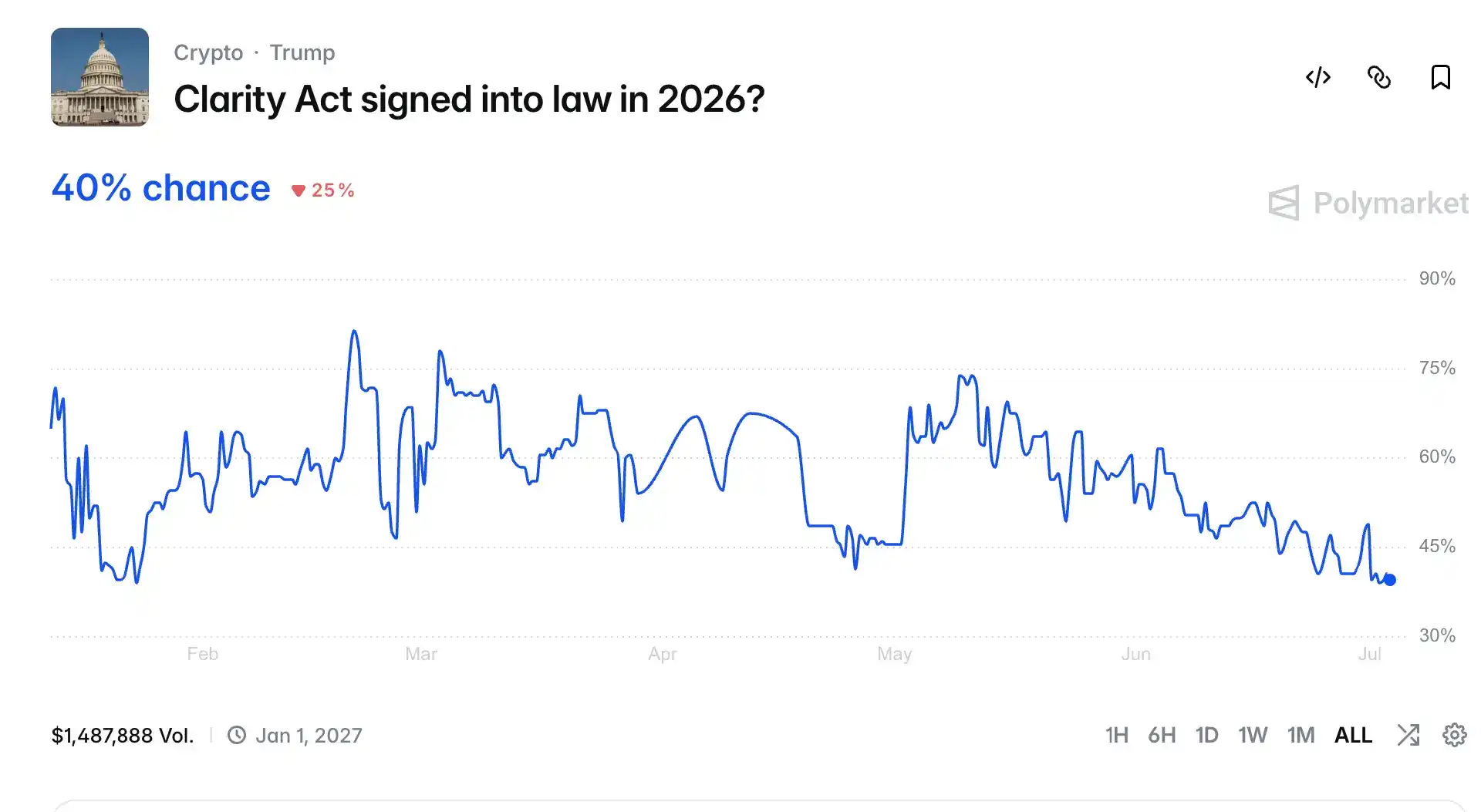
If the window before the August recess is missed, the probability of the CLARITY Act passing this year will further decrease. In fact, data from the prediction market Polymarket shows the probability of the bill passing this year is only 40%; Galaxy Digital has also lowered the probability of passage by 2026 to 50%.
I. Review of the Latest Progress on the CLARITY Act

The CLARITY Act is landmark crypto market structure legislation being advanced in the U.S. Congress, aiming to clarify the regulatory boundaries between the SEC and CFTC, provide a non-security pathway for decentralized tokens, and mandate registration and anti-money laundering obligations for digital commodity intermediaries.

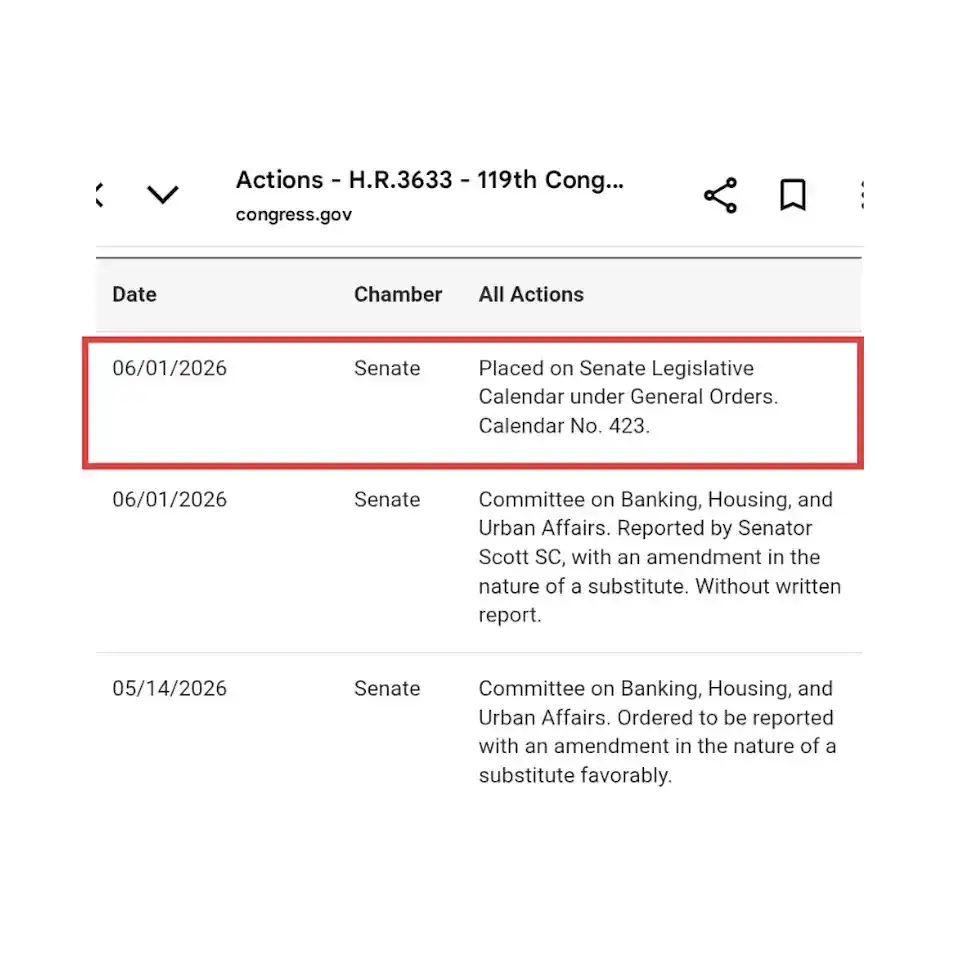
On July 17, 2025, the House of Representatives passed HR 3633, proposed by French Hill, with 294 votes in favor and 134 against, including over 70 votes from Democrats. On May 14, 2026, the Senate Banking Committee advanced and passed it with a 15-9 vote (supported by 13 Republicans and 2 Democrats). On June 1, 2026, the CLARITY Act was officially placed on the Senate legislative calendar (Calendar No. 423), qualifying for full consideration.

However, progress on the CLARITY Act throughout June was not smooth. On June 9th, negotiations over the ethics clause regarding the President's crypto holdings broke down, directly leading to some Democratic lawmakers softening their stance or imposing additional conditions, slowing the pace of the bill reaching the floor for debate. On June 10th, the White House held meetings with police and prosecutor groups. Afterwards, the enforcement battle over Section 604 (the developer protection clause) in the Blockchain Regulatory Certainty Act reached an impasse; if unresolved, law enforcement groups might lobby against it, and Democratic lawmakers might also vote against it for "insufficiently protecting consumers/combating crime."

In simple terms, the former is a "political/ethics hurdle," and the latter is an "enforcement/security red line." Together, they constitute the final two major obstacles before the CLARITY Act can "clear" the Senate. If these are not resolved, it will be difficult to gather the 60 votes and finalize the text, making it impossible to complete the legislation before the August 10th recess. These two sets of negotiations are the key "stumbling blocks" directly hindering the final advancement of the CLARITY Act, causing the July 4th target to be missed and the overall progress to stall. Negotiations are still trying to break the deadlock, but time is running very short.

Brian Gardner, Chief Washington Policy Strategist at Stifel Financial, stated that for the bill to pass in 2026, "it likely needs to pass the Senate by the end of July, preferably in June," and warned that if the Senate misses the recess deadline, the outlook would deteriorate significantly.
However, the market has largely lost hope for the bill's passage this year. Alex Thorn, Head of Galaxy Research, lowered his prediction for the bill passing in 2026 from 75% to 60% on June 5th, citing the increasingly tight Senate schedule. Data from the prediction market Polymarket shows the probability of the bill passing this year is only 40%.

II. What Will Happen to Crypto If the CLARITY Act Fails to Pass on Schedule?

According to CCN's analysis, if the CLARITY Act fails to pass before the August recess, the market's most likely reaction will not be a crash, but rather a "slow bleed through premium products." In fact, the poor performance of cryptocurrencies throughout June indicates that the market has already begun to reprice for legislative uncertainty. (Odaily Note: The premium products here mainly refer to various spot ETFs.)

Data shows that throughout June, U.S. spot Bitcoin ETFs saw cumulative net outflows of approximately $4.5 billion, equivalent to about 77,000 BTC being redeemed. This marks the largest monthly net outflow since the products launched in January 2024, surpassing the previous record from February 2025 (~$3.56 billion), setting the worst monthly record ever.

In fact, XRP might be the asset most directly and significantly affected by the bill, as it would permanently cement its commodity classification, eliminating the risk of reversible agency interpretation. In case of long-term delay or failure, XRP could lose some of its "regulatory premium."

Geoffrey Kendrick, Global Head of Digital Asset Research at Standard Chartered, forecasts an XRP target price of $8, contingent on the Senate fully passing the relevant bill and $4-8 billion in ETF inflows. JPMorgan predicts that if the bill passes, XRP ETFs could see $4.3-8.4 billion in inflows in the first year. Data shows that since the launch of XRP spot ETFs in November 2025, cumulative net inflows have been about $1.41 billion, with 84% from retail, while institutional inflows await clearer regulatory signals.

For Bitcoin, which was already classified as a commodity through a joint SEC-CFTC interpretation in March 2026, the CLARITY Act's main role would be to codify this reversible decision into permanent federal law. Even if the bill fails or is significantly delayed, Bitcoin's "digital gold" narrative is relatively robust, and the direct impact would be smaller.

The impact on ETH is similar to Bitcoin. Ethereum was also classified as a commodity via the joint interpretation. Failure of the bill could lead to prolonged compliance ambiguity for DeFi protocols, stifling innovation and capital inflows. Standard Chartered's Geoffrey Kendrick previously forecasted an ETH target price of $7,500 by the end of 2026 (later revised to $4,000), contingent on the passage of the relevant bills.

Kristin Smith, President of the Solana Policy Institute, stated that many asset allocators are actively exploring investments in digital assets but are holding back funds due to the lack of clear regulatory guidelines. The same principle applies to institutional DeFi; currently, DeFi projects are also on hold awaiting the outcome of Section 604.

III. What's the Path Forward?

Time is running short for the CLARITY Act to overcome the final hurdles. The following scenarios are possible:

  • First, Passage Before the August Recess: The biggest catalyst, likely triggering a significant price rebound, especially for XRP and related ETFs.
  • Second, Postponement to 2027: The scenario least desired by the market, extending the "slow bleed" process, with institutional capital continuing to wait on the sidelines.
  • Third, Failure and Pushing to the Next Congress: The CLARITY Act is currently in the 119th Congress. If the Senate floor vote, reconciliation, and final passage are not completed before the August 2026 recess, the entire process cannot conclude within this Congress. When the new Congress (120th, 2027-2028) begins, the bill must be reintroduced and go through the entire process of committee consideration, floor debate, etc., all over again.

The CLARITY Act is currently at a critical stage of being "on the cusp but stuck." Technically, it's on the Senate calendar, but political negotiations, the time window, and bipartisan support remain the biggest obstacles.

However, as Vincent Chok, CEO of First Digital, stated: "The fact that the CLARITY Act has reached the Senate floor vote itself shows the U.S. is closer than ever to resolving regulatory ambiguity... A successful vote would accelerate this process, but failure won't necessarily stop it. In fact, delays in the U.S. framework could create urgency and extend the time window for setting global standards, potentially positioning the U.S. as the de facto global digital asset hub."


Tiền kỹ thuật số thịnh hành

Câu hỏi Liên quan

QWhat is the CLARITY Act and what are its primary objectives in regulating the US cryptocurrency market?

AThe CLARITY Act, officially the Digital Asset Market Transparency Act, is a landmark piece of U.S. crypto market structure legislation. Its primary objectives are to clarify the jurisdictional boundaries between the SEC and CFTC, provide a non-security pathway for decentralized tokens, and mandate that digital commodity intermediaries register and comply with anti-money laundering obligations.

QWhat are the two main political and procedural obstacles currently blocking the CLARITY Act's progress in the Senate?

AThe two main obstacles are: 1) A political/ethics threshold related to negotiations over a provision concerning presidential crypto holdings, which softened some Democratic support. 2) A law enforcement/safety red line concerning the developer protection clause (Section 604) in the related Blockchain Regulatory Certainty Act, which law enforcement groups oppose. These unresolved issues make it difficult to secure the necessary 60 votes for Senate passage.

QAccording to the article, what is the most likely market consequence if the CLARITY Act fails to pass before the August recess?

AThe most likely consequence is not a market crash, but a 'slow bleed' through premium products like spot ETFs. The article points to the record $4.5 billion in net outflows from US Bitcoin spot ETFs in June as evidence that the market is already repricing assets due to legislative uncertainty, and this trend would likely continue.

QWhy is XRP considered the asset most directly impacted by the fate of the CLARITY Act?

AXRP is most directly impacted because the Act would permanently codify its classification as a commodity into federal law, eliminating the risk of a reversible agency interpretation (like the SEC potentially re-classifying it as a security). Without the Act's passage, XRP could lose a portion of its 'regulatory clarity premium' that has been supporting its valuation expectations for an ETF and institutional inflows.

QWhat are the three potential future scenarios for the CLARITY Act outlined in the article if it does not pass before the August recess?

AThe three scenarios are: 1) Passage before the August recess (leading to a significant price rebound, especially for XRP). 2) Delayed to 2027, extending the period of market uncertainty and 'slow bleed'. 3) Failure in the current (119th) Congress, requiring the entire legislative process to restart from scratch in the next (120th) Congress beginning in 2027.

Nội dung Liên quan

Bitcoin có thể chưa hoàn tất giai đoạn đầu hàng – Tại sao mức đáy 50 nghìn USD vẫn có thể xảy ra

Sự tin tưởng trong một thị trường né tránh rủi ro thường là dấu ấn của sức mạnh dài hạn. Thiết lập hiện tại của Bitcoin phản ánh sự tin tưởng đó. Về mặt kỹ thuật, BTC đã ghi nhận ba quý thua lỗ liên tiếp, với mức giảm trung bình khoảng 20% mỗi quý. Đây là chuỗi thua lỗ ba quý đầu tiên kể từ thị trường gấu năm 2022, khiến hơn 50% nguồn cung lưu hành của Bitcoin rơi vào trạng thái "dưới nước" và tập trung sự chú ý vào các nhà đầu tư nắm giữ dài hạn. Điều đáng chú ý là các nhà nắm giữ dài hạn hiện kiểm soát 78% nguồn cung lưu hành và họ không bán ra trong đợt suy yếu này, thay vào đó đang tích lũy thêm. Tuy nhiên, lịch sử cho thấy Bitcoin thường chạm đáy khi nhóm này bắt đầu đầu hàng, một điều chưa xảy ra trong chu kỳ này. Bối cảnh vĩ mô đang thay đổi với kỳ vọng Cục Dự trữ Liên bang Mỹ có thể tiếp tục tăng lãi suất vào mùa thu, tạo ra điều kiện tài chính thắt chặt hơn. So sánh với các chu kỳ gấu trước (2018 và 2022), khi BTC chạm đáy sau chín tháng giảm điểm liên tiếp, chu kỳ hiện tại mới có bảy tháng. Nếu mô hình lịch sử lặp lại, giai đoạn đầu hàng của Bitcoin vẫn có thể còn tiếp diễn. Sự đầu hàng của các nhà nắm giữ dài hạn, kết hợp với bối cảnh vĩ mô bất ổn, có thể đánh dấu đợt thanh lọc cuối cùng, đẩy BTC về vùng 50.000 USD vào cuối quý 3 trước khi hình thành đáy thực sự.

ambcrypto1 giờ trước

Bitcoin có thể chưa hoàn tất giai đoạn đầu hàng – Tại sao mức đáy 50 nghìn USD vẫn có thể xảy ra

ambcrypto1 giờ trước

MSTR tiết lộ bán 3,588 Bitcoin, giá cổ phiếu lao dốc 5% trong ngày

Công ty Strategy, chủ sở hữu doanh nghiệp lớn nhất thế giới, đã công bố việc bán 3.588 Bitcoin trong khoảng thời gian từ 29/6 đến 5/7 để thu về khoảng 216 triệu USD, nhằm chi trả cổ tức cho các cổ phiếu ưu đãi. Đây là lần bán Bitcoin lớn nhất trong lịch sử công ty, đánh dấu sự thay đổi từ chiến lược "chỉ mua, không bán" trước đây sang việc sử dụng Bitcoin như một tài sản để quản lý thanh khoản. Động thái này diễn ra trong bối cảnh giá Bitcoin và cổ phiếu MSTR đều chịu áp lực giảm. Sau thông báo, giá cổ phiếu Strategy đã giảm hơn 5% trong phiên. Công ty trước đây từng tuyên bố "không bao giờ bán Bitcoin", nhưng đã có hai lần bán nhỏ vào tháng 5 và giờ là đợt bán lớn với quy mô gấp hàng trăm lần. Nguyên nhân chính đến từ áp lực tài chính. Strategy phải chi trả khoảng 1,5 tỷ USD cổ tức ưu đãi hàng năm, trong khi dòng tiền từ hoạt động phần mềm không đủ trang trải. Khi huy động vốn mới khó khăn, công ty buộc phải bán Bitcoin để duy trì hoạt động. Mô hình hiện tại của Strategy là tiếp tục mua Bitcoin khi điều kiện tài chính thuận lợi và bán một phần khi cần thanh khoản, tạo thành một vòng vận hành khép kín. Tính đến ngày 5/7, công ty vẫn nắm giữ 84.377 Bitcoin với giá vốn trung bình khoảng 75.700 USD.

华尔街日报6 giờ trước

MSTR tiết lộ bán 3,588 Bitcoin, giá cổ phiếu lao dốc 5% trong ngày

华尔街日报6 giờ trước

Donald Trump, Tổng thống Mỹ biết 'chơi' chứng khoán nhất

Donald Trump, tổng thống Mỹ giàu có nhất lịch sử, đã kiếm được 2,2 tỷ USD trong năm 2025, theo báo cáo tài chính công khai. Phần lớn thu nhập đến từ tiền điện tử (1,4 tỷ USD), đặc biệt là đồng meme $TRUMP và token WLFI của công ty World Liberty Financial do gia đình ông thành lập. Lĩnh vực bất động sản truyền thống mang về 575 triệu USD, với các khu nghỉ dưỡng và sân golf như Mar-a-Lago có doanh thu tăng mạnh nhờ sự hiện diện của ông. Trump cũng thực hiện hơn 22.000 giao dịch chứng khoán trong năm, với tần suất cao bất thường và thời điểm giao dịch trùng khớp với các sự kiện chính sách quan trọng, dấy lên lo ngại về xung đột lợi ích. Dù Nhà Trắng cho biết các giao dịch do đội ngũ chuyên nghiệp quản lý, việc Trump không sử dụng ủy thác mù (blind trust) như các tổng thống tiền nhiệm vẫn là điểm gây tranh cãi. Bài viết nhận định Trump đã biến vai trò tổng thống thành một "cỗ máy kinh doanh", khai thác triệt để ảnh hưởng chính trị để thu lợi nhuận cá nhân và gia đình, từ tiền điện tử, bất động sản đến chứng khoán. Điều này làm dấy lên cuộc tranh luận mới về ranh giới giữa quyền lực công và lợi ích tư trong chính trị Mỹ.

marsbit7 giờ trước

Donald Trump, Tổng thống Mỹ biết 'chơi' chứng khoán nhất

marsbit7 giờ trước

Giao dịch

Giao ngay

Bài viết Nổi bật

Làm thế nào để Mua CAP

Chào mừng bạn đến với HTX.com! Chúng tôi đã làm cho mua Cap (CAP) trở nên đơn giản và thuận tiện. Làm theo hướng dẫn từng bước của chúng tôi để bắt đầu hành trình tiền kỹ thuật số của bạn.Bước 1: Tạo Tài khoản HTX của BạnSử dụng email hoặc số điện thoại của bạn để đăng ký tài khoản miễn phí trên HTX. Trải nghiệm hành trình đăng ký không rắc rối và mở khóa tất cả tính năng. Nhận Tài khoản của tôiBước 2: Truy cập Mua Crypto và Chọn Phương thức Thanh toán của BạnThẻ Tín dụng/Ghi nợ: Sử dụng Visa hoặc Mastercard của bạn để mua Cap (CAP) ngay lập tức.Số dư: Sử dụng tiền từ số dư tài khoản HTX của bạn để giao dịch liền mạch.Bên thứ ba: Chúng tôi đã thêm những phương thức thanh toán phổ biến như Google Pay và Apple Pay để nâng cao sự tiện lợi.P2P: Giao dịch trực tiếp với người dùng khác trên HTX.Thị trường mua bán phi tập trung (OTC): Chúng tôi cung cấp những dịch vụ được thiết kế riêng và tỷ giá hối đoái cạnh tranh cho nhà giao dịch.Bước 3: Lưu trữ Cap (CAP) của BạnSau khi mua Cap (CAP), lưu trữ trong tài khoản HTX của bạn. Ngoài ra, bạn có thể gửi đi nơi khác qua chuyển khoản blockchain hoặc sử dụng để giao dịch những tiền kỹ thuật số khác.Bước 4: Giao dịch Cap (CAP)Giao dịch Cap (CAP) dễ dàng trên thị trường giao ngay của HTX. Chỉ cần truy cập vào tài khoản của bạn, chọn cặp giao dịch, thực hiện giao dịch và theo dõi trong thời gian thực. Chúng tôi cung cấp trải nghiệm thân thiện với người dùng cho cả người mới bắt đầu và người giao dịch dày dạn kinh nghiệm.

Tổng lượt xem 57Xuất bản vào 2026.06.26Cập nhật vào 2026.06.26

Làm thế nào để Mua CAP

Làm thế nào để Mua ANSEM

Chào mừng bạn đến với HTX.com! Chúng tôi đã làm cho mua The Black Bull (ANSEM) trở nên đơn giản và thuận tiện. Làm theo hướng dẫn từng bước của chúng tôi để bắt đầu hành trình tiền kỹ thuật số của bạn.Bước 1: Tạo Tài khoản HTX của BạnSử dụng email hoặc số điện thoại của bạn để đăng ký tài khoản miễn phí trên HTX. Trải nghiệm hành trình đăng ký không rắc rối và mở khóa tất cả tính năng. Nhận Tài khoản của tôiBước 2: Truy cập Mua Crypto và Chọn Phương thức Thanh toán của BạnThẻ Tín dụng/Ghi nợ: Sử dụng Visa hoặc Mastercard của bạn để mua The Black Bull (ANSEM) ngay lập tức.Số dư: Sử dụng tiền từ số dư tài khoản HTX của bạn để giao dịch liền mạch.Bên thứ ba: Chúng tôi đã thêm những phương thức thanh toán phổ biến như Google Pay và Apple Pay để nâng cao sự tiện lợi.P2P: Giao dịch trực tiếp với người dùng khác trên HTX.Thị trường mua bán phi tập trung (OTC): Chúng tôi cung cấp những dịch vụ được thiết kế riêng và tỷ giá hối đoái cạnh tranh cho nhà giao dịch.Bước 3: Lưu trữ The Black Bull (ANSEM) của BạnSau khi mua The Black Bull (ANSEM), lưu trữ trong tài khoản HTX của bạn. Ngoài ra, bạn có thể gửi đi nơi khác qua chuyển khoản blockchain hoặc sử dụng để giao dịch những tiền kỹ thuật số khác.Bước 4: Giao dịch The Black Bull (ANSEM)Giao dịch The Black Bull (ANSEM) dễ dàng trên thị trường giao ngay của HTX. Chỉ cần truy cập vào tài khoản của bạn, chọn cặp giao dịch, thực hiện giao dịch và theo dõi trong thời gian thực. Chúng tôi cung cấp trải nghiệm thân thiện với người dùng cho cả người mới bắt đầu và người giao dịch dày dạn kinh nghiệm.

Tổng lượt xem 34Xuất bản vào 2026.07.01Cập nhật vào 2026.07.01

Làm thế nào để Mua ANSEM

Làm thế nào để Mua DATA

Chào mừng bạn đến với HTX.com! Chúng tôi đã làm cho mua DATA Network (DATA) trở nên đơn giản và thuận tiện. Làm theo hướng dẫn từng bước của chúng tôi để bắt đầu hành trình tiền kỹ thuật số của bạn.Bước 1: Tạo Tài khoản HTX của BạnSử dụng email hoặc số điện thoại của bạn để đăng ký tài khoản miễn phí trên HTX. Trải nghiệm hành trình đăng ký không rắc rối và mở khóa tất cả tính năng. Nhận Tài khoản của tôiBước 2: Truy cập Mua Crypto và Chọn Phương thức Thanh toán của BạnThẻ Tín dụng/Ghi nợ: Sử dụng Visa hoặc Mastercard của bạn để mua DATA Network (DATA) ngay lập tức.Số dư: Sử dụng tiền từ số dư tài khoản HTX của bạn để giao dịch liền mạch.Bên thứ ba: Chúng tôi đã thêm những phương thức thanh toán phổ biến như Google Pay và Apple Pay để nâng cao sự tiện lợi.P2P: Giao dịch trực tiếp với người dùng khác trên HTX.Thị trường mua bán phi tập trung (OTC): Chúng tôi cung cấp những dịch vụ được thiết kế riêng và tỷ giá hối đoái cạnh tranh cho nhà giao dịch.Bước 3: Lưu trữ DATA Network (DATA) của BạnSau khi mua DATA Network (DATA), lưu trữ trong tài khoản HTX của bạn. Ngoài ra, bạn có thể gửi đi nơi khác qua chuyển khoản blockchain hoặc sử dụng để giao dịch những tiền kỹ thuật số khác.Bước 4: Giao dịch DATA Network (DATA)Giao dịch DATA Network (DATA) dễ dàng trên thị trường giao ngay của HTX. Chỉ cần truy cập vào tài khoản của bạn, chọn cặp giao dịch, thực hiện giao dịch và theo dõi trong thời gian thực. Chúng tôi cung cấp trải nghiệm thân thiện với người dùng cho cả người mới bắt đầu và người giao dịch dày dạn kinh nghiệm.

Tổng lượt xem 34Xuất bản vào 2026.07.01Cập nhật vào 2026.07.01

Làm thế nào để Mua DATA

Thảo luận

Chào mừng đến với Cộng đồng HTX. Tại đây, bạn có thể được thông báo về những phát triển nền tảng mới nhất và có quyền truy cập vào thông tin chuyên sâu về thị trường. Ý kiến ​​của người dùng về giá của M (M) được trình bày dưới đây.

活动图片