Anyone Can Easily Create Prediction Markets, But Can Limitless' User-Generated Markets Last?

Foresight NewsXuất bản vào 2026-07-02Cập nhật gần nhất vào 2026-07-02

Tóm tắt

The article discusses the historical challenges of user-generated prediction markets in crypto, where previous attempts like Augur, Omen, Zeitgeist, and Manifold Markets failed due to fragmented liquidity, poor discoverability, and unreliable, slow settlement processes. These issues often led to platforms filled with inactive markets and low user engagement, prompting some, like Polymarket, to shift to a curated model. Limitless recently launched its User-Generated Market (UGM) feature, allowing anyone to create crypto price prediction markets. It addresses past failures through several key design choices: markets are limited to objective, oracle-based price questions (e.g., "Will Asset X be above $Y at time Z?") for instant, automatic settlement via Pyth and Chainlink, eliminating voting disputes. To combat spam and fragmentation, market creation requires burning 100-1000 LMTS tokens (a non-refundable cost), while creators earn 50% of the trading fees generated by their market, aligning incentives. The platform also benefits from an existing active user base and uses an order book model, removing the need for creators to provide initial liquidity. By tackling settlement reliability, liquidity fragmentation, and creator incentives, Limitless presents a new model for sustainable, permissionless prediction markets.


Author: Stacy Muur

Compiled by: AIdidiaoJP, Foresight News


In the crypto space, allowing users to freely create prediction markets has long been an unresolved, major challenge. Over the years, almost all attempts have ended in failure.


@trylimitless (Limitless) has taken a unique path to address this challenge. Recently, they launched the UGM (User-Generated Market) feature, allowing any user to create their own crypto price prediction markets. This is a bold attempt to tackle a long-standing pain point in the prediction market space.


Let's explore previous attempts, the reasons for their failures, and how Limitless is making this model work.


A History of Permissionless Prediction Markets


The earliest permissionless prediction market was @AugurProject. Launched on Ethereum in 2018, its core concept was "anyone can create a market on any topic, priced by the crowd for truth."
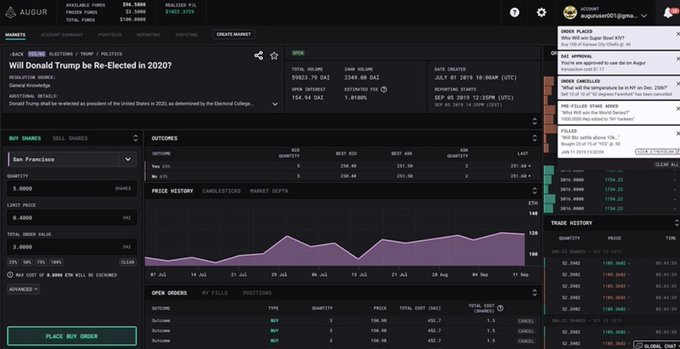


Perfect in theory, but desolate in practice. The project's token reached a peak market cap of over $170 million, yet its daily active users were only about 47, with fewer than 115 users per week.


The reasons for failure were brutal and mutually reinforcing:


  • Liquidity was scattered across thousands of empty markets (because anyone could create a market).
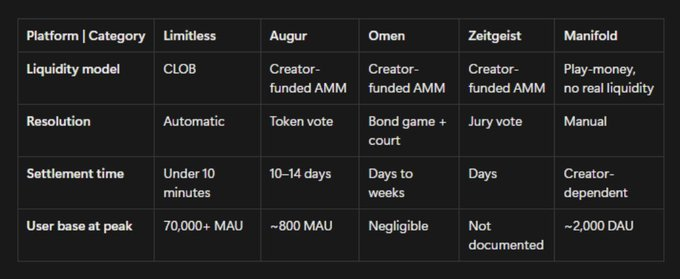
  • Market settlement took 10 to 14 days.
  • User funds were locked until settlement.
  • Users had to run their own Ethereum node before placing bets.


Augur was not an isolated case. @OmenEth on the Gnosis chain adopted a similar model and gradually faded. @ZeitgeistPM on Polkadot even added creator fees but still struggled to generate substantial trading volume. @ManifoldMarkets once built a real community using virtual currency, with daily active users peaking at several thousand, but later declined to below 900 after the hype subsided.


Different teams, different chains, yet all ending the same way.


A Recurring Pattern


This recurring pattern is hard to attribute to mere execution issues. Making creation free and easy doesn't create demand; it just floods the platform with more supply, all competing for the same small pool of attention.


This leads to fragmentation of prediction markets on two levels:


Thin Liquidity


Most markets created by users quickly become ghost towns. On early AMM (Automated Market Maker) platforms, creating a market also required providing initial liquidity with one's own capital, increasing the cost.


Poor Discoverability


When anyone can create a market, you quickly get a dozen slightly different versions of "Will the Fed cut rates in July?" markets, further fragmenting liquidity.


Imagine a user opening the app and seeing a list of half-dead markets, each with almost no liquidity. Who would want to stay?


It was this very problem that forced the industry's biggest player to pivot. In 2022, Polymarket shifted to a curated model, concentrating liquidity into a few deep markets, which proved effective. But it also abandoned its initial promise of open creation—the "harder version" of allowing anyone to easily launch a market remained unsolved.


The Settlement Challenge


Liquidity and discoverability are tricky enough, but if settlement isn't hardcoded, user trust collapses.


After a market ends, the platform needs to decide how to settle it. Objective events like "Will Bitcoin close above $100,000?" are easy to handle. But those requiring subjective interpretation, like whether a politician's statement constitutes endorsement of a specific policy, easily spark controversy.


Most platforms rely on token holder voting to resolve disputes. The intention is decentralized settlement, but in practice, voting power is often concentrated among the largest holders. And since they can also place bets like regular users, they have the potential to manipulate outcomes.


This erodes trust in the fairness of settlement, creating another path back to the liquidity problem.


How Limitless Responds


Any new attempt must overcome the three hurdles of thin liquidity, poor discoverability, and unreliable settlement. @trylimitless has made different choices in these areas.


Focusing on the newly launched UGM feature: any user can create a market in just a few steps:


  • Select an asset.
  • Set a price target (percentage change or specific dollar value).
  • Set a duration (from 15 minutes to 1 day).
  • Launch (requires holding LMTS tokens).


The longer the market duration, the higher the creation cost.


Anyone can trade these markets. Upon expiry, an oracle automatically pulls the asset price and settles the result instantly. These markets rely on real-time price feeds from @PythNetwork and @Chainlink, requiring no voting, no dispute panels, no committees.


Markets are limited to objective types, e.g., "Will SOL be above price X at a given time?". The smart contract can automatically settle the moment the market closes. It's not possible to create markets requiring human interpretation (like election results or disputed news events). Limitless deliberately restricts the scope to price markets because this is the only type that can be reliably settled within seconds every time, whereas other platforms often take hours or even days.


The cold-start problem tripped up most previous platforms. Limitless already has advantages here:


  • Cumulative trading volume exceeding $3 billion.
  • Trading volume in May and June exceeding $1.2 billion.
  • Peak monthly active traders over 70,000.


There is already a fairly active trader base, completely different from Augur in 2018.


Another crucial difference: Limitless uses an order book model rather than the early AMM model. On platforms like Augur, creating a market required funding initial liquidity yourself. Limitless eliminates this step entirely; traders place their own buy and sell orders, and markets only need to attract them.


The most ingenious part is the creator economic mechanism. Creating a market costs 100 to 1000 LMTS tokens, which are non-refundable. In return, the creator receives 50% of all trading fees generated by that market.


On one side is a real cost, on the other a real reward. The cost effectively prevents market spam, as each market requires a real financial commitment. The reward means truly active markets can generate tangible fee income for creators.


The cost mechanism also adds utility to the LMTS token. Creating each market burns LMTS tokens from the open market, directly linking token utility to UGM activity. The more people create markets, the greater the demand for LMTS.


Summary and Outlook


The existing evidence clearly points in one direction: all previous attempts at permissionless prediction markets either got bogged down in settlement disputes, drowned in dead liquidity, or simply abandoned the open model for curation.


Limitless is the first solution designed to address all three failure modes simultaneously.


Settlement (the trickiest problem) is completely avoided by sticking to oracle-based price markets.


The cold-start problem is mitigated by an existing active user base.


The cost-and-reward structure for market creation balances incentives for both sides.


Most importantly, with these markets settling faster, we will quickly see if the design works at scale.


If it does, permissionless prediction markets finally have their first viable blueprint.


Disclosure: The author holds some $LMTS tokens and is a Limitless user.

Tiền kỹ thuật số thịnh hành

Câu hỏi Liên quan

QWhat are the three main reasons why previous attempts at permissionless prediction markets, like Augur, have generally failed?

AThey failed due to three main reasons: 1) Thin liquidity fragmented across thousands of empty markets. 2) Poor discoverability caused by market duplication and a cluttered interface. 3) Unreliable and slow dispute resolution processes, often taking days and being prone to manipulation.

QHow does Limitless's new UGM feature specifically address the problem of market creation spam and low-quality markets?

ALimitless addresses this by implementing a cost-to-create mechanism. Creating a market requires spending 100 to 1000 LMTS tokens, which are burned. This real cost discourages the creation of frivolous or spam markets. In return, creators are incentivized with 50% of all trading fees generated by their market, aligning rewards with market success.

QWhat is the key difference in how Limitless handles market settlement compared to earlier platforms, and why is this significant?

ALimitless exclusively uses oracle-based price markets (e.g., "Will Asset X be above price Y at time Z?") that settle automatically and instantly via price feeds from providers like Pyth Network and Chainlink. This is significant because it completely avoids the slow, contentious, and potentially manipulative dispute resolution processes (like token-holder voting) that plagued earlier platforms, ensuring fast, trustless, and objective settlements.

QWhat advantage does Limitless have over earlier projects like Augur regarding the 'cold start' problem of attracting initial users and liquidity?

ALimitless already has an established, active user base and trading volume before launching UGM. The article cites over $30B in cumulative volume, over $12B in May and June volume, and a peak of over 70,000 monthly active traders. This existing ecosystem provides immediate attention and potential liquidity for newly created user markets, unlike earlier projects that launched into empty platforms.

QAccording to the article, how does the economic design of UGM potentially benefit the LMTS token?

AThe UGM design directly benefits the LMTS token by creating a built-in burn mechanism. Every new market creation burns LMTS tokens, permanently removing them from circulation. As more users create markets, the demand for LMTS tokens to pay the creation fee increases, which can positively impact the token's utility and value.

Nội dung Liên quan

'Tiền tệ có bảo đảm cứng' – CEO Coinbase đề xuất dùng crypto để giải quyết khoản nợ 39 nghìn tỷ USD

Giám đốc điều hành Coinbase, Brian Armstrong, đưa ra đề xuất táo bạo sử dụng tiền mã hóa như một loại "tiền tệ được hỗ trợ cứng" để kiềm chế lạm phát và chi tiêu chính phủ không kiểm soát của Mỹ, trong bối cảnh nợ công liên bang đã chạm mốc 39,4 nghìn tỷ USD. Ông cho rằng Hiến pháp Mỹ thiếu hai điều quan trọng: giới hạn tăng trưởng chi tiêu chính phủ và yêu cầu về một loại tiền tệ được đảm bảo chắc chắn. Bài viết đề cập Bitcoin, với giới hạn nguồn cung 21 triệu coin, được xem như một giải pháp thay thế vàng kỹ thuật số. Tuy nhiên, một phân tích từ VanEck dự báo rằng ngay cả khi chính phủ Mỹ nắm giữ 1 triệu BTC và giá mỗi Bitcoin tăng lên 43 triệu USD vào năm 2049, thì cũng chỉ có thể thanh toán 18%-36% tổng số nợ. Ý tưởng về dự trữ chiến lược Bitcoin và stablecoin cũng được thảo luận, nhưng kết luận chung cho rằng tiền mã hóa không thể giải quyết triệt để vấn đề nợ của Mỹ. Giải pháp thực tế hơn có thể nằm ở việc thiết lập trần chi tiêu chính phủ, một đề xuất được Armstrong ủng hộ cùng với việc thúc đẩy AI và robot để tăng trưởng kinh tế.

ambcrypto52 phút trước

'Tiền tệ có bảo đảm cứng' – CEO Coinbase đề xuất dùng crypto để giải quyết khoản nợ 39 nghìn tỷ USD

ambcrypto52 phút trước

Tiger Research: Thẻ thanh toán tiền điện tử với khối lượng giao dịch 1,5 tỷ USD mỗi tháng bị mắc kẹt trong những năm 1990

Nghiên cứu của Tiger chỉ ra rằng, dù thẻ thanh toán tiền mã hóa đạt khối lượng giao dịch 15 tỷ USD mỗi tháng, ngành công nghiệp này vẫn đang mắc kẹt trong giai đoạn phát triển tương tự thẻ ghi nợ những năm 1990. Điểm khác biệt lớn so với thanh toán truyền thống là thiếu mối quan hệ tài khoản tài chính thường xuyên với người dùng. Phần lớn ví tiền mã hóa không hỗ trợ nhận lương hay thanh toán định kỳ, mà chủ yếu dựa vào nạp stablecoin. Giao dịch tập trung ở các thị trường mới nổi như Bangladesh, Ấn Độ do hạn chế tiếp cận dịch vụ USD, trong khi thị trường phát triển như Mỹ chỉ chiếm 4%. Quy mô này vẫn rất nhỏ so với mạng lưới Visa/Mastercard (24-25 nghìn tỷ USD/năm). Tốc độ lưu chuyển stablecoin cho tiêu dùng chỉ bằng 1/20 so với tiền pháp định, cho thấy mô hình sử dụng chưa ổn định. Bài viết phân tích bốn mô hình kinh doanh chính: Hạ tầng phát hành thẻ (tập trung quanh một vài nhà cung cấp như Rain), Thẻ đi kèm sàn giao dịch (để giữ chân người dùng), Ví DeFi phi tập trung (rào cản kỹ thuật cao) và Ngân hàng số stablecoin (mạnh ở thị trường mới nổi). Tuy nhiên, chỉ chức năng thanh toán đơn thuần khó duy trì phát triển lâu dài. Các hạn chế về quy định (như đạo luật GENIUS cấm trả lãi cho stablecoin tại Mỹ) và thiếu tài khoản chính (như để nhận lương) là những thách thức lớn. Để tồn tại, các công ty cần kiểm soát luồng tiền, giữ vững các thị trường ngách và xây dựng hệ thống tài khoản người dùng độc lập. Tương lai của ngành không nằm ở số lượng thẻ phát hành, mà ở việc ai xây dựng được tài khoản trung tâm cho nhu cầu tài chính hàng ngày của người dùng trước.

marsbit2 giờ trước

Tiger Research: Thẻ thanh toán tiền điện tử với khối lượng giao dịch 1,5 tỷ USD mỗi tháng bị mắc kẹt trong những năm 1990

marsbit2 giờ trước

THEA Gọi Vốn 8 Triệu USD Để Mở Rộng Cơ Sở Hạ Tầng AI Cho Thị Trường Rủi Ro Thời Gian Thực

Công ty THEA, một mạng lưới AI hành vi dự đoán tập trung vào thị trường rủi ro, vừa công bố huy động thành công 8 triệu USD trong vòng tài trợ do Maven11 Capital, Spartan Group, ManifoldTrading, HackVC và Fisher8 Capital dẫn đầu. Được thành lập năm 2024, THEA phát triển các hệ thống trí tuệ hành vi để tối ưu hóa việc ra quyết định trên các thị trường rủi ro theo thời gian thực. Công nghệ này được thiết kế cho các môi trường biến động cao, nơi kết quả không chắc chắn, điều kiện thay đổi nhanh chóng và các quyết định mang lại hậu quả kinh tế tức thì. Số tiền tài trợ sẽ được sử dụng để mở rộng cơ sở hạ tầng AI vận hành và lớp phối hợp trên chuỗi (on-chain) của THEA, được neo trên Solana. CEO Valentin Batura cho biết, hệ thống AI của họ được đào tạo dựa trên hành vi kinh tế thực tế thay vì mô phỏng tổng hợp. Các mô hình của THEA đã được huấn luyện trên hơn 35 tỷ quyết định của con người trong thế giới thực dưới áp lực kinh tế thực sự. Khách hàng triển khai cơ sở hạ tầng AI của THEA báo cáo tỷ lệ giữ chân tăng tới 30% nhờ tối ưu hóa quyết định tốt hơn và nhanh hơn. Một bước quan trọng tiếp theo là việc ra mắt THEA Network trên Solana, một lớp liên kết cho các dịch vụ AI-native, kết hợp hiệu suất cấp đám mây với tính toàn vẹn của blockchain. THEA nằm trong số những mạng lưới AI đầu tiên mã hóa (tokenize) lớp thanh toán cơ sở hạ tầng của mình. Tầm nhìn của THEA là các nền kinh tế trong tương lai gần sẽ yêu cầu trí tuệ rủi ro AI tinh vi, có thể tiếp cận được cho tất cả mọi người, tạo ra các thị trường hiệu quả và công bằng hơn thông qua các hệ thống tự trị, minh bạch trên quy mô toàn cầu. Hiện tại, các ứng dụng trong hệ sinh thái của THEA xử lý hơn 400 triệu truy vấn suy luận AI mỗi tháng trên hơn 30 khu vực pháp lý, phục vụ hơn 3.000 khách hàng doanh nghiệp toàn cầu.

TheNewsCrypto2 giờ trước

THEA Gọi Vốn 8 Triệu USD Để Mở Rộng Cơ Sở Hạ Tầng AI Cho Thị Trường Rủi Ro Thời Gian Thực

TheNewsCrypto2 giờ trước

Cổ phiếu ưu đãi không nợ, không pha loãng, lãi suất cao: Tại sao các công ty kho bạc Bitcoin đang đẩy mạnh huy động vốn?

Bài báo thảo luận về sự phát triển của thị trường cổ phiếu ưu đãi được hỗ trợ bằng Bitcoin, với quy mô khoảng 130 tỷ USD, dẫn đầu bởi các công ty như Strategy và Strive. Báo cáo từ BitcoinTreasuries.net và Apyx dự báo thị phần của loại hình này có thể tăng từ dưới 1% hiện nay lên 3-5% vào năm 2030, thậm chí 10% (1,3 nghìn tỷ USD) về lâu dài. Cổ phiếu ưu đãi giúp các công ty nắm giữ Bitcoin như tài sản kho bạc (ví dụ: Strategy của Michael Saylor) huy động vốn dài hạn để mua thêm Bitcoin mà không pha loãng cổ phiếu phổ thông hoặc gánh khoản nợ có kỳ hạn. Chúng cung cấp cổ tức ưu tiên và được phân loại là vốn chủ sở hữu, không có ngày đáo hạn. Sản phẩm này chuyển đổi tính biến động của Bitcoin thành thu nhập ổn định, thu hút các nhà đầu tư với tỷ suất lợi nhuận hiệu dụng cao (10,8% - 15,2%), vượt xa tài khoản tiết kiệm. Nhu cầu từ các tổ chức thu nhập cố định được cho là vượt xa nguồn cung, bị giới hạn bởi lượng Bitcoin có sẵn để thế chấp (khoảng 1,26 triệu BTC trong kho bạc doanh nghiệp). Các cổ phiếu này duy trì tỷ lệ bao phủ thế chấp cao (3,8 - 4,5 lần), được cho là an toàn hơn nhiều trái phiếu thông thường. Rủi ro chủ yếu mang tính cấu trúc, liên quan đến khuếch đại biến động giá cổ phiếu phổ thông của công ty phát hành. Báo cáo kết luận công cụ này đang ở giai đoạn "0 đến 1", với nhu cầu thị trường vượt quá khả năng cung cấp.

Foresight News3 giờ trước

Cổ phiếu ưu đãi không nợ, không pha loãng, lãi suất cao: Tại sao các công ty kho bạc Bitcoin đang đẩy mạnh huy động vốn?

Foresight News3 giờ trước

Giao dịch

Giao ngay

Bài viết Nổi bật

Làm thế nào để Mua AL

Chào mừng bạn đến với HTX.com! Chúng tôi đã làm cho mua Archloot (AL) trở nên đơn giản và thuận tiện. Làm theo hướng dẫn từng bước của chúng tôi để bắt đầu hành trình tiền kỹ thuật số của bạn.Bước 1: Tạo Tài khoản HTX của BạnSử dụng email hoặc số điện thoại của bạn để đăng ký tài khoản miễn phí trên HTX. Trải nghiệm hành trình đăng ký không rắc rối và mở khóa tất cả tính năng. Nhận Tài khoản của tôiBước 2: Truy cập Mua Crypto và Chọn Phương thức Thanh toán của BạnThẻ Tín dụng/Ghi nợ: Sử dụng Visa hoặc Mastercard của bạn để mua Archloot (AL) ngay lập tức.Số dư: Sử dụng tiền từ số dư tài khoản HTX của bạn để giao dịch liền mạch.Bên thứ ba: Chúng tôi đã thêm những phương thức thanh toán phổ biến như Google Pay và Apple Pay để nâng cao sự tiện lợi.P2P: Giao dịch trực tiếp với người dùng khác trên HTX.Thị trường mua bán phi tập trung (OTC): Chúng tôi cung cấp những dịch vụ được thiết kế riêng và tỷ giá hối đoái cạnh tranh cho nhà giao dịch.Bước 3: Lưu trữ Archloot (AL) của BạnSau khi mua Archloot (AL), lưu trữ trong tài khoản HTX của bạn. Ngoài ra, bạn có thể gửi đi nơi khác qua chuyển khoản blockchain hoặc sử dụng để giao dịch những tiền kỹ thuật số khác.Bước 4: Giao dịch Archloot (AL)Giao dịch Archloot (AL) dễ dàng trên thị trường giao ngay của HTX. Chỉ cần truy cập vào tài khoản của bạn, chọn cặp giao dịch, thực hiện giao dịch và theo dõi trong thời gian thực. Chúng tôi cung cấp trải nghiệm thân thiện với người dùng cho cả người mới bắt đầu và người giao dịch dày dạn kinh nghiệm.

Tổng lượt xem 442Xuất bản vào 2024.12.11Cập nhật vào 2026.06.02

Làm thế nào để Mua AL

Thảo luận

Chào mừng đến với Cộng đồng HTX. Tại đây, bạn có thể được thông báo về những phát triển nền tảng mới nhất và có quyền truy cập vào thông tin chuyên sâu về thị trường. Ý kiến ​​của người dùng về giá của AL (AL) được trình bày dưới đây.

活动图片