You Use Claude and Codex Every Day, but Meta Has Restricted Internal Use

marsbitXuất bản vào 2026-06-30Cập nhật gần nhất vào 2026-06-30

Tóm tắt

In May, Meta imposed internal restrictions on its engineers regarding the use of Claude Code and Codex, two widely used AI programming tools. Despite being a major client, Meta's guidelines, still in effect, prohibit these external models from being used for specific tasks to prevent potential "escalations with partners." The core concern is "distillation"—the risk that outputs from Claude or Codex could inadvertently contaminate the training data and evaluation processes for Meta's in-house AI coding assistant, MetaCode. If MetaCode is trained or evaluated using data generated by these external models, it risks learning their capabilities rather than developing its own, blurring the line of intellectual origin. The restrictions are precise: engineers cannot use the external models to generate test questions, debug source code, or suggest test cases. AI-generated content is also barred from environments accessible to MetaCode. However, AI can still assist with peripheral tasks like workflow setup and code organization, provided all outputs are manually reviewed. This caution reflects a broader industry dilemma. While distillation is a common technique, using a competitor's model output for training raises legal and ethical questions about the ownership of derived capabilities. Contractual terms from companies like OpenAI and Anthropic explicitly forbid using their outputs to build competing products, putting enforcement power in the hands of rivals. The move is also financ...

In May of this year, Meta drew a clear line for its own engineers.

People in the Applied AI Engineering department can no longer freely use Claude Code and Codex.
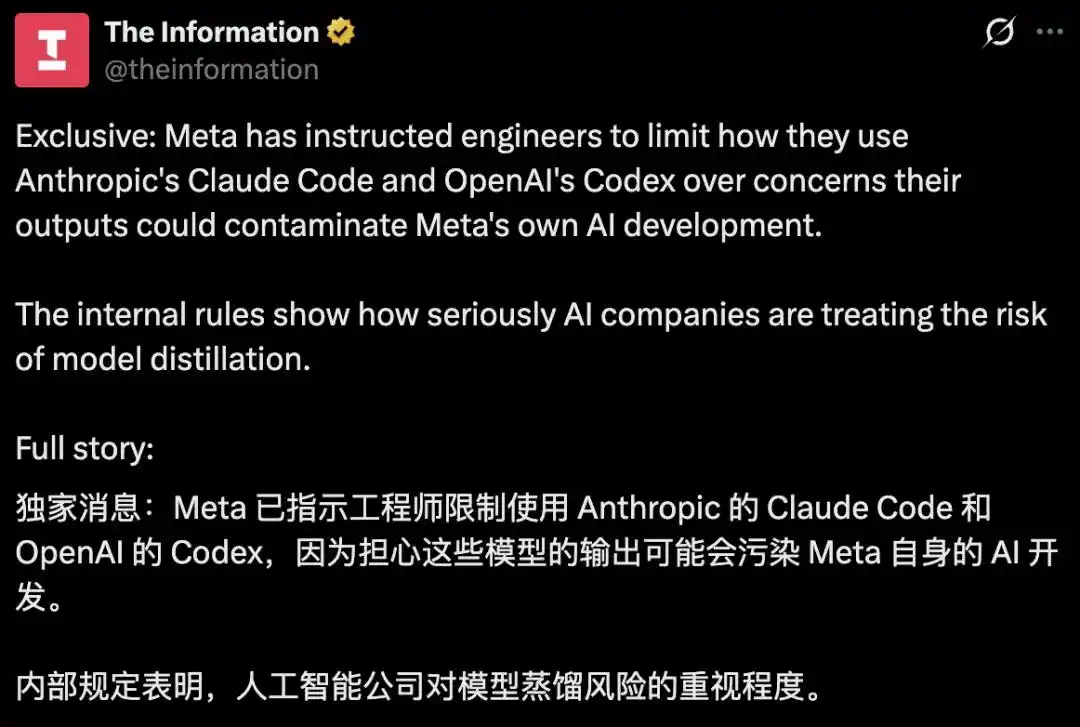
According to an internal guide obtained by The Information, a memo even directly called for a pause on certain tasks involving these two models. The wording was severe, stating this could trigger a "serious escalation with partners."

However, the strangeness lies precisely here.

Meta is one of Claude Code's largest global customers. Its total internal AI bill this year is heading towards tens of billions of dollars.

A tool used daily, purchased by the company at great cost, is now being restricted internally. And the reason for the restriction is probably something you wouldn't expect.

It's not that they aren't useful. On the contrary, it's because they are *too* useful.

This Red Line is Still in Effect

According to The Information report, these restrictions were set in May and are still in effect today.

To understand why Meta is so tense, we need to start with an internal AI coding assistant project.

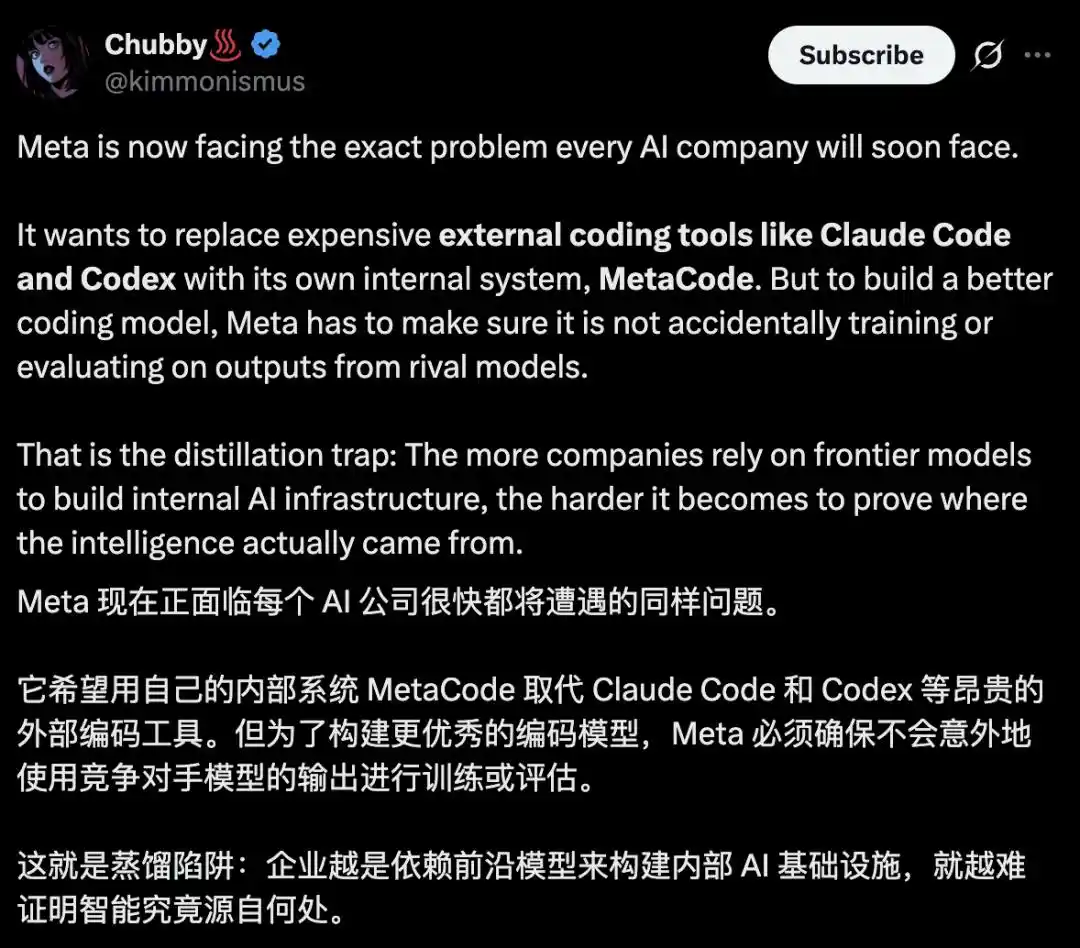
This year, it formed an Applied AI Engineering team, focusing on its self-developed AI coding assistant MetaCode (formerly DevMate).

The goal is to stop Meta from spending huge sums continuing to use others' AI coding models and to train its own.
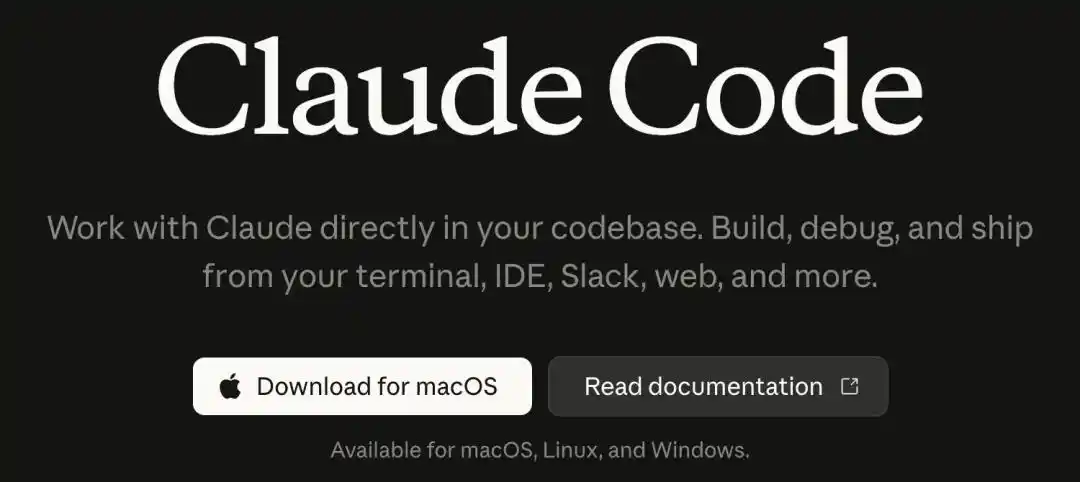
The official interface of Claude Code. Together with OpenAI's Codex, they have become the de facto standard for professional developers doing agentic programming.

But training a model that can write code is not simple.

You need to feed it massive amounts of high-quality data, and also generate enough, sufficiently tricky programming problems for it to practice on and be graded on. This set of problems and evaluations almost determines how powerful a coding model ultimately becomes.

But the problem lies precisely here.

The difficulty Meta encountered is how to prevent employees from becoming too reliant on these external tools while building the internal replacement.

What it worries about is the outputs from these external models seeping into the training data, causing the model it builds to secretly learn the competitor's capabilities.

To understand this concern, you need to know how a model "learns": You feed it what kind of data, it becomes that kind of model.

MetaCode wants to become stronger by relying on the training data and programming problem sets accumulated by engineers.

But once these problems, answers, and even grading criteria come from Claude or Codex, what MetaCode learns is no longer "skills trained by human engineers," but "Claude's skills."

It's copying answers from the competitor's test paper, becoming more and more like the competitor.

Even more hidden is the evaluation part.

Every time a model answers a question, something must tell it if it answered well so it knows where to improve.

If both problem creation and grading are handed to Codex, then MetaCode is evolving towards what "Codex thinks is correct," essentially copying the competitor's judgment standards bit by bit into its own mind.

This is why Meta's guide prohibits AI from being the problem creator or grader, and even governs whether "AI-generated materials can enter the environment accessible to the model under test."

As long as the competitor's output seeps into the training or evaluation chain in any way, the line of "who taught whom" becomes blurred.

Ultimately, Meta's pause on certain tasks is about isolating the training data.

It fears that the AI writes so well that it becomes unclear which skills were trained internally and which were learned from Claude and Codex.

And the latter set of capabilities is rented, not its own.

Surprisingly Detailed Restrictions

It must be clarified first that Meta's internal documents show no actual records of employees violating rules.

A Meta spokesperson also responded that the company has "clear policies" governing the use of AI tools. So this document is more like an internal early warning.

What tasks can't AI handle? Mainly the following three categories:

First, you cannot use Claude or Codex outputs to create test questions for your own model. The guide's exact words are, this "clearly falls into the category where engineers are not in the driver's seat," "We do not want tasks derived from models."

Second, AI cannot find bugs in source code, nor can it help you think about "what to test" based on code analysis.

Third, anything generated by AI cannot be placed anywhere accessible by the model under test.

Simply put, as long as AI participates in the judgment of "what to test" or "whether the answer is correct," the competitor's skills might mix in. The three rules block this opening.

What tasks can AI still do?

Setting up workflows, organizing code and files, building test frameworks for internal tools—these daily chores are allowed. The guide calls this type of work "test scaffolding" and "solution calibration," essentially assisting and building frameworks.

Even for these tasks, there is one ironclad rule: Every line of AI output must be reviewed by a human first.

In Meta's view, once you let a competitor's model create the test and grade it, it becomes unclear whose test this is.

What it truly wants to protect is that line of "who taught whom."

The Unavoidable "Distillation Trap"

What Meta worries about has a specific name in the industry: distillation.

The meaning is easy to understand: Use a stronger model to continuously answer questions, then use these answers to train a weaker model.

It's a bit like having the top student redo the entire exam paper, and the struggling student copies it, catching up to years of effort in months.

The massive investment others put into data, computing power, and research, you almost get for free.

Training a cutting-edge model from scratch costs astronomical sums of money and time. Distillation, however, might only require a batch of outputs from the other model, reducing costs and timelines to a fraction.

Distillation itself is standard industry practice; big companies also often distill their own large models to create smaller, cheaper versions for users.

The trouble only arises: Once you are copying someone else's model, the capabilities you train—are they your own, or borrowed? It's unclear.

Some call this the "distillation trap": The more you rely on the strongest model to build your own foundation, the harder it is to prove where your intelligence actually came from.
In the United States, the law does not explicitly prohibit distillation, and AI-generated content is not protected by copyright. Using the other's output to train your own model basically passes the legal hurdle.

The only barrier is the contract.

Both OpenAI's and Anthropic's terms of service contain similar restrictions: You cannot use the model's outputs to create something that competes with them.

Moreover, the enforcement power for this barrier lies entirely with the competitor.

Last year, Anthropic directly cut off OpenAI's API access to Claude, even though OpenAI claimed it was only for evaluating capabilities and safety, a "standard industry" practice.

Even Musk was forced to admit in a court hearing this past April that his xAI "partially" distilled OpenAI's models.

April 30, 2026, in the witness stand at a California federal court, Musk was asked if xAI used distillation techniques on OpenAI models to train Grok. He first said this was common practice for AI companies.

When pressed if this amounted to a "yes," he replied "partially."

The rules are fuzzy, and "enforcement power" is held by competitors. Who dares to bet their billions in investment that a competitor won't turn hostile?

From this perspective, Meta's tension is not at all excessive.

Here, there's also the consideration of saving money.

According to internal memos, Meta will burn tens of billions of dollars this year just on internal AI use. It has even started setting token usage limits for employees. Even a cash-rich giant like Meta is starting to find AI too expensive and is calculating carefully.

If development work can be shifted from expensive external tools to its own MetaCode, it saves money while avoiding the minefield of distillation—killing two birds with one stone.

A Tightrope-Walking Map

Regarding Meta's internal documents, tech law scholar and legal advisor Mark Leiser has a vivid phrase: This is "almost like a map for walking a tightrope."

On one side, you need to gain the benefits of external models; on the other, you must prevent their capabilities from slipping into your own system.

Of course, Meta isn't the only company walking this tightrope; it touches a vital point for the entire industry.

When you use a sufficiently smart AI to build another equally smart AI, in the end, you might find it hard to say clearly: Is this intelligence something you trained yourself, or did you secretly learn it from someone else's AI?

And this issue isn't that far from ordinary people either.

The code you write with AI, the plans you modify, the materials you compile—feeding them back becomes nourishment for the next generation of models.

In this cycle, who is standing on whose shoulders? That line has become increasingly blurred.

When AI starts helping us build AI, can we still tell whose capabilities are whose?

References:

https://x.com/kimmonismus/status/2071591755351224344

https://www.theinformation.com/articles/internal-docs-show-meta-putting-limits-claude-codex-fearing-distillation

This article is from the WeChat public account "New Zhiyuan", author: ASI Apocalypse

Tiền kỹ thuật số thịnh hành

Câu hỏi Liên quan

QWhy did Meta restrict its engineers from using Claude Code and Codex internally?

AMeta restricted their internal use to prevent knowledge distillation, where the outputs from these powerful external AI models could inadvertently influence and shape the training of Meta's own in-house AI coding assistant, MetaCode. The concern is that if MetaCode is trained on data or evaluations generated by Claude or Codex, its capabilities would be learned from the competitor's model rather than developed independently.

QWhat specific tasks does Meta's policy forbid using Claude or Codex for?

AThe policy forbids three main tasks: 1) Using their outputs to create test cases or benchmarks for Meta's own models. 2) Using them to find bugs in source code or to suggest what should be tested. 3) Placing any AI-generated content in an environment accessible by the model being trained (MetaCode).

QWhat is 'distillation' in the context of AI model training, and what is the 'distillation trap' mentioned in the article?

AIn AI, distillation refers to using a larger, more powerful model's outputs to train a smaller or weaker model. The 'distillation trap' is the dilemma where a company heavily relies on a competitor's model outputs to build its own. This makes it difficult to prove that the resulting model's intelligence and capabilities were developed independently rather than being copied or derived from the competitor.

QWhat are the potential consequences for a company if it's found to have distilled a competitor's AI model?

AWhile not explicitly illegal under current US law, using a competitor's model outputs for training likely violates their Terms of Service. The primary consequence is that the competitor can take action, such as cutting off API access (as Anthropic did to OpenAI). This creates significant business and legal risk, potentially jeopardizing a company's multi-billion dollar AI investments.

QBesides avoiding 'distillation,' what is another key reason for Meta to develop and push its own MetaCode assistant?

AAnother key reason is cost reduction. Meta's internal AI usage is projected to cost tens of billions of dollars this year. By shifting development work from expensive external tools like Claude and Codex to its own MetaCode, the company can save significant money while also mitigating the legal and strategic risks associated with knowledge distillation.

Nội dung Liên quan

Thời đại AI, Bitcoin còn lại gì?

Tác giả Sevclub từ Seven Research chia sẻ quan điểm rằng AI và Bitcoin là hai mặt của một đồng xu trong thời đại số hiện nay. Trong khi AI làm giảm chi phí sản xuất thông tin đến mức gần như bằng không, dẫn đến sự tràn ngập nội dung thật giả lẫn lộn và khó kiểm chứng, thì Bitcoin lại đóng vai trò ngược lại: nó là cỗ máy tạo ra "khả năng xác minh". Bằng cách tiêu thụ năng lượng (thường bị chỉ trích là lãng phí), mạng lưới Bitcoin không tạo ra nội dung hay năng lực tính toán như AI, mà đảm bảo tính bất biến và có thể xác minh độc lập cho một cuốn sổ cái phân tán. Mọi giao dịch đều được xác thực bằng toán học và mật mã học, không cần tin tưởng vào bất kỳ ngân hàng, nền tảng hay cá nhân trung tâm nào. Trong một thế giới mà AI có thể dễ dàng tạo ra văn bản, hình ảnh, video giả mạo, thì thứ trở nên khan hiếm và quý giá chính là những sự thật có thể kiểm chứng được. Tác giả so sánh: AI giống như máy in thời kỳ Phục Hưng, cách mạng hóa việc sản xuất và sao chép; còn blockchain (với Bitcoin là ứng dụng điển hình) giống như phương pháp kế toán kép mới, cách mạng hóa việc xác minh và ghi chép. Chúng không cạnh tranh mà bổ sung cho nhau — một bên giảm chi phí tạo lập, một bên giảm chi phí xác thực. Do đó, giá trị cốt lõi của Bitcoin trong kỷ nguyên AI có thể không nằm ở việc là "tiền" mà ở việc là một "cỗ máy tạo ra tính có thể xác minh" cho lịch sử và tài sản kỹ thuật số.

链捕手27 phút trước

Thời đại AI, Bitcoin còn lại gì?

链捕手27 phút trước

Nhãn mác "chuỗi ma" của Cardano bị bác bỏ? Tại sao 34 ứng dụng phi tập trung (dApp) của ADA không kể toàn bộ câu chuyện

Bài báo thảo luận về nhãn "ghost chain" (blockchain ma) thường bị gán cho Cardano (ADA) do số lượng dApp ít ỏi (chỉ 34) so với các đối thủ như Ethereum hay Solana. Dữ liệu cho thấy hoạt động on-chain và số người dùng hàng ngày của Cardano thấp hơn đáng kể. Tuy nhiên, bài viết lập luận rằng chỉ số này không kể câu chuyện toàn diện. Cardano sử dụng mô hình EUTXO (Extended Unspent Transaction Output) độc đáo, nơi các giao dịch được tổng hợp (batch) trước khi ghi vào sổ cái. Điều này mang lại lợi thế về bảo mật và tính xác định, nhưng cũng dẫn đến việc đánh giá thấp số liệu hoạt động thực tế trên chuỗi. Bên cạnh đó, Cardano tập trung vào phát triển bền vững, bảo mật và phương pháp nghiên cứu chuyên sâu, phù hợp cho các ứng dụng tuân thủ và doanh nghiệp. Mặc dù có những lo ngại như việc đóng cửa công cụ TapTools và cảnh báo về một số dApp có thể ngừng hoạt động, số liệu phát triển của Cardano vẫn rất mạnh. Do đó, bài viết kết luận rằng việc gọi Cardano là "ghost chain" chỉ dựa trên số lượng dApp là không đủ căn cứ, vì nó bỏ qua kiến trúc kỹ thuật và định hướng chiến lược riêng biệt của mạng lưới này.

ambcrypto1 giờ trước

Nhãn mác "chuỗi ma" của Cardano bị bác bỏ? Tại sao 34 ứng dụng phi tập trung (dApp) của ADA không kể toàn bộ câu chuyện

ambcrypto1 giờ trước

Cơ quan FCA của Anh công bố sổ tay quy định về tiền mã hóa: Phương pháp tiếp cận dựa trên rủi ro bắt đầu vào tháng 10/2027

Cơ quan Giám sát Tài chính Anh (FCA) đã công bố một khuôn khổ quy định mới cho tiền mã hóa, áp dụng từ tháng 10/2027, thay vì các quy định cứng nhắc, đồng loạt. Cách tiếp cận dựa trên rủi ro này yêu cầu các công ty tiền mã hóa duy trì vốn đủ để bù đắp tổn thất tiềm năng, nhưng số vốn sẽ thay đổi tùy theo mức độ rủi ro của từng doanh nghiệp. Các công ty nhỏ hơn và ít rủi ro hơn sẽ có yêu cầu công bố thông tin giảm bớt, giúp tiết kiệm chi phí tuân thủ. Các công ty sẽ tự đánh giá rủi ro trên bảng cân đối kế toán và thực hiện kiểm tra áp lực hàng năm, sau đó FCA sẽ xem xét các đánh giá này. Mục tiêu của những thay đổi này là tăng cường sự tin tưởng của thị trường và thu hút thêm 3-4 triệu người dùng tiền mã hóa tại Anh. Đối với stablecoin, FCA đã giữ cấu trúc cơ bản nhưng nới lỏng một số yêu cầu, đồng thời tăng cường bảo vệ người tiêu dùng bằng quy định tài sản dự trữ phải được nắm giữ trong một ủy thác theo luật định. Các quy tắc này tạo thành khuôn khổ cơ bản, trong đó những tổ chức phát hành lớn có thể phải đối mặt với giám sát chặt chẽ hơn.

ambcrypto2 giờ trước

Cơ quan FCA của Anh công bố sổ tay quy định về tiền mã hóa: Phương pháp tiếp cận dựa trên rủi ro bắt đầu vào tháng 10/2027

ambcrypto2 giờ trước

Giao dịch

Giao ngay

Bài viết Nổi bật

Làm thế nào để Mua PEOPLE

Chào mừng bạn đến với HTX.com! Chúng tôi đã làm cho mua ConstitutionDAO (PEOPLE) trở nên đơn giản và thuận tiện. Làm theo hướng dẫn từng bước của chúng tôi để bắt đầu hành trình tiền kỹ thuật số của bạn.Bước 1: Tạo Tài khoản HTX của BạnSử dụng email hoặc số điện thoại của bạn để đăng ký tài khoản miễn phí trên HTX. Trải nghiệm hành trình đăng ký không rắc rối và mở khóa tất cả tính năng. Nhận Tài khoản của tôiBước 2: Truy cập Mua Crypto và Chọn Phương thức Thanh toán của BạnThẻ Tín dụng/Ghi nợ: Sử dụng Visa hoặc Mastercard của bạn để mua ConstitutionDAO (PEOPLE) ngay lập tức.Số dư: Sử dụng tiền từ số dư tài khoản HTX của bạn để giao dịch liền mạch.Bên thứ ba: Chúng tôi đã thêm những phương thức thanh toán phổ biến như Google Pay và Apple Pay để nâng cao sự tiện lợi.P2P: Giao dịch trực tiếp với người dùng khác trên HTX.Thị trường mua bán phi tập trung (OTC): Chúng tôi cung cấp những dịch vụ được thiết kế riêng và tỷ giá hối đoái cạnh tranh cho nhà giao dịch.Bước 3: Lưu trữ ConstitutionDAO (PEOPLE) của BạnSau khi mua ConstitutionDAO (PEOPLE), lưu trữ trong tài khoản HTX của bạn. Ngoài ra, bạn có thể gửi đi nơi khác qua chuyển khoản blockchain hoặc sử dụng để giao dịch những tiền kỹ thuật số khác.Bước 4: Giao dịch ConstitutionDAO (PEOPLE)Giao dịch ConstitutionDAO (PEOPLE) dễ dàng trên thị trường giao ngay của HTX. Chỉ cần truy cập vào tài khoản của bạn, chọn cặp giao dịch, thực hiện giao dịch và theo dõi trong thời gian thực. Chúng tôi cung cấp trải nghiệm thân thiện với người dùng cho cả người mới bắt đầu và người giao dịch dày dạn kinh nghiệm.

Tổng lượt xem 732Xuất bản vào 2024.12.12Cập nhật vào 2026.06.02

Làm thế nào để Mua PEOPLE

Thảo luận

Chào mừng đến với Cộng đồng HTX. Tại đây, bạn có thể được thông báo về những phát triển nền tảng mới nhất và có quyền truy cập vào thông tin chuyên sâu về thị trường. Ý kiến ​​của người dùng về giá của PEOPLE (PEOPLE) được trình bày dưới đây.

活动图片