Can the US Maintain Its Credibility? Ray Dalio's Vision of a 'Tribute-Style' New Order

marsbitXuất bản vào 2026-06-23Cập nhật gần nhất vào 2026-06-23

Tóm tắt

Bridgewater founder Ray Dalio links declining U.S. credibility and rising Chinese influence to a modern "tribute system" – a hierarchical order based on power differentials, economic interests, and diplomatic pressure rather than direct control. This shift, he argues, makes U.S. commitments appear negotiable, prompting Asian nations to reassess security and economic alignments. A key market vulnerability is the advanced semiconductor supply chain concentrated in East Asia, which produces the majority of the world's most advanced chips. Dalio suggests that even without direct conflict, uncertainties over commitments, shipping, or supply chain reshoring can trigger asset price volatility in tech stocks, Asian markets, and RMB-denominated assets. While not predicting immediate extreme events, he warns that policy swings, miscalculations, and non-military pressure could reshape regional order, with market reactions preceding any outright confrontation.

Bridgewater founder Ray Dalio has recently, in interviews and media reports, linked the decline in trust from US allies and the rise in China's strength to a modern version of a 'tribute-style order'. For the markets, this is not merely a historical analogy. If the US's commitments to allies and key regions are seen as more negotiable, while China alters the choices of neighboring countries through economic, financial, and diplomatic influence, the first factors priced into the market are likely to be regional risks, AI chip supply chains, RMB assets, and sentiment in Asian markets.
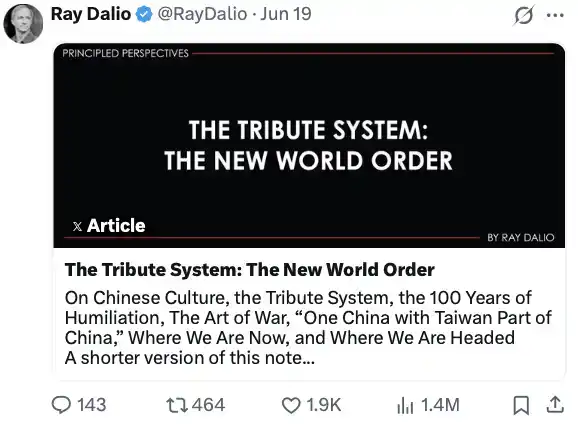
Dalio's assessment is sharp: as US relative deterrence declines and China's economic and financial influence rises, Asian countries may reassess who can provide security and economic order. He borrows the historical concept of the 'tribute system', referring not to simple direct control, but to a hierarchical relationship composed of power differentials, economic interests, diplomatic protocol, and pressure constraints.

One real-world focal point is East Asia's advanced semiconductor supply chain. Related regions hold key positions in the global manufacturing of advanced semiconductors, particularly AI-chip-related wafer fabrication. Public data widely indicates that this region produces over 60% of the world's semiconductors and over 90% of the most advanced chips. Even without extreme events, delays in commitments, shipping uncertainties, diplomatic pressure, or progress in supply chain self-sufficiency alone could be enough to cause related assets to fluctuate in advance.

US Commitments Becoming 'Negotiable' Is a Danger Signal in Dalio's Eyes

Dalio observes several recent events along the same line.

First is the Middle East conflict and risks in the Strait of Hormuz. Market reports surrounding Iran, energy transport, and the cost of US intervention are used by him as an analogy: the US public and government are increasingly unwilling to bear the cost of long-term, multi-front conflicts. This analogy is more of a macro investor's historical reference; it does not mean Middle East developments have already proven US decline. But it explains why a strait risk gets incorporated into narratives about shifts in Sino-US power.

Second is the pace of progress in some US external arrangements. According to reports from AP, *The Washington Post*, etc., planned arrangements involving around $14 billion have not yet been fully finalized. Concerned parties state they have not received suspension notices; a US acting Navy secretary stated that some external arrangements were delayed due to the Iran war and munitions needs. Trump also referred to related matters as a 'negotiating chip' in talks with China.

This is the part most sensitive to the market. If US commitments to key regions are understood by the outside world as negotiable, other Asian economies will reassess the reliability of US promises. Whether the related arrangements are ultimately implemented remains undecided, but 'uncertainty' itself already constitutes a signal.

Third is the change in tone from the US in Asian security forums. US Secretary of Defense Pete Hegseth's speech at the Shangri-La Dialogue on May 30th was interpreted by media compared to 2025 as toning down its hawkishness towards China, though he still emphasized the US would maintain a favorable balance of power in the Indo-Pacific and remain vigilant about China's military expansion. This may not represent a US withdrawal from Asia, but it deepens one question: when the US simultaneously faces pressures in the Middle East, Europe, and the Indo-Pacific, how much cost is it willing to bear for its regional commitments?

'Tribute-Style Order' Is Not a History Lesson, But an Explanation of Indirect Pressure

Dalio's argument sparks discussion because he does not explain China solely from a military perspective, but combines economics and finance, historical narratives, and political culture.

In his understanding, the traditional 'tribute system' was more like a set of regional order arrangements: surrounding states acknowledged power differentials in exchange for trade, protection, and stability; the central state maintained influence through rewards, punishments, protocol, and access rules, without frequently resorting to direct control.

This connects to the idea in *The Art of War* of 'subduing the enemy without fighting'. Truly effective pressure may not be firing shots, but forcing an opponent to adjust on their own in the face of economic, diplomatic, supply chain, and internal costs.

The advanced chip supply chain thus becomes the focal point of this logic. For global markets, key regions are where advanced chip production capacity is highly concentrated. Technology, capital, and regional order overlap here, amplifying any changes in pressure.

Dalio also notes that China's export profits, accumulation of capital surpluses, increased use of the RMB in trade and capital transactions, and the enhanced competitiveness of China's financial system will increase its appeal to neighboring countries. This is not equivalent to 'China's financial system has already replaced the US', but if more trade, financing, and supply chain arrangements revolve around China, regional economies' choices between security and economics will become more complex.

Advanced Chips Are the First Pressure Point Where Markets React

For investors, the most critical question is not 'will an extreme event immediately occur', but whether pressure will change asset prices before an extreme event happens.

Related regions produce the majority of the world's advanced chips. AI servers, cloud computing capital expenditures, semiconductor equipment, and consumer electronics supply chains are all highly tied to them. The AI chip supply chain does not only involve wafer fabrication but also includes HBM, advanced packaging, equipment, and materials. However, the most advanced process capacity is concentrated in key East Asian regions, which remains one of the most sensitive geopolitical risk exposures for global tech stocks.

This is also why Dalio emphasizes 'non-direct conflict'. Modern financial markets do not need to wait for the worst outcome to occur before adjusting. Shipping insurance, chip inventories, corporate capital expenditures, USD and RMB flows, and Asian equity, currency, and bond assets may all fluctuate as risk expectations change.

If China continues to advance self-sufficiency in advanced chips, the external constraints of key production capacity on the mainland supply chain may decrease; but in the short term, related regions remain a key link the global AI industry cannot bypass. The so-called 'threat-as-action' refers precisely to this: when critical capacity is concentrated in a high-pressure region, even just the possibility of blockade or sanctions is enough to affect global tech stock valuations and corporate procurement decisions.

The RMB and Chinese assets will also face dual impacts. On one hand, China's trade surplus and increased use in cross-border settlements will support the RMB internationalization narrative; on the other hand, if regional risks heat up, capital will also reassess the political risk and liquidity constraints of Chinese assets.

Policy Volatility and Miscalculation Are the Hardest Parts to Price

Dalio has not packaged his judgment as a definitive conclusion. His identity is that of a global macro investor; the advantage lies in observing historical cycles, monetary finance, and geopolitical shifts together; the limitation is also here—it's more of a macro scenario than an official policy roadmap.

US policy itself can be volatile. The Trump administration can treat some external arrangements as negotiating chips, but may also re-strengthen regional commitments under pressure from Congress, allies, or electoral politics. The open and contentious nature of US domestic politics increases short-term swings but may also create reverse constraints on key issues.

Internal regional factors will also influence the pace. Different approaches within regions emphasize communication, confrontation, and risk management differently. Election cycles around 2028, US midterms, and China's internal political schedule may all change the timing of actions by various parties.

Chip self-sufficiency is also not something that can be achieved by slogans alone. Advanced processes, equipment, materials, EDA software, and talent systems all require time. If China cannot significantly reduce external dependency in key links, the importance of East Asia's advanced chip capacity will only increase, and the cost of pressure maneuvers will be harder to control.

Indirect pressure does not equal low risk. The greater the reliance on deterrence, ambiguous signals, and diplomatic probing, the more prone the situation is to miscalculation. What the market fears may not be an extreme event suddenly occurring one day, but rather all parties repeatedly testing each other between commitments, exercises, blockades, sanctions, and negotiations, ultimately pushing the situation to a harder-to-manage point. What Dalio truly reminds investors is that changes in the Asian order may not begin with a clear conflict, but first manifest in wavering commitments, diplomatic alignment, chip anxiety, and shifts in capital flows.


Tiền kỹ thuật số thịnh hành

Câu hỏi Liên quan

QWhat is Ray Dalio's main concern regarding the changing world order?

ARay Dalio's main concern is a shifting global order where a perceived decline in the reliability of US commitments and the rise of China's economic/financial influence is leading to a modern 'tribute system' in Asia. This could cause regional instability, with financial markets reacting first to changes in risk, supply chains, and capital flows before any direct conflict occurs.

QAccording to the article, why are advanced semiconductor supply chains considered a primary pressure point?

AAdvanced semiconductor supply chains, particularly in a key East Asian region, are a primary pressure point because they produce over 90% of the world's most advanced chips. Their concentration in a geopolitically sensitive area makes global tech valuations and corporate investment decisions highly vulnerable to perceived risks of disruption, delay, or sanctions, even before any extreme events take place.

QHow does Ray Dalio use the historical concept of a 'tribute system' in his analysis?

ADalio uses the 'tribute system' concept not to suggest direct Chinese control, but as an analogy for a hierarchical regional order built on power differentials, economic benefits, diplomatic protocol, and pressure. It represents a scenario where neighboring countries might align with China based on economic and security calculations, with influence maintained through incentives, penalties, and access rather than outright military conquest.

QWhat are the specific examples the article gives of US commitments becoming 'negotiable'?

AThe article cites the delayed implementation of a planned $14 billion arrangement with a key partner, reports of its potential use as a 'negotiating chip' in US-China talks, and a perceived softening of rhetoric from the US Defense Secretary at a major Asian security forum. These instances create uncertainty about the cost and reliability of US security guarantees in Asia.

QWhat does the article suggest is the most difficult factor for financial markets to price in this situation?

AThe most difficult factor for markets to price is policy volatility and the risk of miscalculation. Both US and regional policies can swing due to domestic politics and election cycles. As各方 rely more on indirect pressure, deterrence, and ambiguous signals, the risk of an unintended escalation from repeated probes and counter-probes increases, creating an unstable environment that is hard to quantify.

Nội dung Liên quan

Vụ Bê Bối Gian Lận Nghiêm Trọng Của Kỳ Lân Mã Hóa Blockstream: Toàn Bộ Cốt Truyện

Từ đầu năm, Blockstream - công ty do Bitcoin tiên phong Adam Back đồng sáng lập - liên tục đối mặt với tranh cãi. Gần đây, tài khoản điều tra NatInfoSec đưa ra cáo buộc nghiêm trọng rằng các ghi chú khai thác Bitcoin (BMN) của Blockstream có dấu hiệu lừa đảo hình xoắn ốc (Ponzi). Cáo buộc tập trung vào bốn điểm chính: 1. **Năng lực khai thác và thanh toán bị nghi ngờ:** NatInfoSec tính toán để đáp ứng nghĩa vụ BMN, Blockstream cần vận hành công suất khai thác (hashrate) từ 20-45 EH/s, nhưng bảng điều khiển của họ chỉ hiển thị 15 EH/s. Không có bằng chứng công khai nào (hồ sơ lưới điện, dữ liệu hải quan, chia sẻ từ mining pool) xác nhận công suất khai thác đủ lớn như vậy. Điều khoản "Substitute Performance BTC" trong hợp đồng cho phép Blockstream sử dụng BTC từ bất kỳ nguồn nào để thanh toán, làm dấy lên lo ngại về tính minh bạch của nguồn tiền. 2. **Lợi suất cao bất thường:** Các ghi chú BMN được phát hành thông qua nền tảng STOKR với lợi suất cố định lên tới gần 20%/năm, một mức rất cao và khó duy trì trong ngành khai thác Bitcoin vốn biến động mạnh. 3. **Tiền sử pháp lý của lãnh đạo và vấn đề công bố thông tin:** Christopher William Cook, cựu lãnh đạo quan trọng trong mảng khai thác của Blockstream và hiện là CEO của Exacore (công ty được tách ra từ hoạt động khai thác), có tiền án lừa đảo qua thư từ năm 2008. Thông tin này không được tiết lộ trong các tài liệu phát hành BMN. Hồ sơ của Cook tại NASA trong tài liệu marketing cũng bị thổi phồng. 4. **Liên hệ đến BSTR và việc phát hành SPAC:** Có lo ngại rủi ro từ BMN có thể ảnh hưởng đến Bitcoin Standard Treasury Company (BSTR) - một công ty liên quan đến Adam Back đang chuẩn bị niêm yết qua SPAC. Tuy nhiên, BitMEX Research chỉ ra rằng về mặt pháp lý, các rủi ro này có thể được tách biệt nếu không có điều khoản bảo lãnh tập đoàn. Phản ứng từ cộng đồng và BitMEX: BitMEX Research thừa nhận tiền án của Cook là có thật và bày tỏ lo ngại về lợi suất cao, nhưng cho rằng nhiều cáo buộc khác thiếu bằng chứng hoặc gây hiểu nhầm, đặc biệt là về mối liên hệ pháp lý giữa BMN và BSTR. Samson Mow, cựu CSO của Blockstream, bảo vệ hoạt động khai thác là có thật. Tuy nhiên, các nhà phê bình như Matthew R. Kratter và Chris Guida tiếp tục đặt câu hỏi về khả năng xác minh độc lập công suất khai thác và nguồn thanh toán thực tế. Tóm lại, mặc dù chưa có bằng chứng kết luận về hành vi lừa đảo, sản phẩm BMN của Blockstream vẫn còn nhiều câu hỏi cần làm rõ về quy mô thực tế, năng lực khai thác đủ để chi trả, nguồn gốc của lợi suất cao cố định, tính minh bạch trong thanh toán và mức độ ảnh hưởng của cá nhân có tiền án. Blockstream chưa có phản hồi chính thức toàn diện về các cáo buộc này.

marsbit1 giờ trước

Vụ Bê Bối Gian Lận Nghiêm Trọng Của Kỳ Lân Mã Hóa Blockstream: Toàn Bộ Cốt Truyện

marsbit1 giờ trước

Nhóm Reddit từng gây 'ép buộc mua vào' phố Wall, đã tìm ra GME tiếp theo?

Tóm tắt: Vào ngày 24/6, cổ phiếu Wendy's (WEN) đã tăng mạnh sau khi một bài đăng trên cộng đồng Reddit r/wallstreetbets với tiêu đề "We need to save Wendy's" thu hút sự chú ý và được thảo luận như một ứng cử viên "meme squeeze" mới. Bài đăng khai thác một meme văn hóa lâu năm trong WSB về việc làm tại Wendy's sau khi thua lỗ. WEN hiển thị một số đặc điểm bề ngoài của cổ phiếu meme: giá gần mức thấp nhất trong năm, tỷ lệ bán khống công khai khá cao ở mức 31.83%, và khối lượng giao dịch tăng đột biến. Tuy nhiên, phân tích cho thấy cấu trúc hiện tại khác xa so với đợt bức ép bán khống (short squeeze) có hệ thống như GameStop (GME) năm 2021. Mặc dù tỷ lệ bán khống đủ cao để tạo ra một đợt bức ép nhẹ, nó không ở mức cực đoan như GME trước đây. Yếu tố then chốt để biến động giá kéo dài - một vòng xoáy gamma squeeze từ việc các nhà tạo lập thị trường phải mua cổ phiếu để phòng ngừa rủi ro khi nhà đầu tư bán lẻ mua ồ ạt quyền chọn mua - vẫn chưa có đủ bằng chứng chắc chắn. Lịch sử cho thấy Wendy's từng là chủ đề meme trước đây nhưng không duy trì được đà tăng. Sức hấp dẫn của câu chuyện "cứu Wendy's" có thể dễ lan truyền, nhưng khả năng biến thành hành động nắm giữ kỷ luật lâu dài của cộng đồng vẫn chưa rõ. Về cơ bản, không có dấu hiệu công ty gần phá sản. Kết luận, đợt biến động này chứng minh sức ảnh hưởng của dòng tiền nhà đầu tư bán lẻ vẫn có thể kích hoạt biến động giá ngắn hạn cho cổ phiếu có thanh khoản trung bình. Tuy nhiên, WEN hiện giống một đợt tăng giá meme (meme pop) nhanh chóng được thúc đẩy bởi sự chú ý hơn là một đợt bức ép bán khống bền vững. Câu trả lời cuối cùng sẽ phụ thuộc vào việc khối lượng giao dịch cao và sự nhiệt tình trên diễn đàn có được duy trì trong những ngày tới hay không, và liệu hoạt động trên thị trường quyền chọn có tạo ra hiệu ứng gamma mạnh mẽ hay không.

marsbit1 giờ trước

Nhóm Reddit từng gây 'ép buộc mua vào' phố Wall, đã tìm ra GME tiếp theo?

marsbit1 giờ trước

Hàn Quốc Nhắm Mục Tiêu 40 Nhà Khai Thác Tiền Mã Hóa Chưa Đăng Ký Trong Đợt Siết Chặt Quy Định

Đơn vị Tình báo Tài chính Hàn Quốc (FIU) đã chuyển hồ sơ khoảng 40 nhà cung cấp dịch vụ tài sản ảo chưa đăng ký cho cơ quan cảnh sát, thể hiện nỗ lực siết chặt quản lý trong nước. Theo luật Hàn Quốc, mọi sàn giao dịch tiền mã hóa phải có Chứng nhận ISMS và đăng ký với FIU trước khi hoạt động. Hiện chỉ 28 thực thể đã đăng ký hợp pháp. Các nền tảng nước ngoài bị phát hiện thu hút khách hàng địa phương qua ứng dụng nhắn tin, trong khi các đổi tiền tư nhân chuyển đổi stablecoin sang won cho khách du lịch, sinh viên. Hành động này là một phần của chiến dịch rộng lớn hơn nhằm tăng cường tiêu chuẩn tuân thủ toàn cầu thông qua các biện pháp của FATF. Giám đốc FIU Lee Hyung-joo kêu gọi các quốc gia thành viên FATF bỏ ngưỡng giao dịch theo Quy tắc Di chuyển (Travel Rule). Hàn Quốc dự kiến áp dụng kiểm tra danh tính cho mọi giao dịch tiền mã hóa từ tháng 8, thay vì chỉ các giao dịch trên 1 triệu won (~730 USD) như hiện nay. Năm 2026, các biện pháp thực thi quy định về tiền mã hóa tại Hàn Quốc tiếp tục được mở rộng, bao gồm khởi tố hình sự các vụ thao túng thị trường và tăng cường hợp tác với các tổ chức tài chính để ngăn chặn giao dịch bất hợp pháp xuyên biên giới.

TheNewsCrypto2 giờ trước

Hàn Quốc Nhắm Mục Tiêu 40 Nhà Khai Thác Tiền Mã Hóa Chưa Đăng Ký Trong Đợt Siết Chặt Quy Định

TheNewsCrypto2 giờ trước

Toàn bộ sự việc về tình trạng gian lận nghiêm trọng tại Blockstream - 'Kỳ lân mật mã'

Đầu năm nay, Adam Back, người tiên phong về Bitcoin và công ty Blockstream của ông, liên tục trở thành tâm điểm chú ý trong cộng đồng tiền mã hóa. Tháng 6, tài khoản điều tra NatInfoSec đã đăng một bài viết cáo buộc Blockstream có thể đang huy động hàng tỷ USD từ nhà đầu tư dưới danh nghĩa lợi nhuận khai thác, nhưng tính xác thực của trang trại khai thác và hashrate bị nghi ngờ, với cấu trúc mang đặc điểm Ponzi. Các cáo buộc chính bao gồm: 1. **Năng lực hashrate và thanh toán bị nghi ngờ:** Để đáp ứng nghĩa vụ từ các ghi chú khai thác (BMN) đã phát hành, Blockstream được cho là cần vận hành hơn 20 EH/s, nhưng bảng điều khiển của họ chỉ hiển thị 15 EH/s. Các bằng chứng công khai về việc mua điện, nhập khẩu thiết bị hoặc phân bổ hashrate trong mining pool không tương xứng với quy mô này. Điều khoản "Substitute Performance BTC" trong BMN2 cho phép Blockstream sử dụng BTC từ bất kỳ nguồn nào để thanh toán. 2. **Lợi suất cao và rủi ro:** Các ghi chú được phát hành qua nền tảng STOKR có lợi suất cố định lên tới khoảng 20%, điều này là bất thường trong ngành khai thác Bitcoin biến động mạnh. Một số khoản thanh toán khi đáo hạn có thể được chuyển sang ghi chú mới với lợi suất cao hơn thay vì hoàn trả gốc. 3. **Tiền án và vấn đề công bố thông tin của Christopher Cook:** Christopher William Cook, cựu lãnh đạo quan trọng trong bộ phận khai thác của Blockstream và hiện là CEO của Exacore (công ty được tách ra từ hoạt động khai thác), đã bị kết án 41 tháng tù vào năm 2008 vì tội lừa đảo qua thư tín. Thông tin này không được tiết lộ trong các tài liệu phát hành BMN. Hồ sơ tòa án liên bang Mỹ xác nhận vụ án (số 06-80187) với khoản bồi thường khoảng 1,85 triệu USD. 4. **Liên quan đến BSTR/SPAC:** Mối lo ngại được đặt ra về việc các nghĩa vụ tiềm ẩn lớn từ BMN và tiền án của Cook không được đề cập trong hồ sơ đăng ký SEC của Bitcoin Standard Treasury Company (BSTR) - công ty có liên quan đến Adam Back và đang chuẩn bị niêm yết qua SPAC. Phản ứng từ cộng đồng: * **BitMEX Research** xác nhận tiền án của Cook có thể là thật và bày tỏ lo ngại về lợi suất cao, nhưng cho rằng các cáo buộc khác thiếu bằng chứng hoặc gây hiểu nhầm, chỉ ra rằng Cook không phải là giám đốc của BSTR và BMN về mặt cấu trúc pháp lý là độc lập. * **Samson Mow** (cựu CSO Blockstream) bảo vệ lập trường, khẳng định Blockstream thực hiện khai thác thật với thiết bị và hợp đồng mua điện riêng. * Các nhà phê bình như **Matthew R. Kratter** và **Chris Guida** nhấn mạnh nhu cầu **xác minh độc lập** về hashrate, nguồn thanh toán và tính minh bạch. Tóm lại, mặc dù chưa có bằng chứng trực tiếp về hành vi lừa đảo, sản phẩm ghi chú khai thác BMN của Blockstream vẫn còn nhiều câu hỏi cần làm rõ về quy mô thực tế, khả năng thanh toán dựa trên hashrate, nguồn gốc lợi suất cao, tính xác minh được của việc thanh toán bằng BTC/L-BTC, cũng như mức độ công bố thông tin liên quan đến tiền án của nhân vật chủ chốt. Tính minh bạch là yếu tố then chốt để giải tỏa nghi ngờ. Tính đến thời điểm này, Blockstream chưa có phản hồi chính thức hệ thống về những cáo buộc trên.

链捕手3 giờ trước

Toàn bộ sự việc về tình trạng gian lận nghiêm trọng tại Blockstream - 'Kỳ lân mật mã'

链捕手3 giờ trước

Giao dịch

Giao ngay
Hợp đồng Tương lai

Bài viết Nổi bật

Làm thế nào để Mua ORDER

Chào mừng bạn đến với HTX.com! Chúng tôi đã làm cho mua Orderly (ORDER) trở nên đơn giản và thuận tiện. Làm theo hướng dẫn từng bước của chúng tôi để bắt đầu hành trình tiền kỹ thuật số của bạn.Bước 1: Tạo Tài khoản HTX của BạnSử dụng email hoặc số điện thoại của bạn để đăng ký tài khoản miễn phí trên HTX. Trải nghiệm hành trình đăng ký không rắc rối và mở khóa tất cả tính năng. Nhận Tài khoản của tôiBước 2: Truy cập Mua Crypto và Chọn Phương thức Thanh toán của BạnThẻ Tín dụng/Ghi nợ: Sử dụng Visa hoặc Mastercard của bạn để mua Orderly (ORDER) ngay lập tức.Số dư: Sử dụng tiền từ số dư tài khoản HTX của bạn để giao dịch liền mạch.Bên thứ ba: Chúng tôi đã thêm những phương thức thanh toán phổ biến như Google Pay và Apple Pay để nâng cao sự tiện lợi.P2P: Giao dịch trực tiếp với người dùng khác trên HTX.Thị trường mua bán phi tập trung (OTC): Chúng tôi cung cấp những dịch vụ được thiết kế riêng và tỷ giá hối đoái cạnh tranh cho nhà giao dịch.Bước 3: Lưu trữ Orderly (ORDER) của BạnSau khi mua Orderly (ORDER), lưu trữ trong tài khoản HTX của bạn. Ngoài ra, bạn có thể gửi đi nơi khác qua chuyển khoản blockchain hoặc sử dụng để giao dịch những tiền kỹ thuật số khác.Bước 4: Giao dịch Orderly (ORDER)Giao dịch Orderly (ORDER) dễ dàng trên thị trường giao ngay của HTX. Chỉ cần truy cập vào tài khoản của bạn, chọn cặp giao dịch, thực hiện giao dịch và theo dõi trong thời gian thực. Chúng tôi cung cấp trải nghiệm thân thiện với người dùng cho cả người mới bắt đầu và người giao dịch dày dạn kinh nghiệm.

Tổng lượt xem 510Xuất bản vào 2024.12.10Cập nhật vào 2026.06.02

Làm thế nào để Mua ORDER

Thảo luận

Chào mừng đến với Cộng đồng HTX. Tại đây, bạn có thể được thông báo về những phát triển nền tảng mới nhất và có quyền truy cập vào thông tin chuyên sâu về thị trường. Ý kiến ​​của người dùng về giá của ORDER (ORDER) được trình bày dưới đây.

活动图片