When Transfers Become Truly Frictionless: How Sui Uses 'Zero Gas' to Become the Underlying Infrastructure for Stablecoin Payments

marsbitXuất bản vào 2026-06-22Cập nhật gần nhất vào 2026-06-22

Tóm tắt

Title: Sui Launches Zero-Gas Stablecoin Transfers to Become the Foundation for Stablecoin Payments Sui has introduced a zero-gas fee feature for peer-to-peer stablecoin transfers, eliminating the need for users or businesses to hold separate SUI tokens to pay transaction costs. This innovation, built on a new underlying account architecture called Address Balances, significantly reduces validator processing costs for eligible transactions. Currently, the feature applies to a whitelist of stablecoins for transfers meeting a minimum amount, effectively preventing spam. This development aims to unlock mainstream payment use cases for stablecoins—such as everyday purchases, remittances, and subscriptions—by removing cost and complexity barriers. It is also positioned to benefit high-frequency micro-payments for AI agents and institutional B2B payments, reducing operational friction. Major custody provider Fireblocks has already announced support. The move follows Sui processing over $1 trillion in stablecoin transfer volume since August 2025. Looking ahead, Sui plans to enhance this infrastructure with protocol-level confidential transactions later in 2026, aiming to provide scalable, free, and privacy-preserving payments. Together, these advancements strengthen Sui's goal of becoming the default settlement layer for stablecoin payments.

Author: Deep Tide TechFlow

If you go to an ATM to transfer money, and the ATM tells you that you must first buy "ATM usage coupons," you would probably think the ATM has gone crazy.

But this has been the operating rule for blockchain for over a decade: to make a transfer, first prepare the Gas.

As stablecoins play an increasingly critical role in the payment field, the cost of this threshold becomes clearer: new users are blocked outside, and payment scenarios are difficult to implement.

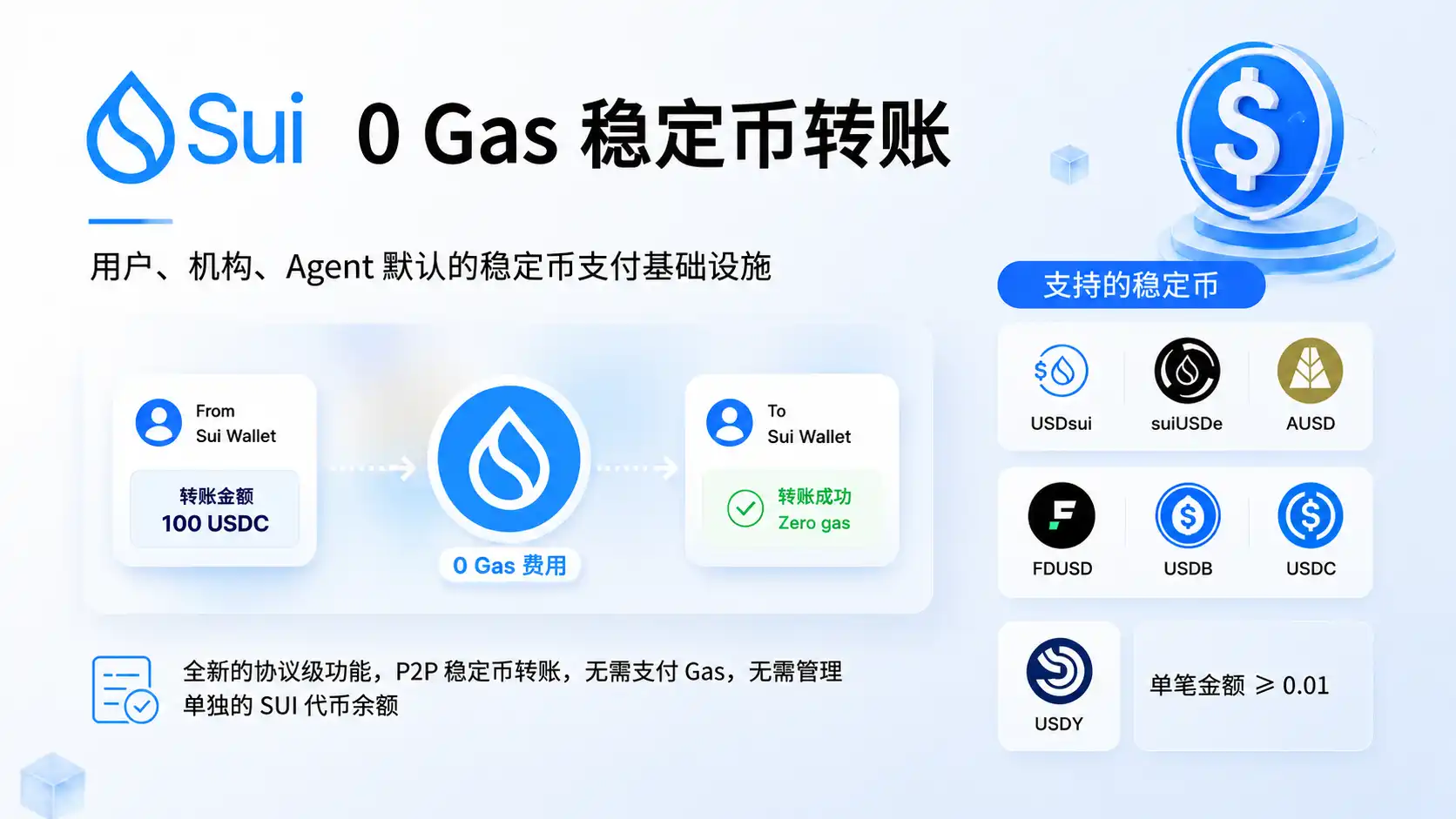
As a key initiative in building the "underlying infrastructure for stablecoin payments," on May 20, 2026, Sui announced the launch of a zero Gas stablecoin transfer feature, allowing users and enterprises to send stablecoins peer-to-peer without paying Gas fees, and without needing to manage a separate SUI token balance.

Although currently, this feature only supports P2P transfers of whitelisted stablecoins, stablecoins now have a real chance to transform from "crypto assets" into "payment infrastructure." The entity achieving this also further strengthens its position as a strong contender for the role of the "default foundation for stablecoin payments."
A New Kind of "Zero Gas": No One Is Paying for You in the Background

When mentioning zero Gas, most users' first reaction might be: Who paid the Gas for me?

This habitual thinking stems from past incomplete attempts at "zero Gas": either through subsidies or relays. The Gas never disappeared; someone was just quietly settling the bill in the background, a superficial solution that doesn't address the root cause.

Sui's "Zero Gas Stablecoin Transfer" targets the fundamental root.

It is built upon a new underlying account architecture called Address Balances. When tokens are sent using specific Move functions, they are automatically consolidated into the single balance of the recipient's address, eliminating the need to create or manage Coin objects. This saves the overhead of object creation, splitting, merging, and version tracking. The processing cost for validators is extremely low, low enough that they can refrain from charging users fees.

Costs are reduced, and boundaries must also be clearly defined: Under the highly restricted PTB mechanism, only P2P transfers of whitelisted stablecoins, with amounts no less than 0.01, are judged as zero Gas. This supports payment scenarios while isolating malicious transactions.
What Can This Infrastructure Run?

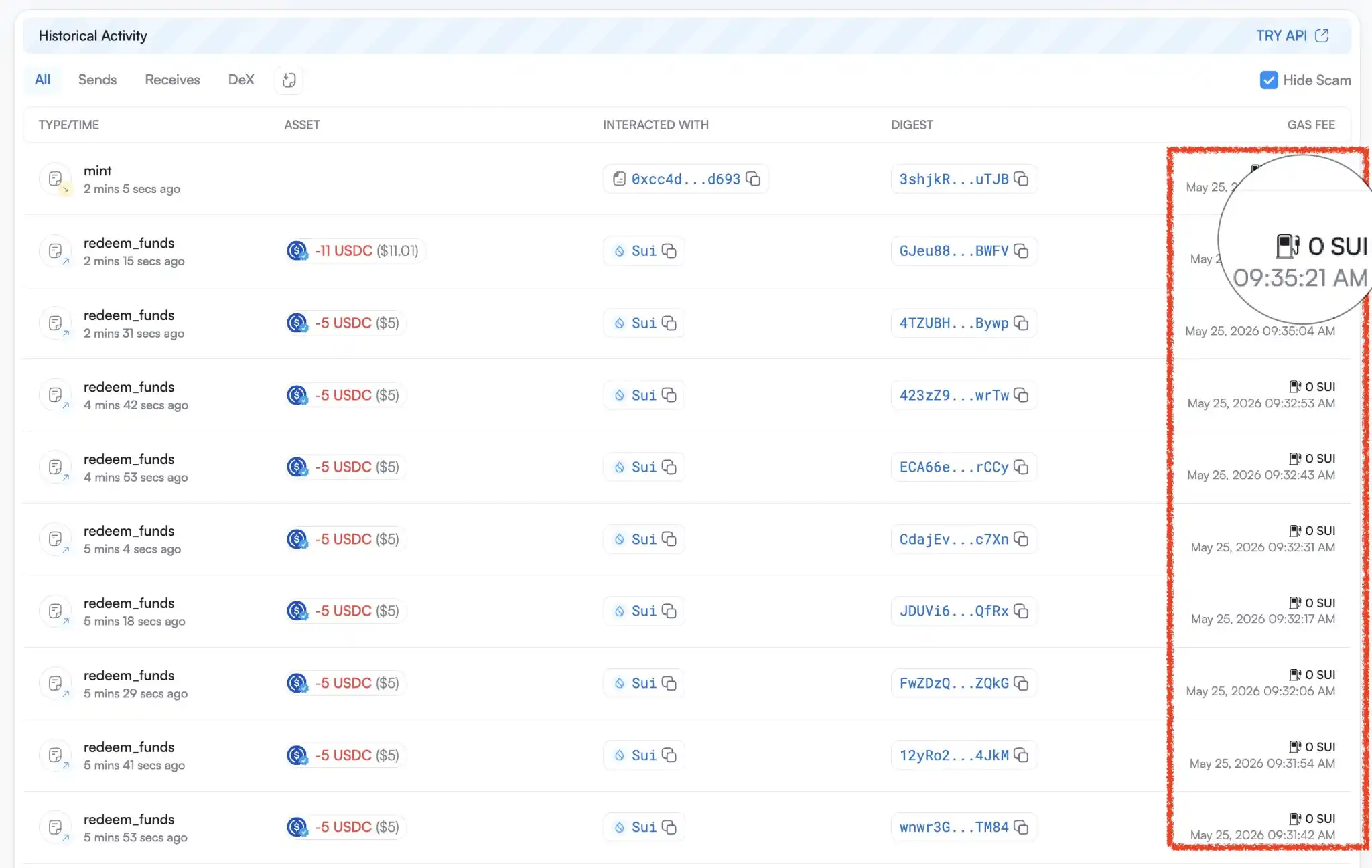
Firstly, it opens the door to daily payments. When the experience is frictionless and the cost is zero, those payment scenarios we once pinned high hopes on for stablecoins—including consumption, tipping, subscriptions, cross-border remittances, etc.—gain the potential for rapid penetration. Stablecoin payments, for the first time, possess the basic conditions to compete head-on with traditional payment tools, potentially even faster and better.

Of course, for high-frequency micro-payment scenarios, many will think of the Agent economy. In the past, actions like AI autonomous transactions and arbitrage required additional Gas management. The zero Gas stablecoin transfer will become the lowest-cost, least-resistance choice for Agents. Combined with Sui's high-performance advantages, it will further support the large-scale deployment of autonomous payment flows.

Another keyword is: Institutions. This is a group Sui officials specifically emphasize. Whether it's cross-border B2B payments, supplier settlements, or platform profit sharing, institutions often face higher payment friction. The protocol-level zero Gas mechanism transforms stablecoins into a payment tool that institutions can directly utilize.

Worth mentioning is that when the zero Gas feature was launched, Fireblocks had already announced support for address balances, and soon after, it supported Gas-free stablecoin transfers, further enhancing the accessibility of Sui's payment infrastructure for institutions. At the same time, several institutional-grade custody platforms and wallets have announced they will support zero Gas transactions.

Zero Gas: The First Half; Privacy: The Second Half

Since August 2025, stablecoin transfer volume on the Sui network has exceeded $1 trillion. This figure is sufficient to show that the underlying logic for stablecoin payments in the Sui ecosystem is already working. The launch of zero Gas stablecoin transfers will undoubtedly accelerate the construction of Sui's role as the "default foundation for stablecoin payments."

But this is only the first half of Sui's 2026 payment narrative.

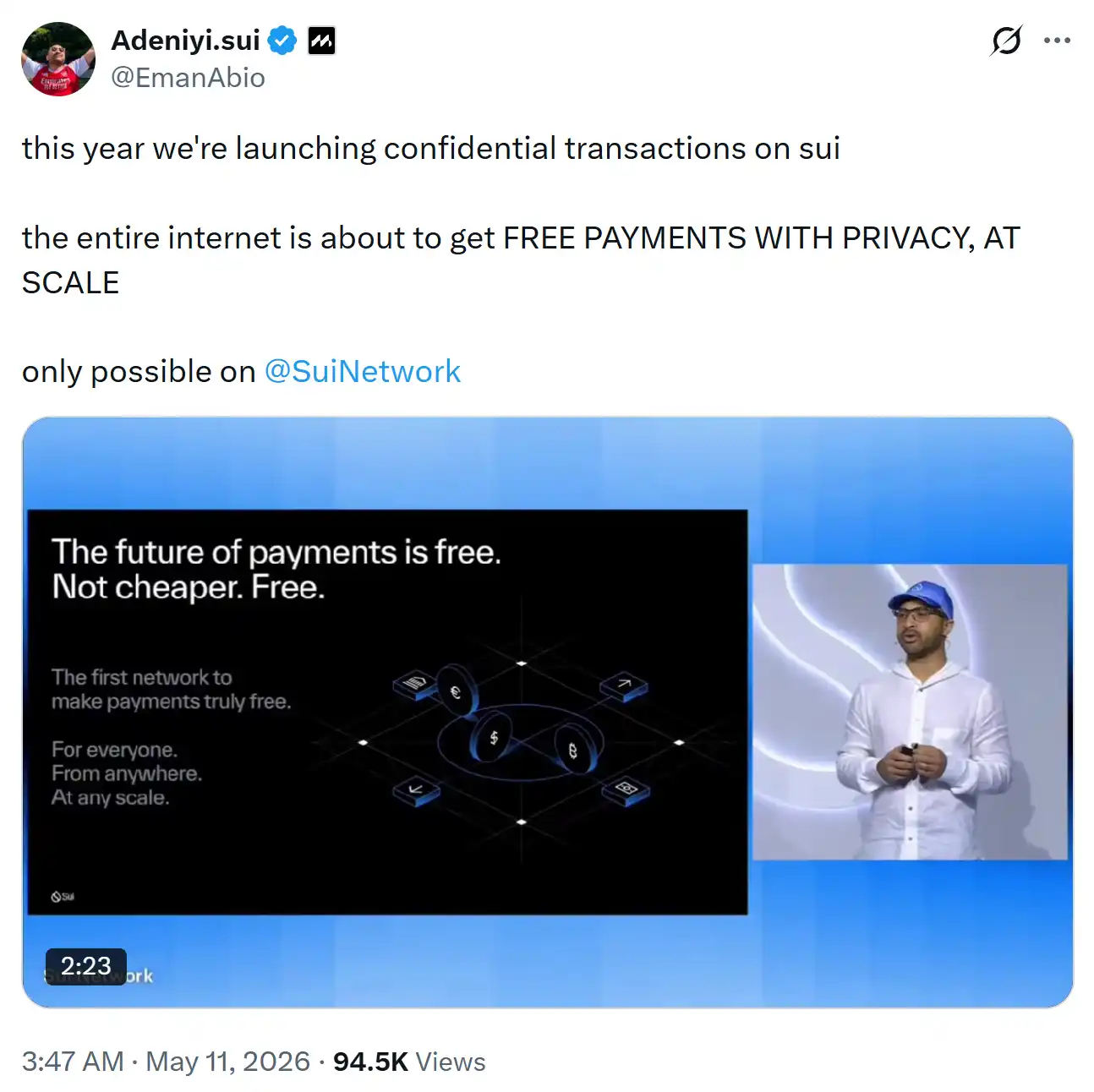
Regarding the second half, the Mysten Labs product team has hinted multiple times: Protocol-level confidential transaction functionality will be launched within 2026, aiming to achieve large-scale, free payments with privacy protection.

Transfers will not only be cost-free but will also be able to hide transaction amounts and certain details, while retaining necessary audit and compliance capabilities.

This combination is crucial for adoption, especially for institutions. The higher the compliance requirements, the greater the value of confidential transactions.
Let Money Flow Like Information.

This can be considered a phrase that runs through all of Sui's technological and ecosystem initiatives.

And now, from payments to Agents to institutions, the fuse that will decide large-scale adoption might just be lit by zero Gas stablecoin transfers.

Tiền kỹ thuật số thịnh hành

Câu hỏi Liên quan

QWhat is the main announcement made by Sui regarding stablecoin transfers, and when was it announced?

ASui announced a zero Gas stablecoin transfer function on May 20, 2026. This feature allows users and businesses to send stablecoins peer-to-peer without paying Gas fees and without needing to manage a separate SUI token balance.

QHow does Sui's 'zero Gas' mechanism for stablecoin transfers fundamentally differ from previous attempts at eliminating Gas fees?

AUnlike previous methods that relied on subsidies or relayers where someone else ultimately pays the Gas, Sui's approach targets the underlying architecture. It is built on the new Address Balances system, where tokens are sent using specific Move functions and automatically merged into the recipient's single balance. This eliminates the overhead of creating, splitting, merging, and tracking Coin objects, reducing validator processing costs so low that fees can be waived for the user.

QAccording to the article, what are some of the key use cases or scenarios enabled by zero Gas stablecoin transfers on Sui?

AThe key use cases include: 1) Everyday payments like consumption, tipping, subscriptions, and cross-border remittances. 2) High-frequency micropayments for the Agent/AI economy, enabling autonomous transactions with minimal cost. 3) Institutional payments such as cross-border B2B payments, supplier settlements, and platform revenue sharing, where reducing friction is crucial.

QWhat is the 'second half' or next major development in Sui's 2026 payment narrative mentioned in the article?

AThe 'second half' of Sui's 2026 payment narrative is the planned launch of a protocol-level confidential transaction feature within the year. The goal is to enable large-scale, free (zero Gas), and privacy-preserving payments that can hide transaction amounts and certain details while retaining necessary audit and compliance capabilities.

QWhat underlying technical principle allows Sui to offer zero Gas fees for eligible stablecoin transfers?

AIt is enabled by the new Address Balances account architecture. When tokens are sent using specific Move functions, they are automatically merged into the recipient's address balance without creating individual Coin objects. This drastically reduces the computational overhead (like object creation, splitting, merging, and version tracking) for validators, making the cost so low that fees are not charged to users for qualifying transactions.

Nội dung Liên quan

Bitcoin có thể chưa hoàn tất giai đoạn đầu hàng – Tại sao mức đáy 50 nghìn USD vẫn có thể xảy ra

Sự tin tưởng trong một thị trường né tránh rủi ro thường là dấu ấn của sức mạnh dài hạn. Thiết lập hiện tại của Bitcoin phản ánh sự tin tưởng đó. Về mặt kỹ thuật, BTC đã ghi nhận ba quý thua lỗ liên tiếp, với mức giảm trung bình khoảng 20% mỗi quý. Đây là chuỗi thua lỗ ba quý đầu tiên kể từ thị trường gấu năm 2022, khiến hơn 50% nguồn cung lưu hành của Bitcoin rơi vào trạng thái "dưới nước" và tập trung sự chú ý vào các nhà đầu tư nắm giữ dài hạn. Điều đáng chú ý là các nhà nắm giữ dài hạn hiện kiểm soát 78% nguồn cung lưu hành và họ không bán ra trong đợt suy yếu này, thay vào đó đang tích lũy thêm. Tuy nhiên, lịch sử cho thấy Bitcoin thường chạm đáy khi nhóm này bắt đầu đầu hàng, một điều chưa xảy ra trong chu kỳ này. Bối cảnh vĩ mô đang thay đổi với kỳ vọng Cục Dự trữ Liên bang Mỹ có thể tiếp tục tăng lãi suất vào mùa thu, tạo ra điều kiện tài chính thắt chặt hơn. So sánh với các chu kỳ gấu trước (2018 và 2022), khi BTC chạm đáy sau chín tháng giảm điểm liên tiếp, chu kỳ hiện tại mới có bảy tháng. Nếu mô hình lịch sử lặp lại, giai đoạn đầu hàng của Bitcoin vẫn có thể còn tiếp diễn. Sự đầu hàng của các nhà nắm giữ dài hạn, kết hợp với bối cảnh vĩ mô bất ổn, có thể đánh dấu đợt thanh lọc cuối cùng, đẩy BTC về vùng 50.000 USD vào cuối quý 3 trước khi hình thành đáy thực sự.

ambcrypto35 phút trước

Bitcoin có thể chưa hoàn tất giai đoạn đầu hàng – Tại sao mức đáy 50 nghìn USD vẫn có thể xảy ra

ambcrypto35 phút trước

MSTR tiết lộ bán 3,588 Bitcoin, giá cổ phiếu lao dốc 5% trong ngày

Công ty Strategy, chủ sở hữu doanh nghiệp lớn nhất thế giới, đã công bố việc bán 3.588 Bitcoin trong khoảng thời gian từ 29/6 đến 5/7 để thu về khoảng 216 triệu USD, nhằm chi trả cổ tức cho các cổ phiếu ưu đãi. Đây là lần bán Bitcoin lớn nhất trong lịch sử công ty, đánh dấu sự thay đổi từ chiến lược "chỉ mua, không bán" trước đây sang việc sử dụng Bitcoin như một tài sản để quản lý thanh khoản. Động thái này diễn ra trong bối cảnh giá Bitcoin và cổ phiếu MSTR đều chịu áp lực giảm. Sau thông báo, giá cổ phiếu Strategy đã giảm hơn 5% trong phiên. Công ty trước đây từng tuyên bố "không bao giờ bán Bitcoin", nhưng đã có hai lần bán nhỏ vào tháng 5 và giờ là đợt bán lớn với quy mô gấp hàng trăm lần. Nguyên nhân chính đến từ áp lực tài chính. Strategy phải chi trả khoảng 1,5 tỷ USD cổ tức ưu đãi hàng năm, trong khi dòng tiền từ hoạt động phần mềm không đủ trang trải. Khi huy động vốn mới khó khăn, công ty buộc phải bán Bitcoin để duy trì hoạt động. Mô hình hiện tại của Strategy là tiếp tục mua Bitcoin khi điều kiện tài chính thuận lợi và bán một phần khi cần thanh khoản, tạo thành một vòng vận hành khép kín. Tính đến ngày 5/7, công ty vẫn nắm giữ 84.377 Bitcoin với giá vốn trung bình khoảng 75.700 USD.

华尔街日报5 giờ trước

MSTR tiết lộ bán 3,588 Bitcoin, giá cổ phiếu lao dốc 5% trong ngày

华尔街日报5 giờ trước

Donald Trump, Tổng thống Mỹ biết 'chơi' chứng khoán nhất

Donald Trump, tổng thống Mỹ giàu có nhất lịch sử, đã kiếm được 2,2 tỷ USD trong năm 2025, theo báo cáo tài chính công khai. Phần lớn thu nhập đến từ tiền điện tử (1,4 tỷ USD), đặc biệt là đồng meme $TRUMP và token WLFI của công ty World Liberty Financial do gia đình ông thành lập. Lĩnh vực bất động sản truyền thống mang về 575 triệu USD, với các khu nghỉ dưỡng và sân golf như Mar-a-Lago có doanh thu tăng mạnh nhờ sự hiện diện của ông. Trump cũng thực hiện hơn 22.000 giao dịch chứng khoán trong năm, với tần suất cao bất thường và thời điểm giao dịch trùng khớp với các sự kiện chính sách quan trọng, dấy lên lo ngại về xung đột lợi ích. Dù Nhà Trắng cho biết các giao dịch do đội ngũ chuyên nghiệp quản lý, việc Trump không sử dụng ủy thác mù (blind trust) như các tổng thống tiền nhiệm vẫn là điểm gây tranh cãi. Bài viết nhận định Trump đã biến vai trò tổng thống thành một "cỗ máy kinh doanh", khai thác triệt để ảnh hưởng chính trị để thu lợi nhuận cá nhân và gia đình, từ tiền điện tử, bất động sản đến chứng khoán. Điều này làm dấy lên cuộc tranh luận mới về ranh giới giữa quyền lực công và lợi ích tư trong chính trị Mỹ.

marsbit6 giờ trước

Donald Trump, Tổng thống Mỹ biết 'chơi' chứng khoán nhất

marsbit6 giờ trước

Giao dịch

Giao ngay

Bài viết Nổi bật

Làm thế nào để Mua GAS

Chào mừng bạn đến với HTX.com! Chúng tôi đã làm cho mua GAS (GAS) trở nên đơn giản và thuận tiện. Làm theo hướng dẫn từng bước của chúng tôi để bắt đầu hành trình tiền kỹ thuật số của bạn.Bước 1: Tạo Tài khoản HTX của BạnSử dụng email hoặc số điện thoại của bạn để đăng ký tài khoản miễn phí trên HTX. Trải nghiệm hành trình đăng ký không rắc rối và mở khóa tất cả tính năng. Nhận Tài khoản của tôiBước 2: Truy cập Mua Crypto và Chọn Phương thức Thanh toán của BạnThẻ Tín dụng/Ghi nợ: Sử dụng Visa hoặc Mastercard của bạn để mua GAS (GAS) ngay lập tức.Số dư: Sử dụng tiền từ số dư tài khoản HTX của bạn để giao dịch liền mạch.Bên thứ ba: Chúng tôi đã thêm những phương thức thanh toán phổ biến như Google Pay và Apple Pay để nâng cao sự tiện lợi.P2P: Giao dịch trực tiếp với người dùng khác trên HTX.Thị trường mua bán phi tập trung (OTC): Chúng tôi cung cấp những dịch vụ được thiết kế riêng và tỷ giá hối đoái cạnh tranh cho nhà giao dịch.Bước 3: Lưu trữ GAS (GAS) của BạnSau khi mua GAS (GAS), lưu trữ trong tài khoản HTX của bạn. Ngoài ra, bạn có thể gửi đi nơi khác qua chuyển khoản blockchain hoặc sử dụng để giao dịch những tiền kỹ thuật số khác.Bước 4: Giao dịch GAS (GAS)Giao dịch GAS (GAS) dễ dàng trên thị trường giao ngay của HTX. Chỉ cần truy cập vào tài khoản của bạn, chọn cặp giao dịch, thực hiện giao dịch và theo dõi trong thời gian thực. Chúng tôi cung cấp trải nghiệm thân thiện với người dùng cho cả người mới bắt đầu và người giao dịch dày dạn kinh nghiệm.

Tổng lượt xem 372Xuất bản vào 2024.12.12Cập nhật vào 2026.06.02

Làm thế nào để Mua GAS

Thảo luận

Chào mừng đến với Cộng đồng HTX. Tại đây, bạn có thể được thông báo về những phát triển nền tảng mới nhất và có quyền truy cập vào thông tin chuyên sâu về thị trường. Ý kiến ​​của người dùng về giá của GAS (GAS) được trình bày dưới đây.

活动图片