Can SK Hynix's Stock Double Again in This Rally?

marsbitXuất bản vào 2026-06-16Cập nhật gần nhất vào 2026-06-16

Tóm tắt

The article discusses the highly optimistic price target of approximately $3,500 for SK Hynix stock, set by Aletheia Capital. This target is significantly above the consensus range of $2,000-$2,520 from major brokerages. The core debate is whether SK Hynix deserves a fundamental re-rating beyond its traditional cyclical discount, based on the long-term impact of AI-driven demand. The $3,500 target hinges on three key assumptions holding simultaneously until at least 2027: 1) Continued shortage and high pricing for HBM (High Bandwidth Memory), a critical component for AI chips; 2) Sustained high prices for standard DRAM, as HBM production consumes capacity and constrains general supply; and 3) Strong AI server demand generating substantial, above-expectation free cash flow. SK Hynix's leading ~58% market share in HBM and its early certification with key clients like Nvidia provide a competitive advantage, allowing it to capture significant supply chain premiums. The HBM shortage is seen not just as a niche growth driver but as a catalyst that amplifies profitability across the entire memory business by tightening overall DRAM supply. However, the article cautions that this target represents an optimistic "tail scenario." Key risks include potential supply increases from competitors (Samsung, Micron) by 2027, a possible slowdown in HBM price growth, and high capital expenditures that could erode the projected free cash flow. The divergence in analyst targets reflects the mar...

TL;DR

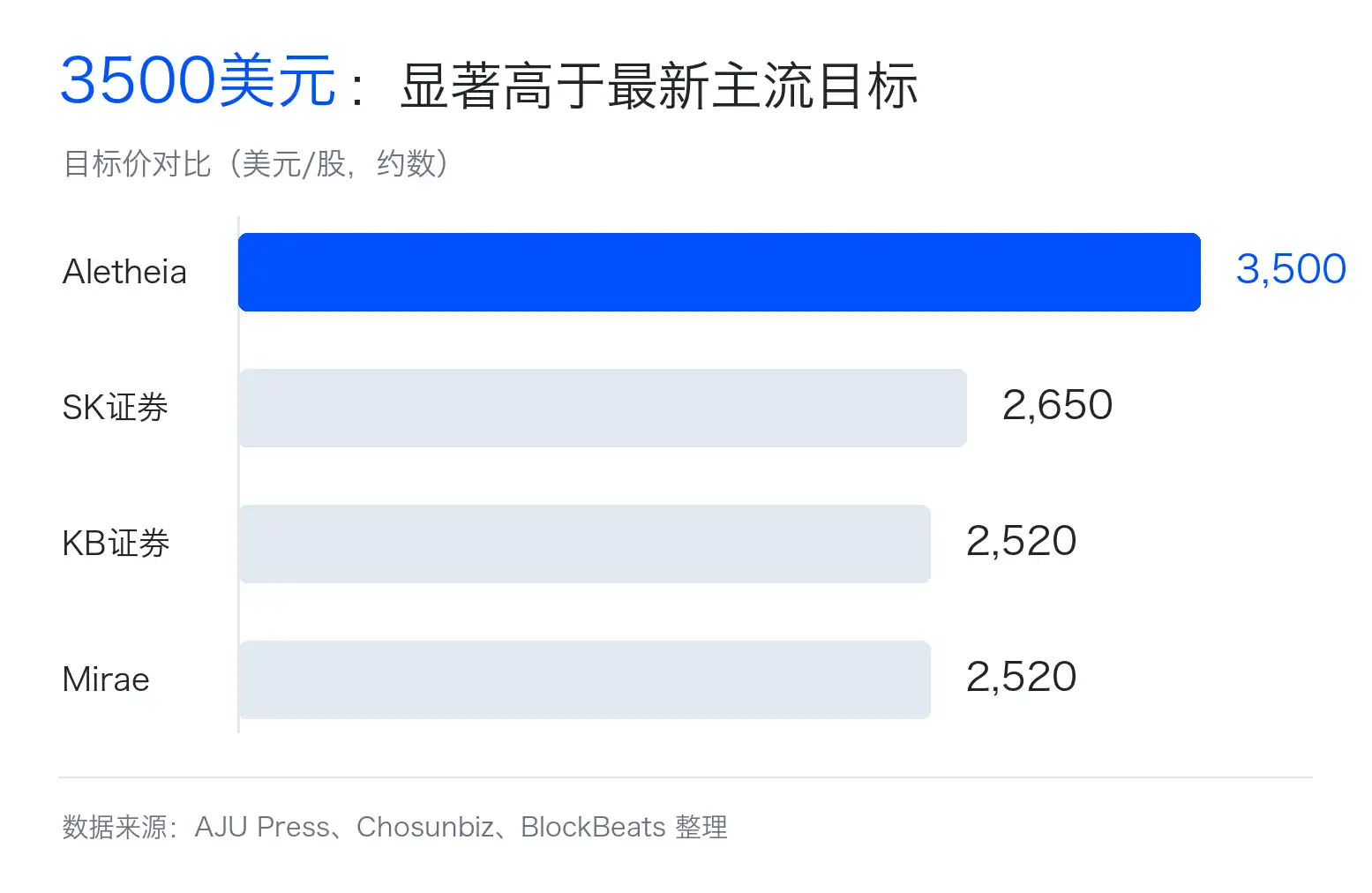
Aletheia Capital raised its target price for SK Hynix to approximately $3,500 in a report released today, pushing it far above the target range of mainstream institutions.

Aletheia Capital is an independent research and investment advisory firm headquartered in Hong Kong, serving institutional investors and covering sectors such as Asian tech hardware. In contrast, publicly reported target prices from SK Securities are around $2,000, while Mirae Asset and KB Securities target around $2,520.

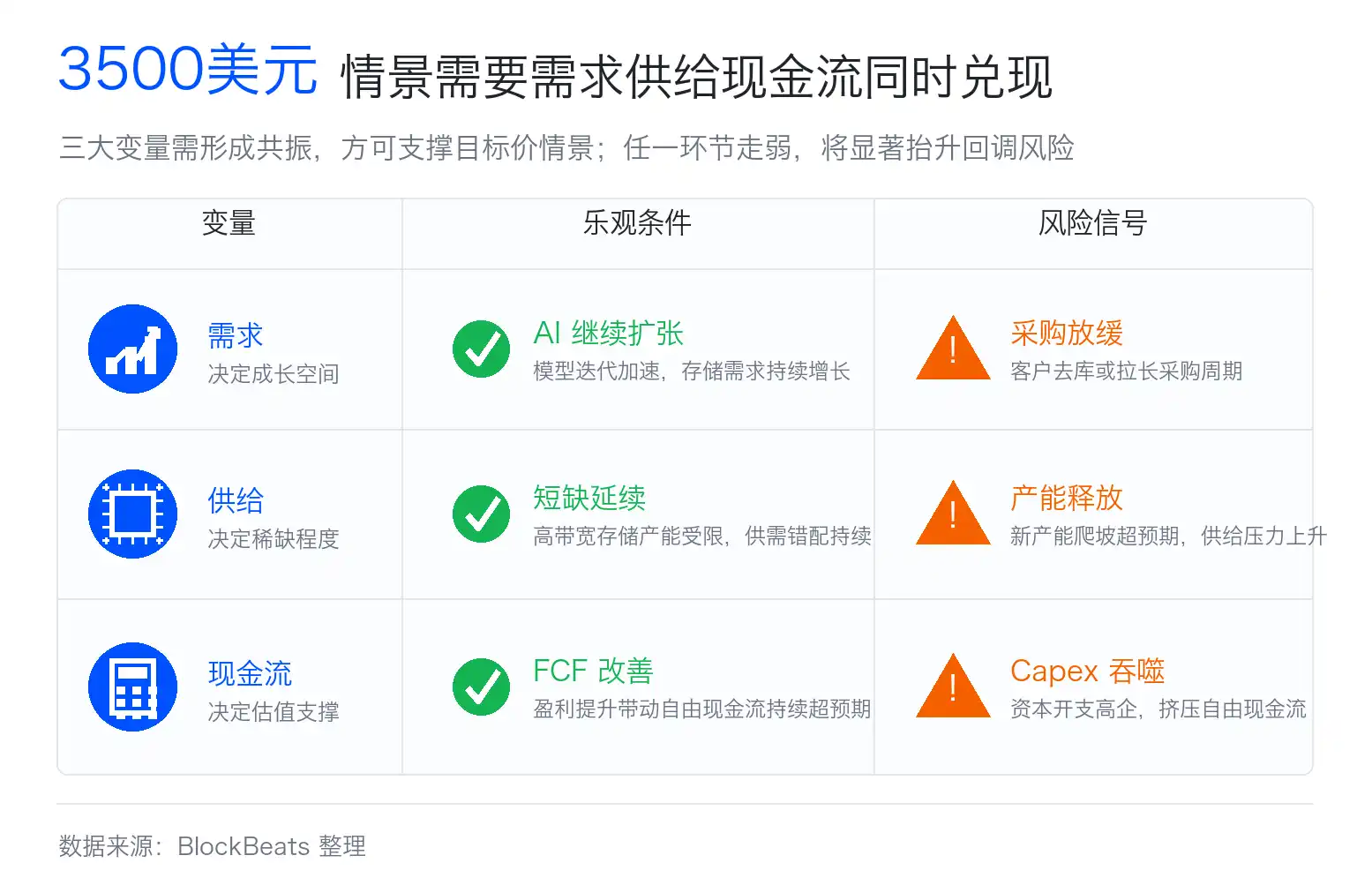
The truly aggressive aspect of the $3,500 target price is not just being more optimistic than mainstream institutions. It requires the market to believe three things will happen simultaneously: continued shortages of HBM (high-bandwidth memory for AI chips), continued price increases for standard DRAM, and AI server demand sustaining both the memory upcycle and free cash flow until 2027.

The market has already acknowledged that SK Hynix deserves a re-rating; the divergence lies in how far this re-rating can go. Most mainstream institutions still apply a cyclical industry discount, while the $3,500 price implies pulling out an optimistic tail scenario even after the re-rating.
The Divergence Lies in the 2027 Profit Base

The $3,500 figure is most easily misread as a simple valuation question: if you just apply a 10x multiple to SK Hynix's 2027 profits or free cash flow, the stock price can continue rising. The difficulty lies not in the multiple itself, but in how much money the company will actually earn and how much cash it will retain in 2027.

Memory company profits are highly volatile. During an upturn, prices rise, inventory clears, and margins expand rapidly. During a downturn, new capacity comes online, customers cancel orders, prices fall, and profits can quickly reverse. This is why the market has long assigned lower valuation multiples to memory companies.

Even with SK Hynix's current strong profitability, its 12-month forward P/E ratio, as mentioned in public reports, remains in the single digits. The market isn't blind to AI; it's concerned that this rally will ultimately still be priced as a cyclical peak.

The aggressive target price circulating from Aletheia challenges this cyclical discount. Based on public descriptions, it bets that sustained AI hardware demand will keep pushing HBM and DRAM prices higher, and SK Hynix's 2027 free cash flow will significantly exceed most current expectations, thus allowing for repricing based on this higher base.

The issue is that $3,500 requires multiple variables to align favorably simultaneously: HBM prices remaining strong, standard DRAM prices not being undercut by new capacity, SK Hynix maintaining its leading market share, capital expenditures not consuming too much cash, and the market still willing to assign a non-low multiple to a cyclical stock. If any link underperforms expectations, the target price would shift from a structural re-rating to a high-cycle extrapolation.

HBM Shortages Spill Over to Standard Memory

HBM can change SK Hynix's pricing logic because it's not a minor upgrade to standard memory; it's a core component next to AI accelerator cards. No matter how fast an AI chip computes, its overall performance can be bottlenecked if data can't be fed in fast enough. HBM's role is to provide a higher-bandwidth data channel for GPUs or AI accelerators.

General investors can think of it this way: the GPU is the engine, and HBM is the high-speed fuel delivery system. The stronger the engine, the higher the demand on the fuel system. In the past, when trading AI hardware, the market looked first at NVIDIA GPUs. Now, the market is increasingly realizing that GPU shipments and the ability to build up AI servers also depend on HBM supply.

Increasing HBM supply isn't as simple as slightly tweaking a standard DRAM production line for immediate volume. It requires more complex stacking, packaging, customer qualification, and consumes more wafer area and advanced packaging resources. Producing an equivalent capacity of HBM typically occupies more production capacity resources than standard DRAM.

This spreads the impact to standard memory. As manufacturers shift more resources to HBM, supply of DRAM for standard servers, PCs, and mobile devices tightens, potentially pushing up the average selling price of DRAM.

This is precisely the core mechanism that makes the ~$3,500 target price plausible. If HBM were just a fast-growing niche product, it could only boost part of SK Hynix's revenue. If HBM simultaneously constrains standard DRAM supply and lifts the entire memory price curve, it becomes an amplifier for the entire company's margins and cash flow.
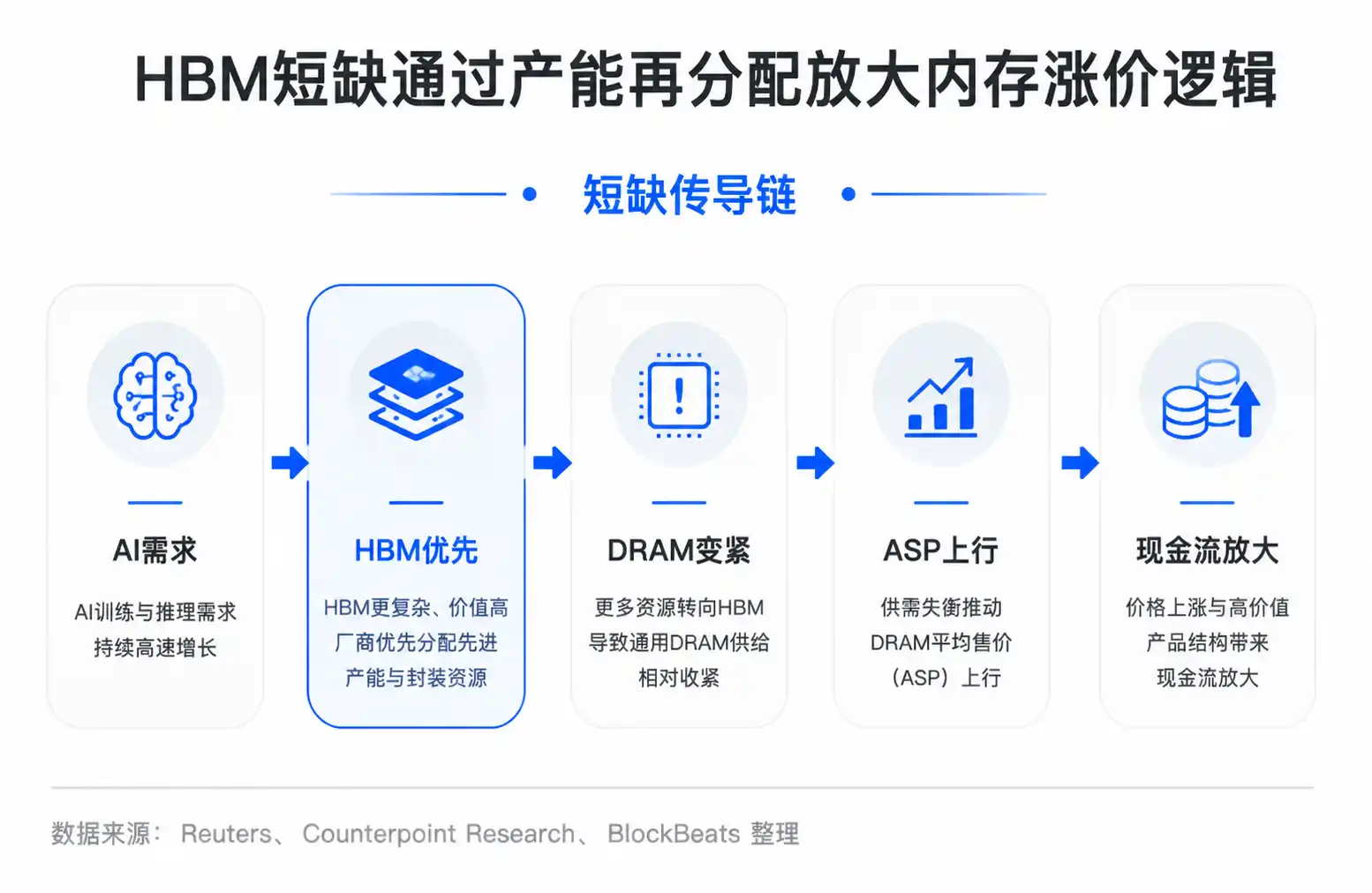
However, HBM shortages can only extend the cycle, not eliminate it. Samsung and Micron are catching up, SK Hynix itself will also expand production, and new wafer fabs and packaging capabilities will eventually be reflected in the supply side. The core of the debate is not whether shortages exist, but how long they will last and how long prices can remain strong.

SK Hynix Reaps the Most Direct Supply Chain Premium

SK Hynix is at the center of this re-rating not just because it's a memory company, but because it's the fastest runner in HBM. According to Reuters citing Counterpoint data, SK Hynix held about 58% of the global HBM market share in Q1 2026, with Samsung and Micron each around 21%. Reuters has also referred to it as a key supplier in NVIDIA's HBM supply chain.
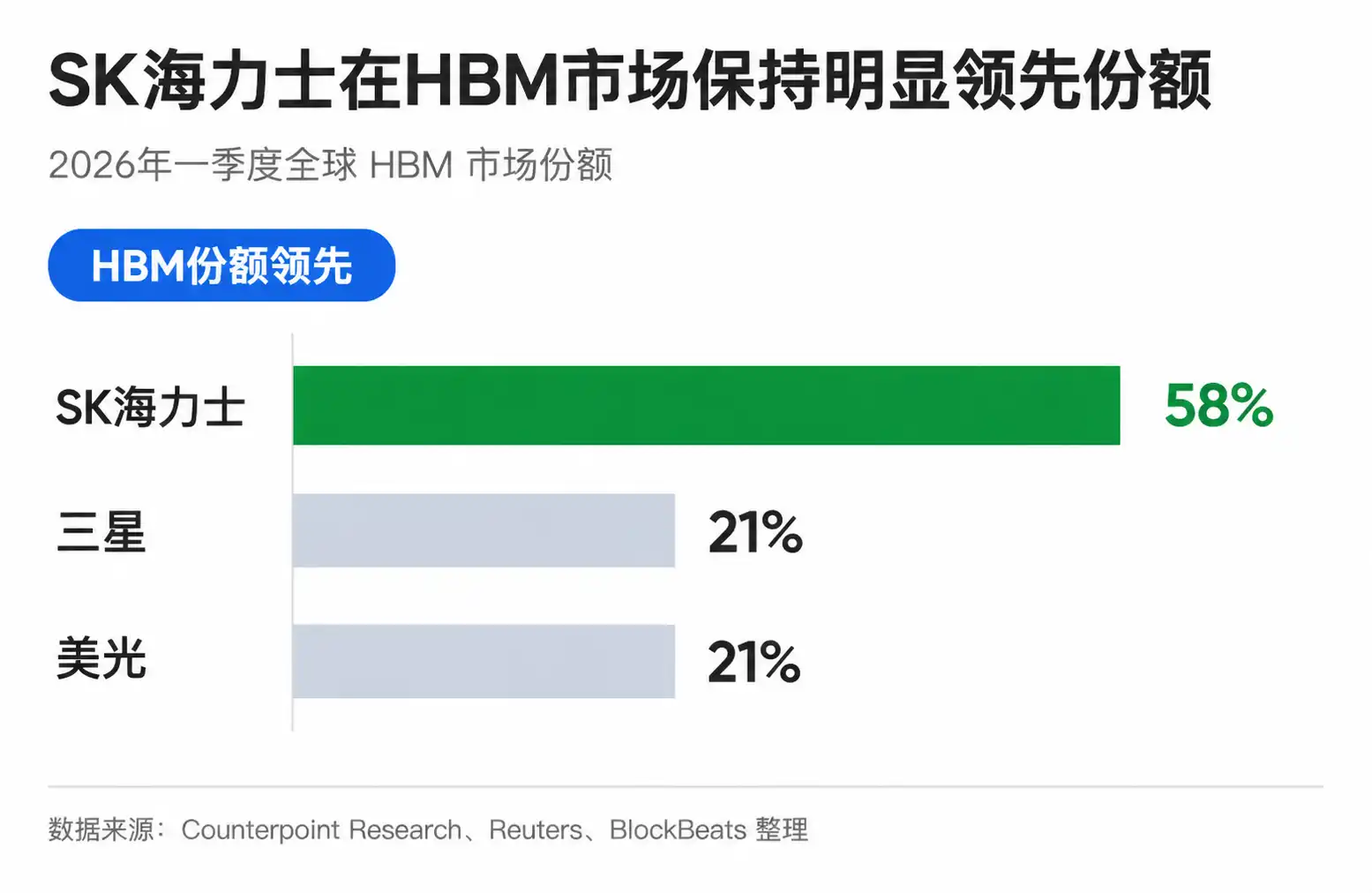
Such a lead is valuable in the semiconductor supply chain. AI chipmakers selecting HBM suppliers consider not just price, but also performance, yield, stability, and qualification progress. Being first to pass customer qualification makes it easier to enter the collaboration window for the next-generation products. Locking in orders earlier provides more initiative in capacity planning and price negotiations.

This is also why 2026 supply-demand visibility is drawing attention. According to a 2025 Reuters report, SK Hynix had completed 2026 HBM supply discussions with key customers. Multiple industry reports also suggest HBM shortages may extend into 2027. For investors, 2026 performance is at least not entirely story-driven.

SK Hynix's benefits aren't limited to HBM revenue itself. Because HBM occupies more capacity, squeezing standard DRAM supply, the traditional memory business may also benefit from price increases. AI demand first enters the financials through HBM, then influences the entire DRAM price through capacity reallocation.

This explains why institutional target prices keep being revised upward. Even without accepting an extreme scenario like $3,500, target prices in the ~$2,000 to $2,520 range indicate that mainstream institutions are already recalculating SK Hynix's profit elasticity for 2026-2027. The difference is that most still retain the discount appropriate for a cyclical industry, not extrapolating post-2027 tightness directly into a new normal.

Doubling the Stock Price Awaits Three Conditions

The $3,500 target price circulating from Aletheia essentially bets on continued strong demand, continued tight supply, and continued cash flow exceeding expectations. Over the past two years, massive GPU purchases by cloud providers and AI companies drove the HBM demand explosion. Next, the market needs to see if inference, enterprise AI, and custom ASICs can continue expanding memory consumption, ensuring demand isn't confined to training clusters.

The supply side also can't loosen too quickly. 2026 tightness is relatively easier to understand due to lags in capacity, packaging, and qualification; by 2027, new capacity and products from Samsung, SK Hynix, and Micron will gradually enter the market. If new supply arrives faster than expected, HBM price increases may narrow, and standard DRAM will face renewed pressure.

Ultimately, it comes down to cash flow. During an upturn, memory companies often increase capital expenditures for expansion, process upgrades, and advanced packaging. Profit growth doesn't necessarily all stay on the balance sheet. If SK Hynix needs significant investment to maintain its lead, the free cash flow base underpinning the $3,500 target price would be eroded.

Therefore, this target price is better viewed as an optimistic scenario, not a validated market consensus. 2027 is the real observation window: if HBM prices, DRAM ASPs, supply timing, and free cash flow continue to align favorably, the market will believe AI is raising the memory industry's profit center. If prices soften first, supply arrives first, or cash flow is consumed by capex, then ~$3,500 would shift from a re-rating anchor to an emotional peak.
Câu hỏi Liên quan

QWhat are the three key conditions that Aletheia Capital's highly optimistic $3,500 price target for SK Hynix relies on?

AAletheia Capital's $3,500 price target for SK Hynix relies on three key conditions simultaneously occurring: 1) Sustained shortage and high prices for HBM (High Bandwidth Memory). 2) Continued price increases for regular DRAM. 3) AI server demand supporting strong market conditions and high free cash flow for the company through 2027.

QAccording to the article, what is the primary challenge in achieving the $3,500 target price, aside from the valuation multiple?

AThe primary challenge is not the valuation multiple itself, but accurately forecasting how much profit (or free cash flow) SK Hynix will actually generate in 2027. This requires multiple favorable variables to align, including HBM and DRAM pricing, market share, manageable capital expenditures, and market willingness to apply a higher multiple to a traditionally cyclical stock.

QHow does HBM shortage theoretically benefit SK Hynix's overall memory business beyond just HBM sales?

AHBM production is more complex and consumes more manufacturing resources (like wafer area and advanced packaging capacity) than regular DRAM. As manufacturers allocate more resources to produce HBM, the supply of regular DRAM for servers, PCs, and phones becomes tighter. This supply constraint can drive up the average selling price (ASP) of all DRAM, thereby boosting the profitability and cash flow of SK Hynix's entire memory division, not just the HBM segment.

QWhy is SK Hynix considered a core beneficiary in the current AI-driven memory revaluation?

ASK Hynix is a core beneficiary not just because it is a memory company, but because it holds a significant technological and supply chain lead in HBM. With reported market share around 58% in Q1 2026 and status as a key HBM supplier to NVIDIA, its early mover advantage in performance, yield, and customer certification allows it to secure orders, plan capacity proactively, and command pricing power more effectively than its competitors.

QWhat does the article suggest the $3,500 price target should be viewed as, rather than a market consensus?

AThe article suggests that the $3,500 price target should be viewed as an optimistic scenario or tail-end outcome, not an established market consensus. It represents a bet on a highly favorable alignment of demand, supply, and cash flow conditions extending through 2027. If any of these factors underperform, the target price would revert from being a structural revaluation anchor to merely reflecting peak-cycle optimism.

Nội dung Liên quan

Niềm tin thuê mướn: Có bao nhiêu là tiền thật trong dòng vốn ETF Bitcoin

Bài viết phân tích dòng tiền ETF Bitcoin, chỉ ra rằng số liệu hàng tuần thường bị "ô nhiễm" bởi giao dịch arbitrage kỳ hạn–tiền mặt (cash-and-carry), một chiến lược trung lập delta nhằm kiếm lời từ chênh lệch giá (basis) thay vì thể hiện niềm tin vào giá Bitcoin. Dữ liệu cho thấy khoảng một nửa biến động dòng tiền ETF hàng tuần có tương quan chặt chẽ (0.70) với việc các quỹ đòn bẩy mở rộng vị thế bán khống hợp đồng tương lai trên CME, trong khi biến động giá Bitcoin gần như không giải thích được dòng chảy này. Tuy nhiên, về tổng thể, phần lớn tài sản ròng chảy vào ETF (khoảng 550 tỷ USD) là dòng tiền ổn định, có định hướng, khoảng 4 tỷ USD mỗi tuần. Phần arbitrage chỉ chiếm khoảng 10 tỷ USD ròng hiện tại, tương đương 4-5% tài sản ETF, và đang thu hẹp dần trong hai năm qua. Do đó, dòng tiền ETF phóng đại sự biến động của "niềm tin" chứ không phải mức độ thực tế của nó. Khi chênh lệch giá (basis) thu hẹp, dòng tiền ETF và vị thế bán khống có xu hướng giảm đồng thời, không nên hiểu nhầm đây là sự rút lui của niềm tin. Để đánh giá chính xác hơn, cần theo dõi chênh lệch lợi suất kỳ hạn so với lãi suất trái phiếu kho bạc Mỹ và vị thế bán khống ròng của các quỹ đòn bẩy trên CME.

marsbit25 phút trước

Niềm tin thuê mướn: Có bao nhiêu là tiền thật trong dòng vốn ETF Bitcoin

marsbit25 phút trước

Sự qua đời của Greenspan: Những quy tắc thị trường ông viết ra, đang được Warsh viết lại

Cựu Chủ tịch Fed Alan Greenspan qua đời ở tuổi 100, để lại di sản sâu sắc cho thị trường tài chính toàn cầu. Bài viết điểm lại những dấu ấn chính trong sự nghiệp của ông: từ việc định hình "Greenspan Put" - kỳ vọng Fed sẽ hỗ trợ thanh khoản mỗi khi thị trường lao dốc mạnh sau sự kiện "Thứ Hai Đen" 1987, sức mạnh ngôn từ với cụm "hưng phấn phi lý" năm 1996, cho đến những quyết định gây tranh cãi như duy trì lãi suất 1% kéo dài, được cho là góp phần tạo bong bóng bất động sản dẫn đến khủng hoảng 2008. Di sản của Greenspan, bao gồm nghệ thuật quản lý kỳ vọng và vai trò của Fed như "lưới đỡ" cuối cùng cho thị trường, hiện đang được kế nhiệm là Chủ tịch Fed Kevin Warsh xem xét lại. Ngay trước khi Greenspan qua đời, Warsh đã thành lập các nhóm công tác để đánh giá toàn diện cách vận hành của Fed, với khả năng thay đổi hoặc thậm chí loại bỏ các hướng dẫn dự báo (forward guidance) - công cụ truyền tải chính sách then chốt trong những thập kỷ gần đây. Động thái này có thể làm suy yếu đáng kể logic "Greenspan Put", đánh dấu sự kết thúc của một kỷ nguyên và đặt Fed trước thử thách mới trong một thế giới phức tạp hơn nhiều so với thời Greenspan nắm quyền.

marsbit42 phút trước

Sự qua đời của Greenspan: Những quy tắc thị trường ông viết ra, đang được Warsh viết lại

marsbit42 phút trước

Tái huy động 75 triệu đô la, tại sao fomo lại khiến các VC hàng đầu tiếp tục tham gia?

Ứng dụng giao dịch tiền mã hóa xã hội fomo vừa huy động thành công 75 triệu USD trong vòng tài trợ Series B, nâng định giá lên 550 triệu USD. Vòng này được dẫn dắt bởi Index Ventures, với sự tham gia của Union Square Ventures (USV) và sự tiếp tục ủng hộ từ Benchmark cùng các nhà đầu tư cá nhân nổi bật. Fomo tập trung vào trải nghiệm người dùng đơn giản, cho phép giao dịch xuyên chuỗi (Bitcoin, Ethereum, Solana, Base, BNB Chain) với một số dư duy nhất, không phí Gas, hỗ trợ Apple Pay và tích hợp tính năng mạng xã hội để theo dõi giao dịch của người khác. Từ khi ra mắt phiên bản beta vào tháng 5/2025, nền tảng đã thu hút hơn 625.000 người dùng, tổng khối lượng giao dịch vượt 4 tỷ USD và có hơn 68.000 người lần đầu mua tiền mã hóa qua ứng dụng. Sản phẩm đang mở rộng từ một ứng dụng giao dịch tiền mã hóa thuần túy sang một mạng lưới giao dịch toàn cầu rộng hơn, gần đây đã ra mắt tính năng hợp đồng vĩnh viễn cho cổ phiếu, Pre-IPO, hàng hóa và các tài sản khác. Đội ngũ sáng lập, với kinh nghiệm từ dYdX và các công ty hàng đầu, cùng mạng lưới ủng hộ rộng rãi từ hơn 140 nhà đầu tư thiên thần trong ngành, đặt mục tiêu biến fomo trở thành cầu nối đơn giản hóa việc tiếp cận tài sản kỹ thuật số và truyền thống cho đại chúng.

Foresight News1 giờ trước

Tái huy động 75 triệu đô la, tại sao fomo lại khiến các VC hàng đầu tiếp tục tham gia?

Foresight News1 giờ trước

Tăng hơn 50 lần trong 18 tháng, Kioxia với màn lội ngược dòng huyền thoại

Bài viết tóm tắt câu chuyện lật ngược ngoạn mục của Kioxia (trước đây là Toshiba Memory). Chỉ sau hơn 1 năm từ một công ty bị thua lỗ nặng và thất bại trong việc sáp nhập, Kioxia đã có màn bứt phá ngoạn mục nhờ làn sóng AI. Sau khi niêm yết vào cuối năm 2024, giá cổ phiếu của họ đã tăng hơn 50 lần trong 18 tháng, vượt qua Toyota để trở thành công ty có vốn hóa lớn nhất Nhật Bản. Lợi nhuận quý đầu năm 2026 dự kiến tăng gấp 30 lần, với công suất NAND cho cả năm đã được bán hết. Thành công này dựa trên nền tảng công nghệ 3D NAND BiCS FLASH độc quyền, với các thế hệ 8, 9, 10 liên tục cải tiến về số tầng xếp chồng (lên đến 332 tầng) và mật độ lưu trữ nhờ các kỹ thuật như CBA và OPS. Ngoài ra, Kioxia đang đặt cược cho tương lai với nghiên cứu 3D DRAM thế hệ mới có tên OCTRAM, sử dụng transistor kênh bán dẫn oxit (như InGaZnO) để giảm rò rỉ điện và tiêu thụ năng lượng, mở đường cho bộ nhớ dung lượng lớn, tiết kiệm điện trong kỷ nguyên AI. Tóm lại, hành trình của Kioxia minh chứng cho sự biến đổi nhanh chóng của ngành bán dẫn, nơi tài sản công nghệ cốt lõi và sự dịch chuyển nhu cầu (như từ AI) có thể hồi sinh một công ty tưởng chừng đã lỡ nhịp.

marsbit1 giờ trước

Tăng hơn 50 lần trong 18 tháng, Kioxia với màn lội ngược dòng huyền thoại

marsbit1 giờ trước

Xu Hướng Thị Trường Chứng Khoán Mỹ (23/6): Đỉnh Cao Ngay Khi Lên Sàn? SpaceX Bốc Hơi Hơn 8.000 Tỷ USD Trong Ba Ngày, Phân Hóa Dữ Dội Nội Bộ Cổ Phiếu Công Nghệ

**SpaceX 'lên đỉnh' ngay khi IPO, nhưng chỉ trong ba ngày đã mất hơn 8000 tỷ USD giá trị vốn hóa.** Thị trường thay đổi định giá chỉ sau mười ngày niêm yết, khi khoản huy động 85,7 tỷ USD từ IPO được xác nhận dùng để mua lại và trả nợ, cùng với đợt phát hành trái phiếu 200 tỷ USD mới. Điều này cho thấy kế hoạch tiếp tục đốt tiền, không giảm đòn bẩy. Thị trường chứng khoán Mỹ phân hóa mạnh. Trong khi các cổ phiếu công nghệ định giá cao như Google, Meta, Amazon, Microsoft giảm mạnh thì các nhóm công nghiệp và tài chính lại kháng cự tốt. Cổ phiếu Micron tăng kỷ lục nhờ thỏa thuận cung cấp bộ nhớ HBM dài hạn cho Anthropic, củng cố câu chuyện về nhu cầu cơ sở hạ tầng AI. Về vĩ mô, giá dầu giảm do thỏa thuận khung Mỹ-Iran, nhưng việc phục hồi hoàn toàn lưu lượng vận chuyển qua eo biển Hormuz sẽ cần thời gian. Tuần này, thị trường tập trung vào cuộc họp cổ đông NVIDIA, báo cáo tài chính của Micron và dữ liệu PCE tháng 5. Kết quả sẽ quyết định hướng đi tiếp theo: nếu Micron đưa ra dự báo HBM mạnh và PCE vẫn cao, áp lực điều chỉnh đối với cổ phiếu tăng trưởng định giá cao có thể còn tiếp diễn.

marsbit1 giờ trước

Xu Hướng Thị Trường Chứng Khoán Mỹ (23/6): Đỉnh Cao Ngay Khi Lên Sàn? SpaceX Bốc Hơi Hơn 8.000 Tỷ USD Trong Ba Ngày, Phân Hóa Dữ Dội Nội Bộ Cổ Phiếu Công Nghệ

marsbit1 giờ trước

Giao dịch

Giao ngay
Hợp đồng Tương lai
活动图片