When Even the Shovel Sellers Borrow to Buy Shovels: The US Stock AI Sector Evaporates Trillions in a Week, as the Market Begins Pricing AI's 'Bill'

marsbitXuất bản vào 2026-06-11Cập nhật gần nhất vào 2026-06-11

Tóm tắt

Last week saw a sharp sell-off in the US AI sector, erasing trillions in market value despite companies reporting record financials. Key events included Alphabet's massive equity raise despite having over $1.2 trillion in cash, Broadcom's stock plummeting after its quarterly report, a 4% Nasdaq drop, and Oracle's stock falling even after posting record revenue and backlog. The market's focus shifted from stellar income statements to cash flow and balance sheets, questioning the massive and increasingly leveraged capital expenditures required to fund the AI infrastructure race. Analysts point out that while growth is strong, profitability and the visibility of AI monetization are now under scrutiny. The financing chain stretches from cash-rich giants like Alphabet raising debt and equity, to chipmakers like Broadcom facing margin pressure, to cloud providers like Oracle with negative free cash flow funding via debt, and finally to unprofitable AI labs like OpenAI and Anthropic—who are the ultimate customers for much of this infrastructure. The market is beginning to price the risk of this concentrated, leveraged bill coming due, with the upcoming SpaceX IPO serving as the next test for this financing ecosystem.

Author: Ada, Deep Tide TechFlow

Over the past week, the US stock AI sector presented a strange picture, with records being broken one after another and stocks being sold off one after another.

On June 1, Alphabet, sitting on hundreds of billions in cash, announced one of the largest equity financings in history; On June 3 after market close, Broadcom delivered its best-ever quarterly report, only for its stock to crash the next day; On June 5, the Nasdaq plunged 4% in a single day, with the semiconductor sector shedding roughly $1 trillion in market value in one session; On June 10 after market close, Oracle reported record revenue and backlog, yet its stock still fell; On June 11, the pricing moment arrived for what is set to be the largest SpaceX IPO in history. The financial numbers themselves are not the issue; the problem is the way these numbers are being achieved: more and more money is being borrowed into this AI infrastructure race through increasingly complex means. When the market began tallying up this bill, even record-breaking numbers couldn't save stock prices.

The Same Script: Record First, Then Get Sold Off

Broadcom went first. According to its earnings report and multiple media outlets, for its fiscal Q2 ended May 3, Broadcom's revenue reached $22.219 billion, up 48% year-over-year; AI chip revenue was $10.8 billion, surging 143% year-over-year; and earnings per share exceeded Wall Street expectations. But the market focused solely on one gap: the company's AI chip revenue guidance for the next quarter is $16 billion, below analyst expectations, and CEO Hock Tan did not raise the full-year AI revenue target, mentioning that Google might diversify its chip supply chain. Nonetheless, Broadcom's stock plummeted about 15% the next day, erasing nearly $280 billion in market value in a single day, making it one of the largest single-day market cap losses in Wall Street history.

Oracle's turn came a week later. According to its earnings report and CNBC, for its fiscal Q4 ended May 31, Oracle's revenue was $19.2 billion, up 21% year-over-year; cloud infrastructure revenue was $5.8 billion, up 93% year-over-year; adjusted EPS was $2.11, beating analyst expectations of $1.95. The backlog was even more staggering: Remaining Performance Obligations (RPO) reached $638 billion, skyrocketing 363% year-over-year, far exceeding analyst expectations of $595.7 billion. Yet the stock also didn't find favor, dropping about 9% in after-hours trading.

Sandwiched between these two earnings reports was a broad sell-off on June 5. According to TheStreet and CNBC, the Nasdaq Composite Index fell 4% that day, its worst single-day performance since the April 2025 tariff turmoil, triggered by Broadcom's cautious AI chip outlook, with AMD and Intel leading the decline across the entire semiconductor sector.

It is worth noting that the June 5 plunge wasn't solely about "AI skepticism." That day, US non-farm payrolls added 172,000 jobs, far exceeding expectations, pushing up rate hike expectations and triggering a rotation from high-valuation growth stocks into defensive sectors like healthcare and consumer staples. AI stocks, having the highest valuations, fell the hardest. In other words, macroeconomic interest rates and sector rotation were one driver, while concerns over AI capital expenditures were another. The two factors compounded, rather than having a single cause.

What's Being Sold Off Isn't the Income Statement, It's the Cash Flow Statement

Putting these three market segments together reveals a commonality: the income statement is still recording "record-breaking" numbers, but the market has already switched to reading the cash flow statement and the balance sheet. The pricing focus has shifted from "how much was earned" to "how much more will be burned and borrowed to earn this."

Oracle is the most straightforward case study. According to its earnings report, for the full FY2026, operating cash flow reached a record $32 billion, up 54% year-over-year, but free cash flow was negative $23.7 billion. For the year, the company has already raised $43 billion in debt and $5 billion in equity. What truly broke investor sentiment was its forward-looking language. According to CNBC, Oracle plans to raise approximately $40 billion more in FY2027 through a combination of debt and equity. A company that just raised nearly $50 billion, with negative free cash flow, and now forecasts another $40 billion financing round—when this appears alongside "record-breaking" numbers, the market chose to price the former.

Broadcom's logic is similar, but manifests elsewhere. According to Barron's, Broadcom lowered its Q3 gross margin guidance from 77% to 74%, attributing it to a higher revenue mix from lower-margin AI chips. Coupled with a retreat from "selling complete systems" to "selling only chips," and customers demanding chip leases to pass on financing pressure, the market sees a business with explosive growth, but deteriorating margins and capital intensity.

Goldman Sachs provided a framework for this shift. According to its research report, investors' tolerance for capital expenditure growth depends on earnings strength and the visibility of AI monetization; the same report noted that Alphabet's stock rose due to raising its profit guidance, while Meta's fell due to flat guidance. The market is no longer indiscriminately rewarding "growth," but differentiating winners from losers based on "the ability to monetize."

The Financing Chain Takes Center Stage: Even the Most Cash-Rich Players Are Borrowing

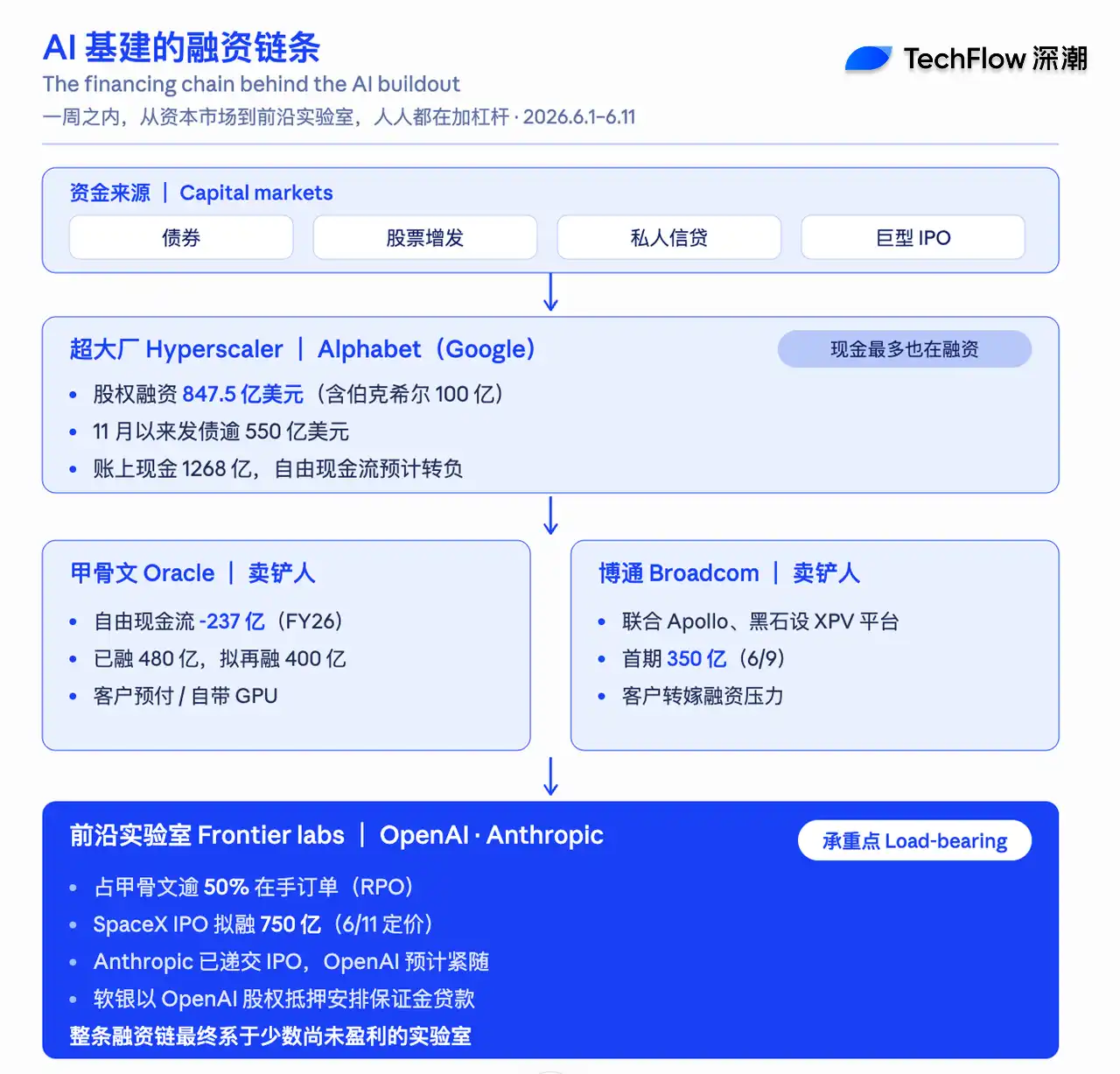
If the income statement is the surface, the financing chain is the true protagonist of this past week. From the very upstream to the very downstream, almost every link is paying for this same AI infrastructure build-out by leveraging up or diluting equity.

The most convincing case study is Alphabet. According to its SEC filing, on June 1, it announced an $80 billion equity financing; on June 2, it upsized and priced the deal at $84.75 billion, including a $10 billion private investment from Berkshire Hathaway. The anomaly is that this company is not short on cash at all. According to multiple media reports, Alphabet had $126.8 billion in cash as of March 2026, annual operating cash flow of $174 billion, and has issued over $55 billion in new debt since November. Despite this, Melius Research estimates Google's free cash flow will turn negative in the coming years. Investor Dan Niles' commentary on this is that capital is not infinite, and the fact that Google, with "the strongest technology stack in all of AI," still needs to raise massive amounts of financing precisely illustrates the intensity of this round of investment.

Looking downstream, every link on the chain is doing the same. New cloud vendor Oracle has negative free cash flow, relies on dual-track debt and equity financing, and asks customers to prepay for GPU costs or bring their own GPUs to reduce its own construction capital outlay; the chip "shovel sellers" like Broadcom, on June 9, partnered with Apollo and Blackstone to establish the AI XPV Platform, with an initial $35 billion targeting over 20 gigawatts of computing power by 2028, serving frontier labs including Anthropic and OpenAI. And at the very end of the chain, the labs are simultaneously employing even more aggressive tools: there were previous reports of SoftBank arranging margin loans secured by OpenAI equity; now SpaceX is rushing towards a Nasdaq IPO targeting $75 billion, Anthropic has confidentially filed for an IPO, and OpenAI is expected to follow closely.

The total scale of this investment is also rapidly inflating. According to CreditSights, the combined capital expenditure for mega-cap companies in 2026 is estimated at around $750 billion, up about 67% from 2025; Goldman Sachs' alternative metric puts the 2026 capex forecast for mega-caps at $518 billion, revised up from $314 billion at the start of the year. Whichever metric is used, the direction is consistent: expenditures are accelerating, the portion that can be covered by operating cash flow is shrinking, and the gap needs to be filled by capital markets.
The Chain's Pressure Point Rests on a Few Unprofitable Labs

Leverage itself isn't terrifying; what's terrifying is who the leverage ultimately rests upon. Pulling this financing chain to its end reveals that its pressure point is highly concentrated.

Oracle's $638 billion backlog seems impregnable, but according to Bank of America, over 50% comes from OpenAI alone; simultaneously, Oracle also disclosed that most of the RPO growth in the past two quarters came from large AI contracts, with customers either prepaying GPU costs or procuring GPUs themselves before handing them to Oracle. Broadcom's six major custom chip customers are similarly concentrated among a handful like Google, Meta, Anthropic, and OpenAI. In other words, from the financing of the mega-caps, to the orders of the "shovel sellers," to the injection of private credit and insurance funds, the ultimate payer for the entire chain converges onto a small group of unprofitable frontier labs like OpenAI and Anthropic, who are themselves queuing up for funding.

The record-breaking revenue is real, and the $638 billion backlog is real; but the buyers of these orders are highly concentrated, are themselves sustained by financing, and the leverage of the entire chain is being re-examined by the market. This past week, the market did not deny AI's growth; it simply started demanding to see clearly who will pay the bill for this growth, and how. SpaceX is set to price after market close on June 11 and list on the Nasdaq at $135 per share, with a valuation of approximately $1.77 trillion on June 12. Whether this largest-ever IPO can be digested smoothly will be the next stress test for this financing chain.


Tiền kỹ thuật số thịnh hành

Câu hỏi Liên quan

QWhat were the main reasons behind the significant sell-off in the AI sector of the U.S. stock market over the past week?

AThe sell-off was driven by a combination of macroeconomic factors and sector-specific concerns. The stronger-than-expected U.S. non-farm payrolls data raised interest rate expectations, triggering a rotation from high-valuation growth stocks (like AI) into defensive sectors. Simultaneously, the market began to reassess the massive capital expenditure required for AI infrastructure. Companies like Broadcom and Oracle reported record revenues but also signaled the need for continued heavy investment and financing, leading to a market focus on negative free cash flow and growing debt, which caused their stock prices to fall despite strong earnings.

QHow did the market's valuation focus shift for AI companies like Oracle and Broadcom, according to the article?

AThe market's valuation focus shifted from the income statement (profit and revenue growth) to the cash flow statement and balance sheet. Investors are no longer just rewarding 'record' earnings; they are now pricing in the significant capital required to generate those earnings. For example, Oracle's record $638 billion backlog and revenue were overshadowed by its negative free cash flow and plans for further large-scale debt and equity financing. For Broadcom, the market focused on the declining gross margin guidance and the increased capital intensity of its AI chip business, even as AI revenue soared.

QWhy did Alphabet, despite having a massive cash reserve, conduct a major equity financing round?

AAlphabet announced an $84.75 billion equity financing round even with $1268 billion in cash and strong annual operating cash flow because, according to analyst estimates (like from Melius Research), its free cash flow is projected to turn negative in the coming years due to the immense intensity of AI infrastructure investment. As noted by investor Dan Niles, this move by a company with the 'strongest technology stack in AI' highlights the enormous scale of capital required for this buildout, suggesting that even the most cash-rich players need to tap external funding to sustain the AI arms race.

QWhat is the common weak point or 'pressure point' in the AI infrastructure financing chain identified in the article?

AThe common weak point or 'pressure point' in the AI financing chain is its heavy reliance on a small group of unprofitable, frontier AI labs like OpenAI and Anthropic. A significant portion of the record orders for companies like Oracle (over 50% from OpenAI alone) and Broadcom's major custom chip customers are concentrated with these labs. These labs are themselves dependent on continued fundraising (e.g., private credit, impending IPOs) to pay their bills. This creates a concentrated risk where the entire chain's viability depends on the financial health and ability of a few non-profitable entities to keep raising capital.

QWhat upcoming event does the article suggest will be the next major test for the AI financing chain?

AThe article suggests that SpaceX's upcoming IPO, scheduled to price on June 11 and list on Nasdaq on June 12 with a target valuation of approximately $1.77 trillion, will be the next major test for the AI financing chain. As the largest IPO in history, its success in being absorbed by the market will serve as a crucial indicator of investor appetite and capacity to fund the massive capital requirements at the end of the AI infrastructure investment chain.

Nội dung Liên quan

SpaceX, AI và XRP: Tại sao lần chuyển dịch tài sản tiếp theo có thể khác biệt?

Bài viết khám phá sự hội tụ tiềm năng của ba lĩnh vực công nghệ - Cơ sở hạ tầng vũ trụ (đại diện bởi SpaceX), Trí tuệ nhân tạo (AI) và mạng lưới thanh toán blockchain (như XRP) - như là động lực chính cho một đợt chuyển dịch tài sản và chu kỳ đầu tư cơ sở hạ tầng mới. Nội dung chính cho rằng, khi các động lực tăng trưởng truyền thống chậm lại, vốn toàn cầu đang tìm kiếm các hệ thống nền tảng mới. Các dự án cơ sở hạ tầng không gian, mạng lưới vệ tinh, trung tâm dữ liệu và năng lực tính toán AI sẽ thúc đẩy nhu cầu lớn về hàng hóa cơ bản. Đồng thời, các hoạt động kinh tế mới nổi này sẽ cần một lớp giải quyết thanh toán toàn cầu hiệu quả, nơi các tài sản kỹ thuật số tập trung vào thanh toán và khả năng tương tác như XRP có thể đóng vai trò then chốt. Bài viết nhấn mạnh sự chuyển dịch từ một "câu chuyện đầu cơ" sang một "câu chuyện cơ sở hạ tầng" trong thị trường tài sản kỹ thuật số, nơi giá trị sẽ ngày càng được xác định bởi tiện ích thực tế như khối lượng giao dịch, hoạt động thanh toán và sự tích hợp với AI (ví dụ: các tác nhân AI thực hiện giao dịch tự động). Sự rõ ràng về mặt quy định được coi là yếu tố quan trọng để thúc đẩy việc áp dụng rộng rãi hơn bởi các tổ chức. Tóm lại, tác giả đưa ra viễn cảnh về một nền kinh tế tương lai, nơi các hệ thống cơ sở hạ tầng vật chất (vũ trụ, AI), nhu cầu nguyên vật liệu và lớp tài chính kỹ thuật số (blockchain) hội tụ, tạo ra cơ hội đầu tư sớm cho những ai nhận ra xu hướng này.

marsbit52 phút trước

SpaceX, AI và XRP: Tại sao lần chuyển dịch tài sản tiếp theo có thể khác biệt?

marsbit52 phút trước

Đếm ngược GPT-5.6: Từ bỏ ảo tưởng API đơn nhất, tốc độ lặp lại sức mạnh tính toán nhanh đến mấy cũng không chống nổi một tờ quy định tuân thủ

Giữa tháng 6, ba sự kiện – Fable 5 bị giới hạn tuân thủ, GLM-5.2 được mã nguồn mở và thời điểm ra mắt GPT-5.6 bị rò rỉ – đánh dấu bước ngoặt cho ngành AI toàn cầu. Các logic vận hành cơ bản đang được định hình lại: 1. **"Khả năng sử dụng" quan trọng hơn "tính tiên tiến":** Chuỗi cung ứng mô hình lớn bước vào giai đoạn "hai luồng" với mã nguồn đóng được kiểm soát và mã nguồn mở triển khai cục bộ cùng tồn tại. 2. **Rào cản cạnh tranh thay đổi:** Các gã khổng lồ mã nguồn đóng chuyển trọng tâm từ "trí tuệ ngôn ngữ" sang "trí tuệ không gian (mô hình thế giới)" đòi hỏi lượng lớn sức mạnh tính toán. 3. **Thiết kế "phi mô hình" là yêu cầu sống còn:** Để đối phó rủi ro tuân thủ xuyên quốc gia, các nhà phát triển ứng dụng phải đảm bảo tính liên tục kinh doanh bằng cách tách biệt logic nghiệp vụ khỏi một mô hình cụ thể. Sự kiện Fable 5 của Anthropic bị hạn chế truy cập chỉ sau 72 giờ đối với người dùng không phải công dân Mỹ cho thấy rủi ro tuân thủ có thể vô hiệu hóa bất kỳ lợi thế công nghệ nào. Trong bối cảnh đó, các mô hình mã nguồn mở như GLM-5.2 của Trí Phổ AI trở thành lựa chọn dự phòng chiến lược, nhờ hiệu suất được cải thiện, chi phí thấp hơn đáng kể và khả năng triển khai cục bộ. Để tái khẳng định giá trị, các hãng mã nguồn đóng như OpenAI đang định vị lại. GPT-5.6 (dự kiến ra mắt) chuyển trọng tâm sang "trí tuệ không gian", nhằm tạo khoảng cách thế hệ mới trong các lĩnh vực như mô phỏng công nghiệp và robot – nơi đòi hỏi sức mạnh tính toán khổng lồ. Bài học rõ ràng: Trong môi trường hiện nay, việc đánh giá cơ sở hạ tầng AI không thể chỉ dựa trên hiệu suất kỹ thuật. Khả năng truy cập ổn định và tuân thủ quy định đã trở thành các yếu tố tiên quyết ngang bằng. Đối với các doanh nghiệp, việc phụ thuộc hoàn toàn vào API của một nhà cung cấp duy nhất là rủi ro cao. Thiết kế kiến trúc "phi mô hình" để có thể chuyển đổi linh hoạt giữa các giải pháp là điều tối cần thiết để đảm bảo tính liên tục trong kinh doanh.

marsbit2 giờ trước

Đếm ngược GPT-5.6: Từ bỏ ảo tưởng API đơn nhất, tốc độ lặp lại sức mạnh tính toán nhanh đến mấy cũng không chống nổi một tờ quy định tuân thủ

marsbit2 giờ trước

Cuộc Chiến 'Trợ Cấp Token' của Những Gã Khổng Lồ AI Sắp Kết Thúc Chưa?

Cuộc chiến trợ cấp Token giữa các gã khổng lồ AI như OpenAI, Anthropic và Google đang diễn ra quyết liệt. Hiện tại, người dùng đang được hưởng mức giá "bẻ gãy" khi các công ty này bù lỗ nặng để thu hút và giữ chân người dùng, đặc biệt là các gói cao cấp. Tuy nhiên, khác với các cuộc chiến trợ cấp thời internet, token AI hầu như không tạo ra hiệu ứng "khóa" người dùng do việc chuyển đổi giữa các nền tảng là quá dễ dàng. Bill Maris, người sáng lập Google Ventures, dự đoán 100% rằng Google - với lợi thế từ cỗ máy in tiền quảng cáo khổng lồ - có thể hạ giá token thêm 80%, gây áp lực khủng khiếp lên các đối thủ phụ thuộc vào vốn đầu tư như OpenAI và Anthropic. Điều này đặt ra câu hỏi về tính bền vững của mô hình kinh doanh khi họ phải công khai báo cáo tài chính sau IPO. Bài viết phân tích hai kịch bản có thể xảy ra: 1) Mô hình "dịch vụ internet" với một vài công ty thống trị rồi tăng giá, hoặc 2) Token trở thành cơ sở hạ tầng tiêu chuẩn như "điện, nước", nơi cạnh tranh đẩy giá xuống sát chi phí và lợi nhuận trở nên rất thấp. Do thiếu hiệu ứng khóa chân người dùng, kịch bản thứ hai có vẻ thực tế hơn. Cuộc chiến này có thể không có kẻ chiến thắng rõ ràng, mà là một cuộc chạy đua tiêu hao kéo dài nhằm giữ vị trí trên "bàn chơi", thúc đẩy AI trở thành một tiện ích cơ sở hạ tầng công cộng mà không công ty nào có thể độc chiếm. Đối với người dùng, điều này có nghĩa là họ có thể tiếp tục được hưởng lợi từ các giao dịch "hời" trong một thời gian dài hơn.

marsbit2 giờ trước

Cuộc Chiến 'Trợ Cấp Token' của Những Gã Khổng Lồ AI Sắp Kết Thúc Chưa?

marsbit2 giờ trước

Ngoài sân cỏ: Trò chơi đầu cơ xoay quanh World Cup

Bên cạnh sân cỏ, World Cup 2026 đã tạo ra một mạng lưới đầu cơ đa dạng, biến sự kiện thể thao thành một thí nghiệm đầu tư toàn cầu kéo dài hàng tháng. Thị trường dự đoán (như Polymarket, Kalshi) nổi lên như một kịch bản đầu cơ mới, thu hút khối lượng giao dịch khổng lồ, thậm chí lấn át sự phát triển của các nền tảng cá cược truyền thống vốn vẫn là thị trường cơ bản lớn nhất. Các cổ phiếu khái niệm liên quan đến World Cup, như cổ phiếu "gà rán" của Hàn Quốc hay cổ phiếu liên quan đến đội tuyển Nhật Bản, biến động mạnh theo kết quả thi đấu và tâm lý người hâm mộ. Thị trường vé xem trở thành sân chơi đầu cơ phức tạp, với việc bán lại vé, giao dịch quyền mua vé (RTB) và cả hành vi "bán khống" vé trên các sàn thứ cấp. Các mặt hàng sưu tầm như sticker Panini hay áo đấu phiên bản giới hạn cũng được săn đón và định giá lại trên thị trường thứ cấp. Lĩnh vực tiền điện tử chứng kiến sự bùng nổ của các meme coin lợi dụng chủ đề World Cup, mang lại lợi nhuận siêu tốc cho một số ít nhưng cũng tiềm ẩn rủi ro sụp đổ lớn. Cuối cùng, một lớp dịch vụ khác thu lợi bằng cách cung cấp công cụ theo dõi giá vé, thông tin hoặc lời khuyên cá cược cho chính những người tham gia vào cuộc chơi đầu cơ này. Tóm lại, World Cup không chỉ là lễ hội bóng đá mà còn là một cửa sổ toàn cầu hiếm có, nơi sự chú ý, cảm xúc và nguồn lực được nén lại, tạo ra một hệ sinh thái đầu cơ đa tầng phức tạp xoay quanh nó.

marsbit3 giờ trước

Ngoài sân cỏ: Trò chơi đầu cơ xoay quanh World Cup

marsbit3 giờ trước

Tuyên Bố ETF Hyperliquid Thu Hút Sự Chú Ý Khi Câu Chuyện HYPE Phát Triển Trên X

Tuyên bố từ AlphaOnChain trên X (trước đây là Twitter) ngày 20 tháng 6 cho biết ba quỹ ETF Hyperliquid (HYPE) được ra mắt vào tháng 5 năm 2026 đã tích lũy tổng cộng 158 triệu USD tài sản. Trong đó, ETF Bitwise HYPE được cho là có 88 triệu USD và ETF 21Shares HYPE có 66 triệu USD. Thông tin này đã thu hút sự chú ý vào cuối tuần, củng cố cho nhận định rằng HYPE đang trở thành một trong những đồng altcoin được theo dõi sát sao, khi các nhà giao dịch tìm kiếm cơ hội vượt trội ngoài Bitcoin và Ethereum. Tuy nhiên, bài viết nhấn mạnh một cảnh báo quan trọng: các con số này đến từ một bài đăng trên mạng xã hội, chưa được xác minh bởi dữ liệu chính thức từ nhà phát hành quỹ, hồ sơ trao đổi hoặc trang thông tin quỹ. Do đó, chúng nên được coi là một tín hiệu cho thấy sự quan tâm ngày càng tăng xung quanh đồng tiền HYPE, chứ không phải là bằng chứng cuối cùng về dòng tiền thực tế. Hyperliquid thu hút cộng đồng nhờ hệ sinh thái tập trung vào giao dịch perpetual trên chuỗi và cơ sở hạ tầng sàn giao dịch. Nếu các sản phẩm ETF liên quan đến HYPE thực sự thu hút được lượng tài sản đáng kể, điều này có thể cho thấy nhu cầu từ cả tổ chức và nhà đầu tư cá nhân đang bắt đầu mở rộng sang các tài sản crypto có rủi ro cao hơn. Đối với các nhà giao dịch, dù sự quan tâm trên mạng xã hội có thể tác động ngắn hạn đến thị trường, nhưng sự tăng trưởng bền vững thường cần đến nhu cầu đã được xác nhận, thanh khoản và sự phát triển liên tục của hệ sinh thái.

bitcoinist4 giờ trước

Tuyên Bố ETF Hyperliquid Thu Hút Sự Chú Ý Khi Câu Chuyện HYPE Phát Triển Trên X

bitcoinist4 giờ trước

Giao dịch

Giao ngay
Hợp đồng Tương lai

Bài viết Nổi bật

Làm thế nào để Mua BILL

Chào mừng bạn đến với HTX.com! Chúng tôi đã làm cho mua Billions Network (BILL) trở nên đơn giản và thuận tiện. Làm theo hướng dẫn từng bước của chúng tôi để bắt đầu hành trình tiền kỹ thuật số của bạn.Bước 1: Tạo Tài khoản HTX của BạnSử dụng email hoặc số điện thoại của bạn để đăng ký tài khoản miễn phí trên HTX. Trải nghiệm hành trình đăng ký không rắc rối và mở khóa tất cả tính năng. Nhận Tài khoản của tôiBước 2: Truy cập Mua Crypto và Chọn Phương thức Thanh toán của BạnThẻ Tín dụng/Ghi nợ: Sử dụng Visa hoặc Mastercard của bạn để mua Billions Network (BILL) ngay lập tức.Số dư: Sử dụng tiền từ số dư tài khoản HTX của bạn để giao dịch liền mạch.Bên thứ ba: Chúng tôi đã thêm những phương thức thanh toán phổ biến như Google Pay và Apple Pay để nâng cao sự tiện lợi.P2P: Giao dịch trực tiếp với người dùng khác trên HTX.Thị trường mua bán phi tập trung (OTC): Chúng tôi cung cấp những dịch vụ được thiết kế riêng và tỷ giá hối đoái cạnh tranh cho nhà giao dịch.Bước 3: Lưu trữ Billions Network (BILL) của BạnSau khi mua Billions Network (BILL), lưu trữ trong tài khoản HTX của bạn. Ngoài ra, bạn có thể gửi đi nơi khác qua chuyển khoản blockchain hoặc sử dụng để giao dịch những tiền kỹ thuật số khác.Bước 4: Giao dịch Billions Network (BILL)Giao dịch Billions Network (BILL) dễ dàng trên thị trường giao ngay của HTX. Chỉ cần truy cập vào tài khoản của bạn, chọn cặp giao dịch, thực hiện giao dịch và theo dõi trong thời gian thực. Chúng tôi cung cấp trải nghiệm thân thiện với người dùng cho cả người mới bắt đầu và người giao dịch dày dạn kinh nghiệm.

Tổng lượt xem 344Xuất bản vào 2026.05.07Cập nhật vào 2026.06.02

Làm thế nào để Mua BILL

Thảo luận

Chào mừng đến với Cộng đồng HTX. Tại đây, bạn có thể được thông báo về những phát triển nền tảng mới nhất và có quyền truy cập vào thông tin chuyên sâu về thị trường. Ý kiến ​​của người dùng về giá của BILL (BILL) được trình bày dưới đây.

活动图片