Anthropic Released the "Most Powerful Model," But Most People Can't Use It

marsbitXuất bản vào 2026-06-10Cập nhật gần nhất vào 2026-06-10

Tóm tắt

In April, Anthropic launched a preview of its "Mythos" model, which was not publicly released due to its exceptional ability to autonomously discover high-risk zero-day vulnerabilities, posing a security threat if misused. It was restricted to a trusted group of security partners under "Project Glasswing." On June 10, Anthropic officially released Fable 5 and Mythos 5. They share the same underlying model but are distributed under different rules. Fable 5 is for general users, while Mythos 5 remains locked for trusted security partners. Benchmarks show Fable 5 leading in software engineering and long-task execution, with significant improvements in generating production-ready code. However, Fable 5 includes a safety classifier that automatically downgrades requests related to cybersecurity, biochemistry, or model distillation to the weaker Opus 4.8 model. This mechanism, while intended for safety, can affect the user experience and has faced criticism for being overly conservative. Pricing is another key point. Fable 5's API costs are double that of Opus 4.8. Furthermore, after a free trial period ending June 23, it will be removed from standard subscription plans, requiring users to purchase additional credits for access. This shift signals a move towards pay-as-you-go pricing for the most advanced capabilities. The strategy highlights a growing divergence in the AI industry: while some players like DeepSeek are drastically cutting prices, Anthropic is increasing them fo...

In April, Anthropic released a preview version of the Mythos model. This model was not made available to the public because during testing, it demonstrated extremely strong cybersecurity and vulnerability discovery capabilities, being able to autonomously find thousands of high-risk zero-day vulnerabilities. If leaked, it could easily be used for malicious attacks.

To confine this capability to defensive scenarios, Anthropic launched Project Glasswing, granting access permissions only to 12 core security partners like Apple, Google, Microsoft, and over 40 critical infrastructure providers, with usage controlled throughout the process.

The act of locking it away before release itself created buzz.

Two months later, on June 10th at 12 AM Beijing time, Anthropic officially launched Fable 5 and Mythos 5.

Judging by benchmark scores, they achieved the highest scores in almost all benchmarks, especially in software engineering and long-task execution, creating a clear gap with other models.

But discussions about this model quickly moved beyond just how powerful it is.

Fable 5 and Mythos 5 actually share the same underlying model. The difference is that Fable 5 is for general users, while Mythos 5 remains locked within the hands of trusted security partners. The same model, two sets of rules, targeting two groups—this is a first in Anthropic's product line.

Furthermore, general users do not get the complete version either. Anthropic has added a security classifier on the outer layer of Fable 5. Once a request touches sensitive directions like cybersecurity, biochemistry, or model distillation, the system will automatically switch to respond using the previous-generation, less capable model, Opus 4.8.

The pricing is also noteworthy: $10 for input, $50 for output per million tokens. The company states this is approximately twice the price of Opus 4.8. Starting June 23rd, Fable 5 will also be removed from subscription plans like Pro, Max, etc. Users who want to continue using it will need to spend additional credits.

This combination of moves makes sense when taken apart. The capabilities are too strong, hence security restrictions; the cost is higher, hence the price increase; the risks are sensitive, hence the tiered release. But when put together, the signal becomes subtle. This differs from the competitive logic of recent years where major model companies raced for speed and openness. Everyone was trying to get their models to reach more users, while Anthropic chose to actively narrow the entry point, making restrictions part of its product strategy.

So, is this so-called unprecedented "most powerful model" being mythologized?

01. Significant Capability Improvements, Automatic Downgrade Becomes Controversial

Regardless of tiers, let's first see how capable it really is.
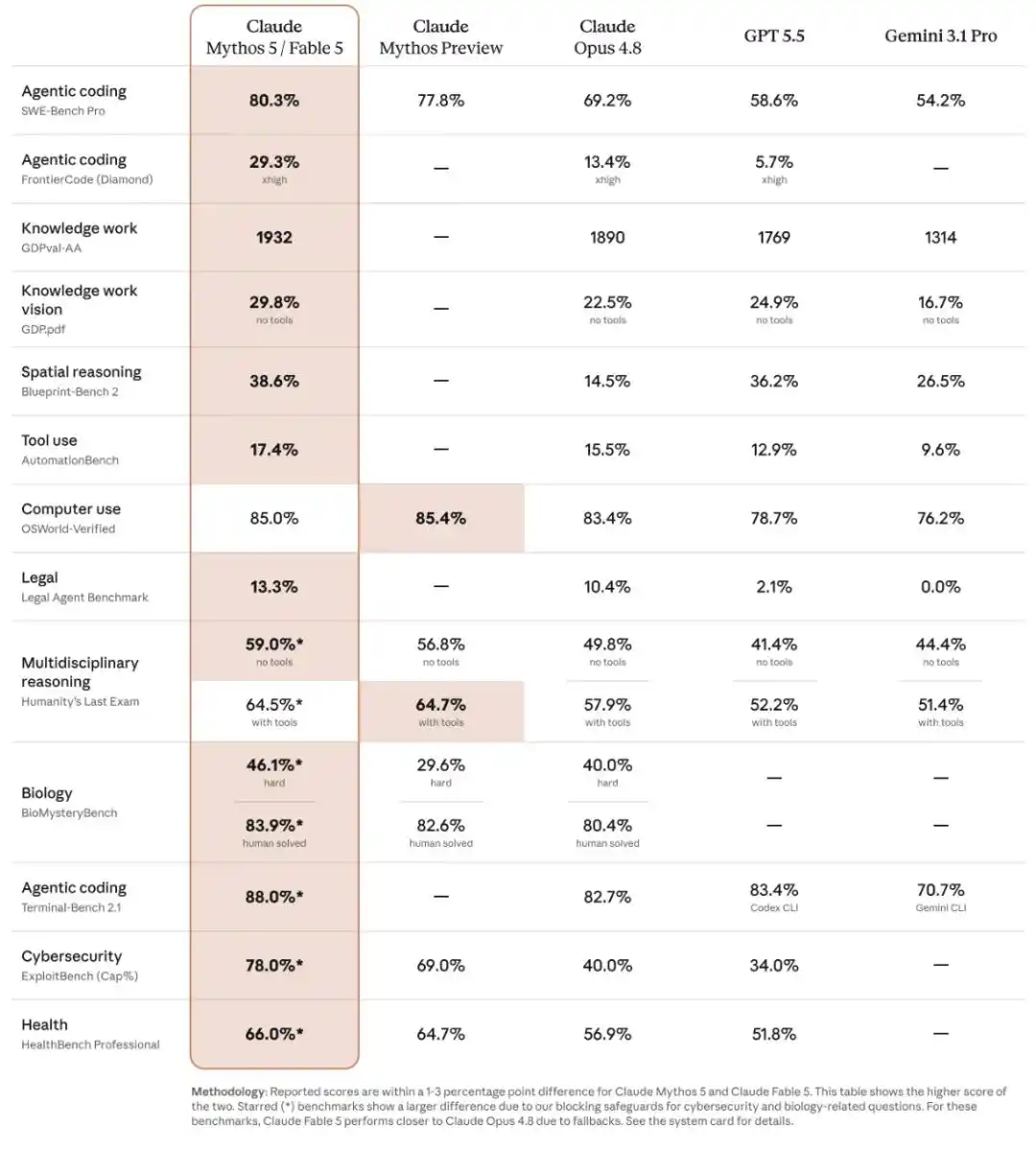
Software engineering is the core highlight of Anthropic's update this time. On the SWE-Bench Pro test, Fable 5 scored 80.3%. This test mainly evaluates whether the model can locate bugs in real GitHub repositories, understand context, and write usable fix code. An 80.3% score means for every 5 real engineering problems, Fable 5 can solve 4.

On the Terminal-Bench 2.1 leaderboard, Fable 5 scored 88.0%, surpassing OpenAI's Codex CLI. Notably, Fable 5 is a general-purpose model, while Codex CLI is a vertical tool specifically built for programming scenarios. The gap between them better reflects Fable 5's programming prowess.

But the real difference can be seen in FrontierCode Diamond. This test examines whether the code generated by the model can meet the quality standards of production-level codebases. Fable 5 achieved 29.3%, while Opus 4.8 only got 13.4%, and GPT-5.5 (Anthropic's internal test result for comparison) only 5.7%.

Over the past few years, the ability of AI models to write code has been improving, but it has long been stuck at a bottleneck: the code can run, but is not easy to maintain; it can pass benchmarks, but problems frequently arise when deployed in real projects.

Fable 5's breakthrough in this dimension shows that Anthropic's upgrade this time is not just about problem-solving ability, but about pushing the model toward genuine engineering delivery.

Programmer Li Xia told "AIX Finance" that AI-generated code often suffers from contextual incoherence. It can precisely understand requirements initially but tends to forget information during long tasks, leading to high maintenance costs later.

In his view, Fable 5 shows clear improvement in logical coherence during long tasks. Similar coding tasks can be completed in one go with higher accuracy. However, compared to Opus 4.8, Fable 5's generation speed is slower, with longer reasoning chains, resulting in an overall decrease in response speed.

Visual capabilities have also improved. Anthropic claims that Fable 5 can extract precise numbers from complex scientific charts and can reconstruct application source code directly from webpage screenshots. The company also demonstrated a practical case where Fable 5 completed the game "Pokémon FireRed" using only screenshots of the game screen, without needing auxiliary tools. Previous-generation models required complex auxiliary systems for similar tasks.

Regarding long context and memory, the official statement is that the longer and more complex the task, the more pronounced Fable 5's advantage becomes.

Additionally, life sciences is another direction highlighted. Anthropic revealed that a single-cell data analysis model built on Mythos 5, covering 138 species, outperforms similar models recently published in "Science," despite having only one-hundredth the parameter count.

Based solely on benchmark scores, comprehensive capabilities have indeed reached a new level.

Now let's look beyond the benchmarks.

Fable 5 comes equipped with a security classifier. As soon as a user request involves directions like cybersecurity, biochemistry, or model distillation, the system automatically switches to Opus 4.8 to respond and informs the user of the model downgrade. The company states that over 95% of daily conversations will not trigger this, and tasks like writing, programming, and analysis are mostly unaffected. However, actual experience may vary depending on the usage scenario.

In practical use, this boundary is actually easy to trigger. Li Xia mentioned that when he wanted to experience Apple's Siri AI features on a Mac in China, which required modifying some system-level serial number parameters, Fable 5 directly refused the operation. Currently, the classifier settings are relatively conservative, prone to misjudgment, and the company states it will be continuously adjusted.

But Anthropic also disclosed another layer of restriction. For requests related to large model development, such as building pre-training pipelines, designing distributed training infrastructure, etc., the model will actively reduce output quality in the background without informing the user.

Overall, Fable 5 has indeed made progress in various hard metrics, but the automatic downgrade mechanism affects the user experience to some extent.

02. The Most Powerful Model Is Not Accessible to Everyone

Anthropic's model upgrade this time uses the same underlying model packaged into two products for two groups.

Mythos 5 stays within the Project Glasswing framework, accessible only to 12 core security partners like Apple, Google, Microsoft, and over 40 critical infrastructure providers, with restrictions on cybersecurity and biology removed. Fable 5 targets C-end subscription users.

Subsequently, Anthropic also plans to open a trusted channel in the biology direction to vetted researchers, providing a version of Fable 5 with biology and chemistry restrictions removed.

This touches on a problem the large model industry hasn't faced before: when a model's capability is sufficient to autonomously discover vulnerabilities, a full public release becomes a risk.

Source / pexels

This explains why Fable 5 and Mythos 5 were split into two versions. In the past, model tiers were based on parameters—the gap between large and small models was one of capability. Now, models with the same parameters are also tiered, but the division is based on trust thresholds.

Independent developer Zhan Bo believes this logic is very reasonable from a security perspective. If Mythos-level vulnerability discovery capabilities were opened to individuals without restriction, it would significantly lower the cost of attacks and could easily be abused for malicious purposes. Locking it down first and then gradually opening trusted access is the most prudent path currently.

But security only explains why layering is needed. Another question is: do all general users who can use Fable 5 actually benefit from it?

Judging from the benchmarks and cases released by Anthropic, this round of upgrades primarily serves programmers and engineering teams.

Zhan Bo used Fable 5 to assist in optimizing his interpreter project written in Rust. In comparable web service scenarios, he compared it with FastAPI (based on Python) and Hono (based on Node.js). The interpreter using Fable 5 required only 9.8MB of resident memory, while FastAPI and Hono required 43.3MB and 63.0MB respectively, with leading throughput and latency metrics as well.

He believes that for the same task, using Fable 5 might complete it much faster and with better results. For developers, output quality is more important than price. As long as the model can significantly improve project outcomes, a higher price is acceptable.

Li Xia also mentioned that for programmers, model generation quality correlates positively with income. Higher output quality means more obvious efficiency gains and greater returns. The improvement in model capability can be directly converted into project quality and time saved, naturally leading to stronger willingness to pay.

But in a different usage scenario, the conclusion changes.

AI blogger Xu Zilong, taking his daily work as an example, said his work is divided into writing code, data analysis, and writing papers. He believes current large models have excessive code capabilities but deficient language abilities. For groups like researchers, content creators, and professionals in law and finance, the core demand for AI focuses on Chinese language understanding, long-form writing, and document processing.

Zhan Bo mentioned that the current trend is not users choosing models, but models selecting users. Heavy programming users are being filtered out by high-end models, while casual light users are pushed toward more cost-effective alternatives. This indicates that AI is no longer a universal tool, but rather a process of screening users layer by layer based on their payment ability and usage intensity.

Even the most powerful model is only worth its cost in the hands of those who need it.

03. Is the Era of Unaffordable AI Coming?

The API pricing for Fable 5 is $10 for input, $50 for output per million tokens. This is double the price of Opus 4.8 and is currently the most expensive among publicly available frontier models globally.
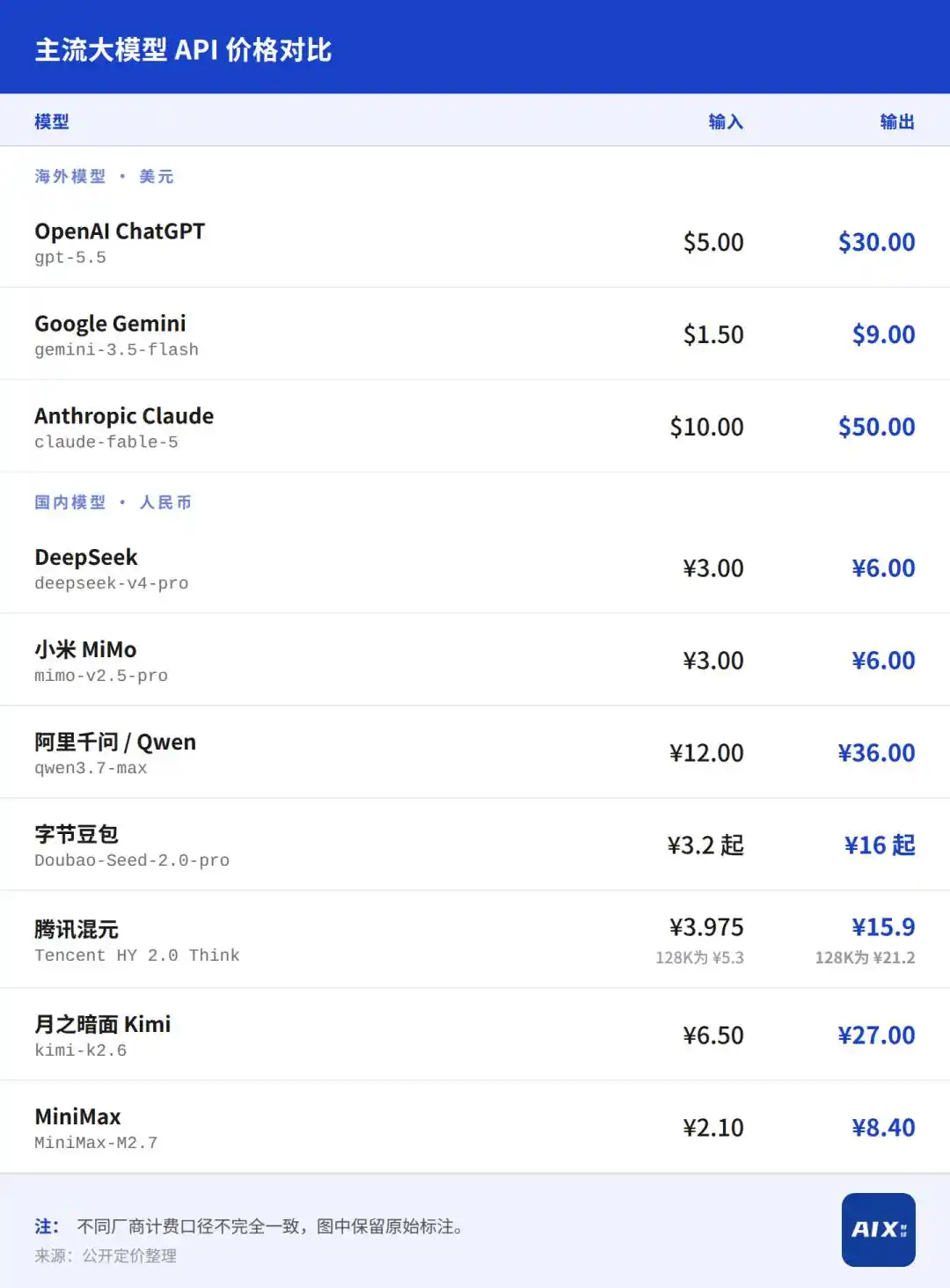
Comparison of Mainstream Large Model API Prices

But what's really worth noting is not that the price doubled, but that the payment method changed.

After Fable 5's launch, Pro, Max, Team, and other subscription users could use it for free for two weeks. Starting June 23rd, the model will be removed from subscription plans. To continue using it, users need to purchase additional credits, settled according to API rates. Using Fable 5 during a subscription period also consumes usage quota at twice the rate of Opus 4.8.

Offering a free trial first and then removing it from subscriptions is also sending a signal: pushing users from fixed monthly fees toward pay-as-you-go. The benefit of a subscription is predictability—users know how much they spend each month. Pay-as-you-go is more favorable for the platform—the more you use, the more you pay, opening up the user's spending ceiling. Simply put, Anthropic wants to tell users: the most advanced things shouldn't be part of a monthly package in the first place.

The timing of this shift is also noteworthy. On June 1st, Anthropic secretly filed its IPO prospectus with the SEC, with a valuation reaching $965 billion, targeting an IPO as early as October this year. From the beginning of the year to the end of May, Anthropic's annualized revenue grew from $9 billion to $47 billion, with Claude Code contributing over $2.5 billion, and enterprise customers contributing the vast majority of revenue.

A company about to go public needs to demonstrate revenue growth potential and pricing power to the capital markets. Separating the most powerful model from fixed subscriptions and guiding high-value users toward pay-as-you-go makes sense from a financial narrative perspective.

Meanwhile, domestic models are doing the exact opposite.

At the end of May, DeepSeek announced a permanent 75% price cut for its V4-Pro API. Xiaomi followed closely, with MiMo-V2.5-Pro seeing a drop of up to 99%, nearly aligning its price with DeepSeek.

On one side, DeepSeek is slashing prices to the floor; on the other, Anthropic is raising the ceiling. Different players have different strategies.

The price cuts by domestic models are partly due to the release of technological dividends; changes in the underlying architecture have saved space, which is being used to capture a larger market.

Anthropic's logic is exactly the reverse. It doesn't need to compete for market share with low prices. The high price itself is also a filter, retaining high-value users willing to pay for cutting-edge capabilities.

Xu Zilong believes AI will become increasingly expensive in the future because demand expansion far exceeds supply expansion. Computing power involves electricity, chips, and model training, and its growth is too slow. AI computing power will become infrastructure like 5G in the future, but unlike 5G, computing power supply is much tighter than bandwidth, so prices will increase accordingly.

From a business model perspective, the AI industry is developing a layered structure similar to the early days of cloud computing. The bottom layer consists of highly standardized, nearly zero-priced general capabilities that anyone can call, monetized through volume. The top layer consists of cutting-edge capabilities controlled by a few vendors, with concentrated pricing power, monetized through customer unit price. The price of general capabilities will continue to be driven down, but the premium for cutting-edge capabilities will persist for a long time.

From capability tiers to payment tiers, the AI industry is replicating the path cloud computing took. Cheap models are becoming more numerous, while the best models are becoming more expensive.

*Li Xia is a pseudonym upon the interviewee's request.

This article is from WeChat public account "AIX Finance," author: Lei Jing, editor: Jin Yufan

Câu hỏi Liên quan

QWhat are the key differences between Anthropic's Fable 5 and Mythos 5 models?

AFable 5 and Mythos 5 share the same underlying model. The key difference is their access and intended use. Mythos 5 is locked within the 'Project Glasswing' framework and is available only to a select group of 12 core security partners (like Apple, Google, Microsoft) and over 40 critical infrastructure providers, with restrictions on cybersecurity and biological/chemical research removed. Fable 5 is released to the general public but has a safety classifier that automatically downgrades requests in sensitive areas (like cybersecurity, biochem, model distillation) to the older Opus 4.8 model and applies other usage limitations.

QHow does Anthropic's Fable 5 perform in software engineering benchmarks according to the article?

AAccording to the article, Fable 5 excels in software engineering benchmarks. It scored 80.3% on the SWE-Bench Pro test, meaning it can solve 4 out of 5 real-world engineering problems involving locating bugs and writing fix code. It achieved 88.0% on Terminal-Bench 2.1, outperforming OpenAI's specialized Codex CLI. Most notably, on the FrontierCode Diamond test for production-ready code quality, Fable 5 scored 29.3%, significantly higher than Opus 4.8's 13.4% and GPT-5.5's 5.7%, indicating a breakthrough in generating maintainable, project-ready code.

QWhat is the 'Project Glasswing' mentioned in the article?

A'Project Glasswing' is a controlled access program launched by Anthropic to safely harness the powerful cybersecurity and vulnerability discovery capabilities of its advanced models like Mythos. It restricts access to a limited, trusted group of entities—specifically 12 core security partners and over 40 critical infrastructure providers. The goal is to lock down these potentially dangerous capabilities within defensive scenarios and prevent them from being used for malicious attacks if released to the public.

QHow is Anthropic changing the pricing and access model for its top-tier Fable 5 model?

AAnthropic is implementing a significant pricing and access shift for Fable 5. Its API price is set at $10 per million tokens for input and $50 for output, roughly double the cost of Opus 4.8. Furthermore, after a free two-week trial for subscribers, Fable 5 will be removed from the standard Pro, Max, and Team subscription plans starting June 23rd. To continue using it, users must purchase additional credits and pay based on API usage (pay-per-token), moving away from a fixed monthly subscription for this premium model.

QWhat contrasting trends in the AI model market does the article highlight between Anthropic and Chinese models?

AThe article highlights a divergence in market strategy. Anthropic is making its top-tier model (Fable 5) more exclusive and expensive, using high price as a filter for high-value users and to assert pricing power. In contrast, major Chinese AI companies like DeepSeek and Xiaomi are aggressively cutting prices. For example, DeepSeek announced a permanent 75% price cut for its V4-Pro API, and Xiaomi's MiMo-V2.5-Pro saw a 99% reduction. This reflects a strategy of leveraging technological efficiencies to lower costs and compete for broader market share through affordability.

Nội dung Liên quan

Kraken Lên Kế Hoạch Cung Cấp Hợp Đồng Tương Lai Vĩnh Viễn Được CFTC Quy Định Cho Nhà Giao Dịch Chuyên Nghiệp Hoa Kỳ

Kraken đang chuẩn bị ra mắt hợp đồng tương lai vĩnh viễn được CFTC quản lý cho các nhà giao dịch chuyên nghiệp đủ điều kiện tại Hoa Kỳ. Sản phẩm sẽ được cung cấp thông qua sàn phái sinh Bitnomial mà Kraken đã mua lại và dự kiến tích hợp vào nền tảng Kraken Pro. Hợp đồng tương lai vĩnh viễn là sản phẩm phái sinh crypto lớn toàn cầu, cho phép giao dịch không ngày đáo hạn. Tại Mỹ, các hạn chế quy định trước đây khiến nhà giao dịch có ít lựa chọn trong nước. Động thái của Kraken nhằm thu hẹp khoảng cách này, cung cấp một con đường được quản lý để tiếp cận sản phẩm chi phối khối lượng giao dịch crypto ở nước ngoài. Việc ra mắt sẽ tập trung vào các nhà giao dịch chuyên nghiệp đủ điều kiện. Các yếu tố cần theo dõi bao gồm điều khoản về tính đủ điều kiện, thiết kế hợp đồng, tài sản được hỗ trợ và quan trọng nhất là thanh khoản khi ra mắt. Thành công của sản phẩm có thể mở đường cho nhiều sản phẩm tương lai vĩnh viễn được quản lý khác tại thị trường Mỹ, đưa sản phẩm phái sinh chủ chốt này tiến gần hơn đến cơ sở hạ tầng thị trường nội địa được quản lý.

bitcoinist36 phút trước

Kraken Lên Kế Hoạch Cung Cấp Hợp Đồng Tương Lai Vĩnh Viễn Được CFTC Quy Định Cho Nhà Giao Dịch Chuyên Nghiệp Hoa Kỳ

bitcoinist36 phút trước

Sự Ra Mắt Của Warsh: Chủ Tịch Fed Hiểu Crypto Nhất Lịch Sử Sẽ Mang Đến Bất Ngờ Hay Cú Sốc Cho Thị Trường?

Tân Chủ tịch Cục Dự trữ Liên bang Kevin Warsh, người được mệnh danh là chủ tịch FED "hiểu rõ về Crypto nhất trong lịch sử", sắp có buổi họp báo chính sách đầu tiên trong bối cảnh thử thách ba mặt: lạm phát quay trở lại, áp lực giảm lãi suất từ Tổng thống Trump và kỳ vọng thị trường về việc tăng lãi suất. Khác với người tiền nhiệm, Warsh có cái nhìn sâu sắc về tài sản số, từng coi Bitcoin như "cảnh sát tốt cho chính sách" và nhấn mạnh giá trị sản xuất của ngành công nghiệp blockchain. Tuy nhiên, ông cũng nổi tiếng là người theo chủ nghĩa diều hâu về lạm phát. Sự kết hợp giữa "lãi suất chặt chẽ" và "quy định thân thiện" từ ông có thể trở thành yếu tố cốt lõi định giá tài sản mã hóa. Bài viết phân tích tác động từ ba khía cạnh: 1. **Chuyển đổi khuôn mẫu kỳ vọng quy định:** Từ phòng thủ sang tích hợp và đổi mới, có thể thúc đẩy các khung pháp lý rõ ràng hơn, hỗ trợ ổn định do khu vực tư nhân phát hành. 2. **Định giá lại lộ trình lãi suất và phần bù rủi ro:** Một chủ tịch hiểu biết và giao tiếp rõ ràng có thể giảm bớt phí bảo hiểm bất định, có lợi về cấu trúc cho thị trường. 3. **Tái phân bổ dòng vốn toàn cầu:** Kinh nghiệm đầu tư cá nhân của Warsh truyền tải tín hiệu về sự chấp nhận chính thống, có thể thúc đẩy các quỹ thể chế truyền thống phân bổ tài sản số. Hai kịch bản chính được đưa ra: * **Ngạc nhiên thú vị:** Nếu Warsh thể hiện thái độ ôn hòa và công nhận giá trị của tài sản số, thị trường có thể được tiếp thêm sức mạnh. * **Cú sốc:** Nếu ông phát tín hiệu tăng lãi suất mạnh mẽ, tài sản rủi ro, bao gồm crypto, có thể chịu áp lực bán. Mặc dù Warsh đã bán các khoản nắm giữ liên quan đến crypto để tuân thủ quy tắc đạo đức, nhưng sự hiểu biết thực sự của ông về công nghệ blockchain được kỳ vọng sẽ đặt nền tảng cho việc chính thống hóa tài sản số về lâu dài, vượt ra ngoài các phản ứng thị trường ngắn hạn.

marsbit52 phút trước

Sự Ra Mắt Của Warsh: Chủ Tịch Fed Hiểu Crypto Nhất Lịch Sử Sẽ Mang Đến Bất Ngờ Hay Cú Sốc Cho Thị Trường?

marsbit52 phút trước

XRP Ledger Ra Mắt Rebrand XRPLd Cùng Với Bản Nâng Cấp Phiên Bản 3.2.0

Phiên bản 3.2.0 của XRP Ledger đã chính thức ra mắt, đánh dấu một bước nâng cấp quan trọng cho cơ sở hạ tầng blockchain cốt lõi. Lần này, các nhà phát triển đã đổi tên phần mềm vận hành mạng từ "rippled" thành "xrpld" để phù hợp hơn với toàn bộ hệ sinh thái của dự án. Bản cập nhật tập trung chủ yếu vào các cải tiến back-end và hiệu suất thay vì tính năng người dùng mới. Các tối ưu hóa bộ nhớ được giới thiệu có khả năng tiết kiệm tới 40% lượng bộ nhớ máy chủ, đồng thời chuẩn bị kiến trúc phần mềm cho việc mở rộng quy mô trong tương lai. Về mặt bảo mật, bản sửa đổi `fixCleanup3_2_0` mang lại nhiều cải thiện cho các mô-đun như kho lưu ký tài sản đơn, giao thức cho vay, sàn giao dịch phi tập trung và mã thông báo đa năng. Các kiểm tra bất biến mới được thêm vào để đảm bảo tính toàn vẹn của sổ cái khi tài khoản bị xóa. Một khả năng mới cho nhà phát triển là ứng dụng có thể truy xuất thông tin định nghĩa giao thức và máy chủ XRP Ledger mà không cần kết nối trực tiếp, hỗ trợ đáng kể việc phát triển ví, công cụ khám phá chuỗi khối và API. Các thay đổi về khả năng mở rộng và ổn định bao gồm kích thước khối có thể cấu hình, hỗ trợ lưu trữ cơ sở dữ liệu hiệu quả qua nuDB, và việc hỗ trợ máy chủ gRPC cho TLS/mutual TLS trở thành tùy chọn. Cổng kết nối ngang hàng mặc định cũng được đổi từ 51235 sang 2459. Các tính năng kiểm tra bất biến giao dịch tạm thời bị vô hiệu hóa trong phiên bản 3.2.0 do ảnh hưởng đến hiệu suất, nhưng không gây rủi ro bảo mật.

TheNewsCrypto1 giờ trước

XRP Ledger Ra Mắt Rebrand XRPLd Cùng Với Bản Nâng Cấp Phiên Bản 3.2.0

TheNewsCrypto1 giờ trước

AGI không phải là điểm kết thúc, nghiên cứu mới của DeepMind: Hướng tới ASI, tiến bộ AI thực sự mới chỉ bắt đầu

DeepMind mới đây công bố nghiên cứu cho rằng AGI (Trí tuệ nhân tạo phổ quát) không phải là điểm cuối. AI sẽ tiếp tục phát triển vượt qua khả năng của các nhóm chuyên gia con người hàng đầu, hướng tới ASI (Trí tuệ siêu nhân tạo). Báo cáo phân biệt ba khái niệm: AGI (năng lực nhận thức tương đương mức trung bình của con người), ASI (vượt trội con người trong hầu hết lĩnh vực quan tâm), và UAI (giới hạn lý thuyết tối thượng). Nghiên cứu đề xuất bốn con đường tiềm năng để chuyển từ AGI sang ASI: 1. Mở rộng quy mô tính toán, mô hình và dữ liệu. 2. Tiến hóa thuật toán, có thể thay đổi mô hình mới. 3. Tự cải thiện đệ quy, tạo phản hồi tích cực. 4. Điều phối đa tác tử và trí tuệ tập thể. Đồng thời, báo cáo chỉ ra sáu điểm nghẽn chính: giới hạn dữ liệu chất lượng cao, áp lực tài nguyên và kinh tế, hạn chế của mô hình mạng nơ-ron hiện tại, nghiên cứu ngày càng khó khăn, rào cản trừu tượng, cùng các vấn đề quản lý và phản ứng xã hội. Khi AI vượt con người, các phương pháp đánh giá truyền thống sẽ mất ý nghĩa. Cần xây dựng hệ thống đánh giá mới cho thời kỳ hậu AGI. ASI không phải là hệ thống toàn năng, vẫn chịu ràng buộc bởi các quy luật vật lý, độ phức tạp tính toán, dữ liệu, tài nguyên và tốc độ phản hồi thực tế. Tương lai phát triển của AI vẫn chứa nhiều bất định, đòi hỏi một nỗ lực liên ngành quy mô lớn để theo dõi và ứng phó.

marsbit2 giờ trước

AGI không phải là điểm kết thúc, nghiên cứu mới của DeepMind: Hướng tới ASI, tiến bộ AI thực sự mới chỉ bắt đầu

marsbit2 giờ trước

Kraken Ra Mắt Hợp Đồng Perpetual Trước IPO Cho OpenAI Và Anthropic Với Đòn Bẩy Lên Đến 5x

Kraken đã ra mắt hợp đồng tương lai vĩnh viễn (perps) tiền IPO cho hai công ty trí tuệ nhân tạo hàng đầu là OpenAI và Anthropic. Các hợp đồng này cho phép các nhà giao dịch đủ điều kiện mở vị thế mua (long) hoặc bán (short) đối với các công ty tư nhân được theo dõi sát sao này trước khi họ lên sàn chứng khoán, với đòn bẩy lên tới 5x. Sản phẩm này đánh dấu một bước tiến trong việc mở rộng cơ sở hạ tầng phái sinh tiền mã hóa sang các tài sản ngoài chuỗi, cung cấp cho các nhà giao dịch một cách tiếp cận thay thế để có thể tiếp xúc với các công ty tư nhân vốn thường khó tiếp cận. Tuy nhiên, hợp đồng tiền IPO có những rủi ro đặc thù. Khác với các hợp đồng vĩnh viễn cho tiền mã hóa có giá cả minh bạch, định giá công ty tư nhân phụ thuộc vào nhiều yếu tố như các vòng gọi vốn, giao dịch thứ cấp và kỳ vọng về thời điểm IPO. Điều này khiến việc định giá và quản lý rủi ro trở nên phức tạp hơn. Việc sử dụng đòn bẩy cao có thể khuếch đại lợi nhuận nhưng cũng làm gia tăng đáng kể rủi ro thua lỗ và thanh lý. Do đó, các nhà giao dịch cần hiểu rõ bản chất của sản phẩm mới và các rủi ro độc đáo của thị trường tư nhân trước khi tham gia.

bitcoinist2 giờ trước

Kraken Ra Mắt Hợp Đồng Perpetual Trước IPO Cho OpenAI Và Anthropic Với Đòn Bẩy Lên Đến 5x

bitcoinist2 giờ trước

Giao dịch

Giao ngay
Hợp đồng Tương lai

Bài viết Nổi bật

Làm thế nào để Mua PEOPLE

Chào mừng bạn đến với HTX.com! Chúng tôi đã làm cho mua ConstitutionDAO (PEOPLE) trở nên đơn giản và thuận tiện. Làm theo hướng dẫn từng bước của chúng tôi để bắt đầu hành trình tiền kỹ thuật số của bạn.Bước 1: Tạo Tài khoản HTX của BạnSử dụng email hoặc số điện thoại của bạn để đăng ký tài khoản miễn phí trên HTX. Trải nghiệm hành trình đăng ký không rắc rối và mở khóa tất cả tính năng. Nhận Tài khoản của tôiBước 2: Truy cập Mua Crypto và Chọn Phương thức Thanh toán của BạnThẻ Tín dụng/Ghi nợ: Sử dụng Visa hoặc Mastercard của bạn để mua ConstitutionDAO (PEOPLE) ngay lập tức.Số dư: Sử dụng tiền từ số dư tài khoản HTX của bạn để giao dịch liền mạch.Bên thứ ba: Chúng tôi đã thêm những phương thức thanh toán phổ biến như Google Pay và Apple Pay để nâng cao sự tiện lợi.P2P: Giao dịch trực tiếp với người dùng khác trên HTX.Thị trường mua bán phi tập trung (OTC): Chúng tôi cung cấp những dịch vụ được thiết kế riêng và tỷ giá hối đoái cạnh tranh cho nhà giao dịch.Bước 3: Lưu trữ ConstitutionDAO (PEOPLE) của BạnSau khi mua ConstitutionDAO (PEOPLE), lưu trữ trong tài khoản HTX của bạn. Ngoài ra, bạn có thể gửi đi nơi khác qua chuyển khoản blockchain hoặc sử dụng để giao dịch những tiền kỹ thuật số khác.Bước 4: Giao dịch ConstitutionDAO (PEOPLE)Giao dịch ConstitutionDAO (PEOPLE) dễ dàng trên thị trường giao ngay của HTX. Chỉ cần truy cập vào tài khoản của bạn, chọn cặp giao dịch, thực hiện giao dịch và theo dõi trong thời gian thực. Chúng tôi cung cấp trải nghiệm thân thiện với người dùng cho cả người mới bắt đầu và người giao dịch dày dạn kinh nghiệm.

Tổng lượt xem 708Xuất bản vào 2024.12.12Cập nhật vào 2026.06.02

Làm thế nào để Mua PEOPLE

Thảo luận

Chào mừng đến với Cộng đồng HTX. Tại đây, bạn có thể được thông báo về những phát triển nền tảng mới nhất và có quyền truy cập vào thông tin chuyên sâu về thị trường. Ý kiến ​​của người dùng về giá của PEOPLE (PEOPLE) được trình bày dưới đây.

活动图片