Preface
Over the past few years, public attention on artificial intelligence has largely focused on one direction: which jobs is AI replacing, and what new productivity is it creating.
From generating text and writing code to assisting scientific research and automating office work, AI has become one of the most watched variables in the past several technology cycles. However, compared to the improvement of model capabilities themselves, two recent events may reveal a new trend more worthy of attention from the encryption industry—AI is beginning to participate in discovering problems in complex systems.
Not long ago, Anthropic published a research article, "Recursive Self-Improvement," systematically discussing how AI is gradually participating in its own R&D processes. From experimental design and code generation to bug tracking and performance optimization, models are evolving from purely tool-based roles to becoming participants in the R&D system. Although there is still considerable distance from fully autonomous development of the next-generation model, the trend of AI assisting AI to accelerate iteration has already begun to appear.
Almost simultaneously, another piece of news sparked widespread discussion in the crypto community. Claude Opus 4.8 discovered a critical vulnerability hidden within a zero-knowledge proof system while reviewing Zcash (ZEC) related code. Subsequently, the Zcash development team and community quickly completed risk verification, an emergency upgrade, and vulnerability remediation, preventing the potential impact from further escalation.
On the surface, these two events belong to completely different domains.
The former belongs to artificial intelligence research, discussing how models help models progress; the latter belongs to blockchain security, discussing a technical vulnerability in a privacy protocol. But if we extend the timeline and shift the perspective from a single event to the entire direction of technology industry development, both actually point to the same change:
AI is beginning to participate more deeply in the process of understanding, analyzing, and verifying complex systems.
For the encryption industry, this change is particularly worthy of attention.
Over the past decade, the core way the blockchain industry has built its security system has been relying on cryptography experts, security researchers, and third-party auditing agencies to discover vulnerabilities, verify risks, and complete fixes through a combination of manual analysis and automated tools. Whether it's smart contract auditing, cross-chain bridge security assessment, or zero-knowledge proof system verification, it is essentially built upon human expert experience and limited automated tools.
Now, a new capability is entering this system.
AI can not only read code but has also begun to possess the ability to understand complex logical relationships, generate testing scenarios, locate anomalous behavior, and even assist in verifying vulnerabilities. For a large system with hundreds of thousands or even millions of lines of code, this means that one of the core variables in the security field is changing—the speed of discovering problems.
In fact, historically, the vast majority of major security incidents did not originate from the vulnerability itself, but from the fact that the vulnerability existed for too long before being discovered. The gap between attackers and defenders often lies not in technical level, but in who discovers the risk earlier and who responds faster.
If AI is helping researchers discover hidden problems with unprecedented efficiency, then what it changes is not just the auditing tool, but the entire vulnerability discovery mechanism.
WEEX Labs believes that the "Recursive Self-Improvement" proposed by Anthropic may only be the beginning. In the encryption industry, a similar but more broadly impactful change is occurring: the security system itself is beginning to gain the ability for continuous evolution. Future competition may no longer be about which protocol is absolutely secure, but about who can discover risks faster, verify risks faster, and complete fixes faster.
From this perspective, the significant importance of Claude discovering the ZEC vulnerability may not lie in discovering a specific vulnerability, but in allowing the entire industry to glimpse in advance the outline of a new era—an "Recursive Security Era" driven by AI and continuously evolving.
AI is Entering its Own Acceleration Cycle
If we observe the technological revolutions of the past two hundred years together, an interesting pattern emerges: whenever production tools begin to participate in the manufacturing of production tools themselves, society often undergoes a new efficiency leap.
During the Industrial Revolution, machines were used to manufacture machines, freeing manufacturing from reliance on purely manual production; in the Internet era, software helped develop software, and digital infrastructure began to expand at an unprecedented speed. Today, a similar change is occurring in the field of artificial intelligence—AI is beginning to participate in its own R&D process.
This is also an important reason why Anthropic's recent publication of the "Recursive Self-Improvement" research sparked widespread industry discussion.
Literally, "recursive self-improvement" might easily remind people of superintelligence from science fiction: AI continuously upgrading itself, ultimately breaking free from human control. But Anthropic is not discussing this extreme scenario. The research focuses more on a change happening in the real world—AI is gradually entering the R&D chain and taking on more and more work originally requiring engineers.
In the past, large model R&D was a highly labor-intensive process. Research teams needed to design experiments, write code, analyze results, locate errors, optimize performance, and constantly repeat this cycle. Even with ample computing resources, R&D efficiency was still constrained by human time and cognitive capabilities.
Now, the situation is changing.
From code generation and automated testing to log analysis and problem troubleshooting, more and more R&D steps are beginning to be assisted by AI. Engineers no longer need to write every piece of code from scratch, nor do they have to sift through massive logs for anomalies line by line. Models can quickly process large amounts of context, propose potential problem paths, and generate multiple candidate solutions for developers to verify. This does not mean AI replaces engineers, but it is significantly compressing the most time-consuming parts of the R&D process.
The significance of this change goes far beyond just "improving efficiency."
For a long time, technological innovation has essentially been a cyclical process. Researchers propose hypotheses, build experiments to verify them, then correct the direction based on results and enter the next iteration. The speed of each cycle directly impacts the speed of innovation. And when AI begins participating in this process, the cycle itself begins to accelerate.
The time to discover problems shortens, the time to verify problems shortens, and the time to fix problems shortens. Viewed individually, the improvement in each link may seem limited, but when these improvements accumulate, the entire R&D system exhibits a noticeable acceleration effect.
This is the truly noteworthy aspect behind Anthropic's research. Compared to how much the model parameter size has increased or how much benchmark scores have improved, it's more important that a new flywheel effect is emerging in the R&D system: stronger models help humans build more efficient R&D tools, and more efficient R&D tools help humans train even stronger models.
This cycle can be summarized with simple logic:
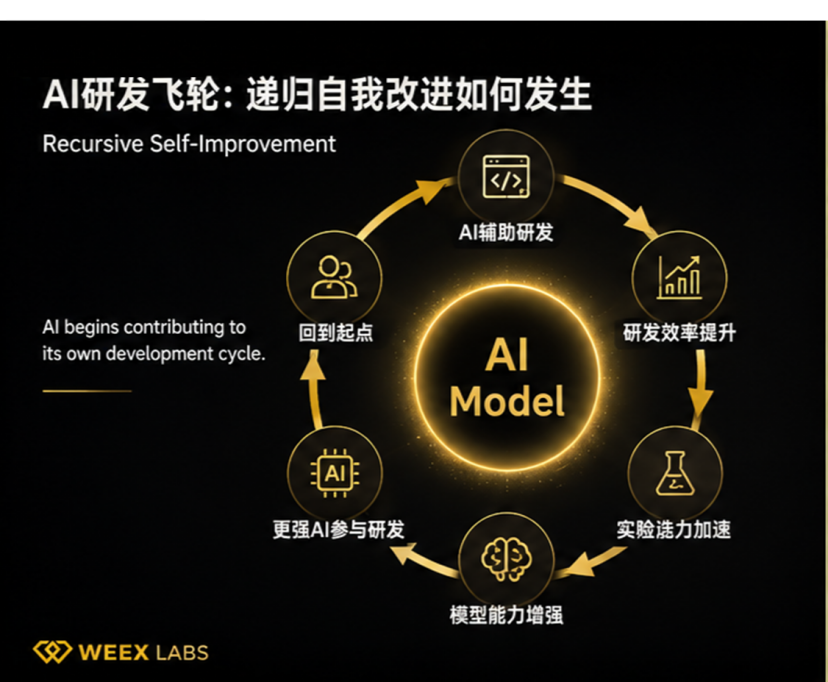
Once this flywheel forms, the development speed of AI no longer depends entirely on the number of researchers but begins to be influenced by the feedback efficiency of the entire system.
In other words, AI is gradually becoming part of the knowledge production system.
This has profound implications for the entire technology industry. Because when AI is no longer just the end product but begins participating in the creation process of products, the changes it brings will expand from single-point capability improvements to efficiency improvements across the entire industry chain.
Historical experience shows that breakthroughs in foundational technology often first impact industries highly reliant on complex information processing. The internet changed finance, media, and retail; cloud computing reshaped enterprise software; and the impact of artificial intelligence will not remain confined to chatbots or content generation.
In fact, as model comprehension and reasoning capabilities continue to improve, more and more industries requiring analysis of complex systems are becoming important application scenarios for AI. Among them, the security field is perhaps one of the most noteworthy directions.
The reason is not complicated. Compared to creating new systems, the core task of security work is actually understanding existing systems. Whether it's code auditing, risk assessment, anomaly detection, or attack path analysis, the essence is finding the few unexpected states within vast sets of information. This is a typical complex pattern recognition task, and pattern recognition is precisely one of modern AI's strongest abilities.
Over the past decade, the internet industry has widely used machine learning technology to identify spam, fraudulent transactions, and network attack behaviors. Today's large models further expand this capability boundary. They can not only identify abnormal results but also combine context to understand the causes of anomalies and, to a certain extent, deduce the potential subsequent impacts of problems.
This means a key change is emerging: AI is moving from "detecting anomalies" to "understanding anomalies."
For the security industry, the importance of this change is no less than the birth of automated tools. Because the real difficulty has never been collecting data, but finding the issues worth attention within massive data. As system complexity continues to increase, human experts find it increasingly difficult to complete this work alone, and AI is becoming a new auxiliary force.
If Anthropic's research reveals how AI accelerates AI development, then for the blockchain industry, another question is perhaps more worthy of consideration: after AI begins to possess the ability to understand complex systems, can it also help humans discover risks hidden within these systems faster?
The answer to this question was soon validated in the encryption industry.
And the case that sparked discussion across the entire community was precisely the recent vulnerability incident involving Zcash.
Claude Discovering the ZEC Vulnerability: What's Truly Important Is Not the Vulnerability
If we look solely at the incident itself, the recent Zcash vulnerability event that sparked discussion in the crypto community is not particularly complex.
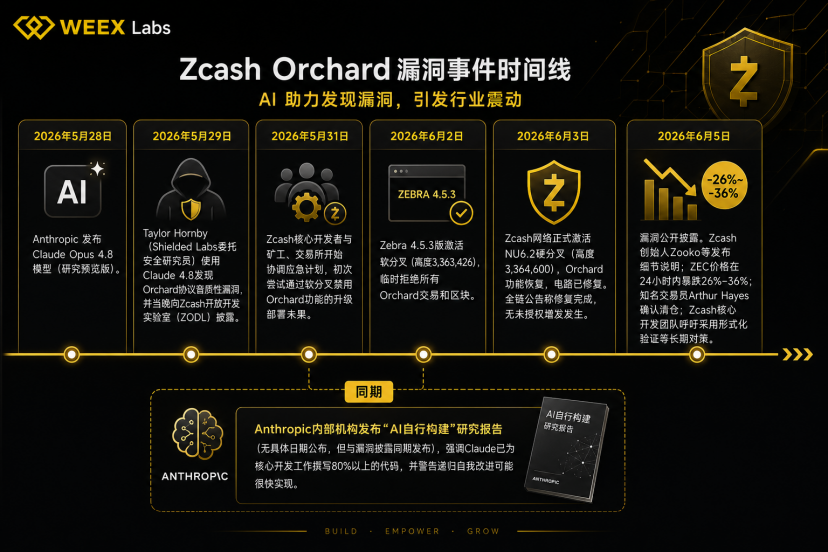
While analyzing Zcash Orchard system-related code, Claude Opus 4.8 identified a potential issue hidden within the implementation logic of the zero-knowledge proof. Subsequently, the development team and security researchers verified the risk and quickly completed the fix and upgrade deployment, preventing the problem from escalating further.
From the perspective of traditional security incidents, this seems like just a standard vulnerability discovery and remediation process.
Over the past decade, similar stories have been common in the crypto industry. Auditing firms discovering issues, white hat hackers submitting vulnerabilities, project teams completing fixes—these have all become important components of the industry's security system.
But this time, the community's focus is not entirely on the vulnerability itself.
What truly sparked discussion is another question:
If the entity discovering vulnerabilities begins to expand from humans to AI, is the entire security system undergoing change?
This is what is truly worth pondering about the Zcash incident.
The past blockchain security system was essentially built upon human expert experience. Whether smart contract auditing, cross-chain bridge security assessment, or zero-knowledge proof system verification, the core processes relied on researchers reading code, understanding protocol logic, constructing attack paths, and gradually narrowing down the risk scope.
This model was effective in the early stages of industry development.
However, as system complexity continues to increase, human analytical capabilities are beginning to face increasingly obvious boundaries.
Today's blockchain systems have far surpassed the scope of simple transfer protocols. Layer 2 scaling networks, cross-chain communication protocols, modular blockchains, and zero-knowledge proof systems are constantly adding new technology layers, and each added layer of abstraction means new risk surfaces are introduced into the system.
The problem is, the growth of complexity often outpaces the growth of security capabilities.
The potential state space of a modern protocol with hundreds of thousands of lines of code has far exceeded the scope that any single research team can fully cover. Even the best auditing agencies can only focus verification around critical paths and cannot exhaust all possible interaction scenarios.
This is why the security industry has long faced a fundamental contradiction:
System complexity continues to rise, while the growth in the number of human experts is limited.
From this perspective, the significant importance of Claude discovering the Zcash vulnerability lies not in AI finding a specific problem, but in it demonstrating a new risk discovery capability.
Unlike traditional rule-based scanning tools, the value of large models lies not just in executing preset rules, but in their ability to understand contextual relationships and search for potential anomalies within complex logic.
They can simultaneously analyze code implementation, protocol constraints, execution paths, and state transition logic, and establish connections between multiple layers.
This capability does not necessarily mean AI understands cryptography better than cryptography experts.
But it means AI can complete a large amount of analytical work originally requiring manual investment at an extremely low cost, helping researchers locate areas worthy of attention more quickly.
In other words, AI is changing a key variable in security research:
The cost of risk discovery.
Historically, every important transformation in the security industry has essentially stemmed from a reduction in discovery cost.
Automated vulnerability scanning tools are like this.
Continuous integration testing systems are like this.
Cloud security monitoring systems are also like this.
And the change brought by AI may further accelerate this process.
If discovering a complex vulnerability used to take weeks or even months, in the future this cycle may be compressed to days, hours, or even shorter.
For attackers, this means more vulnerabilities will be discovered.
For defenders, this also means more vulnerabilities will be discovered early.
Therefore, what AI brings is not simply enhanced security, but an acceleration of the entire risk discovery mechanism.
This is why the Zcash incident deserves to be observed within a larger historical context.
It is not just a successful case of AI-assisted auditing.
It is more like a signal.
A signal that the security industry is gradually moving from "expert-driven" to "expert + AI collaborative-driven."
And when risk discovery capabilities begin to experience exponential improvement, a deeper question also emerges:
If AI can continuously help humans discover risks, will the security system itself, like the AI R&D system, enter a state of continuous evolution?
This question is the core of the next stage of discussion.
From Recursive Self-Improvement to Recursive Security
The core issue discussed by Anthropic in "Recursive Self-Improvement" is how AI participates in its own R&D process and helps the entire R&D system gain continuous acceleration capabilities.
On the surface, this seems like a topic belonging solely to the artificial intelligence industry, but upon further abstraction, one finds that what is truly important behind it is not AI, but a new system structure.
The characteristic of this structure is: the system begins to participate in its own optimization process, models help researchers improve R&D efficiency, higher R&D efficiency helps researchers train stronger models, and then, stronger models again participate in the next round of R&D. The entire system thus forms a continuously circulating feedback loop. This is the essence of "recursive self-improvement." It describes not a single capability breakthrough, but a mechanism capable of continuously generating capability improvements.
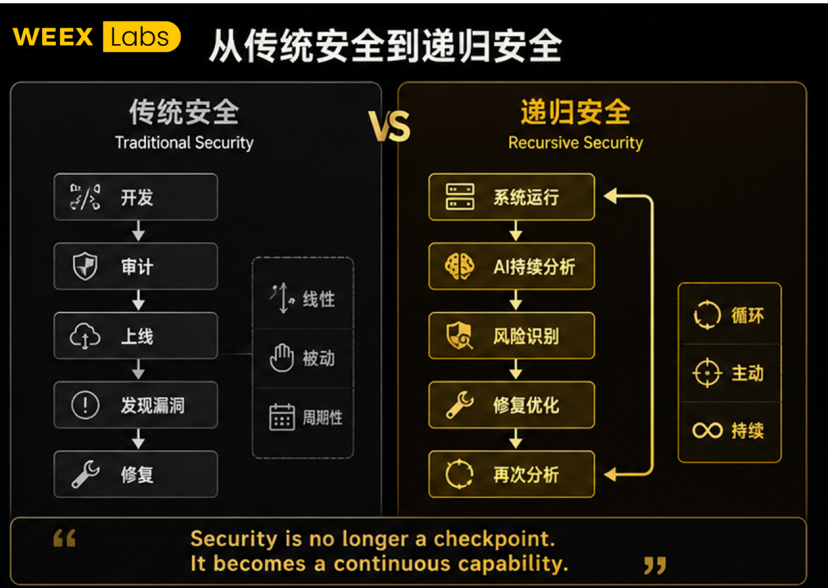
And when we shift our perspective from AI R&D to blockchain security, we find a similar structure emerging. Past security systems were mostly linear: the system was developed, then audited, then launched, problems arose and were fixed, and after fixes were completed, it entered the next round of auditing.
The entire process was dominated by periodic checks, with security capabilities mainly coming from expert experience and periodic assessments.
But as AI begins to participate in vulnerability analysis, this structure is changing.
More and more risk identification work is no longer confined to a fixed point in time but is beginning to become a continuous capability during system operation.
The system runs, generating data; AI continuously analyzes data and code states; potential risks are identified early; the development team completes fixes; the updated system enters the analysis cycle again.
This process bears a highly similar structure to the R&D flywheel described by Anthropic.
The difference lies in their optimization targets. The former focuses on capability growth, the latter on risk control; the former seeks to improve R&D efficiency, while the latter seeks to improve risk discovery and remediation efficiency.
From this perspective, the "recursive self-improvement" proposed by Anthropic is not only applicable to AI R&D systems; it actually provides a new perspective for observing the evolution of complex systems: when a system begins to continuously participate in its own optimization, the feedback loop becomes an important driving force for its evolution.
And in the blockchain security field, a similar feedback structure is gradually forming.
The system runs, generating new data and state changes; AI continuously analyzes these changes; potential risks are identified early; the development team completes fixes and optimizations; and the updated system enters the next round of analysis and verification again.
This continuous discovery, remediation, and verification cycle mechanism differs significantly from traditional security models.
To describe this emerging trend, WEEX Labs calls it:
Recursive Security.
Here, "recursive" does not mean the system can automatically eliminate all risks, but that security capabilities begin to continuously strengthen themselves through ongoing feedback.
In other words, security is evolving from a one-time inspection process to a continuously operating system capability.
Why Security is Becoming the Industry AI Reconstructs First
When a general-purpose technology begins to enter the social production system, it often does not change all industries simultaneously.
Historically, whether the internet, cloud computing, or mobile computing, they always first generated structural impact in certain fields before gradually diffusing into broader industries. AI development follows this same pattern.
A question worth pondering is: if AI has such broad applicability, why has one of the most obvious changes in recent years first appeared in the security field?
The answer may be hidden in the nature of security work.
Contrary to popular belief, the core of security work is not creating new systems, but understanding existing systems. Whether code auditing, vulnerability analysis, anomaly detection, or attack path deduction, the essence is finding behavior patterns that do not meet expectations within complex systems.
This type of work has a common characteristic: it requires processing large amounts of information but only searches for a very few anomaly points.
For human researchers, this is an extremely exhausting task. A large protocol may contain hundreds of thousands of lines of code, hundreds of modules, and countless potential interaction paths, while the issues truly causing risk are often hidden within an extremely small part of the logic. Researchers need to spend a lot of time reading, understanding, verifying, and eliminating false leads before finally locating the problems truly worth attention.
And from an information processing perspective, this is precisely the type of problem AI excels at solving.
Where large models are truly powerful is not just generating content, but in their ability to simultaneously process massive context and establish relational connections from complex information. They can quickly understand system structure, track logical chains, and search for potential inconsistencies between multiple layers.
For the security industry, this means a new capability is emerging.
In the past, the bottleneck of security work was usually insufficient analytical capability; in the future, the bottleneck may gradually shift to verification and decision-making capabilities.
In other words, AI is reducing the cost of "discovering problems," while humans are increasingly focusing on judging whether these problems are real, their risk level, and how to respond.
This change is particularly evident in the blockchain industry.
With the continuous development of Layer 2, modular architecture, cross-chain protocols, and zero-knowledge proof systems, blockchain networks are no longer single on-chain programs but complex systems composed of multiple technology layers. Each added module enhances system functionality but also simultaneously expands potential attack surfaces.
Historical experience shows that complexity is almost always a source of risk.
The more complex the system, the harder it is to complete comprehensive verification purely manually; and the harder a system is to verify, the more it needs new tools to help humans understand hidden risks.
Therefore, AI first impacting the security industry is not accidental.
It is not because the security industry is the easiest to change, but because the security industry most urgently needs a tool that can expand cognitive capabilities. When the growth rate of system complexity surpasses the growth rate of human analytical capability, a new auxiliary system naturally emerges.
From this perspective, the Zcash incident is not an isolated case but more like an early glimpse of a future trend.
As model capabilities continue to strengthen, the future participation of AI may not only include vulnerability discovery but also more complex tasks like protocol evaluation, risk prediction, attack path simulation, and continuous monitoring. And this means the security system is gradually shifting from the traditional human-driven model to a new type of collaborative system composed of both AI and humans.
It is also against this backdrop that the security industry has become one of the earliest fields to exhibit recursive evolutionary characteristics.
Because compared to creating content, generating images, or answering questions, the nature of security work is closer to understanding complex systems. And understanding complex systems is precisely the direction where large models first release value as their capabilities continuously improve.
The Vulnerability Lifecycle is Being Reconstructed
If AI is changing the security industry, the first thing to change is not the vulnerability itself, but the entire lifecycle from vulnerability emergence to remediation.
For a long time, the software industry has followed a relatively fixed security process. After system launch, potential risks are discovered through regular audits, vulnerability reports, community feedback, and security researcher analysis. Then, the development team completes verification and remediation, solving problems through version updates.
This model has worked well over the past few decades, but it is essentially a linear process.
Vulnerabilities are discovered, verified, and fixed, each step having clear boundaries and highly reliant on human involvement. Whether it's the audit cycle or response speed, they are limited by human resources and professional capabilities.
However, as AI begins to participate in security analysis, this linear chain is gradually evolving into a continuously circulating feedback system.
The past security workflow looked more like this:
Development is completed, then audited; the system goes live; vulnerabilities are discovered during operation; then the remediation process begins; finally, returning to a stable state.
With AI participation, security analysis is no longer confined to a single point in time.
Data generated during system operation, code update records, and state change information can all be continuously incorporated into the analysis scope. Risk discovery shifts from a one-time action to a continuous process, vulnerability verification speed keeps increasing, and remediation suggestions can be generated faster.
This means the security system is beginning to possess a capability that was difficult to achieve in the past—continuously observing its own state.
Under the traditional model, a vulnerability could exist for months or even years before being discovered; under the recursive security model, the system is always under analysis, and the risk exposure period is significantly compressed.
The importance of this change far exceeds the improvement in audit efficiency itself.
Because for most security incidents, what truly determines the scale of loss is often not whether the vulnerability exists, but how long it existed before being discovered.
If a high-risk vulnerability takes a year to be discovered, it has ample time to be exploited by attackers; whereas if the same vulnerability is identified within days or even hours, the risk level changes fundamentally.
Therefore, what AI changes is not just security tools, but the time dimension within the security system.
In the past, the industry pursued "discovering vulnerabilities."
In the future, the industry may focus more on "shortening the existence time of vulnerabilities."
This shift will further drive the security system towards a continuous monitoring model.
Future protocols, after launch, will not enter a so-called "secure state" but will enter a state of continuous analysis. Every system upgrade, every new module, and every key parameter change may trigger a new risk assessment process.
In this sense, security will increasingly resemble real-time operating infrastructure rather than a one-time task completed before launch.
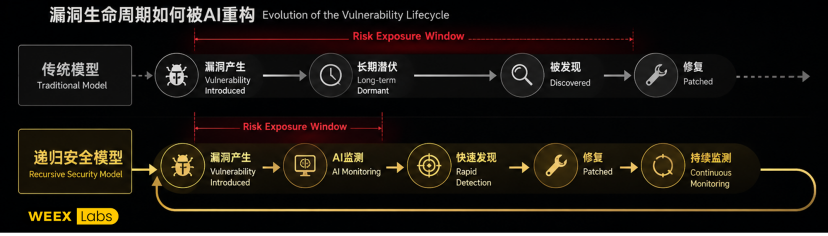
This change also explains why "recursive security" does not mean vulnerabilities disappear.
In fact, any complex system cannot completely eliminate vulnerabilities.
What truly changes is the relationship between the system and vulnerabilities.
In the past, the security system mostly responded after vulnerabilities were exposed; in the future, the security system is gradually gaining the ability for proactive discovery, continuous analysis, and rapid feedback.
As risk discovery speed continuously improves and vulnerability lifecycles keep shortening, the entire industry's understanding of "security" will also change accordingly.
Security is no longer just a step to be completed before a project launch, but a continuous capability that runs through the entire lifecycle of the system.
And this is the underlying mechanism where recursive security begins to take effect.
Risks and Industry Insights
When AI begins to enter the security system, a common misconception is that future systems will therefore become more secure.
In fact, things are not that simple.
Looking back at the history of technological development over the past few decades, every major tool revolution has simultaneously enhanced the capabilities of both defenders and attackers. The internet reduced information acquisition costs but also reduced attack dissemination costs; cloud computing improved system scalability but also expanded attack impact range. And the changes brought by AI follow the same pattern.
It enhances not just security capabilities, but the information processing capabilities of the entire offense-defense system.
For defenders, AI can help analyze massive amounts of code, discover abnormal logic, construct testing scenarios, and predict potential risks. Much work that used to take security teams weeks to complete can now undergo preliminary screening in a shorter time.
But at the same time, attackers also have access to the same technological tools.
Theoretically, any model that can help researchers discover vulnerabilities can also help attackers find attack paths; any capability used for protocol analysis may also be used to find system weaknesses. AI does not naturally side with defenders; it merely improves the efficiency for both sides in understanding complex systems.
Therefore, perhaps the most important change in the future security industry is not reduced risk, but accelerated risk exposure.
From this perspective, the security challenges of the AI era can be summarized into four core dimensions.
First is technological risk.
As AI analytical capabilities continue to improve, many historical legacy issues and hidden defects may be rediscovered. Some risks that have long gone unnoticed due to high complexity will gradually be exposed to industry scrutiny. This means in the coming years, the number of vulnerabilities we see may not decrease and could even see a phased increase.
Second is complexity risk.
The development direction of the blockchain industry is continuously increasing system complexity. Modular architecture, cross-chain communication, Layer 2 scaling, and zero-knowledge proof technology are building increasingly large infrastructure networks. Increased complexity means enhanced functionality but also simultaneous expansion of risk surfaces.
Third is response capability risk.
If vulnerability discovery speed continuously increases, while project governance, development, and upgrade capabilities do not progress synchronously, new bottlenecks will emerge. The key factor determining security levels in the future may no longer be the ability to find problems, but the ability to handle problems quickly.
Finally, governance risk.
For decentralized systems, solving technical problems is often not just an engineering issue. Many critical upgrades require community discussion, governance voting, and even ecosystem coordination. When AI compresses the risk exposure cycle to a shorter time scale, whether the governance system can keep pace with the speed of technological change becomes a new challenge.
These risks will not automatically disappear because of the emergence of AI.
On the contrary, they are being amplified, accelerated, and rearranged.
But at the same time, a new security paradigm is also forming.
More and more projects are shifting from "periodic auditing" to "continuous monitoring"; more and more development teams are introducing automated verification, formal verification, and AI-assisted auditing tools; more and more security work is shifting from single checks to long-term operating mechanisms.
The core of this change is not to make the system reach an absolutely secure state.
But to make risk management capabilities part of the system itself.
In the past, a project's security level often depended on how many audits it had undergone; in the future, a project's security level may depend more on its continuous ability to discover risks, respond to risks, and fix risks.
For the entire industry, this means the dimensions of competition are changing.
Future leading protocols may not necessarily be those with the fewest vulnerabilities, but those that discover risks the fastest, have the highest remediation efficiency, and possess the strongest system resilience.
And this is precisely the direction recursive security truly points to.
It never focuses on eliminating risk, but on continuously improving the system's ability to face risks.
In Conclusion
If we observe Anthropic's research on "Recursive Self-Improvement" together with the recent Zcash vulnerability incident, we find that although they occur in different fields, they both point to the same trend.
AI is evolving from a tool to a participant in the operation of complex systems.
In the R&D field, it is beginning to help humans design experiments, write code, analyze results, and optimize models; in the security field, it is beginning to help humans understand systems, discover risks, and verify problems.
The most important significance of this change lies not in a single capability breakthrough, but in the formation of a new feedback structure.
The system begins to participate in its own optimization.
R&D begins to gain continuous acceleration capabilities.
Security begins to gain continuous evolution capabilities.
And when these two capabilities appear simultaneously, the entire technology industry will enter a new stage of development.
For the encryption industry, this change is particularly important.
Over the past decade, one of the most discussed issues in the industry has always been security. Whether smart contract vulnerabilities, cross-chain bridge attacks, or cryptographic implementation flaws, they all essentially reflect a reality: the speed of system complexity growth often outpaces the speed at which humans can discover risks.
And AI is changing this relationship.
It may not be able to eliminate vulnerabilities, nor can it guarantee absolute system security, but it is helping the industry understand complex systems with unprecedented efficiency and shorten the time between risk generation and discovery.
This may be one of the most noteworthy changes in the coming years.
Because in an increasingly complex digital world, the truly scarce resource is no longer just computing power, capital, or code, but the ability to discover problems.
Who can identify risks earlier, who can respond faster, will be able to maintain stronger stability in the continuously changing environment.
From this perspective, Claude discovering the Zcash vulnerability may not be an isolated event.
It is more like an early signal of an era change.
A signal about AI beginning to enter the security system, beginning to participate in risk discovery, and gradually reshaping the industry's operating methods.
Recursive security may not yet be a widely accepted industry term, but the phenomenon it describes has already begun to appear.
The future security system will no longer be just a one-time audit before launch or an emergency response after a vulnerability appears.
It will increasingly resemble a continuously operating, constantly feedback-driven, constantly evolving system.
And what we are witnessing may be the starting point of this process.
If you are also interested in AI × crypto, why not follow us, WEEX Labs, where we bring you daily updates on cutting-edge AI news!
Unlock more exciting content on X:@WEEXAILabs Follow in-depth articles on Medium:@WEEXLabs_cn