From Mining Pool to Mars: Why Is Wang Chun in the SpaceX Cockpit?

marsbitXuất bản vào 2026-05-26Cập nhật gần nhất vào 2026-05-26

Tóm tắt

Title: From Mining Pool to Mars: Why Wang Chun is in the SpaceX Cockpit? When SpaceX announced that Wang Chun, co-founder of F2Pool, would command the first commercial crewed interplanetary mission, many were shocked. Why would a Bitcoin mining pool founder be on a Mars mission roster? However, understanding Wang Chun's journey over the past decade and the deepening ties between the crypto industry and SpaceX reveals this is not accidental, but an inevitable result of a new era taking shape. Today's Mars plan is no longer just a space engineering project; it is evolving into a civilization-upgrading experiment driven by global tech capital, AI, computing power, energy, and the crypto economy. Wang Chun stands precisely at the intersection of these forces. Part 1: From F2Pool to SpaceX – Wang Chun's Leap F2Pool, founded when Bitcoin was still niche, is one of the earliest large-scale mining pools and once held a significant share of global Bitcoin hash rate. Wang Chun belongs to the first generation of Chinese Bitcoin advocates and infrastructure builders—idealists and engineers who believed in a new value network independent of traditional finance. Miners like him built the hardware, energy, and computing power foundational to decentralized networks. This aligns with the long-term, high-engineering, future-oriented vision required for space civilization. Elon Musk’s space endeavors value such long-term builders over mere capital players, which explains Wang Chun's entry int...

Author: Winnie, CryptoPulse

When SpaceX announced that Wang Chun, co-founder of F2Pool, would serve as the commander of the first commercial manned interstellar flight mission, many people's initial reaction was shock. Why would a Bitcoin mining pool founder make it onto the Mars mission roster?

However, if one truly understands Wang Chun's experiences over the past decade and the deepening ties between the crypto industry and SpaceX today, it becomes clear that this event is not accidental, but rather an inevitable result as a new era gradually takes shape.

Because today's Mars plan is no longer just an aerospace engineering project; it has begun to transform into a civilization-upgrading experiment driven by global tech capital, AI, computing power, energy, and the crypto economy. And Wang Chun happens to stand at the convergence point of these forces.

I. From F2Pool to SpaceX: Wang Chun's Leapfrog Journey

In today's crypto world, F2Pool is almost a living fossil. It was founded during an era when Bitcoin was still very marginal, was one of the earliest large-scale mining pools globally, and also long held a significant share of the world's Bitcoin hashrate.
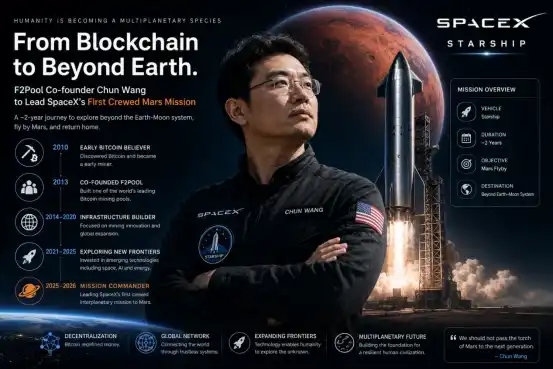
And Wang Chun is one of China's earliest true Bitcoin evangelists and infrastructure builders.

Many people's current understanding of the crypto space revolves around memes, trading, speculation, and KOLs. But in the crypto world around 2011, the core players weren't financial speculators; they were a group of geeks, engineers, and idealists.

They believed the future of the internet needed a new type of value network independent of the traditional financial system. Thus, the earliest miners began building rigs, studying algorithms, maintaining nodes, and constructing hashpower networks. Wang Chun was one of the most typical figures of that era.

The most important significance of F2Pool wasn't just about mining for profit, but that it helped the Bitcoin network truly form a global-scale infrastructure. Because any decentralized network ultimately requires hardware, energy, and computing power support in the real world. In other words, miners are essentially the energy workers of the digital world.

This is also a key reason why Wang Chun later gradually began focusing on aerospace, deep space exploration, and even Mars plans.

Because, looking at the underlying logic, both the Bitcoin network and space civilization belong to the category of infrastructure civilization. They both require long-termism, extremely high engineering capabilities, and imagination for the future world.

Therefore, Wang Chun is not like a traditional financial player; he is more like a builder from the era of technological utopia. This is also why he was later able to gradually enter Elon Musk's aerospace ecosystem.

Because the people Musk truly respects are never merely capital players, but those willing to invest long-term and genuinely believe in the narrative of future civilization.

II. Why Are the Crypto Circle and SpaceX Getting Closer?

Over the past few years, a very clear trend is that the connection between the crypto industry and frontier tech fields like SpaceX, AI, and robotics is rapidly strengthening. Many people find it strange—what exactly is the relationship between rockets and Bitcoin?

But in reality, the connection between them is deepening.

Because the core of today's global tech competition has gradually evolved from internet application competition to infrastructure competition. And the crypto industry and SpaceX are essentially part of the next generation of infrastructure.
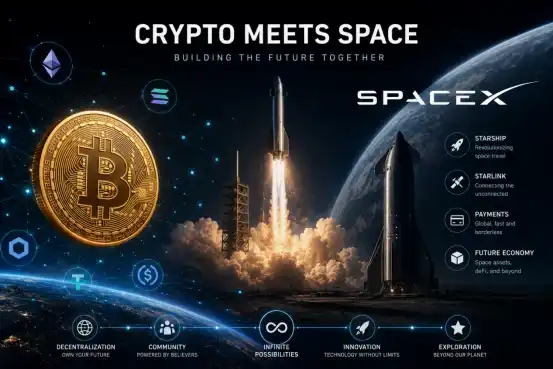
First, what is SpaceX's core mission?

It is to reduce the cost of human access to space. In the past, sending one kilogram of cargo into space cost tens of thousands of dollars. The goal of Starship is to compress that cost to tens of dollars. Once achieved, the entire economic model of human society will be transformed.

Because with low-cost access to space, orbital servers could emerge, space energy could explode, global satellite internet will further proliferate, and even future Mars bases begin to possess practical feasibility.

And these new worlds will require new payment systems, new value networks, and new globalized financial systems.

Thus, cryptocurrency naturally gains an opportunity to enter the space economy.

Because the traditional financial system is fundamentally built on national sovereignty and geographical boundaries. But if an interplanetary economy emerges in the future, traditional banking systems will struggle to cover it.

Blockchain is inherently suited for globalized, cross-regional, trustless value circulation. This is also why more and more tech geeks believe cryptocurrency is likely to become an important component of the future space economy.

Beyond that, there is a deeper reason. That is, the crypto circle and SpaceX essentially share the same spiritual core.

They both belong to high-risk long-termism.

Early Bitcoin was considered impossible to succeed; SpaceX also faced bankruptcy multiple times. But whether Bitcoin believers or Mars plan supporters, they are willing to believe in a goal that seems utterly crazy in the short term but could change the world in the long run.

So today, you'll find more and more people in the crypto industry starting to pay attention to SpaceX, Starlink, AI, robotics, brain-computer interfaces, space energy, supercomputing power... because these things are gradually forming the next generation of civilization systems.

What mattered most in the past internet era were traffic platforms, while what may matter most in the future era are energy, computing power, AI, and space infrastructure.

And the crypto economy could become the value layer within this system.

III. Human Spaceflight History Is Entering the Era of Commercial Civilization

Many interpret this event as a Chinese entrepreneur about to fly by Mars. But in reality, the truly significant aspect of this event far exceeds a piece of commercial space news. Because behind it lies the implication that the power structure of human spaceflight history is changing.

For decades, space exploration has been a state activity—the US, the former Soviet Union, China—relying on state finances, military-industrial systems, and political will.

But today, commercial spaceflight is fundamentally altering this model. SpaceX has proven that private companies can also lead a space revolution.

And Wang Chun's entry into an interstellar mission further indicates that future participants in deep space exploration may no longer be limited to professional astronauts.

Entrepreneurs, engineers, AI researchers, owners of tech capital, and even future robotics experts could all enter space.

This is actually very similar to the Age of Discovery in the 15th century.

Initially, oceanic exploration relied on national fleets. But what truly drove global expansion later was commercial capital. The British East India Company and the Dutch East India Company were essentially tools of commercial civilization expansion.

And today's SpaceX is beginning to possess similar attributes. The difference is that what was crossed in the past were oceans, while what is being crossed now is interstellar space.

More crucially, Wang Chun also made a very important statement this time: "We should not leave the landing plan to the next generation." This statement essentially reminds SpaceX not to deviate from the original intention of a multi-planetary civilization due to commercialization and real-world pressures.

Because over the past year, with the AI explosion, data center construction, and NASA's lunar plan advancement, part of SpaceX's focus has clearly begun shifting toward the Moon.

Compared to Mars, the Moon is easier to commercialize. But Mars is the true key to determining whether humanity can become a multi-planetary civilization.

So today's Mars plan is no longer merely a tech project. It is more like a civilization faith.

And Wang Chun's appearance means that the new capital forces, new tech communities, and new idealists accumulated from the past crypto world are now formally entering the interstellar era.

Conclusion

To summarize, the most shocking aspect of this event is not that an individual is about to fly by Mars, but that the dominant force behind human civilization expansion is gradually shifting from state machinery to tech companies, AI systems, and globalized technology capital.

From mining pool to Mars, from the Bitcoin network to starships, Wang Chun's experience might be an early preview of the direction of technological civilization evolution over the next few decades.


Câu hỏi Liên quan

QWhy was Wang Chun's appointment as mission commander for SpaceX's first commercial interplanetary flight surprising to many?

AMany were shocked because Wang Chun is primarily known as a co-founder of F2Pool, a Bitcoin mining pool. People questioned why a figure from the cryptocurrency industry would be selected to lead a deep-space mission, viewing the fields as unrelated.

QAccording to the article, what is the deeper connection between the cryptocurrency industry and companies like SpaceX?

AThe article states that both the crypto industry and SpaceX represent a shift towards next-generation infrastructure. They share a core ethos of high-risk, long-termism aimed at fundamentally changing systems. Furthermore, cryptocurrencies are seen as a potential value layer for a future multi-planet economy that traditional finance cannot easily support.

QHow does the article describe the evolution of human space exploration's driving forces?

AThe article describes a shift from space exploration being a state-driven endeavor (by nations like the USA, USSR, and China) to an era dominated by commercial civilization. It draws a parallel to the Age of Discovery, where commercial entities like the East India Companies eventually drove expansion, similar to how private companies like SpaceX are now leading space exploration.

QWhat significant concern did Wang Chun express regarding SpaceX's plans, according to the text?

AWang Chun cautioned that the plan 'should not be left to the next generation,' implicitly reminding SpaceX not to lose sight of its original multi-planetary civilization goal by focusing too much on commercially easier targets like the Moon, instead of the more critical objective of reaching Mars.

QWhat does the article suggest Wang Chun's journey from F2Pool to SpaceX symbolizes?

AIt symbolizes a broader evolution in technological civilization, where the driving forces for human expansion are shifting from state mechanisms to technology companies, AI systems, and globalized technical capital. His path is presented as a preview of this future direction.

Nội dung Liên quan

Bitwise: Crypto Trở Thành Lựa Chọn Đầu Tư Ngược Chiều, Ba Logic Để Hiểu Thị Trường Hiện Tại

Tác giả: Matt Hougan, CIO của Bitwise Bài viết phân tích ba khía cạnh chính của thị trường tiền điện tử hiện tại: 1) **Tài sản tiền điện tử trở thành lựa chọn đầu tư nghịch đảo:** Thị trường đang suy yếu (Bitcoin giảm 21%, Ethereum, Solana, XRP giảm sâu hơn) do vốn đổ vào các lĩnh vực nóng như AI và robot, khiến Nasdaq 100 tăng mạnh. Tiền điện tử đã chuyển từ một xu hướng đầu tư thuận chiều sang một lựa chọn đầu tư nghịch đảo, đòi hỏi sự kiên nhẫn và tập trung vào cơ bản dự án (ví dụ: Hyperliquid được ưa chuộng) thay vì đầu cơ theo cảm xúc. 2) **Thị trường chờ đợi quy định, nhưng Dự luật CLARITY khó thông qua:** Sự không chắc chắn về mặt pháp lý, đặc biệt là Dự luật CLARITY ở Mỹ (tỷ lệ thông qua được dự báo thấp), khiến các tổ chức lớn do dự đầu tư. Việc giải quyết tình trạng bất ổn này quan trọng hơn kết quả cuối cùng của dự luật đối với sự phục hồi của thị trường. 3) **Vốn chuyển hướng sang các tài sản cơ bản thế hệ mới:** Khác với các chu kỳ gấu trước đó, lần này vốn không chỉ chạy về Bitcoin mà đang tìm kiếm các tài sản có vốn hóa nhỏ hơn nhưng cơ bản mạnh như Hyperliquid (+72%), Zcash (+50%), XLM (+44%). Điều này cho thấy logic đầu tư nghịch đảo đang hiện hữu và báo hiệu giai đoạn cuối của thị trường gấu. **Kết luận:** Trong ngắn hạn, áp lực vẫn tiếp diễn do cạnh tranh từ AI và bế tắc quy định. Tuy nhiên, đây chính là thời điểm cho chiến lược đầu tư nghịch đảo. Kiên nhẫn và tập trung vào các dự án có giá trị cơ bản vững chắc sẽ mang lại lợi nhuận đáng kể về dài hạn.

marsbit24 phút trước

Bitwise: Crypto Trở Thành Lựa Chọn Đầu Tư Ngược Chiều, Ba Logic Để Hiểu Thị Trường Hiện Tại

marsbit24 phút trước

Chuyên Gia Thị Trường Tiết Lộ Lý Do Ethereum Là Lựa Chọn Đầu Tư Tốt Hơn Solana

Chuyên gia thị trường tiền điện tử Emperor Osmo lập luận rằng Ethereum (ETH) vẫn là khoản đầu tư tốt hơn Solana (SOL) bất chấp cả hai đều giảm giá gần đây. Ông chỉ ra rằng phí ứng dụng trên Solana đang tăng khoảng 9.5% mỗi tháng, trong khi trên Ethereum lại giảm khoảng 6.4%, và khoảng cách về tổng phí ứng dụng hàng năm giữa hai blockchain giờ chỉ còn 9 triệu USD. Tuy nhiên, Osmo nhấn mạnh đến yếu tố then chốt ủng hộ triển vọng dài hạn của Ethereum: mạng lưới này hiện nắm giữ khoảng 161.8 tỷ USD stablecoin, chiếm tới 50.7% tổng giá trị stablecoin trên tất cả các blockchain. Ông cũng đề cập đến sự quan tâm ngày càng tăng từ các tổ chức, như việc BlackRock lựa chọn Ethereum để đăng ký sản phẩm quỹ ERC-20. Dựa trên dự báo thị trường stablecoin có thể đạt 3 nghìn tỷ USD vào năm 2030, Osmo cho rằng nếu Ethereum duy trì thị phần đáng kể, hơn 1.5 nghìn tỷ USD giá trị có thể sẽ được neo trên mạng lưới này. Ông đưa ra ba kịch bản cho ETH liên quan đến dòng vốn ổn định từ tổ chức, với mức tăng trưởng vốn hóa thị trường tài sản lưu hành dao động từ 400% (kịch bản tiêu cực) đến 2,400% (kịch bản tích cực) vào tháng 12/2029.

bitcoinist24 phút trước

Chuyên Gia Thị Trường Tiết Lộ Lý Do Ethereum Là Lựa Chọn Đầu Tư Tốt Hơn Solana

bitcoinist24 phút trước

ChatGPT sau này có thể sẽ biến mất

OpenAI vừa công bố tại hội nghị Intelligence at Work rằng sẽ tích hợp Codex vào ChatGPT trong vài tuần tới, đánh dấu bước tiến lớn hướng tới một "siêu ứng dụng" thống nhất. Mục tiêu là chuyển đổi từ nền tảng trò chuyện (Chat) sang nền tảng hành động (Agent), nơi người dùng có thể ra lệnh bằng ngôn ngữ tự nhiên và ChatGPT sẽ sử dụng Codex để tự động thực hiện công việc thông qua nhiều tác nhân AI. Codex, công cụ lập trình AI ban đầu được phát triển để cạnh tranh với Claude Code của Anthropic, đã đạt 5 triệu người dùng hoạt động hàng tuần, với 20% không phải lập trình viên. OpenAI cũng giới thiệu ba bản cập nhật chính cho Codex: Plugin Agent cho sáu vai trò công việc, tính năng Chú thích (Annotations) để chỉnh sửa cục bộ, và tính năng Sites để tạo ứng dụng web từ kết quả công việc. Bài viết phân tích rằng, mặc dù giữ tên ChatGPT, linh hồn của nền tảng mới sẽ là Codex, phản ánh sự dịch chuyển chiến lược của OpenAI sang trọng tâm là khả năng thực thi. Áp lực cạnh tranh từ Anthropic là động lực chính thúc đẩy sự phát triển nhanh chóng của Codex. Trong khi Claude Code được đánh giá cao về chất lượng code, Codex lại có ưu thế về giá cả và khả năng tiếp cận, đặc biệt với việc tối ưu token hiệu quả trên mô hình GPT-5.5. Xu hướng này mở ra cuộc đua giành "cửa ngõ" (entry point) trong kỷ nguyên Agent, không chỉ giữa OpenAI và Anthropic, mà còn cho các công ty Trung Quốc đang tìm cách xây dựng nền tảng Agent của riêng họ. Tóm lại, ChatGPT trong tương lai có thể sẽ trở thành một biểu tượng, trong khi chức năng thực sự là một nền tảng Agent mạnh mẽ.

marsbit33 phút trước

ChatGPT sau này có thể sẽ biến mất

marsbit33 phút trước

Đạo Luật CLARITY Là Tâm Điểm Của Cuộc Chạm Trán Chính Trị Mới Nhất: Thượng Nghị Sĩ Lummis Đáp Trả Giám Đốc Điều Hành JPMorgan

Thượng nghị sĩ ủng hộ tiền điện tử Cynthia Lummis và CEO JPMorgan Jamie Dimon đã trở thành những nhân vật chính trong cuộc tranh luận mới nhất về Đạo luật CLARITY khi dự luật này được đưa ra thảo luận tại Thượng viện. Trong một cuộc phỏng vấn với CNBC, Lummis đã phản bác trực tiếp những chỉ trích của Dimon về dự luật và về CEO Coinbase Brian Armstrong. Bà cho rằng Dimon "hoàn toàn sai" và thậm chí có thể chưa đọc kỹ dự luật. Dimon, người vốn hoài nghi về tiền điện tử, đã chỉ trích rằng Đạo luật CLARITY và các stablecoin không cung cấp đủ các biện pháp bảo vệ chống rửa tiền (AML) theo Đạo luật Bảo mật Ngân hàng (BSA), và cho rằng các công ty crypto nên tuân theo tiêu chuẩn giống như ngân hàng truyền thống. Tuy nhiên, Lummis nhấn mạnh rằng dự luật này thực chất được xây dựng dựa trên các quy định hiện hành đã áp dụng cho ngân hàng, với hơn 1.600 tham chiếu đến các điều khoản AML/BSA sẽ tiếp tục được áp dụng cho các hoạt động tài sản kỹ thuật số. Về các bước tiếp theo, Lummis tiết lộ Thượng viện đang làm việc để kết hợp các thành phần khác nhau của gói dự luật, bao gồm việc sáp nhập các điều khoản liên quan đến SEC trong Đạo luật CLARITY với các yếu tố thị trường hàng hóa từ Ủy ban Nông nghiệp Thượng viện. Các nhà lập pháp cũng đang lên kế hoạch sửa đổi Đạo luật GENIUS về stablecoin và các điều khoản về đạo đức để trình một dự luật thống nhất lên nghị trường. Bà đang phối hợp với các thượng nghị sĩ khác như Bill Hagerty, Angela Alsobrooks và Thom Tillis để hoàn thiện gói dự luật cuối cùng.

bitcoinist1 giờ trước

Đạo Luật CLARITY Là Tâm Điểm Của Cuộc Chạm Trán Chính Trị Mới Nhất: Thượng Nghị Sĩ Lummis Đáp Trả Giám Đốc Điều Hành JPMorgan

bitcoinist1 giờ trước

TIN VỠ: Mastercard Vừa Mở Cổng Mạng Thanh Toán Toàn Cầu Cho Tiền Mã Hóa — Những Altcoin Nào Được Lựa Chọn?

Vào ngày 3/6, Mastercard thông báo sẽ mở rộng cơ sở hạ tầng thanh toán toàn cầu của mình để hỗ trợ thanh toán trên chuỗi bằng cách sử dụng tiền điện tử thông qua các stablecoin được quản lý. Điều này cho phép các giao dịch thẻ được thanh toán 24/7, kể cả cuối tuần và ngày lễ, lần đầu tiên trong lịch sử mạng lưới. Sáu stablecoin được quản lý được hỗ trợ trong đợt triển khai đầu tiên: USDC của Circle, PYUSD của PayPal, USDG và USDP của Paxos, RLUSD của Ripple và SoFiUSD của SoFi. Việc thanh toán sẽ hoạt động trên tám mạng blockchain: Ethereum, Solana, Polygon, Base, Arbitrum, XRP Ledger, Canton và Tempo. Đây là một bước phát triển ở lớp thanh toán hậu kỳ, không phải là sự thay đổi sản phẩm hướng đến người tiêu dùng. Các đơn vị phát hành và ngân hàng trên mạng Mastercard giờ đây có thể chọn thanh toán các giao dịch thẻ bằng stablecoin trên chuỗi, thay vì thông qua các kênh ngân hàng truyền thống. Cả hai tùy chọn chạy song song. Người dùng thẻ không cần thay đổi cách thanh toán. Sự thay đổi nằm ở cơ sở hạ tầng phụ trợ, giờ có thể hoạt động trên mạng blockchain suốt ngày đêm, loại bỏ các điểm tắc nghẽn do giờ ngân hàng và ngày nghỉ gây ra trong nhiều thập kỷ. Sự kiện này được coi là sự xác nhận thể chế rõ ràng nhất cho nền kinh tế stablecoin cho đến nay.

bitcoinist4 giờ trước

TIN VỠ: Mastercard Vừa Mở Cổng Mạng Thanh Toán Toàn Cầu Cho Tiền Mã Hóa — Những Altcoin Nào Được Lựa Chọn?

bitcoinist4 giờ trước

Giao dịch

Giao ngay
Hợp đồng Tương lai
活动图片