Ending 'Subsidized Growth': The Logic of Ultimate Capital Efficiency Behind Berachain's 'Fiscal' Reform

marsbitXuất bản vào 2026-03-10Cập nhật gần nhất vào 2026-03-10

Tóm tắt

Berachain has implemented a major reform of its Proof-of-Liquidity (PoL) mechanism, reducing the annual inflation rate of its non-transferable governance token $BGT from 8% to 5%—a 46% cut in emissions. This move, described as a "fiscal reform," signals the end of the initial subsidy-driven growth phase and a shift toward a more capital-efficient economic model. The update also involves removing around 200 underperforming reward vaults and introducing stricter, performance-based criteria for vault eligibility. Key tokens in the PoL system include $BERA (gas token), $HONEY (native stablecoin), and $BGT (governance token). The reforms aim to enhance the value and utility of $BGT by directing incentives toward protocols that demonstrate real user activity, sustainable demand, and measurable contributions to the ecosystem—such as boosting transaction volume or deepening liquidity. This restructuring is designed to prioritize quality over quantity, encouraging projects with stronger product-market fit and business models. By making $BGT emissions more scarce and targeted, Berachain aims to build a self-sustaining economy where incentives function as productive capital rather than subsidies, ultimately supporting long-term growth and value creation for token holders.

Author: Black Mario

Recently, Berachain's PoL mechanism underwent a reform, reducing the annual inflation rate of $BGT from 8% to 5% (an active cut of approximately 46% in emissions), while clearing a series of "ghost vaults" and updating the vault access standards. This move has been hailed by the community as a sovereign fiscal reform.

This seems to signal that Berachain is officially ending the subsidy era of its cold start, and through ultimate "capital efficiency" and a "business closed-loop," it is beginning to build a mature economic system with higher ROI certainty.

The Logical Evolution from Cold Start Strategy to Sovereign Value Return

In traditional PoS systems, security is directly tied to the scale of staking, and "staking coins equals participation in governance" is the core logic. Focusing on the PoL (Proof-of-Liquidity) mechanism itself, it is a highly complex financial engineering design that binds network security, governance power, and ecological liquidity together with liquidity as the core element, attempting to redefine the internal power distribution and incentive flow within a public chain.

The operation of the PoL system relies on three types of tokens with clear functions and mutual checks and balances.

  • $BERA (Fuel Base): The operating fuel of the system, carrying basic security functions, is the asset foundation of the entire Berachain.
  • $HONEY (Value Scale): An over-collateralized native stablecoin, serving as the financial settlement medium within the ecosystem, ensuring the stability of on-chain economic activities.
  • $BGT (Governance Hub): As a non-transferable soul-bound token, $BGT is the soul of the PoL system. It deeply binds governance rights with "real ecological contributions." Holding and delegating $BGT means mastering the distribution rights of network incentive routing.

Validators, by receiving delegated $BGT, can dynamically influence which Reward Vaults the incentives flow to. This is not only a symbol of power but also the most critical value lever in Berachain's sovereign economic system.

In the early stages of the mainnet launch, Berachain adopted a high inflation model of approximately 8%–10%. As a typical cold start strategy, it successfully achieved primitive accumulation of liquidity in the short term and verified the实战 resilience of the PoL mechanism.

However, as the ecosystem matures, some potential issues have emerged:

  • The high-yield environment in the early stage attracted a large amount of highly sensitive capital. While this capital completed the task of attracting funds during the cold start phase, its contribution to long-term retention and commercial co-building still has room for optimization.
  • Some vaults in the ecosystem are operating inefficiently, and there are even some self-circulating distribution paths. This, to some extent, disperses the precious $BGT budget and fails to fully transform into long-term stickiness of the ecosystem.
  • Sustained high emission rates have somewhat affected the marginal value of $BGT as a sovereign asset. For long-term builders, optimizing the inflation structure is an inevitable choice to protect their long-term rights and enhance the network's risk resistance.

If the PoL incentive mechanism eventually evolves into a pure operating cost, no matter how good the short-term data looks, the long-term value of the entire ecosystem will face limitations. Incentives should not be just subsidies, nor should they be indiscriminate airdrops. Instead, they should be regarded as productive capital capable of generating ROI. Every unit of $BGT emission should be exchanged for sustainable transactions, user retention, and real cash flow potential. This is perhaps the true meaning behind the slogan "Bera Builds Businesses."

Under this consensus, this reform aimed at "eliminating the false and retaining the true" and重构 sovereign fiscal efficiency officially kicked off at the beginning of the new year 2026.

Berachain's "Fiscal" Reform

$BGT Emission Optimization: Anchoring the Long-Term Value Coordinates of the Ecosystem

In fact, in any mature economy, adjustments in monetary policy often signal a qualitative change in the growth logic. Berachain's reduction of the annual $BGT inflation rate from about 8% to 5% is essentially a key step towards "value sovereignty."
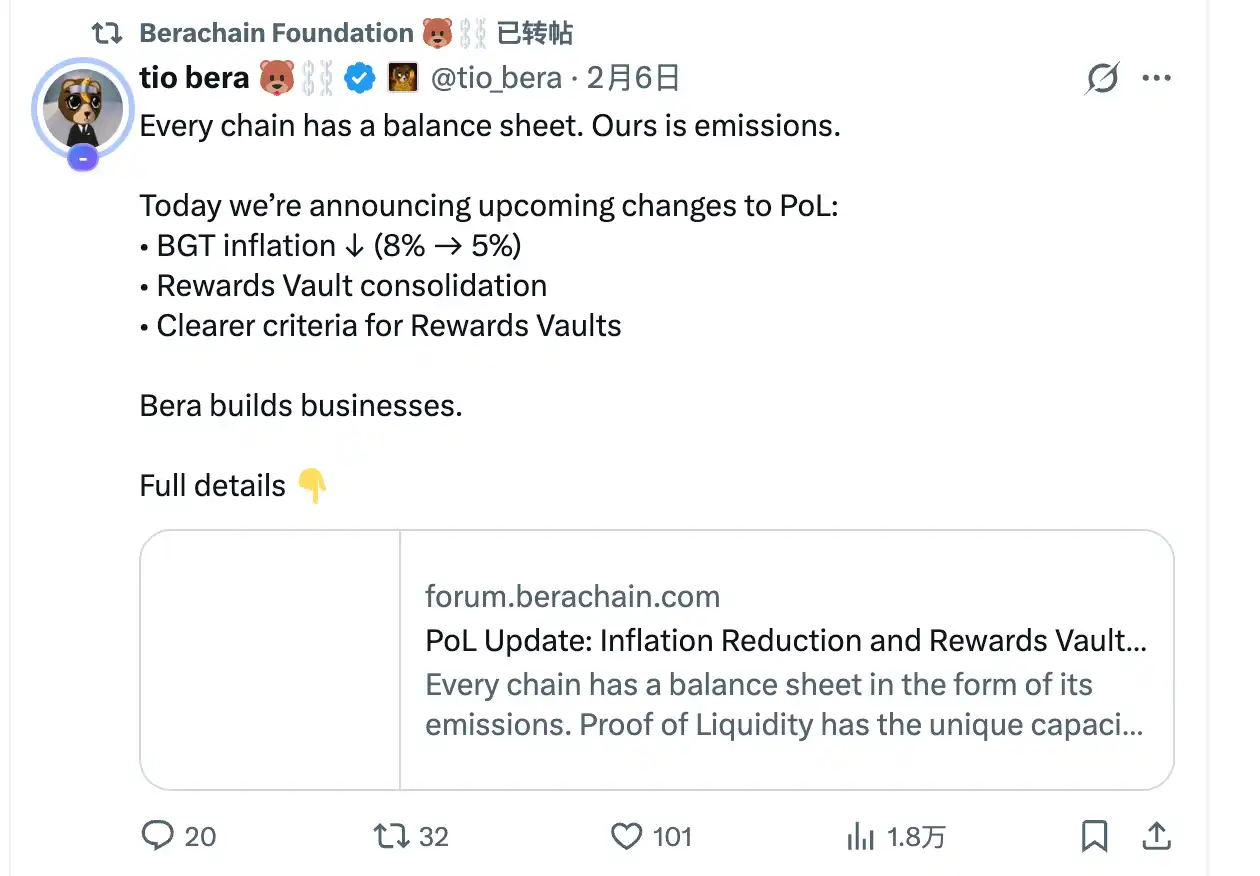
We see that the earlier 8% inflation rate was more like an "expansionary credit" for the ecosystem's startup phase, successfully completing the primitive accumulation of liquidity in the short term. Now, reducing PoL-related emissions by approximately 46% (reward rate reduced from 1.2 to 0.65) not only reflects its precise control over the current ecosystem's carrying capacity and incentive efficiency but also embodies a refinement of liquidity management:

That is, while maintaining the stability of the network security base rate, by moderately tightening new emissions, ensuring that every $BGT injected into the ecosystem gains a higher value anchor.

For $BGT, a governance asset with the attributes of a soul-bound token, scarcity is the core pillar for exercising its引流 power. As the emission rate slows, the marginal dilution pressure faced by holders and delegators is significantly reduced. This "active balance sheet reduction" directly strengthens the hard currency属性 of $BGT as a core governance asset, further promoting the rebalancing of value capture:

Of course, if we observe the development paths of Ethereum or various top L1s, a steady decline in the inflation rate is often the entry ticket to the "golden maturity period." Berachain's turn at this moment actually sends a clear signal that the ecosystem has already achieved stability driven by "endogenous growth" and no longer relies solely on scale expansion.

Then, as the total incentive becomes more precious, protocols within the ecosystem will spontaneously initiate an efficiency competition.

This "tight" incentive budget is actually creating higher溢价 space for high-quality protocols. Under the new economic model, $BGT emission rights will flow more to those "high-productivity protocols" that can generate real interactions and have a deep user base.

Reward Vault Integration—Ecological Value Sedimentation from "Scale Expansion" to "Quality and Depth"

If inflation reduction is a "balance sheet reduction" at the macro level, then the further integration of reward vaults is a precise drip irrigation targeting micro-efficiency within the ecosystem.

The Berachain Foundation stated in its latest tweet that the ecosystem plans to remove about 200 reward vaults with low operational efficiency. Of course, the plan itself is not simply a negation of early projects but more of a resource rebalancing expected after the Berachain ecosystem enters a specific stage.

In fact, during the cold start phase, a wide distribution of vaults helps探测 different market demands. When the ecosystem enters maturity, withdrawing incentive resources from长期闲置 or functionally overlapping pools and re-injecting them into core protocols with real trading activity is an inevitable choice to enhance the network's overall competitiveness.

Similarly, with the integration, Berachain immediately enacted more rigorous and dynamic vault access standards. This means that future incentive distribution will no longer be based on the first-come-first-served inertia of the early days but will更多的是 based on a multi-dimensional KPI evaluation system. Some potential standards may include:

  • Sustained Demand: Examining whether the protocol has generated real transaction volume and user interaction, not just static沉淀 of funds.
  • External Incentive Coordination: Encouraging protocol parties to use their own resources and external financing to form a synergy with $BGT emissions, jointly energizing the ecosystem.
  • Verifiable Contribution: Every unit of incentive emission must be transformed into an observable network effect, such as the depth of $HONEY liquidity or the value回流 of transaction fees.

By clearing some self-circulating or inefficient incentive paths, Berachain is actually making room for growth for teams with real product strength. This process of "discarding the dross and selecting the essential" aims to end models that rely solely on system subsidies for survival,转而扶持 business entities with independent profitability capabilities.

This is also perhaps the embodiment of the "Bera Builds Businesses" vision: the incentive mechanism is no longer an indiscriminate温床 but a precise capital accelerator. Projects筛选ed through this mechanism will have stronger risk resistance and commercial value, thereby providing $BGT holders with more确定性 value support in the fierce L1 competition.

Evolution is the Only Way Out

This major reform of Berachain's PoL marks the ecosystem's official paradigm shift towards a "mature L1 with real output." By optimizing emission efficiency, the ecosystem is彻底重构 $BGT emissions into productive capital with ROI certainty. While pushing the network towards the ultimate capital efficiency interval, it is also anchoring a more solid value signal for $BGT and $BERA holders.

Under the new pilot mechanism, incentives are endowed with precise引流 properties: every unit of injected liquidity will激发超额 real transaction fees, interest income, or ecological溢价 at the protocol layer, thereby constructing a positive value closed-loop of "incentive cost < protocol收益".

This "1 > 1 capital alchemy" is a public chain-level active asset management system,正在 transforming every bit of inflation into KPIs that drive commercial prosperity, fundamentally locking in the return of Berachain's long-term sovereign value, and establishing a leading position towards real economic growth and business闭环 in the highly homogeneous L1 track.

Thus, "Bera Builds Businesses" is also transforming from a grand narrative into a precise financial engine.


Câu hỏi Liên quan

QWhat is the core change in Berachain's PoL mechanism as described in the article?

AThe core change is a reduction in the annual inflation rate of $BGT from 8% to 5%, which is an active cut of approximately 46% in emissions.

QWhat are the three tokens in the PoL system and their primary functions?

AThe three tokens are: $BERA (the gas token and base for security), $HONEY (an over-collateralized native stablecoin for financial settlement), and $BGT (a non-transferable soulbound token that serves as the governance hub, binding governance power to 'real contributions' to the ecosystem).

QWhat was the main purpose of the high inflation model (8-10%) used by Berachain at its mainnet launch?

AIt was a cold-start strategy designed to achieve the primitive accumulation of liquidity in the short term and validate the practical resilience of the PoL mechanism.

QWhat are some of the new potential criteria for a vault to gain access to incentives after the reform?

APotential criteria include: Sustainable Demand (real transaction volume and user interaction), Coordination with External Incentives (using the protocol's own resources and external financing alongside $BGT emissions), and Verifiable Contribution (converting each unit of incentive into observable network effects like $HONEY liquidity depth or fee value回流).

QHow does the article characterize the ultimate goal of Berachain's incentive mechanism after this reform?

AThe goal is to transform the incentive mechanism from a blanket subsidy into a precise capital accelerator, ensuring every unit of $BGT emission is productive capital with a high certainty of ROI, ultimately building a positive value closed-loop where 'incentive cost < protocol revenue' and realizing the vision of 'Bera Builds Businesses'.

Nội dung Liên quan

Kraken Lên Kế Hoạch Cung Cấp Hợp Đồng Tương Lai Vĩnh Viễn Được CFTC Quy Định Cho Nhà Giao Dịch Chuyên Nghiệp Hoa Kỳ

Kraken đang chuẩn bị ra mắt hợp đồng tương lai vĩnh viễn được CFTC quản lý cho các nhà giao dịch chuyên nghiệp đủ điều kiện tại Hoa Kỳ. Sản phẩm sẽ được cung cấp thông qua sàn phái sinh Bitnomial mà Kraken đã mua lại và dự kiến tích hợp vào nền tảng Kraken Pro. Hợp đồng tương lai vĩnh viễn là sản phẩm phái sinh crypto lớn toàn cầu, cho phép giao dịch không ngày đáo hạn. Tại Mỹ, các hạn chế quy định trước đây khiến nhà giao dịch có ít lựa chọn trong nước. Động thái của Kraken nhằm thu hẹp khoảng cách này, cung cấp một con đường được quản lý để tiếp cận sản phẩm chi phối khối lượng giao dịch crypto ở nước ngoài. Việc ra mắt sẽ tập trung vào các nhà giao dịch chuyên nghiệp đủ điều kiện. Các yếu tố cần theo dõi bao gồm điều khoản về tính đủ điều kiện, thiết kế hợp đồng, tài sản được hỗ trợ và quan trọng nhất là thanh khoản khi ra mắt. Thành công của sản phẩm có thể mở đường cho nhiều sản phẩm tương lai vĩnh viễn được quản lý khác tại thị trường Mỹ, đưa sản phẩm phái sinh chủ chốt này tiến gần hơn đến cơ sở hạ tầng thị trường nội địa được quản lý.

bitcoinist1 giờ trước

Kraken Lên Kế Hoạch Cung Cấp Hợp Đồng Tương Lai Vĩnh Viễn Được CFTC Quy Định Cho Nhà Giao Dịch Chuyên Nghiệp Hoa Kỳ

bitcoinist1 giờ trước

Sự Ra Mắt Của Warsh: Chủ Tịch Fed Hiểu Crypto Nhất Lịch Sử Sẽ Mang Đến Bất Ngờ Hay Cú Sốc Cho Thị Trường?

Tân Chủ tịch Cục Dự trữ Liên bang Kevin Warsh, người được mệnh danh là chủ tịch FED "hiểu rõ về Crypto nhất trong lịch sử", sắp có buổi họp báo chính sách đầu tiên trong bối cảnh thử thách ba mặt: lạm phát quay trở lại, áp lực giảm lãi suất từ Tổng thống Trump và kỳ vọng thị trường về việc tăng lãi suất. Khác với người tiền nhiệm, Warsh có cái nhìn sâu sắc về tài sản số, từng coi Bitcoin như "cảnh sát tốt cho chính sách" và nhấn mạnh giá trị sản xuất của ngành công nghiệp blockchain. Tuy nhiên, ông cũng nổi tiếng là người theo chủ nghĩa diều hâu về lạm phát. Sự kết hợp giữa "lãi suất chặt chẽ" và "quy định thân thiện" từ ông có thể trở thành yếu tố cốt lõi định giá tài sản mã hóa. Bài viết phân tích tác động từ ba khía cạnh: 1. **Chuyển đổi khuôn mẫu kỳ vọng quy định:** Từ phòng thủ sang tích hợp và đổi mới, có thể thúc đẩy các khung pháp lý rõ ràng hơn, hỗ trợ ổn định do khu vực tư nhân phát hành. 2. **Định giá lại lộ trình lãi suất và phần bù rủi ro:** Một chủ tịch hiểu biết và giao tiếp rõ ràng có thể giảm bớt phí bảo hiểm bất định, có lợi về cấu trúc cho thị trường. 3. **Tái phân bổ dòng vốn toàn cầu:** Kinh nghiệm đầu tư cá nhân của Warsh truyền tải tín hiệu về sự chấp nhận chính thống, có thể thúc đẩy các quỹ thể chế truyền thống phân bổ tài sản số. Hai kịch bản chính được đưa ra: * **Ngạc nhiên thú vị:** Nếu Warsh thể hiện thái độ ôn hòa và công nhận giá trị của tài sản số, thị trường có thể được tiếp thêm sức mạnh. * **Cú sốc:** Nếu ông phát tín hiệu tăng lãi suất mạnh mẽ, tài sản rủi ro, bao gồm crypto, có thể chịu áp lực bán. Mặc dù Warsh đã bán các khoản nắm giữ liên quan đến crypto để tuân thủ quy tắc đạo đức, nhưng sự hiểu biết thực sự của ông về công nghệ blockchain được kỳ vọng sẽ đặt nền tảng cho việc chính thống hóa tài sản số về lâu dài, vượt ra ngoài các phản ứng thị trường ngắn hạn.

marsbit2 giờ trước

Sự Ra Mắt Của Warsh: Chủ Tịch Fed Hiểu Crypto Nhất Lịch Sử Sẽ Mang Đến Bất Ngờ Hay Cú Sốc Cho Thị Trường?

marsbit2 giờ trước

XRP Ledger Ra Mắt Rebrand XRPLd Cùng Với Bản Nâng Cấp Phiên Bản 3.2.0

Phiên bản 3.2.0 của XRP Ledger đã chính thức ra mắt, đánh dấu một bước nâng cấp quan trọng cho cơ sở hạ tầng blockchain cốt lõi. Lần này, các nhà phát triển đã đổi tên phần mềm vận hành mạng từ "rippled" thành "xrpld" để phù hợp hơn với toàn bộ hệ sinh thái của dự án. Bản cập nhật tập trung chủ yếu vào các cải tiến back-end và hiệu suất thay vì tính năng người dùng mới. Các tối ưu hóa bộ nhớ được giới thiệu có khả năng tiết kiệm tới 40% lượng bộ nhớ máy chủ, đồng thời chuẩn bị kiến trúc phần mềm cho việc mở rộng quy mô trong tương lai. Về mặt bảo mật, bản sửa đổi `fixCleanup3_2_0` mang lại nhiều cải thiện cho các mô-đun như kho lưu ký tài sản đơn, giao thức cho vay, sàn giao dịch phi tập trung và mã thông báo đa năng. Các kiểm tra bất biến mới được thêm vào để đảm bảo tính toàn vẹn của sổ cái khi tài khoản bị xóa. Một khả năng mới cho nhà phát triển là ứng dụng có thể truy xuất thông tin định nghĩa giao thức và máy chủ XRP Ledger mà không cần kết nối trực tiếp, hỗ trợ đáng kể việc phát triển ví, công cụ khám phá chuỗi khối và API. Các thay đổi về khả năng mở rộng và ổn định bao gồm kích thước khối có thể cấu hình, hỗ trợ lưu trữ cơ sở dữ liệu hiệu quả qua nuDB, và việc hỗ trợ máy chủ gRPC cho TLS/mutual TLS trở thành tùy chọn. Cổng kết nối ngang hàng mặc định cũng được đổi từ 51235 sang 2459. Các tính năng kiểm tra bất biến giao dịch tạm thời bị vô hiệu hóa trong phiên bản 3.2.0 do ảnh hưởng đến hiệu suất, nhưng không gây rủi ro bảo mật.

TheNewsCrypto2 giờ trước

XRP Ledger Ra Mắt Rebrand XRPLd Cùng Với Bản Nâng Cấp Phiên Bản 3.2.0

TheNewsCrypto2 giờ trước

AGI không phải là điểm kết thúc, nghiên cứu mới của DeepMind: Hướng tới ASI, tiến bộ AI thực sự mới chỉ bắt đầu

DeepMind mới đây công bố nghiên cứu cho rằng AGI (Trí tuệ nhân tạo phổ quát) không phải là điểm cuối. AI sẽ tiếp tục phát triển vượt qua khả năng của các nhóm chuyên gia con người hàng đầu, hướng tới ASI (Trí tuệ siêu nhân tạo). Báo cáo phân biệt ba khái niệm: AGI (năng lực nhận thức tương đương mức trung bình của con người), ASI (vượt trội con người trong hầu hết lĩnh vực quan tâm), và UAI (giới hạn lý thuyết tối thượng). Nghiên cứu đề xuất bốn con đường tiềm năng để chuyển từ AGI sang ASI: 1. Mở rộng quy mô tính toán, mô hình và dữ liệu. 2. Tiến hóa thuật toán, có thể thay đổi mô hình mới. 3. Tự cải thiện đệ quy, tạo phản hồi tích cực. 4. Điều phối đa tác tử và trí tuệ tập thể. Đồng thời, báo cáo chỉ ra sáu điểm nghẽn chính: giới hạn dữ liệu chất lượng cao, áp lực tài nguyên và kinh tế, hạn chế của mô hình mạng nơ-ron hiện tại, nghiên cứu ngày càng khó khăn, rào cản trừu tượng, cùng các vấn đề quản lý và phản ứng xã hội. Khi AI vượt con người, các phương pháp đánh giá truyền thống sẽ mất ý nghĩa. Cần xây dựng hệ thống đánh giá mới cho thời kỳ hậu AGI. ASI không phải là hệ thống toàn năng, vẫn chịu ràng buộc bởi các quy luật vật lý, độ phức tạp tính toán, dữ liệu, tài nguyên và tốc độ phản hồi thực tế. Tương lai phát triển của AI vẫn chứa nhiều bất định, đòi hỏi một nỗ lực liên ngành quy mô lớn để theo dõi và ứng phó.

marsbit3 giờ trước

AGI không phải là điểm kết thúc, nghiên cứu mới của DeepMind: Hướng tới ASI, tiến bộ AI thực sự mới chỉ bắt đầu

marsbit3 giờ trước

Kraken Ra Mắt Hợp Đồng Perpetual Trước IPO Cho OpenAI Và Anthropic Với Đòn Bẩy Lên Đến 5x

Kraken đã ra mắt hợp đồng tương lai vĩnh viễn (perps) tiền IPO cho hai công ty trí tuệ nhân tạo hàng đầu là OpenAI và Anthropic. Các hợp đồng này cho phép các nhà giao dịch đủ điều kiện mở vị thế mua (long) hoặc bán (short) đối với các công ty tư nhân được theo dõi sát sao này trước khi họ lên sàn chứng khoán, với đòn bẩy lên tới 5x. Sản phẩm này đánh dấu một bước tiến trong việc mở rộng cơ sở hạ tầng phái sinh tiền mã hóa sang các tài sản ngoài chuỗi, cung cấp cho các nhà giao dịch một cách tiếp cận thay thế để có thể tiếp xúc với các công ty tư nhân vốn thường khó tiếp cận. Tuy nhiên, hợp đồng tiền IPO có những rủi ro đặc thù. Khác với các hợp đồng vĩnh viễn cho tiền mã hóa có giá cả minh bạch, định giá công ty tư nhân phụ thuộc vào nhiều yếu tố như các vòng gọi vốn, giao dịch thứ cấp và kỳ vọng về thời điểm IPO. Điều này khiến việc định giá và quản lý rủi ro trở nên phức tạp hơn. Việc sử dụng đòn bẩy cao có thể khuếch đại lợi nhuận nhưng cũng làm gia tăng đáng kể rủi ro thua lỗ và thanh lý. Do đó, các nhà giao dịch cần hiểu rõ bản chất của sản phẩm mới và các rủi ro độc đáo của thị trường tư nhân trước khi tham gia.

bitcoinist3 giờ trước

Kraken Ra Mắt Hợp Đồng Perpetual Trước IPO Cho OpenAI Và Anthropic Với Đòn Bẩy Lên Đến 5x

bitcoinist3 giờ trước

Giao dịch

Giao ngay
Hợp đồng Tương lai

Bài viết Nổi bật

Làm thế nào để Mua POL

Chào mừng bạn đến với HTX.com! Chúng tôi đã làm cho mua Polygon Ecosystem Token (POL) trở nên đơn giản và thuận tiện. Làm theo hướng dẫn từng bước của chúng tôi để bắt đầu hành trình tiền kỹ thuật số của bạn.Bước 1: Tạo Tài khoản HTX của BạnSử dụng email hoặc số điện thoại của bạn để đăng ký tài khoản miễn phí trên HTX. Trải nghiệm hành trình đăng ký không rắc rối và mở khóa tất cả tính năng. Nhận Tài khoản của tôiBước 2: Truy cập Mua Crypto và Chọn Phương thức Thanh toán của BạnThẻ Tín dụng/Ghi nợ: Sử dụng Visa hoặc Mastercard của bạn để mua Polygon Ecosystem Token (POL) ngay lập tức.Số dư: Sử dụng tiền từ số dư tài khoản HTX của bạn để giao dịch liền mạch.Bên thứ ba: Chúng tôi đã thêm những phương thức thanh toán phổ biến như Google Pay và Apple Pay để nâng cao sự tiện lợi.P2P: Giao dịch trực tiếp với người dùng khác trên HTX.Thị trường mua bán phi tập trung (OTC): Chúng tôi cung cấp những dịch vụ được thiết kế riêng và tỷ giá hối đoái cạnh tranh cho nhà giao dịch.Bước 3: Lưu trữ Polygon Ecosystem Token (POL) của BạnSau khi mua Polygon Ecosystem Token (POL), lưu trữ trong tài khoản HTX của bạn. Ngoài ra, bạn có thể gửi đi nơi khác qua chuyển khoản blockchain hoặc sử dụng để giao dịch những tiền kỹ thuật số khác.Bước 4: Giao dịch Polygon Ecosystem Token (POL)Giao dịch Polygon Ecosystem Token (POL) dễ dàng trên thị trường giao ngay của HTX. Chỉ cần truy cập vào tài khoản của bạn, chọn cặp giao dịch, thực hiện giao dịch và theo dõi trong thời gian thực. Chúng tôi cung cấp trải nghiệm thân thiện với người dùng cho cả người mới bắt đầu và người giao dịch dày dạn kinh nghiệm.

Tổng lượt xem 356Xuất bản vào 2024.12.11Cập nhật vào 2026.06.02

Làm thế nào để Mua POL

Thảo luận

Chào mừng đến với Cộng đồng HTX. Tại đây, bạn có thể được thông báo về những phát triển nền tảng mới nhất và có quyền truy cập vào thông tin chuyên sâu về thị trường. Ý kiến ​​của người dùng về giá của POL (POL) được trình bày dưới đây.

活动图片