Abstract
This week, we focus on the following events: 1) Solana’s US$6 million exploit is likely tied to Slope wallet; 2) Banking platform Galoy Raises US$4 million for Bitcoin-backed Synthetic Dollar; 3) US Senate Bill will give CFTC crypto market oversight;
_________________________________________________________________________________________________________
Project Analysis: Sui is the first permissionless Layer 1 blockchain with POS (Proof of Stake) consensus mechanism designed from the ground up to enable creators and developers to build experiences that cater to Web3 users. We explore the value of Sui from the technology, team, investors and tokenomics perspectives.
1. Industry overview
I. Overall market trend
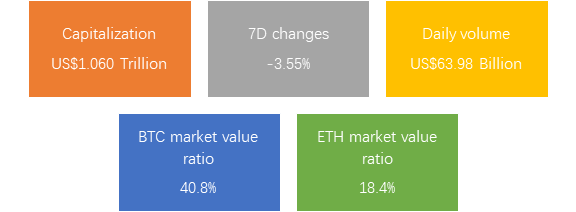
Figure 1. Overall market data
Source: CoinMarketCap
The global cryptocurrency market was affected by several incidents last week, and the market cap fell slightly. Bitcoin has gone lower than US$23,000 and is currently at $22,657. Meanwhile, Ethereum, the second largest cryptocurrency, is currently trading at US$1,611. Solana, which was severely affected by last week’s hacking incident, decreased by about 10% over past week. The price of SOL is currently US$38.90, which is not lower than the floor price over the last few months. Seedify.fund and LooBr, which are new roles on the crypto market, have enjoyed considerable growth and are currently standing at US$2.85 and US$0.0000392 respectively.
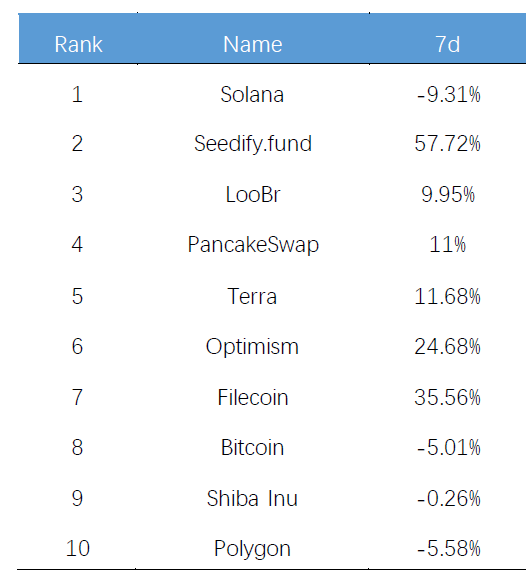
Table 1. Last week's hot currencies
Source: CoinMarketCap
II.NFT
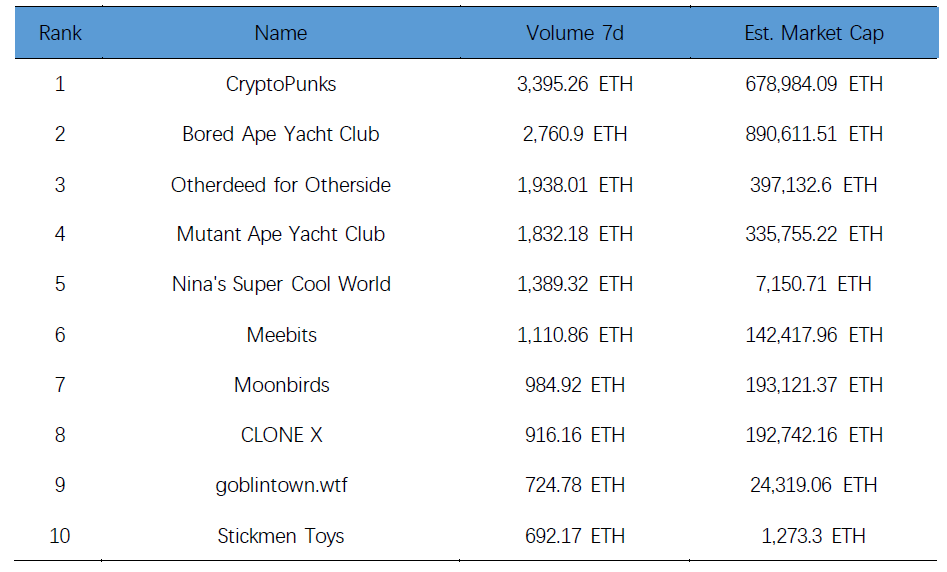
Table 2. NFT Collections Listed By Sales Volume (7d)
Source: CoinMarketCap
NFT market last week has seen some interesting statistics: we are witnessing a US$1,863,035,814.84 market cap, which is a -42.08% change; a seven-day sales volume of US$45,295,211.93, with a 1.74% increase and a total sales of 70,214, which is a 3.06% decrease compared to last week. Apart from that, the floor price and volume of each individual project have not changed much, with the biggest change registering at 0.22%.
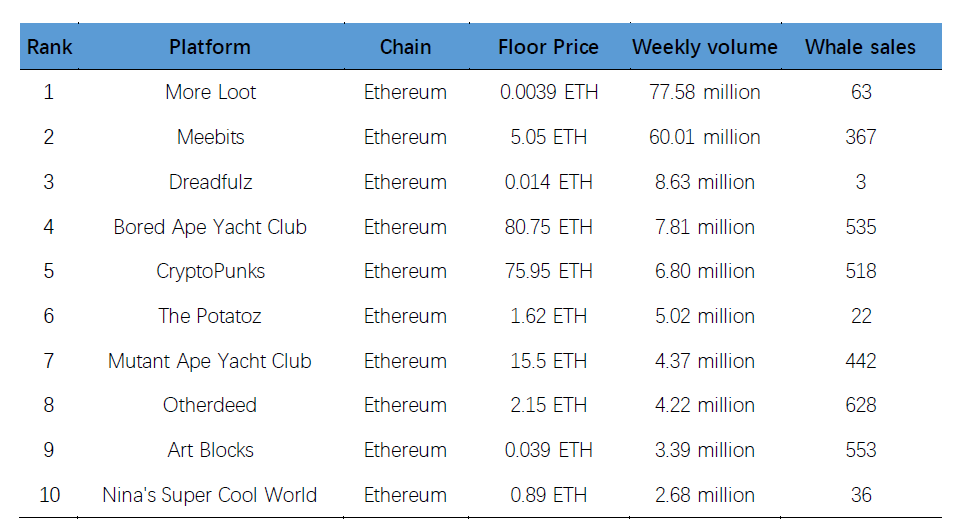
Table 3. Top trending collections on NFTGO (by daily volume)
Source: NFTGO
III.DeFi
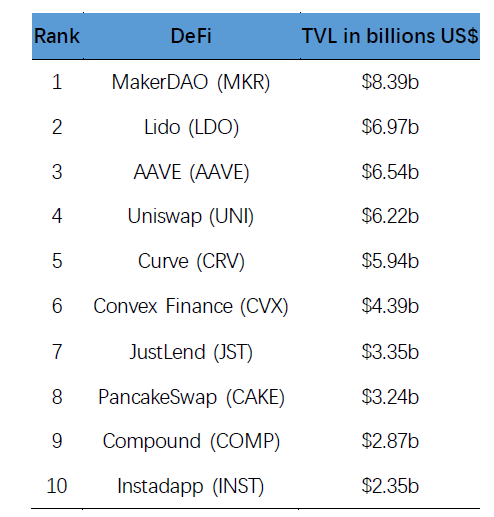
Table 4. DeFi market TVL ranking
Source: DefiLlama
IV.Layer 2
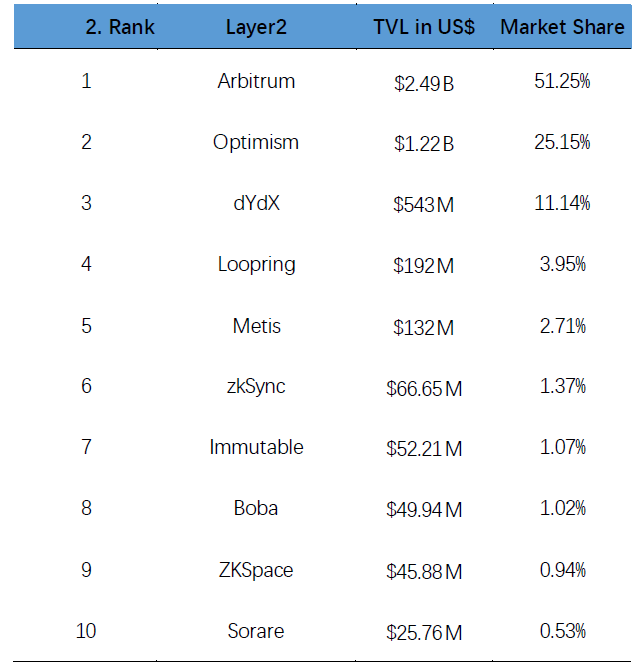
Table 5. Layer2 protocols ranking and market share
Source: l2beat
2. Market news
I. Industry news
Solana’s US$6 million exploit likely tied to Slope wallet
Developers behind the Solana Blockchain are saying that the closed-source Slope wallet may be responsible for an ongoing exploit that has resulted in millions of dollars’ worth of crypto tokens being stolen from more than 9000 hot wallets. “This does not appear to be a bug with Solana core code, but in software used by several software wallets popular among users of the network,” the network said in a Tweet on Wednesday morning. In a statement, Slope developers said "a cohort" of wallets was compromised, but did not confirm whether the private key storage practices may have been involved. Phantom wallet developers, for their part, said they have "reason to believe the reported exploits are due to complications related to importing accounts to and from Slope."
Large volume traders remain super bullish on Bitcoin despite crypto carnage
While the price of Bitcoin is currently way below its peak back in 2021, soime of the biggest traders still hold a favorable view towards the biggest cryptocurrency by market capitalization. Cumberland, a Chicago-based market-making firm that buys and sells within institutions and other firms that perform large transactions, recently surveyed its clients and found that there is some optimism in the market. Talk of a lengthy crypto winter has many investors fretting, so the bullishness among professionals with much at stake stands out. As with conventional markets such as stocks, though, crypto’s path does probably hinge on the Federal Reserve’s decision with regard to U.S. interest rates. And, indeed, Cumberland’s clients took that view. “It’s very striking that the most common response for both positive and negative catalysts is movement by the Fed,” according to the report.
MicroStrategy shares surge as Michael Saylor puts full focus on Bitcoin
MicroStrategy (MSTR) stock was up nearly 15% on Wednesday, helped by a modest rally in Bitcoin (BTC) and news late Tuesday that Michael Saylor is stepping down as CEO to become executive chairman. “In my next job, I intend to focus more on Bitcoin,” Saylor tweeted early Wednesday in a tongue-in-cheek response to those who think the moves might mean he has become less bullish on the cryptocurrency. Rasul, Chief operating Officer of NDAX said Saylor was a key proponent in advocating for corporate Bitcoin adoption, although impairment losses may have spooked other publicly traded companies, especially considering the uncertainties across the global economy and markets.
Binance taps Co-founder Yi He to jead US$7.5 billion venture arm
Binance raised US$500 million for a new fund focused on Web3 and blockchain investments about two months ago and has now appointed co-founder Yi He to oversee its new Venture Capital arm, Binance Labs. Binance Labs focuses on early stage investmenrs and manages US$7.5 billion worth of assets across more than 200 portfolio projects according to a press release. During a CNN appearance on Wednesday, Binance CEO Changpeng Zhao said Yi is "very aggressive" and that Binance would be making "quite a lot of investments" in the near term.
II. Investment and Financing
Banking platform Galoy raises US$4 million for Bitcoin-backed Synthetic Dollar
Galoy, the company behind the open-source banking platform that powers El Salvador’s Bitcoin Beach Wallet, started offering its Stablesats product Wednesday. It also said it has completed a US$4 million capital raising event to enable further development of its core GaloyMoney bitcoin banking platform. The company believes that allowing dollars to flow through bitcoin (BTC) will help solve short-term volatility price risk, which currently stands as one of the biggest hurdles to the growth of Bitcoin as a means for casual payments.
Bits Crypto raises US$1.2 million to facilitate gradual investments in crypto
Fintech startup Bits Crypto has raised $1.2 million in pre-seed funding to build out its mobile crypto-investment application. The round was led by HOF Capital, an investor in crypto companies such as MoonPay, Stripe and Kraken, the company said Tuesday. Bits allows users to invest their spare change in cryptocurrencies through automatic dollar roundups. Each user’s credit card transaction is rounded up to the next dollar and that difference is invested in cryptocurrency. Similar to investment platform Acorns, which automatically invests in a portfolio of stocks, Bits caters to users who want to dollar-cost average small amounts to build their portfolio of crypto investments over time.
III. Supervision
US Senate Bill will give CFTC crypto market oversight
The latest U.S. legislative effort to steer most crypto oversight to the Commodity Futures Trading Commission (CFTC) has bipartisan support but does not answer the question on what constitutes a token being a security or a commodity. The legislation from the leaders of the Senate’s Agriculture Committee would require crypto firms involved in the trading of digital commodities – including Bitcoin (BTC) and Ether (ETH) – to register with the CFTC as their primary regulator. But while the bill would grant expanded authority to the CFTC to oversee crypto spot markets, it relies on the courts and the Securities and Exchange Commission (SEC) to set the boundaries for which tokens may be considered a commodity.
Robinhood's crypto division fined US$30 million by New York financial regulator
The New York State Department of Financial Services (NYDFS) fined the crypto trading unit of Robinhood (HOOD) US$30 million for alleged violations of anti-money laundering and cybersecurity regulations. “As its business grew, Robinhood Crypto failed to invest the proper resources and attention to develop and maintain a culture of compliance – a failure that resulted in significant violations of the Department’s anti-money laundering and cybersecurity regulations,” said NYDFS Superintendent Adrienne A. Harris in a statement.
Singapore's central bank to consult public on stablecoin regulations
The Monetary Authority of Singapore (MAS), the country's central bank, is "actively reviewing" its approach to regulating stablecoins according to minister Tharman Shanmugaratnam. The bank is "assessing the merits" of a regulatory regime that targets "the specific characteristics and risks" of stablecoins, which are cryptocurrencies pegged to the value of other assets, typically to a major currency like the U.S. dollar, Shanmugaratnam said while answering a question during a parliamentary session on Monday. The central bank plans to consult the public on possible rules for stablecoins in the coming months, according to Shanmugaratnam. Although Shanmugaratnam said that the spillover from the crypto market crash to mainstream financial systems is limited and that banks in Singapore have "insignificant exposures" to crypto, MAS officials have vowed to crack down on crypto firms behaving badly in the country.
3.Trending project analysis – Sui
What is Sui?
Sui is the first permissionless Layer 1 blockchain with POS (Proof of Stake) consensus mechanism designed from the ground up to enable creators and developers to build experiences that cater to the next billion users in web3. It uses the Move programming language to define assets as objects that may be owned by an address.
Figure 2: Sui official website
Source: https://sui.io/
Move
Developers on Sui write smart contracts with the Sui Move. Sui Move is an upgraded version of Move. Sui Move addressed the embedding and depicted problems on Move. The Move is based on the Rust programming language. MOVE was designed for the Diem blockchain by Facebook, which serves the function of implementing smart contracts and custom transactions. Origins of Move largely arise from the known issues in the existing blockchain programming languages such as Solidity, which has security and verifiability issues. Any asset in Move can be represented by or stored within resources while scarcity is enforced by default since structs cannot be duplicated.
Move vs Solodity
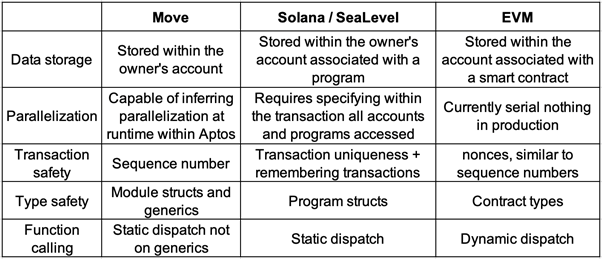
Table 6: Comparison to other VMs
Source: https://aptos.dev/guides/move-guides/move-on-aptos/
Investor & Funding Rounds
Series A
Announced Date: Dec 6, 2021
Money Raised: US$36 million
Lead Investor: a16z
Famous Investor: NFX, Scribble Ventures, Redpoint, Lightspeed Venture Partners, Electric Capital, Samsung NEXT, Slow Ventures, Standard Crypto, Coinbase Ventures
Series B
Announced Date: Currently Pending
Estimated Money Raise: US$200 million
Investor (rumored / Known): FTX Ventures
A total of US$236 million is expected to be raised.
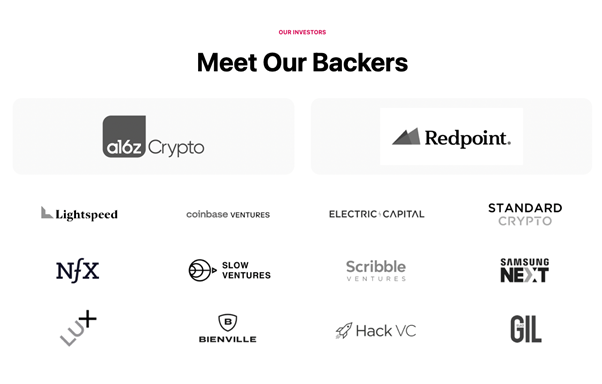
Figure 3: Mysten Labs investors
Source: https://mystenlabs.com/#community
Structure
The Figure below shows the high-level interactions between a client and Sui authorities to perform a transaction.
1. A user with a private signing key creates and signs a user transaction to mutate objects they own, or shared objects, within Sui. Subsequently, user signature keys are not needed, and the remaining aspects of the process may be performed by the user client or a gateway on behalf of the user (denoted as a keyless operation in the diagram).
2. The user transaction is sent to the Sui authorities, each check it for validity, and upon success signs it and returns the signed transaction to the client. The client collects the responses from a quorum of authorities to form a transaction certificate.
3. The transaction certificate is then sent back to all authorities, and if the transaction involves shared objects it is also sent to a Byzantine agreement protocol operated by the Sui authorities. Authorities check the certificate, and in case shared objects are involved also wait for the agreement protocol to sequence it in relation to other shared object transactions, and then execute the transaction and summarize its effects into a signed effects response.
4. Once a quorum of authorities has executed the certificate its effects are final (denoted as finality in the diagram). Clients can collect a quorum of authority responses and create an effects certificate and use it as proof of the finality of the effects of the transaction.
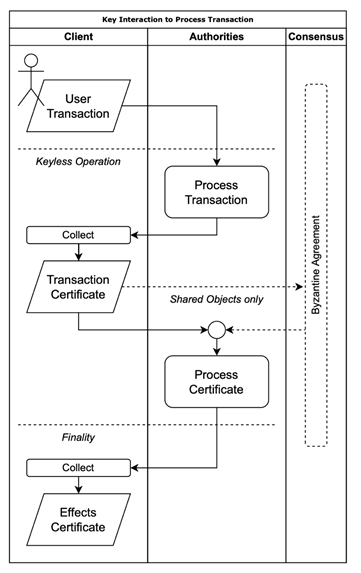
Figure 4: Outline of interactions to commit a transction
Source: https://github.com/MystenLabs/sui/blob/main/doc/paper/sui.pdf
Tokenomics
1. Basic Information:
Token’s name: SUI
Total supply: 10,000,000,000.
Token Utility:
- SUI can be staked within an epoch in order to participate in the proof-of-stake mechanism.
- SUI is the asset denomination needed for paying the gas fees required to execute and store transactions or other operations on the Sui platform.
- SUI can be used as a versatile and liquid asset for various applications including the standard features of money – a unit of account, a medium of exchange, or a store of value – and more complex functionality enabled by smart contracts, interoperability, and composability across the Sui ecosystem.
- SUI token plays an important role in governance by acting as a right to participate in on-chain voting on issues such as protocol upgrades.
2. The Sui Economy
The Sui economy contains three main participants:
- Users submit transactions to the Sui platform in order to create, mutate, and transfer digital assets or interact with more sophisticated applications enabled by smart contracts, interoperability, and composability.
- SUI token holders bear the option of delegating their tokens to validators and participating in the proof-of-stake mechanism. SUI owners also hold the right to participate in Sui’s governance.
- Validators manage transaction processing and execution on the Sui platform.
The Sui economy has five core components:
- The SUI token is the Sui platform’s native asset.
- Gas fees are charged on all network operations and used to reward participants of the POS mechanism and prevent spam and denial-of-service attacks.
- Sui’s storage fund is used to shift stake rewards across time and compensate future validators for storage costs of previously stored on-chain data.
- The POS mechanism is used to select, incentivize, and reward honest behavior by the Sui platform’s operators – i.e. validators and the SUI delegators.
- On-chain voting is used for governance and protocol upgrades (more info coming soon).
Throughout, we use the visual representation in the following figure to aid the discussion.
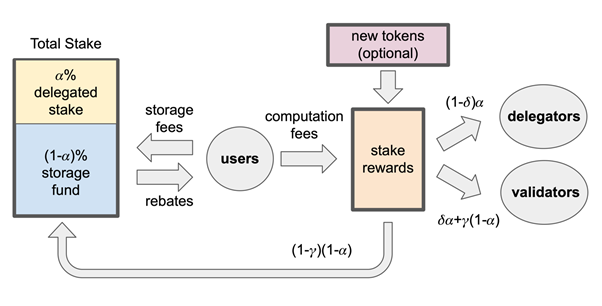
Figure 5: Sui tokenomics flow
Source: https://docs.sui.io/devnet/learn/tokenomics
Team

Figure 6: Mysten Labs Core Team Members
Source: https://mystenlabs.com/#community
Sui was founded by Mysten Labs. Most of them have worked for Diem blockchain and Move programming language previously. Four of them worked at Meta (Facebook) in the past. Although the team members have the same experience as Aptos team members, they have clarified that there is no relationship between the two projects. The Mysten Labs Team also has many experienced designers, analysts, engineers, and so on. Obviously, it is a professional team, with the ability to develop the Sui very well.
Aptos and Sui
Similarities:
- Both are committed to solving the blockchain trilemma
- Both use Move for their smart contract programming language, but Sui’s Move is a little bit different to Apto’s
- Parallel transaction execution and consensus (for lower latency and higher throughput) based on block software transactional memory (“STM”) – instead of in-order transactions and sequential execution of blocks in other L1 designs
- State synchronization to optimize data availability
- SDK, API for improving DX/UX
- Tier 1 Venture Investor Cap Table
- Valuation (more or less)
Differences:
- Sui released its whitepaper, but Aptos did not
- Sui’s Move is a little bit different from Aptos’s Move
- Gas Mechanism: Sui is able to keep gas prices low and predictable while incentivizing validators to optimize transaction processing and prevent denial of service (“DoS”) attacks.
- Sui’s SDK is pay more effort on game and NFT, and Aptos’ SDK is pay more effort on DX/UX.
- For Sui, the storage fees are paid separately to transaction execution.
- There are only two projects (Sui wallet and Ethos) that are known on the Sui network, but there are more than one hundred projects on Aptos economy.
Summary
In the Layer 1 blockchain field, Sui is an excellent blockchain.
1. Strong backers: it was invested by a16z, FTX Ventures, Coinbase Ventures, and many famous investors. These investors have supported many famous projects and they also have many professional analysts to choose good projects.
2. Excellent team: all team members are experienced and worked at famous companies and projects before. I'm sure that they have enough strength to develop Sui.
3. High performance: as written in docs, an unoptimized single-worker Sui validator running on an 8-core M1 Macbook Pro can execute and commit 120,000 token transfer transactions per second (TPS). Throughput scales linearly with the number of cores–the same machine processes 25,000 TPS in a single core configuration. High performance can give users very good experiences.
4. Good programming language: Sui uses Move as its programming language. The Move is designed to solve the safety problems for assets on the blockchain.
However, Sui is facing a strong opponent, Aptos. Aptos began to start a few months earlier than Sui, and Aptos have these points better than Sui:
- ~2x community/users (by Discord members and Twitter followers);
- ~3x developer activity (as measured by GitHub stargazers);
- Similar throughput magnitudes, but largely unclear at this point;
- More metrics can be analyzed after the mainnet, such as TVL, active users (wallet addresses), active nodes, minimum staking requirements, etc.
Although Sui is a good Layer 1 blockchain, it still has some shortcomings compared to Aptos. Sui’s design (the storage fees are paid separately to transaction execution) fills the gap posed by current Layer 1 blockchains. If Sui wants to have the same valuation as Aptos in the series B funding rounds, it needs to pay more effort into expanding the size of its community and incentivizing more developers to build on Sui.
4. Calendar of future popular asset events
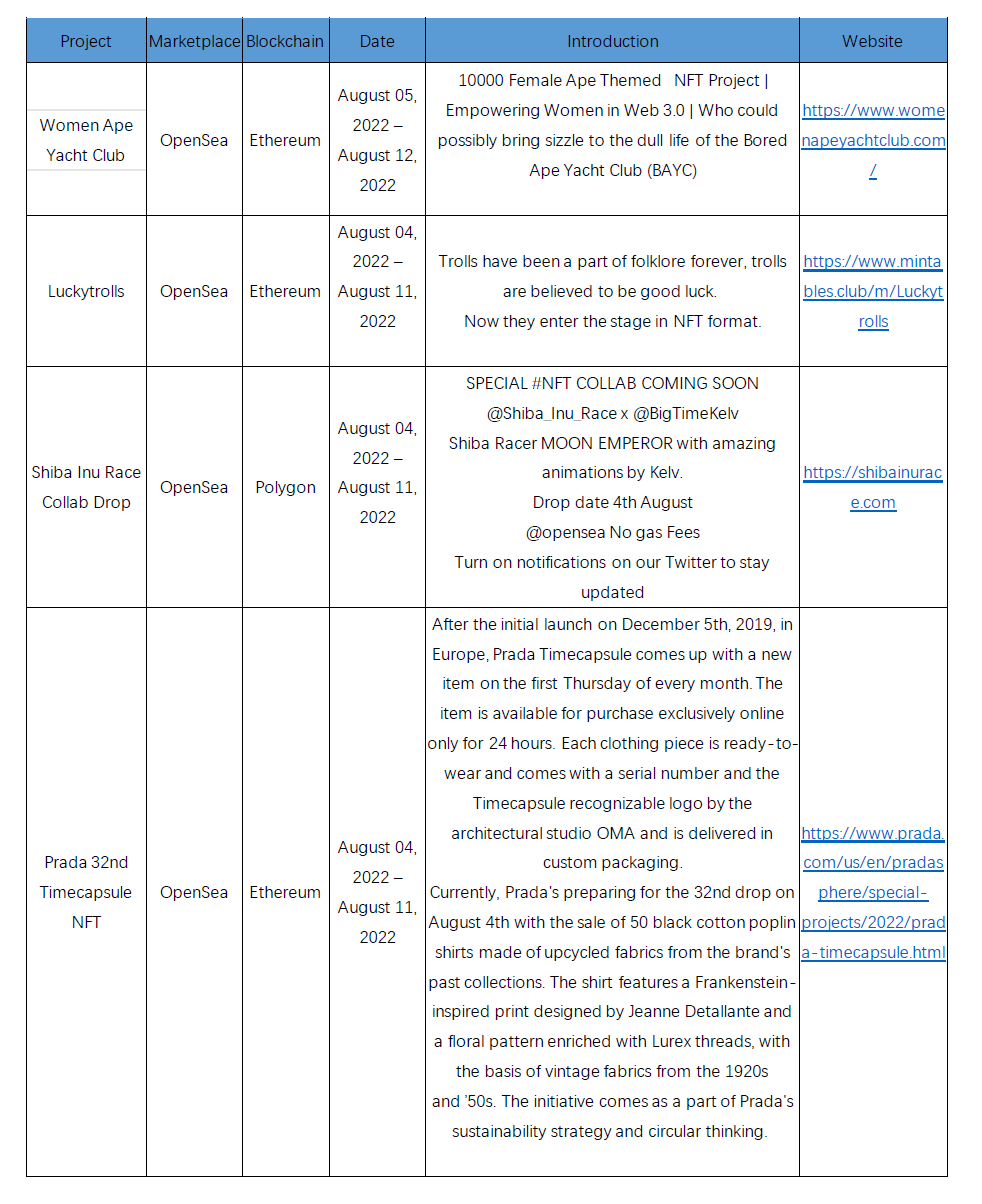
I. NTF mint Calendar
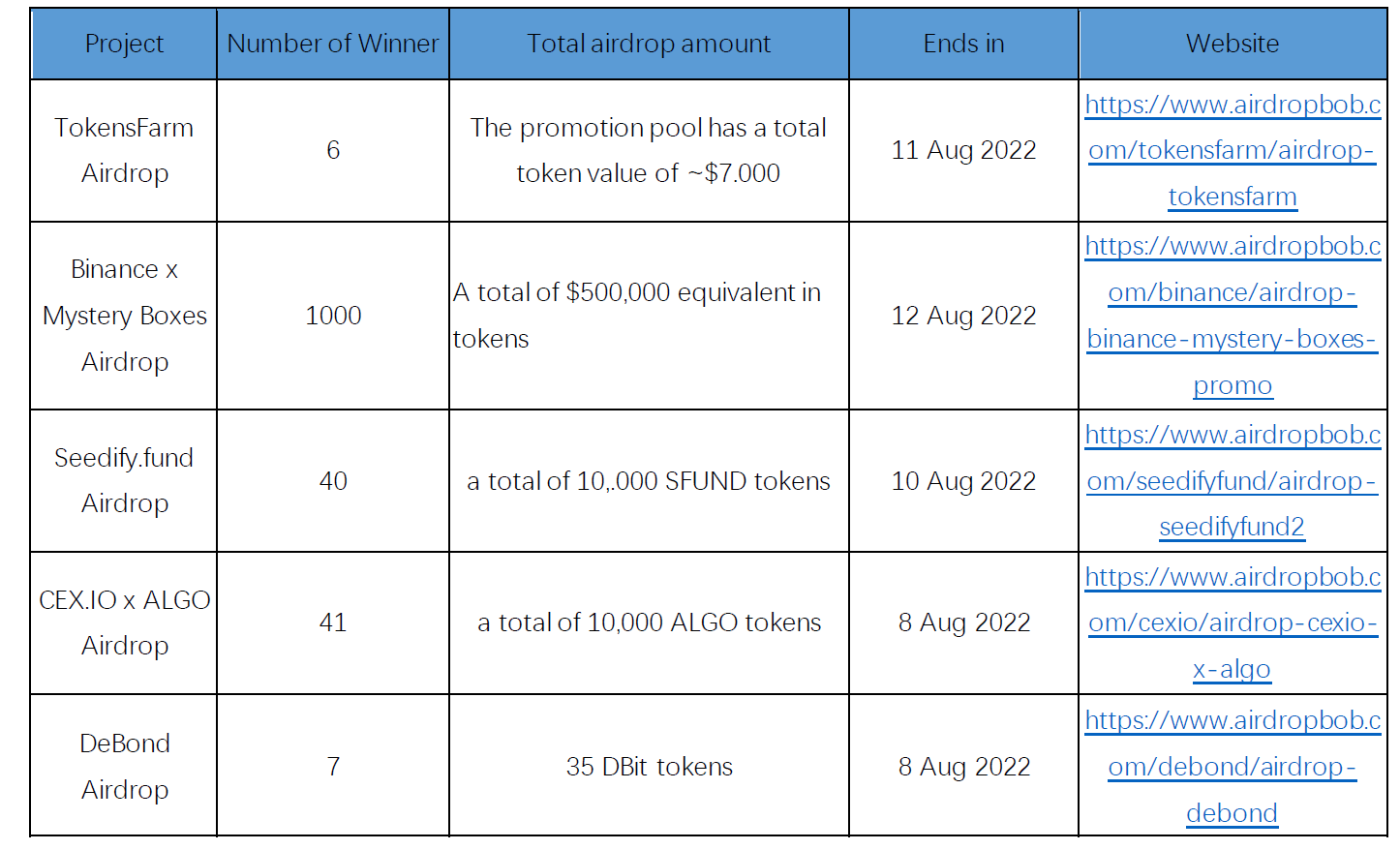
II. Token Airdrops