The Merge is confusing!
Let’s start from the very beginning and go from 0-60 about one of the most important events to ever happen in the history of crypto!
1. What is ‘the Merge’?
‘The Merge’ is the name of the event when the Ethereum blockchain changes from using Proof-of-Work (PoW) to Proof-of-Stake (PoS).
It’s called ‘the Merge’ because it is the merging of two independent blockchains that are currently running in parallel. The main Ethereum blockchain is being ‘merged’ with a special-purpose blockchain called ‘the Beacon Chain’.
The Beacon Chain launched on December 1st, 2020. The purpose of the Beacon chain is to do one thing and one thing only: be a Proof-of-Stake blockchain.
There are no transactions on the beacon chain. There are no tokens or DeFi apps. It is an empty blockchain that is solely meant to be a blockchain that runs a Proof of Stake consensus mechanism.
Because the Beacon Chain is an ‘empty chain’, it can merge with the Ethereum blockchain and replace Ethereum’s PoW mechanism, without having to be concerned about any other variables.
Once these two chains are merged, Ethereum’s PoW validation will be replaced by a brand new PoS consensus mechanism.
2. Why is the Merge so hyped?
The Merge is considered one of the biggest events in crypto history since the genesis of Bitcoin itself.
It’s considered this for a number of reasons:
No blockchain has undergone such a significant change in crypto’s history. Blockchains do not change such a critical part of its operation very often, and none have made changes with an as large and robust economy built on top of them as Ethereum has.
The ETH asset has a $203B (previously $550b😭) market cap today, with many more billions worth of value based on top of the network. Ethereum is by far the largest and most robust economic ecosystem in crypto, and the security of all of this economic activity will be changed from a PoW-based to a PoS-based economy.
There are certainly a lot of risks involved with getting something wrong, which is one of the main reasons why the Merge has taken so long.
There’s lots and lots and lots of testing and perfecting.
3. How does the Merge impact ETH?
The Merge has a massive effect on the economics of ETH. To investors, this aspect of the Merge is the most significant.
The Merge drastically changes the economics of ETH in two ways: Reducing ETH issuance and imbuing ETH as a native yield-bearing asset.
Reducing ETH issuance
The Merge will reduce yearly ETH issuance from 4.3% to 0.43%.
This is because of the fundamental improvements to efficiency that a PoS consensus mechanism brings. PoS is designed to provide the highest level of blockchain security, for the lowest amount of cost, and these savings are passed into ETH, by reducing the amount of ETH that needs to be issued to pay for security.
PoW is expensive and requires significant resource overhead to compensate security providers (miners) for their services.
In contrast, the costs of PoS security is merely the opportunity cost of capital, which doesn’t represent any real-world commodity or tangible cost. Unlike PoW, PoS does not need to issue significant amounts of currency to pay for security. As a result, these lower costs of security make PoS consensus mechanisms far more efficient.
Thanks to the diminished need to pay PoW miners, Ethereum is capable of reducing yearly ETH issuance from 4.3% to 0.43%. The reduction of new ETH issuance is generally considered…extremely bullish.
This is because PoW miners sell most of their incoming rewards immediately and over time the portion of their total mined supply that they sell approaches 90+%.
With PoS, issuance is reduced by over 90%, but also the overhead costs of being a PoS validator basically fall to 0.
PoW proponents argue that the high-costs of PoW blockchains is a feature, not a bug. They argue that the costs prevent centralization by creating churn in the asset holds, as they are forced sellers to pay for the costs of PoW miners. While PoW likely does create asset decentralization, it simultaneously creates security centralization as a second order effect.
4. Why does the Merge make ETH deflationary?
Almost exactly one year ago, on August 5th 2021, Ethereum introduced EIP-1559, an upgrade that changed how transaction fees are managed on Ethereum.
Instead of simply paying the entire transaction fees to the miners, the majority would instead be burnt.
This is done for a number of reasons; to dive down that rabbit hole, listen to our podcast with crypto-economic researcher Hasu 🎧.
Post-merge, ETH issuance drops by over 90%, increasing the proportional magnitude of how much ETH is burnt every block.
When gas fees on Ethereum are 7 gwei or higher, the rate of ETH being burnt is higher than the rate of ETH being issued, making the supply of ETH decrease.
During the peak of the bull market, gas prices sustained 200 gwei or higher for many many months, making that 7 gwei threshold a very low bar to achieve. Even now in the bear market, we are ac
5. Does the Merge lower Ethereum’s gas fees?
No.
This is a misconception that has occurred with a conflation between ‘Ethereum 2.0’ and ‘The Merge’.
‘ETH 2.0’ is a name for the future states of Ethereum that is no longer used in the Ethereum community. ‘ETH 2.0’ refers to the future version of Ethereum that will have PoS and sharding enabled.
For a while in Ethereum’s history, these two updates, PoS and Sharding, were thought to be coming at the same time. As R&D progressed, the developers realized they could compartmentalize these updates and ship them separately.
Sadly, the ‘ETH 2.0’ nomenclature has stuck around.
Sharding will low Ethereum’s gas fees on the L1, but true gas fee minimization and elimination for end users will ultimately occur on L2s like Optimism, Arbitrum, Polygon, StarkNet, zkSync, or other L2s.
When Ethereum L1 gas fees lower, L2 fees will lower by an order of magnitude more. The solution for Ethereum’s gas fees has never been to lower them on the L1, it’s been to migrate users to L2s and have them enjoy the fast and cheap transaction experience found there.
6. Does the Merge increase Ethereum’s transaction speeds?
This is actually the same question as above (does the Merge low gas fees), but said in a different way.
Transaction volume and transaction costs offer the same supply & demand dynamics in a crypto network.
After the Merge, Ethereum’s block time (how often a block is added to the Ethereum blockchain) does get marginally faster, from 13.6 seconds average block time to 12 seconds.
This represents a 12% increase in transaction capacity and therefore also a 12% reduction of gas cost.
But this is a negligible amount, and should not be considered as “lowering gas fees”.
7. Does the Merge reduce Ethereum energy consumption?
Yes. Big time. That’s one of the main outcomes of The Merge and PoS.
Post-Merge, Ethereum will consume ~99.95% less energy than its current usage.
PoS secures a blockchain with capital instead of energy. So the remaining energy that is needed to maintain Ethereum is comparable to basic computer usage; the stuff you are doing right now like reading this article, sending tweets, downloading a movie to your hard drive, etc.
With PoS enabled, the energy cost for Ethereum is just running a node—about 2.6 MWh per year. That’s ~1,300 times lesser than what the entire US gaming industry consumes.
Ethereum will quite literally be the most environmentally-friendly financial system that the world has ever seen.
The banking and financial industry still requires people to physically move around in combustion-engine cars, have the lights on in physical buildings, and otherwise consume energy that would no longer be needed in a crypto-enabled world.
Maybe Wall Street should go green by using Ethereum ;)
8. Will ETH Stakers dump their ETH after the merge?
Nope! They can’t.
ETH withdrawals from ETH staking nodes are not enabled immediately post-Merge. This is due to simply keeping things as maximally simple as possible, while Ethereum undergoes the largest and most complex upgrade the industry has ever seen.
Withdrawals are expected to be unlocked 6-12 months after the Merge.
So will the stakers just dump their ETH once withdrawals are enabled?
Maybe, but there are still constraints on this. There’s a withdrawal/deposit queue that limits how fast people can stake and unstake. This, again, is a mechanism to keep the chain stable and not let rapid volatility in the app layer of Ethereum impact the security of the chain.
The deposit/withdrawal bottleneck is limited to X/ETH per day, where X equals to:
#validators / 65536, rounded down to the nearest whole number.
The 65536 number is derived from 2^16. The Ethereum devs like these square numbers for some reason. It’s apparently called the ‘Churn Limit Quotient’ and you can read about it here and here.
Right now, there are 433,916 Ethereum validators on the Beacon chain. To find our how many validators per epoch, divide that by 65,536 and round down to the nearest whole number.
433,916 (total validators) / 65,536 ≈ 6 validators per epoch
So the activation/deactivation number is 6 validators per epoch. One Ethereum epoch is 6.4 minutes, making 225 epochs in 24 hours.
So the current rate of validator activation/deactivation is 1,350 validators per day.
225 epochs * 6 validators per epoch = 1350 validators per day
There are 32 ETH per validator, so that’s a maximum of 43,200 ETH unlocked per day.
32 ETH * 1350 validators = 43,200 ETH
Additionally, the APY of being an ETH staker increases post-merge, because ETH stakes are then also collecting transaction fees.
This is expected to increase ETH yields from 4.2% to 5%+, but also much higher during times of heavy gas consumption.
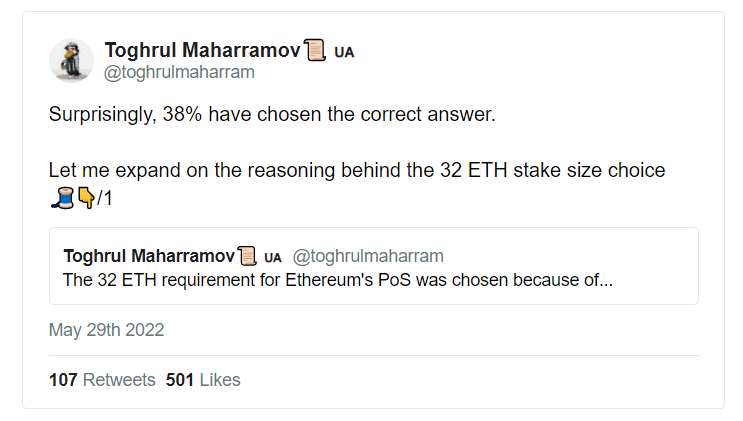
9. Why 32 ETH?
Why does it take 32 ETH to run a node, not 31, 33, or any other number?
The answer is that the more nodes there are, the more total messaging there is between nodes. If the amount of ETH is low, then more nodes are able to come online. While this is good for decentralization (🙂), it’s a constraint on scale (☹️).
32 ETHwas chosen as an optimal balance between these two ends of the spectrum, and also because it’s a square number: 2^5.
Since node messaging is exponential, lowering the ETH validator requirement from 32 to 16 would 4x the amount of messaging across all the nodes. 32 has been chosen as the minimum amount of ETH stake that can also produce ‘finality’ inside of 768 seconds, or ‘2 epochs.’
Is 32 ETH permanent?
Not necessarily! It could certainly be amended down to 16 or lower with improved consumer hardware, messaging compression, and better signature aggregation.
10. Proof of Stake is NOT on-chain governance
A frequent critique (largely out of the Bitcoin camp) is that PoS is equivalent to the ‘fiat system’ that we’re trying to get away from.
What they mean to say is that those who hold the capital, hold the power.
This is such a frustratingly misinformed position, and many of the frequent proponents of this opinion are perhaps maliciously spreading this in order to discredit any consensus mechanism outside of Bitcoin’s.
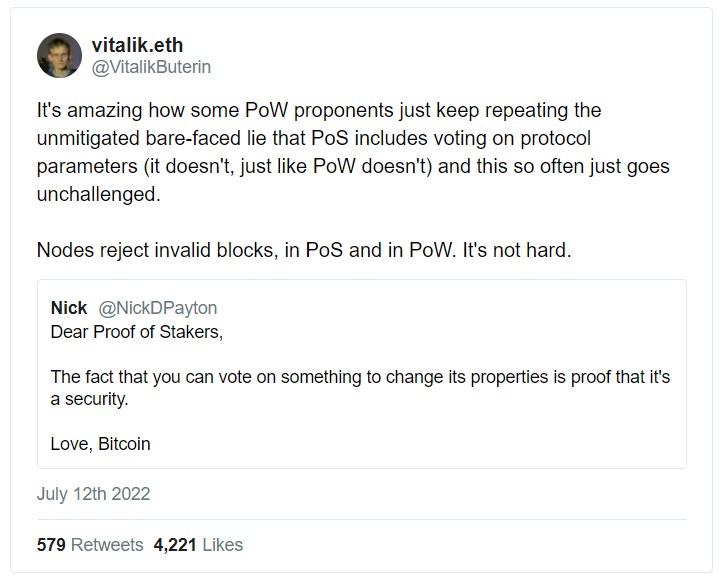
The role of ETH validators is the exact same role as PoW miners. It’s a 1:1 comparison.
ETH holders do not have governance powers over Ethereum. Just like in Bitcoin, that power is held by non-validating node operators, aka “the community”.
It’s quite ironic that these camps promote PoS as a ‘rich-get-richer’ scheme when its an inarguable fact that PoW mining facilities generates a larger return on investment for wealthier and more capitalized entities than smaller, lesser capitalized ones.
Tl;DR:
PoS Ethereum having a native yield in ETH is the most democratizing consensus mechanism possible, as it offers the same proportional returns to 32, 320, 3,200, or 32,000 ETH.
They all receive the same ~5% interest rate.
This is in stark contrast to PoW miners, in which a $100M investment into a mining facility will produce far more than 10x the hash power than a $10M investment due to all the economies of scale that come with PoW hardware & energy costs.