Introduction
After years of seeking regulatory compliance, Diem, a cryptocurrency payment project from Facebook/Meta, ended abruptly in 2022. Its assets were sold off, including the underlying blockchain network. Mo Shaikh and Avery Ching, two former Meta employees, were unwilling to accept the fate of the project they spent nearly three years on. Therefore, they decided to continue their work, only this time as CEO and CTO of the newly founded Aptos Labs.
Based on the knowledge its staff gained working on the Diem codebase, Aptos Labs sought to create a general-purpose blockchain network with the following goals in mind:
1.Revive Diem’s technology by utilizing its programming language, Move, to create a scalable, secure, and flexible infrastructure that could compete with existing blockchains like Bitcoin and Ethereum.
2.Ensure high throughput, low latency, and verifiable state synchronization in a decentralized network by leveraging Diem’s architecture along with a wide variety of novel techniques.
Aptos Devnet has been live since March of this year, enabling developers to begin building decentralized applications and immediately run/test them. Furthermore, in preparation for the public mainnet launch, which is anticipated to launch in the third quarter of 2022, there will be multiple incentivized testnet’s to generate community feedback through participation.
Funding
Despite launching four months prior, in March of 2022, Aptos reported raising $200 million at a valuation greater than $1 billion. The funding round was led by Andreessen Horowitz and included Tiger Global, FTX, Coinbase, 3AC, and other notable names. l. While there isn’t information on the funding round’s exact valuation, Aptos’ CEO, Mo Shaikh, has stated that they’ve reached unicorn status.
Aptos Company Profile – SigDev
This Monday, July 25th, Aptos Labs announced that it had concluded a Series A funding round led by FTX Ventures and Jump Crypto, including investments from Andreessen Horowitz, Multicoin Capital, and Circle Ventures, among others. According to Bloomberg, the most recent $150 million fundraising more than doubled Aptos Labs’ previous $1 billion valuation. In contrast, Ethereum raised around $18.4 million in 2014.
Read the complete publication on their most recent fundraising here.
Architecture
1.Aptos is running on the fourth iteration of their consensus protocol, Aptos BFT, which they claim is the lowest latency and most advanced iteration to date. The consensus protocol is a derivative of HotStuff, the underlying consensus protocol initially used at Diem. Recent additions to the system include:
2.An innovative reputation system that is particularly conformed for decentralized environments, examining the on-chain data and automatically changing leader rotations to account for unresponsive validators without requiring human intervention
Blocks are now committed in significantly shorter trips (down to 2), making sub-second finality the average occurrence.
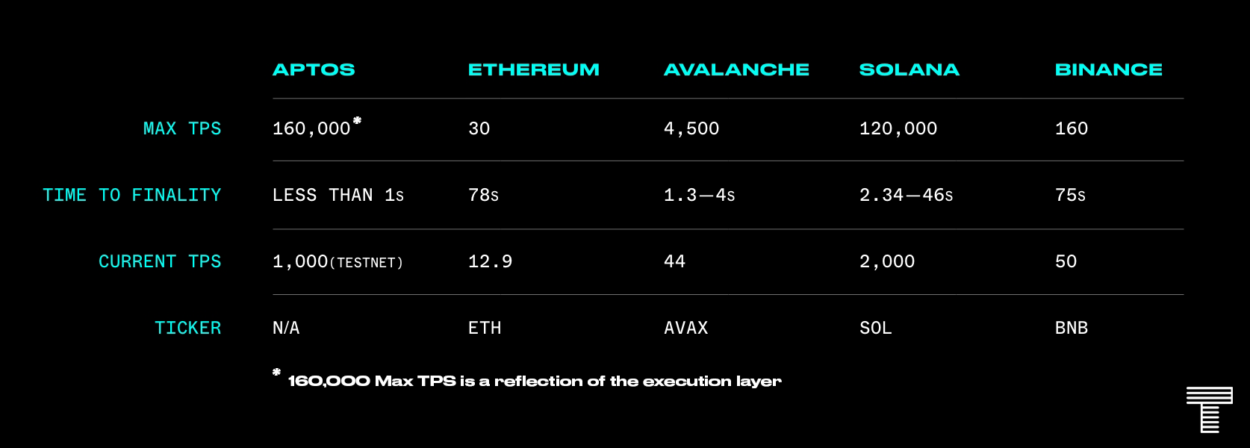
While current TPS on testnet sits around 1,000TPS, Aptos Labs is following a roadmap that they believe will allow them to maximize the utilization of their engine, which they claim has a max TPS capability of 100k+. As per their roadmap, the process of achieving such a feat can be generalized into three milestones:
Milestone 1: Separating Consensus from Execution
The first architectural milestone is the complete detachment of the consensus mechanism from transaction execution. The consensus protocol accepts the proposed transaction ordering. Validators carry out the transactions in a different protocol, away from the critical path, and come to an agreement on the final transaction ordering and execution outcomes. By eliminating the co-dependencies that come with combining consensus and execution, higher throughput and latency are achieved. Aptos Labs is focusing its efforts on this decoupling for their next protocol iteration, which is on track to be integrated into testnet later this year.
Milestone 2: Transaction Execution Time
Generally speaking, when projects refer to how good their system performance is, they tend to emphasize finality and system throughput. Finality is the interval between the creation and submission of a transaction by a client and the confirmation of its commitment by a different party. Throughput is depicted as transactions per second (tps) which gauges how many transactions every node in the network can complete in a second. With that said, smart contract execution represents a significant throughput bottleneck.
Validators must execute the transactions in the ordered blocks after submitting blocks and agreeing on their order. The validators must then reach the same conclusion, consistent with the transactions being executed sequentially. This process of sequential execution impairs network performance, even more apparent during times of increased network activity. Unfortunately, current blockchain systems lack inherent scalability solutions to answer this problem; they function sequentially or utilize highly inefficient off-chain workloads.
Aptos Labs designed an in-memory smart contract parallel execution engine called Block-STM. STM stands for Software Transactional Memory, a new approach to engineering that supports flexible transactional programming of synchronization procedures. However, when applied generally, STM models suffer from performance limitations due to a conflict between bookkeeping and aborts. With that said, upon evaluation Aptos Labs has concluded that when applied to specific use-cases such as DLT along with a combination of innovative techniques, they were able to achieve 100k+ TPS with 32 cores within their execution-only benchmark. Furthermore, their experimental evaluation has also shown that Block-STM outperforms sequential execution by up to 20x on low-contention workloads, and up to 9x on high contention ones.
Milestone 3: Optimized Authenticating Data Structures
The final milestone is achieving an optimized authenticating data structure. To combat the scalability issues that come with writing Merkle-trees to persistent storage, Aptos is developing authenticated data structures with the aim of being a scalable, database-friendly solution. This will be achieved through the evaluation of higher branching factors, access pattern optimized caching, and careful versioning,
To read more about Block-STM, including the supplemental techniques applied to enhance the performance of STM, refer to the documentation here along with the GitHub implementation here.
To review the security audit, refer here.
Move Programming Language
The Move programming language was created to serve as a secure, programmable foundation for Aptos’ vision to create a financial infrastructure that empowers the masses. With this in mind, Move was designed to address the primary pain points of current blockchain languages. As a result, the proposed solutions by Aptos can be summarized in four key goals: first-class resources, flexibility, safety, and verifiability.
Move’s main feature is the ability to define custom resource types, which statistically ensures that a resource can only be moved between program storage places and never cloned or deleted. This implementation significantly improves security by effectively preventing issues such as the vulnerabilities described above. Resources are then governed by move modules, similar to smart contracts in that they control the procedures that encode the rules for creating, updating, and deleting declared resources. Move modules’ benefit over smart contracts is that they enforce data abstraction, meaning that a resource is transparent inside its declaring module and opaque outside of it. Furthermore, with the help of an expressive specification language, the Move prover can formally validate the characteristics of Move modules and is efficient enough to be used in continuous integration testing.
To read more about the Move programming language, refer to the documentation here.
Protocols on Aptos
While Aptos is relatively new, developer activity has increased exponentially since the incentivized test net was first launched earlier this year in March. With every new blockchain, the most important protocols to keep an eye out for are the ones that bring real value to the chain via infrastructure — Similar to how money markets like Compound and oracles like Chainlink enabled the growth of mainnet DeFi.
Thala Labs – Recently announced in June as a Stablecoin Protocol. Until protocol documents are published, there is very little information about Thala Labs. That said, stablecoins are essential to the growth of a nascent ecosystem as stablecoins create liquidity incentives for other projects, consequently driving up TVL.
Pontem Network – Pontem has recently put out a generalized roadmap iterating that they intend to build numerous products on Aptos, with the first product being a decentralized exchange. DEXs represent a sufficient liquidity structure that enables automated swaps between different tokens while encouraging liquidity growth through liquidity mining incentives. Other products on Pontem’s roadmap include a yield aggregator, an EVM layer for Aptos, a dApp-Integrated wallet, and a governance protocol.
Switchboard – A Solana-based general purpose oracle network with an emphasis on generalized price feeds. To learn more about oracles and the value that they bring, refer to my deep-dive report here.
Vial – Vial is a pooled interest rate protocol that enables users to lend and borrow assets on Aptos. Money markets bring value by enabling efficient methods for capital management and diversification along with enabling on-chain leverage, which in turn drives liquidity throughout the ecosystem.
Aptosphere – Aptosphere is an indexing protocol for querying data on Aptos. For insights on why indexing protocols are crucial to the success of a new blockchain, refer to my report on databases here.
Team & Traction
As mentioned, Aptos was founded by Mo Shaikh and Avery Ching, currently sitting as CEO and CTO at Aptos Labs.
Other members of the Aptos founding team include Alden Hu, Alin Tomescu, David Wolinsky, Greg Nazario, Jake Skinner, Josh Lind, Max Kaplan, Mo Ahmed, Neil Harounian, Rati Gelashivili, Rustie Lin, Sasha Spiegelman, Sherry Xiao, Sital Kedia and Zekun Li, all of who have admirable credentials with proven track records within their fields.
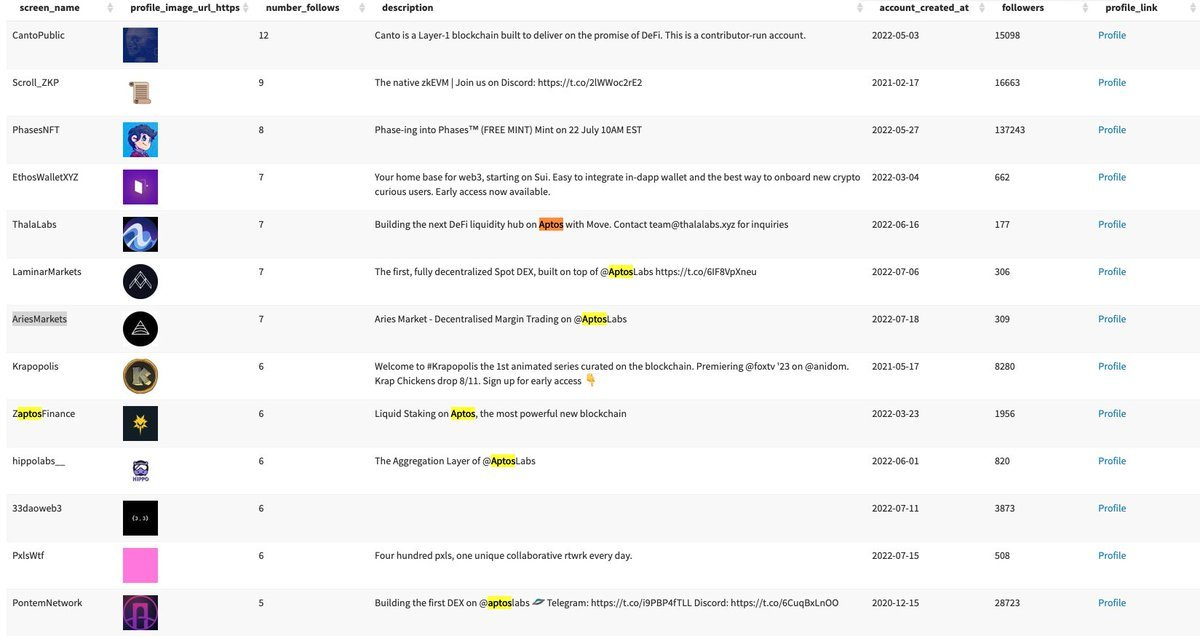
It’s also important to note that Aptos’ social growth has been massively on the rise lately, as the scalability solution narrative continues. According to data from The TIE’s Apefluencer tool, which helps institutions track what matters to key opinion leaders, 19 of the top 50 recent most followed accounts in crypto are part of the Aptos Ecosystem.
Final Thoughts & Considerations
This report introduced Aptos, a BFT general-purpose public blockchain created to be a scalable, secure, and flexible infrastructure that could compete with existing blockchains like Bitcoin and Ethereum.
Scalability has been a common topic of conversation within the space over the past few years. It’s become apparent that many of the widely used blockchain systems aren’t inherently optimized to support blockchain technology’s continuous growth and adoption. Aptos addresses these pain points by implementing novel methodologies focusing on performance, scalability, and user operability. All of these aspects highlight the continuous value that Aptos proposes to bring to the space- along with the underlying goal of creating infrastructure that can rival existing blockchains like Bitcoin and Ethereum.