EthCC happened last week in Paris.
There were free macaroons, tons of POAPs, and a sweltering heat wave (the organizers airdropped fans to all attendees).

There was a lot going on, but if you missed it, here’s a quick taste of what was going on.
Infrastructure
1. Ethereum is only 55% complete
Vitalik wrapped up the conference on the last day with some big-picture thoughts on the long-term future of Ethereum. The goal of Ethereum is to optimize for being a robustly secure foundational base, while the complex functionalities are left to the Layer-2, referred to as “functionality escape velocity”.
This requires a lot of rapid change in the short-term, which creates volatility for the market and general building, but the rate of change will slow down in the long run.
On how far towards completion Ethereum is:
"The difference between Bitcoin and Ethereum is that Bitcoiners consider Bitcoin to be 80% complete, but Ethereans consider Ethereum to be 40% complete… I'd say Ethereum would be 55% complete after The Merge, so we're getting close and are in the second half of this big, long vision."
2. Zk-Rollups are coming
On that note, DeFi is betting big on zk-rollup technology.
Polygon, along with zkSync and Scroll, announced the launch of zkEVM, a scaling solution that combines zk-rollups with EVM compatibility. This is huge and it shouldn’t be understated.
Zk-rollups are technically complex, and until now, it was difficult for developers to build on. With the launch of zkEVMs, developers can more easily launch smart contracts on this new, emerging technology.
3. DeFi UX needs to improve
While Layer-2s are scaling transaction speed, a whole host of other builders are working in tandem to scale the DeFi user experience in a world of multiple wallets, chains, and assets.
Co-founder of rhino.fi, Daniel Yanev, spoke on the importance of the DeFi user experience in a multi-chain world. DeFi is complicated to use because its plumbing is still undergoing rapid innovation and yet to reach the point where simplicity is its focus: “Users are not stupid, the user experiences were just bad”.
That places the onus on builders to simplify the decentralized finance experience into a one-stop platform, in particular DeFi aggregators like rhino.fi and deBridge, the latter of which launched a cross-chain composability feature at ETH CC.
For a nifty intro to the topic, Paraswap founder Mounir Benchemled takes the mainstage to talk about how aggregators are helping scaling the DeFi user experience.
DeFi
1. VeTokens get supercharged
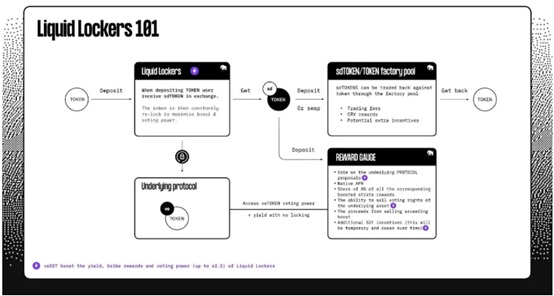
The Curve wars inspired a new paradigm of “metagovernance” veTokenomics that made governance tokens valuable by letting users lock them up for boosted yield and governance power, but at the cost of sacrificing liquidity.
Stake DAO, a seminal player in the Curve wars announced this week Liquid Lockers, which lets users supercharge their veTokenomics by leveraging their veTokens for yield, SDT incentives, and governance voting power without the same restrictions.
The feature is live and currently caters to CRV, FXS, ANGLE and BAL.
2. Cosmos DeFi gains traction
It’s ETH CC but it’s not always about Ethereum. Cosmonauts, this one is for you.
Osmos co-founder Sunny Aggarwal explains why builders (i.e. dYdX) are finding interchain DeFi like Cosmos increasingly attractive, for reasons like customized fee parameters (e.g. being able to pay fees in any token, charging higher fees for different types of transactions), custom execution models (e.g. experimenting with different virtual machines, multi-asset shielded pools), self-executing code (e.g. batched AMMs), custom transaction ordering and more.
Sebastien Couture, founder of Interop Ventures, also made the bull case for the Cosmos interchain with a focus on many top players in the ecosystem like Osmosis, Evmo, Kava and more.
DAOs
1. The Regen opportunity is here
How do you create Web3 systems and projects that are anti-fragile to shock events?
Kevin Owocki takes the mainstage on this important question (see also Kevin’s last week published Bankless piece Front-running The Regen Opportunity).
2. RetroPGF takes center stage
Karl Floresch, CTO of Optimism gave a lively talk on retroactive public goods funding where he shared how Optimism vision aligns positive impact to Web3 broadly with a profit reward to the individual.
That way, the creation of public goods becomes profitable to create. 🌱
3 Likes
3. DAO governance is hard
Stablenode’s Doo Wan Nam talks about some of the biggest challenges and best practices in DAO governance, while Aragon DAO’s Head of Ecosystem Ivan Fartunov dives into how infrastructural tooling can make up for these shortfalls.
The unsexy truth about running a DAO is that you’re operating in a highly uncertain space with a whole bunch of risks.
Culture
1. The Era of Web3 Social
Stani Kulechov, Founder and CEO of Aave and Lens, is leading the charge on decentralized social media. Lens lowers the barrier to build what we traditionally think of as “social media” on one, unified composable social graph protocol so user experience becomes the priority, rather than user acquisition and curating a moated network effect like in Web2.
If you scanned the POAP at the Lens booth, remember to collect your Lens handle!
2. Ethereum goes to Hollywood
Camila Russo, author of The Infinite Machine is producing Ethereum’s first Hollywood full feature film. Russo’s co-producer Alejandro Miranda confirmed that they were in the process of writing the script. And because this is a film about Web3, the production of the film itself is interwoven with Web3 aspects, for example letting you appear in the film if you mint an Infinite Machine Movie NFT.
See Camila on the Bankless podcast on Ethereum’s Hollywood Moment.
3. NFTs are the key to distribute community ownership
Finally, 3mint Founder Tom Borgers, talked about how NFTs started out as a luxury speculative good but will evolve into a credible way for commercial brands and content creators to acquire customers and fans, by giving real ownership to (loyal) users, tap into new communities through complementary partnerships and leverage new channels of distribution.
If you can’t tell, the week was jam-packed.
It was nearly impossible to cover everything.
But we do know that crypto is moving forward and progressing as fast as ever.
Bear markets are for building after all.