
Primitive Ventures: The Crypto World Feels a Bit Dead

marsbitXuất bản vào 2026-01-13Cập nhật gần nhất vào 2026-01-13

Tóm tắt

Primitive Ventures' Dovey Wan argues that despite Bitcoin hitting new all-time highs in 2025, the crypto market feels stagnant and disconnected. Key issues include a lack of altcoin momentum, underperformance against traditional assets like stocks and gold, and a significant divergence between onshore (U.S.) buying and offshore selling. U.S. investors bought spot Bitcoin, while international traders sold into strength and used leverage. Structural shifts, including Bitcoin ETFs and institutional products, changed liquidity dynamics. Retail interest declined, and miners sold Bitcoin to fund AI ventures. Major sell pressure came from early whales, miners, and gray market entities. The traditional 4-year cycle is broken; future performance depends on macro conditions and institutional adoption. Crypto must evolve from speculative asset to utility-driven technology to attract new cycles of investment.

Author: Dovey Wan, Founding Partner of Primitive Ventures

Compiled by: Dayu

In 2025, the cryptocurrency industry achieved almost all its expected goals. Structurally, this should have been a glorious year.

But why does it feel... so lifeless?

It's not just that "prices didn't rise" and it's all over. Bitcoin hit new highs. But the atmosphere, sentiment, internal confirmation, follow-through from other cryptocurrencies, and retail enthusiasm have all changed. Perhaps most worryingly, the former "hot money leading asset" has now lost its appeal in terms of wealth effect and volatility.

Related cryptocurrency assets no longer move in sync with Bitcoin and Ethereum as they did in previous cycles:

1. Memecoins topped the charts from Q4 2024 to Q1 2025, and the launch of Trump tokens pushed this trend to its peak.

2. Crypto stocks peaked around the Circle IPO and began to fall back between May and August 2025.

3. Most altcoins never formed a sustained trend. There was asymmetry on the way up, and the decline was entirely dominated by all participants.

Zooming in, the situation becomes even stranger.

Despite a friendly policy environment, Bitcoin's performance in 2025 lagged behind almost all major traditional financial assets, including gold, U.S. stocks, Hong Kong stocks, A-shares, and even some bond benchmark indices.
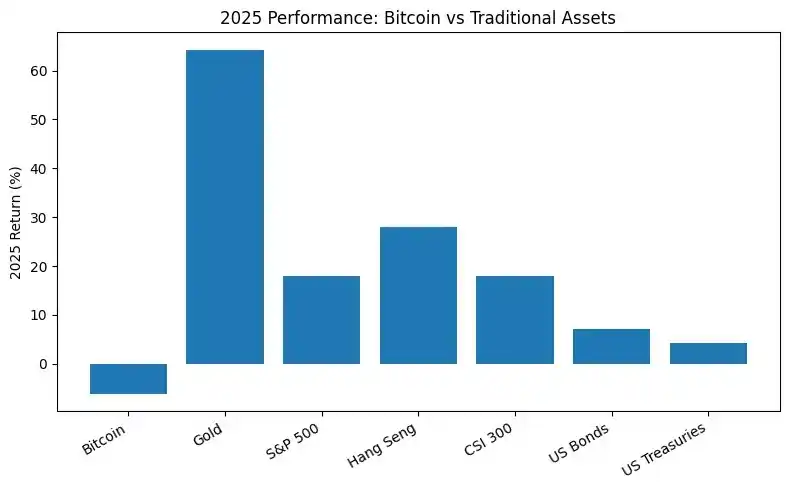
(Bitcoin's performance compared poorly to other assets)

This is the first time Bitcoin's performance has decoupled from all other asset classes.

This divergence is crucial: prices hit new highs, but there was no internal confirmation, and other markets performed better. This reveals a simple yet unsettling fact: Bitcoin's liquidity supply chain has undergone significant changes, and its original four-year settlement cycle has been altered by greater forces in other markets.

Therefore, we will delve into who was buying at the highs, who exited the market, and where the price bottom lies.

The Great Divide: Onshore vs. Offshore Operations

We experienced three distinct phases in this cycle—

  • Phase A (November 2024 to January 2025): Trump's election victory and a more friendly regulatory environment triggered FOMO among both domestic and foreign investors. Bitcoin's price broke through $100,000 for the first time.

  • Phase B (April to mid-August 2025): After deleveraging selling, BTC resumed its upward momentum and broke through $120,000.

  • Phase C (Early October 2025): BTC hit its current local all-time high in early October, then experienced a flash crash on October 10th and entered a correction phase.

In each phase, we saw a significant divergence between U.S. buying and overseas selling—

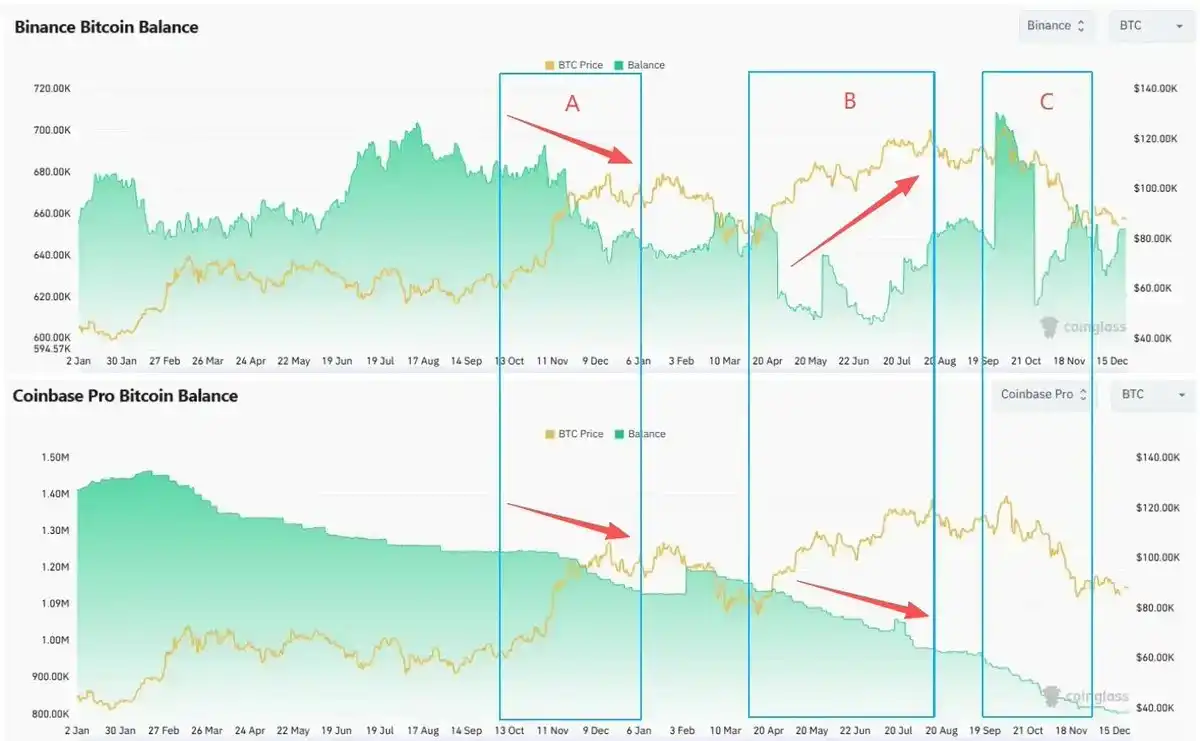
Spot: Onshore buying on breakouts, offshore selling on strength.
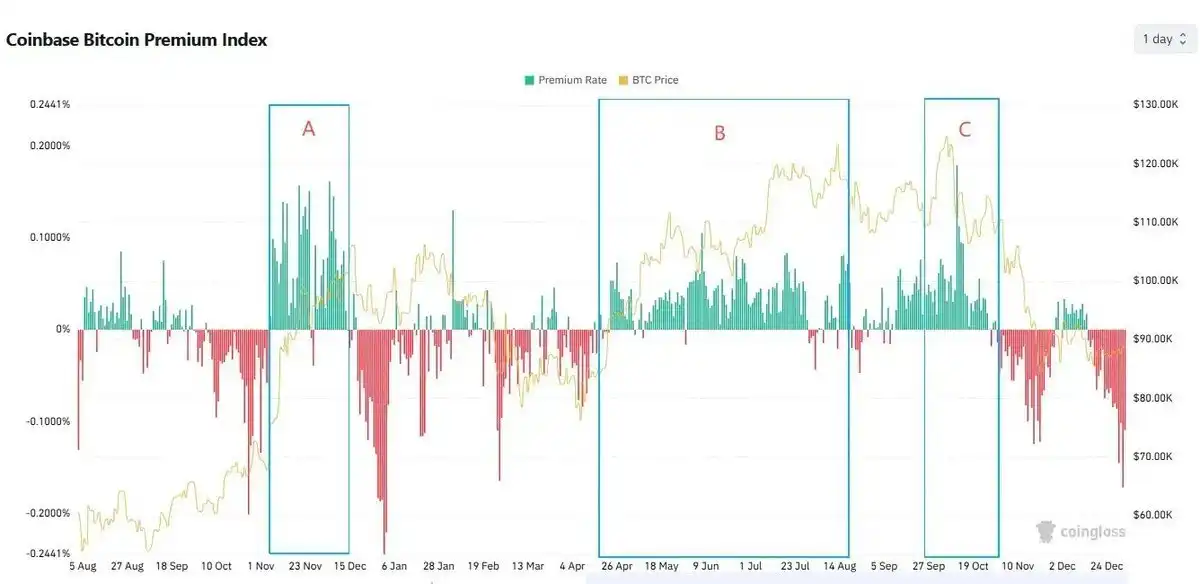
  • Coinbase Premium remained positive in Phases A, B, and C. High levels of buy-side demand primarily came from onshore spot funds.

  • Coinbase BTC balances showed a declining trend throughout the cycle. Sellable inventory on the U.S. side decreased.

  • As prices rebounded in Phases B and C, Binance balances increased significantly. Offshore spot holders replenished inventory, increasing potential selling pressure.
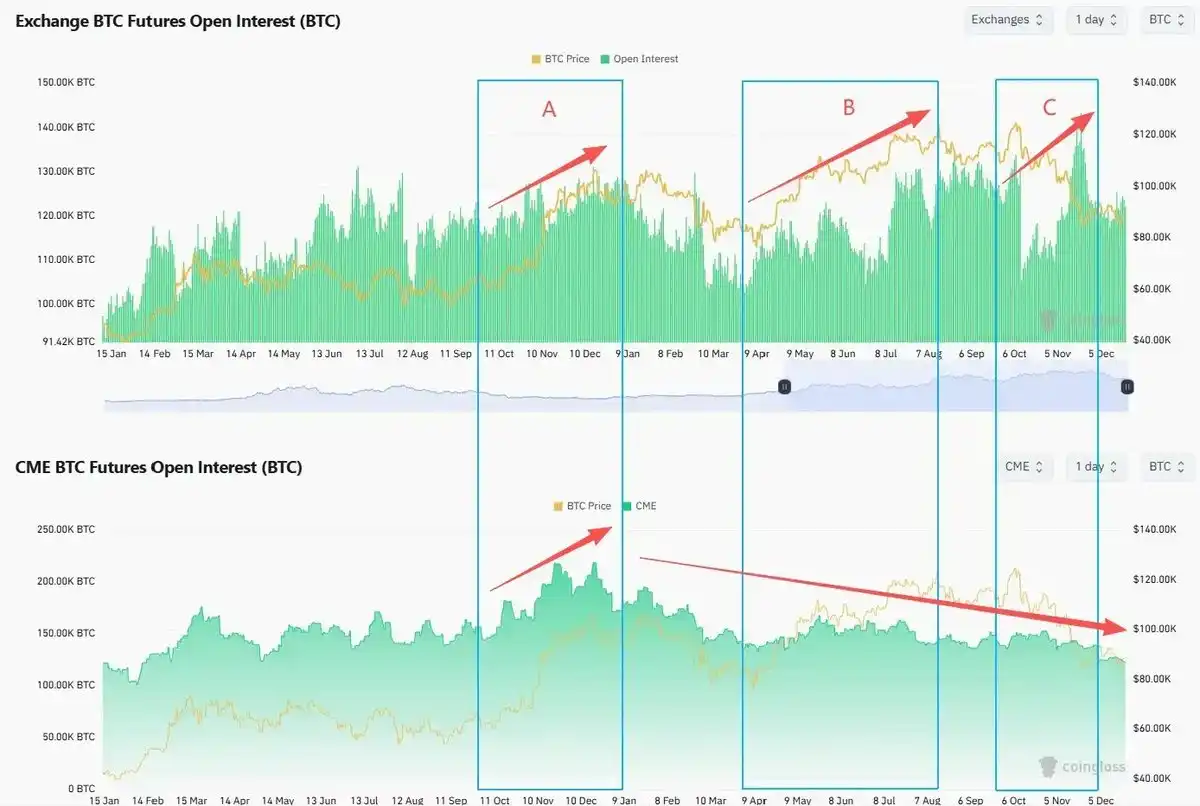
Futures: Offshore leverage rises, onshore positions decline

Offshore open interest (Binance and other offshore exchanges) climbed during Phases B and C. Leverage increased. Even after October 10th, leverage quickly recovered and returned to or exceeded previous peaks.

Onshore open interest (CME) has been on a downward trend since early 2025. Institutional investors did not increase their risk exposure as contracts hit new highs.
Meanwhile, Bitcoin volatility diverged from price action.

In August 2025, when Bitcoin's price first surpassed $120,000, DVOL was near a local low. The options market did not adequately compensate for continued risk.
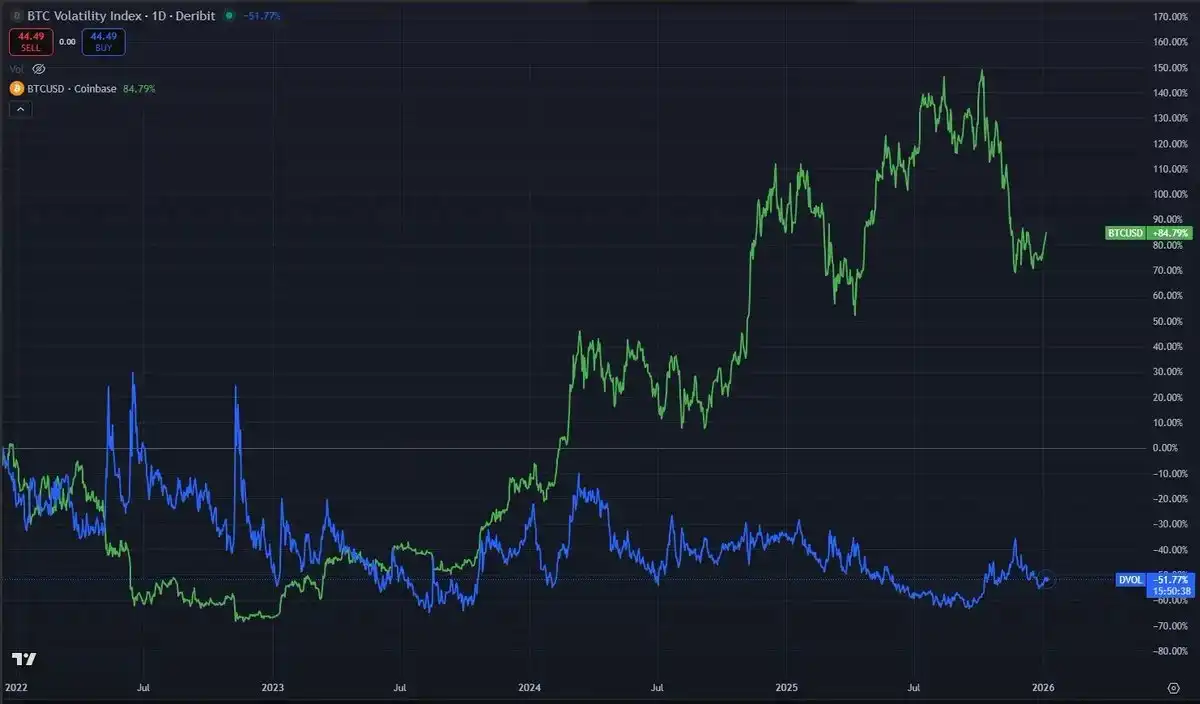
Each "top" seemed to reflect a divergence between onshore and offshore traders. When onshore spot funds pushed prices to break out, offshore spot traders sold into strength. When offshore leveraged capital chased the rally, onshore futures and options traders reduced positions and stayed on the sidelines.

Where are the marginal buyers? Who is left to buy?

Glassnode estimates that the number of Bitcoins held by corporate and DAT-like tools increased from about 197,000 in early 2023 to about 1.08 million by the end of 2025, a net increase of about 890,000 over two years. DATs have become one of the largest structural investment vehicles in the Bitcoin system.

Another often misunderstood area is ETFs. By the end of 2025, U.S. spot Bitcoin ETFs held approximately 1.36 million, a year-on-year increase of about 23%, accounting for about 6.8% of the circulating supply.

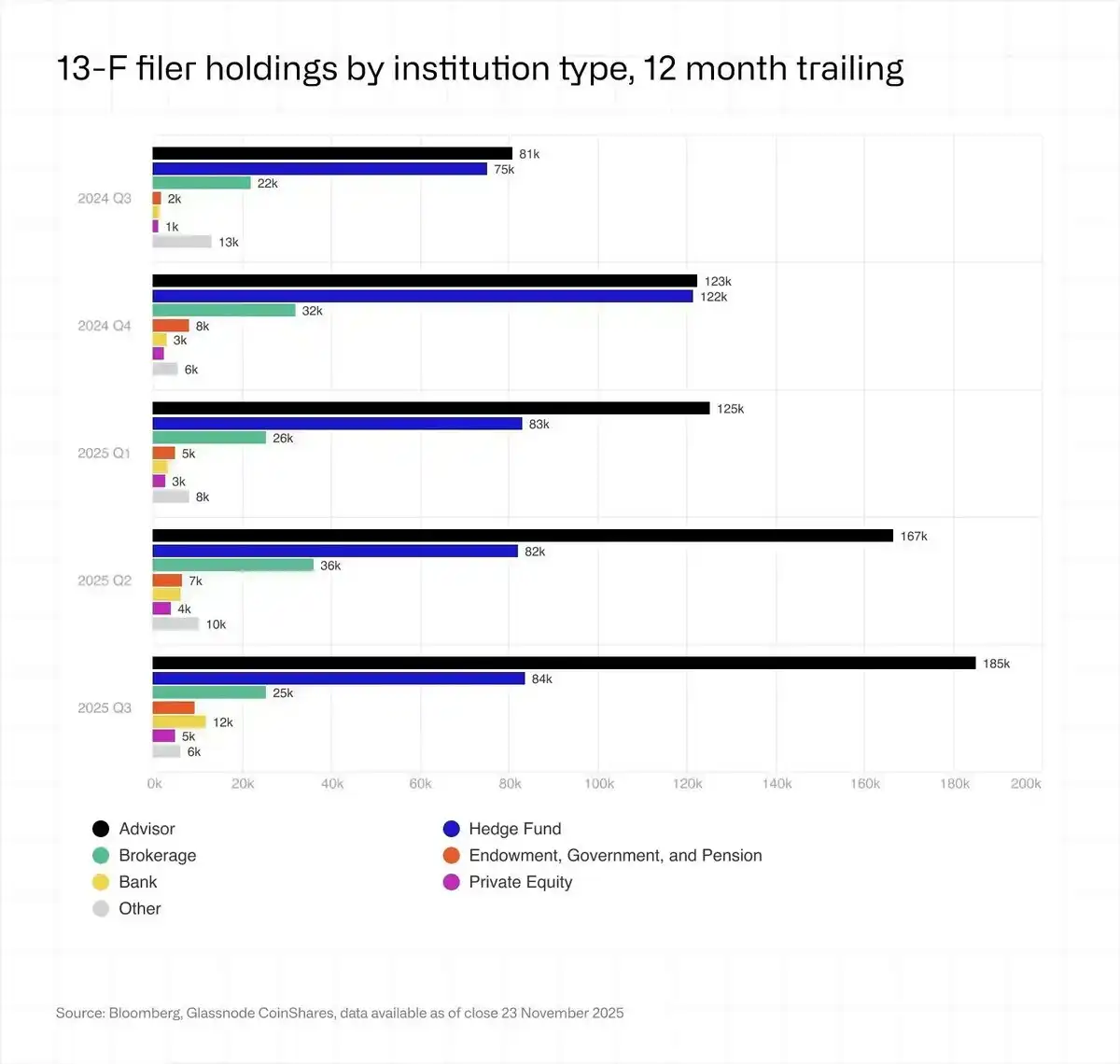
Institutional investors (13F filers) hold less than a quarter of the total ETF amount, and most of these are hedge funds and investment advisors, clearly not the "diamond hand" families we know.
The Death of Retail

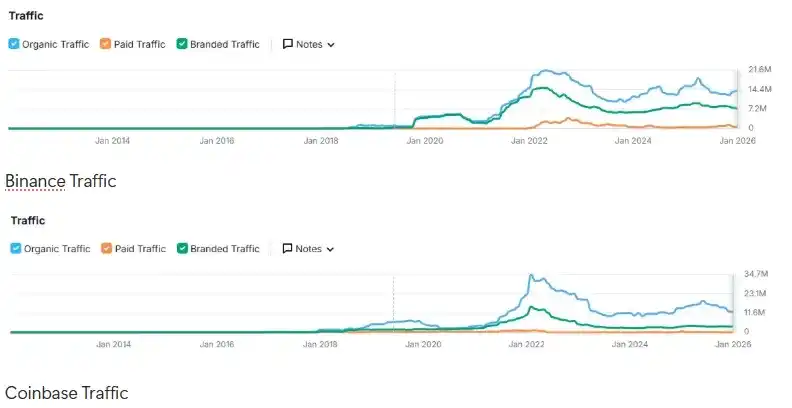
Since early 2025, flow data from Binance, Coinbase, and other top exchanges clearly shows that retail investor weakness has continued since Trump sold his "memecoins".

Furthermore, overall social sentiment among retail investors has actually been bearish since early 2024.

Overall website traffic has been on a downward trend since peaking in 2021.

Bitcoin's price hitting new highs did not bring traffic back to previous levels.
You can read more on this topic in our article from last year. "Who is the marginal buyer?"

Exchange strategies have also adjusted. Facing high customer acquisition costs and low activity from existing users, exchanges have shifted from "striving for growth" to "retaining existing capital through yield products and multi-asset trading (actively listing U.S. stocks, gold, and forex)".

Everywhere Else, It's a Bull Market

The real "wealth effect" in 2025 was not in crypto: the S&P 500 (+18%), Nasdaq (+22%), Nikkei (+27%), Hang Seng Index (+30%), KOSPI (+75%), and even A-shares rose 19%, all posting strong gains. Gold (+70%) and silver (+144%) also surged, making "digital gold" seem somewhat ridiculous by comparison.

AI stocks, 0DTE (zero-day to expiration) options, and commodities like gold and silver further eroded its appeal.

Speculative money did not rotate into alternative investments. Many exited altogether, returning to equity volatility markets, while new speculators happily profited in U.S. stocks or their domestic equity markets.

Even Korean retail investors sold off Upbit to bet on the KOSPI index and U.S. stocks: Upbit's average daily trading volume in 2025 fell about 80% compared to 2024. During the same period, the KOSPI rose over 75%. Korean retail investors net bought about $31 billion in U.S. stocks.

Who Are the Biggest Sellers?

Every cycle has whales selling at local highs, but interestingly, the timing of seller distribution this cycle coincided perfectly with the RSI divergence points.

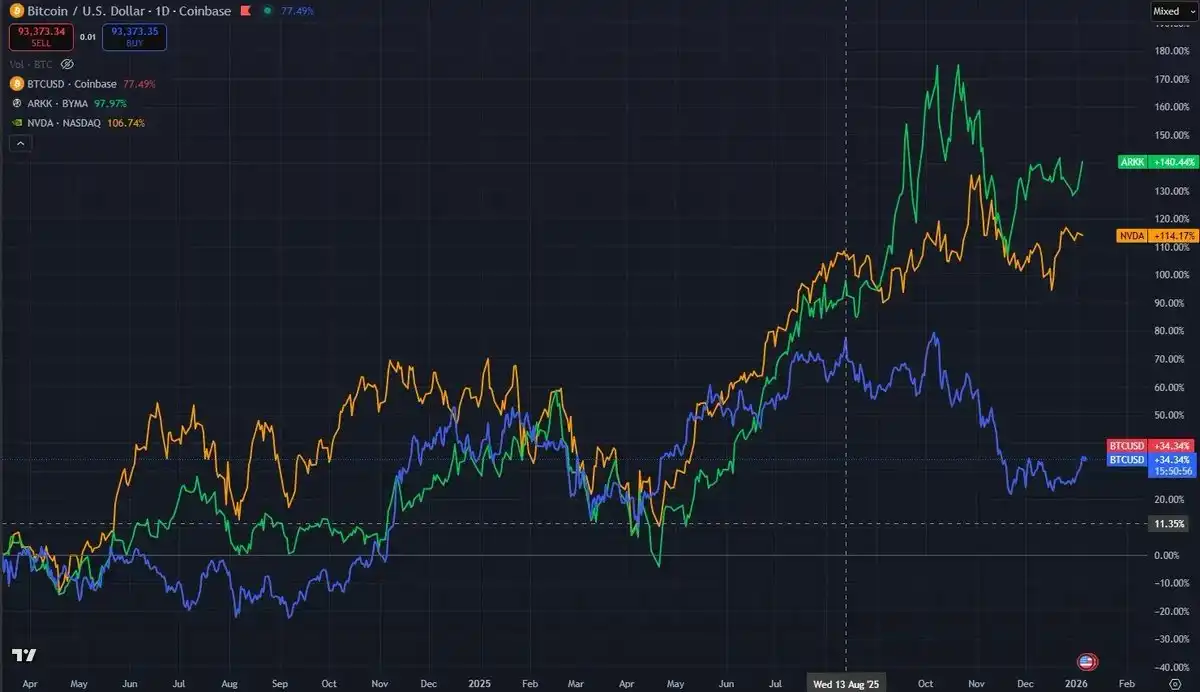
Bitcoin had previously moved closely in line with U.S. tech stocks until around August 2025, when Bitcoin began to significantly lag ARKK and Nvidia, followed by the October 10th flash crash, and it has yet to close the gap since.

Just before this divergence appeared, in late July, Galaxy disclosed in its earnings report and media briefings that it had executed a sell order of over 80,000 Bitcoins on behalf of an established holder. This transaction brought the phenomenon of "Satoshi-era whale profit-taking" into public view.
Miners Selling for AI Capex

From the 2024 Bitcoin halving to the end of 2025, miner reserves experienced their most sustained decline since 2021. By year-end, reserves were around 1.806 million Bitcoins. Hash rate fell about 15% year-on-year.

  • Under the "AI Diversion Plan," miners transferred approximately $5.6 billion worth of Bitcoin to exchanges to fund the construction of AI data centers.

  • Bitfarms, Hut 8, Cipher, Iren, and others are converting sites into AI and high-performance computing campuses, signing 10 to 15-year compute contracts, treating power and land as "gold in the AI era."

  • Riot, a representative HODLer, announced in April 2025 that it would begin selling all coins mined monthly.

It is estimated that by the end of 2027, about 20% of mining power capacity could be redeployed to AI workloads.

China took more severe measures. In December 2025, Xinjiang again became a target for the People's Bank of China and various ministries. About 400,000 ASIC miners were forced offline, causing global hash rate to drop 8% to 10% in a few days.

Gray Whales: Bitcoin's Black Hangover

Similar to the significant impact of the PlusToken scam in the 2021 cycle, several large-scale fraud and gambling cases in 2025, including Qian Zhimin's Ponzi scheme/cult network and the Cambodia Prince Group/Chen Zhi case, were likely major behind-the-scenes drivers of Bitcoin's price action.

Both cases involved the seizure of tens of thousands of Bitcoins, totaling at or above the level of 100,000 black coins.

This may also add potential selling pressure from governments, while significantly inhibiting large gray market long-term holders of Bitcoin, which could create selling pressure in the medium term but is overall positive in the long run.

2026 Outlook

Under this new structure, the original "four-year halving cycle" is no longer a feasible self-fulfilling path.

The next phase of the regime is primarily driven by two axes.

  • Vertical: Macro liquidity and credit conditions, interest rates, fiscal stance, AI investment cycle.

  • Horizontal: Valuation and premium levels of DATs, ETFs, and other Bitcoin alternative assets.
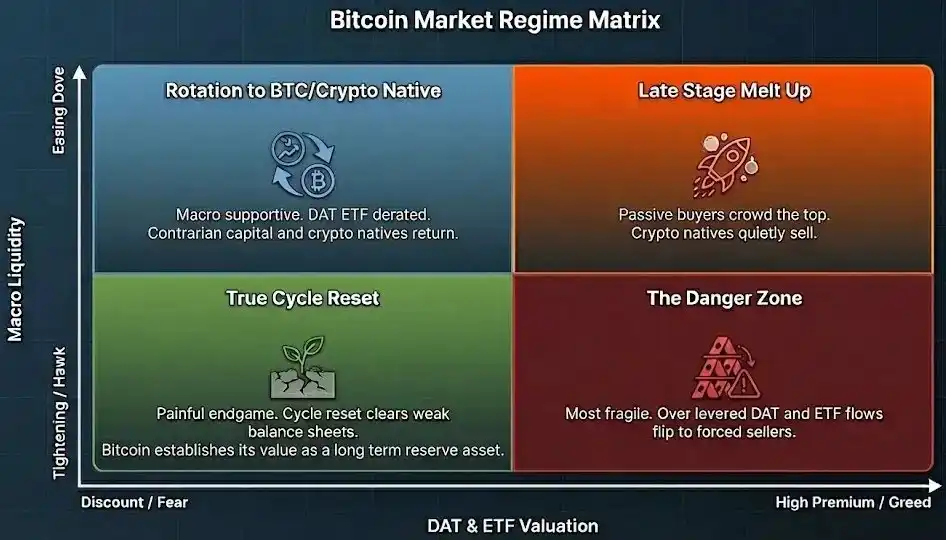
Early Bitcoin winners, including OGs, miners, and Asian gray whales, are distributing tokens to passive ETF holders, DAT structures, and long-term national capital.

Bitcoin's trajectory seems similar to that of FAANG between 2013 and 2020: the market is slowly shifting from a high-beta strategy dominated by early retail and growth funds to a passive allocation strategy dominated by index funds, pension funds, and sovereign wealth funds.

Bitcoin is now the crypto asset you can own easily without touching crypto. You can buy it through a brokerage account, custody it like an ETF, account for it clearly, and explain it to a trader investment committee in five sentences.

Whereas the valuation of most other crypto assets does not stem from their actual utility or legitimacy in the physical market and Wall Street.

We always look forward to the next bull market, but it would be great if this bull market wasn't just about price increases, but also about utility increases, translating the legitimacy of the ETF era into on-chain demand, converting passive holding into active use, and bringing real yield returns, not just constantly shifting narratives.

If that happens, today's "bag holders" won't look like fools trapped at the cycle's peak, but rather like the first investors of the new cycle.

Bitcoin finally becomes national reserve currency

Code is eating the bank

Crypto still needs to evolve into a new tool of civilization.

Câu hỏi Liên quan

QAccording to the article, why does the crypto world feel 'dead' despite Bitcoin hitting new highs in 2025?

AThe article states that while Bitcoin hit new highs, the atmosphere, sentiment, internal confirmation, follow-through from other cryptocurrencies, and retail enthusiasm have all changed. It points to a lack of wealth effect and volatility appeal, poor performance compared to other asset classes, and a significant shift in Bitcoin's liquidity supply chain and its traditional four-year cycle.

QWhat key divergence does the article highlight between onshore (US) and offshore trading activity for Bitcoin?

AThe article highlights a major divergence where onshore (US) spot buyers were the primary demand driving breakouts, while offshore spot holders sold into strength. Conversely, offshore futures leverage increased during rallies, while onshore futures and options traders reduced their positions and remained on the sidelines.

QWho does the article identify as the largest structural investment vehicle in the Bitcoin system by the end of 2025?

AThe article identifies DATs (Digital Asset Trusts, likely referring to products like Grayscale's GBTC) as the largest structural investment vehicle in the Bitcoin system by the end of 2025, holding an estimated 1.08 million BTC.

QWhat are the two main drivers the article proposes for Bitcoin's price trajectory in 2026, replacing the old 'four-year halving cycle'?

AThe article proposes that Bitcoin's trajectory in 2026 will be driven by two main axes: 1) The vertical axis: macro liquidity and credit conditions, interest rates, fiscal stance, and the AI investment cycle. 2) The horizontal axis: the valuation and premium levels of DATs, ETFs, and other Bitcoin proxy assets.

QBesides early whales and miners, what other significant source of selling pressure ('black whales') does the article mention?

AThe article mentions 'black whales' or 'grey whales' as a significant source of selling pressure, referring to large-scale fraud and gambling cases like the Qian Zhimin Ponzi scheme/cult network and the Cambodia Prince Group/Chen Zhi case, which involved the seizure of tens of thousands of Bitcoin, potentially adding over 100,000 black coins to the market and government selling pressure.

Nội dung Liên quan

43 phút của Trump: Cốt truyện người mạnh mất kiểm soát, chiến tranh truyền thông leo thang

Trong bài diễn văn kéo dài 43 phút sau hơn một tuần vắng bóng công chúng, Tổng thống Mỹ Donald Trump đã cố gắng thể hiện hình ảnh một nhà lãnh đạo mạnh mẽ và kiểm soát. Tuy nhiên, phần lớn thời gian được dành cho các chủ đề phụ như hồ phản chiếu trên National Mall, so sánh quy mô đám đông với Martin Luther King Jr., cùng những lời công kích nhắm vào phóng viên, đảng Dân chủ và các thành phố lớn. Ông còn ký sắc lệnh hành pháp hủy bỏ các biện pháp bảo vệ việc làm cho hàng nghìn công chức cấp cao liên bang, một động thái có thể gia tăng sự phụ thuộc vào lòng trung thành cá nhân hơn là năng lực chuyên môn trong chính phủ. Bài viết nêu bật trạng thái cá nhân đầy lo lắng và phòng thủ của Trump, thể hiện qua việc ông đột ngột kết thúc sự kiện và nhân viên nhanh chóng dọn dẹp hiện trường. Tác giả cũng phân tích cuộc tấn công của Trump vào nữ phóng viên CNN, Kaitlan Collins, coi đó là một phần của nỗ lực làm mất uy tín giới truyền thông. Bài báo cảnh báo về áp lực ngày càng lớn từ quyền lực chính trị và lợi ích thương mại lên các cơ quan báo chí chính thống, dẫn đến cuộc khủng hoảng về tính độc lập biên tập, như trường hợp Scott Pelley của CBS. Thông điệp chính kêu gọi công chúng ủng hộ các nhà báo và phương tiện truyền thông độc lập, những người được coi là lực lượng quan trọng duy trì sự thật khi các thể chế khác bị xâm phạm. Bài viết kết thúc với viễn cảnh lạc quan khi đề cập đến việc Hạ viện, với sự ủng hộ của một số thành viên đảng Cộng hòa, đã thông qua nghị quyết yêu cầu chấm dứt hành động quân sự ở Iran, cho thấy sự bất đồng ngày càng tăng ngay trong nội bộ đảng của Trump.

marsbit1 giờ trước

43 phút của Trump: Cốt truyện người mạnh mất kiểm soát, chiến tranh truyền thông leo thang

marsbit1 giờ trước

Kalshi, MTS và tham vọng của a16z

Trí tuệ thị trường dự đoán và tham vọng "Truyền thông Mới" của a16z Bài viết phân tích sự trỗi dậy của thị trường dự đoán (prediction markets), đặc biệt là công ty Kalshi được định giá 220 tỷ USD, dưới góc nhìn chiến lược đầu tư và truyền thông của quỹ mạo hiểm a16z. Tác giả điểm lại lịch sử tư tưởng của thị trường dự đoán, từ học thuyết của Hayek về việc thị trường tổng hợp tri thức phân tán, đến cơ chế khuyến khích của Robin Hanson (LMSR) và ý tưởng chính phủ dựa trên dự đoán (Futarchy). Trọng tâm bài viết nằm ở việc a16z, sau khi đầu tư vào Kalshi, đã định vị lại giá trị cốt lõi của thị trường dự đoán không chỉ là sòng bạc hay sàn giao dịch, mà là một phương tiện truyền thông mới mang lại "cảm giác hiện diện" (presence). Trong một thế giới ngày càng bị che khuất và bất lực, việc dùng tiền thật để đặt cược vào các sự kiện toàn cầu giúp cá nhân tái khẳng định vai trò "người quan sát tối thượng", can thiệp và diễn giải thực tại. Kalshi, theo logic này, sẽ trở thành nơi định đoạt tính xác thực và tầm quan trọng của sự kiện. Bài viết liên kết điều này với tầm nhìn "Truyền thông Mới" của a16z – một hệ thống truyền thông toàn diện từ định hình luận điệu, tài trợ, phát hành sản phẩm đến thu hút khách hàng với tốc độ và cường độ chưa từng có, nhằm "tiếp quản dòng thời gian". Ví dụ điển hình là MTS (Monitoring The Situation), một hãng truyền thông chuyên phát sóng tin tức 24/7 trên Twitter. Kết luận cho rằng sức hút thực sự của Kalshi và lý do định giá khổng lồ của nó nằm ở "trường lực bẻ cong hiện thực" – khả năng tạo ra một thực tại thay thế có sức thuyết phục cao nhờ vào khối lượng giao dịch bằng tiền thật, từ đó trở thành một mảnh ghép quyền lực trong đế chế truyền thông mới của a16z.

marsbit3 giờ trước

Kalshi, MTS và tham vọng của a16z

marsbit3 giờ trước

Bất Ngờ: Cựu Nhân Sự Trụ Cột Trong Dự Án Chip Của OpenAI Gia Nhập Anthropic

Chuyên gia chip "nhân viên số 002" của OpenAI, Clive Chan, vừa thông báo rời OpenAI để gia nhập Anthropic. Anh là một trong những thành viên sớm nhất của đội ngũ phát triển chip tự thiết kế của OpenAI, tham gia từ giai đoạn hình thành đến nay. Dù đánh giá cao đội ngũ chip tại OpenAI, Clive Chan chia sẻ anh luôn có mong muốn "chinh phục một ngọn núi mới từ chân núi", đó là lý do anh chuyển sang Anthropic. Tại Anthropic, anh ấn tượng với năng lực, giá trị cốt lõi và tham vọng của đội ngũ, đồng thời trải nghiệm cường độ làm việc rất cao. Khi được hỏi về tiến độ dự án chip của OpenAI, Clive Chan đề cập đến thông tin hợp tác công khai giữa OpenAI và Broadcom, với kế hoạch triển khai bắt đầu từ nửa cuối năm 2026. Clive Chan có kinh nghiệm làm việc tại nhiều công ty công nghệ hàng đầu như Tesla, Google, SpaceX trước khi gia nhập OpenAI vào đầu năm 2024. Việc chuyển đổi của anh là một ví dụ nữa cho thấy dòng chảy nhân tài đáng chú ý giữa OpenAI và Anthropic, sau sự kiện nhà nghiên cứu nổi tiếng Andrej Karpathy chuyển sang Anthropic hồi tháng 5. Động thái này càng thu hút sự chú ý khi Anthropic vừa hoàn thành vòng gọi vốn với định giá gần 1.000 tỷ USD.

marsbit3 giờ trước

Bất Ngờ: Cựu Nhân Sự Trụ Cột Trong Dự Án Chip Của OpenAI Gia Nhập Anthropic

marsbit3 giờ trước

a16z chuyển hướng toàn cầu hóa: VC đang trở thành "động lực thúc đẩy" của liên minh công nghệ Mỹ

Biên tập: Thông báo của Ben Horowitz cho thấy một bước chuyển quan trọng trong chiến lược toàn cầu hóa của a16z: họ không chỉ tìm kiếm dự án ở nước ngoài hay mở rộng đầu tư quốc tế, mà còn đặt mình vào khuôn khổ cạnh tranh công nghệ và hợp tác đồng minh rộng lớn hơn. Trong bối cảnh AI, robot, công nghệ quốc phòng, an ninh mạng và tái cấu trúc chuỗi cung ứng trở thành trọng tâm cạnh tranh quốc gia, con đường quốc tế hóa của startup trở nên phức tạp hơn. A16z đang phản ứng với sự thay đổi này thông qua việc thành lập văn phòng Tokyo, bổ nhiệm Anne Neuberger phụ trách các vấn đề toàn cầu, và nâng cấp nhóm quan hệ nhà đầu tư thành nhóm đối tác toàn cầu. Tín hiệu quan trọng nhất là a16z gắn kết mạng lưới toàn cầu của mình với năng lực lãnh đạo công nghệ của "Mỹ và các đồng minh". Đối với a16z, mạng lưới đầu tư mạo hiểm trong tương lai không chỉ giúp nhà sáng lập gọi vốn, tuyển dụng, bán hàng mà còn hỗ trợ họ tiếp cận thị trường trọng điểm, kết nối với chính phủ và các tổ chức chiến lược, cũng như hiểu rõ môi trường chính sách và quy định của các quốc gia khác nhau. Điều này có nghĩa vai trò của các tổ chức đầu tư mạo hiểm hàng đầu đang được định nghĩa lại. Họ không còn chỉ là trung gian vốn, mà là người tổ chức kết nối công ty khởi nghiệp, năng lực quốc gia, nguồn lực ngành, hệ thống đồng minh và vốn toàn cầu. Chiến lược toàn cầu hóa lần này của a16z có thể được xem như một sự chủ động định vị của vốn Silicon Valley trong cuộc cạnh tranh công nghệ toàn cầu mới.

marsbit3 giờ trước

a16z chuyển hướng toàn cầu hóa: VC đang trở thành "động lực thúc đẩy" của liên minh công nghệ Mỹ

marsbit3 giờ trước

Kalshi, MTS và Tham vọng của a16z

Bài viết phân tích tầm quan trọng của thị trường dự đoán (prediction markets), tập trung vào Kalshi, và tầm nhìn của quỹ đầu tư mạo hiểm a16z trong việc xây dựng một đế chế truyền thông mới. Tác giả điểm qua lịch sử tư tưởng đằng sau thị trường dự đoán, từ lý thuyết của Hayek về việc thị trường tổng hợp tri thức phân tán, đến cơ chế khuyến khích của Robin Hanson (LMSR) và ý tưởng "Futarchy". Trọng tâm bài viết là việc a16z đầu tư mạnh vào Kalshi (định giá 220 tỷ USD) và cách họ diễn giải giá trị cốt lõi của nó: mang lại "cảm giác hiện diện" (presence). Trong một thế giới mà con người ngày càng thụ động và xa cách với thực tại, thị trường dự đoán cho phép họ tham gia tích cực bằng cách dùng tiền thật để đặt cược vào các sự kiện, từ đó cảm thấy mình là người quan sát và dự báo lịch sử. a16z coi đây là mảnh ghép quan trọng cho tham vọng "truyền thông mới" của họ - một hệ thống toàn diện từ định hình narrative, tài trợ sản phẩm, đến tiếp cận khách hàng với tốc độ cực cao, nhằm "tiếp quản dòng thời gian". Công ty truyền thông MTS (Monitoring The Situation) là một ví dụ điển hình cho triết lý này. Bài viết kết luận rằng sức mạnh thực sự của Kalshi và thị trường dự đoán nằm ở "trường lực bẻ cong hiện thực" - khả năng định nghĩa tính xác thực và tầm quan trọng của sự kiện thông qua khối lượng giao dịch bằng tiền thật, từ đó giành được quyền giải thích tối cao về tương lai, một thứ quyền lực hiếm khi nằm trong tay một công ty tư nhân.

链捕手3 giờ trước

Kalshi, MTS và Tham vọng của a16z

链捕手3 giờ trước

Giao dịch

Giao ngay
Hợp đồng Tương lai

Bài viết Nổi bật

Làm thế nào để Mua WAN

Chào mừng bạn đến với HTX.com! Chúng tôi đã làm cho mua Wanchain (WAN) trở nên đơn giản và thuận tiện. Làm theo hướng dẫn từng bước của chúng tôi để bắt đầu hành trình tiền kỹ thuật số của bạn.Bước 1: Tạo Tài khoản HTX của BạnSử dụng email hoặc số điện thoại của bạn để đăng ký tài khoản miễn phí trên HTX. Trải nghiệm hành trình đăng ký không rắc rối và mở khóa tất cả tính năng. Nhận Tài khoản của tôiBước 2: Truy cập Mua Crypto và Chọn Phương thức Thanh toán của BạnThẻ Tín dụng/Ghi nợ: Sử dụng Visa hoặc Mastercard của bạn để mua Wanchain (WAN) ngay lập tức.Số dư: Sử dụng tiền từ số dư tài khoản HTX của bạn để giao dịch liền mạch.Bên thứ ba: Chúng tôi đã thêm những phương thức thanh toán phổ biến như Google Pay và Apple Pay để nâng cao sự tiện lợi.P2P: Giao dịch trực tiếp với người dùng khác trên HTX.Thị trường mua bán phi tập trung (OTC): Chúng tôi cung cấp những dịch vụ được thiết kế riêng và tỷ giá hối đoái cạnh tranh cho nhà giao dịch.Bước 3: Lưu trữ Wanchain (WAN) của BạnSau khi mua Wanchain (WAN), lưu trữ trong tài khoản HTX của bạn. Ngoài ra, bạn có thể gửi đi nơi khác qua chuyển khoản blockchain hoặc sử dụng để giao dịch những tiền kỹ thuật số khác.Bước 4: Giao dịch Wanchain (WAN)Giao dịch Wanchain (WAN) dễ dàng trên thị trường giao ngay của HTX. Chỉ cần truy cập vào tài khoản của bạn, chọn cặp giao dịch, thực hiện giao dịch và theo dõi trong thời gian thực. Chúng tôi cung cấp trải nghiệm thân thiện với người dùng cho cả người mới bắt đầu và người giao dịch dày dạn kinh nghiệm.

Tổng lượt xem 263Xuất bản vào 2024.12.11Cập nhật vào 2026.06.02

Làm thế nào để Mua WAN

Thảo luận

Chào mừng đến với Cộng đồng HTX. Tại đây, bạn có thể được thông báo về những phát triển nền tảng mới nhất và có quyền truy cập vào thông tin chuyên sâu về thị trường. Ý kiến ​​của người dùng về giá của WAN (WAN) được trình bày dưới đây.

活动图片













