Is XRP Becoming A Privacy Coin? Ripple’s New Proposal Says Yes—And No

bitcoinistXuất bản vào 2025-09-17Cập nhật gần nhất vào 2025-09-17

Tóm tắt

Ripple’s developer arm has floated a blueprint to bring privacy-coin-like functionality to the XRP Ledger—without abandoning the network’s long-standing emphasis...

Trusted Editorial content, reviewed by leading industry experts and seasoned editors. Ad Disclosure

Ripple’s developer arm has floated a blueprint to bring privacy-coin-like functionality to the XRP Ledger—without abandoning the network’s long-standing emphasis on public supply integrity and compliance tooling.

In a new XRP Ledger Standards (XRPLF) discussion opened on September 13, Ripple engineers Murat Cenk and Aanchal Malhotra propose “Confidential Multi-Purpose Tokens (MPTs),” an amendment that would encrypt balances and transfer amounts using EC-ElGamal and zero-knowledge proofs, while preserving the accounting semantics of XRPL’s existing MPT framework. RippleX subsequently highlighted the proposal on X, drawing mainstream attention to what could be the most consequential privacy addition yet considered for XRPL.

Is XRP Becoming A Privacy Coin?

At its core, the draft introduces confidentiality at the token layer without obscuring aggregate supply.

Confidential MPTs provide confidential transfers and balances using EC-ElGamal encryption and Zero-Knowledge Proofs (ZKPs), while preserving XLS-33 semantics,” the authors write. Crucially, they stress that “Public auditability” remains intact because issuance limits continue to be enforced by the network’s existing invariant—OutstandingAmount never exceeding MaxAmount—so validators can verify that no new tokens are silently minted even if individual balances are encrypted.

The design leans on a practical architectural compromise. Instead of redefining supply math for a private system, issuers would maintain a designated “second account” that the ledger treats like any other holder. Public supply metrics, including OutstandingAmount, then account for both public and confidential balances, with a new ConfidentialOutstandingAmount field tracking the private portion. This lets validators enforce the same XLS-33 rule set they already understand, while transactions themselves rely on equality proofs and range proofs to ensure spends are valid without revealing amounts.

The proposal is explicit about the “twist” that differentiates it from pure privacy chains such as Monero or Zcash: selective disclosure and issuer controls are built in. The spec outlines two auditor models—an on-chain, trust-minimized approach that supports pre-defined auditors and later additions via re-encryption, and a simpler issuer-controlled “view key” option. It also proposes issuer-only freeze and clawback capabilities over confidential balances, framed as compliance tools rather than discretionary surveillance. In the authors’ words, the system enables “flexible auditability” while keeping private balances “encrypted under the holder’s key,” with optional auditor copies of the same ciphertext verifiably bound via ZK equality proofs.

To make the flow reliable at scale, the draft adopts a split-balance model that separates a holder’s encrypted funds into a spendable “Spending” balance and an “Inbox” for new incoming transfers. A lightweight merge operation prevents “stale proof” failures that can occur when a new receipt lands while a user is preparing a proof for an outgoing transfer. That operational detail, commonplace in high-throughput confidential systems, suggests the authors are mindful of UX and wallet-developer realities, not just cryptographic elegance.

If advanced, the change would arrive as an XRPL amendment and need to clear the ledger’s formal governance hurdle: more than 80% validator approval sustained for two weeks before activation on mainnet. Nothing in the discussion implies a live vote yet; the status is “Discussion,” and any production path would first require code landing in a stable server release.

Context matters here. The multi-purpose token standard (XLS-33, “MPT”) already equips XRPL with a more compact, compliance-aware fungible token primitive than legacy trustlines, including allow-lists, freeze and clawback, and on-chain metadata. Confidential MPTs don’t replace that model; they extend it. The ledger would continue to expose supply caps and enforce invariants even as per-account balances become opaque, aiming squarely at institutional tokenization where privacy, auditability, and policy controls must coexist.

Technically—and politically—the framing invites the obvious question in the headline. Is XRP becoming a privacy coin? The honest answer is ambivalent by design. On one hand, balances and amounts would be encrypted end-to-end, with ZKPs securing the flow—indistinguishable at a glance from what privacy coins promise. On the other hand, the draft hardwires audit channels and issuer recourse that privacy-maximalist communities typically reject, and it preserves validator-enforced supply checks that make “stealth inflation” mathematically impossible. That is the “Yes—and No” in a nutshell.

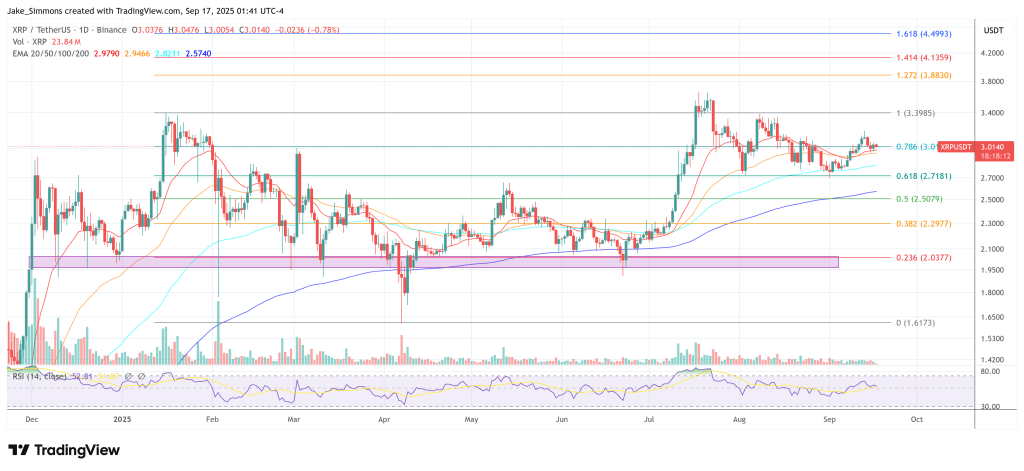
At press time, XRP traded at $3.01.
XRP price
XRP price, 1-day chart | Source: XRPUSDT on TradingView.com
Featured image created with DALL.E, chart from TradingView.com
Editorial Process for bitcoinist is centered on delivering thoroughly researched, accurate, and unbiased content. We uphold strict sourcing standards, and each page undergoes diligent review by our team of top technology experts and seasoned editors. This process ensures the integrity, relevance, and value of our content for our readers.

Jake Simmons has been a Bitcoin enthusiast since 2016. Ever since he heard about Bitcoin, he has been studying the topic every day and trying to share his knowledge with others. His goal is to contribute to Bitcoin's financial revolution, which will replace the fiat money system. Besides BTC and crypto, Jake studied Business Informatics at a university. After graduation in 2017, he has been working in the blockchain and crypto sector. You can follow Jake on Twitter at @realJakeSimmons.

Nội dung Liên quan

Lưu ý: Dự kiến sẽ có đợt mở khóa token lớn ở 16 đồng altcoin! Đây là danh sách chi tiết từng ngày và từng giờ

Tuần này, thị trường tiền điện tử đã trải qua một đợt tăng giá đáng mong đợi. Bitcoin đã tăng 22%, trong khi các altcoin như Ethereum và XRP cũng tăng trưởng ấn tượng, lần lượt là 30% và 51%. Động lực chính đến từ quyết định của Bộ Tài chính Mỹ về việc tăng mua lại trái phiếu. Tuy nhiên, một sự kiện quan trọng sắp diễn ra là đợi mở khóa token lớn của 16 altcoin, có thể tạo áp lực bán. Lịch trình mở khóa cụ thể như sau (theo giờ Thổ Nhĩ Kỳ, UTC+3): * **Ngày 25/8:** Plasma (XPL), Humanity (H), ChainOpera AI (COAI), Perle Labs (PRL), Iris (IRYS), OVERTAKE (TAKE). * **Ngày 26/8:** GateToken (GT), Huma Finance (HUMA), Sahara AI (SAHARA). * **Ngày 27/8:** AEON (AEON). * **Ngày 28/8:** Grass, Corn, Sign. * **Ngày 29/8:** Falcon Finance (FF), Midnight (NIGHT). * **Ngày 30/8:** BSquared Network (B2). Một số dự án có tỷ lệ mở khóa đáng chú ý so với vốn hóa thị trường là Humanity (H) 14,71%, Huma Finance (HUMA) 26,47% và AEON 26,11%. Sự kiện này cần được các nhà đầu tư theo dõi sát sao do tiềm ẩn tác động đến thanh khoản và giá. *Lưu ý: Đây không phải là lời khuyên đầu tư.

cryptonews.ru3 giờ trước

Lưu ý: Dự kiến sẽ có đợt mở khóa token lớn ở 16 đồng altcoin! Đây là danh sách chi tiết từng ngày và từng giờ

cryptonews.ru3 giờ trước

Tại sao các trang trại tiền điện tử ở Georgia trở thành chủ đề tranh cãi về hệ thống năng lượng

Bài viết thảo luận về những tranh cãi xoay quanh các trang trại khai thác tiền điện tử (cryptocurrency) ở Georgia, dựa trên tuyên bố của chính trị gia đối lập Roman Gotsiridze. Ông chỉ trích rằng các trang trại này tạo ra gánh nặng nguy hiểm cho lưới điện quốc gia, gần như không đóng góp gì cho ngân sách nhà nước và chỉ tồn tại được nhờ các đặc quyền về thuế cùng giá điện. Gotsiridze nhấn mạnh rằng hoạt động khai thác tiền điện tử không phải là vấn đề nếu kinh doanh công bằng, nhưng tại Georgia, ngành này được hưởng ưu đãi bất thường. Ông ước tính các trang trại này tiêu thụ khoảng 6% tổng sản lượng điện, tương đương 1 tỷ kWh mỗi năm – ngang với mức tiêu thụ của thành phố Batumi – trong khi đóng góp tài chính rất ít. Ông còn cho rằng hoạt động liên tục, 24/7 của chúng gây áp lực lớn, dẫn đến các sự cố lưới điện thường xuyên. Bài viết cũng đề cập đến bối cảnh chính trị, với cáo buộc của Gotsiridze rằng các trang trại lớn có liên hệ với giới tinh hoa trong đảng cầm quyền. Cuối cùng, ông kêu gọi cấm hoàn toàn việc khai thác tiền điện tử trong các khu công nghiệp tự do, thay vì chỉ điều chỉnh các điều kiện ưu đãi. Cuộc tranh luận này phản ánh mối quan tâm chung trên toàn cầu về tác động năng lượng của ngành công nghiệp tiền điện tử.

cryptonews.ru3 giờ trước

Tại sao các trang trại tiền điện tử ở Georgia trở thành chủ đề tranh cãi về hệ thống năng lượng

cryptonews.ru3 giờ trước

Nghiên cứu của Fed: Động lực của nhà đầu tư tiền điện tử là niềm tin, lợi nhuận thay đổi quyết định của họ

Một nghiên cứu mới từ Cục Dự trữ Liên bang Cleveland (Mỹ) phát hiện rằng niềm tin cá nhân về lợi nhuận tương lai, chứ không phải đặc điểm nhân khẩu học, là yếu tố chính thúc đẩy các nhà đầu tư mua tiền mã hóa. Người sở hữu tiền mã hóa kỳ vọng lợi nhuận trung bình 22% trong năm tới, cao hơn nhiều so với mức 7% của người không sở hữu, và họ cũng đánh giá tài sản này ít rủi ro hơn. Đáng chú ý, một thử nghiệm ngẫu nhiên cho thấy việc cung cấp thông tin về hiệu suất lợi nhuận trong quá khứ của Bitcoin có thể làm tăng đáng kể mong muốn sở hữu và dẫn đến các giao dịch mua thực tế sau đó, đặc biệt là ở những người trước đây thiếu thông tin. Điều này gợi ý một cơ chế hình thành bong bóng đầu cơ: lợi nhuận tích cực thu hút người mới, đẩy giá lên và lại thu hút thêm nhiều người tham gia. Nghiên cứu cũng chỉ ra rằng sự gia tăng giá trị tiền mã hóa có xu hướng được chi tiêu cho các mặt hàng lâu bền, giống như "tiền thắng cược" hơn là sự gia tăng tài sản vĩnh viễn. Kết luận chung cho thấy sự thiếu hiểu biết chung, quan điểm khác biệt rõ rệt và tác động của thông tin lợi nhuận quá khứ lên hành vi có thể là nguyên nhân khiến biến động giá vẫn là đặc điểm nổi bật của thị trường tiền mã hóa.

cryptonews.ru3 giờ trước

Nghiên cứu của Fed: Động lực của nhà đầu tư tiền điện tử là niềm tin, lợi nhuận thay đổi quyết định của họ

cryptonews.ru3 giờ trước

Giao dịch

Giao ngay
活动图片