Anyone Can Easily Create Prediction Markets, But Can Limitless' User-Generated Markets Last?

Foresight NewsPublished on 2026-07-02Last updated on 2026-07-02

Abstract

The article discusses the historical challenges of user-generated prediction markets in crypto, where previous attempts like Augur, Omen, Zeitgeist, and Manifold Markets failed due to fragmented liquidity, poor discoverability, and unreliable, slow settlement processes. These issues often led to platforms filled with inactive markets and low user engagement, prompting some, like Polymarket, to shift to a curated model. Limitless recently launched its User-Generated Market (UGM) feature, allowing anyone to create crypto price prediction markets. It addresses past failures through several key design choices: markets are limited to objective, oracle-based price questions (e.g., "Will Asset X be above $Y at time Z?") for instant, automatic settlement via Pyth and Chainlink, eliminating voting disputes. To combat spam and fragmentation, market creation requires burning 100-1000 LMTS tokens (a non-refundable cost), while creators earn 50% of the trading fees generated by their market, aligning incentives. The platform also benefits from an existing active user base and uses an order book model, removing the need for creators to provide initial liquidity. By tackling settlement reliability, liquidity fragmentation, and creator incentives, Limitless presents a new model for sustainable, permissionless prediction markets.


Author: Stacy Muur

Compiled by: AIdidiaoJP, Foresight News


In the crypto space, allowing users to freely create prediction markets has long been an unresolved, major challenge. Over the years, almost all attempts have ended in failure.


@trylimitless (Limitless) has taken a unique path to address this challenge. Recently, they launched the UGM (User-Generated Market) feature, allowing any user to create their own crypto price prediction markets. This is a bold attempt to tackle a long-standing pain point in the prediction market space.


Let's explore previous attempts, the reasons for their failures, and how Limitless is making this model work.


A History of Permissionless Prediction Markets


The earliest permissionless prediction market was @AugurProject. Launched on Ethereum in 2018, its core concept was "anyone can create a market on any topic, priced by the crowd for truth."
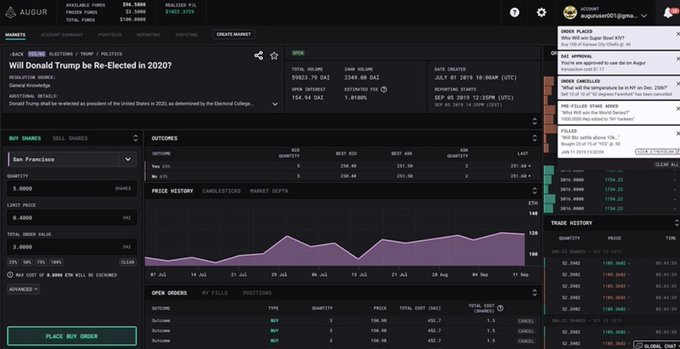


Perfect in theory, but desolate in practice. The project's token reached a peak market cap of over $170 million, yet its daily active users were only about 47, with fewer than 115 users per week.


The reasons for failure were brutal and mutually reinforcing:


  • Liquidity was scattered across thousands of empty markets (because anyone could create a market).
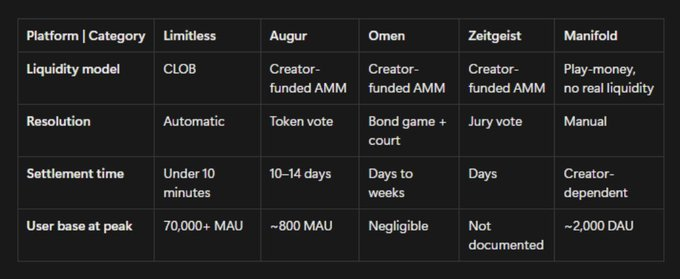
  • Market settlement took 10 to 14 days.
  • User funds were locked until settlement.
  • Users had to run their own Ethereum node before placing bets.


Augur was not an isolated case. @OmenEth on the Gnosis chain adopted a similar model and gradually faded. @ZeitgeistPM on Polkadot even added creator fees but still struggled to generate substantial trading volume. @ManifoldMarkets once built a real community using virtual currency, with daily active users peaking at several thousand, but later declined to below 900 after the hype subsided.


Different teams, different chains, yet all ending the same way.


A Recurring Pattern


This recurring pattern is hard to attribute to mere execution issues. Making creation free and easy doesn't create demand; it just floods the platform with more supply, all competing for the same small pool of attention.


This leads to fragmentation of prediction markets on two levels:


Thin Liquidity


Most markets created by users quickly become ghost towns. On early AMM (Automated Market Maker) platforms, creating a market also required providing initial liquidity with one's own capital, increasing the cost.


Poor Discoverability


When anyone can create a market, you quickly get a dozen slightly different versions of "Will the Fed cut rates in July?" markets, further fragmenting liquidity.


Imagine a user opening the app and seeing a list of half-dead markets, each with almost no liquidity. Who would want to stay?


It was this very problem that forced the industry's biggest player to pivot. In 2022, Polymarket shifted to a curated model, concentrating liquidity into a few deep markets, which proved effective. But it also abandoned its initial promise of open creation—the "harder version" of allowing anyone to easily launch a market remained unsolved.


The Settlement Challenge


Liquidity and discoverability are tricky enough, but if settlement isn't hardcoded, user trust collapses.


After a market ends, the platform needs to decide how to settle it. Objective events like "Will Bitcoin close above $100,000?" are easy to handle. But those requiring subjective interpretation, like whether a politician's statement constitutes endorsement of a specific policy, easily spark controversy.


Most platforms rely on token holder voting to resolve disputes. The intention is decentralized settlement, but in practice, voting power is often concentrated among the largest holders. And since they can also place bets like regular users, they have the potential to manipulate outcomes.


This erodes trust in the fairness of settlement, creating another path back to the liquidity problem.


How Limitless Responds


Any new attempt must overcome the three hurdles of thin liquidity, poor discoverability, and unreliable settlement. @trylimitless has made different choices in these areas.


Focusing on the newly launched UGM feature: any user can create a market in just a few steps:


  • Select an asset.
  • Set a price target (percentage change or specific dollar value).
  • Set a duration (from 15 minutes to 1 day).
  • Launch (requires holding LMTS tokens).


The longer the market duration, the higher the creation cost.


Anyone can trade these markets. Upon expiry, an oracle automatically pulls the asset price and settles the result instantly. These markets rely on real-time price feeds from @PythNetwork and @Chainlink, requiring no voting, no dispute panels, no committees.


Markets are limited to objective types, e.g., "Will SOL be above price X at a given time?". The smart contract can automatically settle the moment the market closes. It's not possible to create markets requiring human interpretation (like election results or disputed news events). Limitless deliberately restricts the scope to price markets because this is the only type that can be reliably settled within seconds every time, whereas other platforms often take hours or even days.


The cold-start problem tripped up most previous platforms. Limitless already has advantages here:


  • Cumulative trading volume exceeding $3 billion.
  • Trading volume in May and June exceeding $1.2 billion.
  • Peak monthly active traders over 70,000.


There is already a fairly active trader base, completely different from Augur in 2018.


Another crucial difference: Limitless uses an order book model rather than the early AMM model. On platforms like Augur, creating a market required funding initial liquidity yourself. Limitless eliminates this step entirely; traders place their own buy and sell orders, and markets only need to attract them.


The most ingenious part is the creator economic mechanism. Creating a market costs 100 to 1000 LMTS tokens, which are non-refundable. In return, the creator receives 50% of all trading fees generated by that market.


On one side is a real cost, on the other a real reward. The cost effectively prevents market spam, as each market requires a real financial commitment. The reward means truly active markets can generate tangible fee income for creators.


The cost mechanism also adds utility to the LMTS token. Creating each market burns LMTS tokens from the open market, directly linking token utility to UGM activity. The more people create markets, the greater the demand for LMTS.


Summary and Outlook


The existing evidence clearly points in one direction: all previous attempts at permissionless prediction markets either got bogged down in settlement disputes, drowned in dead liquidity, or simply abandoned the open model for curation.


Limitless is the first solution designed to address all three failure modes simultaneously.


Settlement (the trickiest problem) is completely avoided by sticking to oracle-based price markets.


The cold-start problem is mitigated by an existing active user base.


The cost-and-reward structure for market creation balances incentives for both sides.


Most importantly, with these markets settling faster, we will quickly see if the design works at scale.


If it does, permissionless prediction markets finally have their first viable blueprint.


Disclosure: The author holds some $LMTS tokens and is a Limitless user.

Trending Cryptos

Related Questions

QWhat are the three main reasons why previous attempts at permissionless prediction markets, like Augur, have generally failed?

AThey failed due to three main reasons: 1) Thin liquidity fragmented across thousands of empty markets. 2) Poor discoverability caused by market duplication and a cluttered interface. 3) Unreliable and slow dispute resolution processes, often taking days and being prone to manipulation.

QHow does Limitless's new UGM feature specifically address the problem of market creation spam and low-quality markets?

ALimitless addresses this by implementing a cost-to-create mechanism. Creating a market requires spending 100 to 1000 LMTS tokens, which are burned. This real cost discourages the creation of frivolous or spam markets. In return, creators are incentivized with 50% of all trading fees generated by their market, aligning rewards with market success.

QWhat is the key difference in how Limitless handles market settlement compared to earlier platforms, and why is this significant?

ALimitless exclusively uses oracle-based price markets (e.g., "Will Asset X be above price Y at time Z?") that settle automatically and instantly via price feeds from providers like Pyth Network and Chainlink. This is significant because it completely avoids the slow, contentious, and potentially manipulative dispute resolution processes (like token-holder voting) that plagued earlier platforms, ensuring fast, trustless, and objective settlements.

QWhat advantage does Limitless have over earlier projects like Augur regarding the 'cold start' problem of attracting initial users and liquidity?

ALimitless already has an established, active user base and trading volume before launching UGM. The article cites over $30B in cumulative volume, over $12B in May and June volume, and a peak of over 70,000 monthly active traders. This existing ecosystem provides immediate attention and potential liquidity for newly created user markets, unlike earlier projects that launched into empty platforms.

QAccording to the article, how does the economic design of UGM potentially benefit the LMTS token?

AThe UGM design directly benefits the LMTS token by creating a built-in burn mechanism. Every new market creation burns LMTS tokens, permanently removing them from circulation. As more users create markets, the demand for LMTS tokens to pay the creation fee increases, which can positively impact the token's utility and value.

Related Reads

Bernstein Reveals Details of Core Scientific's $14 Billion Deal with AMD

Analysts from Bernstein revealed details of a deal between Core Scientific and AMD with a potential total value of over $14 billion. According to the report, initial contracts for 530 MW of capacity could generate this revenue over 15 years, with AMD acting as a credit guarantor for part of the bitcoin miner's infrastructure. The partnership, announced on July 28, has the potential to allocate up to 2.5 GW of data center capacity for AI. Bernstein broke down the 530 MW into 377 MW of direct triple-net lease for AMD and 152 MW for an unnamed cloud provider backed by AMD's credit. This structure is seen as lowering financing costs and counterparty risk. AMD also received warrants to buy 30 million Core Scientific shares at $23.47 each, which vest upon reaching the 2.5 GW target. Average annual revenue from the deal is estimated at around $0.9 billion, or about $1.8 million per megawatt, which is 5-25% below recent AI hosting deals by other miners. However, the 377 MW triple-net lease for AMD carries a margin close to 100%. Core Scientific expects capital expenditures for the deal to be $11-12 million per MW, totaling about $6 billion. Bernstein views this partnership as a new phase in the transformation of former bitcoin miners into AI infrastructure operators, with AI chipmakers like AMD now acting as direct anchor tenants. Recent similar deals include Hut 8 allocating 704 MW to a tenant believed to be Nvidia, and AMD reserving 200 MW with Riot Platforms. Core Scientific also paid Block $41.9 million to terminate a mining chip supply contract as part of its accelerated diversification into AI.

cryptonews.ru30m ago

Bernstein Reveals Details of Core Scientific's $14 Billion Deal with AMD

cryptonews.ru30m ago

Trading

Spot

Hot Articles

How to Buy AL

Welcome to HTX.com! We've made purchasing Archloot (AL) simple and convenient. Follow our step-by-step guide to embark on your crypto journey.Step 1: Create Your HTX AccountUse your email or phone number to sign up for a free account on HTX. Experience a hassle-free registration journey and unlock all features.Get My AccountStep 2: Go to Buy Crypto and Choose Your Payment MethodCredit/Debit Card: Use your Visa or Mastercard to buy Archloot (AL) instantly.Balance: Use funds from your HTX account balance to trade seamlessly.Third Parties: We've added popular payment methods such as Google Pay and Apple Pay to enhance convenience.P2P: Trade directly with other users on HTX.Over-the-Counter (OTC): We offer tailor-made services and competitive exchange rates for traders.Step 3: Store Your Archloot (AL)After purchasing your Archloot (AL), store it in your HTX account. Alternatively, you can send it elsewhere via blockchain transfer or use it to trade other cryptocurrencies.Step 4: Trade Archloot (AL)Easily trade Archloot (AL) on HTX's spot market. Simply access your account, select your trading pair, execute your trades, and monitor in real-time. We offer a user-friendly experience for both beginners and seasoned traders.

8.8k Total ViewsPublished 2024.05.06Updated 2026.06.02

How to Buy AL

Discussions

Welcome to the HTX Community. Here, you can stay informed about the latest platform developments and gain access to professional market insights. Users' opinions on the price of AL (AL) are presented below.

活动图片