Hurun Report Interview with Justin Sun: New Paradigm of Value Circulation in the Web3 Transformation Cycle

链捕手Publicado a 2026-05-29Actualizado a 2026-05-29

Resumen

In an interview with *Hurun Report*, Justin Sun, founder of TRON, discussed the evolution of the Web3 industry as it transitions from early-stage exploration to large-scale adoption. He emphasized that the fundamental goal of blockchain technology is to build an open and inclusive internet of value, enabling low-cost, efficient fund transfer for anyone globally, regardless of location or access to banking. Sun highlighted stablecoins as the most mature and scalable application within Web3, noting that TRON has grown into one of the world's largest stablecoin networks, with over $86.3 billion in USDT circulation. He attributed this growth to genuine user demand in cross-border payments and daily transactions, reflecting a structural shift where blockchain's openness and efficiency are naturally supplementing traditional financial systems. Regarding strategy, Sun outlined a framework combining data-driven iteration, rapid execution, and user-centricity. He pointed to TRON's partnership with Tether for TRC-20 USDT as a key decision that leveraged market trends and network effects to build a competitive moat. He also stressed the importance of globalization, noting that success in different markets depends on deep local compliance, cultural adaptation, and partnership networks. Sun expressed strong interest in the convergence of AI and blockchain, viewing AI as a transformative force that can enhance blockchain's intelligence and user experience, while blockchain provides dece...

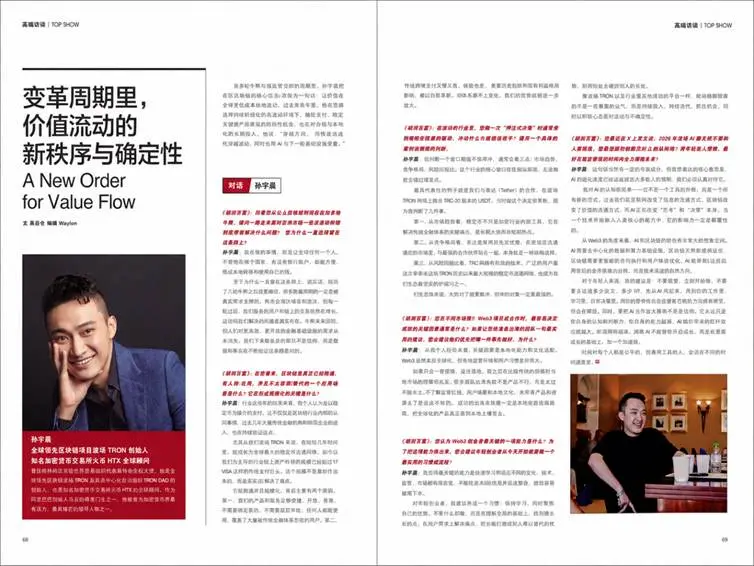
Against the backdrop of the Web3 industry entering a deep-water zone and the accelerated global restructuring of financial infrastructure, blockchain is transitioning from early exploration to large-scale application. As an authoritative institution with extensive influence in business and investment, an in-depth interview by the renowned magazine, Hurun Report, is regarded as a significant industry barometer. Recently, Justin Sun, founder of TRON, in an exclusive interview with Hurun Report, systematically elaborated his judgment on industry evolution and long-term value around core issues such as stablecoin payments, globalization path, and AI integration trends. His views also reflect the critical stage where Web3 infrastructure is moving from "feasibility verification" to "global adoption".
Stablecoins Building a Global Value Circulation Network, Web3 Infrastructure Enters Scaling Phase

In the interview with Hurun Report, Justin Sun summarized the core goal he has long been committed to in extremely concise terms: "To enable any person in the world, regardless of location or whether they have a bank account, to transfer and use their funds at low cost and high efficiency." This statement fundamentally reveals the value essence of blockchain technology — constructing an open and inclusive value internet.

He further pointed out that after the blockchain industry has gone through multiple bull and bear cycles, projects truly capable of weathering these cycles must be built upon real demand and practical usage. The continuous growth of on-chain user scale and transaction volume is an important basis for his judgment of industry direction. In this context, the on-chain payment system centered around stablecoins has become the most mature and capable application scenario for scaling currently.

In the Hurun Report interview, Justin Sun mentioned that TRON has rapidly developed into one of the world's largest stablecoin circulation networks, with its on-chain asset transfer volume even surpassing that of some traditional payment networks. This growth is not driven by short-term market sentiment but based on the continuous use by real users in scenarios such as cross-border transfers, value storage, and daily payments. Official data shows that the current circulation of USDT on the TRON chain has exceeded $86.3 billion, a scale reflecting strong network effects driven by real user demand.

From a structural advantage perspective, the scaling of stablecoin payments benefits from two factors: on one hand, blockchain networks possess openness and permissionless characteristics, enabling them to cover user groups difficult for the traditional financial system to reach; on the other hand, the limitations of traditional cross-border payment systems in efficiency, cost, and user experience provide significant substitution space for new-generation infrastructure. Sun believes this trend is essentially a "natural substitution" of existing financial systems by technological progress, not short-term competition.

Globalization Strategy and Technology Convergence Advance in Parallel, Building Long-term Competitive Advantage for Web3

When discussing enterprise growth and strategic decision-making, Justin Sun presented a highly systematic methodology in the Hurun Report interview. He summarized the success factors as the combination of "data-driven iteration, rapid execution, and user orientation," emphasizing that in a rapidly changing technological environment, single-dimensional capabilities can no longer support long-term competitiveness; the synergy of these three is necessary to achieve efficient trial-and-error and precise decision-making.

At the organizational level, he proposed a management framework of "clear direction, layered support, and a sense of ownership among all members" to avoid deviation and loss of control during rapid expansion. This organizational structure, emphasizing flatness and agility, is seen as an important foundation for Web3 enterprises to maintain competitiveness in highly uncertain environments.

Regarding key strategic decisions, Sun reviewed the case of TRON's partnership with Tether to launch TRC-20 USDT in the Hurun Report interview. He stated that this decision was based on a comprehensive assessment of market trends, competitive landscape, and risk-reward ratio: stablecoins represent a long-term trend in financial system evolution, top assets possess significant network effects, and the upside potential in this field far outweighs the potential risks. It has been proven that this cooperation became a crucial growth engine for the TRON ecosystem and built its core competitive moat in the stablecoin domain.

Regarding global expansion, Sun emphasized that while Web3 has inherent cross-border properties, its actual implementation remains highly dependent on local compliance and cultural adaptation. In the Hurun Report interview, he noted that different markets have significant differences in regulatory frameworks, user habits, and business environments. The success of a project often depends on the depth of understanding of these differences and the ability to build local partnership networks.

Furthermore, Justin Sun expressed a clear judgment on the development of AI technology. In the interview, he stated that AI is not merely a tool upgrade but a reconstruction of "thinking and decision-making capabilities." Its integration with blockchain in data, computing power, and intelligent execution will become a crucial direction for the next stage of technological evolution. Blockchain provides decentralized infrastructure for AI, while AI enhances the intelligence and user experience of blockchain systems; the convergence of the two holds long-term strategic value.

For industry participants and young entrepreneurs, the core advice Justin Sun gave in the Hurun Report interview is: in a highly uncertain environment, continuous learning and rapid adaptation are the most critical abilities. Simultaneously, one should focus investments based on an understanding of the overall industry landscape, building irreplaceable core strengths rather than dispersing resources across multiple tracks.

From early-stage technical verification and market exploration, gradually entering the large-scale application phase represented by stablecoins, and extending towards AI convergence and global compliant implementation. In this process, TRON is continuously advancing the implementation and evolution of the value internet through infrastructure capabilities, globalization strategy, and forward-looking technological layout.


Criptos en tendencia

Lecturas Relacionadas

MoonPay lanza PayBox

MoonPay, desarrolladora de soluciones de pagos en cripto y monedas tradicionales, ha lanzado PayBox, una nueva cartera de pagos que permite a asistentes de IA como Claude y ChatGPT realizar transacciones. Los usuarios pueden gestionar activos digitales y pagar servicios en línea directamente dentro del chat. Con una solicitud a la IA, se pueden realizar acciones como comprar PYUSD, intercambiar tokens, transferir activos entre blockchains, depositar fondos en protocolos DeFi o reservar vuelos. Cada operación requiere confirmación mediante una clave de acceso. PayBox es compatible con Solana y blockchains basados en EVM (Ethereum, Base, Arbitrum, Polygon, Hyperliquid, Tempo y Robinhood Chain), con planes de agregar más redes. Admite tanto carteras de criptomonedas como tarjetas de pago. La seguridad se garantiza mediante tecnología MPC (computación multipartita) y entornos de ejecución seguros, evitando que cualquier parte, incluidos MoonPay o el asistente de IA, tenga acceso total a los activos. Ofrece dos modos de permisos: "Preguntar siempre", que requiere confirmación manual, y "Autónomo", donde la IA opera dentro de límites predefinidos. Todos los permisos son modificables en cualquier momento. PayBox utiliza la tecnología de Sodot, empresa especializada en carteras seguras adquirida por MoonPay este año, infraestructura que ya protege más de $50 mil millones en activos digitales en más de 10 millones de carteras.

cryptonews.ruHace 14 min(s)

MoonPay lanza PayBox

cryptonews.ruHace 14 min(s)

Casper prepara el lanzamiento de la versión actualizada de csprUSD

La plataforma de blockchain Casper, junto con la empresa de inversión Sarson Funds, ha presentado una versión actualizada de su stablecoin csprUSD. Tras su lanzamiento, se convertirá en el principal stablecoin vinculado al dólar dentro del ecosistema Casper. Una de sus funciones clave será facilitar los pagos automatizados entre agentes de inteligencia artificial mediante el protocolo x402. Esta actualización surge tras la creación de la Fundación x402 bajo Linux Foundation, que cuenta con miembros como Visa, Mastercard, Google, Coinbase, Circle, Stripe, AWS y Cloudflare. El protocolo x402 permite a los agentes de IA pagar bienes y servicios en línea enviando peticiones HTTP estándar, sin depender de los sistemas de pago tradicionales. La nueva versión de csprUSD será compatible con Casper 2.0 e incorporará el soporte para el estándar CEP-3009. Esto permitirá a usuarios y agentes de IA confirmar pagos fuera de la cadena de bloques (off-chain), cuya ejecución final se realizará dentro de la red. Además, se integrará la tecnología ProofLayer de Casper, que genera pruebas criptográficas para datos externos a la blockchain. Esta tecnología permitirá verificar las reservas en dólares que respaldan al csprUSD, así como supervisar la emisión y amortización de los tokens. Antes del lanzamiento en la red principal, el contrato inteligente del stablecoin será sometido a una auditoría de seguridad independiente. Previamente, Casper ya había reducido la comisión mínima por transacción de 2.5 a 0.1 CSPR tras la aprobación de la propuesta CEP-97.

cryptonews.ruHace 17 min(s)

Casper prepara el lanzamiento de la versión actualizada de csprUSD

cryptonews.ruHace 17 min(s)

La blockchain Ethereum cumple 11 años. Cómo ha crecido 'ether' y qué viene a continuación

Hace once años, el 30 de julio, se lanzó la red principal de Ethereum. La criptomoneda ETH, que sigue siendo la segunda más grande por capitalización de mercado (más de 230 mil millones de dólares a mediados de 2026), ha crecido unas 6,200 veces desde su precio inicial estimado de 0.31 dólares en su ICO de 2014, hasta alcanzar unos 1,920 dólares actualmente. También se ha revalorizado notablemente frente al Bitcoin. A pesar de este crecimiento a largo plazo, el precio de ETH ha mostrado un rendimiento menos positivo en los últimos cinco años, manteniéndose muy por debajo de su máximo histórico cercano a los 5,000 dólares alcanzado en 2021 y nuevamente en 2025. Este período de estancamiento relativo coincidió con una fase de inactividad en el desarrollo del protocolo tras su transición al mecanismo de prueba de participación (staking) en 2022. Sin embargo, desde 2026, la comunidad de desarrolladores de Ethereum ha reactivado sus esfuerzos. Las áreas de enfoque actuales son ambiciosas e incluyen la construcción de infraestructura para inteligencia artificial, la mejora de la privacidad, el escalado de la red e incluso la preparación contra posibles amenazas de computación cuántica. Vitalik Buterin ha descrito estos planes como una reestructuración integral del sistema. Paralelamente, se están formando nuevas organizaciones para fomentar el interés institucional en el activo.

cryptonews.ruHace 45 min(s)

La blockchain Ethereum cumple 11 años. Cómo ha crecido 'ether' y qué viene a continuación

cryptonews.ruHace 45 min(s)

Trading

Spot

Artículos destacados

Cómo comprar SUN

¡Bienvenido a HTX.com! Hemos hecho que comprar SUN (SUN) sea simple y conveniente. Sigue nuestra guía paso a paso para iniciar tu viaje de criptos.Paso 1: crea tu cuenta HTXUtiliza tu correo electrónico o número de teléfono para registrarte y obtener una cuenta gratuita en HTX. Experimenta un proceso de registro sin complicaciones y desbloquea todas las funciones.Obtener mi cuentaPaso 2: ve a Comprar cripto y elige tu método de pagoTarjeta de crédito/débito: usa tu Visa o Mastercard para comprar SUN (SUN) al instante.Saldo: utiliza fondos del saldo de tu cuenta HTX para tradear sin problemas.Terceros: hemos agregado métodos de pago populares como Google Pay y Apple Pay para mejorar la comodidad.P2P: tradear directamente con otros usuarios en HTX.Over-the-Counter (OTC): ofrecemos servicios personalizados y tipos de cambio competitivos para los traders.Paso 3: guarda tu SUN (SUN)Después de comprar tu SUN (SUN), guárdalo en tu cuenta HTX. Alternativamente, puedes enviarlo a otro lugar mediante transferencia blockchain o utilizarlo para tradear otras criptomonedas.Paso 4: tradear SUN (SUN)Tradear fácilmente con SUN (SUN) en HTX's mercado spot. Simplemente accede a tu cuenta, selecciona tu par de trading, ejecuta tus trades y monitorea en tiempo real. Ofrecemos una experiencia fácil de usar tanto para principiantes como para traders experimentados.

900 Vistas totalesPublicado en 2024.12.12Actualizado en 2025.03.21

Cómo comprar SUN

Discusiones

Bienvenido a la comunidad de HTX. Aquí puedes mantenerte informado sobre los últimos desarrollos de la plataforma y acceder a análisis profesionales del mercado. A continuación se presentan las opiniones de los usuarios sobre el precio de SUN (SUN).

活动图片