The Return of the Rimland: A Renewed Game Around Sea Power, Energy, and the Dollar

marsbitОпубліковано о 2026-04-13Востаннє оновлено о 2026-04-13

Анотація

Retitled "The Return of the Rimland: A Re-Game Surrounding Sea Power, Energy, and the Dollar," this analysis argues that the conflict centered on Iran is no longer a localized military issue but a systemic global struggle over who controls the flows of energy and trade. The U.S. is employing a "Rimland" strategy, using naval blockades, threats of 50% tariffs on nations aiding Iran, and the redirection of energy routes (like reactivating the Trans-Arabian Pipeline) to draw China into the conflict and bypass strategic chokepoints like the Strait of Hormuz. This has turned a regional confrontation into a structural shock impacting global energy markets, supply chains, and the financial system. Key market risks are not yet fully priced in. While oil prices have spiked, the second-order effects—such as tightened liquidity, pressure on tech investments (like AI from helium supply risks), reduced consumer spending, and agricultural supply shocks from high fertilizer costs—are only beginning to manifest. The Federal Reserve faces a dilemma on whether to tighten policy against this energy-driven inflation. The conflict's escalation is inevitable; the central questions are the pathways of its diffusion and when markets will price in these broader, systemic risks.

Editor's Note: Ceasefire, blockade, and tariff threats—the conflict surrounding Iran has not subsided but continues to spill over. From the Strait of Hormuz to the Red Sea, from energy corridors to trade秩序, the core of the situation is no longer a local military confrontation but a systemic博弈 around "who controls the flow."

Using the "Rimland" strategy as a线索, this article points out that the United States is attempting to turn the conflict from a regional issue into a global one by海上封锁 and restructuring energy routes, drawing China into it. As sanctions and interception measures escalate, the confrontation originally centered on the Middle East is transforming into a structural冲击 affecting global energy, supply chains, and the financial system.

More critically, the market has not fully digested this "chain reaction." The immediate fluctuations in oil prices are only the first step; their transmission to liquidity, tech investments, consumer spending, and even agricultural supply is just beginning to show. After the revaluation of energy prices, the real test is how the global economy will withstand the second-round冲击 triggered by this.

This means that the current issue is no longer whether the conflict will escalate, but along which paths its impact will扩散, and when the market will start to pay for these尚未定价 risks.

Below is the original text:

Alright, the situation is now clear.

The tensions we highlighted last Wednesday have proven to be irreconcilable.

Iran wants nuclear weapons and control over the strait; and Trump cannot accept either of these. How far apart are these two "target circles"? So much so that even Israel's war with Lebanon hasn't been included in the discussion agenda.

I won't claim my judgment was precise, but we may indeed have entered the "mid-game." This is not a conflict that can be called off in an afternoon. The core issue is very simple: Who will control the world's most important水道? And, is Iran willing to threaten its neighbors to gain bargaining chips for nuclear negotiations?

That is the key.

What is now becoming clear is a整套策略路径. Readers who have followed along, from "Fighting for the Dollar" to "Don't Take the Bait," to "Awakening the Hegemon" and "Fragile Peace," should already see the pattern.

Trump is executing a "Rimland" strategy.

Intercept shipping. Threaten to impose 50% tariffs on all countries providing weapons to Iran. Instead of attacking the内陆(heartland), control the maritime channels of energy transport to draw China into this博弈. For every mine Iran lays, for every oil tanker it attacks, retaliate tenfold—seize their vessels, control oil tankers, directly sell their crude oil.

Settle in U.S. dollars.
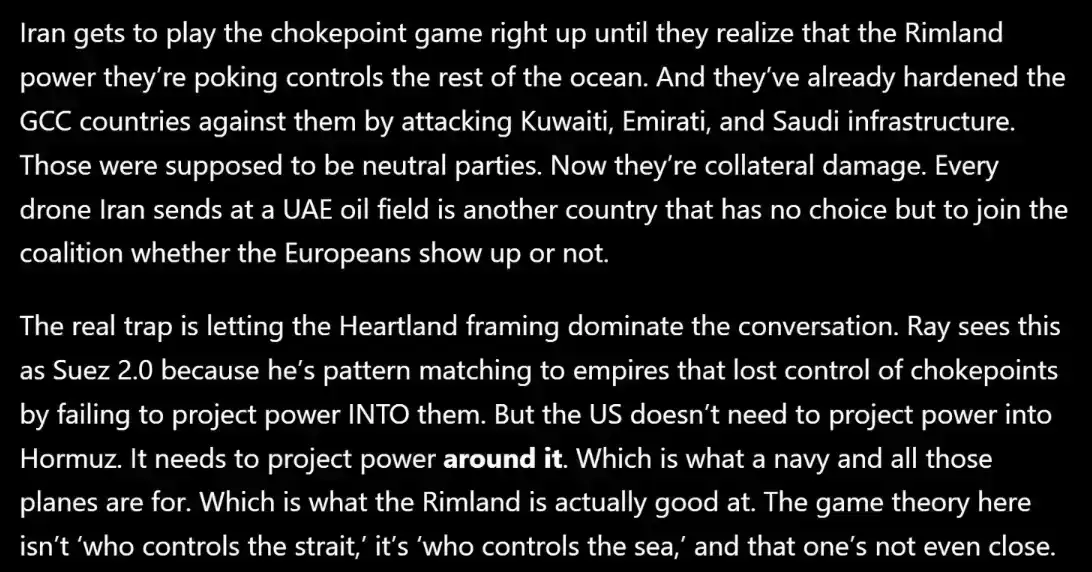
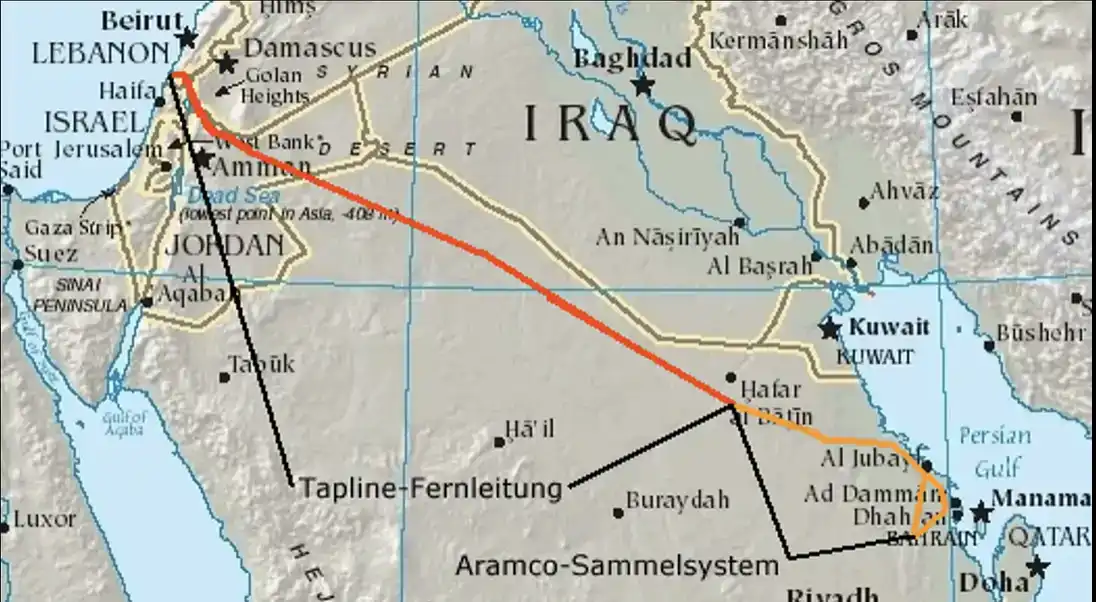
Then there's the "Abraham Accords." Saudi oil is transported via Jordan to the port of Haifa; the Trans-Arabian Pipeline (Tapline) is being reactivated. A corridor of physical infrastructure is connecting coastal countries into an energy network, completely bypassing the "heartland." This is a "Rimland alliance" built with pipelines and steel.

In my view, we have reached this point largely due to this process itself—Iran (and China) ignited Israel through Hamas' actions on October 7, thereby interrupting this normalization process; had this process advanced, it could have formed an alternative trade route bypassing the Strait of Hormuz and even the "Belt and Road."
This also explains the divergence between Washington and Brussels. The U.S. feels the weight of responsibility; Europe似乎 believes it can secure energy access through private negotiations while letting the "older brother" bear the cost of conflict. France, on one hand, blocked relevant UN Security Council resolution, while on the other, negotiated bilateral transit arrangements through the strait with various parties and called for the formation of an "alliance of independent nations." This is a typical "heartland" mindset: making deals with inland powers, avoiding direct conflict, as if maritime routes will maintain themselves.

Trump has just堵上了 this漏洞—and thus turned America's problem into the world's problem.

As of writing, crude oil prices have risen over 6%, stocks have fallen about 1%, and last week's gains due to the ceasefire look highly likely to be quickly erased. I bought some VIX call options over the weekend, so you could say I have a bit of a立场.

How the situation develops next depends on a series of more fundamental questions:

· Can the ceasefire hold for another week, or will it collapse in "reverse deduction"?·

Trump has stated he will intercept ships that have paid "tolls" to Iran—does this include Chinese ships? What will happen when they try to load crude from Kharg Island?

· He has also reiterated the threat of imposing 50% tariffs on any country providing weapons to Iran—does this mean a trade war is back on the agenda?

Then there's Iran's countermeasures: it could activate the Houthis, who still have the capability to make the Bab el-Mandeb strait difficult to pass. Notably, most oil tankers transporting crude via Saudi Arabia's "East-West Pipeline" are VLCCs (Very Large Crude Carriers) that cannot pass through the Suez Canal. If the Houthis escalate, it would affect not only Red Sea shipping but force these giant tankers carrying the most critical crude to take much longer routes.

The main thread is: this conflict continues to expand in scale and spillover scope.

By escalating actions to全面拦截 all ships paying "tolls" to Iran and reiterating tariff threats, Trump has explicitly drawn China into this博弈. Beijing has been hoarding crude for years precisely for scenarios like this. But against the backdrop of an economy dragged down by real estate, how long can the Chinese market remain "calm"? How likely is it to escalate confrontation to ensure energy supply?

From Venezuela to Iran, the sequence of these actions looks increasingly like a deliberately designed strategy.

The "Rimland" is returning.

Next, are the chain reaction questions at the market level:

· How bad will Monday's open be? The first round of selling came mainly from short-term funds and retail buying of put options. When will long-term funds start to see volatility as uncontrollable, forcing them to sell or hit risk limits?

· Last week, hedge funds quickly covered their "long AI hardware, short software" positions. But with oil prices, falling bonds, tightening liquidity,再加上 Gulf helium supply chain risks (a key input for chip manufacturing), is it enough to reprice expectations for the AI acceleration cycle?

· Before the conflict, the U.S. Q1 economy grew almost zero. As energy prices surge, household disposable income is eaten up by gasoline, heating, and jet fuel—will families cut spending or lever up further?

· Fed meeting minutes show policymakers are already discussing tightening policy to counter energy-driven inflationary pressures. A new round of debate on "how to handle negative supply shocks" is unfolding. Faced with an energy shock of this magnitude, can the Fed still "choose to look away"?

Ultimately, these questions point to a larger "chain reaction."

The "Rimland" strategy addresses energy and the dollar, but it does not solve the entire system supported by energy. The market is currently only pricing the "first node," it hasn't transmitted to the "second node" yet. Oil prices can revalue quickly on news, but agricultural production cycles don't. Urea prices are still at $700, and the USDA's projected wheat planting area will be the lowest since 1919—this won't reverse just because two diplomats shake hands. Farmers who couldn't afford fertilizer in March can't "replant" in April.

Пов'язані питання

QWhat is the core strategic concept discussed in the article regarding the US approach to the Iran conflict?

AThe article identifies the US strategy as a revival of the 'Rimland' strategy, which involves controlling key maritime energy transport routes and applying economic pressure (like tariffs and shipping interdictions) to draw global powers like China into the conflict, rather than engaging in direct inland ('heartland') military confrontation.

QAccording to the article, how is the conflict impacting global markets beyond the immediate oil price spike?

AThe article states that the initial oil price volatility is just the first step. The conflict's effects are beginning to transmit to broader areas, including liquidity, technology investment (potentially repricing AI cycle expectations due to helium supply risks), consumer spending (as energy costs erode disposable income), and agricultural supply chains (due to high fertilizer costs and reduced planting areas that cannot be quickly reversed).

QWhat specific action did the US take to counter European attempts to secure energy access independently?

AThe article states that the US, under Trump, 'plugged the loophole' by moving to intercept all ships that had paid 'transit fees' to Iran. This action countered European efforts (like France's bilateral passage negotiations and calls for an 'independent coalition') to privately secure energy transit deals while avoiding direct conflict, thereby making the US problem a global one.

QWhat is one major potential Iranian countermeasure discussed, and what would be its secondary effect on oil transport?

AA major potential Iranian countermeasure is activating the Houthis to disrupt the Bab el-Mandeb Strait. A secondary effect is that this would not only impact Red Sea shipping but also force Very Large Crude Carriers (VLCCs) carrying Saudi oil via the East-West pipeline to take much longer routes, as these massive ships cannot transit the Suez Canal.

QHow does the article connect the 'Rimland' strategy to the broader global economic system and the Federal Reserve's potential response?

AThe article argues that the 'Rimland' strategy addresses issues of energy and dollar control but does not solve the problems for the entire system that energy supports. It suggests the Federal Reserve may be forced to abandon its practice of 'looking through' energy-driven inflation and instead tighten monetary policy to confront a major negative supply shock, which would have widespread economic consequences.

Пов'язані матеріали

The Era Has Arrived Where Human Writers Must Prove They Are Not Machines

The article describes an era where AI-generated content is flooding the market, forcing human authors to prove they are not machines. It begins with the example of dozens of AI-written, error-ridden biographies of Henry Kissinger appearing on Amazon within hours of his death, a pattern repeated for other deceased celebrities and even living experts who find fraudulent books under their names. This spam content has exploded, with monthly new book releases on platforms like Amazon reaching 300,000 by late 2025. The issue spans genres, from suspiciously high proportions of AI-written teen romance and self-help books to dangerous, AI-generated foraging guides containing lethal advice. The platforms' automated review systems, designed to catch plagiarism and banned words, are ill-equipped to detect AI-generated text that avoids these pitfalls while being nonsensical or fraudulent. The problem has infiltrated traditional publishing. A major publisher, Hachette, had to recall a bestselling horror novel after AI detection tools suggested 78% of its content was machine-generated. An acclaimed European philosophy book was later revealed to be entirely written by AI under a fake author persona. In response, authors are fighting back. At the 2026 London Book Fair, 10,000 writers published a blank book titled "Don't Steal This Book" containing only their signatures—using emptiness as a protest weapon in an age of AI overproduction. Initiatives like the "Human Author Certification" program have emerged, ironically placing the burden on humans to prove their work is not machine-made. The article warns of a vicious cycle: AI-generated low-quality books pollute the data used to train future AI models, leading to "model collapse" and an ever-worsening flood of digital waste, eroding trust in publishing and devaluing human creativity.

marsbit13 хв тому

The Era Has Arrived Where Human Writers Must Prove They Are Not Machines

marsbit13 хв тому

The King of Blind Date Attire in Korea: How SK Hynix Made a Comeback Against Samsung?

In South Korea's dating scene, SK Hynix employees are now highly sought after, a status shift fueled by the company's astronomical profits and employee bonuses, projected to reach up to 6.1 million RMB per person by 2027. This marks a dramatic reversal for the long-time second-place player in memory semiconductors, which has now surpassed its rival Samsung in annual operating profit. The turnaround story began in 2008 when a struggling Hynix, emerging from bankruptcy restructuring, took a risky bet by agreeing to develop High Bandwidth Memory (HBM) with AMD. At the time, HBM had no clear market beyond high-end graphics cards and was a costly, complex technology. Major players like Samsung, pursuing its own HMC technology, declined. For Hynix, with only memory as its core business, it was a gamble born of necessity. The pivotal moment came in 2012 when SK Group Chairman Chey Tae-won acquired Hynix. Defying industry downturns, he invested heavily in R&D and fabrication, sustaining the HBM project through over a decade of commercial uncertainty and internal challenges. A key break occurred around 2016-2017 when Samsung faced production issues supplying HBM2 for Google's TPU, allowing SK Hynix to gain a crucial foothold in the data center market. The AI explosion post-ChatGPT in 2022 was the catalyst, turning HBM into a critical bottleneck for AI accelerators like NVIDIA's GPUs. By 2025, SK Hynix captured 62% of the global HBM market, leaving Samsung at 17%. For the first time, its annual operating profit exceeded Samsung's. Analysts point to the "innovator's dilemma" to explain Samsung's miss: its vast, successful business portfolio made it risk-averse, preventing an all-in bet on the initially niche HBM technology. In contrast, SK Hynix, as a challenger with its back against the wall, had no choice but to commit fully. The story highlights how Korea's chaebol system allows for ultra-long-term bets beyond quarterly pressures. However, SK Hynix's lead isn't guaranteed. Samsung is aggressively catching up on HBM4, and challenges like customer concentration (heavy reliance on NVIDIA) and technical hurdles in advanced packaging remain. The narrative underscores a market truth: the greatest alpha often comes from betting on uncertain, long-term directions others dismiss, much like HBM in 2008.

marsbit53 хв тому

The King of Blind Date Attire in Korea: How SK Hynix Made a Comeback Against Samsung?

marsbit53 хв тому

Торгівля

Спот
Ф'ючерси
活动图片