Strategy CEO Highlights Scenarios Where Company Would Sell Bitcoin — Report

bitcoinistОпубліковано о 2026-05-11Востаннє оновлено о 2026-05-11

Анотація

Strategy CEO Phong Le outlined potential scenarios for the company to sell portions of its massive Bitcoin holdings, a departure from its "Never Sell" philosophy. In a CNBC interview, Le stated sales could occur to finance dividend payments for its Perpetual Preferred Stock if doing so increases shareholder value, defined as a rise in "Bitcoin per share." He emphasized a data-driven approach, prioritizing math over ideology. Other reasons include when the company's book value is below market value or to capture tax benefits. As the largest corporate holder with 818,334 BTC (~$65 billion), Strategy has significant annual dividend obligations (~$1.5 billion). Le believes the Bitcoin market's high liquidity (~$60B daily volume) can absorb such sales without major price impact. Bitcoin currently trades around $80,840.

Strategy CEO Phong Le has highlighted scenarios in which the company would offload some of its Bitcoin holdings. This explanation follows the treasury firm’s chairman, Michael Saylor, hinting at the possibility of strategically selling portions of its BTC over the past week.

Why Strategy Could Shed Some Of Its Bitcoin Holdings

In an interview with CNBC, Le analyzed the conditions under which Strategy could sell some of its Bitcoin holdings. While this move would be in stark contrast to the firm’s “Never Sell” strategy, the CEO believes a change in philosophy might be necessary given current market conditions.

The CEO mentioned that the company could sell some of its BTC to finance the payment of the 11.5% dividend yield on its Perpetual Preferred Stock (STRC). Le said that Strategy would sell a portion of its BTC to cover the dividend if it increases shareholder value (defined as a rise in the “Bitcoin per share”).
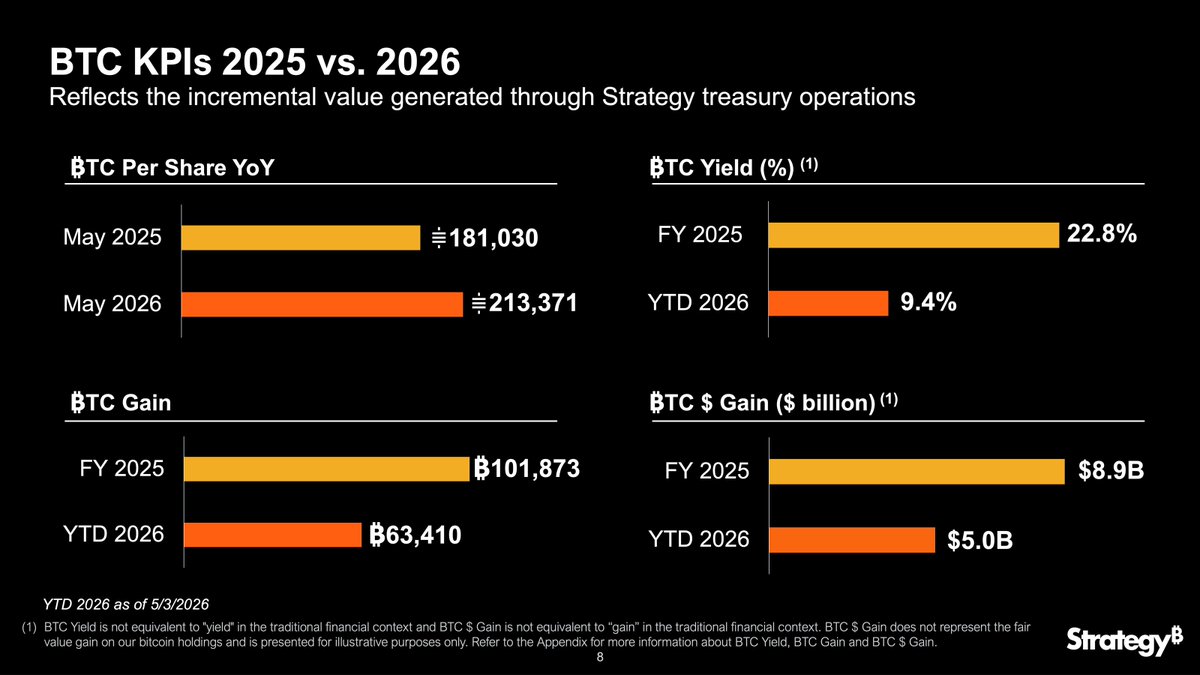
Source: @phongle on X

Le said in the interview:

I believe in math over ideology, and at the point where selling Bitcoin versus selling equity to pay a dividend is better for our Bitcoin per share, and for our common shareholders, we will do it.

Strategy’s CEO further explained that BTC sales are accretive to shareholder value when the company’s book value is below market value, or vice versa. Le also mentioned the option to sell Bitcoin to capture deferred tax gains (and losses, as in its current case).

As of press time, Strategy is the largest corporate holder of Bitcoin, with about 818,334 BTC (approximately 4% of the cryptocurrency’s supply) on its books. With more than $1.5 billion in annual dividend obligations, Le suggested that its $65 billion BTC holdings are more than enough to cover these payments.

How Could Strategy’s Sales Affect Bitcoin Price?

As expected, the idea that the largest corporate holder of Bitcoin would sell its holdings to meet obligations has not been well received. However, the Strategy CEO believes that the premier cryptocurrency is liquid enough to withstand any major sales by his firm.

In Le’s own words, selling in the open market to fund a $1.5 billion dividend payment is a drop in the ocean of Bitcoin’s daily trading volume of over $60 billion. While admitting that Strategy is a significant player in the market, Le does not believe his firm’s activity has any major influence on price (considering how liquid the market is).

As of this writing, BTC is valued at around $80,840, reflecting a 0.5% price increase in the past 24 hours.

The price of BTC on the daily timeframe | Source: BTCUSDT chart on TradingView


Пов'язані питання

QAccording to the article, what is the primary scenario under which Strategy might sell some of its Bitcoin holdings?

AStrategy might sell some of its Bitcoin to finance the payment of the 11.5% dividend yield on its Perpetual Preferred Stock, but only if doing so increases shareholder value by raising the 'Bitcoin per share' metric.

QWhat are the two conditions mentioned by CEO Phong Le under which selling Bitcoin would be considered accretive to shareholder value?

ASelling Bitcoin would be accretive to shareholder value when the company's book value is below its market value, or conversely, when the market value is below the book value.

QHow does CEO Phong Le justify a potential shift from the company's 'Never Sell' strategy regarding Bitcoin?

APhong Le justifies the potential shift by stating 'I believe in math over ideology,' meaning that a change in philosophy might be necessary given current market conditions if selling Bitcoin benefits shareholders more than selling equity.

QWhat is the approximate size of Strategy's Bitcoin holdings, and how does it compare to the overall Bitcoin supply?

AStrategy holds about 818,334 BTC, which is approximately 4% of Bitcoin's total supply, with a value of approximately $65 billion as referenced in the article.

QHow does CEO Phong Le assess the potential market impact of Strategy selling Bitcoin to cover its dividend obligations?

ALe believes the impact would be minimal, stating that selling to fund a $1.5 billion dividend payment is a 'drop in the ocean' compared to Bitcoin's daily trading volume of over $60 billion, and he does not believe his firm's activity has a major influence on price given the market's liquidity.

Пов'язані матеріали

The Jacobian Conjecture that plagued Yitang Zhang for 7 years was overturned and disproven by Fable 5 overnight

**Summary:** The mathematical community was shocked when the longstanding **Jacobi Conjecture**—a core problem in polynomial mapping that had remained open for 87 years—was reportedly **disproven** by **Fable 5** (an AI model from Anthropic). The conjecture, first posed in 1939, asks whether a polynomial map with a constant, non-zero Jacobian determinant must have a polynomial inverse. Despite seeming intuitive, it had resisted numerous proof attempts by leading mathematicians. The breakthrough came when a researcher, Levent Alpoge, shared a succinct counterexample generated by Fable 5: a specific polynomial map from ℂ³ to ℂ³ whose Jacobian is the constant -2, yet which is not injective (mapping three distinct points to the same image). This elegantly falsifies the conjecture in its general form for dimensions ≥3. The counterexample is simple enough to be verified by hand or with tools like Wolfram Alpha. The event sparked intense discussion, with other AI models like GPT-5.6 quickly analyzing the result and even proposing a refined conjecture. It demonstrated AI's emerging capacity for genuine mathematical creativity, not just pattern matching. The story carries a poignant human dimension: renowned mathematician **Yitang Zhang** had devoted seven years of his early career to this problem under his PhD advisor, using a flawed lemma provided by the advisor. This setback contributed to Zhang leaving academia for years, including a period working at Subway, before his later breakthrough on the Twin Prime Conjecture. The AI's swift resolution underscores the tragic waste of his early effort on a conjecture now shown to be false in higher dimensions. It's important to note the disproof specifically targets the generalized (n-dimensional, n≥3) conjecture. The 2-dimensional case, which Zhang worked on, remains open and is considered mathematically distinct and even more challenging. Nonetheless, the event marks a significant moment, prompting reflections on AI's future role in mathematical discovery.

marsbit22 хв тому

The Jacobian Conjecture that plagued Yitang Zhang for 7 years was overturned and disproven by Fable 5 overnight

marsbit22 хв тому

Bought Bitcoin at $117,000, Sold at $62,000 in Tears: This Company’s Faith Only Lasted a Year

Wall Street's once-hot trend of corporate "Bitcoin hoarding" has hit a painful reality check. Empery Digital, formerly an electric motorcycle company, pivoted to Bitcoin in July 2025, accumulating over 4,000 BTC at an average cost of approximately $117,600 each. As Bitcoin's price plummeted, the company faced massive paper losses exceeding its total market value by early 2026, triggering internal conflict with a major shareholder demanding a sale. In a stark reversal from its earlier refusal to sell, Empery Digital recently sold 1,400 BTC at an average price of $62,000, locking in a significant loss of roughly $77 million on just those coins. The proceeds were used to pay down $10 million in debt, prepare for legal fees related to shareholder lawsuits, and, most notably, fund a new strategic shift: a $65 million investment for a 25% stake in an AI data center facility. This move completes a cycle of chasing market trends—from electric vehicles to Bitcoin treasury and now to AI infrastructure. Empery's case exposes the leveraged nature of the corporate "treasury model," where buying Bitcoin with borrowed money works only while prices rise. Once the asset fell below its cost basis, the company was forced to sell at a loss to service debt and pivot to the next opportunity. The company's remaining assets are 1,514 BTC and its ambitions in AI, demonstrating that its stated "long-term belief" in Bitcoin had a clear price tag: a 50% discount.

marsbit32 хв тому

Bought Bitcoin at $117,000, Sold at $62,000 in Tears: This Company’s Faith Only Lasted a Year

marsbit32 хв тому

Visa Joins the Stablecoin Arena: Not to Eliminate Stablecoins, but to 'Collect Rent' from Them

Visa is entering the stablecoin arena by launching a stablecoin platform, aiming not to eliminate existing stablecoins but to facilitate and profit from their broader adoption. The platform will enable banks, financial institutions, and fintech companies to more easily issue, manage, and integrate stablecoins into Visa's existing global payment network, which spans over 200 million merchants and 15,000 financial institutions. This move is expected to expand the overall stablecoin market by creating more use cases. For USDC (Circle), it presents a short-term benefit due to likely direct integration and its compliance advantages, though long-term competition may increase from bank-issued or consortium stablecoins. For USDT (Tether), the impact could be more significant in traditional payment and settlement areas, as Visa's platform may favor more transparent, compliant options, though USDT is expected to remain strong in pure crypto trading contexts. Regarding Ethereum, Visa's initiative is seen as neutral to slightly positive. It could drive more traditional capital into the Ethereum ecosystem in the form of stablecoins, increasing network activity and demand for Ethereum as a settlement layer, especially with Layer-2 scaling solutions. While the platform will support multiple blockchains, Ethereum's maturity and decentralization make it a likely primary choice for compliant stablecoins. In essence, Visa's strategy is to embrace stablecoins, collect fees from increased transaction volume on its network, and grow the overall market, rather than displace major incumbents like USDC and USDT directly.

marsbit1 год тому

Visa Joins the Stablecoin Arena: Not to Eliminate Stablecoins, but to 'Collect Rent' from Them

marsbit1 год тому

Торгівля

Спот
活动图片