# Пов'язані статті щодо Structure

Центр новин HTX надає останні статті та поглиблений аналіз на тему "Structure", що охоплює ринкові тренди, оновлення проєктів, технологічні розробки та регуляторну політику в криптоіндустрії.
Will Middle Management Be Replaced by AI? What Will the Future Company Structure Look Like

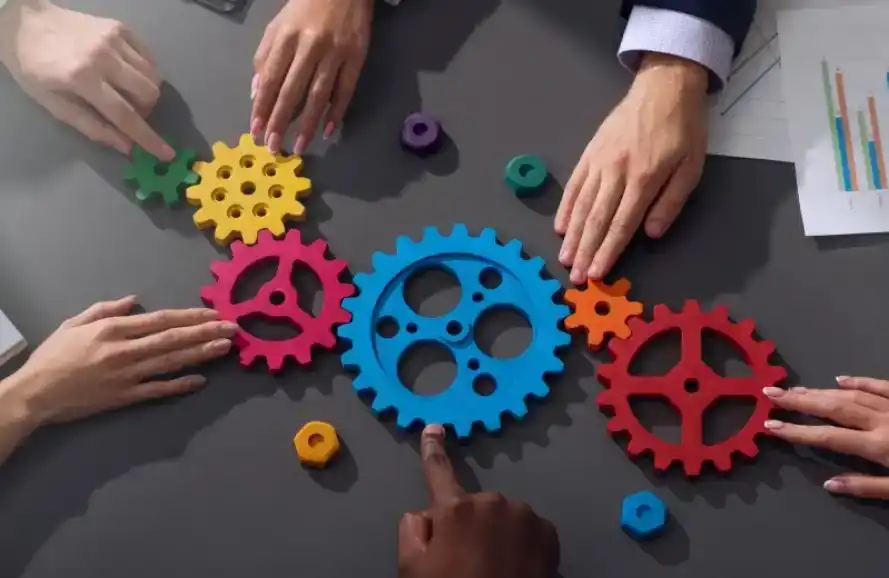
The article explores whether AI will eliminate middle management and reshape future corporate structures. It traces the historical evolution of organizations—from Roman military units to modern corporations—showing how hierarchical systems emerged to manage information flow under the constraint of limited "span of control." Middle management, matrix structures, and bureaucratic systems were all solutions to coordination challenges in information-scarce environments. AI, however, challenges this foundational premise. By enabling real-time modeling, understanding, and distribution of information, AI could replace human-centric coordination mechanisms. Examples like the AI firm "Moon Dark Side" illustrate radical experiments: no departments, titles, or traditional KPIs, with co-founders directly managing large teams and AI agents handling tasks from data processing to code generation. Block (founded by Jack Dorsey) is presented as a case study in building an "intelligent company." This model relies on two core components: a "company world model" (a real-time understanding of internal operations via digital traces) and a "customer world model" (built from real behavioral data, especially financial transactions). An intelligence layer uses these models to dynamically combine capabilities (e.g., payments, lending) to serve customers proactively, without pre-defined product roadmaps. In this structure, traditional roles shift. Middle managers are replaced by a system that handles coordination, while humans focus on individual contributions (ICs), direct responsibility (DRIs), or player-coach roles. The organization becomes flatter, faster, and more adaptive. The article concludes that AI is not just a tool for efficiency but a transformative force that could redefine organizational design, moving companies from human-led hierarchies to system-driven intelligence.

marsbit04/01 08:11

Will Middle Management Be Replaced by AI? What Will the Future Company Structure Look Like

marsbit04/01 08:11

Behind RedotPay's Potential US Listing: The Structural Logic and Regulatory Boundaries of a Stablecoin Payment Platform

RedotPay, a Hong Kong-based stablecoin payment platform, is reportedly considering a U.S. IPO with a potential valuation exceeding $4 billion. This move highlights broader questions about how such platforms structure their operations across regulatory boundaries. Beyond functioning as a simple payment card, RedotPay operates as an integrated financial account system offering services including custody, crypto swaps, lending, remittances, and yield-earning products. Its legal structure involves multiple entities across jurisdictions (Hong Kong, Panama, Argentina, and the U.S.), each handling specific services under distinct regulatory frameworks. For instance, its Crypto Earn service is explicitly not offered to Hong Kong residents and is managed by its Panama entity. The platform’s terms of service clearly define fund usage—such as pooled and non-segregated assets in its Earn product—and acknowledge credit functions, aligning with credit card logic in certain regions. While RedotPay explicitly disclaims being a bank or a stored value facility, regulatory scrutiny will likely focus on functional realities rather than contractual disclaimers. An IPO would subject RedotPay to intense scrutiny regarding legal structure consistency, customer asset handling, risk disclosure, and alignment between growth narratives and compliance practices. The company’s emphasis on detailed legal terms and jurisdictional clarity may strengthen its position, but the key challenge remains demonstrating that its multi-entity framework can withstand regulatory and investor due diligence. Ultimately, RedotPay’s a trend in PayFi where success depends not only on product innovation but also on the ability to maintain legally robust and explainable operational structures across diverse regulatory environments.

marsbit03/01 01:32

Behind RedotPay's Potential US Listing: The Structural Logic and Regulatory Boundaries of a Stablecoin Payment Platform

marsbit03/01 01:32

What Endures Through Bull and Bear Markets Is Not Consensus, But Structure: Learning from Century-Old Football Clubs to Understand Web3

This article draws parallels between the sustainability of century-old European football clubs and the challenges faced by Web3 projects in building lasting communities. It argues that while Web3 excels at discussing growth, incentives, and tokenomics, it often lacks the deep sense of belonging and trust that allows communities to endure market cycles. The piece uses the origins of clubs like Manchester United, FC Barcelona, and Juventus to illustrate how they were founded on strong cultural identity, grassroots community, and a shared sense of purpose—principles that Web3 projects can emulate. It highlights how these identities, forged in local communities and through powerful narratives, created unwavering fan loyalty. Furthermore, it examines how clubs like Liverpool and Borussia Dortmund survived existential crises not through wealthy owners, but through the unwavering support of their fan communities. The article points to governance models like the member-owned structure of FC Barcelona or Germany’s “50+1” rule as examples of how deep community integration creates resilience. Finally, it discusses the role of legendary figures, like Liverpool’s Bill Shankly, as spiritual leaders who embody the community’s values and provide a narrative anchor. For Web3, this underscores the importance of authentic leadership and using key figures to build emotional resonance, while also ensuring the community’s culture is institutionalized to outlast any individual. The core conclusion is that Web3 can learn from football’s focus on authentic identity, community-powered governance, and shared cultural narratives to build projects that survive beyond short-term hype.

比推12/30 04:52

What Endures Through Bull and Bear Markets Is Not Consensus, But Structure: Learning from Century-Old Football Clubs to Understand Web3

比推12/30 04:52

Circle Acquires Axelar Team but Excludes Token, How Should Token Holders Respond to Value Stripping?

Circle, the stablecoin giant, has announced the acquisition of the core team and technology behind Axelar Network's initial team, Interop Labs, to advance its cross-chain infrastructure strategy. However, the acquisition explicitly excludes the Axelar Network project itself, its foundation, and the AXL token, which will continue to operate independently under community governance. This has led to a sharp 15% drop in AXL's price. The move has sparked significant controversy, highlighting the ongoing debate over "equity vs. token" interests in the crypto industry. Critics, including VCs and industry figures, argue that the acquisition effectively abandons token holders who supported the project, calling it a "rug pull" and morally questionable. They emphasize that while the team and intellectual property were monetized, token investors were left with depreciating assets. Supporters, however, view it as a standard market practice, noting that tokens sit at the bottom of the capital structure in traditional finance, behind debt and equity. They argue that Circle’s decision reflects rational business logic, where acquirers prioritize valuable assets like talent and IP without obligation to token holders. The core issue revolves around the ambiguous legal and economic nature of tokens—often treated as "quasi-equity" during bullish phases but stripped of rights in events like acquisitions. The incident underscores the need for clearer definitions and structures for tokens to protect investors and ensure fairness in future deals.

比推12/16 15:08

Circle Acquires Axelar Team but Excludes Token, How Should Token Holders Respond to Value Stripping?

比推12/16 15:08

活动图片