# Пов'язані статті щодо Stock Market

Центр новин HTX надає останні статті та поглиблений аналіз на тему "Stock Market", що охоплює ринкові тренди, оновлення проєктів, технологічні розробки та регуляторну політику в криптоіндустрії.
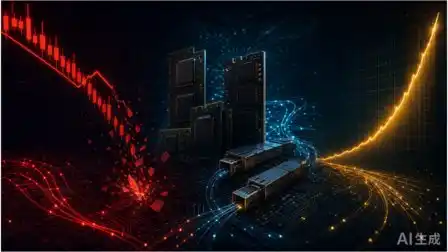
The Philadelphia Semiconductor Index Tumbles Nearly 5% in a Single Night, Optical and Memory Sectors 'Collapse' Together: Surging U.S. Bond Yields Shake AI Belief

On the evening of August 18th, the US stock market saw a sharp sell-off concentrated in the AI hardware sector, with the Philadelphia Semiconductor Index plummeting nearly 5%. Leading AI infrastructure and components companies in fields like optical communication and memory chips experienced some of the steepest declines, such as Fabrinet (-19.38%) and Kioxia ADR (-13%). The sell-off was not broad-based but rather targeted the long-duration, high-momentum stocks previously driven by AI narrative optimism. This market shift is primarily attributed to a significant surge in long-term US Treasury yields, with the 30-year yield hitting its highest level since 2007. Rising yields increase discount rates, disproportionately impacting the valuations of growth stocks whose profits are projected far into the future—a category that includes most AI hardware plays. Additional pressure came from climbing oil prices due to Middle East tensions, which fueled inflation concerns. The article identifies three structural reasons for the severity of the drop in these specific subsectors: excessive prior gains and crowded positioning, high sensitivity to the sustainability of AI capital expenditure narratives, and inherent high volatility within the supply chain. Importantly, the sell-off appears to be a valuation and positioning reset rather than a fundamental repudiation of AI, evidenced by the relatively modest decline in a bellwether like Nvidia (-2.34%). Looking ahead, the direction hinges on three key indicators: whether the 30-year Treasury yield stabilizes, the trajectory of oil prices and geopolitical risks, and the market's pricing of new AI-related corporate debt. For related Asian and A-share markets, short-term negative sentiment spillover is expected, but medium-term drivers like domestic cloud capex may provide divergence. The episode signifies a market transition from pricing AI's "story" to rigorously evaluating its returns against a backdrop of higher financing costs.

marsbit7 год тому

The Philadelphia Semiconductor Index Tumbles Nearly 5% in a Single Night, Optical and Memory Sectors 'Collapse' Together: Surging U.S. Bond Yields Shake AI Belief

marsbit7 год тому

Zhang Lei: How He Became the Biggest Money-Maker This Year

Zhang Lei's company Pinzhun Laser (频准激光) became the biggest "meat sign" (highly profitable new share) of the year on its A-share market debut. Its stock price skyrocketed nearly 600% from its IPO price, generating potential single-lot profits of over 550,000 RMB for lucky subscribers. Founded by Zhang Lei, a 2014 Ph.D. graduate from the Shanghai Institute of Optics and Fine Mechanics, Pinzhun Laser specializes in ultra-stable, narrow-linewidth lasers critical for quantum computing. Its lasers are used by leading global research teams at Harvard, Caltech, and France's PASQAL. The company later successfully applied its core frequency conversion technology to the semiconductor sector, developing deep-ultraviolet lasers for advanced chip manufacturing and inspection. This move diversified its revenue, with semiconductor sales growing rapidly to account for over 25% of its business by 2025. The company boasts gross margins consistently above 69%. Remarkably, Pinzhun Laser required only two major external funding rounds before its IPO, a testament to its early profitability. Key strategic investors in its IPO included major downstream players like BOE,佰维存储 (BIWIN), and中微半导体 (AMEC), signaling strong industry validation. The article highlights the crucial early-stage support from Hangzhou-based capital, particularly funds associated with the Hangzhou Institute of Optics and Fine Mechanics. This "patient capital" model, part of Hangzhou's broader 300-billion-yuan industrial fund strategy, focuses on partnering with scientist-entrepreneurs through the risky valley of death from lab to market. The success of Pinzhun Laser and another Hangzhou-backed firm,宇树科技 (Unitree Robotics), showcases how this supportive ecosystem helps build leading hard-tech companies.

marsbit23 год тому

Zhang Lei: How He Became the Biggest Money-Maker This Year

marsbit23 год тому

Crypto & Stock Market Barometer | Strategy Spends Another $132 Million to Repurchase STRC; Bitmine Adds 9,926 ETH Last Week, BTC Holdings Increase to 210 Coins (August 18)

**Weekly Crypto-Equity Market Digest (August 18, 2026)** Global equity markets showed mixed trends, with US stocks gaining on US-Iran tension relief, while Korean stocks declined after a rally. A-shares surged on hype around robotics firm Unitree's upcoming IPO. Key corporate treasury activity was highlighted. In BTC treasuries, companies collectively had a net weekly BTC purchase of just $5.32M, down 90.34% from the prior week. **MicroStrategy did not buy BTC but spent $132M to repurchase its shares.** Other notable moves included Metaplanet issuing bonds, Trump Media adjusting its strategy with $891M in BTC, and Norway’s sovereign wealth fund boosting its indirect BTC exposure to a record 11,549 coins. In ETH treasuries, **Bitmine significantly increased its holdings, adding 9,926 ETH and bringing its BTC total to 210 coins.** SharpLink expanded its strategy by staking $200M worth of ETH via Lido, despite reporting a large quarterly loss. For SOL-focused companies, Forward Industries reported a Q3 net loss of $69M linked to SOL holdings, though it increased its total SOL stake to ~7.8M coins. Other notable actions included Duquesne Family Office's new $23M stake in Hyperliquid (PURR), Greenlane Holdings reporting a 76.6% unrealized loss on its BERA token holdings, and StablecoinX holding ~30B ENA tokens, roughly 20% of the total supply.

marsbitВчора 09:41

Crypto & Stock Market Barometer | Strategy Spends Another $132 Million to Repurchase STRC; Bitmine Adds 9,926 ETH Last Week, BTC Holdings Increase to 210 Coins (August 18)

marsbitВчора 09:41

How Will the US Midterm Elections Stir the Market? Citi Presents a Roadmap for 50 and 30 Days Before the Election

With the U.S. midterm elections less than three months away, investors are reassessing the potential market impacts of various political outcomes. Citigroup's strategy team has outlined a trading framework, suggesting that bond markets could rally if the Republican party loses its current unified control of Congress and the White House. The elections on November 3 will determine the composition of the House and Senate. Currently, Republicans hold the presidency and both chambers. Prediction market Polymarket indicates a 48% perceived chance of Democrats winning both houses, though officials warn such data is often misunderstood and is not an official forecast. Citigroup strategists, led by Alex Saunders, argue that a divided government—where different parties control separate power centers—would likely benefit bonds by weakening fiscal expectations and pushing Treasury prices higher, as lower prospects for major new spending typically lead to falling yields. They note that 10-year Treasury yields often decline in such scenarios. Beyond bonds, the election is expected to influence stocks and credit. Historically, markets begin to feel pressure approximately 50 trading days before the vote due to policy uncertainty. However, a relief rally in equities often emerges around 30 days prior to Election Day, potentially extending through year-end. The rise of prediction markets like Polymarket and Kalshi is changing how participants view elections, though their growth sparks concerns about public misinterpretation and potential market volatility if odds diverge from certified results. Sector-wise, Citigroup believes a divided government could benefit cyclical tech and certain industrial stocks, while defensive sectors like healthcare and consumer staples might lag. For investors, the key is assessing whether the election outcome alters the fiscal policy trajectory, Treasury supply expectations, and the market's pricing of future interest rates, with power dispersion seen as supportive for bonds and potentially boosting risk appetite in select equities.

marsbitВчора 06:15

How Will the US Midterm Elections Stir the Market? Citi Presents a Roadmap for 50 and 30 Days Before the Election

marsbitВчора 06:15

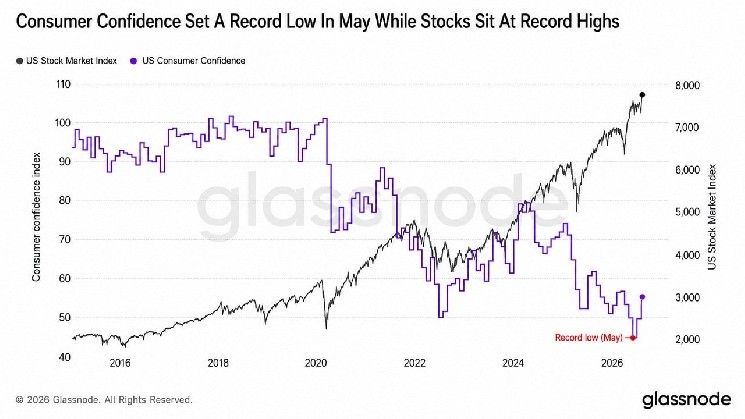
Glassnode: Consumer Confidence Falls as AI-Related Stocks Rise, Bitcoin Lags Behind

According to Glassnode, consumer confidence remains at one of its lowest levels in a decade, despite two consecutive months of improvement. This has not stopped households from moving money out of cash, as they expect further cost-of-living increases and a broader economic slowdown. The key question is where this capital is flowing. US stocks hit a new all-time high in early August, primarily driven by trading in AI-related stocks rather than a broad market rally. Bitcoin, historically seen as a hedge against declining trust in traditional finance, has not participated in this movement. Spot Bitcoin ETFs saw outflows of $389.7 million in one week, coinciding with rising equity markets—a divergence that aligns with Glassnode's data on capital flows. Bitcoin is currently trading at roughly half its October 2025 peak, stuck in a narrow range. Meanwhile, AI-related trading continues to attract fresh capital from retail traders, hedge funds, and even crypto-native institutional investors, who are redirecting funds into AI stocks and tokens. The macroeconomic backdrop has not been hostile to Bitcoin, with core inflation at a moderate 2.5% in July. However, Bitcoin's muted response to favorable inflation data is seen as a concerning signal, given its supposed role as a hedge against currency debasement. Spot Bitcoin exchange trading volume has fallen to its lowest since 2019, and recent ETF inflows are only a "fraction of any prior accumulation wave," suggesting institutional buying may have paused. This trend extends beyond trading: some Bitcoin miners are repurposing their power contracts and data center capacity for AI workloads. This appears to be a structural shift that could pressure Bitcoin's status as the default destination for capital leaving cash. The fundamental arguments for Bitcoin as a hedge against inflation or scarcity are not invalidated, but their expected impact has not materialized within the timeline anticipated by crypto optimists this summer.

cryptonews.ruВчора 09:55

Glassnode: Consumer Confidence Falls as AI-Related Stocks Rise, Bitcoin Lags Behind

cryptonews.ruВчора 09:55

活动图片