AI Computing Power Boom: A Global Capital 'High-Interest Poison'?

marsbitОпубліковано о 2026-08-17Востаннє оновлено о 2026-08-17

Анотація

The AI computing boom is fueling a surge in global borrowing, pushing inflation-adjusted "real" yields on government bonds to multi-year highs. Major US tech firms like Alphabet, Amazon, and Meta have already issued over $220 billion in bonds this year, more than double 2025's total, to fund massive AI infrastructure investment. Concurrently, persistent high fiscal deficits in the US and Europe are flooding the market with sovereign debt. This deluge of bond supply, coupled with expectations of robust economic growth and reduced central bank bond buying, is driving up real yields—the true cost of capital after inflation. While strong corporate earnings have so far shielded stock markets from the negative impact, analysts warn that rising real yields threaten to erode the attractiveness of equities and could eventually curb investment and consumption, posing risks to economic growth. Experts caution that the structural forces behind higher yields, particularly heavy government and corporate borrowing, show no signs of abating.

In the past few weeks, market indicators measuring inflation-adjusted borrowing costs in major global economies have soared to their highest levels in over a decade.

In the past few weeks, market indicators measuring inflation-adjusted borrowing costs in major global economies have soared to their highest levels in over a decade. As AI companies and governments ramp up bond issuance, risks for the stock market and the global economy are accumulating...

Real yields, the returns bond investors demand above the inflation rate, are a core measure of the true cost of borrowing for governments and corporations. This indicator typically depends on expectations for economic growth, interest rate trends, and the supply-demand dynamics of capital.

Currently, the U.S. 30-year real yield, measured by inflation-linked bonds, is approaching an 18-year high—around 3%, while 10-year real yields in the UK and Germany are also hovering near their highest levels in over a decade.
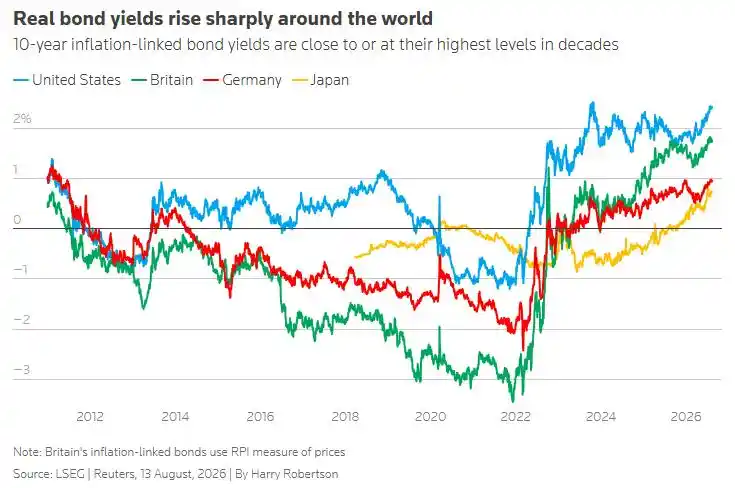
Investors and analysts point out that against the backdrop of high fiscal spending by governments, the explosive growth in borrowing by AI 'hyperscale computing giants' is becoming the latest factor pushing yields higher. This is because buyers are demanding higher returns to continue purchasing the flood of bonds hitting the market.

Despite ongoing conflicts in Iran, overall inflation expectations remain stable, which also means that the rise in real yields has pushed up nominal yields on global bonds in recent months. The winning yield on the 30-year Treasury bond auctioned by the U.S. Treasury last Thursday was 5.22%, marking the highest borrowing cost for that maturity since 2001.

Surge in AI Bond Issuance

According to LSEG data, U.S. tech giants like Alphabet, Amazon, and Meta have issued nearly $220 billion in bonds so far this year, more than double the $108 billion issued in the whole of 2025.
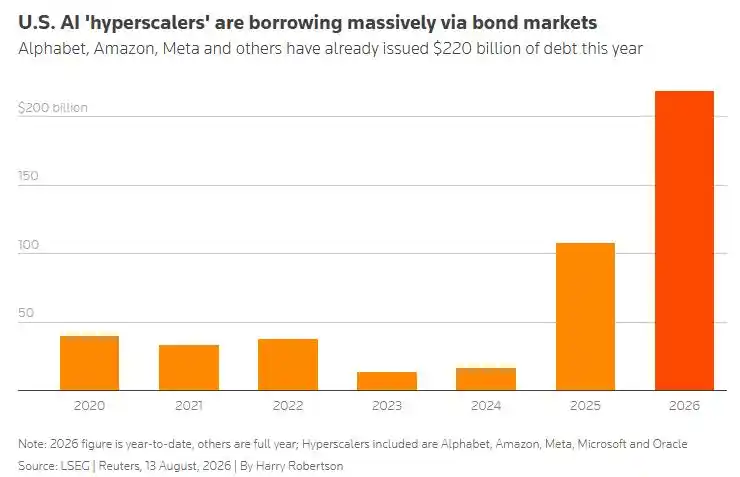
"We are experiencing a capital competition unprecedented in recent years," said Vivek Paul, chief investment strategist for the UK at BlackRock Investment Group.

"Driven by factors like the continued acceleration of AI infrastructure construction, this competitive landscape of capital scarcity is evolving rapidly and is directly reflected in rising bond yields."

Simultaneously, governments worldwide continue to borrow heavily. This year, the U.S. fiscal deficit is expected to account for about 6% of its GDP (approximately $1.9 trillion), France is expected at 5%, and the UK at 4%.

Al Cattermole, senior fixed-income portfolio manager at Mirabaud Asset Management, pointed out: "In Europe, defense spending, energy security, and infrastructure investment are more critical drivers than AI-specific expenditures."

Additionally, markets are digesting expectations for future interest rate hikes, which, all else being equal, tend to further push up real yields.

Max Kitson, European rates strategist at Barclays, stated that relatively strong economic growth—especially in the U.S.—is an important factor. He also noted that major central banks have stopped buying bonds, whereas their bond purchases had long suppressed yields.

Beware of Stock Market Risks

Real yields are the benchmark for measuring the inflation-adjusted true borrowing cost for governments and corporations.

If a bond has a nominal yield of 3% and an expected inflation rate of 2%, its real yield is approximately 1%. Analysts say that in the past, nominal yields were primarily driven by inflation expectations, but recently, real yields have become a more central determining factor.
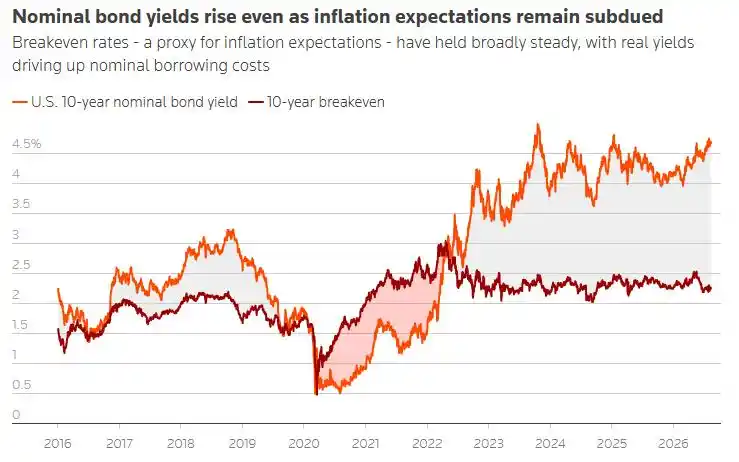
In theory, rising real yields diminish the relative attractiveness of stocks. On one hand, investors can obtain higher inflation-adjusted returns in the bond market; on the other hand, the future cash flows of companies—whose present value is discounted based on yields—will also appear less attractive.

So far, however, thanks to strong corporate earnings and resilient economic performance, the stock market, which has repeatedly hit new highs, has not been brought down by these concerns. JPMorgan recently raised its profit expectations for the S&P 500 index; LSEG I/B/E/S data also shows that the profit growth rate of European blue-chip companies is expected to hit its highest level since the end of 2022.

Matt King, founder of Satori Insights, holds a more cautious view. He points out that major tech giants are currently accelerating their consumption of cash reserves and will become more reliant on credit markets in the future. At that point, the rise in real rates will begin to have a substantial impact.

He wrote in a research note: "We expect real yields to continue rising until the high costs completely suppress this wave of borrowing frenzy driving yields higher—and end the rotation into risk assets that previously fueled the stock market rebound."

Furthermore, higher inflation-adjusted borrowing costs, after reaching a certain critical point, could force businesses and households to cut consumption and investment, thereby dragging down overall economic growth.

Ashok Bhatia, chief investment officer at Neuberger Berman, stated that current U.S. real yields are still below his estimated range of 3%–4% that would substantially impact economic growth. "But the current yield level is already a warning signal: while the current 1.5% to 2% economic growth is considered robust, there is a risk of erosion in the future."

Bhatia added that, given concerns about fiscal policy, he remains cautious on long-term bonds; while Barclays' Kitson believes that due to the general lack of political will to reduce fiscal deficits, real yields may continue to rise in the future.

Kitson concluded: "The structural factors supporting higher yields remain deeply entrenched, and there are currently no signs indicating they will recede in the short term."

This article is from the WeChat public account "STAR Market Daily," author: Xiaoxiang

Пов'язані питання

QWhat is the main factor cited as a key driver behind the recent surge in global real yields?

AThe massive borrowing by AI 'hyperscale compute giants' to fund infrastructure expansion, alongside sustained high government spending, is creating intense competition for capital, pushing bond yields higher as investors demand higher returns.

QWhat are the potential risks to the stock market according to the article, given the rising real yields?

ARising real yields can make bonds more attractive relative to stocks and reduce the present value of companies' future cash flows. A more specific risk is that as tech giants deplete cash reserves, their increased reliance on credit markets will make them more vulnerable to higher borrowing costs, potentially disrupting the equity rally.

QHow does the borrowing scale of major US tech companies in 2026 compare to 2025, and what is the primary reason for this increase?

AAccording to LSEG data, the borrowing scale of major US tech companies like Alphabet, Amazon, and Meta in 2026 so far is nearly $220 billion, which is more than double the $108 billion issued in all of 2025. The primary reason for this surge is the acceleration of artificial intelligence infrastructure construction.

QBeyond AI spending, what other key factors are driving high government borrowing and contributing to higher yields in Europe?

AIn Europe, key drivers for high government borrowing and yields include defense spending, energy security investments, and infrastructure investment, which are cited as more critical factors than AI-specific spending.

QWhat is the threshold level for US real yields that, according to Neuberger's Ashok Bhatia, could start to meaningfully impact economic growth?

AAccording to Neuberger's Ashok Bhatia, US real yields would need to reach a range of 3%-4% to start having a material negative impact on economic growth. Current levels, while a warning signal, are below this threshold.

Пов'язані матеріали

Wall Street Morning Report: S&P Earnings Growth Hits 30-Year High, Nvidia Becomes SpaceX's 6th Largest Shareholder

Wall Street Morning Report: S&P 500 earnings growth hits a 30-year high; Nvidia becomes SpaceX's 6th largest shareholder. Market Summary: U.S. stocks ended slightly lower on Friday after record highs, with the S&P 500 posting a weekly gain. Weaker-than-expected July retail sales data significantly reduced market expectations for a September Fed rate hike. Key Themes: * **Macro & Rates:** The probability of the Fed holding rates steady in September rose to ~70%. Geopolitical tensions in the Middle East supported oil prices near $90. Focus this week is on a $16B 20-year Treasury auction testing investor demand amid high yields. * **Corporate Earnings:** S&P 500 Q2 earnings grew 31%, the fastest pace since 1992 excluding recession recoveries, driving a valuation reset. * **AI & Tech Sector Rotation:** The AI investment narrative faces scrutiny over financing and return timelines. Semiconductor stocks saw divergence: memory (SanDisk, Micron) and optical communication (Applied Optoelectronics) surged, while Broadcom fell sharply on credit rating downgrade concerns over AI leasing exposure. * **Notable Moves:** Nvidia disclosed a ~$21B stake in SpaceX. AMD rose 6.5% after a record debt issuance. Reddit rallied ahead of its S&P 500 inclusion. This Week's Highlights: * **Fed Minutes (Thu):** Key for gauging policy divergence and September rate outlook. * **Key Earnings:** Alibaba, Walmart, Nvidia, AMD. * **Events:** Seoul AI Summit, World Robot Conference, potential恒生指数 rebalancing. * **Data:** U.S. jobless claims, Japan core CPI, Korea early export data (a leading indicator for semiconductors).

marsbit51 хв тому

Wall Street Morning Report: S&P Earnings Growth Hits 30-Year High, Nvidia Becomes SpaceX's 6th Largest Shareholder

marsbit51 хв тому

BTC in Range-Bound Consolidation, HYPE Daily Rebound Confirmed | Invited Analysis

**Market Analysis: BTC Consolidates in Range, HYPE Shows Daily Rebound Confirmation (Weekly Outlook)** **BTC Analysis:** The market is at a key juncture. Bitcoin is undergoing a daily correction, with a critical focus on whether it can find support and stabilize above the $60,950 level. The adjustment that began from the May 6th high has formed a complex seven-segment structure on the daily chart. Three potential paths are identified: 1. **Continuation of the c-wave rally** (primary scenario), targeting $67,300 initially, then $69,500-$71,000. 2. **Range-bound consolidation** between $60,950 and $65,500, forming an "ascending中枢" before an upward breakout. 3. **Breakdown and secondary探底** if support at $60,950-$61,500 fails. Analysis favors the first two scenarios. The 4-hour chart suggests the current adjustment phase is nearing completion near the strong $60,950-$61,500 support zone. **BTC Strategy:** * **Key Levels:** Support at $62,268, $60,950-$61,500, $57,820. Resistance at $65,500, $67,300, $69,500-$71,000. * **Mid-term:** Current model indicates a bearish structure with ~20% short exposure. Consider adding to shorts (up to 50%) only if price rallies to $69,500-$71,000, shows clear stagnation, and model confirms. * **Short-term (30% capital):** Two tactical plans: * **A) Test shorts** near strong resistance ($69,500-$71,000) upon signs of weakness. * **B) Test longs** near strong support ($60,950-$61,500) upon stabilization signals. **HYPE Analysis:** HYPE has established a daily rebound from the August 2nd low. The 4-hour chart shows a five-segment上升 structure with a formed "ascending中枢". The current (76-77) segment is crucial. Two outcomes are possible: 1. **Breakout (Central离开段):** If price breaks and holds above the $58-$58.5 resistance zone, the uptrend continues. Monitor for momentum背驰 between the initial and breakout segments. 2. **Consolidation (Central Extension):** Failure to hold above $58-$58.5 leads to a return to中枢 consolidation, requiring new signals for direction. **HYPE Strategy:** * **Key Levels:** Support at $50-$52, $45. Resistance at $58.5-$60, descending channel upper rail, $72.97. * **Watch:** Whether price can break/hold above $58-$58.5 to confirm the breakout. * **Action:** * **Existing longs (from $50-$52):** Move stop-loss above entry cost. * **New entrants:** Consider light longs only on a confirmed breakout above $58.5-$60 with a tight stop-loss. Exit quickly if momentum背驰 appears. **General Risk Management:** * Set initial stop-loss immediately upon entry. * Move stop-loss to breakeven at +1% profit. * Trail stop-loss upwards by 1% for every subsequent 1% gain to lock in profits. **Disclaimer:** Market conditions change rapidly. This analysis is for informational purposes only and not investment advice. Trading carries significant risk.

marsbit54 хв тому

BTC in Range-Bound Consolidation, HYPE Daily Rebound Confirmed | Invited Analysis

marsbit54 хв тому

Not Chasing AI or Buying Back Shares, Can 'Stingy' Jingdong Still Succeed?

On August 13th, JD.com (JD.US) released its Q2 2026 earnings, delivering a mixed and generally "flat" performance that met low expectations but offered few positives. Overall revenue declined by approximately 3% year-over-year (YoY) to ~¥346.4 billion, aligning with weakened domestic consumption trends. While group operating profit saw a YoY improvement, this was primarily due to reduced losses in the food delivery segment compared to the high-cost "delivery war" period of the previous year. Key details reveal deeper concerns: revenue from JD's core domestic retail segment fell 4.7% YoY. While electronics sales declined less than feared (~12% YoY), growth in daily necessities and advertising services plummeted by about 10 percentage points each, raising doubts about the segment's mid-term growth momentum post-subsidy adjustments. Logistics revenue growth also slowed to 5.9% as the delivery boom faded. Profitability presented a nuanced picture. The retail segment's operating margin edged up slightly YoY but failed to deliver the significant beats seen in past quarters, suggesting efficiency gains may be nearing limits. Losses from the New Businesses segment (including food delivery and overseas ventures) remained elevated at ~¥9.9 billion, as increased overseas investment partially offset reductions in delivery subsidies. Notably, JD's shareholder returns weakened significantly, with share buybacks in H1 2026 annualizing to only about 5% of market cap. The company opted to park cash in short-term investments rather than boost returns, drawing criticism. Looking ahead, JD's performance hinges on a potential recovery in China's e-commerce sentiment in H2 2026 and the scale of ongoing losses in new ventures. While not burdened by massive AI capex like some peers, and offering relative defensive stability, the lack of positive earnings surprises and diminished shareholder returns provide little compelling reason for investors to favor the stock in the near term.

marsbit1 год тому

Not Chasing AI or Buying Back Shares, Can 'Stingy' Jingdong Still Succeed?

marsbit1 год тому

Торгівля

Спот
活动图片